
Engelbrecht Andries P. Computational Intelligence: An Introduction
Подождите немного. Документ загружается.

418 18. Natural Immune System
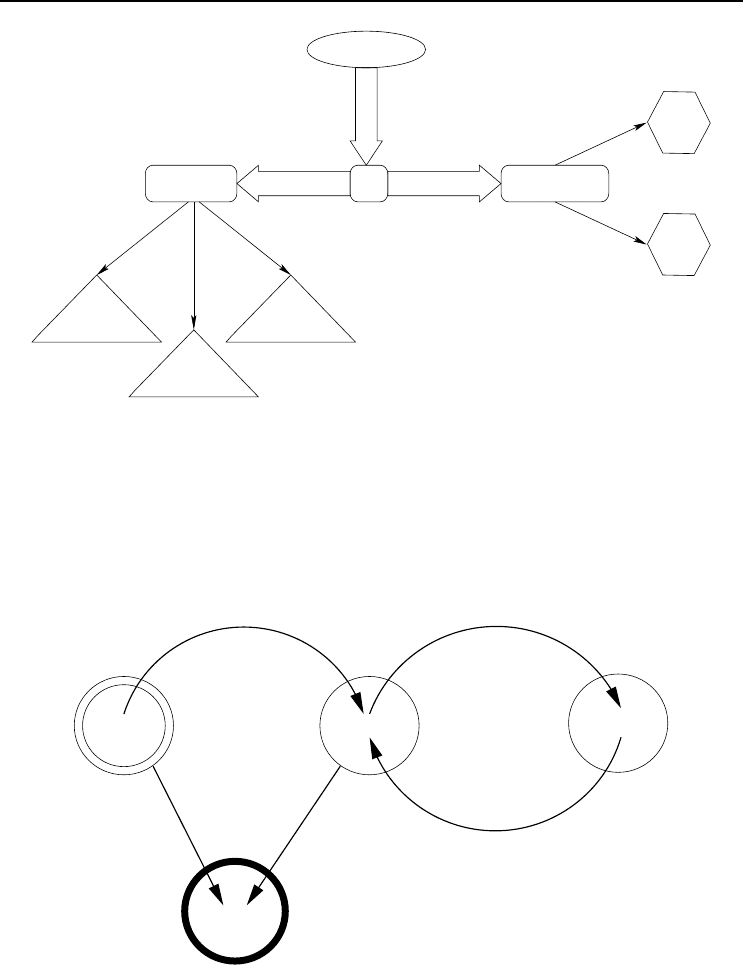
Celldevelops into develops into LymphocytesPhagocytes
Bone Marrow
Creates
Macrophages
NeutrophilsMonocytes
BŦCells
TŦCells
Figure 18.2 White Cell Types
internal structure of a cell. MHC-molecules are grouped into two classes: Type I and
Type II. MHC-molecules of Type I is on the surface of any cell and MHC-molecules
of Type II mainly on the surface of B-Cells [678]. There are two types of T-Cells:
The Helper-T-Cell and Natural-Killer-T-Cell. Each of these types of lymphocytes are
describedindetailbelow.
Immature Mature
Memory
Annihilated
Figure 18.3 Life Cycle of A Lymphocyte
The B-Cell
B-Cells are created in the bone marrow with monomeric IgM-receptors on their sur-
faces. A monomeric receptor is a chemical compound that can undergo a chemical
18.3 The White Cells 419
Partitioning antigen
Antigen Receptor
BŦCell
MHCŦII
Peptides
Mature TŦCell
Lymphokines
Plasma cell
An
t
i
bod
i
es
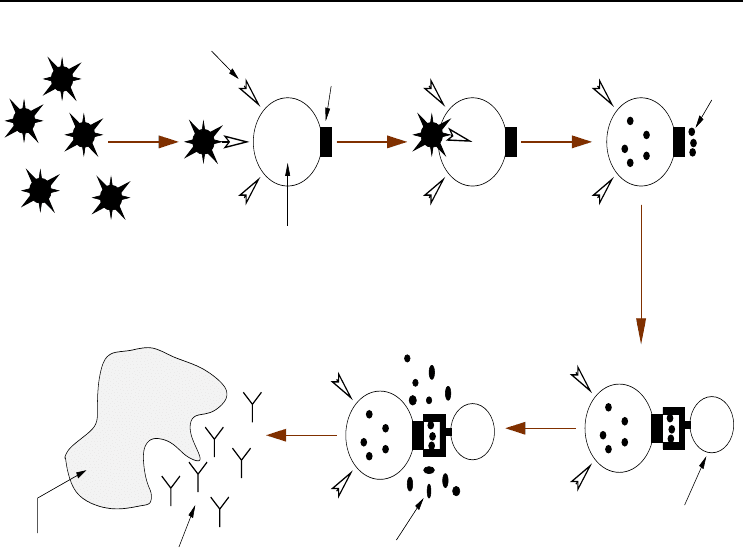
Figure 18.4 B-Cell Develops into Plasma Cell, Producing Antibodies
reaction with other molecules to form larger molecules. In contrast to T-Cells, B-Cells
leave the bone marrow as mature lymphocytes. B-Cells mostly exist in the spleen and
tonsils. It is in the spleen and tonsils that the B-Cells develop into plasma cells after
the B-Cells come into contact with antigens. After developing into plasma cells, the
plasma cells produce antibodies that are effective against antigens [582]. The B-Cell
has antigen-specific receptors and recognizes in its natural state the antigens. When
contact is made between B-Cell and antigen, clonal proliferation on the B-Cell takes
place and is strengthened by Helper-T-Cells (as explained the next subsection). Dur-
ing clonal proliferation two types of cells are formed: plasma cells and memory cells.
The function of memory cells is to proliferate to plasma cells for a faster reaction to
frequently encountered antigens and produce antibodies for the antigens. A plasma
cell is a B-Cell that produces antibodies.
The Helper-T-Cell (HTC)
When a B-Cell’s receptor matches an antigen, the antigen is partitioned into peptides
(as shown in Figure 18.4). The peptides are then brought to the surface of the B-Cell
by an MHC-molecule of Type II. Macrophages also break down antigen and the broken
down antigen is brought to the surface of the macrophage by an MHC-molecule of Type
II. The HTC binds to the MHC-molecule on the surface of the B-Cell or macrophage
420 18. Natural Immune System
and proliferates or suppresses the B-Cell response to the partitioned cell, by secreting
lymphokines. This response is known as the primary response. When the HTC bounds
to the MHC with a high affinity, the B-Cell is proliferated. The B-Cell then produces
antibodies with the same structure or pattern as represented by the peptides. The
production of antibodies is done after a cloning process of the B-Cell.
When the HTC does not bind with a high affinity, the B-Cell response is suppressed.
Affinity is a force that causes the HTC to elect a MHC on the surface of the B-Cell
with which the HTC has a stronger binding to unite, rather than with another MHC
with a weaker binding. A higher affinity implies a stronger binding between the HTC
and MHC. The antibodies then bind to the antigens’ epitopes that have the same
complementary structure or pattern. Epitopes are the portions on an antigen that
are recognized by antibodies. When a B-Cell is proliferated enough, i.e. the B-Cell
frequently detects antigens, it goes into a memory status, and when it is suppressed
frequently it becomes annihilated and replaced by a newly created B-Cell. The immune
system uses the B-Cells with memory status in a secondary response to frequently
seen antigens of the same structure. The secondary response is much faster than the
primary response, since no HTC signal or binding to the memory B-Cell is necessary
for producing antibodies [678].
Peptides
MHCŦI
Cell dies
Natu
r
a
lŦKill
e
rŦTŦ
Ce
ll
Antigen
Macrophage
Partitioning antigen
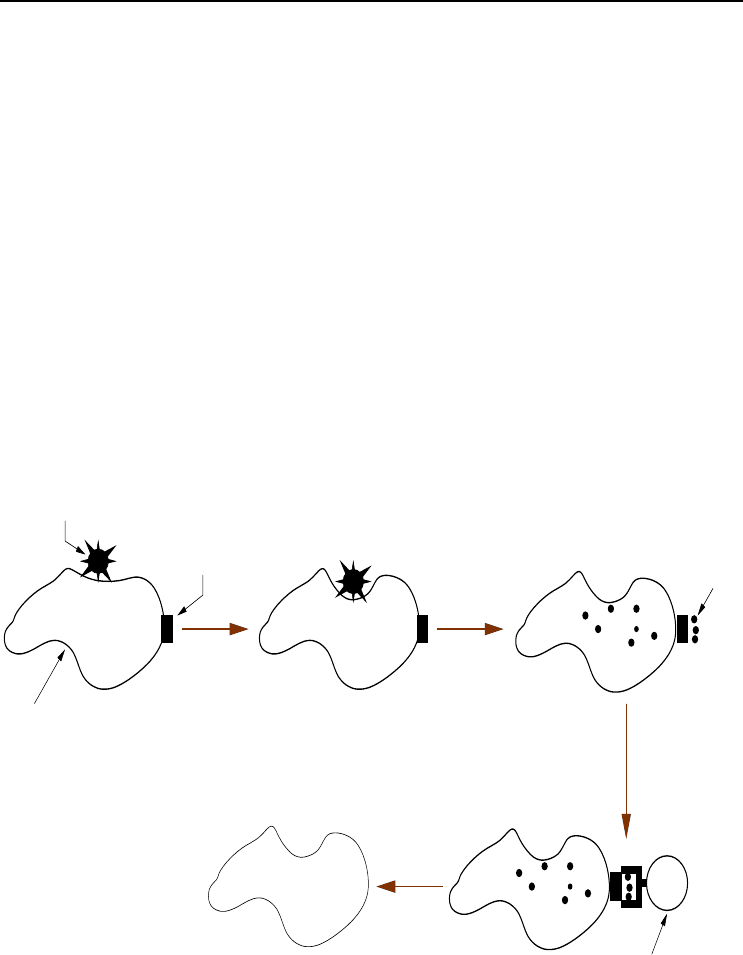
Figure 18.5 Macrophage and NKTC
The Natural-Killer-T-Cell (NKTC)
The NKTC binds to MHC-molecules of Type I (as illustrated in Figure 18.5). These
MHC-molecules are found on all cells. Their function is to bring to light any viral

18.4 Immunity Types 421
proteins from a virally infected cell. The NKTC then binds to the MHC-molecule of
Type I and destroys not only the virally infected cell but also the NKTC itself [678].
18.4 Immunity Types
Immunity can be obtained either naturally or artificially. In both cases immunity can
be active or passive. This section discusses the different types of immunity.
Active naturally-obtained immunity: Due to memory-cells, active naturally-
obtained immunity is more or less permanent. It develops when the body gets infected
or receives foreign red blood cells and actively produces antibodies to deactivate the
antigen [582].
Passive naturally-obtained immunity: Passive naturally-obtained immunity is
short-lived since antibodies are continuously broken down without creation of new
antibodies. New antibodies are not created because the antigens did not activate
the self immune system. The immunity type develops from IgG-antibodies that are
transplanted from the mother to the baby. The secreted IgA-antibodies in mothers-
milk are another example of this immunity type and protect the baby from any antigens
with which the mother came into contact [582].
Active artificially-obtained immunity: Active artificially-obtained immunity
develops when dead organisms or weakened organisms are therapeutically applied.
The concept is that special treated organisms keep their antigens without provoking
illness-reactions [582].
Passive artificially-obtained immunity: Passive artificially-obtained immunity
is obtained when a specific antibody that was produced by another human or animal,
is injected into the body for an emergency treatment. Immunity is short-lived, since
the immune system is not activated [582].
18.5 Learning the Antigen Structure
Learning in the immune system is based on increasing the population size of those lym-
phocytes that frequently recognize antigens. Learning by the immune system is done
by a process known as affinity maturation. Affinity maturation can be broken down
into two smaller processes namely, a cloning process and a somatic hyper-mutation
process. The cloning process is more generally known as clonal selection,whichisthe
proliferation of the lymphocytes that recognize the antigens.

422 18. Natural Immune System
The interaction of the lymphocyte with an antigen leads to an activation of the lym-
phocyte where upon the cell is proliferated and grown into a clone. When an antigen
stimulates a lymphocyte, the lymphocyte not only secretes antibodies to bind to the
antigen but also generates mutated clones of itself in an attempt to have a higher
binding affinity with the detected antigen. The latter process is known as somatic
hyper-mutation. Thus, through repetitive exposure to the antigen, the immune sys-
tem learns and adapts to the shape of the frequently encountered antigen and moves
from a random receptor creation to a repertoire that represents the antigens more pre-
cisely. Lymphocytes in a clone produce antibodies if it is a B-Cell and secrete growth
factors (lymphokines) in the case of an HTC.
Since antigens determine or select the lymphocytes that need to be cloned, the process
is called clonal selection [582]. The fittest clones are those which produce antibodies
that bind to antigen best (with highest affinity). Since the total number of lymphocytes
in the immune system is regulated, the increase in size of some clones decreases the
size of other clones. This leads to the immune system forgetting previously learned
antigens. When a familiar antigen is detected, the immune system responds with
larger cloning sizes. This response is referred to as the secondary immune response
[678]. Learning is also based on decreasing the population size of those lymphocytes
that seldom or never detect any antigens. These lymphocytes are removed from the
immune system. For the affinity maturation process to be successful, the receptor
molecule repository needs to be as complete and diverse as possible to recognize any
foreign shape [678].
18.6 The Network Theory
The network theory was first introduced by Jerne [416, 677], and states that B-Cells
are interconnected to form a network of cells. When a B-Cell in the network responds
to a foreign cell, the activated B-Cell stimulates all the other B-Cells to which it is
connected in the network. Thus, a lymphocyte is not only stimulated by an antigen,
but can also be stimulated or suppressed by neighboring lymphocytes, i.e. when a
lymphocyte reacts to the stimulation of an antigen, the secretion of antibodies and
generation of mutated clones (see Section 18.5) stimulate the lymphocyte’s immediate
neighbors. This implies that a neighbor lymphocyte can then in turn also react to
the stimulation of the antigen-stimulated lymphocyte by generating mutated clones,
stimulating the next group of neighbors, etc.
18.7 The Danger Theory
The danger theory was introduced by Matzinger [567, 568] and is based on the co-
stimulated model of Lafferty and Cunningham [497]. The main idea of the danger
theory is that the immune system distinguishes between what is dangerous and non-
dangerous in the body. The danger theory differs from the classical view in that the
immune system does not respond to all foreign cells, but only to those foreign cells
18.7 The Danger Theory 423
Partitioning antigen
Antigen Receptor
BŦCell
MHCŦII
Peptides
Lymphokines
Plasma cell
Antibodies
APC
Stress signal
antigen
Mature TŦCell
CoŦstimulation
Necrotic cell death
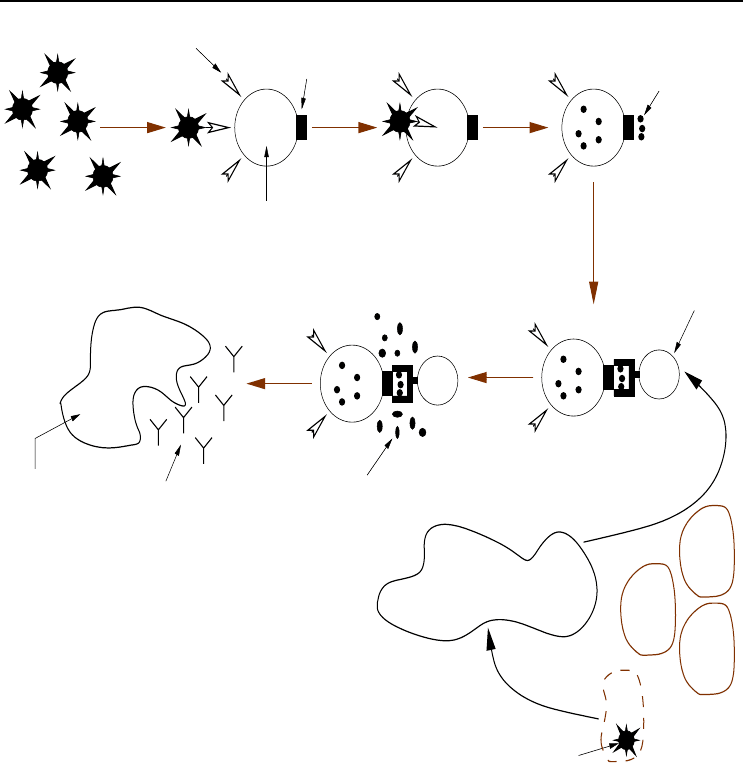
Figure 18.6 Co-Stimulation of T-Cell by an APC
that are harmful or dangerous to the body. A foreign cell is seen to be dangerous
to the body if it causes body cells to stress or die. Matzinger gives two motivational
reasons for defining the new theory, which is that the immune system needs to adapt
to a changing self and that the immune system does not always react on foreign or
non-self.
Although cell death is common within the body, the immune system only reacts to
those cell deaths that are not normal programmed cell death (apoptosis), i.e. non-
apoptotic or necrotic deaths. When a cell is infected by a virus, the cell itself will
send out a stress signal (known as signal 0) of necrotic death to activate the antigen
presenting cells (APCs) (as illustrated in Figure 18.6). Thus, co-stimulation of an
APC to a helper T-Cell is only possible if the APC was activated with a danger
or stress signal. Therefore, the neighboring cells of an APC determines the APC’s

424 18. Natural Immune System
state. Hereon the immune reaction process is as discussed within the classical view
(see Section 18.1), where now mature helper T-Cells are presented with a peptide
representation of the antigen and co-stimulated by an activated APC.
The different types of signals from a dying or stressed cell is unknown. According
to Matzinger these signals could either be defined as the sensing of a certain protein
within a cell that leaked after the cell’s death or an unexpected connection lost between
connected cells after one of the cells died. Thus, if none of the above signals are fired
by a cell, no immune response will be triggered by an antigen to activate the antigen
presenting cells (APCs).
Thus, from a danger immune system perspective a T-Cell only needs to be able to
differentiate APCs from any other cells. If an APC activated a T-Cell through co-
stimulation, then only will the immune system respond with a clonal proliferation of
the B-Cell (as discussed in Section 18.3.1). The B-Cell will then secrete antibodies to
bind with the dangerous antigen instead of binding to all foreign harmless antigen.
18.8 Assignments
1. Identify the main difference between the classicial view of the NIS
(a) and network theory,
(b) and danger theory.
2. Discuss the merit of the following statement: “The lymphocytes in the classical
view perform a pattern matching function. ”
3. At this point, discuss how the principles of a NIS can be used to solve real-world
problems where anomalies need to be detected, such as fraud.
4. Discuss the merit of the following statement: “A model of the NIS (based on the
classical view) can be used as a classifier.”

Chapter 19
Artificial Immune Models
Chapter 18 discussed the different theories with regards to the functioning and orga-
nizational behavior of the natural immune system (NIS). These theories inspired the
modeling of the NIS into an artificial immune system (AIS) for application in non-
biological environments. Capabilities of the NIS within each theory, are summarised
below:
• The NIS only needs to know the structure of self/normal cells.
• The NIS can distinguish between self and foreign/non-self cells.
• A foreign cell can be sensed as dangerous or non-dangerous.
• Lymphocytes are cloned and mutated to learn and adapt to the structure of the
encountered foreign cells.
• The build-up of a memory on the learned structures of the foreign cells.
• A faster secondary response to frequently encountered foreign cells, due to the
built-up memory.
• The cooperation and co-stimulation among lymphocytes to learn and react to
encountered foreign cells.
• The formation of lymphocyte networks as a result of the cooperation and co-
stimulation among lymphocytes.
This chapter discusses some of the existing AIS models. More detail is provided on
the most familiar AIS models. These models are either based on or inspired by the
capabilities of the NIS (as summarised above) and implement some or all of the basic
AIS concepts as listed in Section 19.1. The chapter contains a section for each of
the different theories in immunology as discussed in Chapter 18. In each of these
sections, the AIS models that are based on or inspired by the applicable theory, are
discussed. The rest of the chapter is organised as follows: Section 19.1 lists the basic
concepts of an artificial immune system. A basic AIS algorithm is proposed and given
in pseudo code. The different parts of the basic AIS pseudo code is briefly discussed.
Section 19.2 discusses the AIS models based on or inspired by the classical view of
the natural immune system. Section 19.3 gives an algorithm in pseudo code that is
inspired by the clonal selection theory of the natural immune system. Other clonal
selection inspired models are also discussed. Section 19.4 discusses the AIS models
based on or inspired by the network theory of the natural immune system. Section 19.5
discusses the AIS models based on or inspired by danger theory. Section 19.6 concludes
Computational Intelligence: An Introduction, Second Edition A.P. Engelbrecht
c
2007 John Wiley & Sons, Ltd
425

426 19. Artificial Immune Models
the chapter by giving a brief overview on some of the problem domains to which the
artificial immune system has been successfully applied.
19.1 Artificial Immune System Algorithm
The capabilities of the NIS summarized above imply that it is mainly the inner working
and cooperation between the mature T-Cells and B-Cells that is responsible for the
secretion of antibodies as an immune response to antigens. The T-Cell becomes mature
in the thymus. A mature T-Cell is self-tolerant, i.e. the T-Cell does not bind to self
cells. The mature T-Cell’s ability to discriminate between self cells and non-self cells
makes the NIS capable of detecting non-self cells. When a receptor of the B-Cell binds
to an antigen, the antigen is partitioned and then brought to the surface with an
MHC-molecule. The receptor of the T-Cell binds with a certain affinity to the MHC-
molecule on the surface of the B-Cell. The affinity can be seen as a measurement to
the number of lymphokines that must be secreted by the T-Cell to clonally proliferate
the B-Cell into a plasma cell that can produce antibodies. The memory of the NIS
on frequently detected antigen is built-up by the B-Cells that frequently proliferate
into plasma cells. Thus, to model an AIS, there are a few basic concepts that must be
considered:
• There are trained detectors (artificial lymphocytes) that detect non-self patterns
with a certain affinity.
• The artificial immune system may need a good repository of self patterns or
self and non-self patterns to train the artificial lymphocytes (ALCs) to be self-
tolerant.
• The affinity between an ALC and a pattern needs to be measured. The measured
affinity indicates to what degree an ALC detects a pattern.
• To be able to measure affinity, the representation of the patterns and the ALCs
need to have the same structure.
• The affinity between two ALCs needs to be measured. The measured affinity
indicates to what degree an ALC links with another ALC to form a network.
• The artificial immune system has memory that is built-up by the artificial lym-
phocytes that frequently detect non-self patterns.
• When an ALC detects non-self patterns, it can be cloned and the clones can be
mutated to have more diversity in the search space.
Using the above concepts as a guideline, the pseudo code in Algorithm 19.1 is a
proposal of a basic AIS. Each of the algorithm’s parts are briefly explained next.
1. Initializing C and determining D
T
: The population C can either be populated
with randomly generated ALCs or with ALCs that are initialized with a cross
section of the data set to be learned. If a cross section of the data set is used to
initialize the ALCs, the complement of the data set will determine the training
set D
T
. These and other initialization methods are discussed for each of the AIS
models in the sections to follow.
19.1 Artificial Immune System Algorithm 427
Algorithm 19.1 Basic AIS Algorithm
Initialize a set of ALCs as population C;
Determine the antigen patterns as training set D
T
;
while some stopping condition(s) not true do
for each antigen pattern z
p
∈ D
T
do
Select a subset of ALCs for exposure to z
p
, as population S⊆C;
for each ALC, x
i
∈Sdo
Calculate the antigen affinity between z
p
and x
i
;
end
Select a subset of ALCs with the highest calculated antigen affinity as
population H⊆S;
Adapt the ALCs in H with some selection method, based on the calculated
antigen affinity and/or the network affinity among ALCs in H;
Update the stimulation level of each ALC in H;
end
end
2. Stopping condition for the while-loop: In most of the discussed AIS models,
the stopping condition is based on convergence of the ALC population or a preset
number of iterations.
3. Selecting a subset, S,ofALCs: The selected subset S can be the entire set
P or a number of randomly selected ALCs from P. Selection of S can also be
based on the stimulation level (as discussed below).
4. Calculating the antigen affinity: The antigen affinity is the measurement
of similarity or dissimilarity between an ALC and an antigen pattern. The most
commonly used measures of affinity in existing AIS models are the Euclidean
distance, r-continuous matching rule, hamming distance and cosine similarity.
5. Selecting a subset, H,ofALCs: In some of the AIS models, the selection of
highest affinity ALCs is based on a preset affinity threshold. Thus, the selected
subset H can be the entire set S, depending on the preset affinity threshold.
6. Calculating the network affinity: This is the measurement of affinity be-
tween two ALCs. The different measures of network affinity are the same as those
for antigen affinity. A preset network affinity threshold determines whether two
or more ALCs are linked to form a network.
7. Adapting the ALCs in subset H: Adaptation of ALCs can be seen as the
maturation process of the ALC, supervised or unsupervised. Some of the se-
lection methods that can be used are negative selection (or positive selection),
clonal selection and/or some evolutionary technique with mutation operators.
ALCs that form a network can influence each other to adapt to an antigen.
These selection methods are discussed for each of the discussed AIS models in
the chapter.
8. Updating the stimulation of an ALC: The stimulation level is calculated in
different ways in existing AIS models. In some AIS models, the stimulation level
is seen as the summation of antigen affinities, which determines the resource