
Engelbrecht Andries P. Computational Intelligence: An Introduction
Подождите немного. Документ загружается.


428 19. Artificial Immune Models
A A B C D G U W J S W E H U T S D F E S S T R
ALC
Pattern
7co
n
t
in
uous
m
atc
h
es
A H F H E H U D U S W E H U T S E F J F J E T
Figure 19.1 r-Continuous Matching Rule
level of an ALC. The stimulation level can also be used to determine a selection
of ALCs as the memory set. The memory set contains the ALCs that most
frequently match an antigen pattern, thus memory status is given to these ALCs.
The stimulation level is discussed for the different AIS models in the chapter.
19.2 Classical View Models
One of the main features in the classical view of the natural immune system is the ma-
ture T-Cells, which are self-tolerant, i.e. mature T-Cells have the ability to distinguish
between self cells and foreign/non-self cells. This section discusses AIS models based
on or inspired by the classical view of the natural immune system. Thus, the discussed
AIS models train artificial lymphocytes (ALCs) on a set of self patterns to be self-
tolerant, i.e. the ability to distinguish between self and non-self patterns. A training
technique known as negative selection is discussed as well as the different measuring
techniques to determine a match between an ALC and a self/non-self pattern.
19.2.1 Negative Selection
One of the AIS models based on the classical view of the natural immune system is the
model introduced by Forrest et al. [281]. In this classical AIS, Forrest et al. introduced
a training technique known as negative selection. In the model, all patterns and ALCs
are represented by nominal-valued attributes or as binary strings.
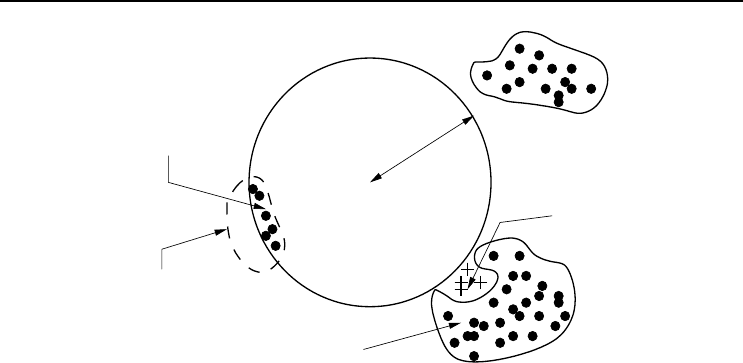
The affinity between an ALC and a pattern is measured using the r-continuous match-
ing rule. Figure 19.1 illustrates the r-continuous matching rule between an ALC and
a pattern.
The r-continuous matching rule is a partial matching rule, i.e. an ALC detects a
pattern if there are r-continuous or more matches in the corresponding positions. r
is the degree of affinity for an ALC to detect a pattern. In Figure 19.1 there are
seven continuous matches between the ALC and the pattern. Thus, if r =4,theALC
matches the pattern in Figure 19.1, since 7 >r.Ifr>7, the ALC does not match
the pattern in the figure. A higher value of r indicates a stronger affinity between an
ALC and a pattern.
A set of ALCs in the model represents the mature T-Cells in the natural immune
system. A training set of self patterns is used to train the set of ALCs using the
19.2 Classical View Models 429
negative selection technique. Algorithm 19.2 summarizes negative selection.
Algorithm 19.2 Training ALCs with Negative Selection
Set counter n
a
as the number of self-tolerant ALCs to train;
Create an empty set of self-tolerant ALCs as C;
Determine the training set of self patterns as D
T
;
while size of C not equal to n
a
do
Randomly generate an ALC, x
i
;
Matched=false;
for each self pattern z
p
∈ D
T
do
if affinity between x
i
and z
p
is higher than affinity threshold r then
matched=true;
break;
end
end
if not matched then
Add x
i
to set C;
end
end
For each randomly generated ALC, the affinity between the ALC and each self pattern
in the training set is calculated. If the affinity between any self pattern and an ALC is
higher than the affinity threshold, r, the ALC is discarded and a new ALC is randomly
generated. The new ALC also needs to be measured against the training set of self
patterns. If the affinity between all the self patterns and an ALC is lower than the
affinity threshold, r, the ALC is added to the self-tolerant set of ALCs. Thus, the
set of ALCs is negatively selected, i.e. only those ALCs with a calculated affinity less
than the affinity threshold, r, will be included in the set of ALCs.
The trained, self-tolerant set of ALCs is then presented with a testing set of self
and non-self patterns for classification. The affinity between each training pattern
and the set of self-tolerant ALCs is calculated. If the calculated affinity is below the
affinity threshold, r, the pattern is classified as a self pattern; otherwise, the pattern
is classified as a non-self pattern. The training set is monitored by continually testing
the ALC set against the training set for changes. A drawback of the negative selection
model is that the training set needs to have a good representation of self patterns.
Another drawback is the exhaustive replacement of an ALC during the monitoring of
the training set until the randomly generated ALC is self-tolerant.
19.2.2 Evolutionary Approaches
A different approach is proposed by Kim and Bentley [457] where ALCs are not ran-
domly generated and tested with negative selection, but an evolutionary process is
used to evolve ALCs towards non-self and to maintain diversity and generality among
the ALCs. The model by Potter and De Jong [689] applies a coevolutionary genetic
430 19. Artificial Immune Models
a
neg
False negatives
False positives
Unknown self
Kn
ow
n
se
lf
Figure 19.2 Adapted Negative Selection
algorithm to evolve ALCs towards the selected class of non-self patterns in the training
set and further away from the selected class of self patterns. Once the fitness of the
ALC set evolves to a point where all the non-self patterns and none of the self patterns
are detected, the ALCs represent a description of the concept. If the training set of self
and non-self patterns is noisy, the ALC set will be evolved until most of the non-self
patterns are detected and as few as possible self patterns are detected. The evolved
ALCs can discriminate between examples and counter-examples of a given concept.
Each class of patterns in the training set is selected in turn as self and all other classes
as non-self to evolve the different concept in the training set.
Gonzalez et al. [327] present a negative selection method that is able to train ALCs
with continuous-valued self patterns. The ALCs are evolved away from the training set
of self patterns and well separated from one another to maximize the coverage of non-
self, i.e. the least possible overlap among the evolved set of ALCs is desired. A similar
approach is presented in the model of Graaff and Engelbrecht [332]. All patterns are
represented as binary strings and the Hamming distance is used as affinity measure.
A genetic algorithm is used to evolve ALCs away from the training set of self patterns
towards a maximum non-self space coverage and a minimum overlap among existing
ALCs in the set. The difference to the model of Gonzalez et al. [327], is that each ALC
in the set has an affinity threshold. The ALCs are trained with an adapted negative
selection method as illustrated in Figure 19.2.
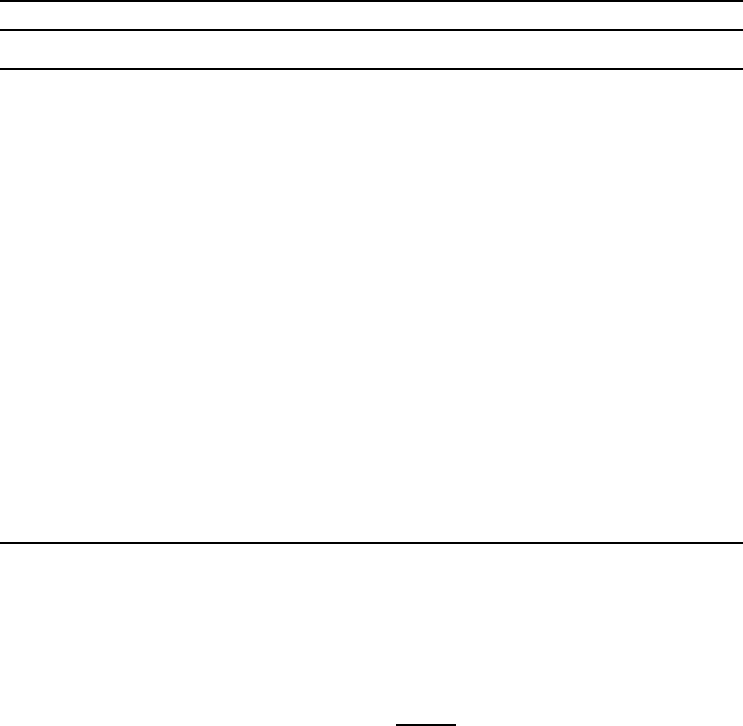
With the adapted negative selection method the affinity threshold, a
neg
,ofanALC
is determined by the distance to the closest self pattern from the ALC. The affinity
threshold, a
neg
, is used to determine a match with a non-self pattern. Thus, if the
measured affinity between a pattern and an ALC is less than the ALC’s affinity thresh-
old, a
neg
, the pattern is classified as a non-self pattern. Figure 19.2 also illustrates the
drawback of false positives and false negatives when the ALCs are trained with the
adapted negative selection method. These drawbacks are due to an incomplete static
self set. The known self is the incomplete static self set that is used to train the ALCs

19.3 Clonal Selection Theory Models 431
and the unknown self is the self patterns that are not known during training. The
unknown self can also represent self patterns that are outliers to the set of known self
patterns.
Surely all evolved ALCs will cover non-self space, but not all ALCs will detect non-self
patterns. Therefore, Graaff and Engelbrecht [332] proposed a transition function, the
life counter function, to determine an ALC’s status. ALCs with annihilated status
are removed in an attempt only to have mature and memory ALCs with optimum
classification of non-self patterns.
19.3 Clonal Selection Theory Models
The process of clonal selection in the natural immune system was discussed in Sec-
tion 18.5. Clonal selection in AIS is the selection of a set of ALCs with the highest
calculated affinity with a non-self pattern. The selected ALCs are then cloned and
mutated in an attempt to have a higher binding affinity with the presented non-self
pattern. The mutated clones compete with the existing set of ALCs, based on the
calculated affinity between the mutated clones and the non-self pattern, for survival
to be exposed to the next non-self pattern. This section discusses some of the AIS
models inspired by the clonal selection theory and gives the pseudo code for one of
these AIS models.
19.3.1 CLONALG
The selection of a lymphocyte by a detected antigen for clonal proliferation, inspired
the modeling of CLONALG. De Castro and Von Zuben [186, 190] presented CLON-
ALG as an algorithm that performs machine-learning and pattern recognition tasks.
All patterns are presented as binary strings.
The affinity between an ALC and a non-self pattern is measured as the Hamming
distance between the ALC and the non-self pattern. The Hamming distance gives
an indication of the similarity between two patterns, i.e. a lower Hamming distance
between an ALC and a non-self pattern implies a stronger affinity.
All patterns in the training set are seen as non-self patterns. Algorithm 19.3 summa-
rizes CLONALG for pattern recognition tasks. The different parts of the algorithm
are explained next.
The set of ALCs, C, is initialized with n
a
randomly generated ALCs. The ALC set is
split into a memory set of ALCs, M, and the remaining set of ALCs, R, which are not
in M.Thus,C = M∪Rand |C| = |M| + |R| (i.e. n
a
= n
m
+ n
r
). The assumption
in CLONALG is that there is one memory ALC for each of the patterns that needs to
be recognized in D
T
.
Each training pattern, z
p
, at random position, p,inD
T
,ispresentedtoC. The affinity
between z
p
and each ALC in C is calculated. A subset of the n
h
highest affinity ALCs
432 19. Artificial Immune Models
Algorithm 19.3 CLONALG Algorithm for Pattern Recognition
t = t
max
;
Determine the antigen patterns as training set D
T
;
Initialize a set of n
a
randomly generated ALCs as population C;
Select a subset of n
m
= |D
T
| memory ALCs, as population M⊆C;
Select a subset of n
a
− n
m
ALCs, as population R⊆C;
while t>0 do
for each antigen pattern z
p
∈ D
T
do
Calculate the affinity between z
p
and each of the ALCs in C;
Select n
h
of the highest affinity ALCs with z
p
from C as subset H;
Sort the ALCs of H in ascending order, according to the ALCs affinity;
Generate W as the set of clones for each ALC in H;
Generate W
as the set of mutated clones for each ALC in W;
Calculate the affinity between z
p
and each of the ALCs in W
;
Select the ALC with the highest affinity in W
as
ˆ
x;
Insert
ˆ
x in M at position p;
Replace n
l
of the lowest affinity ALCs in R with randomly generated ALCs;
end
t = t − 1;
end
is selected from C as subset H.Then
h
selected ALCs are then sorted in ascending
order of affinity with z
p
. Each ALC in the sorted H are cloned proportional to the
calculated affinity with z
p
and added to set W. The number of clones, n
ci
, generated
for an ALC, x
i
, at position i in the sorted set H, is defined in [190] as
n
ci
= round
β × n
h
i
(19.1)
where β is a multiplying factor and round returns the closest integer.
The ALCs in the cloned set, W, are mutated with a mutation rate that is inversely
proportional to the calculated affinity, i.e. a higher affinity implies a lower rate of
mutation. The mutated clones in W are added to a set of mutated clones, W
.The
affinity between the mutated clones in W
and the selected training pattern, z
p
,is
calculated.
The ALC with the highest calculated affinity in W
,
ˆ
x, replaces the ALC at position,
p,insetM, if the affinity of
ˆ
x is higher than the affinity of the ALC in set M.
Randomly generated ALCs replace n
l
of the lowest affinity ALCs in R. The learning
process repeats, until the maximum number of generations, t
max
, has been reached. A
modified version of CLONALG has been applied to multi-modal function optimization
[190].

19.3 Clonal Selection Theory Models 433
19.3.2 Dynamic Clonal Selection
In some cases the problem that needs to be optimized consists of self patterns that
changes through time. To address these types of problems, the dynamic clonal selection
algorithm (DCS) was introduced by Kim and Bentley [461]. The dynamic clonal
selection algorithm is based on the AIS proposed by Hofmeyr [372]. The basic concept
is to have three different populations of ALCs, categorized into immature, mature and
memory ALC populations.
Kim and Bentley [461] explored the effect of three parameters on the adaptability of the
model to changing self. These parameters were the tolerization period, the activation
threshold and the life span. The tolerization period is a threshold on the number of
generations during which ALCs can become self-tolerant. The activation threshold is
used as a measure to determine if a mature ALC met the minimum number of antigen
matches to be able to become a memory ALC. The life span parameter indicates the
maximum number of generations that a mature ALC is allowed to be in the system.
If the mature ALC’s life span meets the pre-determined life span parameter value,
the mature ALC is deleted from the system. The experimental results with different
parameter settings indicated that an increase in the life span with a decrease in the
activation threshold resulted in the model to have an increase in detecting true non-
self patterns. An increase in the tolerization period resulted in less self patterns being
detected falsely than non-self patterns, but only if the self patterns were stable.
With a changing self the increase in tolerization period had no remarkable influence
in the false detection of self patterns as non-self patterns. Although the DCS could
incrementally learn the structure of self and non-self patterns, it lacked the ability to
learn any changes in unseen self patterns. The memory ALCs in the DCS algorithm
had infinite lifespan. This feature was omitted in the extended DCS by removing
memory ALCs that were not self-tolerant to newly introduced self patterns [460].
A further extension to the DCS was done by introducing hyper-mutation on the deleted
memory ALCs [459]. The deleted memory ALCs were mutated to seed the immature
detector population, i.e. deleted memory ALCs form part of a gene library. Since
these deleted memory ALCs contain information (which was responsible for giving
them memory status), applying mutation on these ALCs will retain and fine tune the
system, i.e. reinforcing the algorithm with previously trained ALCs.
19.3.3 Multi-Layered AIS
Knight and Timmis [468] proposed a novel clonal selection inspired model that consists
of multi-layers to address some of the shortfalls of the AINE model as discussed in
Section 19.4. The defined layers interact to adapt and learn the structure of the
presented antigen patterns. The model follows the framework for an AIS as presented
in [182]. The basic requirements in [182] for an AIS are the representation of the
components (like B-Cells), the evaluation of interactions between these components or
their environment (affinity) and adaptability of the model in a dynamic environment

434 19. Artificial Immune Models
(i.e. different selection methods, e.g. negative or clonal selection).
The proposed multi-layered AIS consists of the following layers: the free-antibody
layer (F), B-Cell layer (B) and the memory layer (M). The set of training patterns,
D
T
, is seen as antigen. Each layer has an affinity threshold (a
F
, a
B
, a
M
), and a death
threshold (
F
,
B
,
M
). The death threshold is measured against the length of time
since a cell was last stimulated within a specific layer. If the death threshold does not
exceed this calculated length of time, the cell dies and is removed from the population
in the specific layer. The affinity threshold (a
F
, a
B
, a
M
) determines whether an
antigen binds to an entity within a specific layer. The affinity, f
a
, between an antigen
pattern and an entity in a layer is measured using Euclidean distance. Algorithm 19.4
summarizes the multi-layered AIS. The different parts of the algorithm are discussed
next.
An antigen, z
p
, first enters the free-antibody layer, F. In the free-antibody layer, the
antigen pattern is then presented to n
f
free-antibodies. The number of free-antibody
bindings is stored in the variable n
b
. The antigen, z
p
, then enters the B-Cell layer, B,
and is randomly presented to the B-Cells in this layer until it binds to one of the B-
Cells. After binding, the stimulated B-Cell, u
k
, produces a clone,
˜
u
k
, if the stimulation
level exceeds a predetermined stimulation threshold, γ
B
. The stimulation level is based
on the number of free-antibody bindings, n
b
, as calculated in the free-antibody layer.
The clone is then mutated as u
k
and added to the B-Cell layer. The stimulated B-
Cell, u
k
, produces free antibodies that are mutated versions of the original B-Cell.
The number of free antibodies produced by a B-Cell is defined in [468] as follows:
f
F
(z
p
, u
k
)=(a
max
− f
a
(z
p
, u
k
)) × α (19.2)
where f
F
is the number of antibodies that are added to the free-antibody layer, a
max
is the maximum possible distance between a B-Cell and an antigen pattern in the data
space (i.e. lowest possible affinity), f
a
(z
p
, u
k
) is the affinity between antigen, z
p
,and
B-Cell, u
k
,andα is some positive constant.
If an antigen does not bind to any of the B-Cells, a new B-Cell, u
new
,iscreatedwith
the same presentation as the unbinded antigen, z
p
. The new B-Cell is added to the
B-Cell layer resulting in a more diverse coverage of antigen data. The new B-Cell,
u
new
, also produces mutated free antibodies, which are added to the free-antibody
layer.
The final layer, M, consists only of memory cells and only responds to new memory
cells. The clone,
˜
u
k
, is presented as a new memory cell to the memory layer, M.The
memory cell with the lowest affinity to
˜
u
k
is selected as v
min
. If the affinity between
˜
u
k
and v
min
is lower than the predetermined memory threshold, a
M
,andtheaffinity
of
˜
u
k
is less than the affinity of v
min
with the antigen, z
p
(that was responsible for
the creation of the new memory cell,
˜
u
k
), then v
min
is replaced by the new memory
cell,
˜
u
k
. If the affinity between
˜
u
k
and v
min
is higher than the predetermined memory
threshold, a
M
, the new memory cell,
˜
u
k
, is added to the memory layer.
The multi-layered model improved the SSAIS model [626] (discussed in Section 19.4)
in that the multi-layered model obtained better compression on data while forming
stable clusters.
19.3 Clonal Selection Theory Models 435
Algorithm 19.4 A Multi-layered AIS Algorithm
Determine the antigen patterns as training set D
T
;
for each antigen pattern, z
p
∈ D
T
do
n
b
=0;
bcell
bind = false;
Randomly select n
f
free antibodies from set F as subset E;
for each free antibody, y
j
∈Edo
Calculate the affinity, f
a
(z
p
, y
j
);
if f
a
(z
p
, y
j
) <a
F
then
n
b
++;
Remove free antibody y
j
from set F;
end
end
for each randomly selected B-Cell, u
k
, at index position, k, in B-Cell set, B do
Calculate the affinity, f
a
(z
p
, u
k
);
if f
a
(z
p
, u
k
) <a
B
then
bcell
bind = true;
break;
end
end
if not bcell
bind then
Initialize new B-Cell, u
new
,withz
p
and add to B-Cell set B;
Produce f
F
(z
p
, u
new
) free antibodies and add to free-antibody set F;
end
else
Produce f
F
(z
p
, u
k
) free antibodies and add to free-antibody set F;
Update stimulation level of u
k
by adding n
b
;
if stimulation level of u
k
≥ γ
B
then
Clone B-Cell, u
k
,as
˜
u
k
;
Mutate
˜
u
k
as u
k
;
Add u
k
to B-Cell set B;
Select memory cell, v
min
,fromM as memory cell with lowest affinity, f
a
,
to
˜
u
k
;
if f
a
(
˜
u
k
, v
min
) <a
M
then
Add
˜
u
k
to memory set M;
end
else
if f
a
(z
p
,
˜
u
k
) <f
a
(z
p
, v
min
) then
Replace memory cell, v
min
, with clone,
˜
u
k
, in memory set, M;
end
end
end
end
end
for each cell, x
i
,insetF∪B∪Mdo
if living time of x
i
>
F,B,M
then
Remove x
i
from corresponding set;
end
end

436 19. Artificial Immune Models
19.4 Network Theory Models
This section discusses the AIS models based on or inspired by the network theory of the
natural immune system (as discussed in Section 18.6). The ALCs in a network based
AIS interact with each other to learn the structure of a non-self pattern, resulting
in the formation of ALC networks. The ALCs in a network co-stimulates and/or co-
suppress each other to adapt to the non-self pattern. The stimulation of an ALC is
based on the calculated affinity between the ALC and the non-self pattern and/or
the calculated affinity between the ALC and network ALCs as co-stimulation and/or
co-suppression.
19.4.1 Artificial Immune Network
The network theory was first modeled by Timmis and Neal [846] resulting in the arti-
ficial immune network (AINE). AINE defines the new concept of artificial recognition
balls (ARBs), which are bounded by a resource limited environment. In summary,
AINE consists of a population of ARBs, links between the ARBs, a set of antigen
training patterns (of which a cross section is used to initialize the ARBs) and some
clonal operations for learning. An ARB represents a region of antigen space that is
covered by a certain type of B-Cell.
ARBs that are close to each other (similar) in antigen space are connected with
weighted edges to form a number of individual network structures. The similarity
(affinity) between ARBs and between the ARBs and an antigen is measured using
Euclidean distance. Two ARBs are connected if the affinity between them is below
the network affinity threshold, a
n
, calculated as the average distance between all the
antigen patterns in the training set, D
T
. Algorithm 19.5 summarizes AINE.
For each iteration, all training patterns in set D
T
are presented to the set of ARBs, A.
After each iteration, each ARB, w
i
, calculates its stimulation level, l
arb,i
, and allocates
resources (i.e. B-Cells) based on its stimulation level as defined in equation (19.7).
The stimulation level, l
arb,i
,ofanARB,w
i
, is calculated as the summation of the
antigen stimulation, l
a,i
, the network stimulation, l
n,i
, and the network suppression,
s
n,i
. The stimulation level of an ARB is defined as [626]
l
arb,i
(w
i
)=l
a,i
(w
i
)+l
n,i
(w
i
)+s
n,i
(w
i
) (19.3)
with
l
a,i
(w
i
)=
|L
a,i
|
k=0
1 −L
a,ik
(19.4)
l
n,i
(w
i
)=
|L
n,i
|
k=0
1 −L
n,ik
(19.5)
s
n,i
(w
i
)=−
|L
n,i
|
k=0
L
n,ik
(19.6)
19.4 Network Theory Models 437
Algorithm 19.5 Artificial Immune Network (AINE)
Normalise the training data;
Initialise the ARB population, A, using a randomly selected cross section of the
normalised training data;
Initialise the antigen set, D
T
, with the remaining normalised training data;
Set the maximum number of available resources, n
r,max
;
for each ARB, w
i
∈Ado
for each ARB, w
j
∈Ado
Calculate the ARB affinity, f
a
(w
i
, w
j
);
if f
a
(w
i
, w
j
) <a
n
and i = j then
Add f
a
(w
i
, w
j
) to the set of network stimulation levels, L
n,i
;
end
end
end
while stopping condition not true do
for each antigen, z
p
∈ D
T
do
for each ARB, w
i
∈Ado
Calculate the antigen affinity, f
a
(z
p
, w
i
);
if f
a
(z
p
, w
i
) <a
n
then
Add f
a
(z
p
, w
i
) to the set of antigen stimulation levels, L
a,i
;
end
end
end
Allocate resources to the set of ARBs, A, using Algorithm 19.6;
Clone and mutate remaining ARBs in A;
Integrate mutated clones into A;
end
where L
a,i
is the normalised set of affinities between an ARB, w
i
,andallantigenz
p
∈
D
T
for which f
a
(z
p
, w
i
) <a
n
. The antigen stimulation, l
a,i
is therefore the sum of
all antigen affinities smaller than a
n
.Notethat0≤L
a,ik
≤ 1 for all L
a,ik
∈L
a,i
.The
network stimulation, l
n,i
, and the network suppression, s
n,i
, are the sum of affinities
between an ARB and all its connected neighbours as defined in equations (19.5) and
(19.6) respectively. Here L
n,i
is the normalised set of affinities between an ARB, w
i
,
and all other ARBs in set A. Network stimulation and suppression are based on the
summation of the distances to the |L
n,i
| linked neighbours of the ARB, w
i
.Network
suppression, s
n,i
represents the dissimilarity between an ARB and its neighbouring
ARBs. Network suppression keeps the size of the ARB population under control.
The number of resources allocated to an ARB is calculated as
f
r
(w
i
)=α ×
$
l
arb,i
(w
i
)
2
%
(19.7)
where l
arb,i
is the stimulation level and α some constant. Since the stimulation level
of the ARBs in A are normalised, some of the ARBs will have no resources allo-
cated. After the resource allocation step, the weakest ARBs (i.e. ARBs having zero
resources) are removed from the population of ARBs. Each of the remaining ARBs
in the population, A, is then cloned and mutated if the calculated stimulation level of