
Floud R., Johnson P. The Cambridge Economic History of Modern Britain, Volume 1: Industrialisation, 1700-1860
Подождите немного. Документ загружается.


British population during the ‘long’ eighteenth century 91
1986: tab. 11.12, 332: the figures for 1800 and 1851 refer to the male
labour force; those for 1600 and 1700 relate to the proportion of the
population dependent on agriculture for a living). The change appears to
have been progressive throughout the period 1600–1800. King and Massie,
who each made estimates of the social and economic composition of the
national population, divided the population into categories which do
not readily equate with the divisions which are now conventional. As a
result, assumptions must be made about the allocation to occupational
groupings of categories which represented status rather than occupation:
theallocation, for example, of cottars between agriculture and other
employments. In my view, however, their estimates support the figures
just quoted. My interpretation of their data yields a figure of about 60 per
cent of families working in agriculture for King (1688) and 50 per cent for
Massie (1760). If the assumptions made in arriving at this interpretation
of their work are justified, they support the picture just outlined (Wrigley
1987c: 171–2; see also Mathias 1979b).
Urban growth accounts for only part of the rapid rise in the proportion
of the population finding a living from non-agricultural occupations. By
1800 about half of the population of rural England was no longer de-
pendent on agriculture for employment. Indeed, between 1600 and 1800
ruralnon-agricultural employment may well have accounted for a slightly
larger share of the overall growth in employment outside agriculture
than is attributable to the growth of urban employment (Wrigley 1987c:
tab. 7.4, 170). This was the fruit of Smithian growth, of the successful
exploitation of the opportunities for growth afforded by an organic econ-
omy. Its momentum dominated the growth process throughout the long
eighteenth century. It remained powerful until well into the nineteenth
century. When Rickman made provision for more extensive occupational
returns in the 1831 census than he had in the three earlier censuses,
thedistinction which he drew between manufacturing on the one hand,
and retail trade and handicraft on the other, though not very clearly
defined in the instructions sent to the overseers of the poor, proved in
practice to correspond closely to the distinction between the production
of goods for large, dispersed, national or international markets and the
production of goods and services for a local market. The former, in other
words, embraced both factory-based production and forms of employ-
ment, such as framework knitting, where production was still domestic
but the market was large and remote. Both such forms of employment
were heavily concentrated in limited areas. The retail trades and handi-
crafts, in contrast, were widely spread throughout the country, forming
astable fraction of local employment and serving the immediate locality
almost exclusively (Wrigley 2002).
Manufacturing employment in England in 1831 was dwarfed by em-
ployment in retail trade and handicraft. The former employed 314,000
males aged 20 and over compared with a total of 964,000 engaged in
Cambridge Histories Online © Cambridge University Press, 2008

92 E. A. Wrigley
the latter, 10.4 per cent and 32.0 per cent respectively of the total of
males aged 20 and over; and while 55 per cent of all manufacturing
employment was to be found in Lancashire and the West Riding of York-
shire alone, retail trade and handicraft employment was distributed in
anotably even fashion throughout the kingdom (Wrigley 1986: 297 n. 8
and tab. 11.2, 300–1). The largest individual occupations in the latter in
declining order of size in 1831 were: shoemaker, carpenter, tailor, publi-
can, shopkeeper, blacksmith, mason, butcher, bricklayer and baker. The
first four of these occupations alone between them employed almost as
many men as the whole of manufacturing. Furthermore, employment
in the ten trades collectively grew by 39.3 per cent between 1831 and
1851,aperiod during which the national population increased by only
26.2 per cent (Wrigley 1986: tab. 11.2, 300–1; Wrigley et al.1997: tab. A9.1,
614–15). Any account of the early nineteenth century which focuses exclu-
sively on those industries which were ultimately to dominate the national
economy will overlook some of the most substantial growth areas of the
time.
The dominant feature of the English economy in the long eighteenth
century was the transformation in agricultural productivity which took
place between the end of Elizabeth’s reign and the beginning of Victo-
ria’s. The striking increase in output per acre has long been remarked;
that in output per head less so, but the latter underwrote success else-
where in the economy. Although the scale of the change may be diffi-
cult to pinpoint accurately, and both the timing and the causes of the
change remain controversial, it was certainly substantial. Overton offers
two calculations of its size, based on ‘population’ and on ‘output’. The
two methods produce a contrasting picture of the phasing of the in-
crease between 1700 and 1850, but are in agreement that productivity
per head roughly doubled over the period as a whole (Overton 1996a:
tabs 3.8(b) and 3.8(c), 82). Nor should it be overlooked that, since agri-
cultural labourers earned less than workers in most other employments,
the parallel rise in non-agricultural employment implies a rise in average
incomes through compositional change independent of any additional
benefits gained from rising wages in particular employments.
The great majority of those no longer working on the land were em-
ployed, as we have seen, in local service and handicraft industries. To
many of these industries the parable of the pinmakers, which Adam
Smith told to illustrate the vast possibilities for rising output per head
where the scale of the market allowed division of function, hardly ap-
plied. Shoemakers, carpenters, tailors, publicans, butchers and the like, if
they continued to serve only a local market, possessed neither the means
nor the opportunity to achieve large gains in productivity, yet such occu-
pations remained the source of livelihood for a very substantial fraction of
all non-agricultural employment until well into the nineteenth century.
The significance of the increase in production per head in agriculture is
underlined by this consideration.
Cambridge Histories Online © Cambridge University Press, 2008

British population during the ‘long’ eighteenth century 93
CONCLUSION
The long eighteenth century was a period in which the demographic his-
tory of Britain presented a great contrast with that of the continent. Pop-
ulation growth was far faster than across the Channel, though not swifter
than in much of Scandinavia. Demographic growth, however, though no-
table, was outstripped by economic growth. The British economy in the
long eighteenth century achieved a degree of aggregate growth unrivalled
elsewhere in Europe. In 1820 it appears from Maddison’s estimates that
gross domestic product per head in Britain was about 36 per cent higher
than in the Netherlands and 44 per cent higher than in France (Maddison
1982: tab. 1.4, 8 and 167). For England alone the gap would be still wider
(Wrigley 2000: 118–19). The British advantage compared with Germany,
Italy or Spain must have been substantially greater. If, for argument’s
sake, it is assumed conservatively that GDP per head was 50 per cent
higher than in France, the Netherlands, Germany, Spain and Italy com-
bined in 1820, and noting that whereas population in these five countries
combined rose by about 50 per cent between 1680 and 1820, the British
population rose by 140 per cent, the scale of the contrast in overall growth
is evident (Wrigley 1987c: tab. 9.1, 216; the Scottish population was as-
sumed to have been 1.0 million in 1680, 2.1 million in 1820). How large
thegap between British and continental levels of GDP per head had been
at the start of the long eighteenth century is uncertain, indeed essen-
tially guesswork. Suppose, however, that the difference in 1680 was 25
per cent rather than 50 per cent, and suppose further that GDP per head
on the continent rose on average by 20 per cent during the period. On
these assumptions, the GDP of the continental countries would have in-
creased by 80 per cent (100 × 1.5 × 1.2): over the same period the British
GDP would have risen by 246 per cent (100 × 2.4 × (180/125)), a massive
relative gain.
During the period 1680–1820, the great bulk of the expansion taking
place was attributable to the ‘old’ rather than the ‘new’ economy, to the
remarkably successful exploitation of the possibilities of an advanced
organic economy rather than to the prospects opened up by the new
mineral-based energy economy. Contemporaries were doubtful about the
future and their forebodings were not without foundation (Wrigley
1987b). Adam Smith feared that no country would prove able to avoid the
fate which was overtaking the Dutch Republic (A. Smith 1961 [1776]: I,
101–10). The work of de Vries and van der Woude in describing and
analysing the dynamic rise and subsequent stagnation of the Dutch econ-
omy shows that ‘modernity’, the advent of a capitalist economy, is not a
guarantee of indefinite growth (de Vries and van der Woude 1997: 711;
Wrigley 2000: 133–7).
All pre-industrial economies experience a tension between produc-
tion and reproduction, the tension which Malthus, as a young man,
Cambridge Histories Online © Cambridge University Press, 2008

94 E. A. Wrigley
attempted to capture by contrasting arithmetical and geometric growth
rates (Malthus 1986a [1798]: 8–10). Ultimately, Britain might well have
found it impossible to avoid crippling difficulties if it had not succeeded
in gradually ceasing to be an organic economy. In areas of ancient set-
tlement the mass of the population in organic economies usually paid
abitterpriceforrapid population growth. As the eighteenth century
drew towards its close there were signs that the familiar pattern was
about to be repeated in Britain. That the signs faded over the next half
century, to be replaced by harbingers of a new age, was made possible
inter alia by the transformation of the energy base of the economy and
the concomitant escape from the constraints imposed on the output of
secondary industry as long as its raw materials were almost exclusively
derived from plants and animals, and therefore limited by the produc-
tivity of the land (Wrigley 1988: chs. 2 and 3). Yet the advent of the new
should not obscure what was achieved within the older, organic economy.
Britain experienced its greatest growth relative to its neighbours during
the long eighteenth century while still dominantly an organic economy,
managing to cope successfully, if not without strain, with a prolonged
period of population growth which, at its peak, was faster than at any
other time in British history.
Despite the rapidity of the population growth which took place, there
wasnothing remarkable about the strictly demographic attributes of the
English population in the long eighteenth century. Marital fertility was
not exceptionally high. In much of France and Germany it was higher. Nor
wasmortality notably low. Throughout the period there was a close simi-
larity in both level and trend between mortality in England and in Scan-
dinavia, especially so in the case of Denmark. Moderate levels of marital
fertility and unremarkable levels of mortality, however, proved sufficient
to produce a surge in population unmatched elsewhere in Europe.
More unusual perhaps were the constraints and feedback mechanisms,
theeconomic structures and cultural conventions which influenced the
attitudes and behaviour of individual men and women. The tendency for
nuptiality trends to mirror secular changes in the real wage, for example,
waspotentially of major importance in preserving or enhancing living
standards and so creating an aggregate demand structure favourable to
innovation and investment. Though the nature of the link between the
two trends and its explication remain controversial, it is none the less
clear that its possibility turned on the existence of a particular set of
conventions and a distinctive social milieu. A combination of the general
rule that there should be no more than one married couple per household
with the fact that a majority of young people of both sexes spent a part of
their adolescence and early adulthood in service away from the parental
household meant that on marriage a young couple needed to command
theresources to establish a new household and further that their ability
to do so was often dependent principally on their prior earnings rather
Cambridge Histories Online © Cambridge University Press, 2008

British population during the ‘long’ eighteenth century 95
than a decision made by the older generation (Hajnal 1965, 1983; Laslett
1972a, 1977; Anderson 1980, 1990; Kussmaul 1981; R. M. Smith 1981).
But there were many other features of early modern English society
which may have played an important role in helping to maintain an
easy balance between production and reproduction. It seems probable,
forexample, that the nature of the poor law was important in enabling
thevictims of life-cycle difficulties – the elderly, the crippled, the sick,
the widowed, the orphaned – to survive with a degree of dignity. The
poor law must have tended to lessen the importance of kinship ties and
obligations, and it may also have encouraged freer movement between
parishes. Or again, as Malthus in his maturity pointed out, the nature
of an increasingly capitalist agriculture may have had highly important
implications both for living standards and for mobility. He sketched a
distinction widely employed at times by development economists when
analysing the weaknesses of traditional, ‘peasant’ society. If, as he re-
marked, a capitalist farmer has no reason to retain in his employment
any man whose product does not at least equal the value of the wage
paid to him, the failure of the marginal producer to be a net contributor
to income will provoke movement off the land.
16
In contrast the peasant
family’s system of values may be such that no one leaves the family hold-
ing until the average product has fallen to the level of subsistence. The
two contrasting cases are extreme and artificially simple, but a structural
difference in this regard may help to explain why in the nineteenth cen-
tury the percentage of total income contributed by the agricultural sector
in England was roughly equal to its share of the labour force, whereas in
many continental countries the former was far smaller than the latter
(Crafts 1985: tab. 3.4, 57).
Averylonglistofcomparabletopics might be compiled. The inter-
weaving of production and reproduction is fundamental to the life of
any society in any age. Elucidating the relationship presents a host of op-
portunities, balanced by as many challenging difficulties. In one respect,
however, matters have advanced substantially in recent decades. The mar-
gin of uncertainty relating to changes in the main demographic variables
determining reproduction, which in this sense, of course, includes mor-
tality and nuptiality no less than fertility, has narrowed to the point
where it seems reasonable to assert that it is little if any greater for the
long eighteenth century than for the century which succeeded it.
16
‘Upon the principle of private property . . . it could never happen [a situation in which
population growth was pushed to a limiting extreme]. With a view to the individual
interest, either of a landlord or farmer, no labourer can ever be employed on the soil,
who does not produce more than the value of his wages; and if these wages be not on
an average sufficient to maintain a wife, and rear two children to the age of marriage, it
is evident that both the population and produce must come to a stand’ (Malthus 1986b
[1826]: 405).
Cambridge Histories Online © Cambridge University Press, 2008

4
Agriculture during the
industrial revolution,
1700–1850
ROBERT C. ALLEN
Contents
Introduction 96
The rise of the great estate 98
Outputs 101
Inputs 103
Land 103
Labour 104
Capital 106
Productivity growth 107
Farm methods and productivity growth 108
Farm size and productivity growth 110
Enclosure and productivity growth 110
Agrarian change and economic growth 114
A longer-term perspective 116
INTRODUCTION
British agriculture developed in a distinctive manner that made impor-
tant contributions to economic growth. By the early nineteenth century,
agricultural labour productivity was one third higher in England than
in France, and each British farm worker produced over twice as much as
his Russian counterpart (Bairoch 1965; O’Brien and Keyder 1978; Wrigley
1985; Allen 1988, 2000). Although the yield per acre of grains was no
higher in Britain than in other parts of north-western Europe, the region
as a whole reaped yields twice those in most other parts of the world
(Allen and O’Gráda 1988; Allen 1992.)
Most accounts of British farming link the high level of efficiency to
Britain’s peculiar agrarian institutions. In many parts of the continent,
farmswere small, operated by families without hired labour and often
owned by their cultivators. Farms often consisted of strips scattered in
Cambridge Histories Online © Cambridge University Press, 2008

Agriculture during the industrial revolution 97
open fields, and animals were often grazed on commons. Peasant farming
of this sort was consolidated by the French Revolution. In contrast, in
Britain, the open fields were enclosed, farm size increased and tenancy
became general. While this transformation had been underway since the
middle ages, it reached its culmination during the industrial revolution.
Furthermore, it is often claimed that the agrarian transformation made
important contributions to industrialisation by increasing output and
supplying the industrial economy with labour and capital.
One of the most basic questions is the timing and nature of the agri-
cultural revolution. Toynbee (1969 [1884]), Mantoux (1905), Ernle (1961)
and mostly recently Overton (1996a, 1996b) located the agricultural rev-
olution in the eighteenth century, and their revolution comprised both
institutional change and the modernisation of farm methods. In con-
trast, most twentieth-century historians have emphasised that much pro-
ductivity growth occurred before 1700 and have tended to decouple
improvements in farming from enclosure and farm size increases. Cer-
tainly by 1700 crop yields were higher than in the middle ages, labour
productivity had increased, and output per worker in English farming
was already 55 per cent higher than in France. The first half of the nine-
teenth century was also a time of sustained improvement, but a question
mark hangs over the eighteenth century: some scholars see it as a pe-
riod of stasis; others as a century of steady progress. The importance of
enclosure and large-scale farming as bases for productivity growth is not
independent of this issue since enclosure and farm amalgamation pro-
gressed so substantially during the eighteenth century. The relationships
between productivity growth, rural social structure and agriculture’s role
in economic development remain fundamental questions of historical
research.
Abroad chronological and geographical perspective is needed for an
assessment of British agriculture during the industrial revolution. Histo-
rians of farming concentrate on biological indicators like the yield of an
acre or the weight of a fleece, but from an economic perspective the pro-
ductivity of labour is a more critical variable since a larger fraction of the
population can be employed off the farm if each cultivator produces more
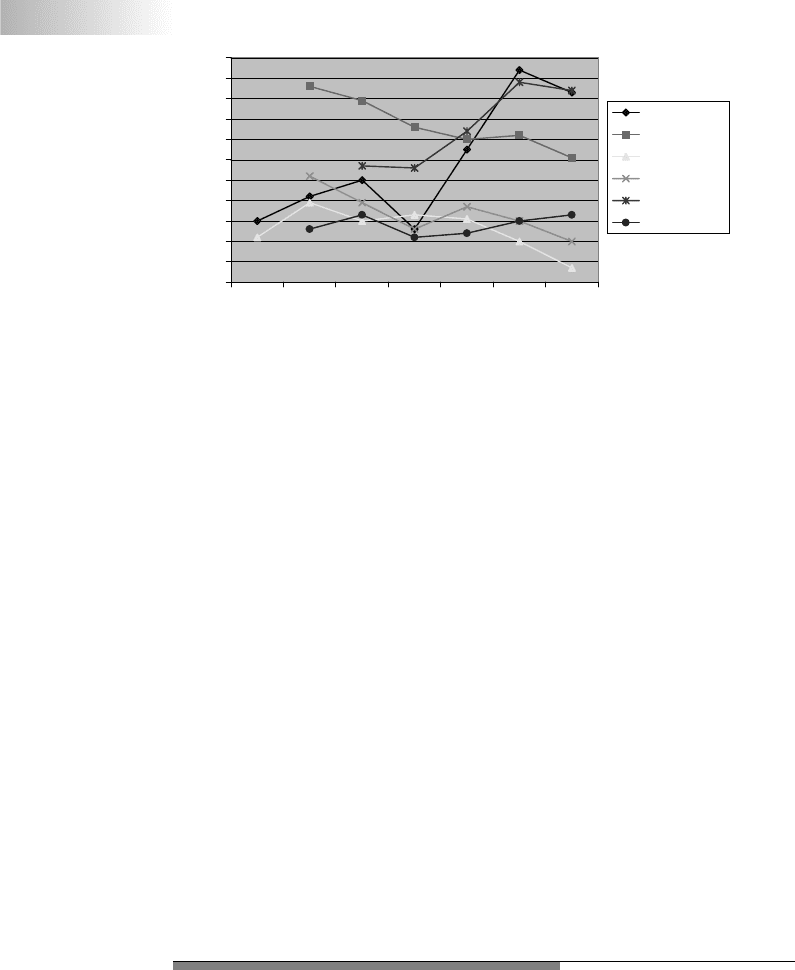
food. Figure 4.1 shows output per worker in six European countries from
1300 to 1800, and this helps put the achievements of British farming into
perspective. In Italy, France and Germany agricultural labour productivity
declined slowly after 1400, although France shows slight improvement in
theeighteenth century. The renowned husbandry of medieval Flanders
meant that productivity was exceptionally high in present-day Belgium.
Population pressure in later centuries meant that output per worker
slumped, but it still remained above the level on most of the continent.
The well-known agricultural revolutions of the early modern period –
those of the Dutch and the English – stand out in the figure. Output per
worker in English farming leapt from the continental norm in 1600 to a
Cambridge Histories Online © Cambridge University Press, 2008
98 Robert C. Allen
0.5
0.6
0.7
0.8
0.9
1
1.1
1.2
1.3
1.4
1.5
1.6
1300 1400 1500 1600 1700 1750 1800
Ratio (England in 1500 = 1.00)
England
Belgium
Italy
Spain
Netherlands
France
Figure 4.1 Output per
worker in agriculture,
1300–1800
Source: Allen 2000:
21.
leading position in 1750. It is important that this advance occurred before
theindustrial revolution, and, indeed, that there was no further advance
between 1750 and 1800. It is also important that England’s advances did
not push her efficiency above that of the Low Countries.
The modernisation of agriculture took place in the context of fluctu-
ating farm prices. They fell during the second quarter of the eighteenth
century – the so called agricultural depression – and then increased er-
ratically until the 1790s. Corn prices doubled and tripled during the har-
vest years of 1795, 1799 and 1800, and the price level remained high and
volatile until the end of the Napoleonic Wars. Then began a slide of prices
that lasted until the middle of the nineteenth century. The pace of im-
provement of farm methods may have been a determinant of the price
history through its impact on agricultural supply, but tariff policy and
increased market integration also played a role. The fluctuations in the
price level certainly affected the evolution of farming and rural society
in general. Rising prices after 1750 and especially during the Napoleonic
Wars accelerated enclosure; the high prices of the 1790s threatened the
standard of living of the rural poor, gave rise to radicalism, and brought
on changes in poor relief like the Speenhamland system; landowners who
had gained from the high prices of 1795–1815 sought to preserve their
rent rolls in the succeeding deflation through the corn laws, which im-
posed substantial duties on imported grain (Hueckel 1981).
THE RISE OF THE GREAT ESTATE
Eighty per cent of Britain’s farm land lay in England and Wales, which
produced 89 per cent of Britain’s farm output in the mid-nineteenth cen-
tury (Feinstein 1978: 635, n. 55; cf. Solar 1983 and Table 4.1). While the
agriculture of the Scottish Highlands was revolutionised by the clear-
ances, the changes that affected the largest share of British agricul-
ture occurred mainly in England and comprised the enclosure of the
open fields, the growth in farm size and the consolidation of the great
Cambridge Histories Online © Cambridge University Press, 2008

Agriculture during the industrial revolution 99
estate. Hence, discussion will focus on the English story. Many of the
changes in farm methods and management affected Scottish agriculture
as well.
Over half of the farm land in medieval England was organised in open
fields and commons. Under this system, the land of the village was di-
vided rigidly between arable and pasture. Holdings of arable consisted of
strips scattered around the village. The strips were grouped into several
large fields, which were also often units in a crop rotation. Three fields
were common, in which case one was planted with wheat or rye, the sec-
ond with barley, oats, beans or peas, and the third was fallow. Each year
the fields shifted to the next phase in the sequence. Every farmer had
to follow this communally agreed plan. The grass of the village included
themeadow on which hay was cut, and the common where the sheep
and cattle were pastured in a village herd. In densely settled regions,
the commons were small, but in many parts of the kingdom there were
great tracts of waste used as common pasture for sheep. The herd was
also turned onto the fallow field, as well as the other fields after they
were harvested, in order to eat weeds and manure the land.
Enclosed farming was the antithesis of the open field system. When
land was enclosed, the owners usually exchanged strips and divided com-
mons, so that each proprietor had large, consolidated blocks of property.
Communal rotations and grazing were abolished. Each owner acquired
exclusive control over his property, so every farmer could cultivate as he
pleased without reference to the rest of the community. In 1500, about
45 per cent of the farm land in England was already enclosed, and most
of that had probably never been open. The open fields in 1500 included
much of the grain growing land in the country. In 1700, 29 per cent
of England remained open or common, and the proportion shrank to
5per cent in 1914, where it remains today (Wordie 1983: 502). This phase
of the enclosure movement was particularly intense in the Midlands,
where over half of the farmland was enclosed in the eighteenth and nine-
teenth centuries (Wordie 1983: 500). Most of the remaining open land was
common pasture.
In the eighteenth century, much of the enclosing was accomplished by
parliamentary act. In such an enclosure the principal landowners of the
village petitioned parliament for a bill to enclose their village. Unanimity
of the owners was not required: in general the owners of 75 per cent to
80 per cent of the land had to be in favour in order for the bill to proceed.
Since landownership was highly concentrated, an enclosure could – and
often did – proceed with a majority of small proprietors opposed. In the
memorable phrase of the Hammonds (1924: 25), ‘the suffrages were not
counted but weighed’. The bill named commissioners, who carried out the
enclosure, and endorsed their award in advance. The commissioners held
hearings in the village, identified the proprietors, appointed a surveyor
who mapped the village and valued each holding, and finally reallocated
Cambridge Histories Online © Cambridge University Press, 2008

100Robert C. Allen
theland so that each proprietor (including those who opposed the en-
closure) received a grant of land in proportion to the value of his or her
holdings in the open fields. A total of 3,093 acts enclosed 4,487,079 acres
of open field and common pasture in this manner. A further 2,172 acts
were concerned exclusively with the enclosure of an additional 2,307,350
acres of common pasture and waste (Turner 1980: 26, 178).
Asecond major change was an increase in farm size. In the middle
ages demesnes were already several hundred acres, but the farms of serfs
were usually 30 acres or less (Kosminski 1956; Allen 1992). During the
population decline in the fourteenth and fifteenth centuries, farm size in-
creased. Estate surveys show that the average farm – including demesnes,
copyholds and leased land – in northern England and in open field vil-
lages in southern England was 65 acres in c.1700. Enclosed farms in
thesouth were already larger, however. In the eighteenth century, small
farmswere amalgamated into large ones in open field villages in the
south, and throughout the north. By 1800, 150 acres was the average
across all types of farms in the south, and 100 acres was the average in
thenorth (Wordie 1974; Allen 1988).
The growth in farm size was accompanied by a revolution in land
tenure. Many small farms in 1700 either were owned outright by their oc-
cupiers or were held on very long term agreements like copyholds for lives
or beneficial leases. During the eighteenth century, small freeholds were
bought up by great estates and manorial lords stopped renewing copy-
holds for lives and beneficial leases. The formerly yeomen lands passed
into the hands of the gentry and aristocracy. The small farms were amal-
gamated into large and were then leased to large-scale farmers. The re-
sult was the consolidation of the great estate and the emergence of the
three-tiered social structure of rich landlord, substantial tenant farmer
and poor landless labourer.
Eighteenth-century agricultural improvers regarded enclosure and the
creation of large farms as prerequisites for the modernisation of agricul-
ture, and this view has become widespread among historians. Since en-
closing began on a large scale in the late fifteenth century, the defenders
have argued that it led to the adoption of modern methods. Quesnay, the
French physiocrat, advanced the view that higher farm output required
more investment, and that only large-scale farmers had access to the req-
uisite capital. Arthur Young adopted this view and merged it with the
claim that enclosure also led to modernisation. For Young (1774: 287–8),
thelarge ‘farmer, with a greater proportional wealth than the small oc-
cupier, is able to work great improvements in his business...Healso
employs better cattle and uses better implements; he purchases more ma-
nures, and adopts more improvements.’ Open fields inhibited this style of
farming since they gave the small, backward farmers the power to check
theinitiative of the large-scale entrepreneur. Enclosure was essential to
set free the process of investment and modernisation.
Cambridge Histories Online © Cambridge University Press, 2008