
Floud R., Johnson P. The Cambridge Economic History of Modern Britain, Volume 1: Industrialisation, 1700-1860
Подождите немного. Документ загружается.


Money, finance and capital markets 161
Quantity of financing
Rate
of
return
Retained earnings
Demand
Supply
Liquidity
Long-run
investment
New equity
Borrowing
(credit and
loans)
Figure 6.4 Supply
and demand for
industrial finance
c. 1790
Source: Neal 1994:
176.
the opportunity cost of not meeting these obligations was ruin. After
non-deferrable expenses comes the entrepreneur’s opportunity for long-
run investments in the company. The remainder of the demand curve was
short-run opportunities such as extending credit to customers, increas-
ing production or repaying credit not yet due. The composite demand
schedule is also presented in Figure 6.4. Because immediate obligations
must be addressed first, a firm without access to external borrowing had
to hold internal funds as precautionary reserves, so the availability of
external debt to cover short-run liquidity needs freed internal capital for
investment purposes.
Shifts in the components of supply and demand demonstrate the
power of shocks to ruin firms. For example, trade cycles were a common
feature of the era. In a trade boom, revenue would easily flow in; internal
profits would grow, providing room for expansion of long-run investment
and opportunistic short-run lending. A downturn, however, reduced rev-
enues, so firms had less internal profit exactly when the demand from
immediate obligations increased, so a liquidity crisis on top of a trade cri-
sis was devastating (Pressnell 1956: 468). The supply schedule would shift
up and the right tail of the middle (borrowing) component of the supply
curve would truncate as lenders rationed credit. The more the system of
external lending eased business access to money during regular periods,
themore the same businesses became vulnerable to disruptions of that
system, and studies have found that bankruptcy correlated with trade
and liquidity crises (Duffy 1985; Hoppit 1987; Neal 1994). The evolution
of the British financial system in the eighteenth century increased this
channel through which large shocks propagated through the domestic
economy.
NINETEENTH-CENTURY REORGANISATION
The Revolutionary and Napoleonic wars with France and the Panic of 1825
that followed triggered a series of shocks, crises and innovations that re-
organised the British system of money and banking. The transformation
Cambridge Histories Online © Cambridge University Press, 2008

162 Stephen Quinn
began with the suspension of the convertibility of Bank of England notes
into gold. War with France was causing a drain of gold out of the Bank
of England that became precipitous in early 1797, so on 26 February the
King ordered the Bank of England to suspend convertibility (Clapham
1944a: 272). Suspension drove coinage out of circulation, and the Bank of
England responded to the demand for money by expanding the supply
of its notes through bill discounting, including the rediscounting of bills
from London bankers. Discounting supported the government’s war effort
because London banks could invest heavily in high-return government
debt and easily borrow from the Bank of England at a fixed rate of
5per cent should the banks require momentary liquidity. Discounting
wasalso very profitable for the Bank of England since notes could be is-
sued without any gold backing; however, the Bank of England did ration
its discounting to keep credit levels from growing too much (Duffy 1983).
Banknote issue also expanded outside of London. Parliament re-
sponded to the lack of coinage for small payments by lifting restrictions
on small-denomination banknotes in March 1797. The expansion of credit
and the freedom to issue small-denomination notes promoted the expan-
sion of country banking, but another factor at work was an increased
demand for banking by industry. The success of Napoleon’s Continental
Blockade and the need to arm Wellington’s Peninsular Campaign shifted
resources within Britain towards heavy industry such as metallurgy (Neal
1990: 205). From 1797 to 1810, the number of country banks in England
and Wales almost tripled from 230 to 783, and the growth of private
banknotes was especially demanded by industry (Pressnell 1956: 11, 148).
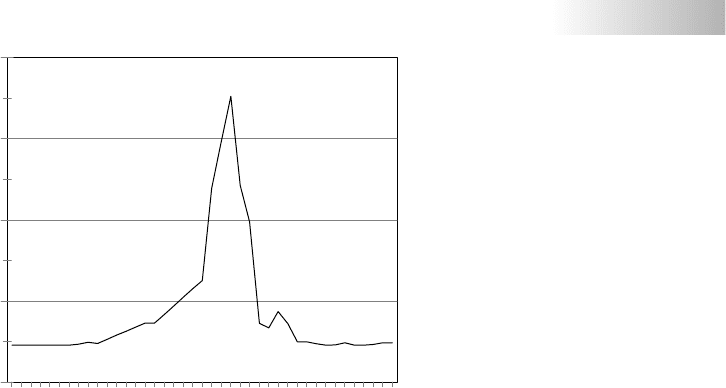
The increase in supply of banknotes brought inflation. The price of gold
peaked in 1813 at 36 per cent above its pre-suspension level. Figure 6.5
plots the price of gold in London from 1790 to 1830. Rapid deflation fol-
lowed in 1814 and 1815, yet not until 1819 did the Resumption Act order
the BankofEngland to restore convertibility. The Bank of England re-
sponded by building up its stock of gold, reducing the number of notes
in circulation, and keeping the discount rate at 5 per cent in an era of
falling rates (Neal 1998: 55). The resulting final spurt of deflation allowed
the Bank ofEngland to restore convertibility in 1821.
Warfinance also disrupted the relationship between country banks
and London bankers. The expansion of country banking and industrial
growth during the wars increased demand for country bank discounting
on London when London was reducing the supply of rediscounting (King
1936: 6). With high wartime rates on government debt, London bankers
favoured the more secure government debt over the bills offered by coun-
try banks (Neal 1990: 217). Also, the Bank of England would not rediscount
bills for country banks. Even the secondary market was problematic be-
cause the Bank of England would only discount bills of less than sixty-five
days, which excluded two-thirds of the bills sent to London by country
banks (Pressnell 1956: 99).
Cambridge Histories Online © Cambridge University Press, 2008
Money, finance and capital markets 163
£4.0
£4.5
£5.0
£5.5
£6.0
Pounds per fine ounce
1790 1795 1800 1805 1810 1815 1820 1825 1830
Figure 6.5 Price of
gold in London,
1790–1830
Source: Officer 2002.
To improve the liquidity of bills, bill brokers emerged who charged a
fee to connect buyers and sellers. The brokers’ ‘primary function then
quickly came to be that of receiving bills from the ‘‘industrialist” banker
and arranging for the discount either in London or by the ‘‘agricultural-
ist” country bankers’ (King 1936: 6). Bill brokers took no position on the
bill itself, and brokers claimed that they screened borrowers on behalf
of investors, so country banks using brokers suffered fewer losses (King
1936: 16). With peace and the subsequent fall in rates on government
debt, brokers gained further business when private bankers were slow to
reduce their discount rates and the Bank of England refused to reduce its
discount rate at all (King 1936: 27–8). Bill brokering rapidly increased the
liquidity of the secondary market for bills and bolstered the eighteenth-
century system of localised banking. In terms of Figure 6.3, bill brokerage
improved the ability of bills to move between the countryside and London.
The spread of commercial banking across Britain also brought banking
panics. In 1793 the end of a trade boom and speculation in canals had
forced many country banks to suspend payments. As mentioned above,
in 1797 the Bank of England was granted the suspension of convertibility
to forestallacrisis. Even during the Suspension Era, private banks failed
in waves of runs between 1810 and 1813 caused by bad harvests and the
downturn in foreign trade (Pressnell 1956: 466–70). An even larger panic
hit Britain in 1825 when about fifty English banks went bankrupt and
more suspended payments.
Scotland, however, seemed ‘almost immune to the virus’ (Clapham
1944b: 102), so the Scottish system became a template for English banking
reforms. In 1826, Parliament allowed banks beyond 65 miles from London
to become joint-stock banks of more than six members; 117 were created
from 1826 to 1844, and only nineteen failed or closed (Cottrell and Newton
1999: 84). The new joint-stock banks displaced over half the traditional
Cambridge Histories Online © Cambridge University Press, 2008

164 Stephen Quinn
country banks by 1844, but most joint-stock banks remained local in lend-
ing and ownership, with one-fifth having been converted from private
banks (Cottrell and Newton 1999: 90–2, 103). Often, joint-stock banks con-
tinued insider lending and used shares as collateral (Hudson 1986: 224).
In 1833, Parliament expanded joint-stock banking to London, but joint-
stock banks operating in London were prohibited from issuing notes to
avoid direct competition with the Bank of England. By 1844, London had
five joint-stock banks that averaged three times the deposits per bank
of private London banks, but private banks were still twelve times more
numerous (Cottrell and Newton 1999: 103).
What did not happen until the 1860s was extensive bank amalgama-
tion or bank branching. Many banks found that the benefits of diversifi-
cation were outweighed by the challenges of managing branches (Newton
and Cottrell 1998: 121–2). Also, joint-stock bank development was stymied
from 1844 to 1857 by legal restrictions such as a minimum capital require-
ment of £100,000 and a minimum share value denomination of £100, and
only six new joint-stock banks were formed from 1844 to 1857 (Collins
1988: 74). A key element of the Scottish model of joint-stock banking,
however, was not introduced to England until limited liability for share-
holders was finally made legal in 1858 and 1862; then a rapid expansion
of joint-stock banking and bank branching followed (Newton and Cottrell
1998: 127). A consequence of the expansion of bank size was the growth
of overdraft services at the expense of discounting bills of exchange. In-
creasing scale of bank operations meant joint-stock banks had less need
for the liquidity that bills offered, so they favoured the convenience that
overdrafts offered.
Another consequence of the Panic of 1825 was the geographic expan-
sion of the Bank of England. The government pushed the Bank of England
to establish branches so local money markets could be stabilised through
thedirect supply of Bank of England notes and discounting (Kindleberger
1993: 86). The Bank of England did not want to expand, but the govern-
ment threatened to revoke the Bank of England’s monopoly, so, from 1826
to 1829, the Bank of England established eleven branches in Manchester,
Gloucester, Swansea, Birmingham, Liverpool, Bristol, Leeds, Exeter,
Newcastle, Hull and Norwich (Ziegler 1990; Neal 1998: 72). To discour-
age local note issue, the Bank of England branches offered favourable
termstobanks that did not issue notes (Pressnell 1956: 152). Also, the
branches supplied coinage, that was particularly useful to industrialists
forpaying wages. To secure this advantage, in 1829 Parliament banned
notes below £5 in England and Wales. As a consequence, the compo-
sition of the English monetary stock became dominated by commercial
bank deposits, and commercial banknotes gradually became unimportant
(Collins 1983: 390).
Still another consequence of the Panic of 1825 was that London banks
discovered that the Bank of England could not be relied on to assist other
Cambridge Histories Online © Cambridge University Press, 2008

Money, finance and capital markets 165
banks during a crisis. In the eighteenth century, London’s banking system
had become based on Bank of England notes, but the Bank of England
avoided lending to banks, especially the rediscount of bills of exchange
that a private bank had already discounted. The Bank of England was a
for-profit operation and resisted offering assistance to competitors at the
Bank of England’s expense (Goodhart 1988). Expectations were altered,
however, during the suspension era when the Bank of England liberally
rediscounted bills of exchange for banks. With the return of convert-
ibility, the Bank of England returned to its aversion to rediscounting.
During the liquidity crisis of 1825, the Bank of England’s first instinct
wastobuild reserves and restrict lending (Clapham 1944b: 98). In 1825,
London bankers were caught between the demand on them for redis-
counts by their country bank correspondents and the Bank of England’s
refusal to supply London bankers with rediscounts. This painful expe-
rience caused London private bankers to develop greater cash reserves
and demand interest-paying call deposits (King 1936: 62–3). With banks
willing to take a rate of return on call deposits less than what bills of
exchange offered, the largest bill brokerages began to supply the service.
In doing so, the brokerages became dealers – discount houses – who took
demand deposits from banks and invested the money in bills of exchange.
The transformation from bill brokerage to discount house was encour-
aged in 1830 when the Bank of England began permitting discount houses
to rediscount with the Bank (King 1936: 89). This seemingly innocuous
policy change by the Bank of England rerouted the flow of emergency
funds from the Bank of England through discount houses instead of di-
rectly to banks (King 1936: 89). The mediation of discount houses between
banks and the Bank of England caused the Bank of England’s rediscount
policies to focus on systemic needs rather than on whether particular
banks deserved assistance (Capie 1999). Bill dealing and rediscounting
was further changed by the 1833 repeal of the usury ceiling on bills of
exchange of up to three months. For discount houses, the spread between
therates offered on call deposits and the rates available on bills was no
longer limited. For the Bank of England, instead of having to restrict
thequantity of discounting supplied at 5 per cent, the Bank of England
could instead raise rates to reduce the quantity demanded. The flexibility
allowed the Bank of England’s discount rate to become the primary pol-
icy instrument calibrating the Bank of England’s relationship with the
discount houses.
Discount houses were also critical to the new form of British banking.
The combination of the note-issue ban in London and the presence of
Bank of England branches outside of London meant that most joint-stock
banks chose not to finance by note issue but instead sought deposits. As
aresult, country banknote issue (private and joint-stock) peaked in 1836
(Newton and Cottrell 1998: 126). Joint-stock banks made deposit-based
liabilities profitable by keeping low cash reserves and rediscounting bills
Cambridge Histories Online © Cambridge University Press, 2008

166 Stephen Quinn
to provide liquidity when needed (King 1936: 39–40). London’s discount
houses became the key intermediaries as joint-stock banks rediscounted
bills of exchange on a daily basis, and joint-stock banks increased the
volume of the bill market by buying bills when funds were deposited and
selling bills when funds were withdrawn. Similarly, joint-stock banks put
their cash reserves to profitable use as call loans to discount houses (King
1936: 42).
As with other new financial technologies, the new discount market
was pushed to an unsupportable extreme. The ease of rediscounting
caused banks to discount more bills and bills of less quality, yet the
security of a bank’s endorsement lulled discount houses into ignoring
thevolume and quality of liabilities banks were creating (King 1936: 94).
Those pushing the limits of the system included joint-stock banks that
discounted the bills of merchant houses specialising in Anglo-American
trade. When the scale of the American-based liabilities became clearer
in 1836, the Bank of England refused to discount the bills, so a panic
began, based on the weakness of the affected merchant houses and their
banks. The Bank of England then chose to reverse policy, and the panic
subsided, but the Bank of England was locked into a generous rediscount
policy for three years. The moral hazard created by the Bank of England’s
easy liquidity caused banks and discount houses to lack restraint. The
increasing supply of Bank of England notes, however, scared continental
markets into a run on the currency side of the Bank of England in 1839
out of fear that the Bank of England would not be able to maintain con-
vertibility (King 1936: 97). In response, the Bank of England increased the
discount rate to 6 per cent, limited rediscounts and pushed London into
asevere liquidity crisis (King 1936: 82).
The failure of the Bank of England in the 1830s to balance its role as
defender of the pound and rediscounter of last resort fuelled a reforma-
tory agenda that became law in 1844. Members of the currency school
believed that the freedom to issue notes caused swings in the overall price
level and created instability. The Bank of England and other members of
thebanking school felt that so long as notes were issued with reason-
able gold backing – thought to be 33 per cent by the Bank of England’s
Governor – that note issue did not threaten price stability (Kindleberger
1993: 91). The Bank of England’s failure during panics in 1836 and 1839
gave the currency school the upper hand in government, and, in 1844,
theBank of England was split into an Issue Department and a Banking
Department with the goal of limiting note issue (Kindleberger 1993: 91).
The Issue Department was given the monopoly on the issue of Bank of
England notes while the Banking Department was given all the remaining
business of the Bank of England. The Issue Department was allowed £14
million in fiduciary notes, after which every additional Bank of England
note issued had to be fully backed by gold. To limit further the supply
of banknotes, existing English banks could not expand their note issue,
Cambridge Histories Online © Cambridge University Press, 2008

Money, finance and capital markets 167
while existing Scottish and Irish banks could only expand issue with full
gold backing like the Bank of England now had to have (Collins 1988: 72).
Finally, no new note issuing banks were allowed anywhere in Britain.
While the Bank Act of 1844 created strict currency controls, the dis-
count policy of the Bank of England remained largely unrestricted be-
cause rediscounts could be created by deposit liabilities instead of notes.
The exception was when withdrawals from the Bank of England de-
manded more notes than could be supplied, but here an ad hoc solution
wasfound. During panics in 1847, 1857 and 1866, the Treasury waived
the penalties for violating the constraint, so the Bank of England was
free to supply emergency liquidity (Kindleberger 1993: 94). The very sus-
pension of restrictions on Bank of England note issue was enough to end
the domestic portion of the panic of 1847 (Dornbusch and Frenkel 1984).
The era of domestic panics ended when the Bank of England commit-
tedtoemergency rediscounting while minimising moral hazard prob-
lems. The solution adopted by the Bank of England was to commit to
offering easy access to rediscounting during panics but to charge a high
rate of interest to penalise those who most exposed themselves to the
threat of a liquidity crisis. The policy was most prominently championed
in the 1860s and 1870s by Walter Bagehot, and the adoption of Bagehot’s
policy by the Bank of England in the 1870s along with the growth of bank
branches and the amalgamation of banks created a very crisis-resistant
payments system (Ogden 1991). In the following decades, individual banks
failed and international exchange-rate crises threatened the pound, but
domestic panics on the banking system ceased (Capie 1999: 125–6).
SECURITIES
The evolution of large-scale finance in Britain was also framed by shocks
and by liquidity enhancing innovations. More so than with short-run fi-
nance, liquidity was crucial for solving the differences in time horizons
between suppliers and demanders of capital. For example, the dominant
consumer of long-term capital from 1688 to 1873 was the British govern-
ment itself, and the advent of reliable, liquid government debt allowed
the British government to borrow extraordinary amounts in the eigh-
teenth century compared to Holland or France (Neal 1998). Even after the
introduction of securities by foreign governments, transportation, finan-
cial services and industry, British government debt in 1873 still accounted
for38per cent of the London Stock Exchange (Figure 6.1).
The revolution in the finance of the British government began with the
Glorious Revolution of 1688. The ascension of Holland’s William of Orange
to theEnglish throne brought a new constitutional compromise. Parlia-
ment would support William’s Holland in the Nine Years War (1688–97)
against France, but William III would recognise parliament’s control of
Cambridge Histories Online © Cambridge University Press, 2008

168 Stephen Quinn
thepublic revenue (North and Weingast 1989). The settlement also cre-
ated the national debt because funded debt was created under parlia-
ment’s direct authority to commit specific tax revenues to maintenance
of the debt it authorised (Dickson 1967). The involvement of parliament
complemented the introduction in England of the Dutch practice of long-
term borrowing byannuity,andlowerinterestrates on government debt
resulted (Wells and Wills 2000; Quinn 2001; Stasavage 2002). Annuities
backed by the expansion of taxation by parliament created a revolution in
military finance essential to Britain’s emergence as a Great Power (Brewer
1988; O’Brien 1988).
Annuities, however, were difficult to transfer, so their secondary mar-
ket was limited by their lack of liquidity, and the Bank of England was
an innovation that addressed this problem. By the 1690s, the use of joint-
stock organisation by companies was well established (Harris 2000: 39–46).
Because stock was much easier to transfer than government debt and gov-
ernment debt formed more than 90 per cent of the Bank of England’s
revenue-producing assets, Bank of England stock was, in effect, a more
liquid form of government debt (Neal 1990: 15). After the success of the
Bank of England, annuities were sold to other joint-stock companies: the
Million Bank in 1695, the New East India Company in 1698 (£2 million)
and the South Sea Company in 1711 (£9 million). Also, the Bank of
England expanded its holding of government debt in 1697 and 1709 in
exchange for extensions of its charter and parliamentary prohibitions on
competing banks noted earlier (Acres 1931: 101). In all these cases, parlia-
ment traded support for a company in exchange for corporate borrowing,
and the public supported the scheme by either buying stock, swapping
government debt for stock or accepting banknotes.
The new stock deepened the secondary market for securities in London.
Even companies that did not absorb government debt, like the Royal
Africa Company and the Hudson’s Bay Company, experienced an increase
in trade activity (Carlos et al.1998). Deepening the market meant that
buyers and sellers had increasing confidence that a trading partner could
be found. The key intermediaries in deepening the market were brokers
and jobbers. Brokers specialised in matching buyers with sellers while
jobbers actually bought and sold their own positions. Although maligned
in their day, jobbers created liquidity for sellers and a constant market
forbuyers in a manner similar to what warehousemen provided for trade
goods (Michie 1999: 23–4). Most long-run investors rarely bought or sold,
but the volume of business generated by short-run holders, especially
merchants, kept intermediaries in business, so long-run investors enjoyed
low-cost liquidity (Michie 1999: 26).
Government borrowing by annuity was introduced in the 1690s, but
annuities came to dominate government borrowing during the War of
theSpanish Succession (1701–13) (Dickson 1967: 358–60). By the coro-
nation of George I in 1714, interest charges were consuming half of
Cambridge Histories Online © Cambridge University Press, 2008

Money, finance and capital markets 169
thegovernment’s yearly revenue (Roseveare 1991: 53). While Britain won
both wars, roughly one-third of the debt, £15 million worth, was irrede-
emable – meaning that the government could not force repayment of the
99-year annuities (Dickson 1967: 92–3). The solution to the government’s
debt problem was to extend the mechanism of debt-for-equity swaps to
their logical extreme through the conversion of the irredeemables and
other annuities into stock. In 1720, the South Sea Company outbid the
Bank of England for the right to create stock and swap it for most of the
outstanding government debt. At the time, a similar scheme under the di-
rection of the Scotsman John Law seemed to be succeeding in Paris (Neal
1990). By mid-1720, more than 80 per cent of privately held annuities (£26
million) were voluntarily exchanged for South Sea stock (Dickson 1967:
522–3). The windfall for the government was that annuities costing the
government between 6 and 9 per cent were transformed into debt owed
to the South Sea Company paying 5 per cent and could be redeemed.
Individuals traded their annuities for South Sea Company stock out
of an expectation that stock prices would rise. A bubble formed because
investors were inexperienced about how to value these new securities,
and new types of securities also led to later bubbles in canals, foreign
debt, and railroads. The bubble was also inflated by extensive credit cre-
ation. The South Sea Company only required subscribers to put down a
fraction of the subscription in cash. To circumvent Parliament’s prohibi-
tion on corporate banking, the South Sea Company used a partnership
called the Sword Blade Company to issue banknotes that were used to
finance more purchases of the South Sea stock. While Sword Blade notes
only functioned as a medium of exchange in Exchange Alley, that circu-
lation was sufficient to support a price increase that reached ten times
par in the summer of 1720. Annuity holders responded enthusiastically
to the opportunity to swap annuities for stock which lent credibility to
thescheme (Neal 1990 109). By the end of August 1720, the South Sea
Company’s assets were £75 million in subscribed cash, £26 million in
swapped annuities, £11 million in loans, and £17.5 million in unissued
stock, while liabilities were only £8 million owed to the government in
various pledges and £5 million in bonds (Dickson 1967: 125, 134, 160–1;
Murphy 1986: 161–2).
The bubble burst because most of the South Sea Company’s £75 million
in cash was pledged rather than in hand, and, when collecting the cash
began to look very unlikely because that amount of money was beyond
the ability of the banking system to create, stock prices plummeted (Neal
1990: 109). Liquidation spread, London banks suffered runs, the prices of
East India Company stock and Bank of England stock fell, and the Sword
Blade Company failed on 24 September 1720 (Dickson 1967: 158; Neal
1990: 106). Investors clamoured for legislative relief, and parliament ruled
that the South Sea Company would not collect the remaining cash due;
however, the annuity–stock swaps were ruled final, and the £26 million
Cambridge Histories Online © Cambridge University Press, 2008

170 Stephen Quinn
in annuities collected through the stock swaps were restructured into
marketable government annuities that provided enough secondary mar-
kettrading to maintain the broker-jobber infrastructure of the London
market (Neal 2000: 128).
Although the South Sea annuities were finally paid off in 1850, parlia-
ment continued to issue new annuities (Roseveare 1991: 59). Because each
new issue was based on a different revenue fund, these securities collec-
tively became called the Funds, and, from 1749–52, Lord Treasurer Pelham
directed the consolidation of the Funds into one perpetual annuity pay-
ing 3 per cent interest per year called the Three Per Cent Consol (Dickson
1967: 228–41). The Consol was simple and secure, with a deep secondary
market. The liquidity of the Consol promoted investment because it re-
duced the money that a bank, insurance company or other business had
to hold for precautionary purposes.
In the decades following the Bubble, the market for government debt
also consolidated around the Bank of England. New annuities were issued
through the Bank of England eight times from 1727 to 1751. Instead
of purchasing annuities, transferring annuities or collecting interest on
annuities at the Treasury in Westminster, investors came to conduct the
business much more conveniently at the Bank of England. The Rotunda
of the Bank of England, opened in 1765, was popular for trading because
transfer of both Consols and Bank of England stock was registered there
(Michie 1999: 32). Securities trading also occurred outside of the Bank
of England, and in 1773 a syndicate built a stock exchange in Sweetings
Alley and charged for people to trade there (Michie 1999: 31). The benefit
fortraders was a common set of rules and regulations; however, the
exchange was not a closed system, and the exchange’s Committee for
General Purposes lacked the power to exclude defaulters or adjudicate
disputes (Michie 1999: 34).
Another consequence of the South Sea Bubble was the passage of the
Bubble Act in 1720 that prohibited the formation of publicly traded joint-
stock companies except by government charter or act. The act was a piece
of special-interest legislation pushed by the South Sea Company to sup-
press rival schemes during the Bubble (Harris 1994). Although famous,
theBubble Act was easily circumvented and eventually repealed in 1825
(Harris 1994: 623–6; 1997). Circumvention was especially important for
thegrowth of insurance, which benefited from economies of scale. When
theincorporation of new life insurance companies was blocked by the
Bubble Act, new companies instead organised around private trusts that
were effectively the same as joint-stock companies (Supple 1970: 54–61).
The exception was marine insurance, because the Bubble Act contained a
clause that granted joint-stock charters to the Royal Exchange Assurance
and London Assurance and prohibited any other company or partner-
ship from underwriting marine insurance (Supple 1970: 32–3). Because
both joint-stock companies expanded slowly and because the exclusivity
Cambridge Histories Online © Cambridge University Press, 2008