
Floud R., Johnson P. The Cambridge Economic History of Modern Britain, Volume 1: Industrialisation, 1700-1860
Подождите немного. Документ загружается.


Trade: discovery, mercantilism and technolog y 191
Statistics appear to confirm the impression of trade’s importance
(Crouzet 1980). The proportion of national income derived from exports
and spent on imports nearly doubled relative to national income during
the eighteenth century (despite a sharp setback during the American War
of Independence when exports fell by more than a quarter). The ratio of
trade to national income continued to grow in the nineteenth century,
although somewhat surprisingly it hardly increased during the industrial
revolution itself, when British cotton textiles firms quickly found large
overseas markets for products of their improved technology, but did so
at sharply lower prices. Imports, of course, increased along with exports.
Britons in the heyday of Victoria’s reign spent at least one out of every
four pounds on foreign goods, a higher share than in France or Germany,
and much higher than in the United States. Some three-quarters of all
imports were foods and raw materials and imports were frequently the
major, or even only, source of supply.
Britain was the pivot of international trade and events affecting her
trade, such as the commercial revolution in long-distance trade or the
move to free trade in the middle decades of the nineteenth century,
might be expected to react on the British economy for good or evil with
special force. In the decade 1876–85 (the earliest dates with usable statis-
tics) Britain exported about 38 per cent of manufactured goods in world
trade; a few decades earlier, the share had no doubt been larger (Hilgerdt
1945: 157–8). This position of dominance was unique, approached but not
equalled even by the United States, whose share in world manufactured
exports peaked at 27 per cent in 1950. Only after the First World War did
theUnited States exceed Britain in exports of all kinds (with American
wheat and British coal included in the accounting) and only after the
Second World War in total exports of manufactures (Maizels 1963).
THE IMPORTANCE OF TRADE AND WHY BRITAIN
DID NOT ‘DEPEND’ ON TRADE
Britain and the world, then, appear to have been mutually dependent, yet
thesize of trade is not necessarily a good guide to its importance. Trade
alters economic structure as trading economies allocate resources in re-
sponse to trading opportunities, and certainly trade promoted British
industrialisation. In the eighteenth century Britain purchased tropical
goods like sugar and tobacco by producing more manufactured goods
and exporting them to customers, particularly in America. In the nine-
teenth century, industrial exports purchased a wider range of food and
rawmaterials. We need, however, to be careful in talking about the de-
pendence of an economy on trade. A careless reading of the statistics sug-
geststhat removing trade might have cut national income by 25 or 30 per
cent and British wheat consumption (for example) by 80 per cent – after
Cambridge Histories Online © Cambridge University Press, 2008

192C.Knick Harley
all, these were the shares of foreign supplies in national income and in
wheat consumption. The volume of a trade, however, is a poor guide to
how much the economy’s prosperity depends on it. The issue is simplest
to see in the case of a single commodity. Victorian Britain, denied imports
of wheat, would grow more wheat and other home-grown foods with the
resources that had previously produced exports to pay for foreign wheat.
Foregoing wheat from the fertile plains of Illinois or the Ukraine would
have a cost, but the loss to British wellbeing would be much less than
the whole value of the wheat imported.
The reasoning here is characteristically economic, focusing as it does
on the alternatives to acquiring goods by trade. A stress on exports rather
than imports as the things-to-be-desired is non-economic. One hears it
said, for example, that Britain had to import corn and timber and wine
in order to give foreigners the wherewithal to buy British manufactures.
Aperson or nation fully employed, however, yearns to acquire goods, not
to getrid of them. Exports are an unfortunate sacrifice that people or
nations must make to acquire imports for consumption. As Adam Smith
remarked in his attack on the mercantilist doctrine that an excess of
exports over imports should be the goal of policy: ‘Consumption is the
sole end of and purpose of all production...Themaxim is so per-
fectly self-evident, that it would be absurd to attempt to prove it’ (Smith
1976 [1776]: 625). Correct determination of the contribution of trade to
economic welfare involves estimating the loss involved in reallocating re-
sources devoted to the production of goods for export and instead using
them to produce substitutes for domestic imports.
Although the volume of trade is an inappropriate yardstick, the gains
from trade properly conceived may still seem large. For example, O’Brien
and Engerman (1991) argue that export industries employed an increasing
proportion of the labour force in the eighteenth century which the econ-
omy would have had trouble employing in the absence of growing trade.
If so, reducing trade would have eliminated jobs in export industries and
theworkers would have produced goods of much lower value than the
imports obtained by trade. It is not entirely clear whether O’Brien and
Engerman feel that, even in the long run, markets in the early modern
British economy lacked the flexibility to reallocate resources to domestic
use or whether they feel that their productivity in alternative uses would
have been very low.
In a somewhat different vein, Kenneth Pomeranz (2000) has recently
argued, comparing China and Europe, that Britain’s ability to trade man-
ufactured goods for food and raw materials with America was key to the
success of the industrial revolution, because it released Europe from bio-
logical limits to growth. The argument seems overblown. The great food
imports came late in the nineteenth century, well after the industrial
revolution; much of Europe imposed tariffs to frustrate American food
imports; and much of Britain’s food and raw material imports did not
Cambridge Histories Online © Cambridge University Press, 2008

Trade: discovery, mercantilism and technolog y 193
come from American sources. None the less, it is useful to investigate
thelikely magnitude of income loss that could have occurred if exports
had been unavailable as a means of acquiring imports.
Calculating the benefits of trade, or alternatively the cost of abandon-
ing it, is of little significance in itself, for no historical issue turns on
the literal abandonment of British foreign trade, but it provides useful
background to more modest experiments in counterfactuals and checks
exaggerated opinions of Britain’s dependence on trade. Foreign trade can
be viewed as an industry that produces imports, say wheat, in exchange
forsacrifices of exports, say cotton cloth. The ‘productivity’ of this indus-
try is the rate at which a quarter of wheat exchanges for yards of cloth,
i.e. the ‘terms of trade’. The price of Britain’s exports of cotton cloth,
iron, coal, shipping services and so forth divided by the price of imports
of wheat, lumber, tobacco, raw cotton and so forth is the terms of trade,
and indicates the amount of imports a unit of exports can buy. The gains
from trade depend on the extent that trade changed the terms of trade
between goods imported and exported and on the importance of the for-
eign trade ‘industry’ relative to other, domestic, industries. The ratio of
exports (or imports) to national income rose from about 0.08 early in the
eighteenth century to about 0.30 by the end of the nineteenth. If trade
made imported goods 10 per cent cheaper, and the share of trade were
0.19 of income (its average for the two centuries), national income would
rise on this account by no more than (10 per cent) ∗ (0.19), or 1.9 per cent.
The matter of concept settled, the remaining question is the difficult
counterfactual one of how much the terms of trade would have moved
had Britain lacked trading opportunities. Clearly, without trade the price
of now-abundant exportables like cloth would have fallen relative to the
price of now-scarce, land-intensive importables like wheat. In other words,
theterms of trade would have deteriorated. How much? Since no such
event occurred we cannot answer this question precisely, but the ac-
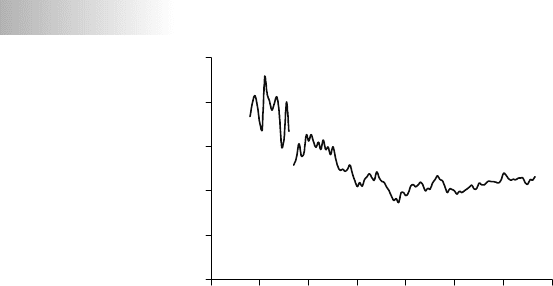
tual course of the terms of trade over the nineteenth century, shown in
Table 7.3 and Figure 7.2, gives some guidance. The massive fall from 170
in 1820 to 100 in 1860 resulted from Britain’s ingenuity in making ex-
ported cotton cloth cheaper, which more than overcame the effect of the
push of population in Europe against supplies of grain. The (smaller) rise
Table 7.3 The terms of trade, 1820–1910
1820 170
1840 130
1860 100
1880 110
1900 130
1910 130
Source: Imlah 1958.
thereafter was a consequence of the full
application of steam and steel to the
making and, especially, the shipping of
food and raw materials to Britain from
hitherto remote parts of the globe. Al-
though no exact guess is possible, per-
haps the 70 or 30 per cent fall and
rise in the terms of trade can provide a
guide to the terms of trade implied by
self-sufficiency in, say, 1860. Not much
Cambridge Histories Online © Cambridge University Press, 2008
194C.Knick Harley
0
50
100
150
200
250
1780 1800 1820 1840 1860 1880 1900 1920
Figure 7.2 Terms of
trade, 1796–1913
Sources: Imlah 1958;
Davis 1979; Crafts
1985.
of a rise in the price of German toys relative to British clocks, perhaps
10 per cent, would have been necessary before domestic production would
have replaced shipments into or out of Britain. But quite a large rise
would have been necessary to stop wheat and raw cotton coming in or
textiles going out, so powerful were the forces of specialisation in these
goods. With a tariff of 40 per cent, British farmers fed the nation in years
of good harvest under the corn laws. A doubling of the price of cotton
cloth exports during the cotton famine caused by the American Civil War
sharply reduced exports but only by a third, but the experiment is flawed
because the prices of Britain’s competitors in this market went up as well.
As an illustration we may consider that a prohibition of trade might have
reduced the price of exportables relative to importables by, say, 50 per
cent. The share of imports in income to multiply the 50 per cent would
be half the way from zero, under the prohibition, to the 25 per cent that
actually occurred in 1860. Self-sufficiency in 1860, then, would have cost
Britain only (50 per cent) ∗ (0.125) or about 6 per cent of national income.
Six per cent of national income – or even, if, improbably, the terms
of trade effect were twice as great, 12 per cent – looks small beside bold
metaphors of Britain’s ‘dependence’ on foreign trade. Indeed, the calcu-
lation is worthwhile only to loosen the grip of the metaphor (for other
attempts see Kravis 1970, 1973; Crafts 1973). Even on the absurd premise
of no foreign trade at all, Britain’s loss would have been small relative to
nineteenth-century growth of about 2 per cent per year that increased in-
come some sevenfold. True, had Britain suddenly been denied all trade by
strike or edict, the immediate effects would have been larger (cf. Crouzet
1958, 1964; Olson 1963). The experiment relevant to all the history of
this period except times of war and blockade, however, is not a sudden
denial of trade but a failure of it to grow over a long term. It is precisely
thesteady and rapid growth over two centuries that has led people to
attribute to foreign trade a major role in economic growth.
The previous calculations focus on the gains trade provides from real-
locating resources in response to comparative advantage. Unfortunately,
economists have long recognised that such reallocation, on which their
techniques focus, does not explain very much of the economic growth we
Cambridge Histories Online © Cambridge University Press, 2008

Trade: discovery, mercantilism and technolog y 195
observe in modern economies. It is possible to imagine forces that would
have increased trade’s long-run influence. This is particularly tempting in
Britain’s case since we often loosely, but mistakenly, use the term ‘indus-
trialisation’ as a synonym for modern economic growth. The empirical
impact of possible dynamic influences, however, was probably small. Like
many traditional historical narratives, some modern analytical models
emphasise learning by doing as an important source of technological
change and hence growth (Helpman and Krugman 1985). However, trade
implies not only that some industries grow relative to the size they would
have been without trade but also that some are smaller. Therefore a net
gain in technological progress requires that the gains from learning in
theexpanding industries exceed the losses from failing to learn in the
industries from which resources were drawn. The dynamic British indus-
tries would have been large even if they had not captured export markets,
and there is no evidence that the expansion from trade contributed learn-
ing that would not have occurred in somewhat smaller industries. Ex-
panding trade could also have increased growth, if by chance the people
enriched by the extension of foreign trade, such as East and West Indian
merchants, cotton manufacturers and coal owners, saved or invested
more than the people impoverished by the trade, such as timber own-
ers and silk manufacturers. New industries probably had more scope for
learning by doing, and income earners more orientated towards capitalist
expansion may have saved and innovated more than those orientated to-
wardsaristocratic privilege, but there is no persuasive evidence that these
effects were large. Britain was left with, say, its 6 per cent – no trivial sum,
to be sure, but measured against the whole rise in output per worker of
roughly 80 per cent from 1855 to 1913, only one thirteenth of the story.
MERCANTILISM, TRADE AND GROWTH
Britain’s transformation from an economic backwater into Europe’s lead-
ing economy with sophisticated commercial and financial institutions
and a large manufacturing sector occurred during the mercantile era of
growing long-distance trade. Two important issues have long attracted
historians’ attention. First, trade developed in the context of mercantilist
imperial regulations, conflict and warfare among European empires. How
much of Britain’s success depended on policies that supported military
and naval success? Second, Britain’s – and more widely, Europe’s – grow-
ing trade was intertwined with imperialism. In the New World, the con-
querors displaced indigenous societies and enslaved the population to
exploit the mines. When the indigenous societies failed to provide ad-
equate labour, they imported as many as 10 million African slaves for
labour. In the east, the Dutch controlled the Spice Islands and the British
developed hegemony in India. In the centuries that followed, Europeans
became spectacularly richer while the peoples that fell under European
Cambridge Histories Online © Cambridge University Press, 2008

196C.Knick Harley
control did not. Were European success and non-European stagnation two
parts of a single process in which Europeans became rich by exploiting
therest of the world (Williams 1944; Wallerstein 1980)? Temporal re-
lationships have led many to conclude that success in war and imperial
exploitation were keys to Europe’s economic success, but more careful ex-
amination of the historical details and economic connections casts doubt
on these positions.
In the eighteenth-century imperial wars, Britain adopted a ‘blue-water
strategy’ that exploited its island position. The navy protected the British
Isles from invasion and harassed French trade while the British subsidised
continental allies to fight land campaigns against France. The ‘blue-water
strategy’ was expensive, since fleets required greater and more sustained
outlays than armies and subsidies required large amounts of cash at
short notice. Success rested on Britain’s superior ability to tax and to bor-
row at least as much as on its island position (Baugh 1988, 1998; Brewer
1989; O’Brien 1998, 2000; chapter 8 below). Shipping and commerce were
central to the strategy’s success. Merchant shipping provided the man-
power for wartime fleets. Duties on imports provided significant, but by
no means overwhelming, revenue. Probably more important, the com-
mercial establishment in London lent large amounts to the government
on short notice – an indispensable British asset in time of war.
Even though British politicians paid close attention to trade and ship-
ping interests, it would probably be incorrect to place excessive emphasis
on power politics in the development of British trade, and by possible ex-
tension, on growth. Despite naval domination in most of the wars, Britain
gained little territory and the loss of the thirteen mainland American
colonies, the greatest territorial change in eighteenth-century empires,
went decisively against Britain.
The eighteenth-century British Empire was not exceptionally large or
prosperous. The Spanish, French and English sugar islands in the West
Indies all had about the same population (300,000 to 350,000 around
1750). The British islands were high-cost producers, unable to compete
with the rapidly growing output of French Saint-Domingue without pro-
tection. During the eighteenth century, French trade to the West Indies
grew more rapidly than British, and merchants in the French Atlantic
ports dominated the re-export, of sugar and coffee to northern Europe
(Crouzet 1996). Even in 1750, Spanish America’s population of 10.5 mil-
lion provided a much larger market than British America’s 1.5 million.
Portugal’s colony in Brazil had a population equal to that of all of British
America. The British Empire’s size or trading contribution can hardly
have made the decisive contribution to Britain’s lead in the emergence
of modern economic growth.
Somewhat ironically, the northern mainland American colonies –
undesirable from a mercantilist view and established well before Britain
became an aggressive participant in European imperial conflicts –
Cambridge Histories Online © Cambridge University Press, 2008

Trade: discovery, mercantilism and technolog y 197
provided the main support to the trading pattern that accelerated
Britain’s industrialisation. By financing their imports by selling food, raw
materials and commercial services to the staple exporting colonies they
allowed Britain to expand exports of manufactured goods other than
the traditional woollen textiles to a much greater extent than would
have been possible with only bilateral trade. The French Empire, in con-
trast, had considerable difficulties supplying food and raw materials to
its sugar colonies and failed to develop export trades in manufactured
goods comparable to Britain’s. However, the independence of the thirteen
colonies hardly affected trade. Attempts to limit American trade with the
West Indies failed because West Indian interests depended on American
imports. British exporters retained their American markets after Inde-
pendence. Re-emergence of European war in 1793 following the French
Revolution only reinforced the American connection for Britain’s manu-
factured exports to the Americas. American neutrality expanded multi-
lateral trade to the Caribbean and South America and Britain’s exports
surged (Cuenca Esteban 1997).
Europe’s imperialistic military success, the horror of the African slave
trade, and global inequality of incomes today, have led some scholars to
maintain that the tropical trade of the seventeenth and eighteenth cen-
turies rested on Europeans’ aggressive exploitation of power and that in
the process Europe extracted resources from the rest of the world that
made a unique contribution to Europe’s growth. The modern debate on
this issue still refers to ‘Capitalism and Slavery’ (see Williams 1944, an
Oxford doctoral thesis written by Eric Williams, later the first prime min-
ister of Trinidad and Tobago). Williams argued that the slave trade and
thesugar plantations yielded great profits that played a key role in the
mobilisation of capital for Britain’s industrial revolution. Williams’s view
is now seen as overblown and the slave trade as not exceptionally prof-
itable, but debate continues (Inikori 1987; Solow 1991a; Morgan 2000).
Barbara Solow (1985) presents calculations that show that slave profits
equalled a large portion of industrial investment, but this calculation is
misleading. It rests primarily on the fact that the investment require-
ments of the British industrial revolution were very small relative to
national income or the incomes of property owners. Solow’s slave-related
profits grow from under three-tenths of 1 per cent of national income
in the late eighteenth century to close to 1.5 per cent by 1770, but total
income from wealth was close to half of Britain’s national income. Con-
sequently, her calculation would be duplicated for many other potential
investors without providing any useful clues. It is hard not to agree with
therecent assessment made by David Eltis and Stanley Engerman – two
leading scholars of the slave economies of the Caribbean – that ‘sugar
cultivation and the slave trade were not particularly large, nor did they
have strong growth-inducing ties with the rest of the British economy’
(2000: 123).
Cambridge Histories Online © Cambridge University Press, 2008

198C.Knick Harley
The Navigation Acts forced colonial trade through Britain, potentially
enriching Britain at the expense of the colonies. In sugar, the most valu-
able of the traded staples, however, mercantile restriction hurt British
income for the benefit of West Indian plantation owners by reserving
the British market to high-cost British colonies. Sugar from the French
colonies would have saved British consumers money. Mercantilist restric-
tions that required colonists to purchase manufactured imports from
Britain seem to have had little effect. The American colonies continued
to purchase almost exclusively from Britain after Independence just as
they had before. The Navigation Acts’ requirement that tobacco sold in
continental Europe pass through British ports distorted trade in Britain’s
favour. The distortion has been studied by economic historians interested
in the role of economic grievances in the American Revolution in classic
studies in the New Economic History that combine clearly specified mod-
els with detailed historical data (Thomas 1965; McClelland 1969; Thomas
and McCloskey 1981). The cost to the colonies was small and the gain
to Britain even smaller. The extra expenses of shipment were not large
and were balanced by the considerable credit and marketing services
that British, particularly Scottish, merchants provided to the Chesapeake
planters. After Independence British merchants continued to handle a
substantial portion of American tobacco exports to continental Europe
(Davis 1962).
Abroader set of connections to European imperialism and European
growth has been suggested by a ‘global economy’ literature that raises
alargenumber of issues beyond the profitability of the slave trade
(Wallerstein 1980). These writers see the increase in the economic and
political power of merchants engaged in long-distance trade and the rise
of port cities and their associated manufacturing hinterland as key fea-
tures in the social and economic transformation of Europe into a capi-
talist society. These arguments rest on still poorly articulated and largely
untested views of the dynamics of growth that require a very large weight
to be placed on small parts of the early modern economy. After all, trade
wasarelatively small part of even Britain’s economic activity and the
long-distance trade to Asia and the Americas was a small part of trade.
It is hard not to agree with O’Brien’s (1982) conclusion ‘that the periph-
ery was peripheral’ in the development of modern economic growth in
north-western Europe.
TRADE AND THE INDUSTRIAL REVOLUTION
Exports are often seen as crucial to Britain’s growth during the industrial
revolution. They increased much faster in volume than total output and
themost dynamic industries exported very large proportions of their out-
put. Some commentators have concluded from this that the demand for
Cambridge Histories Online © Cambridge University Press, 2008

Trade: discovery, mercantilism and technolog y 199
0.00
0.05
0.10
0.15
0.20
0.25
1700 1750 1800 1850 1900
Figure 7.3 Exports as
proportion of national
income, 1700–1913
Source: Imlah 1958:
94–8.
these exports was a crucial causal factor in growth (Cuenca Esteban 1997).
This conclusion is almost certainly inappropriate. Calculation of volume,
or ‘real’ values, by aggregating quantities at the unchanged prices of a
base year is an indispensable tool for removing distortions that arise in
periods in which the value of money changes such, as during the infla-
tion caused by American treasure in the sixteenth and seventeenth cen-
turies. But when the relative prices of goods change radically, ‘real’ values
have ambiguous meaning. During the industrial revolution exports grew
not because foreign demand for British goods at the prevailing price in-
creased, but because technological improvements caused a fall in prices
that attracted foreign buyers. As Figure 7.3 shows, because prices fell the
value of the larger volume of exports actually grew more slowly than the
value of total output over the period 1800 to 1830.
We sometimes see reference to Britain benefiting from a monopoly in
industrial revolution industries, but this is unfortunate; there was clearly
no monopoly despite Britain’s dominance. Firms were small and entered
the British industry easily. As a consequence, technological improvements
lowered costs, and competition caused prices to fall as well. Lower prices
passed the benefits of technology to consumers; the foreign two-thirds
of cotton textile customers shared the benefits equally with domestic
customers. Competition among firms meant that the British gained little
from the rapidly growing exports but the rest of the world gained from
cheap textiles. Had the British industry been able to act as a monopolist
and sold at a higher price, Britain would have benefited more.
Cotton textiles that British firms exported earned foreign exchange
that bought raw materials and foodstuffs. In the twenty-five years af-
terthe Napoleonic War, technological progress reduced the capital and
labour needed to spin and weave a piece of cotton cloth in Lancashire
by nearly half, and competition among firms drove textile prices down
in step. In 1840 an exported piece of cloth could purchase only half the
foreign goods it had commanded at war’s end (Imlah 1958). Because price
declines and exports transferred benefits of technological change to for-
eign consumers, conventional aggregation of national income overstates
thebenefits to Britain of the cotton industry’s growth. Table 7.4 illus-
trate the magnitudes involved. In 1841 Britain produced 5.2 times the
Cambridge Histories Online © Cambridge University Press, 2008

200 C. Knick Harley
Table 7.4 Cotton textile production and consumption yielded,
1815–41: effects of terms of trade
Quantities Prices
1815 1841 1815 1841
Output 100 520 1.0 0.5
Raw cotton 25 161
Consumption
Cotton 40 208 1.0 0.5
Imports 35 75.5 1.0 1.0
Aggregate consumption Index, 1815 = 100
1815 prices 75 283.5 378
1841 prices 55 179.5 326
Source: See text.
cotton textiles it had produced in 1815.
About 60 per cent of output was exported
in both years. Think of the foreign ex-
change earned from the export sales first
paying for the industry’s imported raw
cotton, with the remainder purchasing
imports for consumption. In 1815, raw
cotton imports cost about a quarter of
the industry revenue; in 1841 the propor-
tion was somewhat higher at 31 per cent.
About 35 per cent (60 per cent minus
25) of the output in 1815 was exported
forforeign consumption goods. In 1841
about 29 per cent of a much larger out-
put was exchanged for such consump-
tion goods. This was 4.3 times as many textiles as in 1815 but these ex-
changed for only 2.15 times as many foreign goods because revenue from
agiven piece of cloth could now purchase only half as many imports. The
cotton textiles produced increased more than fivefold, but the consump-
tion (British-consumed cotton goods and imports) it provided increased
less than fourfold. The growth of exports increased the industry’s size
and social impact but had modest impact on national income.
Repeal of the corn laws has also at times been seen as making a major
contribution to British growth. The height of the tariff and its changes
are illustrated by the ratio of tariff revenues to the value of imports
in Figure 7.4 (the measure misses the effect of outright prohibitions or
duties so high as to be prohibitive). In 1841, import duties equalled 35 per
cent of the value of imports and by 1881 they had fallen to only 6 per
cent. Peel’s political change, however, contributed only modestly to this
decline. More than three-quarters of the revenue before 1846 came from
the duties on sugar, spirits and wine, tea and coffee, and tobacco, which
remained after repeal (‘that the labouring classes should bear their share
of the burden in a form in which it will be palpable and intelligible to
them’, as Gladstone said in presenting his 1860 budget). These revenue
tariffs were able to decline between 1841 and 1881 because government
expenditure declined from 9 per cent of income to 6 per cent and imports
rose from 12 per cent of income to 30 per cent (in part owing to falling
tariffs). Import duties could have fallen to about 9 per cent of imports
and still have provided the same share of government revenue. By 1881,
new tax sources – primarily income tax and estate duties – provided a
little over a fifth of revenue and a shift of tax burden from customs duties
to excise taxes further lowered customs duties to 6 per cent of the value
of imports (McCloskey 1980: 309–13).
Trade theories help to evaluate the impact of repeal and emphasise
that the impact on the distribution of income is greater than on its size.
Cambridge Histories Online © Cambridge University Press, 2008