
Floud R., Johnson P. The Cambridge Economic History of Modern Britain, Volume 1: Industrialisation, 1700-1860
Подождите немного. Документ загружается.


Money, finance and capital markets 171
clause kept out new companies until it was repealed in 1824, Lloyd’s pri-
vate underwriters dominated marine insurance in the eighteenth century
(Supple 1970: 53, 186).
Liquid, secure government securities also played an essential role in
the development of insurance. Insurance companies needed liquid assets
to meet unexpected claim demands, so insurance companies preferred
securities to mortgages, and government debt was particularly favoured.
Forexample, from 1734 to 1784, government securities rose from being
22 per cent to 54 per cent of the Royal Exchange Assurance’s assets, and
in 1840 their share peaked at 70 per cent (Supple 1970: 74, 314). Mutual
fire insurance societies also made heavy use of South Sea annuities and
Consols (John 1953: 144–5). The reliance on the liquidity of government
securities by insurance companies only declined in the middle of the
nineteenth century as life insurance companies grew so large that cash
requirements could be confidently predicted (Supple 1970: 314).
English savings banks also relied on government debt. Begun in
Ruthwell, Scotland, in 1810 as a charity, savings banks allowed the work-
ing class to earn interest on small-value deposits (Horne 1947: 43). The
concept was wildly popular with members of the upper class who desired
to promote thrift among the working poor, so, by the end of 1815, all of
Scotland except the far north had access to a savings bank (Horne 1947:
50). The concept soon moved south; however, private banks in England
would not pay savings banks for deposits like Scottish banks did. The
English solution was for the government to offer savings banks a guaran-
teed, above-market rate of return for money invested through the Bank
of England into a special account of the national debt (Horne 1947: 77–8).
The bill became law in 1817, and about 150 new savings banks formed
within twelve months after passage. The total amount those savings banks
held in their special fund at the Bank of England increased by an aver-
age of one million pounds per year over the next thirty years (Horne
1947: 116) and provided a way for working-class Britains to gain access
to reasonable rates of return on their savings yet still have the ability to
liquidate those savings if needed.
The Napoleonic Wars also brought changes to the stock market. War
shocked the market for government securities with increased volume
and volatility, while refugees from Paris and Amsterdam brought experi-
enced traders who were new to the London market (Michie 1999: 33–4).
The resulting problem of traders defaulting began harming the liquidity
of government securities, so the exchange on Sweetings Street organised
to limit access to the market. In March 1801, the stock exchange changed
itself into a subscription room with rules of behaviour, controlled admis-
sion, administration paid by subscriptions, monitoring, and enforcement
by thethreat of expulsion (Michie 1999: 35). The exchange soon refused
admittance to members whose principal business was not brokering or
jobbing, to avoid linkages between external business failure and members
Cambridge Histories Online © Cambridge University Press, 2008

172 Stephen Quinn
going bankrupt (Michie 1999: 38–9). Positions between members could
be substantial, and the illiquidity of assets in bankruptcy threatened the
system. The institutional firewall was made formal in 1812 when the ex-
change ruled that all members had to be solely stock brokers or jobbers
(King 1936: 39).
The tension between brokers and jobbers then kept the exchange from
imposing additional limits (Davis and Neal 1998: 41–2). Brokers wanted
fixed commissions and transparent bid-ask spreads that jobbers opposed.
Jobbers also opposed limits on the number of brokers or limits on trade
with non-members desired by brokers. In such a competitive environ-
ment, brokers favoured adding new listings, so gaining access to the ex-
change was not constrained, and the success of British government secu-
rities in London attracted a wave of new securities from foreign govern-
ments after the Napoleonic Wars. Merchant bankers like the Barings and
theRothschilds arranged for issues by France, Prussia, Spain, Denmark,
Russia, Austria and the new nations of Latin America (Neal 1998: 61–4).
Despite the offerings of safe securities like French debt, many investors
with little information gambled on new nations like Peru and related for-
eign mineral companies. Despite the deserved collapse of some foreign
securities during the panic of 1825, the flotation of foreign securities by
merchant banks remained an important aspect of the London market.
New domestic securities, however, were slow to develop. The first joint-
stock canal was formed in 1766 (Harris 2000: 97). A boom in joint-stock
canals came later and peaked in the early 1790s, but most canal capital
wasraised locally, often along the path of the canal itself where property
owners would be most benefited (Thomas 1973: 6). Most canal shares were
never traded, and many canal companies discouraged speculation and
jobbing of shares by limiting the amount of shares any one person could
hold, so organised trade was limited and centred in London (Thomas 1973:
6–7). Similarly, joint-stock gas works and water works were local affairs,
often with limited individual holdings with little secondary trading. The
development of provincial auctioneers into stock brokers instead relied
on the growth of railway securities in the 1830s which coincided with
thegrowth of joint-stock banks mentioned earlier (Thomas 1973: 10–11).
At thepeak of the first railways boom in 1836, brokers in Liverpool and
Manchester created formal exchanges (Thomas 1973: 18–19).
After the first wave of railways established profitability in the early
1840s, a second wave of railways formation began and the source of
capital shifted from insiders who would directly benefit from the new
railways to outsiders and the London market (Killick and Thomas 1970:
97–102). The change was essential because railways required such substan-
tial amounts of capital (Reed 1999: 10). Margin buying, investor exuber-
ance, inadequate accounting and a rush to be the first to lay track turned
the second railway wave into a bubble. The number of railway companies
Cambridge Histories Online © Cambridge University Press, 2008

Money, finance and capital markets 173
Table 6.2 Changes in the number of railways listed by stock
exchange
End of 1845 End of 1846 Percentage change
Liverpool 305 233 −24%
Manchester 166 105 −37%
Leeds 77 69 −10%
Bristol 72 29 −60%
Birmingham 88 21 −76%
Sheffield 105 36 −66%
London 204 147 −30%
Source: Thomas 1973: 33.
listed on the Liverpool exchange in-
creased from thirty-eight in 1836 to one
hundred in 1844, and to 305 in 1845
(Thomas 1973: 33). Numerous provincial
stock exchanges appeared in 1844 and
1845, but only a few exchanges survived
the collapse of the bubble in late 1845.
Table 6.2 shows the retrenchment of rail-
ways after the bubble by listing the num-
ber of railway companies listed by ex-
change at the end of 1845 and 1846.
For the next quarter-century, British
investment focused on foreign securities
as the London stock market assumed its 1873 balance of domestic and
foreign securities. From the mid-1850s to the 1870s, investment in for-
eign securities increased fivefold and included new securities issues from
thirty-four nations, Indian and colonial governments, foreign railways,
and private companies operating overseas (Davis and Gallman 2000: 158).
By 1873, a quarter-million British savers directly owned paper securities;
however, far more savers reached the securities market through deposits
and life insurance policies. While commercial banks were by far the
largest intermediaries shepherding British savings, insurance companies
did account for about one-fifth of all the assets held by UK financial in-
stitutions (Davis and Gallman 2000: 88). Savings banks accounted for an
additional 10 per cent of all financial assets, and savings banks repre-
sented more than 3 million depositors (Horne 1947: 389, 392). In 1873,
British savers had a variety of intermediaries with which to access the
securities market.
CONCLUSION
From 1688 to 1873, shocks and incremental innovations created a new
system of finance for the British economy. Britain began with coins, bills
of exchange and local credit networks. London also had deposit bank-
ing. The Glorious Revolution was the first great shock and triggered a
revolution in government finance marked by the Bank of England, the
South Sea Bubble, the Three Percent Consol and restrictions on English
banking. As a consequence, banking developed more quickly in Scotland
than in England, but the market for securities in London became ro-
bust. The Napoleonic Wars were the second great shock and triggered
token coins, savings banks, discount houses, the London Stock Exchange,
awaveofnew foreign securities after 1815, the panic of 1825, Bank of
England branches and joint-stock banking in England. As a consequence,
Cambridge Histories Online © Cambridge University Press, 2008

174 Stephen Quinn
commercial banks replaced banknotes with deposits, and London’s money
market and securities market became the largest in the world.
Lesser shocks also mattered. Railway bubbles created provincial stock
exchanges, repeated panics turned the Bank of England into a lender of
last resort, and limited liability laws brought branches and bank amalga-
mation. Still, the adoption of most new financial technology throughout
Britain was incremental. Chains of commercial credit led to specialised
financiers like staplers and warehousemen. Brokers, like attorneys, devel-
oped local networks of external credit. Quasi-bankers integrated lending
with the supply of means of payment, and insider lending became del-
egated lending. Joint-stock banks and railway finance only slowly moved
beyond their local beginnings, and, even by 1873, little British industry
was financed by the national market.
Another consequence of the evolutionary nature of British financial
development was an element of path dependency. The particular se-
quence of English financial development produced a system resistant to
reform based on lessons available from other systems such as Scotland,
America or the continent. For example, many authors have commented
that England suffered from greater banking regulation relative to Scot-
land (Cameron 1967: 98–9; Checkland 1975; White 1995). A consequence,
however, was that England took a different developmental path focused
on the deepening of the secondary market for bills of exchange and es-
pecially on the development of discount houses (Cameron 1967: 58–9).
The London money market created a resilient source of liquidity that
supported bills of exchange as a means of payment, bills of exchange as
ameans of lending, and a banking system that relied on both functions
of the versatile bill of exchange. The Bank of England also used the bill
market to conduct her discount policy. As Bagehot concluded in Lombard
Street,‘Asystemofcreditwhich has slowly grown up as years went on,
which has suited itself to the course of business, which has forced itself
on the habits of men, will not be altered because theorists disapprove of
it, or because books are written against it’ (Bagehot 1873: 160). Instead,
rapid change followed macro-shocks that disrupted business habits, and
slow change followed micro-improvements to the flow of business.
Cambridge Histories Online © Cambridge University Press, 2008

7
Trade: discovery,
mercantilism and technology
C. KNICK HARLEY
Contents
Introduction 175
The commercial revolution 176
The American trade 181
The industrial revolution and trade 186
Repeal of the corn laws 187
Trade and growth 190
The importance of trade and why Britain did not
‘depend’ on trade 191
Mercantilism, trade and growth 195
Trade and the industrial revolution 198
Conclusion 202
INTRODUCTION
In the mid-eighteenth century Britain was the world’s greatest trading
nation. Manufacturers exported a wide variety of textiles and hardware.
Rich London and Bristol merchants imported tropical goods and more
modest provincial merchants dealt in Baltic timber and grain. Two cen-
turies earlier, England had been an economic backwater, exporting un-
finished heavy woollen cloth to the Low Countries for further finishing
before sale throughout Europe. During the century and a half after 1750,
British firms and British investors provided leadership in industrial revo-
lution technology and policy shift that created a fully globalised trading
world.
Trade from the mid-sixteenth century to the end of the industrial
revolution may be envisaged, somewhat oversimply, in two periods. Until
thelate eighteenth century, incorporation of the Americas drove change.
The British industrial revolution introduced a shorter second period that
lasted until about 1850. Late in the eighteenth century, British firms in
afew keyindustries developed technological superiority over producers
Cambridge Histories Online © Cambridge University Press, 2008

176C.Knick Harley
elsewhere. As British firms adopted superior technology and competition
among them drove prices down, they captured world markets. Since the
new cotton textiles depended on a tropical raw material, new import
trades grew as well. In 1846 repeal of the corn laws symbolised a shift in
policy from mercantilism to free trade. Later in the nineteenth century,
anew phase of multilateral globalisation occurred, driven primarily by
technology that dramatically lowered transportation costs, reinforced by
liberal economic policy and population growth.
THE COMMERCIAL REVOLUTION
The broad dimensions of British trade from the Restoration to the
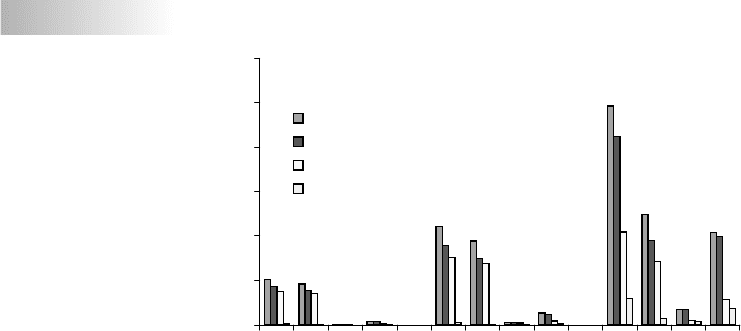
American Revolution are illustrated in Table 7.1 and Figure 7.1 (compar-
isons over time are not entirely appropriate since the 1660s data relate
only to London). Broad trends are clear. Initially Britain exported woollen
textiles to Europe. In the eighteenth century, distant markets, particu-
larly in the American colonies, became important. Imports initially came
mainly from continental Europe; about half were manufactured goods –
mainly linen from north-western Europe – with the remainder split be-
tween wine and spirits and various raw materials. By the end of the
period, imports from Europe still predominated but manufactured goods
had less importance and imports were raw materials – raw silk and dye-
stuffs from southern Europe for the textile industries and iron and tim-
ber from the Baltic. The most dramatic change in imports, like that of
exports, was the rise of distant markets. Initial expansion occurred in
oriental goods: spices – particularly pepper – and cotton and silk textiles.
In the eighteenth century the imports of new tropical and semitropical
staples – sugar, tea and tobacco – grew rapidly to make up nearly 30 per
cent of all imports in the 1770s (Davis 1954, 1962, 1973, 1979; Minchinton
1969). The bulk of Britain’s trade remained focused on nearby areas of
Europe. Exports remained primarily woollen cloth but some change was
underway by 1660. At the beginning of the seventeenth century British
merchants exported heavy unfinished woollen cloth to more advanced
textile centres in the Low Countries for finishing and final sale. After
1568, revolt in the Spanish Netherlands and the Thirty Years War severely
disrupted this trade. Many skilled Protestant craftsmen and merchants
escaped the horrors of war and religious persecution on the continent
and brought their skills and capital to England. English firms began to
produce lighter, more finished, woollen (and worsted) cloth – the New
Draperies – and established a flourishing trade with southern Europe
independent of the Low Countries.
Although Britain’s European trade developed and remained the source
of most trade, the rise of long-distance trade attracted the attention
of contemporaries and historians. These trades introduced exciting new
Cambridge Histories Online © Cambridge University Press, 2008

Table 7.1 Official values of British trade, 1663–
1774 (£000)
1663 & 9 (London only)
1699–1701
1772–4
World Europe East Americas
World Europe East Americas World Europe East Americas
Exports
2,039 1,846 30 163
4,433 3
,772 122 539
9,853 4,960 717
4176
Manufactures 1,734 1,562 1
9 153
3,583 2,997 111 475
8,487 3,816 690 3981
Woollens 1,512 1,423 1
9 70
3,045 2,771 89 185
4,186
2,849 189 1148
Metal
44 15
29
114 31 10 73
1,198 295 148 755
Imports
3,495 2,665 409 421
5,849 3,986 756 1,107
12,735 8,122 1,929 2,684
Manufactures 1,292 1,077
215
1,844 1,292 552
2,157 1,364 792
1
Pepper
80
80
103
103
33
33
Tea
0
8
8
848
848
Sugar
292 36
256
630
630
2,360
2,360
Tobacco
70
1
69
249
249
519
1
518
Re-exports
1,986 1,660 14 312
5,818 4,783
63 972
Manufactures
746 491 3 252
1,562 959
7 596
Sugar
287 287
429 428
1
Tobacco
422 421 1
904 884
1 19
Sources: Davis 1954, 1962.
Cambridge Histories Online © Cambridge University Press, 2008
178C.Knick Harley
0
2,000
4,000
6,000
8,000
10,000
12,000
World
Europe
East
America
World
Europe
East
World
Europe
East
America
America
Official value (£000)
Total exports
Manufactures
Woollens
Metal
London, 1663 & 9 England, 1699-1701 England, 1772-4
Figure 7.1 British
exports, 1660s, 1700s
and 1770s
Source:Table 7.1.
goods – printed calicos and silks, porcelain, sugar, tobacco and tea – to
everyday use in the eighteenth century and expanded European horizons
(see chapter 13). The trade demanded large capital and new forms of
organisation. The East India and West India merchants epitomised new
wealth, sophistication and political influence that had accumulated in
London as a result of a commercial revolution.
The Spanish and Portuguese discovery of sea routes at the end of the
fifteenth century created the long-distance trades to the Orient and to
America. The voyages of discovery had been motivated by the search for
new routes to Asia and brought eastern goods to Europe. Dutch mer-
chants, despite the revolt against Spain, quickly re-established their mer-
cantile presence in the Iberian peninsula and came to dominate trade by
thelate sixteenth century. The Portuguese initially attempted to restrict
thegrowth of Asian trade to maintain prices and profits, but Dutch and
British competition led to dramatic decline in the European prices of
Asian goods. In England the price of pepper – the main spice from the
East – fell to less than a quarter of its 1570 price by 1660 (Clark 2001b: 60).
The trade tapped into existing networks in Asia but became domi-
nated by the great Dutch and English East India companies whose success
rested on institutional and financial innovations. The Dutch East India
Company led the way early in the seventeenth century by displacing the
Portuguese in the Spice Islands and innovating in business structure. In
1612 the company shifted its organisation from adventures in individual
voyages – as had long been common in European long-distance trade – to
a company with a permanent capital that was not redistributed to the in-
vestors at the end of each voyage. The British company soon adopted simi-
lar structure (Neal 1990). The companies’ success rested on mobilising the
large capital that supported permanent presence in the east. The heavily
Cambridge Histories Online © Cambridge University Press, 2008

Trade: discovery, mercantilism and technolog y 179
capitalised companies required not only profitable trading ventures but
also a secondary market for company shares. This market developed in the
already quite sophisticated seventeenth-century Dutch and English capi-
tal markets. The Dutch company’s control of Java and the Spice Islands
forced the British to relocate to India – a second-best solution – and ob-
tain spices by Asian trade. The companies flourished for two centuries on
thebasis of their organisational skill and military strength, their trad-
ing monopolies and the success, particularly of the English company,
in developing European markets for Indian cotton textiles and Chinese
tea.
Europe’s Asian trade exhibited a peculiarity that is as central to its un-
derstanding as the institutional innovations of the East India Companies.
While Europeans eagerly imported eastern goods, little corresponding
eastward flow of European goods developed. Instead, trade was financed
by an eastward flow of gold and silver that many Europeans (and subse-
quent historians) found disturbing. In fact, trading had become multilat-
eral and the bullion and specie came from America. European demand
foreastern goods was certainly high, but Asian demand for bullion and
coin was so great that the rise of European trade with the east should
be seen primarily as a consequence not of trade routes to the east but of
the discovery of America.
European discovery of America had extraordinary repercussions on
world trade. The dramatic conquest of Mexico (1519–22) and Peru (1531–5)
established Spanish dominance and incorporated the Americas into world
trade. The changes that followed were unlike anything that occurred be-
fore or since. International trade reflects an equilibrium in which traders
in different countries engage in profitable exchange. Although at times
political events create large adjustments, trade usually evolves gradually
as new technologies reduce production and trading costs and as political
changes ease or hamper exchange. America was quite different. Eurasian
and American societies had developed in isolation. In the Americas, Eu-
ropeans found that, sometimes after protracted periods of discovery and
development, they could produce four principal commodities at much
lower cost than previously prevailed in Eurasia. Chronologically the first
wasthe humble codfish of the northern continental shelf – to which we
will return briefly. The most spectacular was precious metal – silver and
gold. A century or so after the conquest, the great plantation crops of
sugar and tobacco became important.
The Conquistadores plundered native treasures, but the great bullion
flows from America were mined. American deposits were far richer than
any remaining in the Old World. Table 7.2 presents estimates of the an-
nual flow of bullion to Europe; about 2 million rix-dollars of additional sil-
verannually flowed directly to Manila from Mexico around 1700 (Attman
1986; Giraldez and Flynn 1994). The bullion flows were large. In the mid-
1780s all British domestic exports were worth about £11.4 million or
Cambridge Histories Online © Cambridge University Press, 2008

180C.Knick Harley
Table 7.2 Circulation of precious metals, 1550–1800 (millions of rix-dollars per year)
1550 1600 1650 1700 1750 1780 1800
Production
Spanish America 5 11–14 10–13 12 18–20 22 30
Brazil (gold) – ––19–104 3
Shipments to Europe
To Spain 3 10 8–9 10–12 10–15 15–20 20–5
To Portugal – – – 0.5 8–10 3 2
Europe to the East (2–3) 4.4 6 8.5 12.2 14.7 18
Source: Attman 1986: 33.
48.5 million rix-dollars; so bullion shipments from America had a value
equal to about half of British exports.
Gold and silver were monetary metals and could be easily sold (or
equivalently, used to purchase goods) world-wide. The increase in money
drove down its real value through price inflation and the purchasing
power of silver in Europe declined to approximately a third of its pre-
discovery level in the sixteenth and seventeenth centuries. The monetary
use of gold and silver was not confined to Europe so, as their value in
Europe fell, European traders found that profits could be made using sil-
verand gold to buy goods elsewhere. If we assume roughly that monetary
demand was proportionate to population so that additions to the money
stock would eventually distribute themselves in proportion to population,
we can begin to appreciate the nature of early modern trade between
America, Europe and Asia. America, with only about 2 per cent of world
population, was clearly going to sell most of the gold and silver it mined
to therest of the world for other goods. The output of the American
mines, of course, flowed initially in colonial trade to Spain and Portugal –
the Spanish crown collected 20 per cent as tax. However, the population
of Spain and Portugal did not exceed that of the Americas in 1600 and
so very little of the bullion remained in the Iberian peninsula. Much
spread to the rest of Europe as Spanish Habsburg monarchs fought ex-
pensive wars against the Protestant Reformation. Most of the rest bought
European goods for consumption in the peninsula and in America. But
western Europe was only a small part of the monetised economy of the
Old World. Economically advanced China and India each had a popula-
tion twice that of western Europe, and the population of eastern Europe,
the Ottoman Empire and the trading states of central Asia approximately
equalled that of western Europe. American treasure spread throughout
these Old World societies in an exchange of specie from Europe for valu-
able, easily transportable goods from Asia.
The inherent logic of the distribution of the extraordinary windfall of
rich American mines was reinforced by domestic developments in China.
Kenneth Pomerantz has recently summed up the situation (2000: 159–61):
Cambridge Histories Online © Cambridge University Press, 2008