
Floud R., Johnson P. The Cambridge Economic History of Modern Britain, Volume 1: Industrialisation, 1700-1860
Подождите немного. Документ загружается.


Government and the economy 211
attempted to block a more liberal and market-orientated government and
parliament. I do not argue that all the common law judges objected to
free markets and supported regulation. But I reject the claim of Atiyah
and others that they were, on the whole, passionate supporters of eco-
nomic liberalism. The judgements varied according to economic contexts,
legal doctrines, judges and cases. If anything can be said on a more gen-
eral level, it is that some of the key common law and Chancery judges
of the closing decades of the eighteenth century and opening decades of
the nineteenth, the heyday of the industrial revolution, including Chief
Justice Kenyon, Lord Ellenborough and Lord Chancellor Eldon, were more,
and not less, interventionist and restraining than their predecessor Lord
Mansfield. A claim, based on parliamentary deregulation alone, that the
British state became less interventionist in the nineteenth century, which
ignores judicial re-regulation, is misguided.
To conclude, in order to advance the discussion of the regulatory role
of the state in the period 1700–1850, we have to move beyond listing or
even counting statutes. Different statutes had different scopes. Counting
clauses is not sufficient either, because at times single clauses (as with
patents and joint-stock companies) had considerably more impact than
statutes containing dozens of clauses (like those that aimed at regulat-
ing a single sector in a limited region). Public acts and private acts had
different impacts, but neither disregarding the private ones nor giving
the two equal weight is sufficient. A move from the statute books to the
real world is essential.
A good first step is studying the resources invested in enforcing the
statutes – budgets and employees – but this is only a first step. Much
more can be done to integrate local enforcement and private enforce-
ment. Actual prosecution in court can teach us much. The court played
a multiple role: it created common law regulation, interpreted statutory
regulation and enforced both. Its role as a regulator is an important but
often neglected facet of the regulatory scene. It receives less attention
from economic historians than statutory regulation because cliometri-
cians do not possess sufficiently good theories and methodologies to deal
with it (Harris 2003). The only generalisation I am willing to espouse at
this stage is that, in the books, regulation provides a very limited view
of the forms and extent of the state’s role in the economy. While await-
ing further research on the actual effects of regulation, we shall turn in
the next sections to other roles of the state in the economy that should
receive at least as much attention as regulation.
P U B L I C V E R S U S P R I VAT E OW N E R S H I P
While industry overall (with the exception of royal dockyards and ar-
senals) was in private hands during the first industrial revolution,
Cambridge Histories Online © Cambridge University Press, 2008

212 Ron Harris
infrastructure and utilities were not in purely private hands. Three of
the most interesting examples of the complex mixture of private and
public ownership are turnpike roads, water supply projects and railways.
The failure of local government to maintain and improve the king’s high-
ways led to the development of a new institution, the turnpike trust,
which first appeared in full in 1706 (see chapter 11). Turnpike trusts were
created by acts of parliament, usually for a renewable period of twenty-
one years. The acts named trustees who were empowered to raise money,
conduct improvement works, close the road with gates and collect tolls
from passengers. A turnpike trust did not have joint stock. Yet the money
it used was private loans, not state money. The entrepreneurs involved
did not receive dividends. Yet they benefited personally from its earnings
by way of interest, salaries, freight hauling, etc. In fact, the state granted
some property rights to groups of entrepreneurs over a section of road
for a fixed period of time in return for investment in that road, subject
to some regulation of the exercise of these property rights (Albert 1972;
Pawson 1977; Harris 2000: 86–100). England did not privatise its king’s
highways. It created a private–public partnership, more or less along the
lines of modern BOT (Build, Operate, Transfer) schemes.
Urbanisation took the government by surprise. Governmental reaction
to the rapid growth of cities was, as we shall see in the next section, one
of inaction. A notable exception was water supply. Here it is often as-
sumed that the response was successful because the central government
stepped aside, pushed aside local government, and let privately owned
enterprise in. Entrepreneurs who raised capital on the stock market pe-
titioned parliament for incorporation and then invested large sums in
developing sources of drinking water, bringing the water to town cen-
tres and distributing it through a newly constructed network of mains
and pipes. Is this another example of the positive role of the market and
of private ownership in the unfolding of the industrial revolution? No.
Things in fact were more complicated: the state played various roles in
the functioning of these seemingly private companies. Until the passage
of the General Incorporation Act of 1844, the state controlled the use of
the corporate form. Until that time, parliament incorporated some water
supply undertakings and refused to incorporate others. At the time of
incorporation, parliament determined two major aspects of the activity
of the water supply companies. First, parliament determined the limits
on the powers of these companies to infringe on the property rights of
city dwellers in order to construct pipes and works. Second, parliament
determined the level of competition in the field when deciding whether
or not to grant regional monopolies.
In the case of London, the New River Company achieved a dominant
position by the early nineteenth century, acquiring or driving out of busi-
ness most of its eighteenth-century rivals including the London Bridge
Water Works and the York Buildings Company. In 1806–7, parliament
Cambridge Histories Online © Cambridge University Press, 2008

Government and the economy 213
authorised the incorporation of the West Middlesex Company and the
East London Company and the two began competing with the New River,
one invading its eastern neighbourhoods and the other its western areas
(Rudden 1985; Foreman-Peck and Millward 1994). A decade of competition
drove down prices but also the quality of service, and parliament was
again called upon to act. The next decades were marked by an attempt
to divide London into one-company monopoly districts and at the same
time to regulate the quality of water and service. But important issues
such as the responsibility of water companies for cholera and typhoid epi-
demics, for drains and waste water, or their obligation to provide water
to every household within their territory remained unsettled. This led to
the establishment of numerous Royal Commissions and Select Commit-
tees and to the passage of many general and private acts of parliament.
Edwin Chadwick became the leading mid-nineteenth-century reformer
in this field. He proposed to consolidate the water supply companies and
local sewers commissions into a single public body. While this proposed
body was being discussed in parliament, he exchanged ideas with John
Stuart Mill regarding it. What is interesting about this exchange and
about much of the contemporary discourse as a whole is the consensus
that existed as to the undesirability of private companies. Unlike Adam
Smith who, three-quarters of a century earlier, had viewed water supply
as a sector that should be in the hands of private joint-stock companies
(as opposed to individual entrepreneurs), Mill believed that it should be
in public hands. The discussion dealt only with the nature of the public
body: should it be central or local, should it be staffed by elected rep-
resentatives or by professional experts (Schwartz 1966)? In the end, the
lobby for the water companies was able to block Chadwick’s centralisa-
tion proposal for a while longer. But even so, water supply was not truly
private. At the supposed heyday of laissez-faire and entrepreneurship, the
state was engaged in massive regulation of water supply and seriously
considered its nationalisation.
Railways provide another interesting example of the presence of the
state as a factor in the development of infrastructure and of the link
between regulation and public ownership (see also chapter 11). When the
first railway scheme, the Stockton and Darlington, was conceived in the
early 1820s, its promoters had to turn as a first step to parliament. An
act of parliament was needed both for incorporation of the railway com-
pany and for enabling land expropriation. This involved the state in the
development of the railway sector, beginning with the very first line. The
value of the technology itself was discussed in the House of Commons.
An elaborate set of standing orders made parliamentary scrutiny very
detailed and expensive. Every bill went through a trial-like process in
which its technical, financial and legal aspects were examined and all
affected parties heard. By controlling entry, parliament not only shaped
individual projects but also the formation of the network and the level
Cambridge Histories Online © Cambridge University Press, 2008

214 Ron Harris
of competition (Kostal 1994: 110–43). This was not done intensively or
through any coherent policy. Until 1844, state intervention was felt pri-
marily by way of private bills incorporating specific companies. In that
year, a major general statute, Gladstone’s Railway Act, was passed. This
act, comparable in scope to the Interstate Commerce Act (which was the
first major federal regulation of big business – railways – in the US and
has been widely studied by historians), has not always received the atten-
tion it deserves. It regulated various aspects of the services and rates of
the railway companies. It strengthened the Board of Trade Railway De-
partment so that it could supervise the implementation of the regulation.
It required railway companies to issue financial reports. Most importantly
(and unlike the ICC Act), it empowered the state to buy out, twenty-one
years after their authorisation, railway companies formed after 1844. In
fact, in the heyday of laissez-faire, parliament enabled the government to
nationalise much of Britain’s railway network, an option the state did
not exercise when it became relevant in the 1860s. But the existence of
the threat influenced business practices, prices and profits in the sector
and facilitated the passage of more substantial regulation in 1868 in re-
turn for relinquishing the nationalisation option (Parris 1960; McLean
and Foster 1992; Foreman-Peck and Millward 1994).
Thus the commonly held view that British economic growth was
achieved by private enterprise is only partly correct. Manufacturing was
indeed in private hands, but, as shown in this section, infrastructure and
utilities were not purely private. The state not only authorised and shaped
the undertakings in these fields, but in some cases also retained a degree
of control over them or considered nationalising them. As we shall see
in the next section, the state also played a significant role in encour-
aging and subsidising overseas trade, particularly within the expanding
Empire.
F I S C A L P O L I C Y : T A X A T I O N A N D E X P E N D I T U R E
The 1970s and 1980s witnessed renewed interest in examining the role
of government in the economy through its fiscal, rather than regulatory,
activity. I will sketch this trend, beginning with revenues, in the form
of taxation and borrowing, and moving on to expenditure. Taxation was
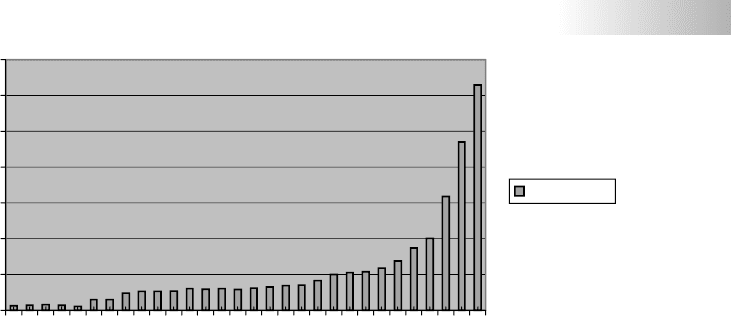
on the rise during the eighteenth century. In the century beginning in
1715, tax revenues rose tenfold in current prices and about fourfold in
constant, inflation-adjusted prices.
The increase is lower, but still significant, when adjusted to the in-
crease in population (an increase of 250 per cent) and to the increase in
production (its proportion of the GDP rose from about 10 per cent to 18
per cent – though these figures are more tentative, as are GDP growth
figures). The rate of rise in taxation in Britain was considerably faster
Cambridge Histories Online © Cambridge University Press, 2008
Government and the economy 215
0
10
20
30
40
50
60
70
1665
1675
1685
1695
1705
1715
1725
1735
1745
1755
1765
1775
1785
1795
1805
Periods
Total taxes (£ m)
Total taxes
Figure 8.1 Total tax
revenue, 1665–1805
Source: O’Brien 1988:
tab 4.
than in France, and probably the fastest in Europe. The real burden of
taxation (relative to production and to population) in Britain by the mid-
dle of the eighteenth century was about twice as high as in France – its
chief rival – and by the close of the century about three times as high
(Mathias and O’Brien 1976).
The composition of tax revenues was changing. The most remarkable
change was the decline of direct taxation on manifestations of wealth
and income and the rise of excise, levied on the purchase of consump-
tion goods. The share of excise in total tax revenues rose from 26 per cent
at the beginning of the eighteenth century to 50 per cent in the middle of
the century, and decreased very moderately thereafter. The share of direct
taxes decreased from 36 per cent to 15–20 per cent (to increase sharply
for a few years during the Napoleonic Wars with the introduction of Pitt’s
short-lived income tax). It was argued that the shift from direct to indirect
taxation had considerable redistributive effects (O’Brien 1988). While the
rich carried much of the burden of direct taxation (on land and houses,
servants and carriages), excise was levied mostly on basic consumption
(salt, bricks, printed cloth, domestic spirits, etc.) of the middle and even
the lower classes. The magnitude of the redistribution and the question
of how much tax was paid by each social group, and the more com-
plicated question of whether the social groups that paid more actually
carried the burden or shifted it elsewhere via the market, are still being
debated.
The state revenue system experienced two institutional transforma-
tions late in the seventeenth century, transformations whose effects on
eighteenth-century government was immense. While during the Tudor
and early Stuart reigns, non-parliamentary revenues (crown income, sales
of lands and monopolies, and mint profits) comprised about 75 per cent
of total revenues, these dropped to about 3 per cent of the total after
the Glorious Revolution. This put parliament in control of the revenue
side of British fiscal policy. The system of tax collection changed after
Cambridge Histories Online © Cambridge University Press, 2008
216 Ron Harris
2,524
4,780
5,947
6,497
6,765
6,595
6,484
7,478
7,525
8,292
0
1,000
2,000
3,000
4,000
5,000
6,000
7,000
8,000
9,000
1690 1708 1716 1726 1741 1748 1755 1763 1770 1782/3
Periods
No. of employees
Figure 8.2
Employees in fi scal
bureaucracy,
1690–1782/3
Source: Brewer 1988:
tab 2.
the Restoration and the Revolution from tax farming
2
to direct collec-
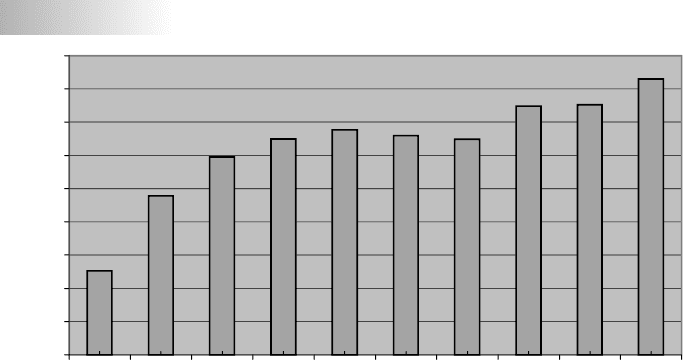
tion by government departments. This was reflected in the growth of
the tax collection bureaucracy from a few hundred employees during the
Interregnum to 2,500 in 1690 and to over 8,000 in 1782/3, making revenue
department employees by far the largest group of government employees
(Brewer 1988).
The transformation of taxation in terms of overall revenue, composi-
tion and the levying and collection institutions, had far-reaching political
and economic consequences. Among others, it created the precondition
for another major transformation: the creation of the national debt. A
variety of institutional novelties coupled with the changing tax system to
bring this about. They included the subjection of the crown to parliamen-
tary supervision through the Bill of Rights; the linking of loans to specific
taxes that were supposed to provide the assured stream of income out of
which interest would be paid – the so-called funded debt; and the incorpo-
ration of the Bank of England as a pivot that connected private lenders
with the Exchequer. These political-constitutional-institutional changes
were completed by the time the Hanoverians arrived in 1714. They en-
abled the Hanoverians, so it is argued, to make the credible commitment
that they would repay what they borrowed. This was a novelty, because
the Stuarts had been unable to convey credibility in the previous century,
both because of their practice of forcing loans and stopping the payment
of debt, and because they did not create institutional safeguards that
would prevent them from repeating these practices (North and Weingast
1989; Weingast 1997). I shall examine the actual credibility of the Orange
and Hanoverian crown in the next section. Whatever its cause, the result
2
Under tax farming, private institutions paid the government a lump sum fee for the right
to collect tax. This transferred both the cost of collection and the risk of default from the
government to the private contractor.
Cambridge Histories Online © Cambridge University Press, 2008

Government and the economy 217
1690 1700 1710 1720 1730 1740 1750 1760 1770 1780
Size of the national debt (£ millions)
Nine
Years
War
started
1689
War of
Spanish
Succession
War of
Austrian
Succession
Seven
Years
War
American
War
Figure 8.3 Growth of
national debt,
1690–1780s
Source: Brewer 1988,
Fig. 4.6.
of the change was stupendous. National debt jumped from around £1
million in 1688 to £15m a decade later, to £78m in 1750 and £244m in
1790. The trend was remarkable, and indeed exceptional, by European
standards (Dickson 1967).
What did the government do with all the new resources, tax and loan
money, at its disposal? It conducted wars. Total expenditure fluctuated
considerably between war years and peacetime. The task of the newly
created national debt was to flatten this fluctuation and enable massive
government military expenditure during war years, to be repaid by tax
money in the years of peace that followed.
Eighteenth-century British expenditure was pre-modern in the sense
that it was mainly military. But its size constantly grew until it reached a
modern scale, enabling Britain to operate more ships and soldiers in more
remote parts of the globe than in past centuries and most importantly on
a scale with which the French fiscal system could not compete (Kennedy
1987; Brewer 1988; Ferguson 2001; see also table 8.1).
How did these military expenses contribute to Britain’s economic
growth? Wars disrupt trade and bring destruction and casualties. But a
Table 8.1 Size of navies, 1689–1815 (Ships of the Line)
1689 1739 1756 1779 1790 1815
Britain 100 124 105 90 195 214
Denmark 29 – – – 38 –
France 120 50 70 63 81 80
Russia – 30 – 40 67 40
Spain – 34 – 48 72 25
Sweden 40 – – – 27 –
United Provinces 66 49 – 20 44 –
Source: Kennedy 1987, Table 5.
nation that is able to win wars can
minimise these and partly offset them
by spillover effects, territorial expansion
and, in the long run, also by increas-
ing trade. It is argued that the British
regime tended to wage more profitable
wars than the French regime and to have
the means ultimately to win these wars
(Hoffman and Rosenthal 1997). Britain
was able to fight its long eighteenth-
century wars on foreign soils, spend
Cambridge Histories Online © Cambridge University Press, 2008

218 Ron Harris
0%
10%
20%
30%
40%
50%
60%
70%
80%
90%
100%
1665
1675
1685
1695
1705
1715
1725
1735
1745
1755
1765
1775
1785
1795
1805
Periods
Direct taxes
Customs duties
Excises and
stamps
Figure 8.4 Allocation
of government
expenditure,
1665–1805
Source: O’Brien 1988:
tab 1.
more money on them and win more of them. In this way, it improved
its relative political and economic position vis-à-vis France, Spain and the
Netherlands.
Wars have been fought throughout human history, by all regimes and
nations. What was unique in eighteenth-century Britain, and thus is rele-
vant to our discussion, was how the wars were financed. A central aspect
of the financial revolution was the emergence of a stock market. The
state, wishing to borrow money from private individuals, issued bonds.
Primary and secondary markets in government bonds soon appeared.
These featured specialised brokers and jobbers, trading techniques, meet-
ing places, investment and information networks, regulation, and a stock
market press. A market in corporate shares soon followed (Neal 1990; see
also chapter 6 above). In a sense, the share market enjoyed positive ex-
ternalities of the government bond market. Its players were free riders
on the bond market institutions. By the canal age, the share market, to-
gether with the bond market, was well established, and with the advance
of the railway the former surpassed the latter in volume (Michie 1999;
Harris 2000: 168–98, 216–23).
Can we conclude that the government played a major role in the for-
mation of a share market that, in turn, financed industrialisation? To
answer this question we need to address several elements. I will deal
with only one of them, the assertion that the government bond market
and the corporate share market competed with one another. One mani-
festation of this assertion is the application of the ‘crowding-out’ discus-
sion in fiscal policy to eighteenth-century Britain. In our case, the idea
is that the British government attracted investors who would otherwise
have invested in the private sector (Mokyr 1987; Williamson 1987). Dur-
ing the most critical phase of industrialisation (1789–1815), the British
government raised unprecedented sums of money in order to finance its
Cambridge Histories Online © Cambridge University Press, 2008

Government and the economy 219
costly involvement in the Revolutionary and Napoleonic Wars. This, so
the argument goes, hampered the rate of investment and growth in the
industrial revolution.
Did the government bond market create the share market or compete
with it? Probably both. But while the benefits for the share market from
the prospering of the stock market are tangible, the disadvantages are
not. Contemporaries did not believe in a crowding-out thesis. A few ultra-
conservative politicians expressed the concern that the rise of the share
market would curtail the government’s ability to raise money for fighting
the next war (Banner 1998). But the key economic ministers did not hold
such views and businessmen did not express reverse concerns. Despite
the rise of the share market, with every war the government was able to
raise more money, peaking in the years after 1789. This did not prevent
the investing public from engaging in speculative investment in the pri-
vate market in wartime: during the canal mania of the 1790s and the
share boom of 1805–7.
This presentation of the problem at hand is somewhat simplistic be-
cause the distinction between private and public markets and funds is not
always clear (Alborn 1998). The Bank of England and its stock had char-
acteristics of both. The conversion of the national debt into South Sea
Company shares in 1720 also blurred this distinction. The ever-important
case of the East India Company further complicates any attempt to dis-
tinguish clearly between a government bond market and a private share
market. The money raised by this company was used both for overseas
trade with India and China, and for financing the Company’s army and
other expenses related to the conquest and governing of India. In fact,
turning India into the ‘Jewel in the Crown’ of the British Empire was
a joint private–public venture. Thus even if the two markets competed
for investors, the moneys they raised often ended up in the same place.
Furthermore, government stock attracted foreign (particularly Dutch) in-
vestors and risk-averse investors such as widows, orphans and trustees
who would not consider investing in even the most solid shares. This
suggests that the markets complemented each other, attracting investors
of different types.
So far we have discussed revenues and military expenditure. The
British state between the years 1700 and 1850 was indeed a warfare state,
not a welfare state. But does this mean that it performed no other func-
tions of the modern state? Some such functions – education, housing,
environmental protection and medical services – were provided on a very
low level, by modern standards, up to the middle of the nineteenth cen-
tury. The government devoted no administrative employees or budgets,
and almost no parliamentary attention in the form of commissions or
legislation, to these spheres of activity.
Results of the passivity of the government were vividly felt, and can
be best exemplified by the state of the rapidly growing industrial towns.
Cambridge Histories Online © Cambridge University Press, 2008

220 Ron Harris
These towns were speedily built from the start, with minimal investment
in social overheads. The consequences were familiar to contemporaries
from Chadwick to Engels and are confirmed by modern research. The
underinvestment in infrastructures such as roads, pavements, lighting,
drainage, water supply, sewage and public building had immediate ef-
fects. The towns were ugly, crowded and polluted, breeding high mor-
tality and morbidity. The economic effects of this underinvestment are
debatable. Williamson stresses the possibility that higher investment in
towns could have left less available capital for investment in industry.
In addition, higher investment in towns might have had to be borne by
the poor urban population in the form of higher taxes or lower wages
(Williamson 1994). This reminds us that there were no free lunches and
that the state as such could not carry the burden of social overheads for
the fast-growing towns. But the state could determine the trade-off be-
tween producing more commodities and having a healthier environment,
or between a higher real wage and a better overall quality of life.
Other state functions to which twentieth-century central governments
devote a large share of their budgets were performed in our period with
very low central government expenditure. The English criminal system
is a good example of a function that was performed cheaply by the cen-
tral government. The low costs were achieved by a combination of fac-
tors, some dating back to the early days of the common law and some to
eighteenth-century measures. Henry II and his successors constructed the
superior royal courts as low-cost, high-impact courts. No more than ten
to twelve judges sat on these courts at any given time throughout their
history and only three or four of these were normally involved in crimi-
nal litigation. Several devices, including the assize system, the jury, the
adversarial procedure and court fees, transferred much of the costs of op-
erating this slim system to the parties and communities involved (Baker
1990). Lesser criminal offences were tried by the quarter sessions, local
government courts. Justices of the Peace, whose main duties involved lo-
cal administration, presided over these courts (Landau 1984). Though the
central government partly supervised these local institutions, it did not
finance them with Treasury money. Policing and prosecution was also to
a large degree the responsibility of local government, at the parish and
county level. The victims themselves, the informers, the locally hired
watchmen and private prosecution associations complemented the sys-
tem (Beattie 1986; Hay and Snyder 1989). Only after 1829, and more so
after 1856, did professional police forces and state prosecution officers
appear. The punishment structure was another means of economising
on state costs. The introduction of capital punishment for a large num-
ber of offences in the eighteenth century, the ‘Bloody Code’, to compen-
sate for the low level of prosecution, enabled the maintenance of higher
deterrence levels at lower cost. Transporting and whipping, which were
less expensive than imprisonment, were the most common punishments.
Cambridge Histories Online © Cambridge University Press, 2008