
Floud R., Johnson P. The Cambridge Economic History of Modern Britain, Volume 1: Industrialisation, 1700-1860
Подождите немного. Документ загружается.


Household economy 251
young and single testifies to the importance attached to an independent
household on marriage and to the value in the service contract of the on-
the-job training and experience. For most farmers a mix of live-in servants
and independent wage labourers best met their needs, the proportions
depending upon farm type and price variations (Kussmaul 1981).
Changes in the seasonality of marriage provided indirect evidence of
thedecline of service. Marriage for farm servants frequently occurred
shortly after their last yearly hiring, the annual wages allowing them to
form an independent household (Kussmaul 1981). Changes in the propor-
tion of all marriages that took place in October provided a rough guide
to theimportance of service and were used as an indicator of trends
over time. Farm service apparently fell from 1750, with a slight reversal
during the Napoleonic Wars but a sharper slide thereafter (for a discus-
sion of the hazards of this method see Snell 1985: 85; Woodward 2000).
Service for a full year guaranteed settlement under the old poor law.
1
Thus changes in the proportion of all settlements obtained by yearly
hiring, as revealed in settlement examinations, provided another rough
indicator of the decline in service (Snell 1985). According to this evidence,
the decline in service was not regionally uniform but progressed fastest in
thesouth-east, where it was advanced by 1820. Contemporary social com-
mentary corroborated these trends, claiming that the decline in ‘tradi-
tional’ service with its enforced intimacy between employer and employee
contributed to the yawning gulf in class relations (see Snell 1985 for a
summary).
The decline of service was related to its costs and benefits. The cause
was not industrialisation per se,though the transition to capitalism in
agriculture played an underlying role. Movements in food prices, reflect-
ing demographic conditions, made the room and board of servants expen-
sive or cheap compared with day wages and so determined long swings
in the composition of farm labour (Kussmaul 1981). The inflation of the
Napoleonic Wars operated as a sharp disincentive to indoor service. With
rising expenditure on poor relief and diminishing anxieties about the
availability of harvest labour in overstocked rural labour markets, aver-
sion to forms of hiring that bestowed settlement grew (Snell 1985). New
preferences for privacy on the part of both the farmer and the servant
(Pinchbeck 1969[1930]), increasing farm size and the disappearance of
family farms (Moses 1999) also contributed.
Recent work based on the printed and manuscript census returns and
oral histories suggests that farm service did not disappear as rapidly as
previously believed but remained important through the nineteenth cen-
tury, especially in the north of England, Scotland and Wales (Devine 1984;
1
Under the poor law, poor persons seeking assistance in cash or kind had a right to apply
to local overseers of the poor only in their parish of settlement. Birth within a parish
created an automatic right of settlement, but settlement could also be acquired through
apprenticeship and certain extended periods of employment.
Cambridge Histories Online © Cambridge University Press, 2008

252 Jane Humphries
Short 1984; Howkins 1994; Caunce 1997b; and see also Kussmaul 1981).
Thus by 1871, the final year for which a distinction was made between ser-
vants and labourers in the census, in England only 16 per cent of hired
workers were servants. But in Scotland most permanent farm workers,
and in Wales and Ireland more than half of the total, continued to fall
into this category (Howkins 1994: 60). Even in the south-east of England,
where decline proceeded fastest, in 1831 between 15 and 38 per cent of
theagricultural labour force were ‘farm-servants’ (Snell 1985: 84).
Service survived even in arable areas and on large-scale capitalist farms.
Forexample in the East Riding as late as the 1920s over half of farm
workers were servants (Caunce 1991). Service’s resilience stemmed from
its adaptability. In the East Riding, with the transition to capitalist farms,
new or extended farm houses included accommodation for servants away
from that occupied by the farmer and his family, thus preserving the in-
stitution of service alongside the preference for privacy (Moses 1999). Else-
where servants were housed in a bothy or separate structure, or boarded
with foremen (Howkins 1994). From about 1780, living-out forms of farm
service also developed (Snell 1985). Service survived, but it did so in part
by detaching itself from co-residence.
Outside agriculture, live-in service offered analogous advantages and
disadvantages to masters and servants. The same economic changes that
discouraged farm service also undermined living-in in trade and industry.
Yetthe proportions of households with servants and trade assistants in
fourteen sub-districts from the published Census Report of 1851 suggest
that living-in was still widespread (Armstrong 1972: table 6.12; see also
theevidence for York and Ashford, market towns and railway termini, in
Table 9.2 of this chapter).
Domestic servants fared differently. The generally adverse conditions
were, inthecaseofmale domestics, exacerbated by the taxation levied on
them atatimewhenmen were needed for the army and navy. But female
service was held to have increased, promoted by the absence of competing
job opportunities, especially in rural areas. Recent work has cast doubt
on this view by questioning the validity of nineteenth-century census
enumeration of female domestic servants and the related back projec-
tions on which the purported increase was based (Higgs 1983; Schwartz
1999). The proportion of living-in maidservants may even have declined
from 1780 to 1851.
Apprentices were also numerically and economically important work-
ers who traditionally lived in. The apprentice was bound by indentures
(a training contract, typically five years in length) to a tradesman who
wascovenanted to teach him his trade. The apprentice contributed to
the costs of his training and maintenance by working for the master dur-
ing the contract, and by paying a premium up-front. The apprentice lived
with the master as part of the family. Training extended to learning the
wayoflife associated with the future occupation (see chapter 12).
Cambridge Histories Online © Cambridge University Press, 2008

Household economy 253
While the legal history of apprenticeship is well known, trends in its
quantitative significance remain vague (see Dunlop 1912). Surviving town
employment books suggest that apprentices probably counted for about
5percentof the early industrial urban population, but maybe 10 per
cent in some parts of London where many boys went to be trained (Earle
1989; Humphries 2002). That the institution declined is agreed, but the
timing and explanation remain unclear (see Snell 1985). One tendency is
to associate decline with the diminishing control of the guilds a century
or so before the industrial revolution. Snell is one of the few historians to
attempt to document the decline in terms of the reduced times actually
served and the growth of illegal apprenticeships as revealed in settlement
examinations. His evidence suggests regional differences in the timing of
the decline and a different chronology between guilded towns and more
rural contexts. The length of the term served declined from the mid-
eighteenth century, especially after 1780 and with 1811–20 seeing most
change (Snell 1985; see also Rushton 1991). Lane (1996), however, argues
foramuch more gradual decline, unaffected by the repeal of the Statute
of Artificers in 1814.
Apprenticeship too survived by adapting to the new conditions.
‘Clubbing-out’ apprenticeships where the apprentice remained at home
or boarded, and worked with the master during the day much like a
journeyman, became increasingly common after 1780 (Snell 1985). These
were similar to the living-out forms of farm service that developed in
thesame period. Shorter-term apprenticeships also gained in popularity
(Snell 1985).
All forms of living-in service were put under pressure by late
eighteenth- and early nineteenth-century conditions: high food prices,
overstocked labour markets, reluctance to help employees gain settle-
ments, and a desire by employers to create social distance from employees.
As a result, households shed workers and contracted. Yet these employ-
ment forms did not disappear as speedily or as universally as implied
in Kussmaul’s vivid metaphor. The conditions that made live-in service
unattractive were particularly chronic in the agricultural south-east, sig-
nificantly the main focus of both Kussmaul and Snell’s research. In other
regions and sectors conditions favoured living-in. Over time the factors
that had undermined service faded: food prices came down from wartime
levels, and in 1834 yearly hiring ceased to be a criterion for settlement.
The significant minority of households that contained servants (includ-
ing but not only domestic servants), trade assistants and apprentices in
1851 testifies to co-residence’s survival as more that a quaint relic. On the
other hand the adaptations that in part preserved service moved it out of
the household and reduced the yearly bond to an employment contract.
Living-in was associated with the traditional master–servant relation-
ship, and hence its disappearance with the demise of small-scale produc-
tion. Suggestions that living-in survived in some sectors and adapted to
Cambridge Histories Online © Cambridge University Press, 2008

254 Jane Humphries
changing conditions are consistent with the view that small and micro
units of production remained important until well on into the nineteenth
century (Berg 1994; Howkins 1994).
In agriculture, the processes of enclosure, increasing size of farms
and changes in land tenure had long worked together to separate small-
scale proprietors from the land and make them wage dependent. Perhaps
60 per cent of families were in receipt of wages by 1700, though some of
these may have retained some vestigial rights to land (Tilly 1984; Snell
1985). The extensive development of waged labour in the early modern
countryside has long been held to be one of the deep roots of the indus-
trial revolution, and through the constraints on proletarian households’
size to have contributed to the small families of the era.
During the eighteenth century, small freeholds were bought up and
landlords eliminated secure leases. The former yeoman lands passed into
the hands of the gentry and the aristocracy. Small farms were combined
and leased to large-scale capitalist farmers (Allen 1992; chapter 4 above).
By 1830 another 15 per cent of families had been added to the wage
earning class (Tilly 1984). Over the same time horizon, the remnants of
diffused property ownership in the form of common rights, which had
continued to be exploited by some members of proletarian households,
were expunged (Martin 1984; Snell 1985; Malcolmson 1988; but see also
Shaw-Taylor 2001). The result was the consolidation of the great estate
and the emergence of the three-tiered social structure of rich landlord,
substantial tenant farmer and poor landless labourer.
But this process did not proceed at the same pace throughout the
British Isles (Devine 1984; Howkins 1994). Outside the arable south-east,
large-scale capitalist agriculture and proletarianisation were not univer-
sal. For example, the survival of family farms in northern Lancashire has
already been linked to the propensity of rural households to include kin
and servants.
Outside agriculture, the standard story was of an inexorable shift away
from family firms and businesses towards larger-scale production units.
But while huge capitalist enterprises dominated the imaginations of con-
temporaries and some historians, more recent research has demonstrated
that these coexisted with a varied industrial organisation (Berg 1994). As
late as 1840, over 75 per cent of British manufacturing was in diverse, dis-
persed and unspectacular industries. Artisan production flourished along-
side networks of putting out, and both were often symbiotically interre-
lated with centralised capitalist enterprises (Hudson 1986; Levine 1987;
Rose 1988; Berg 1994; chapter 2 above). Small-scale production was some-
times threatened, the fate of the handloom weavers held up to exemplify
theexperience of handicraft manufacturers in the age of mechanisation.
But remember that the handloom weavers persisted as independent pro-
ducers well on into the nineteenth century, still numbering some 200,000
in 1840 (Bythell 1969). Elsewhere small-scale manufacturing survived and
Cambridge Histories Online © Cambridge University Press, 2008

Household economy 255
indeed sometimes flourished, for example in the metal industries of Birm-
ingham and the Black Country, the hosiery trades of the Midlands, and
themyriad consumer industries ranging from furniture and shoe manu-
facturing to the tobacco and food industries (Berg 1994).
Experts on industrial organisation have pointed out that small-scale
production units can offset diseconomies of scale by being flexible and
responsive, producing high quality, and networking among themselves
(Piore and Sable 1984; Best 1990). Producing households that employed
resident servants and kin were particularly well placed to develop these
competitive advantages. Resident servants were available for work twenty-
four hours of the day, facilitating fast responses to orders. Apprentices
and kin-workers who had often been trained within the household had
reliable skills. Quality was relatively easily monitored.
Recent discussions have highlighted the importance of trust in facil-
itating economic co-operation, which, while mutually advantageous, is
threatened by the ability of individuals to renege on prior agreements
about the divisions of rewards and responsibilities. Household-based pro-
duction units, especially if they employed kin, provided trustful environ-
ments. Kinship ties represented networks of relationships within which
disputes could be mediated, settlements negotiated and, in the last resort,
multi-sided punishments in the form of social and economic shunning
threatened, without the costs of calling in exogenous authorities. The
on-going kinship relation held both master and man to the implicit em-
ployment contract and so ensured co-operation, which, while efficient,
could not be maintained by a solely market relationship. This was prob-
ably particularly important in the small-scale sector, where liquidity was
short and payments often had to be postponed until the contract was
fulfilled. The frequency with which journeymen sought out relatives as
masters or co-workers suggests the importance of trust in economic ex-
change, especially in contexts (small-scale sector, early industrialisation)
when contracting was not routine. Family businesses, which took in kin as
servants, could continue to benefit from co-residence without sacrificing
household intimacy. Moreover business networks across firms, important
in sustaining and initiating enterprise, were built on kinship as well as
community links (Pearson and Richardson 2001).
Thus the persistence of small and micro enterprise provided a niche
for household production, co-residence and kin-service. But in turn these
features also actively contributed to the resilience of the small-firm sector.
Household production units shaded imperceptibly into self-employed
households. Ubiquitous in industrialising Britain, they provided another
niche for household-based economic co-operation. In the countryside
every village had its blacksmith, carpenter and butcher and such house-
holds were multiplied in the towns and cities and augmented by masons,
bricklayers, plumbers, glaziers and all the myriad trades represented in
thecensus listing of occupations.
Cambridge Histories Online © Cambridge University Press, 2008

256 Jane Humphries
Households of manufacturers involved in putting out occupied a posi-
tion between the self-employed households of tradesmen and the house-
holds of waged workers. Middlemen supplied raw materials, marketed
thefinished products and sometimes rented out the equipment. But the
household organised production.
Households engaged in artisan production, self-employment and mak-
ing to order shared a constitutional tendency for all family members
to become involved. Income depended on output. Ancillary processes in
production, such as winding, seaming, stitching, doing the accounts,
minding the shop and supervising the apprentices, unless done by other
family members, took the primary producer’s time or involved payments
to outsiders, in both cases reducing family income. Not surprisingly, de-
scriptions of such households from working-class memoirs or contem-
porary observation document the widespread and advantageous involve-
ment of wives and children (Vincent 1981). Natural categories like age and
gender provided a division of labour within the mini-production team.
Multifaceted interdependence along with ongoing and intimate contact
reduced the incentive and ability to shirk, and so made the monitoring
of effort and quality less necessary. Rarely separately remunerated, and
disguised behind job descriptions such as ‘assisting’, these contributions
enabled many domestic units to remain competitive.
But there was a darker side to these advantages. Family labour had the
potential for exploitation, pressure from falling prices of output leading
to household members being worked longer and harder to keep the fam-
ily enterprise afloat (Medick 1976). Thus as piece-rates and earnings fell
in handloom weaving, families responded by employing more of their
members, their wives and their children, and increasing output in a bid
to maintain incomes (Lyons 1989). In the framework knitting community
of Shepshed, by 1851, the inability of families to survive on the low earn-
ings of male heads of households had pulled increasing numbers of other
family members into the trade: 80 per cent of households contained at
least two people employed in some branch of the trade and 50 per cent
contained three or more, an incidence of ‘wage-earning co-residence’ ap-
preciably higher than among agricultural labourers or tradesmen and
craftsmen (Levine 1977: 27; see also Rose 1988). In trades, hard times
led to increased numbers of apprentices. Of course ‘adding workers’ and
increasing output only exacerbated the situation of oversupply.
The tendency of household-based production units to respond to pres-
sure on prices by increasing labour input resonates with modern inter-
pretations of the industrial revolution that conceptualise its early phase
in terms of increasing labour input rather than increasing labour produc-
tivity (Crafts and Harley 1992; Crafts 1994; de Vries 1994; Voth 2000). But
this was an ‘industrious revolution’, driven not by aspiration to higher in-
comes and new consumer goods but by the desire to maintain standards.
In the terminology of de Vries (1993), it involved a coerced rather than
Cambridge Histories Online © Cambridge University Press, 2008

Household economy 257
awilling transfer of domestic production and leisure time into market
work. Its empirical investigation awaits a closer look at family employ-
ment levels and living standards.
WAGE EARNING HOUSEHOLDS IN
THE INDUSTRIAL REVOLUTION
The ‘family wage economy’ was susceptible to the same degenerative ten-
dencies as producing households squeezed by declining piece-rates or
prices. Faced with falling wages, the responses at the level of the house-
hold, adding workers or working longer and harder, if replicated on
awide scale, reduced wages further, leaving households no better and
maybe even worse off while putting out more effort (Medick 1976).
Marx and Engels were not alone in recording these tendencies, though
they were unusual in understanding them as inevitable aspects of capital-
ist progress. Modern historians have traced these effects on the household
economies of hand workers as they came into competition with mecha-
nised production (Levine 1977; Rose 1988; Lyons 1989). In this view, the
households of the early industrial economy, especially those of domes-
tic manufacturers competing with mechanised production, were charac-
terised by a low ratio of non-workers to workers, high participation rates
of wives and mothers, and early working for children. To the extent that
mechanisation itself freed manufacturing production from the need for
physical strength, enabling women and children to be employed, and re-
ducing wage rates, it too was associated with an intensification of work.
An increasingly ‘work rich’ but ‘time and welfare poor’ early indus-
trial household, while consistent with anecdotal evidence and studies of
specific trades, jarred with the belief that industrialisation marked the
transition from a pre-industrial family economy in which everyone was
involved in production to a male breadwinner family system in which
women and children were dependent on men. How important was the
intensive phase of family employment and over what time frame did it
give rise to the male breadwinner family? There was no agreement on
either question (Creighton 1996). With only patchy empirical evidence on
women and children’s work and isolated studies of family employment
structure, the debate shed more heat than light (Thomas 1988).
Whether early industrialisation really saw an increase in the intensity
of family employment was disputed (Richards 1974). The increasing visi-
bility of women’s and children’s work as it emerged from the privacy of
the household may have misled observers. Whether the intensive employ-
ment of women and children reached its peak in domestic production
or was matched in the early factories was also debated (Pinchbeck and
Hewitt 1973). Nor was it clear how intensive family employment squared
with accounts of women’s work in which the movement of production
Cambridge Histories Online © Cambridge University Press, 2008

258 Jane Humphries
outside the home, by making it hard to combine productive with do-
mestic activities, undermined women’s independence. Not that everyone
agreed that the disappearance of producing households had deleteri-
ous effects on the status and well-being of women. At least it freed the
home from the dirt, noise and stress of the workplace (see Pinchbeck
1969[1930]). In optimistic accounts, the nascent capitalist economy pro-
vided opportunities for women and girls and liberated them from patri-
archal control.
There was also debate about why these ‘work-rich, time and welfare-
poor’ households gave way to the male breadwinner family system. Some
economic historians emphasised supply conditions, particularly the in-
come effects associated with increases in men’s earnings which allowed
more leisure for women and children (Nardinelli 1990). As budget con-
straints relaxed, the male breadwinner family system was preferred, giv-
ing a Whig twist to the history of the household! Others saw working
men as advancing their own position at the expense of working women.
Demands for family wages and agitation for protective labour legisla-
tion, while perhaps genuine expressions of concern for women and child
workers, could alternatively be interpreted as attempts to legitimise men’s
claims to a pay premium while excluding competing workers from the
better-paid jobs. Whatever the mix of motives, the proclamation of wom-
anly standards that extolled motherhood and housework, and derided
working wives, undoubtedly reinforced patriarchal social norms. By link-
ing their demands to a hierarchical gender order that was familiar and
cherished, working-class men induced sympathy and allied with men
from other classes (Benenson 1984; Rose 1992; Seccombe 1993).
These struggles took place in a class context. Elements among the em-
ploying classes were sympathetic to the demand for family wages because
they realised that the employment of women and children could lead to
thephysical and mental deterioration of the working class as a whole.
Perhaps too the campaigns for family wages and protective labour leg-
islation represented the defence not of patriarchal privilege but of fam-
ily integrity and working-class living standards. Working-class women as
well as men may have seen the advantages in a strategy that freed mar-
ried women from the drudgery of the double shift and enabled children
to go to school, while reducing the supply of labour and raising wages
(Humphries 1977).
Doubt was expressed about whether patchy and often inconsistent
empirical evidence could ever resolve the disagreements (Thomas 1988).
Systematic studies of the employment structure of households were rare,
and often time and industry specific (see Collier 1964; Levine 1977; Rose
1988; Lyons 1989). But recently, working-class household budgets, recov-
ered from a variety of original sources, have allowed trends in household
employment and incomes to be tracked for a number of broad occu-
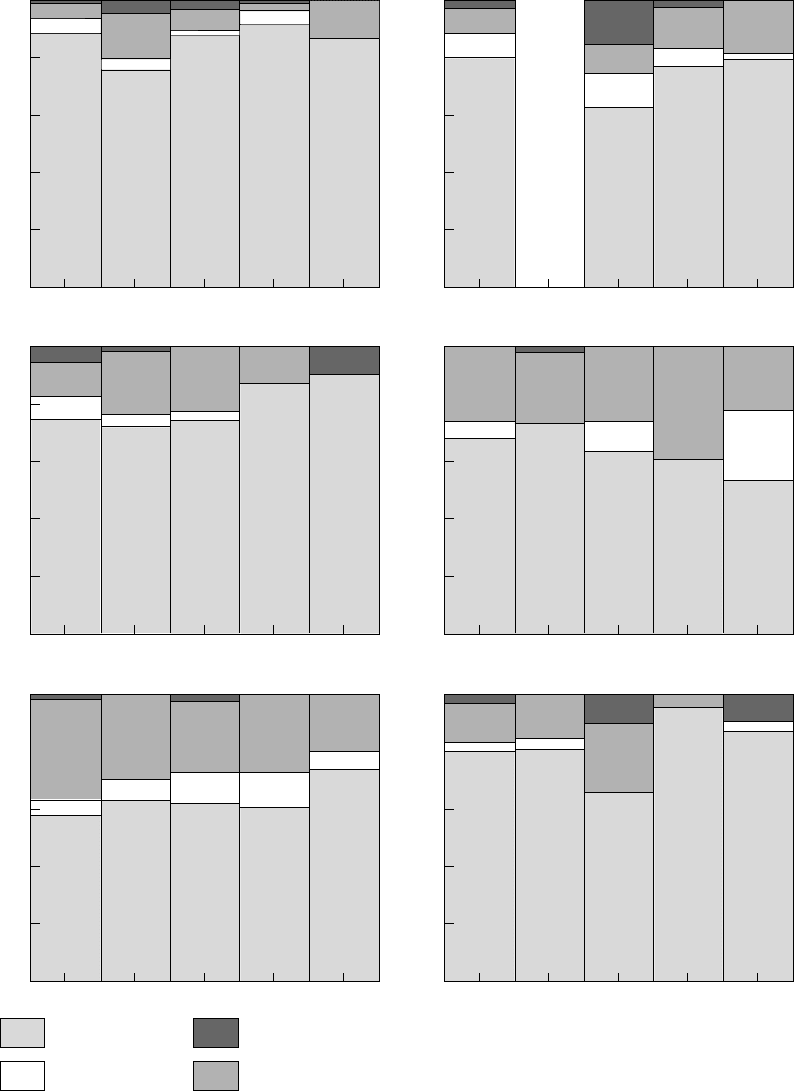
pational groups (Horrell and Humphries 1992, 1995a, 1995b). Figure 9.1
summarises the evidence on trends in the composition of family incomes.
Cambridge Histories Online © Cambridge University Press, 2008
0
1787–1815 1816–20 1821–40 1841–5 1846–65
20
40
60
80
100
High-wage agriculture
Mining
Outwork Trades
Factory
Low-wage agriculture
0
1787–1815 1816–20 1821–40 1841–5 1846–65
20
40
60
80
100
0
1787–1815 1816–20 1821–40 1841–5 1846–65
20
40
60
80
100
0
1787–1815 1816–20 1821–40 1841–5 1846–65
20
40
60
80
100
0
1787–1815 1816–20 1821–40 1841–5 1846–65
20
40
60
80
100
0
1787–1815 1816–20 1821–40 1841–5 1846–65
20
40
60
80
100
Man's earnings
Woman's earnings
Other income
Children's earnings
Figure 9.1 Contributions to household income
Source: Horrell and Humphries 1995a.
Cambridge Histories Online © Cambridge University Press, 2008

260 Jane Humphries
The transition to a male breadwinner family system seems to have
been a precocious but patchy and interrupted development. Before the
industrial revolution was underway many families were already reliant
on the earnings of husbands and fathers. Families of factory workers and
domestic manufacturers had the most democratically sourced incomes.
But even here men on average contributed about 60 per cent of family
income. In factory families the relative contributions of different family
members held constant through the industrial revolution, but in domes-
tic manufacturing families by the 1840s there were signs of increasing
dependence. Equally striking was that for all families, including those
headed by factory workers and domestic manufacturers, children and
not women were the most important secondary contributors. Working
women’s apparent detachment from productive work in advance of in-
dustrialisation is consistent with the evidence that middle-class women
became increasingly dissociated from business from 1680 on (Hunt 1996).
In the course of the industrial revolution, families became increasingly
dependent on men’s earnings, though not in any uniform way. The pe-
tering out of married women’s earnings and their opportunities to con-
tribute through self-provisioning were not as important as the decline in
children’s contributions.
The structural change associated with industrialisation initially in-
creased the relative weight of families headed by factory workers and
domestic workers. But the declining importance of domestic industry by
thesecond quarter of the nineteenth century, alongside the increased
importance of artisan and mining families in which men’s earnings were
always dominant, drove the aggregate trend away from more equal con-
tributions (Horrell and Humphries 1997).
While assigning some role to the driving force of male earnings, the
trends in individual occupations leave room for demand-side, institu-
tional and cultural explanations. In southern agriculture, declining job
opportunities for women and children (Snell 1985; Sharpe 1999) produced
agrowing dependence on inadequate and stagnant male earnings. In con-
trast, in mining, increased male earnings provided a beneficent route to
themale breadwinner family, though protective labour legislation by pro-
hibiting women and children from underground work, also played a role.
Families headed by factory workers provided another tier of experience.
Relatively high and buoyant male earnings were not enough to offset the
inducements of own wage effects for women and children. Nor did the
Factory Acts immediately cut children’s contributions, though perhaps
theincreased contribution from wives and mothers after 1845 was a re-
sponse to limits on child employment (see also Rose 1988; Dupree 1995).
For these families there was a phase of intensive family employment con-
sistent with a voluntary industrious revolution motivated by economic
opportunities. In contrast it was stagnant male earnings that enforced
thepersistently high contributions from other family members in the
Cambridge Histories Online © Cambridge University Press, 2008