
Floud R., Johnson P. The Cambridge Economic History of Modern Britain, Volume 1: Industrialisation, 1700-1860
Подождите немного. Документ загружается.


Living standards and the urban environment 281
Table 10.2 Consumption of luxury goods (in pounds of weight) and standard-of-living indicator (in pounds sterling)
Standard-of-living indicator, based on:
Sugar Tea Tobacco Borda ranking Sugar Tea Tobacco
1794–6 16.03 1.6 1.12 6
1795–9 15.96 16.09 8.78
1804–6 22.86 1.74 1.14 2
1805–9 17.03 16.04 9.32
1814–16 17.35 1.57 0.97 7
1815–19 15.54 15.29 8.58
1824–6 21.64 1.61 0.91 6
1825–9 16.64 15.49 10.9
1834–6 20.72 1.88 0.98 4
1835–9 16.51 15.88 14.12
1844–6 22.26 1.85 1.03 3
1845–9 17.79 16.20 16.84
1854–6 33.11 2.43 1.2 1
Source: Mokyr 1988.
as well as luxury items such as sugar, coffee, tobacco and tea, has demon-
strated that the history of consumption offers little support for the view
that living standards improved markedly. These findings are largely cor-
roborated by household budgets.
Joel Mokyr (1988) was among the first to wonder whether luxury con-
sumption supported optimistic interpretations of the industrial revolu-
tion. He examined commodities that were not produced domestically,
such as tea, coffee, sugar and tobacco. Because they were imported, it is
relatively straightforward to establish total volumes consumed. Spending
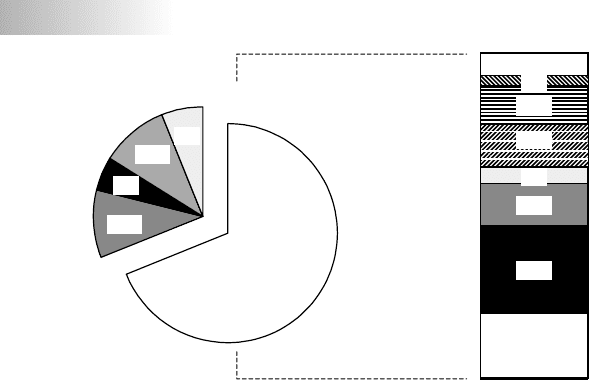
on these goods probably represented only a small share of total expen-
diture (Figure 10.3). None the less, since they are generally regarded as
superior goods, their consumption should have risen by more than 1 per
cent for every percentage point gain of income, thus making them a
particularly sensitive indicator of trends in incomes.
Instead of rising rapidly, however, rates of increase remained mod-
est for most luxury commodities. Tobacco imports per inhabitant were
broadly stagnant, while sugar and tea consumption began to rise after
the end of the Napoleonic Wars. Yet not all of the increase can be seen
as a sign of increasing riches: prices of some of these goods declined in
relative terms, making them easier to purchase. By adjusting for these
changes, Mokyr constructs an index of ‘latent’ purchasing power, revealed
by thepattern of imports (Table 10.2, final three columns). Consumption
of sugar, adjusted for price changes, only rose by 14 per cent between the
1790s and the second half of the 1840s (Mokyr 1988). The respective fig-
ure for tea is 2.3 per cent. In the case of tobacco, this indicator stagnates
until the 1820s, but then doubles. We can rank periods by the amount of
Cambridge Histories Online © Cambridge University Press, 2008
282 Hans-Joachim Voth
20%
27%
13%
5%
12%
3%
7%
Food
Bread
Wheat flour
Oatmeal
Potatoes
Meat
Dairy
Tea, coffee
Sugar, treacle
Food
Rent
Fuel and light
Drink
Clothing
69%
10%
5%
10%
6%
13%
Figure 10.3
Composition of
working-class
expenditures, 1788/92
Source:Feinstein
1998a.
each commodity available per head of the English population and aggre-
gate these rankings into a single score per time period according to the
‘Borda rule’.
3
This shows that 1804–6 recorded relatively high levels of
luxury consumption. The 1820s, on the other hand, marked a low point.
Despite improvement in the 1830s, it was not before the 1850s that con-
sumption of luxury products exceeded levels seen in the 1800s. With the
exception of tobacco, there is therefore no sign of people spending much
more money on the kind of goods that would have been most likely to
attract additional purchases, had living standard indeed improved sub-
stantially.
This interpretation is indirectly vindicated by the so-called ‘food puz-
zle’ that some researchers have identified in industrialising Britain (Clark
et al.1995), based on the premise of rapid income growth. They extend
Mokyr’s question to food consumption in general. The sum of domestic
food production plus imports may well have failed to keep up with popu-
lation growth during the period (Holderness 1989). Clark, Huberman and
Lindert try to resolve the puzzle by assuming changes in the relationship
between final food consumption and the value added by agriculture and
imports. However, the markedly more pessimistic estimates of income
growth seen in Feinstein imply that the food puzzle no longer exists –
food consumption barely changed, and may have fallen on a per capita
basis, because purchasing power was largely stagnant.
There is one part of household budgets that probably saw rising real
expenditure: the purchases of durables and semi-durables. While cloth-
ing is not customarily classified as a durable good, it provides a stream
3
The Borda rule facilitates the compilation of composite indices, especially where we aggre-
gate across conceptually very different individual indicators. For each variable, the observa-
tions (or time periods) are ranked. In our case, we assign a lower rank to a more favourable
outcome. Next, we calculate the sum of these scores for each observation (or time period)
across all indicators, and again rank them. The outcome is a Borda ranking.
Cambridge Histories Online © Cambridge University Press, 2008

Living standards and the urban environment 283
of services for an extended period. A number of indirect indicators sug-
gest that Englishmen and women were accumulating clothing and other
(semi-)durables at a higher rate. First, probate inventories show that, dur-
ing the second half of the eighteenth century at least, even the poor were
dying in possession of a larger number of goods than they had half a cen-
tury before (King 1997). Second, workers were devoting a greater share of
their budgets to the purchase of clothes–possiblyrisingbyasmuchas
one half between 1788/92 and 1858/62, from 6 to 9 per cent of the total
(Feinstein 1998a: 635). This was, to a large extent, a response to a shift in
relative prices. The nominal price of clothing goods probably declined by
one-third between the 1770s and the 1850s, at a time when the prices of
almost all other commodities in the Feinstein cost-of-living index were
rising (Feinstein 1998a: 640). Household budgets show that, while total
household spending grew by 43 per cent between 1789–96 and 1830–9
in nominal terms, total expenditure on non-essential items increased by
137per cent (Horrell 1996). In the absence of growing riches, such a shift
waspredominantly driven by the relatively lower price of these goods,
especially cotton clothing. In contrast to the assertions of those who de-
tect a ‘consumer revolution’ unfolding in eighteenth-century England
(McKendrick et al.1982), changes in material life did not necessarily re-
quire substantial income growth (see chapter 13 below).
URBANISATION, MORTALITY AND
THE VALUE OF LIFE
Average life expectancy at birth in England rose between 1760 and 1850.
Despite this improvement, the history of mortality does not provide unan-
imous support for an optimistic interpretation of the industrial revo-
lution. First, the levels reached were unimpressive by the standards of
England’s own demographic history. Second, the experience of important
subgroups and regions shows a decline in life expectancy. Third, com-
pared with other industrialising countries at the same level of income
per capita, English life expectancy was disappointingly low.
In the very long run, the age of Elizabeth I stands out for the long lives
that Shakespeare and his contemporaries could expect. From a peak of
42.7 years in 1581, life expectancy at birth fell for the following century
and a half, reaching a nadir of 25.3 years in 1726 (Wrigley et al.1997:
614). By 1826, it had recovered to almost the same level as the one seen
250 years earlier – 41.3 years, before falling back to 39.5 in 1850. The
experience of subgroups was often much less favourable.
Housing conditions in Britain during the industrial revolution were
dismal. In the Inquiry into the Sanitary Conditions of the Labouring Population
in 1842, Edwin Chadwick argued that:
Cambridge Histories Online © Cambridge University Press, 2008

284 Hans-Joachim Voth
various forms of epidemic, endemic, and other disease [are] caused . . . chiefly
amongst the labouring classes . . . by decomposing animal and vegetable sub-
stances, by damp and filth, and close and overcrowded dwellings [that] prevail
amongst the population in every part of the kingdom, whether dwelling in
separate houses, in rural villages, in small towns, in the larger towns – as they
have been found to prevail in the lowest districts of the metropolis.
(Chadwick 1842: 369–70)
In early modern Europe, towns in general could exist only because of a
steady influx of migrants from the countryside; death rates almost never
fell below birth rates. Crowding, unsanitary conditions, and difficult ac-
cess to fresh drinking water and fresh food, as well as lack of immunity
from infectious disease for many of the new migrants from the more
isolated areas, all conspired to drive up mortality rates. These difficulties
were compounded when a very large proportion of the population began
to move to the cities over a relatively short period. Few places inspired
quite the same horror as did Britain’s industrial cities – which is why
Friedrich Engels’s description of conditions as ‘social murder’ is partic-
ularly appropriate. None the less, it is worth noting that, by the 1840s,
thegreat cities of industrialising Britain were no longer in danger of dis-
appearing without in-migration: because of strong demographic growth,
birth rates actually exceeded death rates (Williamson 1990a: 222). Dread-
ful as conditions were – especially in the industrialising cities of the
north – the period between 1750 and 1850 also saw major improvements
in the urban environment, at least in part. Many of the main streets
were paved, and gas lighting, street names and house numbers became
more common (Reed 2000). Wooden structures with thatched roofs were
replaced by brick buildings with tiled roofs, reducing the risk of fires and
infection from rats (Appleby 1980); the gradually growing separation of
residential areas from the place of work reinforced these benign tenden-
cies. New suburbs began to grow near the major metropolitan centres,
while museums, public libraries and government offices were built (Clark
2000).
The great shift out of agriculture and into industry, now seen as the
defining characteristic of the industrial revolution, also implied a re-
allocation of labourers from rural areas and small towns to the cities
(Williamson 1990; Crafts and Harley 1992). New industrial cities changed
theurban hierarchy. The proportion of the population living in cities
approximately doubled over the period, rising from 26 per cent in 1776
to 56.4 per cent eighty years later (see chapter 3 above). Not only did the
move to Britain’s cities occur earlier than in most other European coun-
tries. For any given level of per capita income, British urbanisation was
also markedly higher than on the continent (Crafts 1985a: 62). While, for
example, other countries showed an urbanisation rate of 23 per cent at
thelevel of per capita income reached by England in 1800, her figure was
33.9 per cent. Nor did the gap decline over time. Forty years later, when
almost every second Englishman and woman lived in an urban area, the
Cambridge Histories Online © Cambridge University Press, 2008

Living standards and the urban environment 285
45.1
36.7
29
27
25.7
25.3
051015 20 25 30 35 40 45 50
Rural Surrey
London
Bristol
Glasgow
Liverpool
Manchester
national average=41.7
Figure 10.4 Life
expectancy at birth (in
years) in selected cities
and areas, 1841
Source: Szreter and
Mooney 1988: 93;
Wrigley et al.1997:
614.
European norm suggested that fewer than one in three should have been
living in cities.
To put things into perspective, comparisons with the urbanisation ex-
perience in the Third World are instructive. Williamson (1990: 220–3)
finds that Britain’s cities grew more slowly than their counterparts in
theless developed countries today. Also, cities and rural areas in poorer
parts of the world show very similar mortality and birth rates. In con-
trast, in Britain the crude rate of natural increase was markedly higher
in the countryside than in the cities. In 1842, Chadwick had guessed
‘[t]hat of the 43,000 cases of widowhood, and 112,000 cases of destitute
orphanage relieved from the poor’s rates in England and Wales alone’,
themajority was attributable to unsanitary living conditions, and that
at least thirteen years of productive life were lost in each case. The full ex-
tent to which life expectancy suffered in the industrial centres of north-
ern England has only been confirmed in recent years. It appears that,
in a number of cities at least, Chadwick’s number is even an under-
estimate of the mortality penalty in the cities where conditions were
worst.
While life expectancy in the largest city of Europe, London, in 1841
wasnot far below the national average – though considerably below that
of rural areas such as Surrey – the rapidly growing industrial cities of
the north experienced very high levels of mortality. Children born in
Manchester suffered a penalty of 16.4 years compared to the average for
England as a whole. Szreter and Mooney (1998: 105) demonstrate the ex-
tent to which the move to the cities extracted a high and growing price in
thefirst half of the nineteenth century. Based on the unusually good data
in Glasgow, and the general similarity in the mortality experience of En-
glish provincial cities with more than 100,000 inhabitants and Glasgow’s,
they calculate that average life expectancy possibly fell by six years be-
tween the 1820s and 1830s. Improvements beyond that low level were not
visible before the 1850s, but it took until the 1870s to reach the same low
mortality levels as in the 1820s.
Cambridge Histories Online © Cambridge University Press, 2008

286 Hans-Joachim Voth
Also, there is growing evidence that the second quarter of the nine-
teenth century saw a general rise in childhood mortality. Death rates
during childhood reached a high point of 348 per 1,000 in the second
quarter of the seventeenth century. Some seventy-five years later, it was
25 per cent lower, at 263. After reaching this low point, it started to in-
crease again, reaching 287 in the period 1825–37, and 315 in 1837–54.
This trend is apparent in the reconstitution study, undertaken by the
Cambridge Group for the History of Population, which relies on parishes
that were predominantly in relatively small market towns. In the aggre-
gate,infant mortality increased after the Napoleonic Wars, registering
arise of 10 per cent between the 1810s and the 1820s, and a rise of
11 per cent between the 1810s and the 1850s. It was worse in industrial-
ising areas. Even in relatively small towns with around 15,000 to 20,000
inhabitants, those that had a high share of labour employed in agricul-
ture saw a worsening of infant mortality (Huck 1995). In a sample of nine
parishes with substantial employment in mining, the cotton industry and
iron manufacturing, infant mortality rose from a low of 151 per 1,000 in
1813–18 to 172 in 1831–6.
What is the value of changes in life expectancy? Usher (1980) suggested
an innovative method to adjust real income per capita for changes in mor-
tality. The value of an increase in life expectancy will be equivalent to the
extra future consumption that it makes possible – assuming that the gain
in life expectancy is not driven by higher income itself. This method has
been refined and applied to industrialising England (Williamson 1984).
To make such an adjustment, we need assumptions about the extent to
which people discount future increases in consumption, and how much
they value consumption in their utility function. Depending on the as-
sumptions used, Williamson calculated that the growth of lifetime in-
come over the period 1781–1851 would have to be revised upwards by
0.01–0.16 per cent per year. Even the highest of these figures is relatively
low compared to the ‘pessimistic’ estimates of earnings growth by Fein-
stein, who calculated that full-time earnings grew by 0.43 per cent per
year over the period. The value of changes in life expectancy was small
because the gains themselves were relatively small too.
The great move to the cities normally led to wage gains, even after ad-
justing for the higher cost of housing and much else (Williamson 1990).
At thesame time, the penalty in terms of higher mortality rates was any-
thing but trivial (Figure 10.4). Was one sufficient to compensate for the
other? In a cross-section of English towns, those with higher infant mor-
tality and population density also recorded higher wages. Based on these
observations, we can calculate the proportion of the urban wage pre-
mium that was simply compensating for urban disamenities. Williamson
(1990: 255–6) finds that, relative to rural wages, premiums of 10 to 30
per cent were necessary to compensate workers for moving to the cities
of industrialising England. For the south of England, this implies that
Cambridge Histories Online © Cambridge University Press, 2008

Living standards and the urban environment 287
there were still gains in living standards for those workers making the
transition, whereas in the north the gain might be slim indeed, with
thedisamenity premium accounting for 28 and 83 per cent of the nom-
inal wage gain (Williamson 1990: 186). Once the higher cost of living
is taken into account, the increase in living standards seems relatively
small. Also, the national figures for wage gains must be adjusted for the
fact that some of the apparent real wage gains simply compensated for
urban disamenities. In the aggregate, real wage gains need to be reduced
by 3to8percentage points (Feinstein 1998a: 650).
An alternative method is to use the observed premiums for risky jobs,
and to calculate the proportion of the wage gain that simply compensates
forhigher mortality risk (Costa and Steckel 1997: 76). In the USA, the risk
premium for dangerous jobs in 1969 was about 5 per cent, and surveys
show that workers are willing to pay 2 to 4 per cent of annual income
forareduction in job-related mortality risk from 0.1 per cent per year to
zero. Costa and Steckel also find that similar or even larger magnitudes
prevailed in the nineteenth century. Of course, the use of risk premiums
from the twentieth century is not without conceptual difficulties. If we
use the figures employed by Costa and Steckel, what does this method-
ology imply for urban disamenities in industrialising Britain? I use the
Princeton life table ‘North’ to translate life expectancies into mortality
rates. The average 25-year-old man in England in 1841 had a 49.4 per cent
chance of living to the age of 65. By moving to Bristol (by no means the
worst of the industrial cities, see Figure 10.4), his chances would decline
to 34.9 per cent. A 15.5 percentage point higher chance of death by age 65
is the ‘physical price’ of moving – for every seven Englishmen per cohort
dying in rural areas, nine would be dead by age 65 in the cities. What
is the monetary value of this penalty? If the risk premium is between
2and 5 per cent, this would imply that he should have demanded a
wage premium of 16 to 41 per cent per year to be compensated for
the higher risk of early death.
4
Since real wage premiums ranged from
26 per cent in the north to 96 per cent in the south, this would imply
that migrants may have shown a net gain in the north, depending on the
risk premium used, and that a sizeable advantage was likely in the south.
In the north, men in the cities had to last to age 56 to enjoy the same
cumulative earnings as their rural peers between age 25 to 65. Fewer than
40 per cent of each cohort of 25-year-olds did, which suggests a certain
degree of ‘irrational exuberance’. In the south, they only had to live to
age 43; approximately 64 per cent managed. In cities with lower life ex-
pectancy than Bristol, such as Manchester, even smaller fractions of each
cohorts lived to ‘break even’. The welfare implications therefore depend
on the extent to which we take revealed preferences at face value. If we
4
Because of continuous compounding, the death rates per year would be 1.76 per cent for
national average, and 2.6 per cent for Glasgow.
Cambridge Histories Online © Cambridge University Press, 2008

288 Hans-Joachim Voth
assume that, by moving to the cities, people made an informed choice,
we rule out the possibility that their standard of living may have deteri-
orated as a result. If we allow for some degree of myopia and less than
perfect information, and use reasonable figures for the value of years lost,
urban disamenities may easily have been large enough to cancel out any
increase in living standards for the majority of migrants.
COMPOSITE MEASURES OF WELFARE
As the discussion in this chapter has tried to emphasise, the standard of
living is notoriously hard to define. No single variable provides a reliable,
comprehensive view. At the same time, policy makers and historians are
keen to be able to compare trends over time, nations with each other, or
thedifferential fates of subgroups. In response to these needs, a variety of
composite indices that weight a number of indicators have been compiled
in recent years. The first attempt of this kind was made in the late 1970s,
using a weighted average of infant mortality, life expectancy and adult
literacy (Morris 1997). The United Nations Development Programme later
developed more advanced versions of this human development index
(HDI). In its most commonly used form, it contains normalised indices of
national income per capita, life expectancy and educational attainment.
The level of each variable is compared to the minimum (the dollar value
of a subsistence diet in the case of per capita income, for example) and
themaximum values (maximum life expectancy in a human population,
e.g. eighty-five years). For a country that has reached complete literacy,
theindividual component of the index would, for example, record a 1.0
score. A country with a life expectancy of sixty years (assuming a mini-
mum of twenty-five years) would receive a score of
60 − 25
85 − 25
=
35
60
= 0.583.
HDI is simply the weighted average of the three sub-indices.
The choice of indicators included in the index is, however, not com-
pelling. Dasgupta and Weale (1992) offer an alternative index, which also
includes information on political and civil rights. Their aim is to compare
ordinal measures of well-being, not to provide cardinal measurement.
They therefore use the ‘Borda rule’ to aggregate their sub-indices into
their broader measure of well-being (DW-index).
Applying these composite indices to the case of Britain during the
industrial revolution is attractive for a number of reasons. First, it permits
an explicit approach to the vexed question of weighting the importance
of different indicators. Second, the HDI approach allows us to calibrate
differences over time, and to compare levels of overall well-being between
countries. Third, these indices can serve as a basis for further refinements,
Cambridge Histories Online © Cambridge University Press, 2008

Living standards and the urban environment 289
Table 10.3 Alternative indices of living standards in Britain, 1760–1850
HDI (new Pseudo-HDI Pseudo-HDI DW DW
HDI (Crafts) life expectancy) (Floud heights) (Komlos heights) DW (Crafts) (+ working hours) (+ heights*)
1760 0.272 0.254 0.37 0.37 6 6 4
1780 0.277 0.262 0.38 0.35 5 6 6
1800 0.302 0.290 0.41 0.36 4 4 6
1820 0.337 0.307 0.45 0.38 3 3 3
1830 0.361 0.320 0.46 0.40 2 2 2
1850 0.407 0.371 0.44 0.44 1 1 1
Note: *based on Komlos’s heights.
Sources: Crafts 1997, own calculations.
taking gender differences or the inequality of income into account (Costa
and Steckel 1997; Crafts 1997).
Crafts (1997) was among the first to apply these aggregation methods
to the economic history of the industrial revolution. His findings suggest
cautious support for the optimistic case: HDI grew in every period he ex-
amined, by a total of 49.6 per cent. The DW-index also suggests the same
uniform pattern of improvement, and so do the indices taking gender
differences and income inequality into account. These conclusions are,
however, not compelling. A wider set of indicators can be incorporated
into a measure of well-being along the lines of the DW-index. Arguably,
work effort necessary to produce income should be included. In a similar
spirit, the new wage figures by Feinstein should be incorporated in the
index. Also, new data on life expectancy have become available (Wrigley
et al.1997). Finally, numerous authors have computed ‘Pseudo-HDI’ for a
number of countries, choosing stature to replace life expectancy (Costa
and Steckel 1997; Sandberg and Steckel 1997; Twarog 1997). Since evi-
dence from convict data shows declines in average stature, the Komlos
estimate of trends in height time series may be more reliable than the
Floud series. Any one of these changes in the series used, or the type of
measure included, undermines Crafts’s optimistic conclusions somewhat.
Use of the new life expectancy figures reduces estimates of the level
of human development uniformly, but by a greater amount in the 1850s
than in the 1760s. Gains in the standard of living therefore appear some-
what smaller than initially assumed, but improvement over the period
now proceeds more steadily. The same is not true of pseudo-HDI, calcu-
lated on the basis of Komlos’s height series. Here, there is no improvement
until 1800, but a quicker acceleration thereafter.
The DW rankings, once we incorporate additional indicators, also re-
duce the optimistic implications of Crafts’s findings somewhat. Replacing
theGDP figures with real wages by itself does not change the rankings.
Incorporating additional working hours suggests stagnation for the first
twenty years of the industrial revolution. If heights are added to this,
Cambridge Histories Online © Cambridge University Press, 2008
290 Hans-Joachim Voth
0
0.05
0.35
0.4
0.45
0.5
0.55
0.6
0.65
1760 1770 1780 1790 1800 1810 1820 1830 1840 1850
USA
Sweden
UK*
UK**
Germany
Figure 10.5 Pseudo-HDI for Britain, the USA, Sweden and Germany
Notes: *Incorporating height data from Floud.
**Incorporating height data from Komlos.
Sources: Costa and Steckel 1997; Crafts 1997; Sandberg and Steckel 1997; Twarog 1997;
Komlos 1998, own calculations (see text).
theindex first falls, and overall conditions do not improve relative to the
starting level before the end of the Napoleonic Wars.
How do living standard in Britain compare with those in other in-
dustrialising countries? Britain was by far the richest country by the
middle of the nineteenth century in terms of per capita income. Yet
international comparisons of composite welfare measures give a mixed
impression. If the DW-index is used, Britain and Denmark tie for first
place in 1860, and Britain is considerably ahead of other European coun-
tries and North America on the basis of the human development index.
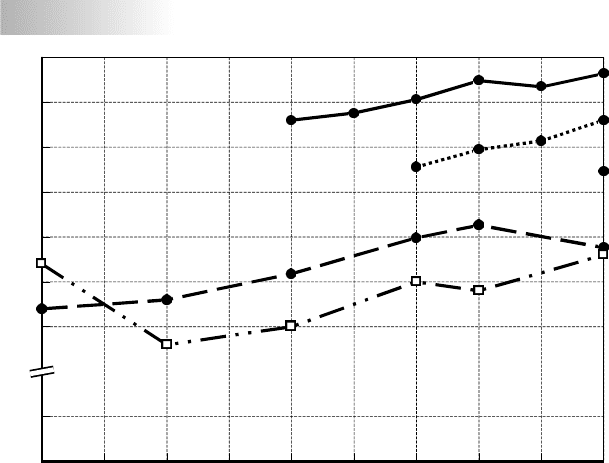
Comparisons using pseudo-HDI, on the other hand, suggest that Britain
was doing markedly worse than other countries. There may have been
adrasticdeclineinthesecond half of the eighteenth century (Komlos
1993, 1998); using the alternative height data, the standard achieved by
1850 was below its peak in 1830 (Figure 10.5).
These results are exclusively driven by the use of heights instead of life
expectancy. For those scholars who believe that heights measure physical
well-being in a more useful way than life expectancy, Britain’s relative
performance in terms of physical well-being was extremely disappointing.
If life expectancy is used instead, Britain emerges as the world leader
by 1860. We have already questioned the extent to which stature is a
more important indicator of the ‘biological standard of living’. Unless
Cambridge Histories Online © Cambridge University Press, 2008