
Francoise J.-P., Naber G.L., Tsun T.S. (editors) Encyclopedia of Mathematical Physics
Подождите немного. Документ загружается.


degenerate. The aim, if possible, is to find an explicit
gauge function so that the corresponding generalized
Minkowski contents or Hausdorff measure of A be
nondegenerate.
Methods of Fractal Analysis in Dynamics
Thermodynamic Formalism
Thermodynamic formalism has been developed by
Sinai (1972), Ruelle (1973), and Bowen (1975),
using methods of statistical mechanics in order to
study dynamics and to find dimensions of various
fractal sets. We first describe a ‘‘dictionary’’ for
explicit geometric constructions of Cantor-like sets.
Let X
p
be the set of all sequences i = (i
1
, i
2
, ...)of
elements i
k
from a given set of p symbols, say
{1, 2, ..., p}. We endow X
p
with the metric d(i, j):=
P
k
2
k
ji
k
j
k
j and introduce the one-sided shift
operator (or left shift) : X
p
!X
p
defined by
((i))
n
= i
nþ1
, that is, (i
1
, i
2
, i
3
, ...) = (i
2
, i
3
, i
4
, ...).
A set Q ˝ X
p
is called the symbolic dynamics if it is
compact and -invariant, that is, (Q) ˝ Q. Hence,
(Q, ) is a symbolic dynamical system. Denote
i[n]:= (i
1
, ..., i
n
). Given a continuous function
’ : Q !R, let us define the topological pressure of
’ with respect to by
Pð’Þ:¼ lim
n!1
1
n
log
X
fi½n:i 2Qg
Eði½nÞ
Eði½nÞ:¼ exp sup
fj 2Q: j½n¼i½ng
X
n1
k¼0
’ð
k
ðjÞÞ
!
The topological entropy of jQ is defined by
h(jQ):= P(0), that is,
hðjQÞ¼ lim
n!1
1
n
log #fi½n: i 2Qg
where # denotes the cardinal number of a set. The
above function ’
n
:=
P
n1
k = 0
’
k
has the property
’
nþm
= ’
n
þ ’
m
n
, and therefore we speak about
additive thermodynamic formalism. Topological pres-
sure was introduced by D Ruelle (1973) and extended
by P Walters (1976). Bowen’s equation (1979) has a
very important role in the computation of the
Hausdorff dimension of various sets. For the unknown
s 2R, and with a suitably chosen function ’,this
equation reads
Pðs’Þ¼0
Geometric Constructions
A geometric construction (Q, )inR
m
indexed by
symbolic dynamics Q is a family of compact sets
i[n]
R
m
, i 2Q, n 2N, such that diam
i[n]
!0as
n !1,
i[nþ1]
˝
i[n]
,
i[n]
= int
i[n]
for every i 2Q
and all n, and int
i[n]
\ int
j[n]
= ; whenever
i[n] 6¼ j[n] (Moran’s open set condition). This family
induces the Cantor-like set
F :¼
\
1
n¼1
[
i 2Q
i½n
!
(see Figure 2). The mapping h : Q !F defined by
h(i):= \
1
n = 1
i[n]
is called the coding map of F.The
above geometric construction includes well-known
iterated function systems of similarities as a special
case. If
1
, ...,
p
are given numbers in (0, 1), and
i[n]
are balls of radii r
i[n]
:=
i
1
...
i
n
,thens := dim
H
F is
the unique solution of Bowen’s equation P(s’) = 0,
where ’ is defined by ’(i):= log
i
1
(Ya Pesin and
H Weiss, 1996). In this case Bowen’s equation is
equivalent to Moran’s equation (1946),
X
p
k¼1
k
s
¼1
This result has been generalized by L Barreira (1996)
using the Carathe´odory–Pesin construction (1988).
Let us illustrate Barreira’s theory of nonadditive
thermodynamic formalism with a special case.
Assume that (Q, ) is a geometric construction for
which the sets
i[n]
are balls, and let there exist >0
such that r
i[nþ1]
r
i[n]
and r
i[nþm]
r
i[n]
r
n
(i)[m]
for
all i 2Q, n, m 2N. Then dim
H
F = dim
B
F = s, where
s is the unique real number such that
lim
n!1
1
n
log
X
fi½n:i 2Qg
r
i½n
s
¼0 ½1
This is a special case of Barreira’s extension of
Bowen’s equation to nonadditive thermodynamic
formalism. Moran’s equation can be deduced from
[1] by defining r
i[n]
:=
i
1
...
i
n
, where i = (i
1
, i
2
, ...),
and
1
, ...,
p
2 (0, 1) are given numbers. Pesin and
Weiss (1996) showed that Moran’s open set condi-
tion can be weakened so that partial intersections of
interiors of pairs of basic sets in the family are
allowed. Thermodynamic formalism has been used
to study the Hausdorff dimension of Julia sets
Δ
1
Δ
11
Δ
12
Δ
21
Δ
22
Δ
2
Figure 2 Cantor-like set.
396 Fractal Dimensions in Dynamics

(Ruelle, 1982), horseshoes (H McCluskey and
A Manning, 1983), etc.
An important example of symbolic dynamics is the
topological Markov chain X
A
generated by a p p
matrix A with entries a
ij
2{0, 1}:
X
A
:¼fi ¼ði
1
; i
2
; ...Þ2X
p
: a
i
k
i
kþ1
¼1 for all k 2Ng
It is a compact, -invariant subset of X
p
.Themap
jX
A
is called the subshift of finite type (Bowen,
1975). A construction of Cantor-like set F using
dynamics Q = X
p
is called a simple geometric con-
struction, while a geometric construction is said to be a
Markov geometric construction if Q = X
A
.IfF is
obtained by a Markov geometric construction such
that all
i[n]
are balls of radii r
i[n]
:=
i
1
...
i
n
, where
i
j
2(0, 1), i
j
2{1, ..., p}, then dim
B
F = dim
H
F = s,
where s is the unique solution of equation
(AM
s
) = 1. Here M
s
:= diag(
1
s
, ...,
p
s
)and
(AM
s
) is the spectral radius of the matrix AM
s
.This
and more general results have been obtained by Pesin
and Weiss (1996).
Any Cantor-like set F obtained via iterated
function system of similarities satisfying Moran’s
open set condition is Hausdorff nondegenerate
(Moran, 1946). If F is of nonlattice type, that is,
the set { log
1
, ..., log
p
} is not contained in r Z
for any r > 0, then F is Minkowski measurable
(D Gatzouras, 1999).
Hyperbolic Measures
Let X be a complete metric space and assume that
f : X !X is continuous. Let be an f-invariant Borel
probability measure on X (i.e., (f
1
(A)) = (A)
for measurable sets A) with a compact support.
The Hausdorff dimension of , and the lower and
upper box dimensions of (L-S Young, 1982) are
defined by
dim
H
:¼ inffdim
H
Z : Z ˝ X;ðZÞ¼1g
dim
B
:¼ lim
!0
inffdim
B
Z : Z ˝ X;ðZÞ1 g
dim
B
:¼ lim
!0
inffdim
B
Z : Z ˝ X;ðZÞ1 g
It is natural to introduce the lower and upper
pointwise dimensions of at x 2X by
d
ðxÞ:¼lim
r!0
log ð B
r
ðxÞÞ
log r
and similarly
d
(x). It has been shown by Young
(1982) that if X has finite topological dimension and
if is exact dimensional, that is,
d
(x) = d
(x) =: d
for -a.e. x 2X, then
dim
H
¼ dim
B
¼ d
She also proved that hyperbolic measures (ergodic
measures with nonzero Lyapunov exponents), invar-
iant under a C
1þ
-diffeomorphism, >0, are exact
dimensional. F Ledrappier (1986) derived exact
dimensionality for hyperbolic Bowen–Ruelle–Sinai
measures. This result was extended by Ya Pesin and
Ch Yue (1996) to hyperbolic measures with semilocal
product structure. J-P Eckmann and D Ruelle (1985)
conjectured that the exact dimensionality holds for
general hyperbolic measures, and this was proved by
Barreira, Pesin, and Schmeling (1996). More precisely,
if f is a C
1þ
-diffeomorphism on a smooth Riemann
manifold X without boundary, and if is f-invariant,
compactly supported Borel probability measure, then
its hyperbolicity implies that
d
ðxÞ¼d
ðxÞ¼d
s
ðxÞþd
u
ðxÞ
for -a.e. x 2X, where d
s
(x) and d
u
(x) are stable
and unstable pointwise dimensions of at x
introduced by Ledrappier and Young (1985).
Multifractal Analysis of Functions and Measures
Invariant sets of many dynamical systems are not
self-similar. Roughly speaking, the aim of multi-
fractal analysis is to make a decomposition of the
invariant set with respect to desired fractal proper-
ties and then to study a fractal dimension of each
set of the decomposition. Some dynamical systems
have invariant sets equal to graphs of Ho¨ lderian
functions f : R
N
!R, so that wavelet methods can
be used. One of the goals of multifractal analysis
of functions is to study the spectrum of singularities
of f defined by
d
f
ðÞ:¼ dim
H
H
ðf Þ
introduced by U Frisch and G Parisi (1985) in the
context of fully developed turbulence. Here H
(f )is
the set of points at which the corresponding
pointwise Ho¨ lder exponent of f is equal to 0.
If the function f is self-similar then d
f
() is real
analytic and strictly concave (first increasing and
then decreasing) on an explicit interval (
a, a)
(S Jaffard, 1997). It is natural to consider the set
C
,
(f ) of points x
0
called chirps of order (, )
(Y Meyer 1996), at which f behaves roughly
like jx x
0
j
sin (1=jx x
0
j
), >0. The function
D
f
(, ):= dim
H
C
,
(f ) is called the chirp spectrum
of f (S Jaffard 2000). Wavelet methods have found
applications in the study of evolution equations
and in modeling and detection of chirps in
turbulent flows (S Jaffard, Y Meyer, R D Robert,
2001).
Basic ideas of multifractal analysis have been
introduced by physicists T Halsey, M H Jensen,
Fractal Dimensions in Dynamics 397

L P Kadanoff, I Procaccia, and B I Shraiman (1988).
In applications it often deals with an invariant
ergodic probability measure associated with the
dynamical system considered. Multifractal analysis
of a Borel finite measure defined on R
N
consists in
the study of the function
d
ðÞ:¼ dim
H
K
ðÞ; 0
called the spectrum of pointwise dimensions of .
Here K
() is the set of points where the pointwise
dimension of is equal to :
K
ðÞ: ¼fx 2R
N
: d
ðxÞ¼d
ðxÞ¼g
It is also of interest to study the Hausdorff
dimension of irregular set K():= {x 2R
N
: d
(x) <
d
(x)}. These sets are pairwise disjoint and consti-
tute a multifractal decomposition of R
N
, that is,
R
N
¼KðÞ[ [
2R
K
ðÞðÞ
The function d
() provides an important informa-
tion about the complexity of multifractal decom-
position. In many situations, there is an open
interval (
, ) on which the function d
()is
analytic and strictly concave (first increasing and
then decreasing), and equal to the Legendre trans-
form of an explicit convex function. We thus obtain
an uncountable family of sets K
() with positive
Hausdorff dimension, which shows enormous com-
plexity of the multifractal decomposition of R
N
.
These and related questions have been studied by
L Olsen (1995), K Falconer (1996), Pesin and Weiss
(1996), Barreira and Schmeling (2000), and many
other authors.
Local Lyapunov Dimension
Let be an open set in R
N
and let f : !R
N
be a
C
1
-map. To any fixed x 2 we assign N singular
values a
1
a
2
a
N
0off, defined as square
roots of eigenvalues of the matrix f
0
(x)
>
f
0
(x),
where f
0
(x) is the Jacobian of f at x, and f
0
(x)
>
its
transpose. The local Lyapunov dimension of f at x is
defined by
dim
L
ðf ; xÞ:¼j þ s
where j is the largest integer in [0, N]suchthat
a
1
a
j
1 (if there is no such j we let j = 0), and
s 2[0, 1) is the unique solution of a
1
a
j
a
s
jþ1
= 1
(except for j = N, when we define s = 0). This
definition, due to B R Hunt (1996), is close to that of
Kaplan and Yorke (1979). The Jacobian f
0
(x)con-
tracts k-dimensional volumes (that is, a
1
a
k
< 1) if
and only if dim
L
(f , x) < k. In this case, we say that f is
k-contracting at x.Furthermore,thefunction
x 7! dim
L
(f , x) is upper-semicontinuous, so that for
any compact subset A of the Lyapunov dimension
of f on A,
dim
L
ðf ; AÞ:¼ max
x 2A
dim
L
ðf ; xÞ
is well defined. Yu S Ilyashenko conjectured that if f
locally contracts k-dimensional volumes then the
upper box dimension of any compact invariant set is
<k. Hunt (1996) proved that if A is a compact,
strictly invariant set of f (i.e., f (A) = A) then
dim
B
A dim
L
ðf ; AÞ½2
This is an improvement of dim
H
A dim
L
(f , A)
obtained by A Douady and J Oesterle´ (1980), and
independently by Ilyashenko (1982). M A Blinchevs-
kaya and Yu S Ilyashenko (1999) proved that if A is any
attractor of a smooth map in a Hilbert space that
contracts k-dimensional volumes then
dim
B
A k.See
[3] below.
A continuous variant of this method is used in
order to obtain estimates of fractal dimensions of
global attractors of dynamical systems (X, S)ona
Hilbert space X. Here S(t), t 0, is a semigroup of
continuous operators on X, that is, S(t þ s) = S(t)S(s)
and S(0) = I. A set A in X is called a global attractor
of dynamical system if it is compact, attracting
(i.e., for any bounded set B and ">0 there exists t
0
such that for t t
0
we have S(t)B ˝ A
"
), and A is
strictly invariant (i.e., S(t)A = A for all t 0).
Applications in Dynamics
Logistic Map
M Feigenbaum, a mathematical physicist, intro-
duced and studied the dynamics of the logistic map
f
: [0, 1] ![0, 1], f
(x):= x(1 x), 2(0, 4]. Tak-
ing =
1
3.570 the corresponding invariant set
A [0, 1] (i.e., S
1
(A) [ S
2
(A) = A, where S
i
are two
branches of f
1
) has both Hausdorff and box
dimensions equal to 0.538 (P Grassberger 1981,
P Grassberger and I Procaccia, 1983). The set A
has Cantor-like structure, but is not self-similar.
Its multifractal properties have been studied by
U Frisch, K Khanin, and T Matsumoto (2004).
Smale Horseshoe
In the early 1960s S Smale defined his famous
horseshoe map and showed that it has a strange
invariant set resulting in chaotic dynamics. The
notion of strange attractor was introduced in 1971
by Ruelle and Takens in their study of turbulence.
Let S be a square in the plane and let f : R
2
!R
2
be
a map transforming S as indicated in Figure 3, such
that on both components of S \ f
1
(S) the map f is
398 Fractal Dimensions in Dynamics
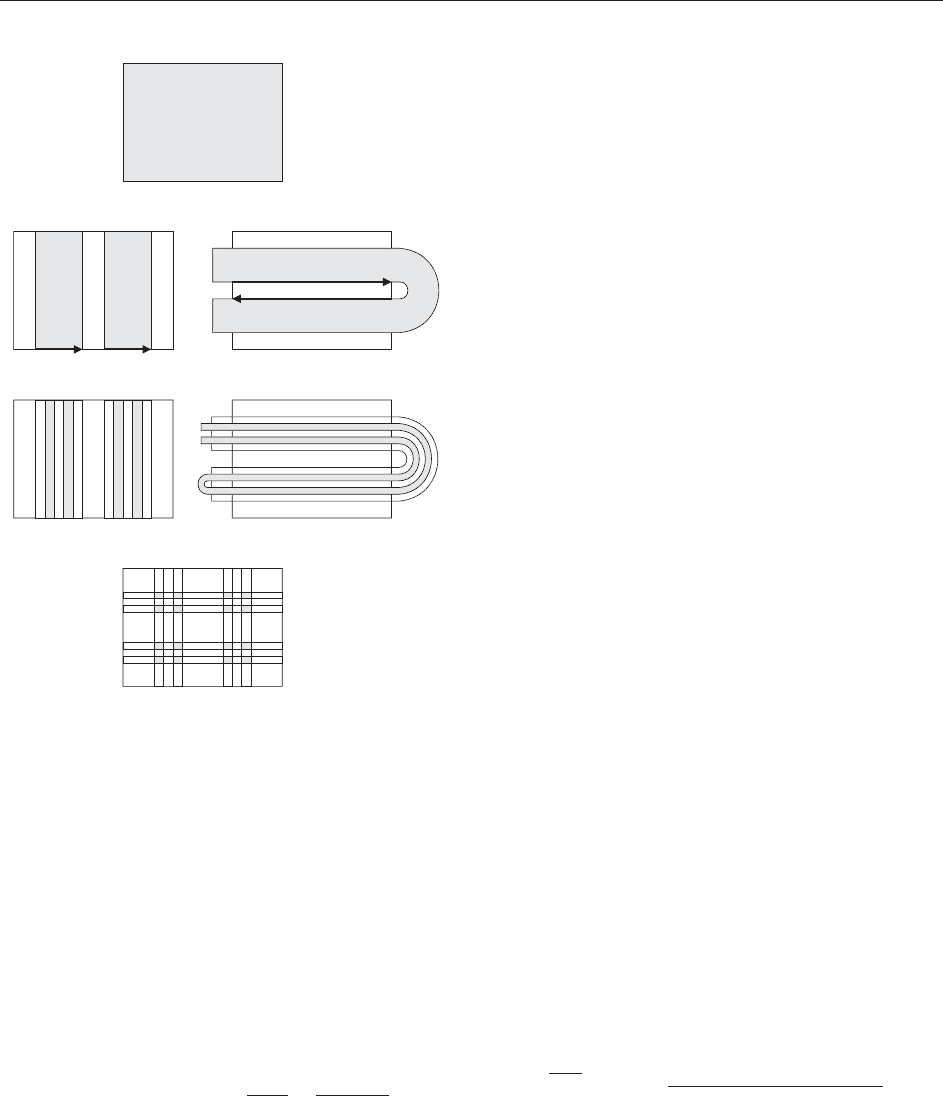
affine and preserves both horizontal and vertical
directions, and such that points 1, 2, 3, and 4 are
mapped to 1
0
,2
0
,3
0
, and 4
0
. Iterating f we get
backward invariant set
:= \
1
j = 0
f
j
(S), forward
invariant set
þ
:= \
1
j = 0
f
j
(S), and invariant set
(horseshoe)
f
:=
þ
\
. These sets have the
Cantor set structure. More precisely, assuming that
the contraction parameter of f in vertical direction is
a 2(0, 1=2), and the expansion parameter in hor-
izontal direction is b > 2, then
þ
= [0, 1] C
(a)
,
where C
(a)
is the Cantor set,
= C
(1=b)
[0, 1], and
f
= C
(1=b)
C
(a)
, so that dim
B
þ
= dim
H
þ
= 1 þ
( log 2)=( log (1=a)) and
dim
B
f
¼ dim
H
f
¼
log 2
log b
þ
log 2
logð1=aÞ
This is a special case of a general result about
horseshoes in R
2
(not necessarily affine), due to
McCluskey and Manning (1983), stated in terms of
the pressure function. Analogous result as above can
be obtained for Smale solenoids. In R
3
it is possible
to construct affine horseshoes
f
such that dim
H
f
<
dim
B
f
(M Pollicott and H Weiss, 1994).
Smale discovered a connection between homoclinic
orbits and the horseshoe map. It has been noticed that
fractal dimensions have important role in the study of
homoclinic bifurcations of nonconservative dynamical
systems. Since the 1970s the relationship between
invariants of hyperbolic sets and the typical dynamics
appearing in the unfolding of a homoclinic tangency
by a parametrized family of surface diffeomorphisms
has been studied by J Newhouse, J Palis, F Takens,
J-C Yoccoz, C G Moreira and M Viana. The main
result is that if the Hausdorff dimension of the
hyperbolic set involved in the tangency is <1then
the parameter set where the hyperbolicity prevails has
full Lebesgue density. If the Hausdorff dimension is
>1, then hyperbolicity is not prevalent. This result and
its proof were inspired by previous work of
J M Marstrand (1954) about arithmetic differences of
Cantor sets on the real line. According to the result by
Moreira, Palis, and Viana (2001) the paradigm
‘‘hyperbolicity prevails if and only if the Hausdorff
dimension is <1’’ extends to homoclinic bifurcations
in any dimension.
Using methods of thermodynamic formalism
McCluskey and Manning (1983) proved that if f
is the above horseshoe map, then there exists a
C
1
-neighborhood U of f such that the mapping
f 7! dim
H
f
is continuous. Continuity of box and
Hausdorff dimensions for horseshoes has been
studied also by Takens, Palis, and Viana (1988).
Lorenz Attractor
E N Lorenz (1963), a meteorologist and student of
G Birkhoff, showed by numerical experiments that
for certain values of positive parameters , r, b, the
quadratic system
_
x ¼ðy xÞ;
_
y ¼rx y xz;
_
z ¼xy bz
has the global attractor A, for example, for = 10,
r = 28, b = 8=3. In this case dim
B
A 2.06, which is
a numerical result (Grassberger and Procaccia,
1983). Using the analysis of local Lyapunov dimen-
sion along the flow in A, G A Leonov (2001) showed
that if þ 1 b 2 and r
2
(4 b) þ 2(b 1)
(2 3b) > b(b 1)
2
then
dim
B
A 3
2ð þ b þ 1Þ
þ 1 þ
ffiffiffiffiffiffiffiffiffiffiffiffiffiffiffiffiffiffiffiffiffiffiffiffiffiffiffiffiffiffiffi
ð 1Þ
2
þ 4r
q
He´ non Attractor
MHe´non (1976), a theoretical astronomer, discovered
the map f : R
2
!R
2
, f (x, y):= (a þ by x
2
, x), cap-
turing several essential properties of the Lorenz
system. In the case of a = 1.4 and b = 0.3, Hunt
(1996) derived from [2] that for any compact, strictly
f-invariant set A in the trapping region [1.8, 1.8]
2
S
1
2
34
S
∩ f
–1
(S )
S
∩ f
–1
(S ) ∩ f
–2
(S )
f
–2
(S ) ∩ f
–1
(S ) ∩ S ∩ f (S )∩ f
2
(S )
AB
f
(s)
f
(A)
f (B )
f
2
(S )
4′′
4′
3′
2′
1′
1′′
2′′
3′′
Figure 3 The Smale horseshoe.
Fractal Dimensions in Dynamics 399

there holds dim
B
A < 1.5. Numerical experiments
show that dim
B
A 1.28 (Grassberger, 1983). Assum-
ing a > 0, b 2(0, 1), and P
(x
, x
) 2A,whereP
are
fixed points of f, Leonov (2001) obtained that
dim
B
A 1 þ
1
1 ln b= lnð
ffiffiffiffiffiffiffiffiffiffiffiffiffiffi
x
2
þ b
p
x
Þ
Here
x
:¼
1
2
b 1
ffiffiffiffiffiffiffiffiffiffiffiffiffiffiffiffiffiffiffiffiffiffiffiffiffiffiffiffi
ðb 1Þ
2
þ 4a
q
The proof is based on the study of local Lyapunov
dimension of f and its iterates on A.
Embedology
The physical relevance of box dimensions in the
study of attractors is related to the problem of
finding the smallest possible dimension n sufficient
to ‘‘embed’’ an attractor into R
n
.IfA R
k
is a
compact set and if n > 2
dim
B
A, then almost every
map from R
k
into R
n
, in the sense of prevalence, is
one-to-one on A and, moreover, it is an embedding
on smooth manifolds contained in A (T Sauer,
J A Yorke, and M Casdagli, 1991). If A is a strange
attractor then the same is true for almost every
delay-coordinate map from R
k
to R
n
. This improves
an earlier result by H Whitney (1936) and F Takens
(Takens’ embedology, 1981). The above notion of
prevalence means the following: a property holds
almost everywhere in the sense of prevalence if it
holds on a subset S of the space V := C
1
(R
k
, R
n
) for
which there exists a finite-dimensional subspace
E V (probe space) such that for each v 2V we
have that v þ e 2S for Lebesgue a.e. e 2E.
Julia and Mandelbrot Sets
M Shishikura (1998) proved that the boundary of the
Mandelbrot set M generated by f
c
(z):= z
2
þ c has the
Hausdorff dimension equal to 2, thus answering
positively to the conjecture by B Mandelbrot,
J Milnor, and other mathematicians. Also for Julia
sets there holds dim
H
J(f
c
) = 2 for generic c in M
(i.e., on the set of second Baire category). The proof is
based on the study of the bifurcation of parabolic
periodic points. Also, each baby Mandelbrot set sitting
inside of M has the boundary of Hausdorff dimension
2 (L Tan, 1998). Shishikura’s results hold for more
general functions f (z):= z
d
þ c,whered 2.
For Julia sets J(f
c
) generated by f
c
(z):= z
2
þ c
there holds d(c):= dim
H
J(f
c
) = 1 þjcj
2
=(4 log 2) þ
o(jcj
2
) for c !0. This and more general results
have been obtained by Ruelle (1982). He also
proved that the function d(c) when restricted to the
interval [0, 1) is real analytic in [0, 1=4) [ (1=4, 1).
Furthermore, it is left continuous at 1/4 (O Bodart
and M Zinsmeister, 1996), but not continuous
(A Douady, P Sentenac, and M Zinsmeister, 1997).
Discontinuity of this map is related to the phenom-
enon of parabolic implosion at c = 1=4. The deriva-
tive d
0
(c) tends to þ1 from the left at c = 1=4 like
(1=4 c)
d(1=4)3=2
(G Havard and M Zinsmeister,
2000). Here d(1=4) 1.07, which is a numerical
result. Analysis of dimensions is based on methods
of thermodynamic formalism.
C McMullen (1998) showed that if is an
irrational number of bounded type (i.e., its contin-
ued fractional expansion [a
1
, a
2
, ...] is such that the
sequence (a
i
) is bounded from above) and
f (z):= z
2
þ e
2i
z, then the Julia set J(f ) is porous.
In particular,
dim
B
J(f ) < 2. Y C Yin (2000) showed
that if all critical points in J(f ) of a rational map
f :
C !C are nonrecurrent (a point is nonrecurrent
if it is not contained in its !-limit set) then J(f )is
porous, hence
dim
B
J(f ) < 2. Urban
´
ski and Przytycki
(2001) described more general rational maps such
that
dim
B
J(f ) < 2.
Spiral Trajectories
A standard planar model where the Hopf–Takens
bifurcation occurs is
_
r = r(r
2l
þ
P
l1
i = 0
a
i
r
2i
),
˙
’ = 1,
where l 2N.If is a spiral tending to the limit
cycle r = a of multiplicity m (i.e., r = a is a zero of
order m of the right-hand side of the first equation
in the system) then dim
B
=2 1=m. Furthermore,
for m > 1 the spiral is Minkowski measurable
(Z
ˇ
ubrinic
´
and Z
ˇ
upanovic
´
, 2005). For m = 1 the
spiral is Minkowski nondegenerate with respect to
the gauge function h("):= "( log (1="))
1
.
Infinite-Dimensional Dynamical Systems
In many situations the dynamics of the global attractor
A of the flow corresponding to an auto-
nomous Navier–Stokes system is finite-dimensional
(Ladyzhenskaya, 1972). This means that there exists a
positive integer N such that any trajectory in A is
completely determined by its orthogonal projection
onto an N-dimensional subspace of a Hilbert space X.
The aim is to find estimates of box and Hausdorff
dimensions of the global attractor, in order to under-
stand some of the basic and challenging problems of
turbulence theory. If A is a subset of a Hilbert space X,
its Hausdorff dimension is defined analogously as for
A R
N
. The definition of the upper box dimension
can be extended from A R
N
to
dim
B
A :¼lim
"!0
log mðA;"Þ
logð1="Þ
½3
400 Fractal Dimensions in Dynamics

where m(A, ") is the minimal number of balls
sufficient to cover a given compact set A X. The
value of log m(A, ") is called "-entropy of A.
Foias¸ and Temam (1979), Ladyzhenskaya (1982),
A V Babin and M I Vishik (1982), Ruelle (1983),
and E Lieb (1984) were among the first who
obtained explicit upper bounds of Hausdorff and
box dimensions of attractors of infinite-dimensional
systems. For global attractors A associated with
some classes of two-dimensional Navier–Stokes
equations with nonhomogeneous boundary condi-
tions it can be shown that
dim
B
A c
1
G þ c
2
Re
3=2
,
where G is the Grashof number, Re is the Reynolds
number, and c
i
are positive constants (R M Brown,
P A Perry, and Z Shen, 2000). V V Chepyzhov and
A A Ilyin (2004) obtained that
dim
B
A
(1=
ffiffiffi
2
p
)(
1
jj)
1=2
G for equations with homoge-
neous boundary conditions, where R
2
is a
bounded domain, and
1
is the first eigenvalue of
. In the case of periodic boundary conditions
Constantin, Foias¸ , and Temam (1988) proved that
dim
B
A c
1
G
2=3
(1 þ log G)
1=3
, while for a special
class of external forces there holds dim
H
A c
2
G
2=3
(V X Liu, 1993). Let us mention an open problem by
V I Arnol’d: is it true that the Hausdorff dimension
of any attracting set of the Navier–Stokes equation
on two-dimensional torus is growing with the
Reynolds number?
In their study of partial regularity of solutions
of three-dimensional Navier–Stokes equations,
L Caffarelli, R Kohn, and L Nirenberg (1982)
proved that the one-dimensional Hausdorff mea-
sure in space and time (defined by parabolic
cylinders) of the singular set of any ‘‘suitable’’
weak solution is equal to zero. A weak solution is
said to be singular at a point (x
0
, t
0
)ifitis
essentially unbounded in any of its neighborhoods.
Dimensions of attractors of many other classes of
partial differential equations (PDEs) have been
studied, like for reaction–diffusion systems, wave
equations with dissipation, complex Ginzburg–
Landau equations, etc. Related questions for non-
autonomous PDEs have been considered by V V
Chepyzhov and M I Vishik since 1992.
Probability
Important examples of trajectories appearing in
physics are provided by Brownian motions. Brow-
nian motions ! in R
N
, N 2, have paths !([0, 1]) of
Hausdorff dimension 2 with probability 1, and they
are almost surely Hausdorff degenerate, since
H
2
(!([0, 1])) = 0 for a.e. ! (S J Taylor, 1953).
Defining gauge functions h("):= "
2
log (1=")
log log log (1=") when N = 2, and h("):= "
2
log (1=")
when N 3, there holds H
h
(!([0, 1])) 2(0, 1) for
a.e. ! (D Ray, 1963, S J Taylor, 1964). If N = 1 then
a.e. ! has the box and Hausdorff dimensions of
the graph of !j
[0, 1]
equal to 3/2 (Taylor, 1953), and
for the gauge function h("):= "
3=2
log log (1=") the
corresponding generalized Hausdorff measure is
nondegenerate. In the case of N 2 we have the
uniform dimension doubling property (R Kaufman,
1969). This means that for a.e. Brownian motion !
there holds dim
H
!(A) = 2 dim
H
A for all subsets
A [0, 1). There are also results concerning almost
sure Hausdorff dimension of double, triple, and
multiple points of a Brownian motion and of more
general Le´vy stable processes.
Fractal dimensions also appear in the study of
stochastic differential equations, like
dx
t
¼ X
0
ðx
t
Þdt þ
X
d
k¼1
X
k
ðx
t
Þd
k
ðtÞ; x
0
¼ x 2R
N
The stochastic flow (x
t
)
t0
in R
N
is driven by a
Brownian motion ((t))
t0
in R
d
. Let us assume that
X
k
, k = 0, ..., d,areC
1
-smooth T-periodic divergence-
free vector fields on R
N
. Then for almost every
realization of the Brownian motion ((t))
t0
,thesetof
initial points x generating the flow (x
t
)
t0
with linear
escape to infinity (i.e.,
lim
t !1
(jx
t
j=t) > 0) is dense
and of full Hausdorff dimension N (D Dolgopyat,
V Kaloshin, and L Koralov, 2002).
Other Directions
There are many other fractal dimensions important
for dynamics, like the Re´nyi spectrum for dimen-
sions, correlation dimension, information dimen-
sion, Hentschel–Procaccia spectrum for dimensions,
packing dimension, and effective fractal dimension.
Relations between dimension, entropy, Lyapunov
exponents, Gibbs measures, and multifractal rigidity
have been investigated by Pesin, Weiss, Barreira,
Schmeling, etc. Fractal dimensions are used to study
dynamics appearing in Kleinian groups (D Sullivan,
C J Bishop, P W Jones, C McMullen, B O Stratmann,
etc.), quasiconformal mappings and quasiconfor-
mal groups (F W Gehring, J Va¨ isa¨la, K Astala,
C J Bishop, P Tukia, J W Anderson, P Bonfert-Taylor,
E C Taylor, etc.), graph directed Markov systems
(R D Mauldin, M Urban
´
ski, etc.), random walks on
fractal graphs (J Kigami, A Telcs, etc.), billiards
(H Masur, Y Cheung, P Ba´lint, S Tabachnikov,
N Chernov, D Sza´sz, IP To´th, etc.), quantum
dynamics (J-M Barbaroux, J-M Combes, H
Schulz-Baldes, I Guarneri, etc.), quantum gravity
(M Aizenman, A Aharony, M E Cates, T A Witten,
G F Lawler, B Duplantier, etc.), harmonic analysis
(R S Strichartz, Z M Balogh, J T Tyson, etc.),
Fractal Dimensions in Dynamics 401

number theory (L Barreira, M Pollicott, H Weiss,
B Stratmann, B Saussol, etc.), Markov processes
(R M Blumenthal, R Getoor, S J Taylor, S Jaffard,
C Tricot, Y Peres, Y Xiao, etc.), and theoretical
computer science (B Ya Ryabko, L Staiger,
J H Lutz, E Mayordomo, etc.), and so on.
See also: Bifurcations of Periodic Orbits; Chaos and
Attractors; Dissipative Dynamical Systems of Infinite
Dimension; Dynamical Systems in Mathematical Physics:
An Illustration from Water Waves; Ergodic Theory;
Generic Properties of Dynamical Systems; Holomorphic
Dynamics; Homoclinic Phenomena; Hyperbolic
Dynamical Systems; Image Processing: Mathematics;
Lyapunov Exponents and Strange Attractors; Partial
Differential Equations: Some Examples; Polygonal
Billiards; Quantum Ergodicity and Mixing of
Eigenfunctions; Stochastic Differential Equations;
Synchronization of Chaos; Universality and
Renormalization; Wavelets: Applications; Wavelets:
Mathematical Theory.
Further Reading
Barreira L (2002) Hyperbolicity and recurrence in dynamical
systems: a survey of recent results. Resenhas 5(3): 171–230.
Chepyzhov VV and Vishik MI (2002) Attractors for Equations of
Mathematical Physics, Colloquium Publications, vol. 49.
Providence, RI: American Mathematical Society.
Chueshov ID (2002) Introduction to the Theory of Infinite-
Dimensional Dissipative systems, ACTA Scientific Publ.
House. Kharkiv.
Falconer K (1990) Fractal Geometry. Chichester: Wiley.
Falconer K (1997) Techniques in Fractal Geometry. Chichester:
Wiley.
Ladyzhenskaya OA (1991) Attractors for Semigroups of
Evolution Equations. Cambridge: Cambridge University
Press.
Lapidus M and van Frankenhuijsen M (eds.) (2004) Fractal
Geometry and Applications: A Jubilee of Benoıˆt Mandelbrot,
Proc. Sympos. Pure Math., vol. 72, Parts 1 and 2, Providence,
RI: American Mathematical Society.
Mandelbrot B and Frame M (2002) Fractals. In: Encyclopedia of
Physical Science and Technology, 3rd edn., vol. 6, pp. 185–207.
San Diego, CA: Academic Press.
Mauldin RD and Urban
´
ski M (2003) Graph Directed Markov
Systems: Geometry and Dynamics of Limit Sets, Cambridge
Tracts in Mathematics, 148. Cambridge: Cambridge Univer-
sity Press.
Palis J and Takens F (1993) Hyperbolicity & Sensitive Chaotic
Dynamics at Homoclinic Bifurcations, Cambridge Studies in
Advanced Mathematics, 35. Cambridge: Cambridge Univer-
sity Press.
Pesin Ya (1997) Dimension Theory in Dynamical Systems: Con-
temporary Views and Applications, Chicago Lecture Notes in
Mathematics. Chicago, IL: University of Chicago Press.
Schmeling J and Weiss H (2001) An overview of the dimension
theory of dynamical systems. In: Katok A, de la Llave R, Pesin Ya,
and Weiss H (eds.) Smooth Ergodic Theory and Its Applications,
(Seattle, 1999), Proceedings of Symposia in Pure Mathematics,
vol. 69, pp. 429–488. Providence, RI: American Mathematical
Society.
Tan L (ed.) (2000) The Mandelbrot Set, Theme and Variations.
London Mathematical Society Lecture Note Series, 274.
Cambridge: Cambridge University Press.
Temam R (1997) Infinite-Dimensional Dynamical Systems in
Mechanics and Physics, 2nd edn. Applied Mathematical
Sciences, 68. New York: Springer.
Zinsmeister M (2000) Thermodynamic Formalism and Holo-
morphic Dynamical Systems, SMF/AMS Texts and Monographs
2. Providence, RI: American Mathematical Society, Socie´te´
Mathe´matique de France, Paris.
Fractional Quantum Hall Effect
J K Jain, The Pennsylvania State University,
University Park, PA, USA
ª 2006 Elsevier Ltd. All rights reserved.
Introduction
Interacting particles sometimes collectively behave
in ways that take us by complete surprise. In a
superfluid
4
He atoms flow without viscosity,
and in a superconductor electrons flow without
resistance. Such behaviors announce emergent
structures and principles which have often found
applications in other areas. This article concerns
the surprising collective effects that occur when
electrons are confined in two dimensions and
subjected to a strong transverse magnetic field.
At low temperatures, the Hall resistance (defined
below) exhibits plateaus on which it is precisely
quantized at
R
H
¼
h
fe
2
½1
where h and e are fundamental constants and f is a
plateau-specific rational fraction. This phenomenon
is known as the ‘‘fractional quantum Hall effect’’
(FQHE), or, after its discoverers, the ‘‘Tsui–Stormer–
Gossard’’ (TSG) effect. The underlying state provides
a new paradigm for collective behavior in nature, and
is understood in terms of a new class of quasiparticles
known as ‘‘composite fermions,’’ which are topologi-
cal bound states of electrons and quantized vortices.
This article will outline the basics of the experimental
phenomenology and our theoretical understanding of
this effect.
402 Fractional Quantum Hall Effect
The Hall Effect
The Ohm’s law, I = V=R, tells us that the current
through a resistor is proportional to the applied
voltage. The local form of the law is
J ¼ E ½2
where is the conductivity, and J = qv is the
current density for particles of charge q and density
moving with a velocity v.
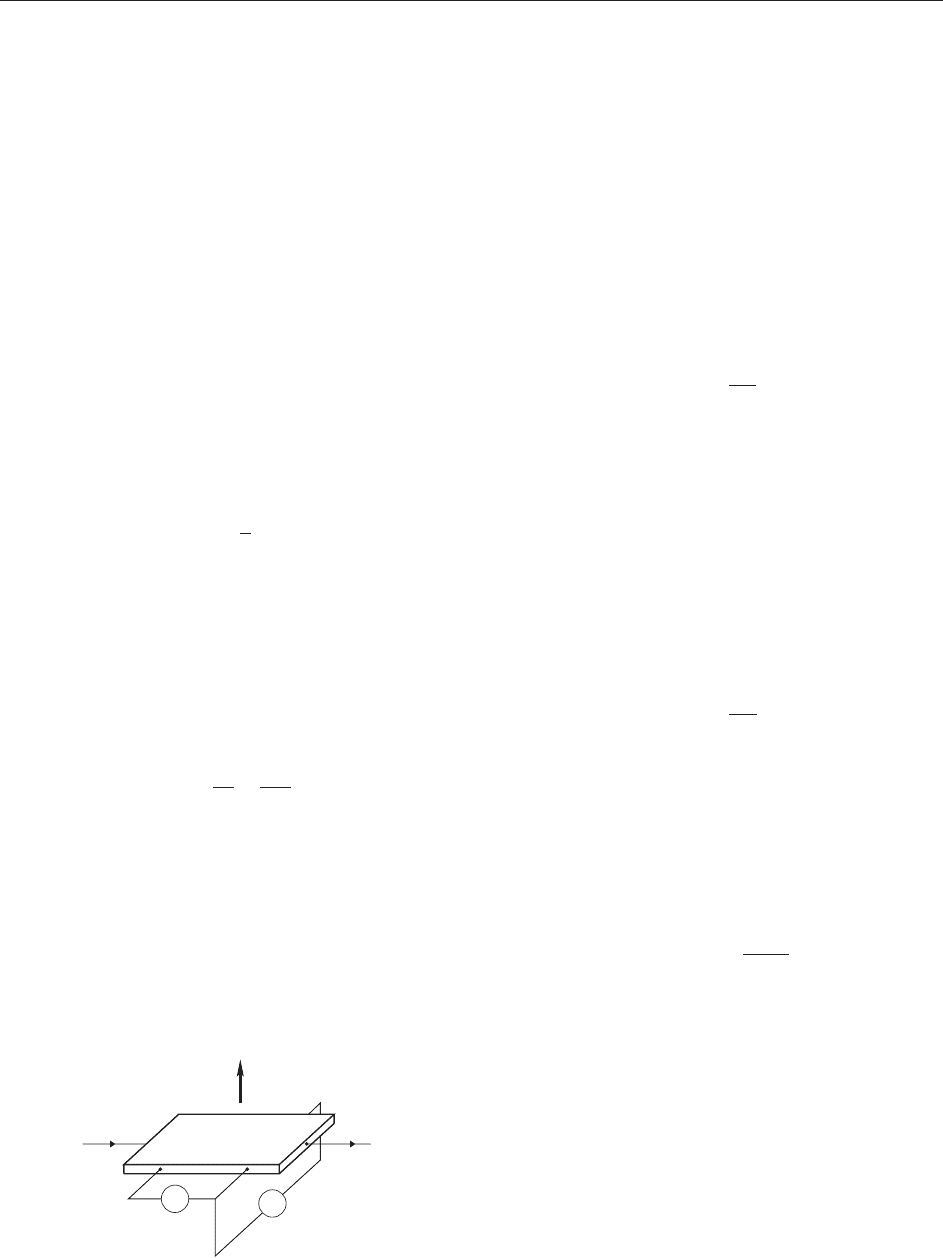
In 1879, E H Hall discovered that in the presence of
a crossed electric and magnetic fields (E and B),
the current flows in a direction ‘‘perpendicular’’ to the
plane containing the two fields. Alternatively, the
passage of current induces a voltage perpendicular to
the direction of the current flow. This is known as
the Hall effect (see Figure 1). The phenomenon has a
classical origin. A consequence of the Lorentz force
law of electrodynamics,
F ¼ q E þ
1
c
v B
½3
which gives the force on a particle of charge q
moving with a velocity v, is that for crossed electric
and magnetic fields the particle drifts in the
direction E B with a velocity v = cE=B. The
current densi ty is therefore given by J = qv, where
is the (three-dimensional) density of particles. That
produces the Hall resistivity
H
¼
E
y
J
x
¼
B
qc
½4
The von Klitzing Effect
Molecular beam epitaxy allows controllable layer
by layer growth in which one type of semiconductor,
say GaAs, can be grown on top of another, say
Al
x
Ga
1x
As, to produce an atomically sharp interface.
By appropriately doping such structures, electrons can
be captured at the interface, thus producing a two-
dimensional electron system (2DES). We note that
these are three-dimensional electrons confined to move
in two dimensions. The interaction has the standard
Coulomb form V(r) = e
2
=r, where is the dielectric
constant of the host material. (In a hypothetical world
which has only two space dimensions, the interaction
would be logarithmic.)
The ‘‘integral quantum Hall effect’’ (IQHE) or the
‘‘von Klitzing effect’’ was discovered unexpectedly
by von Klitzing and collaborators in 1980, in their
study of Hall effect in a 2DES. In two dimensions,
one defines the Hall resistance as
R
H
¼
V
H
I
½5
which, from classical electrodynamics, is expected to
be proportional to the magnetic field B.Thatisindeed
the case at small magnetic fields. At sufficiently high B,
however, quantum mechanical effects appear in a
dramatic manner. The essential observations are as
follows.
1. When plotted as a function of the magne tic field
B, the Hall resistance exhibits numerous plateaus. On
any given plateau, R
H
is precisely quantized with
values given by
R
H
¼
h
ne
2
½6
where n is an integer (hence the name ‘‘integral
quantum Hall effect’’). The plateau occurs in the
vicinity of Be=hc = n, where is the ‘‘filling
factor’’ (defined below).
2. In the plateau region, the longitudinal resis-
tance exhibits an Arrhenius behavior:
R
L
exp
2k
B
T
½7
This gives a filling-factor dependent energy scale ,
which indicates the presence of a gap in the
excitation spectrum. R
L
vanishes in the limit T ! 0.
The absolute accuracy of the quantization has
been established to a few parts in 10
8
for 1
uncertainty, and the relative accuracy to a few
parts in 10
10
. There is presently no known
‘‘intrinsic’’ c orrection t o the quantization. Perhaps,
the most remarkable aspect of t he effect is its
universality. It is indepe ndent of the sample type,
geometry, various material parameters (the band
mass of the electron or the dielectric constant of the
semiconductor), and disorder. The combination
h=e
2
also occurs in the defini tion of the fine
B
I
I
V
L
V
H
Figure 1 Schematics of magnetotransport measurement. I, V
L
,
and V
H
are the current, longitudinal voltage, and the Hall
voltage, respectively. The longitudinal and Hall resistances are
defined as R
L
V
L
=I and R
H
V
H
=I.
Fractional Quantum Hall Effect 403
structure constant = e
2
=hc, the value of which is
approximately 1/137. The Hall effect measure-
ments in dirty, solid state systems thus provide
one of the most accurate values for . Finally, the
lack of resist ance at T = 0 is to be c ontrasted with
ordinary metals, for which the resistance at T ! 0,
called the residual resistance, is finite and propor-
tional to disorder.
The TSG Effect
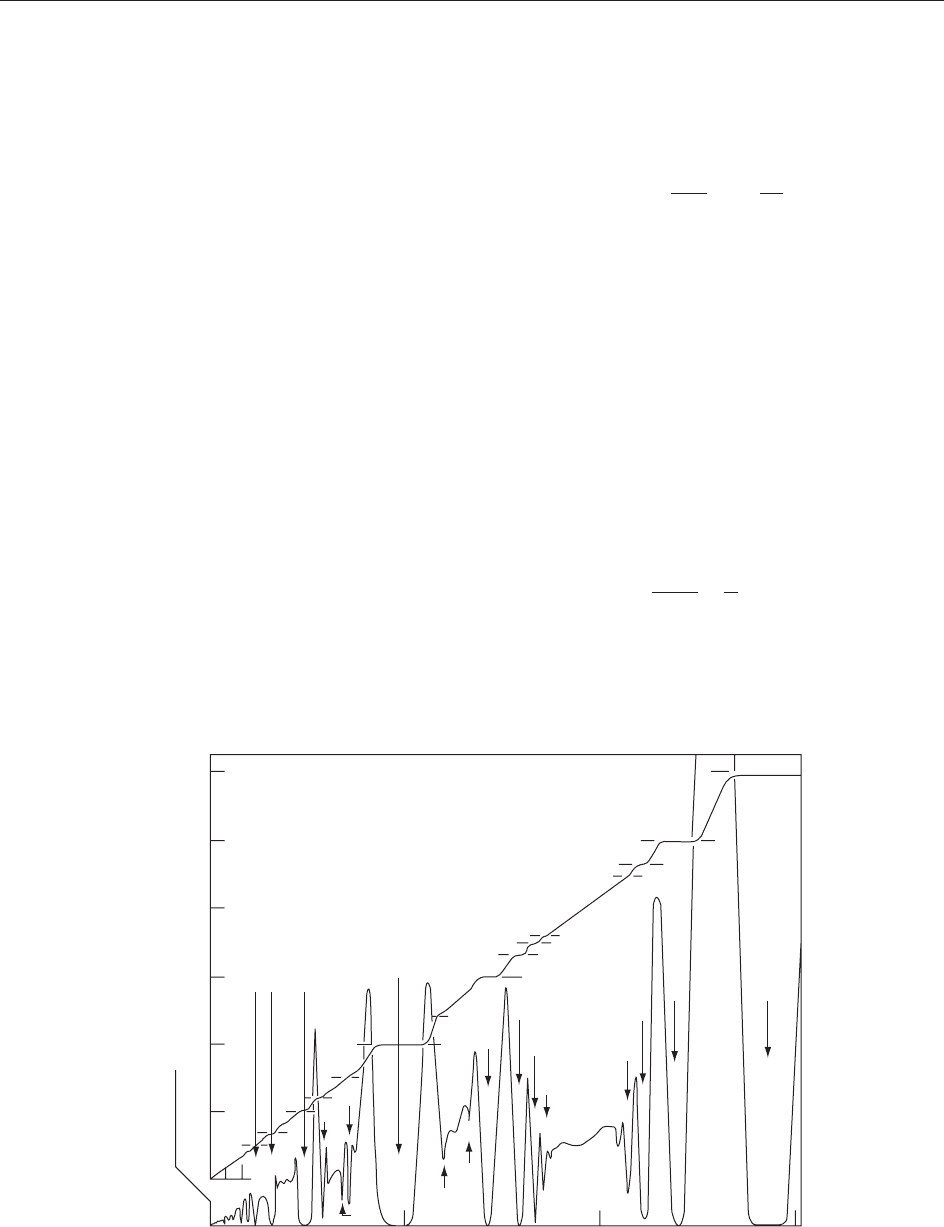
The next revolution occurred in 1982 with the
discovery of the TSG effect, that is, plat eaus on
which the Hall resistance is quantized at values
given by eqn [1] (see Figure 2). The observation
of the R
H
= h=fe
2
plateau is often referred to as
the observation of the fraction f. Improvement
of experimental conditions has led to the observa-
tion of a large number of fractions over the
years, revealin g the richness of the TSG effect.
At the time of the writing of this article, the
number of observed fractions is more than 50 if
one counts only fractions below unity. As in the
von Klitzing effect, the longitudinal resistance
exhibits an Arrhenius behavior, vanishing in the
limit T ! 0.
Landau Levels
The Hamiltonian for a nonrelativistic electron
moving in tw o space dimensions in a perpendicular
magnetic field is given by
H ¼
1
2m
b
p þ
eA
c
2
½8
Here, m
b
is the electron’s band mass and e its
charge. For a uniform magnetic field, the vector
potential A satisfies
Ñ A ¼ B
^
z ½9
Because A is a linear function of the spatial
coordinates, it follows that H is a generalized two-
dimensional harmonic oscillator Hamiltonian which
is quadratic in both the spatial coordinates and in
the canonical momentum p = ihÑ, and therefore
can be diagonalized exactly.
A convenient gauge choice is the symmetric gauge:
A ¼
B r
2
¼
B
2
ðy; x; 0Þ½10
With the magnetic length ‘ =
ffiffiffiffiffiffiffiffiffiffiffiffiffi
hc=eB
p
and the
cyclotron energy h!
c
=heB =m
b
c chosen as the
3
2.5
1.5
0.5
2
1
0
0
R
H
(h /e
2
)
R
4/3
5/7
3/7
4/7
4/5
1/3
2/5
10 20 30
4/9
5/9
2/3
3/5
7/5
5/3
Ma
g
netic field (T)
43 2
Figure 2 The TSG effect. The Hall resistance (R
H
) exhibits many precisely quantized plateaus, concurrent with minima in the
longitudinal resistance (R). Reproduced with permission from Perspectives in Quantum Hall Effects; HL Stormer and DC Tsui;
SD Sarma and A Pinczuk (eds.); Copyright ª 1997, Wiley. Reprinted with permission of John Wiley & Sons, Inc.
404 Fractional Quantum Hall Effect

units for length and energy , the Hamiltonian can be
expressed as
H ¼
1
2
i
@
@x
y
2
2
þi
@
@y
þ
x
2
2
"#
½11
Choosing as independent variables
z x iy;
z x þ iy ½12
we get
H ¼
1
2
4
@
2
@z@
z
þ
1
4
z
z z
@
@z
þ
z
@
@
z
½13
Now define the following sets of ladder operators:
b ¼
1
ffiffiffi
2
p
z
2
þ 2
@
@z
½14
b
y
¼
1
ffiffiffi
2
p
z
2
2
@
@
z
½15
a
y
¼
1
ffiffiffi
2
p
z
2
2
@
@z
½16
a ¼
1
ffiffiffi
2
p
z
2
þ 2
@
@
z
½17
which have the property that
½a; a
y
¼1; ½b; b
y
¼1 ½18
and all the other commutators are zero. In terms of
these operators, the Hamiltonian can be written as
H ¼ a
y
a þ
1
2
½19
The eigenvalue of a
y
a is an integer, n, called the
Landau level (LL) index. The z-component of the
canonical angular momentum operator, the only
relevant component for the two-dimensional prob-
lem, is defined as
L
z
¼i
@
@
¼
z
@
@
z
z
@
@z
¼ a
y
a b
y
b ½20
Exploiting the property [H, L
z
] = 0, the eigenfunctions
will be chosen to diagonalize H and L
z
simultaneously.
The eigenvalue of L
z
will be denoted by m.The
analogy to the Harmonic oscillator problem immedi-
ately gives the solution
Hjm; ni¼E
n
jm; ni½21
where
E
n
¼ n þ
1
2
½22
and
jm; ni¼
ðb
y
Þ
mþn
ffiffiffiffiffiffiffiffiffiffiffiffiffiffiffiffiffiffi
ðm þ nÞ!
p
ða
y
Þ
n
ffiffiffiffi
n!
p
j0; 0i½23
where m = n, n þ 1, .... The single-particle orbital
at the bottom of the two ladders defined by the two sets
of raising and lowering operators is
hrj0; 0i
0;0
ðrÞ¼
1
ffiffiffiffiffiffi
2
p
e
z
z=4
½24
which satisfies
aj0; 0i¼bj0; 0i¼0 ½25
The single-p article states are particularly simple in
the lowest Landau level (n = 0):
0;m
ðrÞ¼hrj0; mi¼
z
m
e
z
z=4‘
2
ffiffiffiffiffiffiffiffiffiffiffiffiffiffiffiffiffiffiffiffiffi
2‘
2
2
m
m!
p
½26
Aside from the ubiquitous Gaussian factor, a general
state in the lowest Landau level is given by a
polynomial of z; it does not involve any
z.Inother
words, apart from the Gaussian factor, the lowest
Landau level wave functions are analytic functions of z.
Landau Level Degeneracy
The state
0, m
(r) is peaked strongly at r =
ffiffiffiffiffiffiffi
2m
p
‘.
Neglecting order-1 effects, there are m states in the
lowest Landau level in a disk of radius r =
ffiffiffiffiffiffiffi
2m
p
‘,
giving a degeneracy of (2‘
2
)
1
per unit area per
Landau level. (The same degeneracy is obtained for
higher Landau levels as well.) It is equal to B=
0
,
where
0
= hc=e is called the flux quantum, that is,
there is one state per flux quantum in each Landau
level.
Filling Factor
The number of filled Landau levels, called the filling
factor, is given by
¼2‘
2
¼
0
B
½27
The Origin of Plateaus
The von Klitzing effect can be explained in terms of
a model which neglects the interactions between
electrons. It occurs because the ground state at an
integral filling is unique and nondegenerate, sepa-
rated from excitations by a gap. Laughlin (1981)
showed that the disorder-induced Anderson locali-
zation also plays a crucial role in the establishment
of the Hall plateaus. To see this, imagine changing
the filling away from an integer by adding some
Fractional Quantum Hall Effect 405