
Francoise J.-P., Naber G.L., Tsun T.S. (editors) Encyclopedia of Mathematical Physics
Подождите немного. Документ загружается.

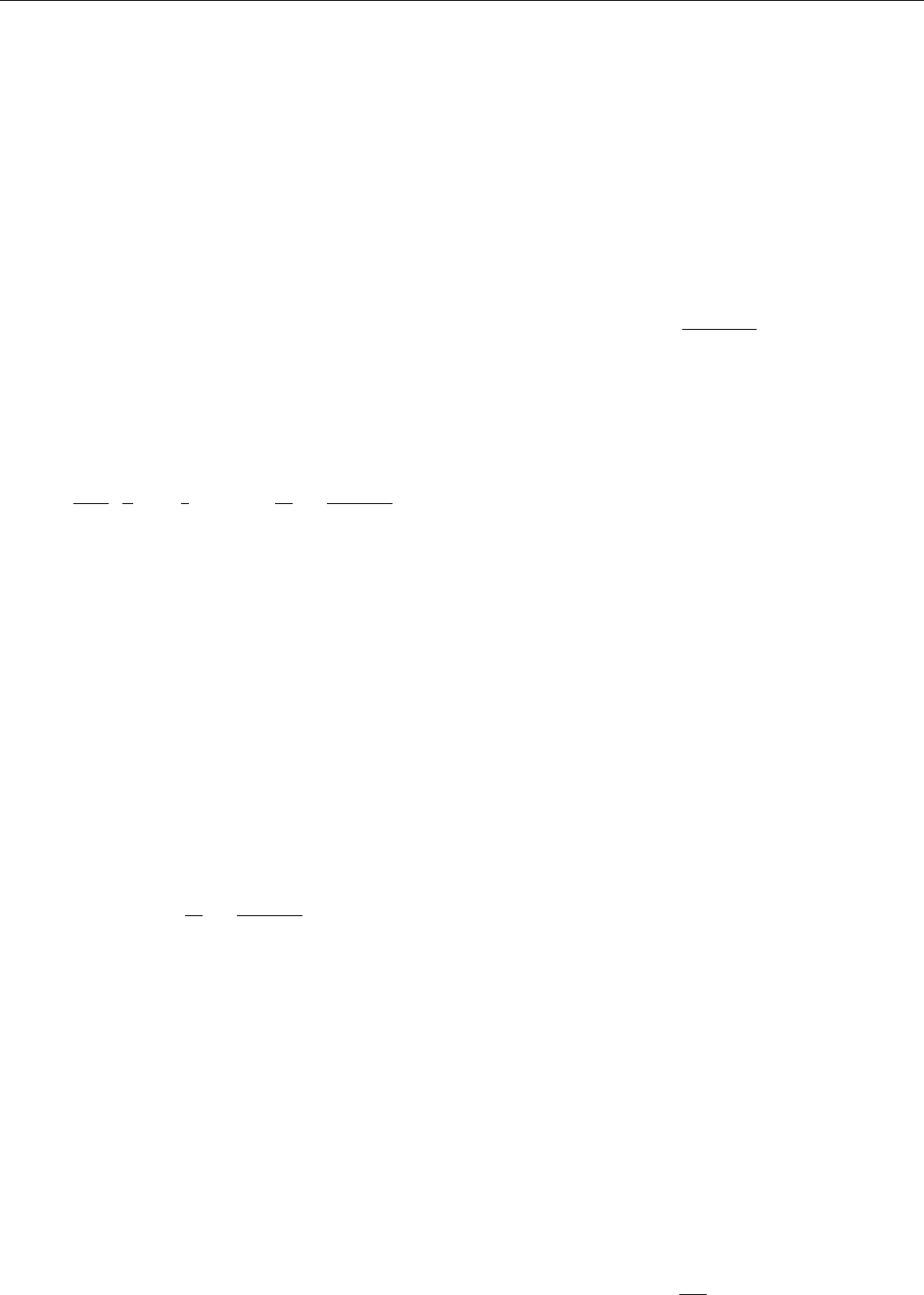
electrons or holes. In a perfect system, the additional
particles would also be free to carry current, but in
the actual, disordered sample, they are immobilized
by impurities (which create localized states in the
energy gap), and do not contribute to transport. The
transport properties therefore remain unaffected as
the filling factor is varied slightly away from an
integer, and the system continues to behave as
though it had filled shells.
The Lowest Landau Level Problem
The TSG effect arises due to interelectron interaction.
We wish to obtain solutions for the Schro¨ dinger
equation
H ¼ E ½28
at an arbitrary filling , where
H ¼
X
j
1
2m
b
h
i
r
j
þ
e
c
Aðr
j
Þ
2
þ
e
2
X
j<k
1
jr
j
r
k
j
½29
The first term on the right-hand side is the kinetic
energy in the presence of a constant external
magnetic field B = rA, and the second term is
the Coulomb interaction energy. (The Zeeman
energy is not included explici tly because we con-
sider, for now, magnetic fields that are sufficiently
high that only fully spin-polarized states are
relevant.) It is convenient to consider the limit
(e
2
=‘)=(h!
c
) ! 0, when the Coulomb interaction is
so weak that it is not able to cause Landau level
mixing, so electrons can be taken to be within the
lowest Landau level. The kinetic energy then is an
irrelevant constant which can be thrown away, and
the Hamiltonian reduces to
H ¼P
LLL
e
2
X
j<k
1
jr
j
r
k
j
P
LLL
½30
‘‘which must be solved with the lowest LL restric-
tion,’’ as explicitly indicated by the lowest LL
projection operator P
LLL
. The problem is thus
mathematically well defined, but requires degenerate
perturbation theory in an enormously large Hilbert
space, with
N=
N
ðÞ
many particle basis vectors. The
usual perturbative techniques are not useful due to
the absence of a small parameter in the problem;
e
2
=‘ merely sets the energy scale in the lowest
Landau level.
Composite-Fermion Theory
Inspired by the qualitative similarity between the
integral and the fractional Hall effects, the composite-
fermion (CF) theory (Jain 1989) postulates that the
eigenfunctions of interacting electrons at filling factor
,
, are related to the (known) eigenfunctions of
noninteracting electrons at filling factor
,
, accord-
ing to
¼P
LLL
Y
j<k
ðz
j
z
k
Þ
2p
½31
where P
LLL
denotes projection of the wave function
on its right into the lowest Landau level. The filling
factors are related by
¼
2p
þ 1
½32
which can be seen as follows: the largest power of z
1
in
(neglecting order-one corrections) is N=
,as
follows from the definition of the filling factor. The
largest power of z
1
on the right-hand side is
therefore pN(N 1) þ N=
. This is the number of
flux quanta penetrating the ‘‘sample.’’ Dividing it by
N and taking the limit N !1gives the inverse of
the filling factor
1
. These wave functions are now
known to capture the correct nonperturbative
physics of the TSG effect (see below), and also
to provide extremely accurate representations for
the actual corre lated ground states and their excita-
tions. They recover Laughlin’s 1983 wave function
for the ground state at = 1=(2p þ 1), while clarify-
ing that it is a part of a much bigger conceptual
structure.
Physical Interpretation
The crucial property of the wave function in eqn [31]
is that the complex Jastrow factor
Q
j<k
(z
j
z
k
)
2p
binds 2p vortices on each electron. More precisely,
each electron sees 2p vortices on every other electron,
in that a complete loop of an electron around any other
electron produces a phase of 2 2 p.Theboundstate
is interpreted as a particle, called the ‘‘composite
fermion.’’ Because the vortex is a topological object, so
is the composite fermion. The vorticity 2p is quantized
to be an even integer, as required by the single-
valuedness and antisymmetry requirements of quan-
tum mechanics, which will be seen to lie at the root of
the exact quantization of the Hall resistance.
When composite fermions move about, they experi-
ence, in addition to the Aharonov–Bohm (AB) phase,
also the Berry phases coming from vortices on other
composite fermions. Imagine taking a composite
fermion in a closed loop enclosing an area A.The
phase associated with that loop is given by
¼2
BA
0
þ 22pN
enc
½33
406 Fractional Quantum Hall Effect
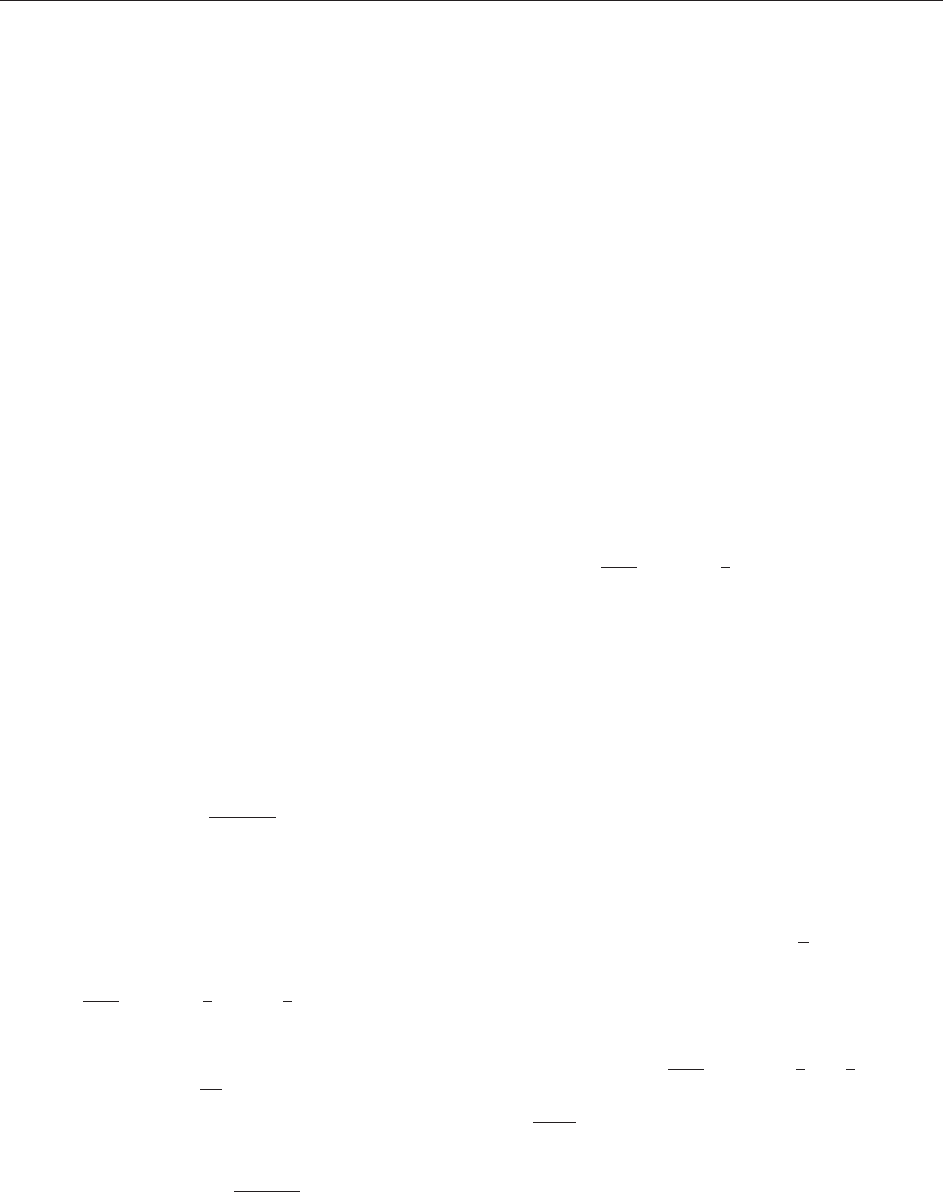
where N
enc
is the number of composite fermions
inside the loop. The first term is the familiar AB
phase due to a charge going around in a loop. The
second is the Berry phase due to 2p vortices going
around N
enc
particles, with each particle producing
a phase of 2. Replacing N
enc
by its average value
A shows that, on average,
is equal to the AB
phase from an ‘‘effective’’ magnetic field
B
¼ B 2p
0
½34
The composite fermions thus experi ence an effective
magnetic field B
which is much smaller than the
external, applied field B. That lies at the heart of the
phenomenology of this lowest Landau level liquid.
One treats composite fermions as noninteracting
in the simplest approximation. They form their own
Landau-like levels in B
. Their filling factor is
defined as
=
0
=B
, with which eqn [34]
becomes equivalent to eqn [32]. The effective field
B
can be antiparal lel to B, in which case
=
0
=B
is formally negative. For negative values
of
,
in eqn [31] is defined as
j
j
= [
j
j
]
,
because complex conjugation is equivalent to
switching the direction of the magnetic field.
Fermion Chern–Simons Theory
Lopez and Fradkin (1991) developed a field-theoretic
formulation of composite fermions through a singular
gauge transformation defined by
¼
Y
j<k
z
j
z
k
jz
j
z
k
j
2p
0
½35
under which the eigenvalue problem of eqn [29]
transforms into
H
0
0
¼ E
0
½36
H
0
¼
1
2m
b
X
i
p
i
þ
e
c
Aðr
i
Þ
e
c
aðr
i
Þ
2
þV ½37
aðr
i
Þ¼
2p
2
0
X
0
j
Ñ
i
ij
½38
where
jk
¼ iln
z
j
z
k
jz
j
z
k
j
is the relative angle between the particles j and k.The
magnetic field corresponding to a(r
i
)isgivenby
b
i
¼ Ñ
i
aðr
i
Þ¼2p
0
X
0
l
2
ðr
i
r
l
Þ½39
The above transformation thus amounts to attaching
a point flux of strength 2p
0
to each electron,
which is how the composite fermion is modeled
in this approach. (A flux quantum is top ologically
equivalent to a vortex.) This definition is reminis-
cent of the treatments of particles obeying fractional
statistics (‘‘anyons’’) introduced by Leinaas and
Myrheim (1977) and Wilczek (1982); an anyon is
modeled as an electron bound to a point flux of
magnitude
0
, where determines the winding
statistics.
It is not possible to proceed further without making
approximations. The usual approach is to make a
‘‘mean-field’’ approximation, which amounts to
spreading the point flux on each electron into a
uniform magnetic field. Formally, one writes
A a A
þ A ½40
Ñ A
¼ B
^
z ½41
The transformed Hamiltonian is written as
H
0
¼
1
2m
b
X
i
p
i
þ
e
c
A
ðr
i
Þ
2
þV þ V
0
¼ H
0
0
þ V þ V
0
½42
V is the Coulomb interaction and V
0
denotes the
terms containing A. The solution to H
0
0
is trivial,
describing free fermions in an effective magnetic
field B
. We have thus decomposed the Hamiltonian
into a part H
0
0
, which can be solved exact ly, and the
rest, V þ V
0
, which is to be treated perturbatively.
Lopez and Fradkin recast the problem in the
language of functional integrals, which is suitable
for studying corrections to the mean-fi eld theory.
One writes the zero-temperature quantum partition
function
Z¼
Z
D D
Da exp
i
h
S
½43
S¼
Z
d
2
r
Z
dtL½44
L¼
ði@
t
a
0
Þ þ
1
2m
b
ihÑ þ
e
c
A
e
c
a
2
þ
1
2p
0
a
0
Ñ a þ
Z
d
2
r
0
ðrÞVðr r
0
Þðr
0
Þ½45
where and
are anticommuting Grassmann
variables. The flux attachment is introduced
through a Lagrange multiplier a
0
; because a
0
enters
linearly in the action, it can be integrated out to
produce a delta function that imposes the
constraint
Ñ aðrÞ¼2p
0
ðrÞ¼2p
0
ðrÞ ðrÞ½46
Fractional Quantum Hall Effect 407

This formalism is closely related to the topological
Chern–Simons (CS) field theory. Recall that the CS
Lagrangian has the form
L
CS
A
F
¼ 2
A
@
A
½47
where F
= @
A
@
A
,and
is the antisym-
metric Levy-Civita tensor, with
012
= 1. The index
takes values = 0, 1, 2, the first being the time
component and the remaining space components.
The CS action is invariant, up to surface terms,
under a gauge transformation, because the change in
L
CS
under a functional variation A
= @
is a total
derivative.
Zhang et al. (1989) noted that the term propor-
tional to a
0
Ñ a in eqn [45], which enforces flux
attachment, is precisely equal to the CS Langrangian
in the Coulomb gauge. Write
L
CS
¼
1
4p
0
a
@
a
¼
1
2p
0
ij
a
0
@
i
a
j
1
4p
0
ij
a
i
@
0
a
j
½48
where i, j represent the spatial components
(i, j = 1, 2), and the time components have been
displayed explicitly in the second step (@
0
= @
t
). The
first term on the right-hand side of eqn [48] is
identical to the third term on the right-han d side of
eqn [45]. In the Fourier spa ce the last term is
proportional to
ij
a
i
ðq;!Þði!Þa
j
ðq; !Þ½49
By choosing the x-axis along q, the Coulomb gauge
condition q.a = 0 implies a
2
(q, !) = 0, guaranteeing
that the last term in eqn [48] is identically zero.
The constraint of eqn [46] is used to eliminate
the two factors of density in the last term of
eqn [45]. The action is then quadratic in the
fermion field, which can be integrated out. Various
response functions can be expressed as correlation
functions of the vector potential field and their
averages over the CS field configurations are
evaluated perturbatively by standard diagrammatic
methods.
The fermion CS theory is believed to capture the
topological properties of composite fermions, but
has not lent itself, because of the lack of a small
parameter, to quantitative calculations. It is not
known what classes of Feynman diagrams will need
to be summed to eliminate the electron mass m
b
(which is not a parameter of the lowest Landau
problem – see eqn [30]) in the fermion CS
approach). Halperin et al. (1993) proceeded by
replacing m
b
by an adjustable parameter m
,
interpreted as the composite-fermion mass. Murthy
and Shankar (1997) proposed to separate out
the inter- and intra-Landau level degrees of
freedom by making a sequence of further
transformations.
Consequences
Fractional Quantum Hall Effect
The CF theory provides a simple understanding of
why gaps open up at ‘‘fractional’’ fillings, which
happens at those fillings = f for which composite
fermions fill integral numbers of CF Landau levels.
That results in Hall plateaus at R
H
= h=fe
2
in the
presence of disorder. The fractional QHE is thus
understood as the integral QHE for composite
fermions.
Sequences of Fractions
The integral fillings of composite fermions corre-
spond to fractional fillings of electrons given by
¼
jnj
2pjnj1
½50
which are precisely the observed fractions. Some of
these are:
f ¼
jnj
2jnjþ1
¼
1
3
;
2
5
; ...;
10
21
½51
f ¼
jnj
2jnj1
¼
2
3
;
3
5
; ...;
10
19
½52
f ¼
jnj
4jnjþ1
¼
1
5
;
2
9
; ...;
6
25
½53
f ¼
jnj
4jnj1
¼
2
7
;
2
5
; ...;
6
23
½54
Particle–hole symmetry in the lowest La ndau level
also implies fractions 1 f . The fractions appear
in the form of sequences because they are all
derived from the sequence of integers. The Hall
quantization is exact because the right-hand side
of eqn [50] is made up of whole numbers and
therefore is not susceptible to small perturbations
in the Hamiltonian. The CF theory unifies the
FQHEs and IQHEs.
408 Fractional Quantum Hall Effect
Fermi Sea at Half Filling
Equation [50] is consistent with the fact that only
odd-denominator fractions have been observed in
the lowest Landau level (i.e., with f < 1). Halperin
et al. (1993) and Kalmeyer and Zhang (1992)
proposed that at the simplest even-denominator
fraction, namely = 1=2, composite fermions form
a Fermi sea. This was motivated by the fact that the
effective magnetic field is B
= 0at = 1=2. A
number of experiments have directly measured the
Fermi sea of composite fermions. The TSG effect
with f = 1=2 is absent because the Fermi sea has
gapless excitations.
Effective Magnetic Field
For small values of B
(i.e., in the vicinity of
= 1=2), the cyclotron radius of composite fermions
can be very large compared to the radius of the
cyclotron orbit of a clas sical electron in B. Direct
measurements of the cyclotron orbit in several
geometric experiments have confirmed that the
charge carriers experience a magnetic field B
rather
than B.
Fractional Charge
Laughlin (1983) showed that the presence of a gap
at a fractional filling implies the existence of
fractionally charged excitations. He obtained an
excitation through the adiabatic insertion of a point
flux quantum at, say the origin, which can be
gauged away at the end leaving behind an exact
excited state. The Faraday’s law implies that the
azimuthal component of the induced electric field is
E
= (2r)
1
d=dt . The current density then is
j
r
=
H
E
, where
H
= fe
2
=h is the Hall conductivity.
The charge leaving the area defined by a circle of
radius r per unit time is 2rj
r
. The total charge
leaving this area in the adiabatic process then is
Q ¼
Z
2rj
r
dt ¼
H
0
¼fe ½55
The charge excess associated with the excitation is
therefore fe. It is in general not an elementary
excitation. For f = n=(2pn 1), it can be shown to
be a collection of n elementary excitations, giving a
charge of e
= e=(2pn 1) for a single elementary
excitation.
Microscopic Tests
Exact solutions of the Schro¨ dinger equation can be
obtained, for a finite number of particles, by a brute-
force diagonalization of the Hamiltonian in the
lowest LL subspace, which enables a rigorous and
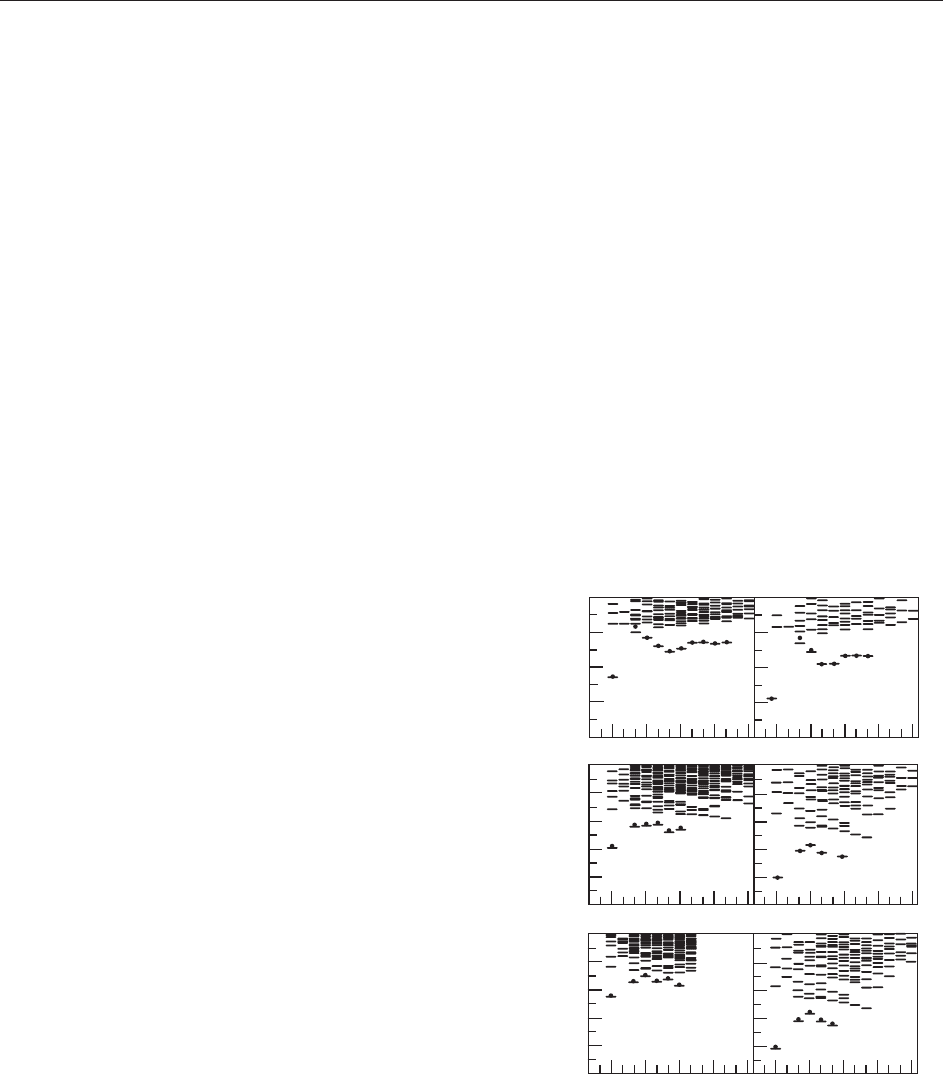
nontrivial testing of the CF theory. Figure 3 shows
some typical comparisons, which help test both the
qualitative and the quantitative aspects of the CF
theory in a model-independent manner. The low-
energy spectrum of interacting electrons at B is
explicitly seen to have a one-to-one correspondence
to that of weakly interacting electrons at B
.
Furthermore, there is a remarkably good quantita-
tive agreement. The predicted energies agree with
the exact energies to better than 0.05%, and the
overlaps between the wave functions of eqn [31]
with the exact eigenfunctions are close to 100%.
Such comparisons are even more convincing in light
of the fact that the wave functions of eqn [31]
do not contain any adjustable parameters for the
states at in eqn [50], because the ground state
wave function and its low-energy excitations at
= n are unique and fully known: the former is
the Slater determinant corresponding to n filled
–0.49
–0.48
–0.47
–0.46
–0.45
–0.44
–0.45
–0.44
–0.43
–0.42
–0.41
N = 8, ν = 2/ 5
N
= 10, ν = 2/ 5
N
= 10, ν = 1/3
N
= 8, ν = 1/3
036912036912
–0.50
–0.49
–0.48
–0.47
–0.46
–0.51
N = 9, ν = 3/ 7
N
= 12, ν = 3/ 7
E (e
2
/ l)
∋
E (e
2
/ l)
∋
E (e
2
/ l)
∋
52
83
179
127
263
493
621
952
744
1182
8
8
21
22
35
33
45
8
31
42
101
111
168
175
227
227
230
8
21
22
35
33
212
304
328
416
LL
Figure 3 Exact spectra (dashes) for several particle numbers
at = 1=3, 2=5, and 3/7. Dots show the CF prediction for the
energy, obtained with no adjustable parameters. The electrons
are taken to be confined on the surface of a sphere in the
presence of a radial magnetic field; L is the total orbital angular
momentum, and each dash represents a multiplet of 2L þ 1
degenerate states. The number on top is the dimension of the
Fock space in the corresponding L sector. Reproduced from
Jain JK (2000) The composite fermion: a quantum particle and
its quantum fluids. Physics Today 39(4): 39–42, with permission
from American Institute of Physics.
Fractional Quantum Hall Effect 409

Landau levels, and the latter are the excitons.
The predicted energies are calculated by determining
the expectation values of the full Hamiltonian
of eqn [30] with respect to the wave funct ions in
eqn [31].
More Physics
Spin
At small Zeeman energies, partially spin-polarized
or spin-unpolarized FQHE states become possible.
The TSG effect with spin is well described by a
generalization of the CF theory. The observed
fractions are still given by eqn [50], but with
n ¼ n
"
þ n
#
½56
where n
"
is the number of occupied spin-up Landau-
like CF bands and n
#
is the number of occupied
spin-down Landau-like CF bands. There are in
general several states with different spin polariza-
tions possible at any given fraction. The observed
quantum phase transitions as a function of the
Zeeman energy, which can be changed by increasing
the parallel component of the magnetic field, are
consistent with this picture. Direct measurements of
the spin polarization further confirm this, but also
see evidence for certain additional fragile states,
which are presumably caused by the residual
interaction between composite fermions.
Bilayers
It has been proposed that for two parallel 2DES
planes at small separations and at total filling = 1,
neutral interlayer excitons (each exciton made up of
an electron in one layer and a hole in the other)
undergo Bose–Einstein condensation, producing a
true off-diagonal long-range order. Tunneling and
transport experiments by Eisenstein and collabora-
tors provide evidence for nontrivial behavior under
such conditions. The resistivity in the antisymmetric
channel is very small but does not vanish.
Pairing
An even-denominator fraction f = 5=2 has been
observed. Writing 5=2 = 2 þ 1=2 and noting that
the lowest LL contributes 2 (counting the spin
degree of freedom), = 5=2 corresponds to a filling
of 1/2 in the second Landau level. The most
promising scenario for the explanation of the 5/2
effect is that compos ite fermions form a p-wave
paired state, which opens up a gap to excitations.
This state is believed to be well described by a
Pfaffian wave function proposed by Moore and
Read (1991)
Pf
1=2
¼ Pf
1
z
i
z
j
Y
i<j
ðz
i
z
j
Þ
2
exp
1
4
X
k
jz
k
j
2
!
½57
The Pfaffian of an antisymmetric matrix M is
defined, apart from an overall facto r, as
PfðM
ij
Þ¼AðM
12
M
34
...M
N1;N
Þ½58
where A is the antisymmetrization operator. The
Bardeen–Cooper–Schrieffer wave function
BCS
¼ A½
0
ðr
1
; r
2
Þ
0
ðr
3
; r
4
Þ...
0
ðr
N1
; r
N
Þ ½59
has the same form as the Pfaffian in eqn [58].
Hence, Pf 1=(z
i
z
j
) describes a p-wave pairing of
electrons, and
Pf
1=2
is interpreted as a paired state of
composite fermions carrying two vortices.
FQHE of Composite Fermions
Recently, some fractions other than those in eqn [50]
have been observed, for example, f = 4=11 and
f = 5=13. These are understood as the delicate
‘‘fractional’’ QHE of composite fermions at
= 1 þ
1=3and
= 1 þ 2=3.
TSG Effect in Higher Landau Levels
The short-range part of the Coulomb interaction
is less effective in higher Landau levels because
of the greater spread of the electron wave f unc-
tion. As a result, composite fermions are less
stable, often losing to charge density wave states.
A few fractions have been observed in the second
Landau level (1/3, 2/3, 2/5, 1/2) and one (1/3) in
the third.
Edge states
There is a gap to excitations in the bulk at the
magic fillings of eqn [50], but there is no gap at the
edge of the sample. The dynamics of the low-energy
edge excitations is formally equivalent to that of a
chiral one-dimensional Tomonaga–Luttinger liquid.
Wen (1991) argued that the exponent characterizing
the long-distance behavior of this liquid is quan-
tized, fully determined by the filling factor of the
bulk state. Experimental studi es of the tunneling
of an external electron into the edge of an
FQHE system provide evidence for a nontrivial
410 Fractional Quantum Hall Effect

Tomonaga–Luttinger liquid but do not find the
predicted universal value for the edge exponent.
Acknowledgments
The author is grateful to the US National Science
Foundation for financial support under grant no.
DMR-0240458.
See also: Abelian Higgs Vortices; Aharonov–Bohm
Effect; Chern–Simons Models: Rigorous Results;
Fermionic Systems; Geometric Phases; Quantum Hall
Effect; Quantum Phase Transitions; Quantum Statistical
Mechanics: Overview.
Further Reading
Chang AM (2003) Chiral Luttinger liquids at the fractional quantum
Hall edge. Reviews of Modern Physics 75: 1449–1505.
Das Sarma S and Pinczuk A (eds.) (1997) Perspectives in Quantum
Hall Effects. New York: Wiley.
Eisenstein JP and MacDonald AH (2004) Bose–Einstein condensation
of excitons in bilayer electron systems. Nature 432: 691–694.
Giuliani GF and Vignale G (2005) Quantum Theory of the Electron
Liquid. Cambridge: Cambridge University Press.
Halperin BI (2003) Composite fermions and the Fermion–
Chern–Simons theory. Physica E 20: 71–78.
Halperin BI, Lee PA, and Read N (1993) Theory of the half-filled
Landau level. Physical Review B 47: 7312–7343.
Heinonen O (ed.) (1998) Composite Fermions. New York: World
Scientific.
Jain JK (1989) Composite-fermion approach for the fractional
quantum Hall effect. Physical Review Letters 63: 199–202.
Jain JK (2000) The composite fermion: a quantum particle and its
quantum fluids. Physics Today 53(4): 39–42.
Jain JK (2003) The role of analogy in unraveling the fractional
quantum Hall effect mystery. Physica E 20: 79–88.
Kalmeyer V and Zhang SC (1992) Metallic phase of the quantum
Hall system at even-denominator filling fractions. Physical
Review B 46: 9889–9892.
Klitzing Kv (1986) Nobel lecture: The quantized Hall effect.
Reviews of Modern Physics 58: 519–531.
Laughlin RB (1981) Quantized Hall conductivity in two dimen-
sions. Physical Review B 23: 5632–5634.
Laughlin RB (1983) Anomalous quantum Hall effect: an
incompressible quantum fluid with fractionally charged
excitations. Physical Review Letters 50: 1395–1398.
Laughlin RB (1999) Nobel lecture: Fractional quantization.
Reviews of Modern Physics 71: 863–874.
Leinaas JM and Myrheim J (1977) On the theory of identical
particles. Nuovo Cimento B 37: 1–23.
Lopez A and Fradkin E (1991) Fractional quantum Hall effect
and Chern–Simons gauge theories. Physical Review B 44:
5246–5262.
Moore G and Read N (1991) Nonabelions in the fractional
quantum Hall effect. Nuclear Physics B 360: 362–396.
Murthy G and Shankar R (2003) Hamiltonian theories of the
fractional quantum Hall effect. Reviews of Modern Physics
75: 1101–1158.
Stormer HL (1999) Nobel lecture: the fractional quantum Hall
effect. Reviews of Modern Physics 71: 875–889.
Stormer HL, Tsui DC, and Gossard AC (1999) The fractional
quantum Hall effect. Reviews of Modern Physics 71:
S298–S305.
Tsui DC (1999) Nobel lecture: interplay of disorder and interaction
in two-dimensional electron gas in intense magnetic fields.
Reviews of Modern Physics 71: 891–895.
Wen XG (1992) Theory of the edge states in fractional quantum
Hall effects. International Journal of Modern Physics B 6:
1711–1762.
Wilczek F (1982) Quantum mechanics of fractional-spin particles.
Physical Review Letters 49: 957–959.
Zhang SC, Hansson H, and Kivelson S (1989) Effective-field-
theory model for the fractional quantum Hall effect. Physical
Review Letters 62: 82–85.
Free Interfaces and Free Discontinuities: Variational Problems
G Buttazzo, Universita
`
di Pisa, Pisa, Italy
ª 2006 Elsevier Ltd. All rights reserved.
Introduction
In several models coming from very different
applications, one needs to describe physical phe-
nomena where the state funct ion may present some
regions of discontinuity. We may think, for instance,
of problems arising in fracture mechanics, where the
function which describes the displacement of the
body has a jump along the fracture, phase transi-
tions, or also of problems of image reconstruction,
where the function that describes a picture (the
intensity of black, e.g., in black-and-white pictures)
has naturally some discontinuities along the profiles
of the objects.
The Sobolev space analysis is then no longer
appropriate for this kind of problem, since Sobolev
functions cannot have jump discontinuities along
hypersurfaces, as, on the contrary, is required by the
models above. For a rigorous presentation of
variational problems involving functions with dis-
continuities, the essential tool is the space, BV, of
functions with bounded variation. The first ideas
about this space were developed by De Giorgi in the
1950s, in order to provide a variational framework to
Free Interfaces and Free Discontinuities: Variational Problems 411

study the problems of minimal surfaces, and several
monographs are now available on the subject. We
quote, for instance, the classical volumes of Evans
and Gariepy (1992), Federer (1969), Giusti (1984),
Massari and Miranda (1984), Ziemer (1989), and the
recent book by Ambrosio et al. (2000), where a
systematic presentation is given, also in view of the
applications mentioned above.
The Space BV
Consider a generic open subset of R
N
, which, for
simplicity, we take bounded and with a Lipschitz
boundary. In the following, we denote by L
N
(E), or
simply jEj, the Lebesgue measure of E in R
N
, while
H
k
denotes the k-dimensional Hausdorff measure.
Definition 1 We say that a function u 2 L
1
()isa
function of bounded variation in if its distribu-
tional gradient Du is an R
N
-valued finite Borel
measure on . In other words, we have
Z
uD
i
dx ¼
Z
dD
i
u
8 2C
1
c
ðÞ; 8i ¼ 1; ...; N ½1
where D
i
u are finite Borel measures. The space of all
functions of bounded variation in is denoted by
BV().
The space BV() is clearly a vector space and,
with the norm
kuk
BVðÞ
¼kuk
L
1
ðÞ
þjDujðÞ½2
it becomes a Banach space. The total variation
jDuj() appearing above is intended as
jDujðÞ
¼ sup
X
N
i¼1
Z
i
dD
i
u: 2C
1
c
ð; R
N
Þ; jj1
()
¼ sup
Z
u div dx: 2C
1
c
ð; R
N
Þ; jj1
and is sometimes indicated by
R
jDuj. The space
BV
loc
() is defined in a similar way, requiring that
u 2 BV(
0
) for every
0
.
From the point of view of functional analysis, the
space BV() does not verify the nice properties of
Sobolev spaces. In particular,
the Banach space BV() is not separable;
the Banach space BV() is not reflexive; and
the class of smooth functions is not dense in
BV() for the norm [2].
The above issues motivate why the norm [2] is not
very helpful in the study of variational problems
involving the space BV(). On the contrary, the
weak
convergence defined below is much more
suitable to treat minimization problems for inte gral
functionals.
Definition 2 We say that a sequence (u
n
)weakly
converges in BV() to a function u 2 BV()ifu
n
! u
strongly in L
1
()andDu
n
! Du in the weak
convergence of measures.
The weak
convergence on BV() satisfies the
following properties:
Compactness Every bounde d sequence in BV()
for the norm [2] admits a weakly
convergent
subsequence.
Lower-semicontinuity The norm [2] is sequen-
tially lower-semicontinuous with respect to the
weak
convergence.
Density Every function u 2 BV() can be
approximated, in the weak
convergence, by a
sequence (u
n
) of smooth functions.
The density property above can be actually made
stronger: in fact, the approximation of (u
n
)tou
holds in the sense that
u
n
! u strongly in L
1
ðÞ
Du
n
! Du weakly
as measures
jDu
n
jðÞ!jDujðÞ
8
>
>
>
>
<
>
>
>
>
:
Further pro perties of the space BV() concern
the embeddings into Lebesgue spaces, traces,
and Poincare´-type inequalities. More precisely, we
have:
Embeddings The space BV() is embedded
continuously into L
N=(N1)
() and compactly
into L
p
() for every p < N=(N 1).
Traces Every function u 2 BV() has a bound-
ary trace which belongs to L
1
(@), and the trace
operator from BV() into L
1
(@) is continuous.
Poincare´ inequalities There exist suitable con-
stants c
1
and c
2
such that for every u 2 BV()
Z
jujdx c
1
jDujðÞþ
Z
@
jujdH
N 1
Z
ju u
jdx c
2
jDujðÞ
where u
¼
1
jj
Z
u dx
412 Free Interfaces and Free Discontinuities: Variational Problems

Sets of Finite Perimeter
An important class of functions with bounded
variation are those that can be written as 1
E
, the
characteristic function of a set E, taking the value 1
on E and 0 elsewhere. This is the natural class where
many phase-transition problems with sharp inter-
faces may be framed.
Definition 3 For a measurable set E R
N
the
perimeter of E in is defined as
PerðE; Þ¼jD1
E
jðÞ
The equality above is intended as Per(E, ) = þ1
whenever 1
E
=2BV(). If Per(E, ) <þ1 then the set
E is called a set of finite perimeter in .
Note that by the compactness property above for
BV functions, a family of characteristic functions of
sets with finite perimeter in a bounded open set
with equibounded perimeter is weakly
-precompact,
and its limit is of the same form.
For a set E of finite perimeter in , we may define
the inner normal versor and the reduced bounda ry
as follows.
Definition 4 Let E be a set of finite perimeter in .
We call reduced boundary @
E the set of all points
x 2 \ sptjD1
E
j such that the limit
E
ðxÞ¼lim
r!0
D1
E
B
r
ðxÞðÞ
jD1
E
j B
r
ðxÞðÞ
exists and satisfies j
E
(x)j= 1. The vector
E
(x)is
called the generalized inner normal versor to E.
In order to link the measure-theoretical objects
introduced above with some structure property of sets
of finite perimeter, we introduce, for every t 2 [0, 1]
and every measurable set E R
N
,thesetE
t
defined by
E
t
¼ x 2 R
N
: lim
r!0
jE \ B
r
ðxÞj
jB
r
ðxÞj
¼ t
½3
For instance, if E is a smooth domain of R
N
, E
1
is
the interior part of E, E
0
is its exterior part, whi le
E
1=2
is the boundary @E.
The main properties of the reduced boundary and
of the generalized inner normal versor are stated in
the following result.
Theorem 5 Let E be a set of finite perimeter in .
Then its reduced boundary @
E coincides H
N 1
-a.e.
with the set E
1=2
introduced in Definition 3, and we
have the equality
PerðE; Þ¼H
N1
ð \ @
EÞ¼H
N1
ð \ E
1=2
Þ
Moreover, the generalized inner normal versor
E
(x)
exists for H
N 1
-a.e. x 2 @
E, and we have
D1
E
¼
E
ðxÞH
N1
9@
E
Note that the lower-semicontinuity of jD1
E
j()
entails the lower-semicontinuity of E 7!H
N1
( \
@
E) with respect to the weak
-convergence of 1
E
.
As a consequence, we may apply the direct methods
of the calculus of variations to obtain, for example,
existence of minimizers of
min PerðE; R
N
Þ
Z
E
g dx
that are sets with prescribed mean curvature g. This
lower-semicontinuity property can be further gen-
eralized, for example, as in the following result for
anisotropic perimeters.
Theorem 6 Let ’ : S
N1
! R be a Borel function.
The energy
Z
\@
E
’ð
E
ÞdH
N 1
is lower-semicontinuous with respect to the weak
-
convergence of 1
E
in BV() if and only if the
positively one-homogeneous extension of ’ from
S
N1
to R
N
is convex.
This result immediately implies the existence of
solutions of isovolumetric problems of the form
min
Z
@
E
’ð
E
ÞdH
N1
: jEj¼c
whose solutions are obtained by suitably scaling the
Wulff shape of ’.
The Structure of BV Functions
The simplest situation occurs when N = 1andso is
an interval of the real line. In this case, decomposing
the derivative u
0
into positive and negative parts, and
taking their primitives, we obtain that u 2 BV()if
and only if u is the sum of two bounded monotone
functions (one increasing and one decreasing). There-
fore, in the one-dimensional case, the BV functions
share all the properties of monotone functions.
The situation is more delicate when N > 1, for
which we need the notion of approxim ate limit.
Definition 7 Let u 2 BV(). We say that u has the
approximate limit z at x if
lim
r!0
1
jB
r
ðxÞj
Z
B
r
ðxÞ
juðyÞzjdy ¼ 0
Free Interfaces and Free Discontinuities: Variational Problems 413

The set where no approximate limit exists is called
the approximate discontinuity set, and is denoted by
S
u
. In a similar way, when x 2 S
u
we may define the
approximate values z
þ
and z
, by requiring that
lim
r!0
1
jB
þ
r
ðx;Þj
Z
B
þ
r
ðx;Þ
juðyÞz
þ
jdy ¼0
lim
r!0
1
jB
r
ðx;Þj
Z
B
r
ðx;Þ
juðyÞz
jdy ¼0
where
B
þ
r
ðx;Þ¼ y 2 B
r
ðxÞ: ðy xÞ>0
fg
B
r
ðx;Þ¼ y 2 B
r
ðxÞ: ðy xÞ<0
fg
Analogous definitions can be given in the vector-
valued case, when u 2 BV( ; R
m
).
The triplet (z
þ
, z
, )inDefinition 7 is unique up
to interchanging z
þ
with z
and changing sign to ,
and is denoted by (u
þ
(x), u
(x),
u
(x)).
We are now in a position to describe the structure
of the measure Du when u 2 BV(), or more
generally u 2 BV(; R
m
). We first apply the
Radon–Nikodym theorem to Du and we decompose
it into absolutely continuous and singular parts:
Du = (Du)
a
þ (Du)
s
. We denote by ru the density of
the absolutely continuous part, so that we have
Du ¼ru L
N
þðDuÞ
s
The singular part (Du)
s
can be further decomposed
into an (N 1)-dimensional part, concentrated on
the approximate discontinuity set S
u
, and the
remaining part, which vanishes on all sets with
finite H
N 1
measure. More precisely, if u 2
BV(; R
m
), we have
Du ¼ru L
N
þ u
þ
ðxÞu
ðxÞðÞ
u
ðxÞH
N1
9S
u
þðDuÞ
c
½4
the three terms on the right-hand side are mutually
singular and are, respectively, called the absolutely
continuous part, the jump part, and the Cantor part
of the gradient measure Du.
In the vector-valued case, Du is an m N matrix
of finite Borel measures, ru is an m N matrix of
functions in L
1
(), and the jump term in [4] is an
(N 1)-dimensional measure of rank 1. The struc-
ture of the Cantor part (Du)
c
is described by the
Alberti’s rank-1 theorem (see Alberti (1993)).
Theorem 8 For every u 2 BV(; R
m
) the Cantor
part (Du )
c
is a measure with values in the m N
matrices of rank 1.
Convex Functionals on BV
Many problems of the calculus of variations deal
with the minimization of energies of the form
FðuÞ¼
Z
f ðx; u; DuÞdx ½5
The direct methods to obtain the existence of at
least a minimizer require some coercivity hypo theses
on F, as well as its lower-semicontinuity. This
last issue, already rather delicate when working
in Sobolev spaces (see, e.g., Buttazzo (1989)
and Dacorogna (1989)), presents additional difficul-
ties when the unknown function u varies in the
space BV(), due to the fact that Du is a measure,
and the precise meaning of the integral in [5] has to
be clarified.
In this section, we limit ourselves to consider the
simpler situation of convex functionals, and we also
assume that the integrand f (x, u, Du) depends only
on x and Du. It is then convenient to study the
problem in the framework of functionals defined on
the space of finite Borel vector measures M(; R
k
).
Let f : R
N
R
k
! [0, þ1] be a Borel function such
that
f is lower-semicontinuous, and
f (x, ) is co nvex for every x 2 R
N
.
We denote by f
1
(x, z) the rece ssion function
associated with f, given by
f
1
ðx; zÞ¼ lim
t!þ1
f ðx; z
0
þ tzÞ
t
where z
0
is any point in R
k
such that f (x, z
0
) < þ1
(in fact, the definition above is independent of the
choice of z
0
). Then we may consider the functional
FðÞ¼
Z
fx;
a
ðxÞðÞdx þ
Z
f
1
x;
d
s
dj
s
j
dj
s
j½6
where =
a
dx þ
s
is the Lebesgue–Nikodym
decomposition of into absolutely continuous and
singular parts, and the notation d
s
=dj
s
j stands for
the density of
s
with respect to its total variation
j
s
j. For simplicity, the last term on the right-hand
side of [6] is often denoted by
R
f
1
(x,
s
).
For the functional F, the following lower-
semicontinuity result holds (see, e.g., Buttazzo
(1989).
Theorem 9 Under the assumptions above the func-
tional [6] is sequentially lower-semicontinuous for the
weak
convergence on M(; R
k
). Moreover, if
f ðx; zÞc
0
jzjaðxÞ
with c
0
> 0 and a 2 L
1
ðÞ½7
414 Free Interfaces and Free Discontinuities: Variational Problems

then the functional F turns out to be coercive for the
same topology.
From Theorem 9 we deduce immediately a lower-
semicontinuity result for functionals defined on
BV(; R
m
).
Corollary 10 Under the assumptions above on the
integrand f(with k = mN) the functional defined on
BV(; R
m
) by
FðuÞ¼
Z
fx; ðDuÞ
a
ðÞdx
þ
Z
f
1
x;
dðDuÞ
s
djDuj
s
djDuj
s
½8
is sequentially lower-semicontinuous for the weak
convergence. Moreover, under the assumption [7]
the functional F is coercive with respect to the same
topology.
For some extensions of the result above to the case
when f(x, ) is quasiconvex (in the vector-valued
situation m > 1), we refer the interested reader to
Fonseca and Mu¨ ller (1992) and references therein.
Fixing boundary data is another difference
between variational problems on Sobolev spaces
and on BV spaces. Due to the fact that the class
{u 2 BV(): u = u
0
on @} is not weakly
closed, to
set in a correct way a minimum problem of Dirichlet
type on BV() with datum u
0
2 BV(R
N
)itis
convenient to consider a larger domain
0
and for every u 2 BV() the extended function
~
u ¼
u on
u
0
on
0
n
whose distributional gradient is
D
~
u ¼Du9 þ Du
0
9
0
n
þðu
0
uÞ
H
N1
9@
being the exterior normal versor to . We have
then the following functional on BV(
0
):
~
Fð
~
uÞ¼
Z
0
fx; ðD
~
uÞ
a
ðÞdx þ
Z
0
f
1
x; ðD
~
uÞ
s
ðÞ
¼
Z
fx; ð DuÞ
a
ðÞdx þ
Z
0
n
fx; ðDu
0
Þ
a
ðÞdx
þ
Z
f
1
x; ðDuÞ
s
ðÞþ
Z
0
n
f
1
x; ðDu
0
Þ
s
ðÞ
þ
Z
@
f
1
x; ðu
0
uÞ
ðÞdH
N1
If we drop the constant term
Z
0
n
fx; ðDu
0
Þ
a
ðÞdx þ
Z
0
n
f
1
x; ðDu
0
Þ
s
ðÞ
irrelevant for the minimization, we end up with the
functional
F
u
0
ðuÞ¼FðuÞþ
Z
@
f
1
ðx; ðu
0
uÞ
ÞdH
N1
where F is as in [8]. The Dirichlet pro blem we
consider is then
min
FðuÞþ
Z
@
f
1
ðx; ðu
0
uÞ
ÞdH
N1
:
u 2 BVðÞ
½9
For instance, if f (z) = jzj, problem [9] becomes
min
Z
jDujþ
Z
@
ju u
0
jdH
N 1
: u 2 BVðÞ
Under the assumptions considered, the problem
above admits a solution u 2 BV(), but in general
we do not have u = u
0
on @ in the sense of BV
traces.
Nonconvex Functionals on BV
In order to introduce the class of nonconvex
functionals on BV(), let us denote v = Du so that
every functional (v) provides an energy F(u). If we
work in the setting of Sobolev spaces, we have u 2
W
1, p
()(p 1), which imp lies v 2 L
p
(; R
N
); now,
it happens that in this case all ‘‘interesting’’
functionals are convex. More precisely, it can be
proved that a functional : L
p
(; R
N
) ! [0, þ1],
which is
sequentially lower-semicontinuous for the weak
convergence of L
p
(; R
N
), and
local on L
p
(; R
N
) in the sense that (v þ w) =
(v) þ (w) whenever v w 0in,
has to be necessarily convex, and of the form
ðvÞ¼
Z
ðx; vðxÞÞdx
for a suitable integrand such that (x, )is
convex. Then the energies F(u) defined on Sobolev
spaces an d obtained by a functional (v) through
the identification v = Du are necessarily convex.
This is no longer true if is defined on the space
M(; R
N
) of measures, and hence F is defined on
BV(). The first example of a nonconvex functional
on M(; R
N
) in the literature comes from the
so-called Mumford–Shah model for computer vision
(see below) and is given by
ðÞ¼
Z
j
a
ðxÞj
2
dx þ #ðA
Þ
Free Interfaces and Free Discontinuities: Variational Problems 415