
Francoise J.-P., Naber G.L., Tsun T.S. (editors) Encyclopedia of Mathematical Physics
Подождите немного. Документ загружается.


Feynman devised practical rules for computing
asymptotic expansions of path integrals, order by
order in perturbation theory. The rules are depicted
by graphs, known as the Feynman diagrams
(’t Hooft and Veltmann 1973). Feynman’s first
explicit nontrivial calculation was the Lamb shift.
It earned him the Nobel prize in 1965 (Feynman
1966). The diagram technique is widely used in
quantum mechanics and quantum field theory. The
time ordering provided by the time parameter in
quantum mechanics becomes, in quantum field
theory, a chronological ordering dictated by light
cones.
Another explicit calculation of a path integral [17]
uses the Taylor expansion of the action functional
S(x) around one of its values. It is known as the
background method (DeWitt 2004). It is called a
semiclassical WKB approximation when one expands
around an extremum S(x
cl
)wherex
cl
is a solution of
the Euler–Lagrange equation S
0
(x
cl
) = 0(Wenzel
1926, Kramers 1927, Brillouin 1926).
Introduced in 1951 (Morette (1951)) semiclassical
approximations are now the subject of a rich
literature reviewed briefly below.
Gaussian Volume Elements
A lesson from Gaussians on R
D
suggests a definition
of volume elements on infinite-dimensional Banach
spaces X.Let
I
D
ðaÞ :¼
Z
R
D
dx exp
a
jxj
2
for a > 0 ½19
dx ¼ dx
1
dx
D
and jxj
2
¼
X
D
j¼1
x
j
2
¼
ij
x
i
x
j
An elementary calculation gives I
D
(a) = a
D=2
. There-
fore, when D = 1,
I
1
ðaÞ¼
0if0< a < 1
1ifa ¼ 1
1 if 1 < a
(
½20
This is clearly an unsatisfactory situation, but it can
be corrected by introducing a dimensionless volume
element:
D
a
x :¼
1
a
D=2
dx
1
dx
D
½21
The volume element D
a
x can be defined by the integral
Z
R
D
D
a
x exp
a
jxj
2
2ih x
0
; xi
:¼ exp ajx
0
j
2
½22
where x
0
is in the dual R
D
of R
D
. Equa tion [22]
suggests the following generalization of Gaussians
on R
D
to Gaussians on a Banach space X:
Z
X
D
s; Q
x exp
s
QðxÞ
exp 2ihx
0
; xiðÞ
:¼ exp sWx
0
ðÞðÞ ½23
where s 2 {1, i}, Q(x) is a qua dratic form on X (see
condition on Q below). W(x
0
) is a quadratic form on
the dual X
0
of X, inverse of Q(x) in the following
sense. Set
QðxÞ¼hDx; xi and Wx
0
ðÞ¼hx
0
; Gx
0
i½24
where h, i is a duality product, for example, the
product of x 2 X and Dx 2 X
0
; then
DG ¼ 1
X
0
; GD ¼ 1
X
½25
Equation [23] defines a Gaussian volume element d
by its Fourier transform
F
s; Q
x
0
ðÞ:¼
Z
X
d
s; Q
ðxÞexp 2ihx
0
; xiðÞ
:¼ exp sWx
0
ðÞðÞ ½26
where the Gaussian volume element
d
s;Q
ðxÞ
R
¼
D
s;Q
ðxÞexp
s
QðxÞ
½27
This is a qualified equality valid upon integration.
The definition of the Gaussian volume element by
its Fourier transform F is valid for s = 1 (Wiener
integral) when Q(x) > 0; it is valid for s = i
(Feynman integral) when ReQ(x) > 0.
Remark Volume elements were introduced with
the notation such as dx; later they were identified
with forms such as ! = dx.In[26] we omit d on the
left-hand side (LHS) for visual clarity.
Example (diagram expansion). The following inte-
grals follow readily (Cartier and DeWitt-Morette
2006) from the definition [26 ]. Let x
0
be in the dual
X
0
of X,
Z
X
d
s;Q
ðxÞhx
0
; xi
2nþ1
¼ 0 ½28
Z
X
d
s;Q
ðxÞhx
0
; xi
2n
¼
2n!
2
n
n!
s
2
n
Wx
0
ðÞ
n
½29
Z
X
d
s; Q
ðxÞhx
0
1
; xihx
0
2n
; xi
¼
s
2
n
X
Wx
0
i
1
; x
0
i
2
ð ÞWx
0
i
2n1
; x
0
i
2n
ðÞ½30
436 Functional Integration in Quantum Physics
where
P
is a sum without repetitions of identical
terms.
For instance when n = 1, eqn [30] reads
Z
X
d
s; Q
ðxÞhx
0
1
; xihx
0
2
; xi¼
s
2
Wx
0
1
; x
0
2
ðÞ½31
W(x
0
1
, x
0
2
) is called the two-point function (a.k.a. the
propagator). In a diagr am it stands for a line from
x
0
1
to x
0
2
.
Feynman diagrams represent Gaussian integrals of
polynomials.
For instance when n = 2, the diagram representa-
tion of [30] is the sum of three terms,
Wx
0
1
; x
0
2
Wx
0
3
; x
0
4
þ Wx
0
1
; x
0
3
Wx
0
2
; x
0
4
þ Wx
0
1
; x
0
4
Wx
0
2
; x
0
3
Example (Linear maps). Linear maps on R
D
are
limited to L : x !Ax, where A is a D D constant
matrix. Linear maps on a Banach space X offer
many possibilities:
(i) Projections. For example, let x : T !R and
L : x 2 X ! xt
1
ðÞ; xt
2
ðÞ; ...; xt
n
ðÞ
fg
2 R
n
Þ½32
This projection is a discretization of the path,
useful in particular in numerical calculations of path
integrals. Equation [32] is unambiguous, whereas
the limit of the discretized expres sion [11] is ill-
defined.
(ii) Liouville decomposition. For example, let D be
a second-order differential operator on a space of
paths x :[t
a
, t
b
] ! M
D
vanishing on the boundary,
x(t
a
) = 0, x(t
b
) = 0. Let {’
k
} be a complete, orthogo-
nal set of eigenfunctions of D, then the decomposi-
tion of x into the basis {’
k
},
x
ðtÞ¼
X
1
k¼1
u
k
ðtÞ½33
is a linear map
L : x 2 X ! u
1
; ...; u
1
2 R
1
It is useful in particular for diagonalizing (see,
e.g., [107]) the Green function G of D [25] (a.k.a.
the covariance in a Gaussian integral [24], or the
two-point function in [31]).
(iii) Volterra maps. For example, let L : X !Y by
yðtÞ¼
Z
T
ds ðt sÞxðsÞ
ðt sÞ¼1 for s < t; 0 otherwise ½34
Let X be the space of square-integrable functions
on T and Y be an L
2, 1
space (square-integrable
function for which the first derivative is also square
integrable) then L maps the canonic al quadratic
form on X into the canonical quadratic form on Y,
hence the canonical Gaussian on X into the
canonical Gaussian on Y. The identity mapping i
from Y into the space C of continuous functions
maps the canonical Gaussian on Y into the Wiener
Gaussian on C (DeWitt-Morette et al. 1979).
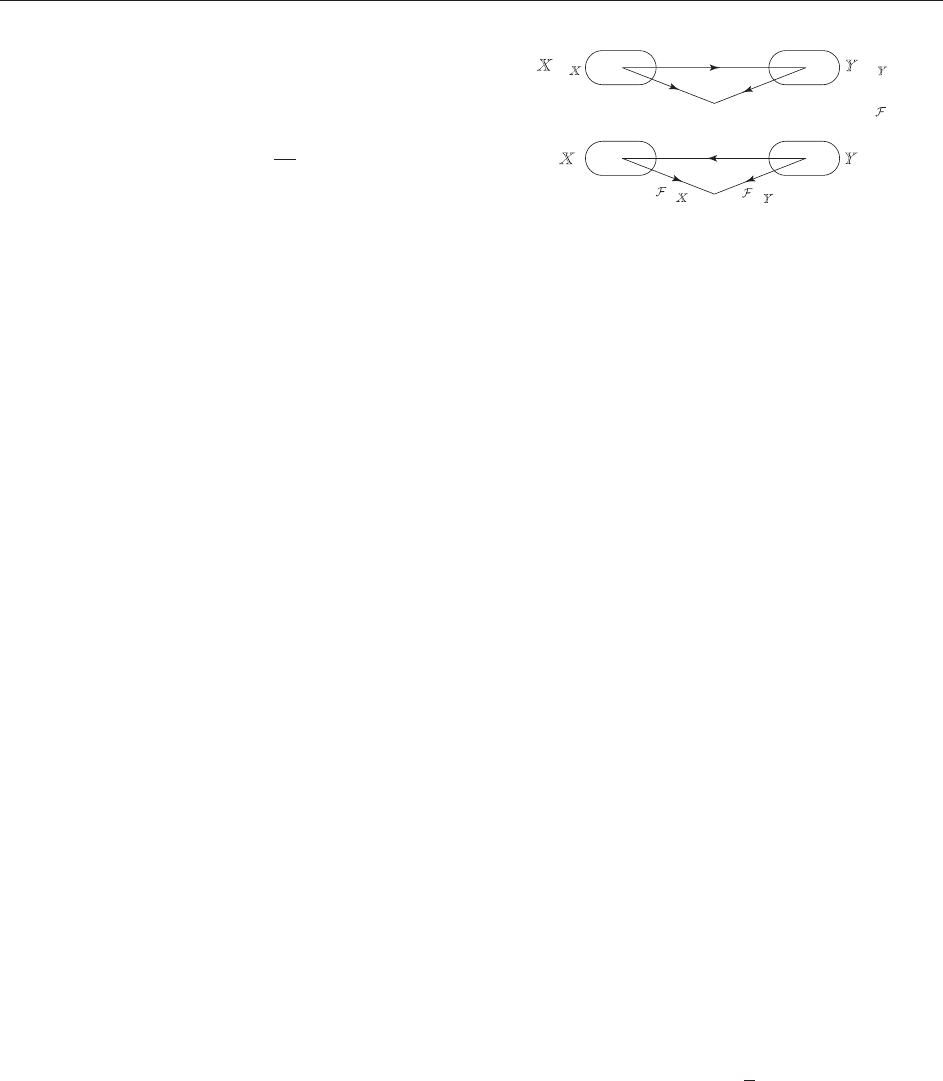
The linear maps [32]–[34] and their obvious
generalizations have been used for computing
explicitly many funct ional integrals (see Figure 2).
The basic formula reads
Z
X
d
X
ðxÞFðxÞ¼
Z
Y
d
Y
ðyÞf ðyÞ; F ¼ f L ½ 35
where the Fourier transform F is given by
F
Y
¼F
X
~
L ½36
~
L is the transpose of the linear map L defined by
h
~
Ly
0
; xi¼hy
0
; Lxi½37
Computing F
Y
does not require any calculation. It
can be read off eqn [36]. Com puting d
Y
is easy in a
number of cases such as the following:
1. Y is finite-dimensional. In other words [35] is
a cylindrical integral. Then
d
Y
ðyÞ¼dy
1
dy
D
detQ
ij
1=2
exp
s
QðyÞ
½38
where Q(y) is an abbreviation of
Q
Y
ðyÞ¼Q
Yij
y
i
y
j
½39
its inverseW
Y
0
ðy
0
Þin the sense of ½24–½25 is
W
Y
0
ðy
0
Þ¼W
ij
Y
0
y
0
i
y
0
j
½40
that is given by [36]:
W
Y
0
ðy
0
Þ¼W
X
0
~
L ½41
x
y
x
′
y ′
L
Γ
Γ
F
f
, Γ
′
, Γ
′
L
~
Γ
Figure 2 Linear maps. (Published with permission by Elsevier,
North Holland.)
Functional Integration in Quantum Physics 437

W
X
0
is the quadratic form defining
X
by [26].
When D is small, say less than 4, and this is not an
unusual situation, it is easy to compute [38].
Example (Wiener Gaussians and Brownian
motion). The Wiener Gaussian on the space P
a
R
of pointed paths x : T ! R, T = [t
a
, t
b
], x(t
a
) = 0is
defined by its variance [26]:
Wðx
0
Þ :¼
Z
T
dx
0
ðt
0
Þ
Z
T
dx
0
ðsÞinfðt; sÞ½42
Let Y be the Wiener differential space consisting of
the differences of two consecutive values of x on the
n-discretized time interval. The space Y is finite
dimensional,
L : X ! Y
by y
j
¼ xt
jþ1
xt
j
¼h
t
jþ1
t
j
; xi
It follows from [37] that
~
Ly
0
¼
X
j
y
0
j
t
jþ1
t
j
and
d
Y
ðxÞ¼dy
1
dy
n
1
Q
n
j¼1
st
j
1=2
exp
s
X
j
x
j
2
t
j
!
½43
where t
j
:= t
jþ1
t
j
and x
j
:= x(t
jþ1
)x(t
j
).
When s = 1 the Gaussian
Y
defines the distribu-
tion of a Brownian path. The Gaussian
X
of
covariance inf(t , s) is the Wiener measure.
&
2. In semiclassical approximations, Q
X
is the
Hessian (second variation) of an action functional S:
Q
X
ðhÞ¼
d
2
d
2
S xðÞðÞ
¼0
with h ¼
@
@
xðÞ
¼0
½44
where {x()} is a one-parameter family of paths [8].
The Jacobi field technology (the Jacobi operator is
defined by [103]; a Jacobi field is a solution of
[102]) yields the inverse of W
Y
0
and its determinants
(Cartier and DeWitt-Morette 2006); they have been
worked out for a variety of boundary conditions on
classical paths.
Volume Elements Other than Gaussian
The definition [26]–[27] of Gaussian volume ele-
ments is a particular case of volume elements on a
Banach space defined by
Z
D
; Z
’ ð’; JÞ :¼ ZðJÞ½45
for ’ in , and J in the dual
0
of . The volume
element D
, Z
is defined by two continuous bounded
functionals
:
0
! C and Z:
0
! C ½46
In quantum field theory, ’ is a field and J is a
source. The functional Z(J) is then the Schwinger
generating functional for the n-point functions. An
axiomatic and applications of functional integrals
on with volume elements D
, Z
can be found in
(Cartier and DeWitt-Morette (1993)).
Example (Poisson volume elements) (Cartier and
DeWitt-Morette (2006 ) and Collins (1997)). A
Poisson random variable is a random variable N
taking values in the set N of non-negative integers
such that the probability p
n
that N = n is
p
n
:¼ PrðN ¼ nÞ :¼ expðÞ
n
n!
; 0 ½47
Thanks to the normalizing constant exp (),
P
1
n = 0
p
n
= 1. The parameter is the mean value of N:
hNi¼ ½48
A record of fortuito us events occurring at random
times t
0
< T
1
< T
2
can consist either of the
number N(t) of events occurring at times less than
or equal to t, or of the waiting times
W
k
¼ T
k
T
k1
½49
between two consecutive events.
When the waiting times are stochastically inde-
pendent and when
Pr t < W
k
< t þ dtðÞ¼p
a
ðtÞdt ½50
p
a
ðtÞ¼a expðatÞ; t > 0 ½51
the record is a Poisson random variable. It is related
to the number of events N(t) as follows.
Let T be a finite time interval [t
0
, t
00
], and
N
T
¼ Nðt
00
ÞNðt
0
Þ½52
the number of events during T. The random variable
N
T
follows a Poisson law [47] with mean value
a
ðTÞ¼aðt
00
t
0
Þ½53
For mutually disjoint time intervals T
(1)
, T
(2)
, ... the
random variables N
T
(1)
, N
T
(2)
, ... are stochastically
independent.
Whereas the parameter must be real non-
negative, the parameter a can be pure imaginary;
therefore, Poisson processes defined by waiting
438 Functional Integration in Quantum Physics
times can be used in quantum physics as well as in
probability. When a is real, it is called the decay
constant because its physical dimension is [time]
1
.
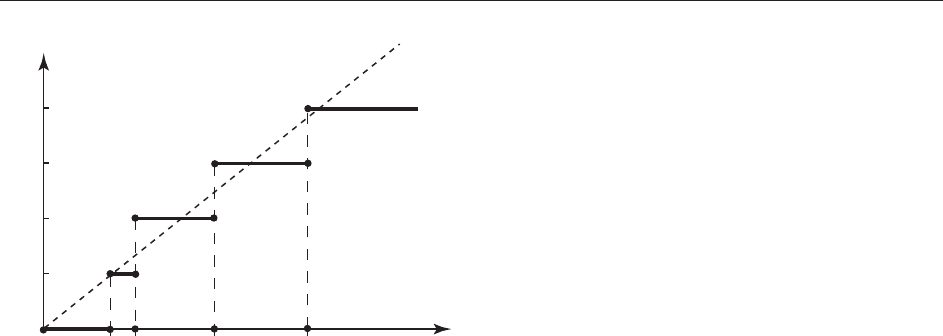
A Poisson path x 2 X
n
is characterized by n jumps
and the jump times during a given time inte rval
T = [t
a
, t
b
](Figure 3 illustrates a Poisson path
in X
4
). The space X of Poisson paths is the union
of all X
n
:
X ¼[X
n
½54
One can define a volume element D
a, T
on X by its
Fourier transform:
Z
X
D
a;T
x exp ihx; f iðÞ:¼ exp
Z
T
dtae
if ðtÞ
½55
Here a path x 2 X
n
, characterized by n jump times
T
1
, ..., T
n
, is represented by the sum
T
1
þþ
T
n
Hence
hx; f i¼fT
1
ð ÞþþfT
n
ðÞ ½56
The dimensionless volume element on T is
dvðtÞ¼a d t
Therefore,
volðTÞ¼aT; T ¼ t
b
T
a
volðX
n
Þ¼a
n
T
n
=n! ½57
volðXÞ¼exp volðTÞðÞ ½58
and it makes sense to write formally
X ¼ exp T
It can be proved that the volume element D
a, T
x is a
measure, in the technical sense of the word (Cartier
and DeWitt-Morette 2006).
Functional integration on spaces of Poisson paths
have been used extensively in solutions of Klein–
Gordon equations, the telegrapher equation and the
Dirac equation (Cartier and DeW itt-Morette 2006).
Other volume elements of interest in quantum
physics include (LaChapelle 2004):
gamma volume elements, which are to gamma
probability distributions what Gaussian volume
elements are to Gaussia n probability distribu-
tions; and
Hermite volume elements convenient for integrat-
ing Wick-ordered polynomials.
ADirac‘‘-function’’ is formally the limit of a
Gaussian integral. Formally, one can introduce a Dirac
functional volume element as the limit of a Gaussian
volume element.
The Koszul Formula
There are several roadblocks on the road from finite
to infinite-dimensional spaces. For instance, a
volume in a D-dimensional space is a top-differential
form, that is, a D-form. There is no top-form in an
infinite-dimensional space – neither on Grassmann
manifolds since Grassmann forms are totally sym-
metric tensors. A D-form in R
D
has only one strict
component and is equivalent to a scalar density of
weight 1, but scalar densities of weight 1 do not
form an algebra.
For these reasons, volume elements have so far
been defined by integrals [26], [27], [43], and [55].
Short of giving an explicit expression for their
differential forms, one can require them to satisfy
the Koszul formula
L
X
! ¼ DivðXÞ! ½59
where ! is a vo lume element on a Banach space X,
X a vector field generating a group of transforma-
tions on X, L
X
the Lie derivative defined by X, and
Div(X) the standard generalization of div(ergence)
on finite-dimensional spaces (see, e.g., Cartier and
DeWitt-Morette (2006) for the explicit expression of
divergences on Riemannian, symplectic, Grassmann
manifolds). The Koszul formula dictates how a
volume element changes under a group of
transformations.
It often happens that an object cannot be defined
per se, but that it is sufficient to define its variation. For
example, one does not define potentials, but potential
differences; the ratio of infinite-dimensional determi-
nants can be defined without defining each determi-
nant; the work of Wiener on ‘‘differential-spaces,’’
which is a landmark in functional integration, is based
N(t )
1
2
3
4
t
(0)
T
1
T
2
T
3
T
4
t
Figure 3 A Poisson path in X
4
.
Functional Integration in Quantum Physics 439

on differences between two consecutive values of a
function, etc. Similarly, the Koszul formula does not
define ! but gives its variation L
X
!.
The Operator Formalism of Quantum
Physics
Functional integrals can be used to represent
operator matrix elements, and solutions of the
Schro¨ dinger equation.
1. Matrix elements of operators on Hilbert spaces.
Symbolically,
hjexp iHt=hðÞji¼
Z
X
Dx exp iSðxÞ=hðÞ½60
The domain of integration X
is a space of paths
x on [t, 0] satisfying initial conditions that
characterize the quantum state , and final
conditions that characterize the quantum state .
The action functional S yields the Hamiltonian H.
A key property of path integrals is their
representations of matrix elements of time-
ordered operators. The path parameter (time,
scale, or any other parameter) provides the
operator ordering [11]. A simp le example is the
two-point function of the Wiener measure [42]:
Z
X
dðxÞxðtÞxðsÞ¼infðt; sÞ½61
The function integral orders the time, that is, the
argument of the variable of integration. In
quantum field theory, time ordering becomes a
chronological ordering dictated by light cones.
2. Schro¨ dinger equation and other parabolic equa-
tions (Cartier and DeWitt-Morette 2006).
The following theorem provides the mathematical
underpinning for a great variety of functional inte-
grals. It also provides a construction of functional
integrals, which begins with the symmetries of a given
physical system rather than its action functional. The
theorem consists of two parts: the definition of a
functional integral, and the partial differential equa-
tion satisfied by the value of the functional integral, as
a function of a set of parameters.
Given a manifold M, consider the contractible
space P
0
M of pointed L
2, 1
paths over T = [t
a
, t
b
]:
x : T ! M; e:g:, xðt
b
Þ¼x
b
;
i:e:, x 2P
0
M ½62
Given D þ 1 vector field Y,{X
()
}, generators of
group of transformations on M, define a map
P : P
0
R
D
!P
b
M by z ! x ½63
explicitly
dxðt; zÞ¼X
ðÞ
xðt; zÞðÞdz
þ Yxðt; zÞðÞdt ½64
xðt
b
; zÞ¼x
b
; zðt
b
Þ¼0 ½65
In general, the vector fields do not commute and the
solution of [64]–[65] is of the form
xðt; zÞ¼x
b
X
ðt; zÞ½66
where (t, z) is an element of a group of right
actions on M, defined by the D þ 1 generators Y,
{X
()
}:
x
b
X
t þ t
0
; z z
0
ðÞ¼x
b
X
ðt; zÞ
X
ðt
0
; z
0
Þ
The path z defined on [t
a
, t] is followed by the path
z
0
on [t, t
0
].
Consider the following functional integral over
P
0
R
D
of a functional of paths on P
b
M:
U
T
ðÞðx
b
Þ :¼
Z
P
0
R
D
D
s;Q
z exp
s
QðzÞ
x
b
X
ðt; zÞ
½67
where
QðzÞ¼
Z
T
dth
_
z
ðtÞ
_
z
ðtÞ½68
The functional (U
T
)atx
b
is a function (T, x
b
). It
is a solution of the generalized Schro¨dinger equation,
@
@T
¼
s
h
L
X
ðÞ
L
X
ðÞ
þL
Y
½69
This equation is valid on manifolds M (e.g., frame
bundles, U(N) bundles, multiply connected spaces,
symplectic manifold phase space) in arbitrary sys-
tems of coordinates.
Example (Polar coordinates on R
D
). Let us
abbreviate z
(t)toz
, x
1
(t)tor,andx
2
(t)to.It
follows from
z
1
¼ r cos ; z
2
¼ r sin ½70
that
dr ¼ cos dz
1
þ sin dz
2
¼: X
1
ð1Þ
dz
1
þ X
1
ð2Þ
dz
2
d ¼
sin
r
dz
1
þ
cos
r
dz
2
¼: X
2
ð1Þ
dz
1
þ X
2
ð2Þ
dz
2
8
>
>
>
>
>
>
>
>
<
>
>
>
>
>
>
>
>
:
½71
440 Functional Integration in Quantum Physics

The dynamical vector fields are, therefore,
X
ð1Þ
¼ cos
@
@r
sin
r
@
@
½72
X
ð2Þ
¼ sin
@
@r
þ
cos
r
@
@
½73
Here h
=
and eqn [69] reads
@
@t
¼
s
4
@
2
@r
2
þ
1
r
2
@
2
@
2
þ
1
r
@
@r
½74
This example is trivial because x(t, z) is not a
functional of z but a function of z(t) given by [70].
In the following example, x(t, z) is a functional of z.
Example (Paths with values on a Riemannian
manifold (M
D
, g)). Consider the frame bundle over
M
D
and a connection defining the horizontal lift
_
(t) of a vector
_
x(t),
_
ðtÞ¼ððtÞÞ
_
xðtÞ½75
In order to bring eqn [75] in the form [64], we think
of a frame u(t) as a linear map from R
D
into the
tangent space T
x(t)
M
D
:
uðtÞ: R
D
! T
xðtÞ
M
D
½76
Let
_
zðtÞ :¼ uðtÞ
1
_
xðtÞ½77
Choose a basis {e
(A)
}inR
D
and {e
()
}inT
x(t)
M
D
such that
_
zðtÞ¼
_
z
A
ðtÞe
ðAÞ
¼ uðtÞ
1
ð
_
x
ðtÞe
ðÞ
Þ½78
Insert u(t) u(t)
1
into [75], then
_
ðtÞ¼X
ðAÞ
ðtÞðÞ
_
z
A
ðtÞ½79
where the dynamical vector fields are
X
ðAÞ
ððt ÞÞ ¼ ðððtÞÞ uðtÞÞ e
ðAÞ
½80
The construction [64]–[69] gives a parabolic equation
on the bundle. If the connection is the metric
connection, then the parabolic equation on the bundle
gives, by projection on the base space, the parabolic
equation with the Laplace–Beltrami operator. Expli-
citly, the projection on the base space of [67] is
t
b
; x
b
ðÞ:¼
Z
P
b
R
D
D
s; Q
ðzÞexp
s
QðzÞ
Dev zðÞðt
a
ÞðÞ ½81
where Dev is the Cartan development map, namely
the bijection, defined by [82], from the space of
pointed paths z on T
b
M
D
(identified to R
D
via the
frame u
B
) into the space of pointed paths x on M
D
(paths such that x(t
b
) = x
b
):
ðÞðtÞ¼: Dev zðÞðtÞ½82
is the projection on the base space. The path
integral [81] is the solution of the equations
@
@t
b
ðt
b
; x
b
Þ¼
s
4
ðt
b
; x
b
Þ½83
ðt
a
; xÞ¼ðxÞ½84
where is the Laplace–Beltrami operator on (M
D
, g),
¼ g
ij
D
i
D
j
½85
and D
i
is the covariant derivative defined by the
Riemann connection .
Semiclassical Expansions
Classical mechanics is a limit of quantum
mechanics; therefore, it is natural to expand the
action functional S of a given system around, or
near, its classical value – namely its minimum S(q),
where q is a solution of the Euler–Lagrange
equation,
S
0
ðqÞ¼0 ½86
Set
SðxÞ¼SðqÞþS
0
ðqÞ þ
1
2!
S
00
ðqÞ
þ
1
3!
S
000
ðqÞ þ ½87
where x 2 X is a path
x : T ! M
D
and , 2 T
q
X is a vector field at q 2 X. The second
variation of S is called its Hessian
S
00
ðqÞ ¼: Hess q; ; ðÞ ½88
The arena of semiclassical expansions of a func-
tional integral schematically written as
I ¼
Z
X
a;b
Dx exp iSðxÞ=hðÞð xt
a
ðÞðÞÞ½89
consists of the intersection U
a, b
of two spaces
X
a, b
X the space of paths satisfying D initial
conditions (a) and D final conditions (b), and
U
2D
(S) the space of critical points of S
q 2 U
2D
ðSÞ; S
0
ðqÞ¼0 ½90
U
a;b
:¼ X
a;b
\ U
2D
ðSÞ ½91
Functional Integration in Quantum Physics 441
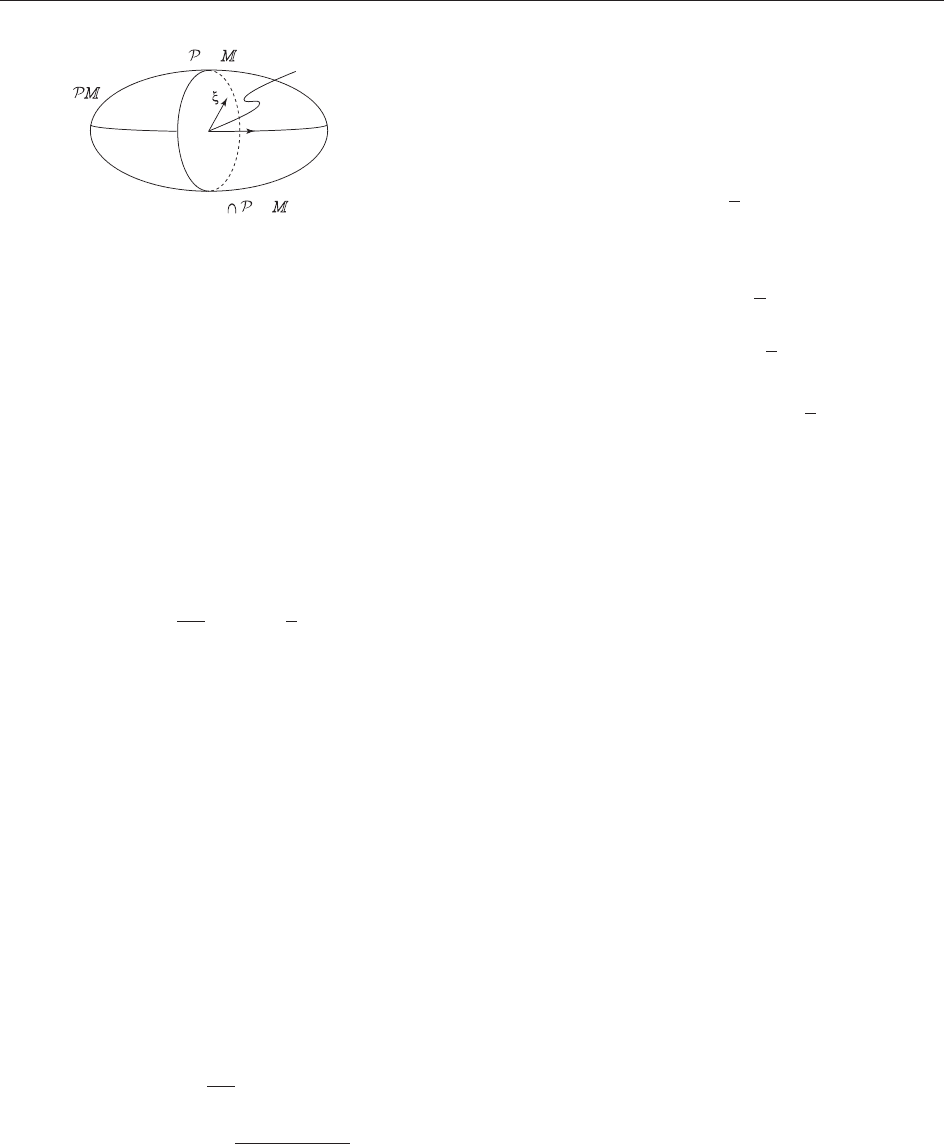
The nature of the intersection U
a, b
determines the
behavior of the system S. Figure 4 shows the
intersection of the space X
a, b
of paths on M
D
with
fixed points. It also shows the space U
2D
(S)of
critical points of S.
We consider first the case in which U
a, b
consists
of a single point q, or several isolated points q
(i)
. The
semiclassical expansion consists in dropping the
terms beyond the Hessian:
I
WKB
:¼
Z
X
b
D exp
2i
h
SðqÞþ
1
2
S
00
ðqÞ
ð xðt
a
ÞÞ ½92
where the initial wave function accounts for the D
initial conditions of the system, and X
b
is the space
of pointed paths
xðt
b
Þ¼x
b
; and ðt
b
Þ¼0 for every x 2 X
b
½93
WKB Approximations
The integral I
WKB
is the Gaussian defined by the
Hessian. Explicit calculations of I
WKB
exploit the
power of Jacobi fields of S at q.
Example (Momentum-to-position transitions) (e.g.,
Cartier and DeWitt-Moret te 2006). We have
I
WKB
ðx
b
; t
b
; p
a
; t
a
Þ¼exp
2i
h
Sqðt
b
Þ; pðt
a
ÞðÞ
det
@
2
S
@q
i
ðt
b
Þ@p
j
ðt
a
Þ
1=2
½94
where S is the action function (a.k.a. Hamilton’s
principal function)
Sqðt
b
Þ; pðt
a
ÞðÞ¼SðqÞþhp
a
; xðt
a
Þi ½95
where the classical path q is characterized by its
initial momentum p
a
and its final position x
b
. The
proof of [94] rests on the following property of
quadratic forms Q. Let L : X ! Y linearly and
Q
X
¼ Q
Y
L ½96
According to the notations used in [26 ], [27] ,
Z
X
D
X
ðxÞexp
s
Q
X
ðxÞ
¼ 1 ½97
According to [35], [27],
1 ¼
Z
X
D
X
ðxÞexp
s
Q
X
ðxÞ
¼
Z
Y
D
Y
ðLxÞexp
s
Q
Y
ðLxÞ
½98
¼jdetLj
Z
D
Y
ðxÞexp
s
Q
X
ðxÞ
½99
If s = 1, that is, if Q
X
and Q
Y
are positive definite,
then
Z
X
D
Y
ðxÞ exp Q
X
ðxÞ
ðÞ
¼¼ det Q
X
=Q
Y
ðÞ
1=2
½100
If s = i, that is, for Feynman integrals
Z
X
D
Y
ðxÞexp Q
X
ðxÞðÞ
¼ det Q
X
=Q
Y
ðÞ
jj
1=2
i
IndðQ
X
=Q
Y
Þ
½101
where ‘‘Ind(Q
X
=Q
Y
)’’ is the ratio of the numbers of
negative eigenvalues of Q
X
and Q
Y
respectively, and
i =
ffiffiffiffiffiffi
1
p
= e
i=2
.
Equation [100] is a key equation for semiclassical
expansions where it is convenient to break up the
second variation S
00
(q) into two quadratic forms:
S
00
ðqÞ ¼ Q
0
ðÞþQð Þ½102
where Q
0
is the kinetic energy. The quadratic form
Q
0
is a convenient Gaussian volume element for
computing [92]. Moreover, splitting the Hessian
into Q
0
þ Q corresponds to splitting the system into
a ‘‘free’’ system and a perturbation.
In eqns [100] and [101] the determinant of the
ratios of the infinite-dimensional quadratic forms
Q
X
=Q
Y
have been shown (Cartier and DeWit t-
Morette 2006) to be a finite-dimensional determi-
nant, thanks to Jacobi field technology.
Degenerate Hessians; Beyond WKB
When U
a, b
consists of isolated points, the Hessian is
not degenerate, and the semiclassical expansion is
usually called the (strict) WKB approximation.
When the Hessian is degenerate,
S
00
ðqÞ ¼ 0 for 6¼ 0 ½103
D
D
h
U
2D
(S )
U
a, b
U
a, b
: U
2D
(S )
a, b
D
a, b
Figure 4 Intersection of the space P
a, b
M
D
(abbreviated to
X
a, b
) of paths on M
D
with fixed points, and the 2D-dimensional
space U
2D
(S) of critical points of the system S. (Adapted from a
Plenum Press publication with permission by Springer-Verlag.)
442 Functional Integration in Quantum Physics
there is at least one nonzero Jacobi fie ld h along q,
S
00
ðqÞh ¼ 0; h 2 T
q
U
2D
ðSÞ ½ 104
with D vanishing initial conditions (a)andD
vanishing final conditions (b). Equation [104] is
the defining equation of Jacobi fields. The vanishing
boundary conditions imply that h 2 T
q
X
a, b
as well
as being a Jacobi field.
For understanding the intersections U
a, b
when the
Hessian is degenerate, one can construct the follow-
ing basis for the intersecting tangent spaces
T
q
U
2D
(S) and T
q
X
a, b
:
Basis for T
q
U
2D
(S): a complete set (if it exists) of
linearly independent Jacobi fields. It can be
constructed by varying the 2D conditions (a), (b)
satisfied by q 2 X
a, b
.
Basis for T
q
X
a, b
: a complete set of orthonormal
eigenvectors {
k
} of the Jacobi operator J(q)
defined by the Hessian
S
00
ðqÞ ¼: hhJðqÞ;i;i½105
JðqÞ
k
¼
k
k
; k 2f0; 1; ...g½106
The basis {
k
} diagonalizes the Hessian. When
the Hessian is degenerate, there is at least one
eigenvector of J(q) with zero eigenvalue.
1. The intersection U
a, b
is of dimension l > 0. Let
{u
k
} be the coordinates of in the {
k
} basis of
T
q
X
a, b
. Then the diagonalized Hessian is
S
00
ðqÞ ¼
X
1
k¼0
k
ðu
k
Þ
2
½107
There are l zero eigenvalues {
k
} when the system of
Euler–Lagrange equations decouples (possibly after
a change of variable in X
a, b
) into two sets: l
constraint equations, and D l equations determin-
ing D l coordinates {q
A
}ofq. Say l = 1, for
simplicity. Then
SðxÞ¼Sðq Þþc
0
u
0
þ
1
2
X
1
k¼1
k
ðu
k
Þ
2
þ Oðjuj
3
Þ½108
where
c
0
¼
Z
T
dt
S
q
j
ðtÞ
j
0
ðtÞ½109
The change of variable ! {u
k
} is a linear change
of variable of type [33]. The integral [92]
decomposes into the product of an ordinary integral
over u
0
and a Gaussian functional integral defined
by a nondegenerate quadratic form. The integral
over u
0
yields a Dirac -function, (c
0
=h). The
propagator vanishes unless the conservation law
c
0
= 0 is satisfied.
Conservation laws appear in the classical limit of
quantum physics. The quantum system may have
less symmetry than its classical limit.
2. The intersection U
a, b
is a multiple root of the
Euler–Lagrange equation. The flow of classical
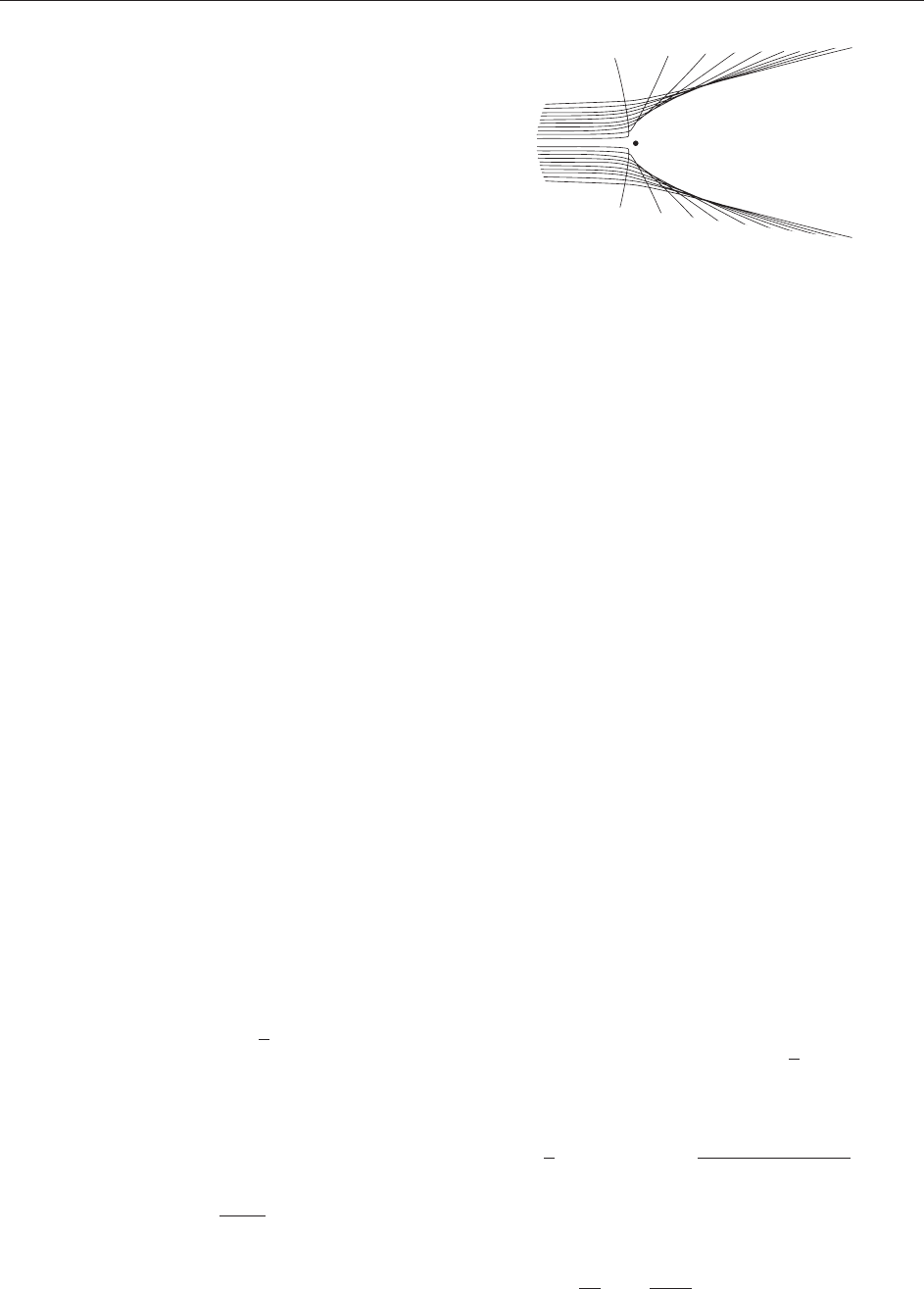
solutions has an envelope, known as a caustic.
Caustics abound in physics: the soap bubble
problem, scattering of particles by a repulsive
Coulomb potential (see Figure 5), rainbow scatter-
ing from a source at infinity, glory scattering etc.
(Cartier and DeWitt-Morette 2006).
Let us consider a specific example for simplicity.
For instance, the scattering of particles of given
momenta p
a
by a repulsive Coulomb potential.
Let q and q
be two solutions of the Euler–
Lagrange equation with slightly different boundary
conditions at t
b
.ComputeI(x
b
, t
b
; p
a
, t
a
)byexpand-
ing the action functional not around q
but around q.
The path q
is not in X
a, b
and the expansion of the
action functional has to be carried up to and including
the third variation. As before, let {u
k
}bethe
coordinates of in the base {
k
}, k 2 {0, 1 ...}. The
integral over u
0
is an Airy integral
1=3
Ai
1=3
c
Z
R
du
0
exp i cu
0
þ
3
u
0
3
½110
where
¼
h
Z
T
dr
Z
T
ds
Z
T
dt
3
S
q
ðrÞq
ðsÞq
ðtÞ
0
ðrÞ
0
ðsÞ
0
ðtÞ
½111
c ¼
2
h
Z
T
dt
S
qðtÞ
0
ðtÞ x
b
x
b
½112
Figure 5 A flow of particles scattered by a repulsive Coulomb
potential. (Reprinted from Physical Review D with permission by
the American Physical Society.)
Functional Integration in Quantum Physics 443

The leading contribution of the Airy function when
h tends to zero can be computed by the stationary
phase method. When x
b
is in the ‘‘illuminated’’
region, the probability amplitude I(x
b
, t
b
; p
a
, t
a
)
oscillates rapidly as h tends to zero. When x
b
is in
the ‘‘dark’’ region, the probability amplitude decays
exponentially. Quantum mechanics softens up the
caustics.
The two kinds of degeneracies described in
sections (1) and (2) may occur simultaneously. This
happens, for instance, in glory scattering for which
the cross section, to leading terms in the semiclassi-
cal expansions, has been obtained by functional
integration in closed form in terms of Bessel
functions (Cartier and DeWitt-Morette 2005).
3. The intersection U
a, b
is the empty set. There is
no classical solution corresponding to the quantum
transition. This phenomenon, called ‘‘tunneling’’ or
‘‘barrier penetration,’’ is a rich chapter of quantum
physics which can be found in most of the books
listed under ‘‘Further reading.’’
A Multipurpose Tool
Functional integration provides insight and techni-
ques to quantum physics not available from the
operator formalism. Just as an example, one can
quote the section ‘‘Beyond WKB’’ which has often
been dismissed in the operator formalism by stating
that ‘‘WKB breaks down’’ in such cases.
The power of functional integration stems from
the power of infinite-dimensional spaces. For
instance, compare the Lagrangian of a system with
its action functional
SðxÞ¼
Z
T
dtL
_
xðtÞ; xðtÞðÞ; x 2 X
a;b
x : T ! M
D
; S : X
a;b
! R ½113
A classical solution q of the system can be defined
either by a solution of the Euler–Lagrange equation,
together with the boundary conditions dictated by
q 2 X
a, b
or by an extremum of the action func-
tional, S
0
(q) = 0. The path q is a significant point in
X
a, b
but it is not isolated and the Hessian S
00
(q)
gives much information on q, such as conservation
laws, caustics, tunneling.
A list of applications is beyond the scope of this
article. We treat only two applications, then give in
the ‘‘Further reading’’ section a short list of books
that develop such applications as polarons, phase
transitions, properties of quantum gases, scattering
processes, many-body theory of bosons and fer-
mions, knot invariants, quantum crystals, quantum
field theory, anomalies, etc.
The Homotopy Theorem for Paths Taking Their
Values in a Multiply-Connected Space
The space X
a, b
of paths x
x: T ! M
D
; x 2 X
a;b
probes the global properties of their ranges M
D
.
When M
D
is multiply connected, X
a, b
is the sum of
distinct homotopy classes of paths. The integral over
X
a, b
is a linear combination of integrals over each
homotopy class of paths. The coefficients of this
linear combinati ons are provided by the homotopy
theorem.
The principle of superposition of quantum states
requires the probability amplitude for a given
transition to be a linear combination of probability
amplitudes. It follows that the absolute value of the
probability amplitude for a transition from the state
a at t
a
to the state b at t
b
has the form
Kb; t
b
; a; t
a
ðÞ
jj
¼
X
ðÞK
b; t
b
; a; t
a
ðÞ
½114
where K
is the interval over paths in the same
homotopy class. The homotopy theorem (Laidlaw
and Morette-DeWitt 1971) and (Schulman 1971)in
Cartier and DeWitt-Morette (2006)) states that the
set {()} forms a representation of the fundamental
group of the multiply connected space M
D
. One
cannot label a homotopy class by an element of the
fundamental group unless one has chosen a point
c 2 M
D
and a homotopy class for paths going from
c to a an d for paths going from c to b – in brief,
unless one has chosen a homotopy mesh on M
D
.
The fundamental group based at c is isomorphic to
the fundamental grou p based at any other point of
M
D
but not canonically so. Therefore, eqn [114] is
only an equality between absolute values of prob-
ability amplitudes. The proof of the homotopy
theorem consists in requiring [114] to be indepen-
dent of the chosen homotopy mesh.
Application: Systems of n-Indistinguishable
Particles in R
D
In order that there be a one-to-one correspondence
between the system and its configuration space,
x : T ! R
Dn
=S
n
¼: R
D;n
where S
n
is the symmetric group for n permutations;
the coincidence points in R
D, n
are excluded so that
S
n
acts effectively on R
D, n
. Note that R
1, n
is not
connected, but R
2, n
is multiply connected. When
D 3, R
D, n
is simply connected and the fundamen-
tal group on R
D, n
is isomorphic to S
n
.
444 Functional Integration in Quantum Physics

There are only two scalar unitary representations
of S
n
:
B
: 2 S
n
! 1 for all permutations
F
: 2 S
n
!
1 for even permutations
1 for odd permutations
Therefore, in R
3
there are two different propagators
of indistinguishable particles:
K
bose
¼
X
B
ðÞK
½115
is a symmetric propagator
K
fermi
¼
X
F
ðÞK
½116
is an antisymmetric propagator.
The arguments leading to the existence of (scalar)
bosons and fermions in R
3
fails in R
2
. Stat istics
cannot be assigned to particles in R
2
; particles
‘‘without’’ statistics have been called anyons.
Application: a Spinning Top
Schulman’s analysis of the Schro¨ dinger equation for
a spinning top (Schulmann 1968) motivated the
formulation of the homotopy theorem. Therefore,
Schulman’s results can easily be form ulated as an
application of [114].
Application: Instantons (DeWitt 2004)
The homotopy theorem reformulated for functional
integrals applies to the total houtjini amplitude of
instantons in Minkowski spacetime.
Scaling Properties of Gaussians
We rewrite the definition [26] of Gaussian volume
elements as
Z
X
d
G
ðxÞexp 2ihx
0
; xiðÞ:¼ exp iWðx
0
ÞðÞ½117
where the covariance G is defined by the variance W,
Wðx
0
Þ¼hx
0
; Gx
0
i
In quantum field theory the definition [26] reads
Z
d
G
ð’Þexp 2ihJ;’iðÞ:¼ exp iWðJÞðÞ½118
where ’ is a field on spacetime (Minkowski, or
Euclidean) and J is called the source. A Gaussian
G
can be decomposed into the convolution of any
number of Gaussians. For example, if
W ¼ W
1
þ W
2
! G ¼ G
1
þ G
2
½119
then
G
¼
G
1
G
2
½120
Explicitly, in QFT
Z
d
G
ð’Þexp 2ihJ;’iðÞ
¼
Z
d
G
2
’
2
ðÞ
Z
d
G
1
’
1
ðÞ
exp 2ihJ;’
1
þ ’
2
iðÞ½121
where
’ ¼ ’
1
þ ’
2
½122
The additive property [119] makes it possible to
express a covariance G as an integral over an
independent scale variable.
Let 2 [0, 1] be an independent scale variable.
(some authors use 2 [1, 1[ and
1
2 [0, 1[). A
scale variable has no physical dimension:
½¼0 ½123
The scaling operator S
acting on a function f of
length dimension [f ] is by definition
S
f ðxÞ :¼
½f
fx=ðÞ ½124
the scaling of an interval [a, b[ is given by
S
[a, b[ = {s=js 2 [a, b[}, that is,
S
½a; b½¼½a=; b=½½125
The scaling of a functional F is
S
FðÞð’Þ¼FS
’ðÞ ½126
In order to decompose a covariance into an integral
of scale-dependent contributions we note that a
covariance G is a two-point function [31].In
quantum field theory [118], the engineering lengt h
dimension of G is twice the field dimension
½G¼2½’½127
Let x, y 2 spacetime and G be a Laplacian Green
function. One can introduce a scaled (truncated)
Green function
G
½l
0
;l½
ðx; yÞ :¼
Z
l
l
0
d
sS
s=l
0
u jx yjðÞ½128
where
½l¼1; ½s¼1; d
s ¼ ds=s
l
0
l; ½u¼½G½129
such that
lim
l
0
¼0;l¼1
G
½l
0
;l ½
ðx; yÞ¼Gðx; yÞ½130
Functional Integration in Quantum Physics 445