
Francoise J.-P., Naber G.L., Tsun T.S. (editors) Encyclopedia of Mathematical Physics
Подождите немного. Документ загружается.


Fredholm alternative, the spectrum of a compact
operator consists only of point spectrum; it is
countable with accumulation point at 0. A Hamilto-
nian of a qua ntum mechanichal system can have
both point and continuous spectra, but its point
spectrum is of special interest because the corre-
sponding eigenfunctions are stationary states of the
system. As was first pointed out by Kac (‘‘Can you
hear the shape of a drum?’’), the spectrum of an
operator acting on functions can reflect the geome-
try of the space these functions are defined on, a
starting point for many interesting and far-reaching
questions in differential geometry.
A self-adjoint linear operator on a Hilbert space
can be described in terms of a family of projections
E
, 2 R via the spectral representation
A ¼
Z
SpðAÞ
dE
Given a Borel real-valued function f on R, the operator
f ðAÞ¼
Z
SpðAÞ
f ðÞdE
yields another self-adjoint operator. A positive
operator A on a dense domain D(A) of some Hilbert
space (H,h, i
H
) has non-negative spectrum and for
any positive real number t, the map 7!e
t
gives
the associated bounded heat-operator
e
tA
¼
Z
SpðAÞ
e
t
dE
while the map 7!
ffiffiffi
p
gives rise to a positive
operator
ffiffiffiffi
A
p
such that
ffiffiffiffi
A
p
2
= A.
The resolvent can also be used to define new
operators
f ðAÞ¼
1
2i
Z
C
f ðÞRðA;Þd
from a linear operator via a Cauchy-type integral
along a countour C around the spectrum; this way
one defines complex power s A
z
of (essentially self-
adjoint) positive elliptic pseudodiffferential opera-
tors which enter the definition of the zeta-function,
z 7!(A, z), of the operator A. The -function is a
useful tool to extend the ordinary determinant to
-det erminants of self-adjoint elliptic operators,
thereby providing an ansatz to give a meaning to
partition functions in the path integral approach to
quantum field theory.
Operator Algebras
Bounded linear operators on a Hilbert space H
form an algebra L(H) closed for the operator norm
with involution given by the adjoint operation
A 7!A
;itisaC
-algebra, that is, an algebra over
C with a norm kkand an involution such that A
is closed for this norm and such that kabkkakkbk
and ka
ak= kak
2
for all a, b 2 A and by the
Gelfand–Naimark theorem, every C
-algebra is
isomorphic to a sub-C
-algebra of some L(H). The
notion of spectrum extends from bounded opera-
tors to C
-algebras; the spectrum sp(a)ofan
element a in a C
-algebra A is a (compact) set of
complex numbers su ch that a 1 is not inver-
tible. The notion of self-adjointness also extends
(a = a
), and just as a self-adjoint operator B 2
L(H) is non-negative (in which case its spectrum
lies in R
þ
) if and only if B = A
A for some bounded
operator A, an element b 2 A is said to be non-
negative if and only if b = a
a for some a 2 A,in
which case sp(a) R
þ
0
.
The algebra C(X) of continuous functions f : X !
C vanishing at infinity on some locally compact
Hausdorff space X equipped with the supremum
norm and the conjugation f 7!
f is also a C
-algebra
and a prototype for abelian C
-algebras, since
Gelfand showed that every abelian C
-algebra is
isometrically isomorphic to C(X), with X compact if
the algebra is unital. To a C
-algebra A, one can
associate an abelian group K
0
(A) which is dual to the
Grothendieck group K
0
(X) of isomorphism classes of
vector bundles over a compact Hausdorff space X.
Compact operators on a Hilbert space H form
the only proper two-sided ideal K(H)oftheC
-
algebra L(H) which is closed for the operator norm
topology on L(H). The quotient L(H)=K(H)is
called the Calkin space, after Calkin, who classi-
fied all two-sided ideals in L(H) for a separable
Hilbert space H; one can set up a one-to-one
correspondence between such ideals and certain
sequence spaces. Corresponding to the Banach
space l
1
(Z) of complex-valued sequences (u
n
)such
that
P
n2N
ju
n
j < 1,isthe-ideal I
1
(H)oftrace-
class operators. The t race tr(A) =
P
n2Z
hAe
n
,e
n
i
H
of a negative operator A 2L(H) lies in [0, þ1]
and is independent of the choice of the complete
orthonormal basis {e
n
, n 2 Z}ofH equipped with
the inner product h, i
H
. I
1
(H) is the Banach space
of bounded linear operators on H such that
kAk
1
= tr(jAj) is bounded. Given an (esssentially
self-adjoint) positive differential operator D of
order d acting on smooth functions on a closed
n-dimensional Riemannian manifold M,its
complex power D
z
is a trace class on the space
of L
2
-functions on M provided Re(z) > n=d and the
corresponding trace tr(D
z
) extends to a mero-
morphic function on the whole plane, the
-function (D, z) which is holomorphic at 0.
Introductory Article: Functional Analysis 95

More generally, Banach spaces l
p
(Z), 1 p < 1,
of complex-valued sequences (u
n
)
n2Z
such that
P
n2Z
ju
n
j
p
< 1 relate to Schatten ideals I
p
(H), 1
p < 1, where I
p
(H) is the Banach space of bounded
linear operators on H such that kAk
p
= (tr (jAj
p
))
1=p
is bounded. Just as all l
p
-sequences converge to 0,
the Schatten ideals I
p
(H) all lie in K(H) and we
have I
pþ1
(H) I
p
(H) K(H).
Compact operators and S chatten ideals are
useful to extend index theory to a noncommuta-
tive context; a Fredholm module (H, F)overan
involutive algebra A is given by a n inv olutive
representati on of A in a Hilbert space H and
a self-adjoint bounded linear operator F on H
such that F
2
= Id
H
and the operator brackets
[F, (a)] are c ompact for all a 2 A.Toa
p-summable F redholm module (H, F), that is,
[F, (a)] 2I
p
(H)foralla 2 A, one associates a
representati ve of the Chern character ch
(H, F)
given by a cyclic cocycle on A, which pairs up with
K-theory to build an integer-valued index map
on K-theory.
Schatten ideals are also useful to investigate the
geometry of infinite-dimensional spaces such as loop
groups, for which the Hilbert–Schmidt operators
(operators in I
2
(H) are also called Hilbert–Schmidt
operators) are particularly useful. A Ho¨ lder-type
inequality shows that the product of two Hilbert–
Schmidt operators is trace-class. Moreover, for any
two Hilbert–Schmidt operators A and B, the
‘‘cyclicity property’’ that tr(AB) = tr(BA) holds,
and the sesquilinear form (A, B) 7!tr(AB
) makes
L
2
(H) a Hilbert space.
Further Reading
Adams R (1975) Sobolev Spaces. London: Academic Press.
Dunford N and Schwartz J (1971) Linear Operators. Part I.
General Theory. Part II. Spectral Theory. Part III. Spectral
Operators. New York: Wiley.
Hille E (1972) Methods in Classical and Functional Analysis.
London: Academic Press and Addison-Wesley.
Kato T (1982) A Short Introduction to Perturbation Theory for
Linear Operators. New York–Berlin: Springer.
Reed M and Simon B (1980) Methods of Modern Mathematical
Physics vols. I–IV, 2nd edn. New York: Academic Press.
Riesz F and SZ-Nagy B (1968) Lec¸ons d’analyse fonctionnelle.
Paris: Gauthier–Villars: Budapest Akademiai Kiado.
Rudin W (1994) Functional Analysis, 2nd edn. New York:
International Series in Pure and Applied Mathematics.
Yosida K (1980) Functional Analysis, 6th edn. Die Grundlehren
der Mathematischen Wissenschaften in Einzeldarstellungen
Band vol. 132. Berlin–New York: Springer.
Introductory Article: Minkowski Spacetime and Special Relativity
G L Naber, Drexel University, Philadelphia, PA, USA
ª 2006 Elsevier Ltd. All rights reserved.
Introduction
Minkowski spacetime is generally regarded as the
appropriate mathematical context within which to
formulate those laws of physics that do not refer
specifically to gravitational phenomena. Here we
shall describe this context in rigorous terms,
postulate what experience has shown to be its
correct physical interpretation, and illustrate by
means of examples its appropriateness for the
formulation of physical laws.
Minkowski Spacetime
and the Lorentz Group
Minkowski spacetime M is a four-dimensional real
vector space on which is defined a bilinear form
g : MM ! R that is symmetric (g(v, w) = g(w, v)
for all v, w 2M) and nondegenerate (g(v, w) = 0
for all w 2Mimplies v = 0). Further, g has index 1,
that is, there exists a basis {e
1
, e
2
, e
3
, e
4
} for M with
gðe
a
; e
b
Þ¼
ab
¼
1ifa ¼ b ¼ 1; 2; 3
1ifa ¼ b ¼ 4
0ifa 6¼ b
8
<
:
g is called a Lorentz inner product for M and any
basis of the type just described is an orthonormal
basis for M. We shall often write v w for the value
g(v, w)ofg on (v, w) 2MM. A vector v 2Mis
said to be spacelike, timelike, or null if v v is
positive, negative, or zero, respectively, and the set
C
N
of all null vectors is called the null cone in M.If
{e
1
, e
2
, e
3
, e
4
} is an orthonormal ba sis and if
we write v = v
1
e
1
þ v
2
e
2
þ v
3
e
3
þ v
4
e
4
= v
a
e
a
(using
the Einstein summation convention, according to
which a repeated index, one subscript and one
superscript, is summed over its possible values) and
w = w
b
e
b
, then
v w ¼ v
1
w
1
þ v
2
w
2
þ v
3
w
3
v
4
w
4
¼
ab
v
a
w
b
96 Introductory Article: Minkowski Spacetime and Special Relativity
In particular, v is null if and only if
ðv
4
Þ
2
¼ðv
1
Þ
2
þðv
2
Þ
2
þðv
3
Þ
2
(hence the name null ‘‘cone’’ for C
N
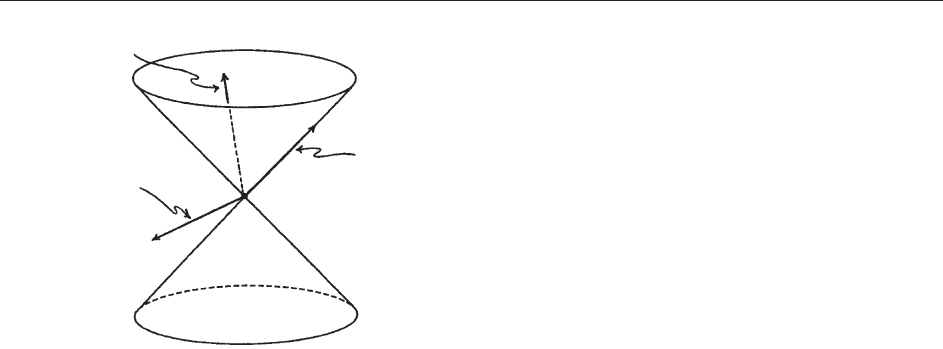
). Timelike vectors
are ‘‘inside’’ the null cone and spacelike vectors are
‘‘outside’’ (see Figure 1).
We select some orientation for the vector space M
and will henceforth consider only oriented, ortho-
normal bases for M. From the Schwartz inequality
for R
3
, one can show (Naber 1992, theorem 1.3.1)
that, if v is timelike and w is either timelike or null
and nonzero, then v w < 0 if and only if v
4
w
4
> 0
in any orthonormal basis. In particular, one can
define an equivalence relation on the set of all
timelike vectors by decreeing that two such, v and
w, are equivalent if and only if v w < 0. For
reasons that will emerge shortly we then say that v
and w have the same time orientation. There are
precisely two equivalence classes, one of which we
select and designate future directed. Timelike vectors
in the other class are then called past directed. One
can show (Naber 1992, section 1.3 and corollary
1.4.5) that this classification can be extended to
nonzero null vectors as well (but not to spacelike
vectors). We will call an oriented, orthonormal basis
time oriented if its timelike vector e
4
is future
directed and will consider only these in what
follows. An oriented, time-oriented, orthonormal
basis for M will be called an admissible basis. If
{e
1
, e
2
, e
3
, e
4
} and {
^
e
1
,
^
e
2
,
^
e
3
,
^
e
4
} are two such bases
and if we write
e
b
¼
1
b
^
e
1
þ
2
b
^
e
2
þ
3
b
^
e
3
þ
4
b
^
e
4
¼
a
b
^
e
a
; b ¼ 1; 2; 3; 4 ½1
then the matrix =(
a
b
)(a = row index,
b = column index) can be shown to satisfy the
following three conditions (Naber 1992, section 1.3):
1. (orthogonality)
T
=,
where T means transpose and
¼ð
ab
Þ¼
1000
0100
0010
0001
0
B
B
@
1
C
C
A
2. (orientability) det =1, and
3. (time orientability)
4
4
1.
We shall refer to any 4 4matrix=(
a
b
)satisfying
these three conditions as a Lorentz transformation
(although one often sees the adjectives ‘‘proper’’ and
‘‘orthochronous’’ appended to emphasize conditions
(2) and (3), respectively). The set L of all such matrices
forms a group under matrix multiplication that we call
simply the Lorentz group. It is a simple matter to show
(Naber 1992, lemma 1.3.4) from the orthogonality
condition (1) that, if
4
4
= 1, then must be of the
form
0
ðR
i
j
Þ 0
0
0001
0
B
B
@
1
C
C
A
where (R
i
j
) is an element of SO(3), that is, a 3 3
orthogonal matrix with determinant 1. The set R of
all matric es of this form is a subgroup of L called
the rotation subgroup. Although it will play no role
in what we do here, it should be pointed out that in
many applications (e.g., in particle physics) it is
necessary to consider the larger group of transfor-
mations of M generated by the Lorentz group and
spacetime translations (x
a
! x
a
þ
a
, for some con-
stants
a
, a = 1, 2, 3, 4). This is called the inhomoge-
neous Lorentz group, or Poincare´ group.
Physical Interpretation
For the purpose of describing how one is to think of
Minkowski spacetime and the Lorentz group physi-
cally it will be convenient to distinguish (intuitively
and terminologically, if not mathematically) between a
‘‘vector’’ in M and a ‘‘point’’ in M (the ‘‘tip’’ of a
vector). The points in Mare called events and are to be
thought of as actual physical occurrences, albeit
idealized as ‘‘point events’’ which have no spatial
extension and no duration. One might picture, for
example, an instantaneous collision, or explosion, or
an ‘‘instant’’ in the history of some point material
particle or photon (‘‘particle of light’’).
Events are observed and identified by the assign-
ment of coordinates. We will be interested in
coordinates assigned in a very particular way by a
Timelike
Spacelike
Null
C
N
Figure 1 Spacelike, timelike and null vectors.
Introductory Article: Minkowski Spacetime and Special Relativity 97
very particular type of observer. Specifically, our
admissible observers preside over three-dimensional,
right-handed, Cartesian spatial coordinate systems,
relative to which photons always move along
straight lines in any direction. With a single clock
located at the origin, such an observer can determine
the speed, c, of light in vacuo by the so-called Fizeau
procedure (emit a photon from the origin when the
clock there reads t
1
, bounce it back from a mirror
located at (x
1
, x
2
, x
3
), receive the photon at the
origin again when the clock there reads t
2
and set
c = 2
ffiffiffiffiffiffiffiffiffiffiffiffiffiffiffiffiffiffiffiffiffiffiffiffiffiffiffiffiffiffiffiffiffiffiffiffiffiffiffiffiffiffi
(x
1
)
2
þ (x
2
)
2
þ (x
3
)
2
q
=(t
2
t
1
)). Now place an
identical clock at each spatial point and synchronize
them by emitting from the origin a spherical
electromagnetic wave (photons in all directions)
and setting the clock whose location is (x
1
, x
2
, x
3
)
to read
ffiffiffiffiffiffiffiffiffiffiffiffiffiffiffiffiffiffiffiffiffiffiffiffiffiffiffiffiffiffiffiffiffiffiffiffiffiffiffiffiffiffi
(x
1
)
2
þ (x
2
)
2
þ (x
3
)
2
q
=c at the instant the
wave arrives. An observer now assigns to an event
the three spatial coordinates of the location at which
it occurred in his coordinate system as well as the
time reading on the clock at that location at the
instant the event occurred. We shall assume also
that our admissible observers are inertial in the sense
of Newtonian mechanics (the trajectory of a particle
on which no forces act, when described in terms
of the coordinates just introduced, is a point or a
straight line traversed at constant speed). It is an
experimental fact (and quite a remarkable one) that
all of these admissible observers (whether or not they
are in relative motion) agree on the numerical value of
the speed of light in vacuo (c 3.00 10
10
cm s
1
).
We shall exploit this fact at the outset to have all of our
admissible observers measure time in units of distance
by simply multiplying their time coordinates t by c.
The resulting time coordinate is denoted x
4
= ct.In
these units all speeds are dimensionless and the speed
of light in vacuo is 1.
In our mathematical model M of the world of
events, this very subtle and complex notion of an
admissible observe r is fully identified with the
conceptually very simple notion of an admissible
basis {e
1
, e
2
, e
3
, e
4
}. If x 2Mis an event and if we
write x = x
a
e
a
, then (x
1
, x
2
, x
3
) are the spatial and x
4
is the time coordinate supplied for x by the
corresponding observer. If {
^
e
1
,
^
e
2
,
^
e
3
,
^
e
4
} is another
basis/observer related to {e
1
, e
2
, e
3
, e
4
}by[1] and if
we write x =
^
x
a
^
e
a
, then
^
x
a
¼
a
b
x
b
; a ¼ 1; 2; 3; 4 ½2
Thus, Lorentz transformations relate the space and
time coordinates supplied for any given event by two
admissible observers. If (
a
b
) 2R, then the two
observers differ only in the orientation of their spatial
coordinate axes. On the other hand, for any real
number one can define an element L()ofL by
L ðÞ¼
cosh 00 sinh
0100
0010
sinh 0 0 cosh
0
B
B
@
1
C
C
A
½3
and, if two admissible bases are related by this Lorentz
transformation, then the coordinate transformation [2]
becomes
^
x
1
¼ cosh ðÞx
1
sinh ðÞx
4
^
x
2
¼ x
2
^
x
3
¼ x
3
^
x
4
¼sinh ðÞx
1
þ cosh ðÞx
4
½4
Letting = tanh (so that 1 <<1) and suppressing
^
x
2
= x
2
and
^
x
3
= x
3
, one obtains
^
x
1
¼
1
ffiffiffiffiffiffiffiffiffiffiffiffiffiffi
1
2
p
x
1
ffiffiffiffiffiffiffiffiffiffiffiffiffiffi
1
2
p
x
4
^
x
4
¼
ffiffiffiffiffiffiffiffiffiffiffiffiffiffi
1
2
p
x
1
þ
1
ffiffiffiffiffiffiffiffiffiffiffiffiffiffi
1
2
p
x
4
½5
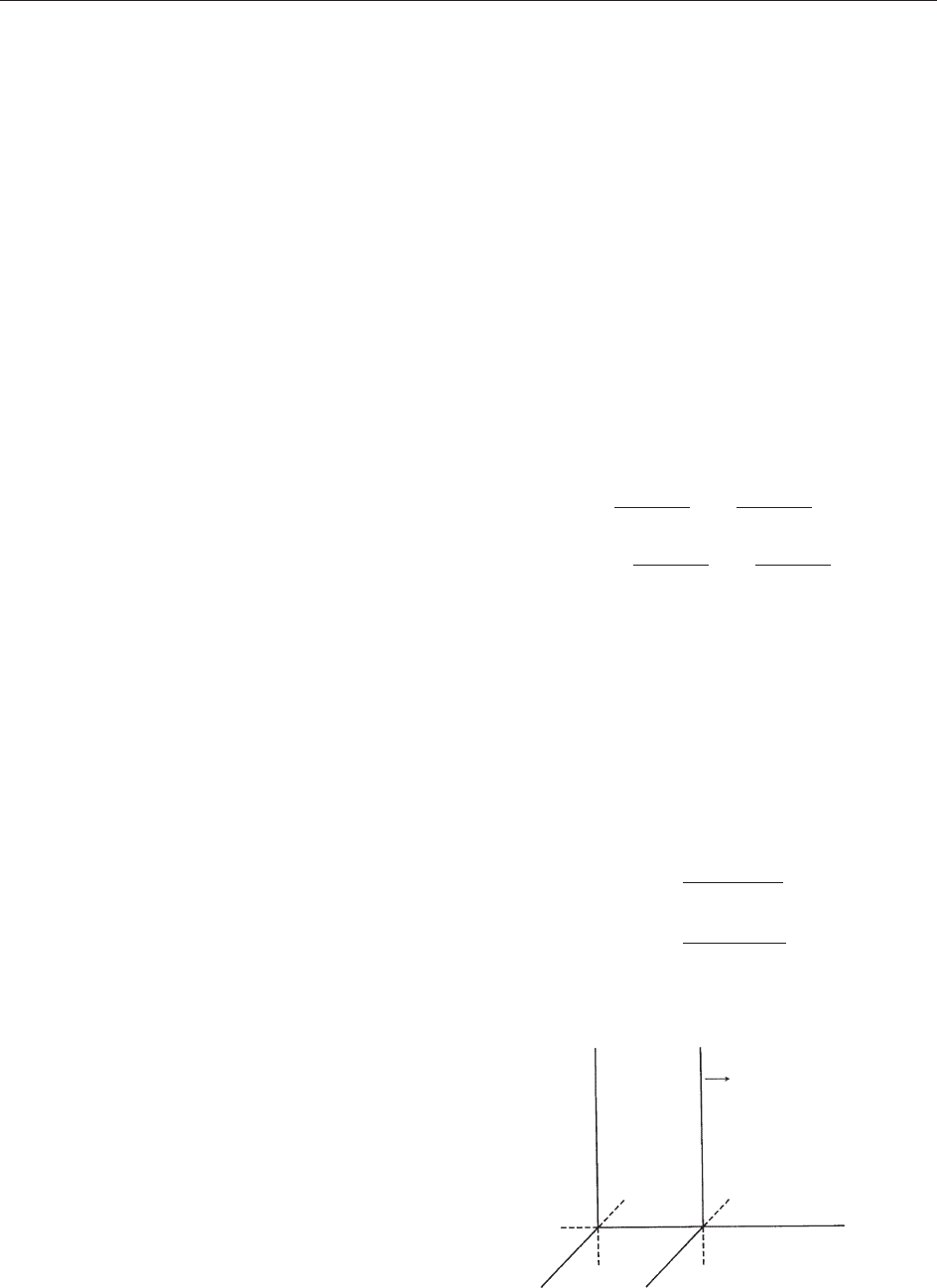
This correspond s to two observers whose spatial
axes are oriented as shown in Figure 2 with the
hatted coordinate system moving along the common
x
1
-,
^
x
1
-axis with speed jj, to the right if >0 and
to the left if <0.
We remark that, reverting to traditional time units,
= v=c,wherejvj is the relative speed of the two
coordinate systems, and [5] becomes what is gener-
ally referred to as a ‘‘Lorentz transformation’’ in
elementary expositions of special relativity, that is,
^
x
1
¼
x
1
vt
ffiffiffiffiffiffiffiffiffiffiffiffiffiffiffiffiffiffiffiffi
1 v
2
=c
2
p
^
t ¼
t ðv= c
2
Þx
1
ffiffiffiffiffiffiffiffiffiffiffiffiffiffiffiffiffiffiffiffi
1 v
2
=c
2
p
½6
x
2
x
3
x
2
(β >
0)
x
3
x
1
x
1
,
ˆ
ˆ
ˆ
Figure 2 Observers in standard configuration.
98 Introductory Article: Minkowski Spacetime and Special Relativity

There is a sense in which, to understand the
kinematic effects of special relativity, it is enough
to restrict one’s attention to the so-called special
Lorentz trans formations L(). Specifically, one can
show (Naber 1992, theorem 1.3.5) that if 2Lis
any Lorentz transformation, then there exists a real
number and two rotations R
1
, R
2
2Rsuch that
=R
1
L()R
2
. Since R
1
and R
2
involve no relative
motion, all of the kinematics is contained in L().
We shall explore these kinematic effects in more
detail shortly.
Now suppose that x and x
0
are two distinct events
in M and consider the displacement vector x x
0
from x
0
to x.If{e
1
, e
2
, e
3
, e
4
} is an admissible basis
and if we write x = x
a
e
a
and x
0
= x
a
0
e
a
, then x
x
0
= (x
a
x
a
0
)e
a
=x
a
e
a
.Ifx x
0
is null, then
x
1
2
þ x
2
2
þ x
3
2
¼ x
4
2
so the spatial separation of the two events is equal to
the distance light would travel during the time lapse
between the events. The same must be true in any
other admissible basis since Lorentz transformations
are the matrices of linear maps that preserve the
Lorentz inner product. Consequently, all admissible
observers agree that x
0
and x are ‘‘connectible by
a photon.’’ They even agree as to which of the two
events is to be regarded as the ‘‘emission’’ of the
photon and which is to be regarded as its ‘‘reception’’
since one can show (Naber 1992,theorem1.3.3)
that, when a vector is either timelike or null and
nonzero, the sign of its fourth coordinate is the same
in every admissible basis (because
4
4
1). Thus,
x
4
x
4
0
is either positive for all admissible observers
(x
0
occurred before x) or negative for all admissible
observers (x
0
occurred after x). Since photons move
along straight lines in admissible coordinate systems
we adopt the following terminology. If x
0
, x 2Mare
such that x x
0
is null, then the straight line in M
containing x
0
and x is called the world line of a
photon in M and is to be thought of as the set of all
events in the history of some particle of light that
‘ ‘experiences’’ both x
0
and x.
Let us now suppose instead that x x
0
is timelike.
Then, in any admissible basis,
x
1
2
þ x
2
2
þ x
3
2
< x
4
2
so the spatial separation of x
0
and x is less than the
distance light would travel during the time lapse
between the events. In this case, one can prove (Naber
1992, section 1.4) that there exists an admissible basis
{
^
e
1
,
^
e
2
,
^
e
3
,
^
e
4
}inwhich
^
x
1
=
^
x
2
=
^
x
3
= 0, that is,
there is an admissible observer for whom the two
events occur at the same spatial location, one after the
other. Thinking of this location as occupied by some
material object (e.g., the observer’s clock situated at
that point) we find that the events x
0
and x are both
‘‘experienced’’ by this material particle and that,
moreover,
ffiffiffiffiffiffiffiffiffiffiffiffiffiffiffiffiffiffiffiffiffiffiffiffiffiffiffiffiffiffiffiffiffiffiffiffiffi
jg(x x
0
, x x
0
)j
p
is just the time lapse
between the events recorded by a clock carried along by
this material particle. To any other admissible observer
this material particle appears ‘‘free’’ (not subject to
forces) because it moves on a straight line with constant
speed. This leads us to the following definitions. If
x
0
, x 2Mare such that x x
0
is timelike, then the
straight line in M containing x
0
and x is called the
world line of a free material particle in M and
ffiffiffiffiffiffiffiffiffiffiffiffiffiffiffiffiffiffiffiffiffiffiffiffiffiffiffiffiffiffiffiffiffiffiffiffiffi
jg(x x
0
, x x
0
)j
p
, usually written (x x
0
), or
simply , is the proper time separation of x
0
and x.
One can think of (x x
0
) as a sort of ‘‘length’’ for
x x
0
measured, however, by a clock carried along by
a free material particle that experiences both x
0
and x.
It is an odd sort of length, however, since it satisfies
not the usual triangle inequality, but the following
‘‘reversed’’ version.
Reversed triangle inequality (Naber 1992,theorem
1.4.2) Let x
0
, xandybeeventsinMfor which y x
and x x
0
are timelike with the same time orientation.
Then y x
0
= (y x) þ (x x
0
) is timelike and
ðy x
0
Þðy xÞþðx x
0
Þ½7
with equality holding if and only if y x and x x
0
are linearly dependent.
The sense of the inequality in [7] has interesting
consequences about which we will have more to say
shortly.
Finally, let us suppose that x x
0
is spacelike.
Then, in any admissible basis
x
1
2
þ x
2
2
þ x
3
2
> x
4
2
so the spatial separation of x
0
and x is greater than the
distance light could travel during the time lapse that
separates them. There is clearly no admissible observer
for whom the events occur at the same location. No
free material particle (or even photon) can experience
both x
0
and x.However,onecanshow(Naber 1992,
section 1.5) that, given any real number T (positive,
negative, or zero), one can find an admissible basis
{
^
e
1
,
^
e
2
,
^
e
3
,
^
e
4
}inwhich
^
x
4
= T. Some admissible
observers will judge the events simultaneous, some
will assert that x
0
occurred before x,andotherswill
reverse the order. Temporal order, cause and effect,
have no meaning for such pairs of events. For those
admissible observers for whom the events are simulta-
neous (
^
x
4
= 0), the quantity
ffiffiffiffiffiffiffiffiffiffiffiffiffiffiffiffiffiffiffiffiffiffiffiffiffiffiffiffiffiffiffiffiffiffiffi
g(x x
0
, x x
0
)
p
is
the distance between them and for this reason this
quantity is called the proper spatial separation of x
0
and x (whenever x x
0
is spacelike).
Introductory Article: Minkowski Spacetime and Special Relativity 99
For any two events x
0
, x 2M, g(x x
0
, x x
0
)is
given in any admissible basis by (x
1
)
2
þ (x
2
)
2
þ
(x
3
)
2
(x
4
)
2
and is called the interval separating
x
0
and x. It is the closest analog in Minkowskian
geometry to the (squared) length in Euclidean
geometry. It can, however, assume any real value
depending on the physical relationship between
the events x
0
and x. Historically, of course, it was
the various physical interpretations of this interval
that we have just described which led Minkowski
(Einstein et al. 1958) to the introduction of the
structure that bears his name.
Kinematic Effects
All of the well-known kinematic effects of special
relativity (the addition of velocities formula, the
relativity of simultaneity, time dilation, and length
contraction) follow easily from what we have done.
Because it eases visualization and because, as we
mentioned earlier, it suffices to do so, we will limit our
discussion to the special Lorentz transformations.
Let
1
and
2
be two real numbers and consider
the corresponding elements L(
1
) and L(
2
)of
L defined by [3]. Sum formulas for sinh and
cosh imply that L(
1
)L(
2
) = L(
1
þ
2
). Defining
i
= tanh
i
, i = 1, 2, and = tanh (
1
þ
2
), the sum
formula for tanh then gives
¼
1
þ
2
1 þ
1
2
½8
The physical interpretation is simple. One has three
admissible observers whose spatial axes are related
in the manner shown in Figure 2. If the speed of the
second relative to the first is
1
and the speed of the
third relative to the second is
2
, then the speed of
the third relative to the first is not
1
þ
2
as a
Newtonian predisposition would lead one to expect,
but rather , given by [8]. This is the relativistic
addition of velocities formula.
We have se en already that, when the int erval
between x
0
and x is spacelike, the events will be
judged simultaneous by some admissible obser-
vers, b ut not by other s. Indeed, if x
4
= 0
and the observers a re related by [5],then
^
x
4
=
(=
ffiffiffiffiffiffiffiffiffiffiffiffiffiffi
1
2
p
)x
1
=
^
x
1
, which will not be
zero unless = 0 and so there is no relative motion
(
^
x
1
cannot be zero since then
^
x
a
= 0for
a = 1, 2, 3, 4 and x = x
0
). This phenomenon is
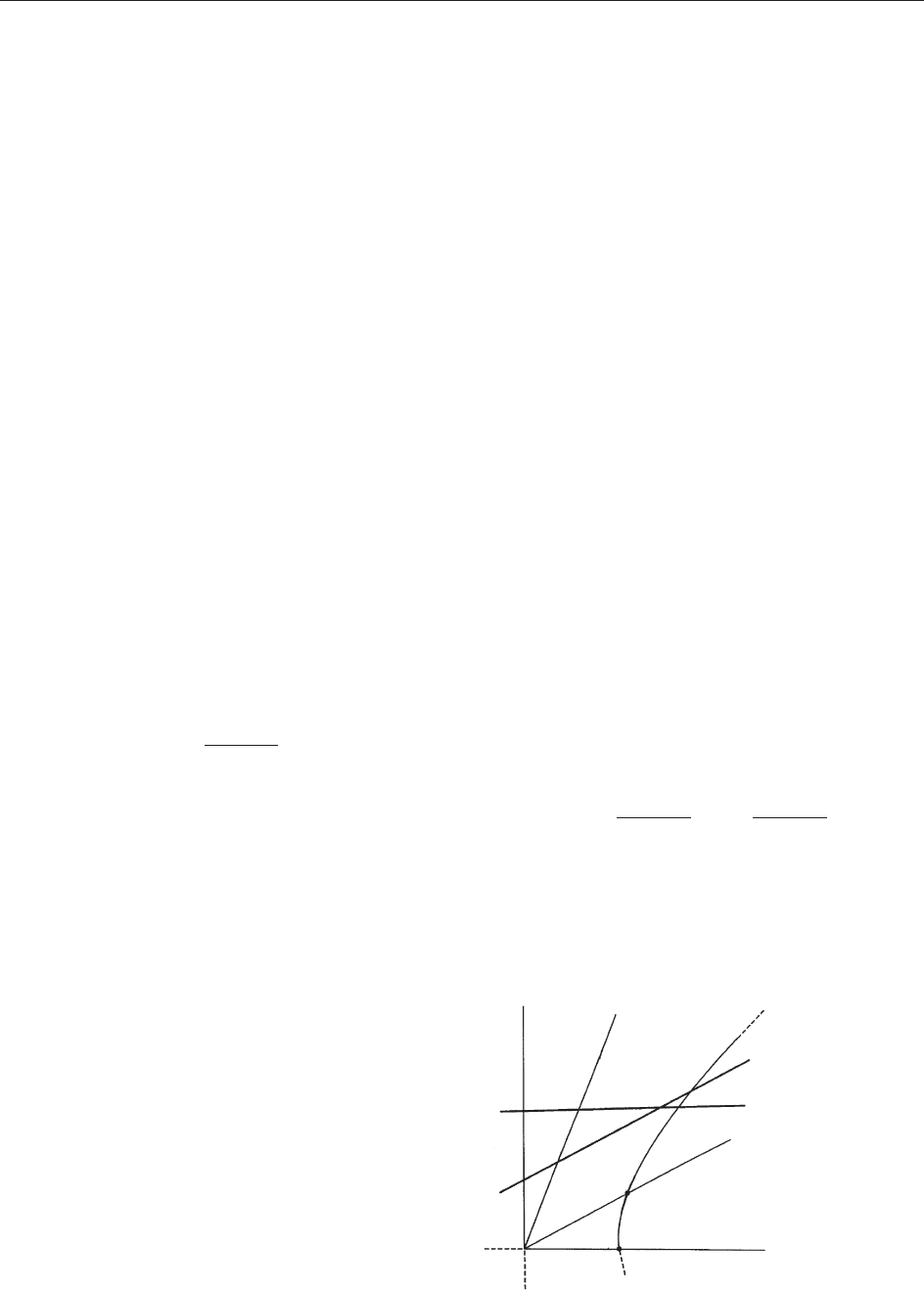
called the relativity of simultaneity and we now
construct a simple ge ometrical repre sentation of it.
Select two perpendicular lines in the plane to
represent the x
1
-andx
4
-axes (the Euclidean ortho-
gonality of the lines has no physical significance and
is unnecessary, but makes the pictures easier to
draw). The
^
x
1
-axis will be represented by the
straight line
^
x
4
= 0 which, from [5], is given by
x
4
= x
1
(in Figure 3 we have assumed that >0).
Similarly, the
^
x
4
-axis is identified with the line
x
4
= (1=)x
1
. Since Lorentz trans formations leave
the Lorentz inner produ ct invariant, the hyperbolas
(x
1
)
2
(x
4
)
2
= k coincide with (
^
x
1
)
2
(
^
x
4
)
2
= k and
we calibrate the axes accordingly, for example, the
branch of ( x
1
)
2
(x
4
)
2
= 1 with x
1
> 0 intersects
the x
1
-axis at the point (x
1
, x
4
) = (1, 0) and intersects
the
^
x
1
-axis at the point (
^
x
1
,
^
x
4
) = (1, 0). This
necessitates a different scale on the hatted and
unhatted axes, but one can sho w (Naber 1992,
section 1.3) that, with this calibration, all coordi-
nates can be obtained geome trically by proje cting
parallel to the opposite axis (e.g., the x
4
-and
^
x
4
-
coordinates of an event result from projecting
parallel to the x
1
- and
^
x
1
-axes, respectively).
Thus, a line of simultaneity in the hatted
(respectively, unhatted) coordinates is parallel to
the
^
x
1
- (respectively, x
1
-) axis so that, in general, a
pair of events lying on one will not lie on the other
(note, however, that these lines are ‘‘really’’ three-
dimensional hyperplanes so what appears to be a
point of intersection is actually a two-dimensional
‘‘plane of agreement ’’, any two events in which are
judged simultaneous by both observers).
For any two events whatsoever the relationship
between the time lapse
^
x
4
in the hatted coordinates
and the time lapse x
4
in the unhatted coordinates is,
from [5],
^
x
4
¼
ffiffiffiffiffiffiffiffiffiffiffiffiffiffi
1
2
p
x
1
þ
1
ffiffiffiffiffiffiffiffiffiffiffiffiffiffi
1
2
p
x
4
so the two are generally not equal. Consider, in
particular, two events on the world line of a point
at rest in the unhatted coordinate system, for
x
4
x
1
ˆ
x
4
x
1
(x
1
x
4
) = (1, 0),
(x
1
x
4
) = (1, 0),
(x
1
)
2
– (x
4
)
2
=
1
Hatted line of simultaneity
Unhatted line of simultaneity
ˆ
ˆˆ
Figure 3 Relativity of simultaneity.
100 Introductory Article: Minkowski Spacetime and Special Relativity
example, two readings on the clock at rest at the
origin in this system. Then x
1
= 0so
^
x
4
¼
1
ffiffiffiffiffiffiffiffiffiffiffiffiffiffi
1
2
p
x
4
> x
4
This effect is entirely symmetrical since, if
^
x
1
= 0,
then [5] implies
x
4
¼
1
ffiffiffiffiffiffiffiffiffiffiffiffiffiffi
1
2
p
^
x
4
>
^
x
4
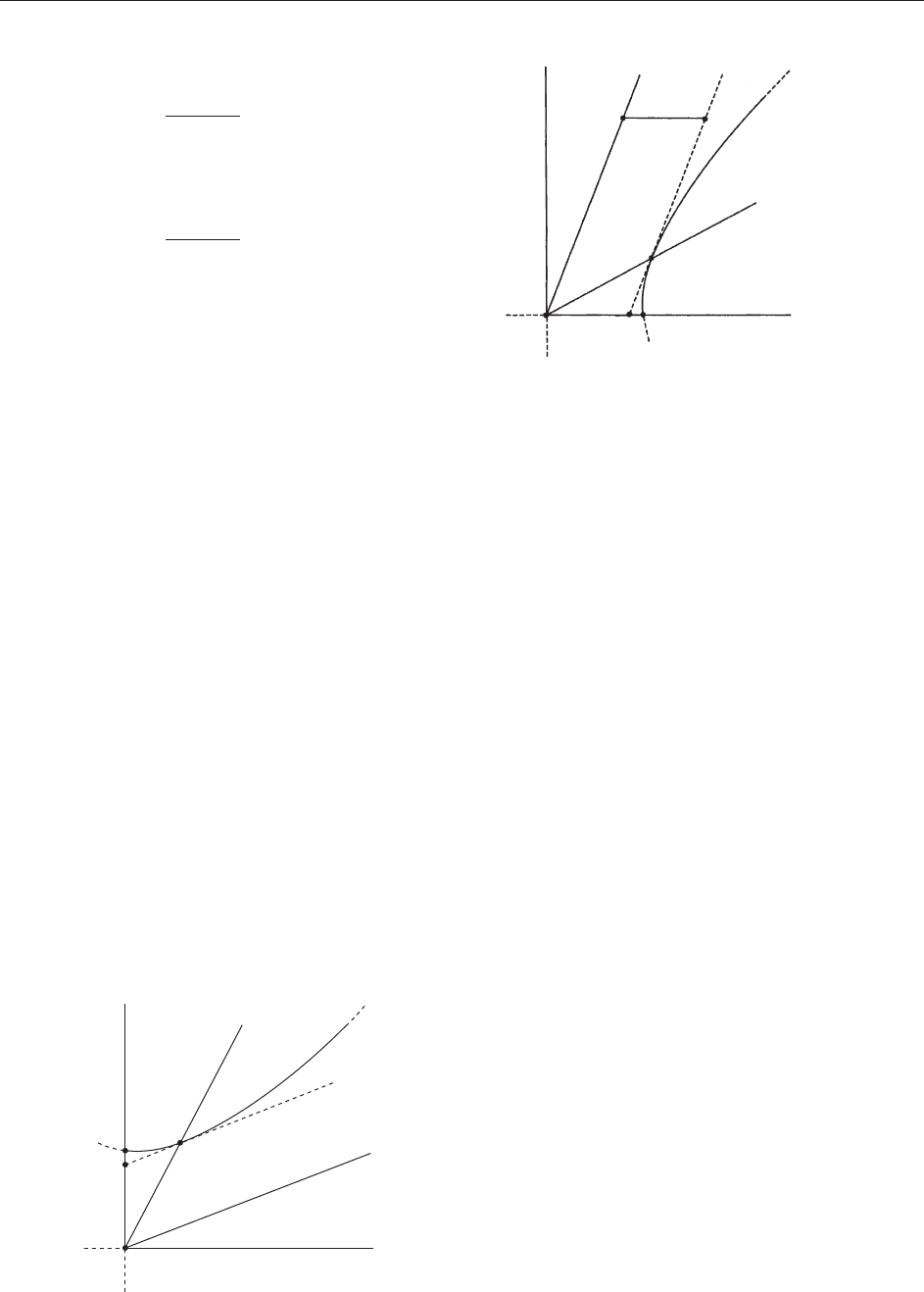
Each observe r judges the other’s clocks to be
running slow. This phenomenon is called time
dilation and is clearly visible in the spacetime
diagram in Figure 4 (e.g., both observers agree
on the time reading ‘‘0’’ for the clock at the origin of
the unhatted system, but the line
^
x
4
= 1 intersects
the world line of the clock, i.e., the x
4
-axis, at a
point below (x
1
, x
4
) = (0, 1)).
We should emphasize that this phenomenon is
quite ‘‘real’’ in the physical sense. For example,
certain types of elementary particles (mesons) found
in cosmic radiation are so short-lived (at rest) that,
even if they could travel at the speed of light, the
time required to traverse our atmo sphere would be
some ten times their normal life span. They should
not be able to reach the earth, but they do. Time
dilation ‘‘keeps them young’’ in the sense that what
seems a normal life time to the meson appears much
longer to us.
Finally, since admissible observers generally
disagree on which events are simultaneous and
since the only way to measure the ‘‘length’’ of a
moving object (say, a measuring rod) is to locate its
end points ‘‘simultaneously,’’ it should come as no
surprise that length, like simultaneity, and time,
depends on the admissible observer measuring it.
Specifically, let us consid er a measuring rod lying
at rest along the
^
x
1
-axis of the hatted coordinate
system. Its ‘‘length’’ in this coord inate system is
^
x
1
.
The world lines of its end points are two stra ight
lines parallel to the
^
x
4
-axis. If the unhatted observer
locates two events on these world lines ‘‘simulta-
neously’’ their coordinates will satisfy x
4
= 0 and,
by [5]
^
x
1
= (1=
ffiffiffiffiffiffiffiffiffiffiffiffiffiffi
1
2
p
)x
1
so
x
1
¼
ffiffiffiffiffiffiffiffiffiffiffiffiffiffi
1
2
p
^
x
1
<
^
x
1
and the moving measuring rod appears contracted in
its direction of motion by a factor of
ffiffiffiffiffiffiffiffiffiffiffiffiffiffi
1
2
p
.As
for time dilation, this phen omenon, known as length
contraction, is entirely symmetrical, quite real, and
clearly visible in a spacetime diagram (Figure 5).
The Relativity Principle
We have found that admissible observers can disagree
about some rather startling things (whether or not two
events are simultaneous, the time lapse between two
events even when no one thinks they are simultaneous,
and the length of a measuring rod). This would be
a matter of no concern at all, of course, if one could
determine, in any given situation, who was really
right. Surely, two events are either simultaneous or
they are not and we need only sort out which
admissible observer has the correct view of the
situation? Unfortunately (or fortunately, depending
on one’s point of view) this distinction between
the judgments made by different admissible observers
is precisely what physics forbids.
The relativity principle (Einstein et al. 1958). All
admissible observers are completely equivalent for
the formulation of the laws of physics.
We must be clear that this is not a mathematical
statement. It is rathe r a statement about the physical
world around us and how it should be described,
gleaned from observations, some of which are
x
4
x
4
x
4
= 1
x
1
x
1
(x
1
)
2
– (x
4
)
2
= –1
(x
1
, x
4
) = (0, 1)
(x
1
, x
4
) = (0, 1)
ˆ
ˆ
ˆˆ
ˆ
Figure 4 Time dilation.
x
4
x
4
x
1
= 1
x
1
x
1
(x
1
)
2
– (x
4
)
2
= 1
(x
1
, x
4
) = (1, 0)
(x
1
, x
4
) = (1, 0)
ˆ
ˆ
ˆ
ˆˆ
Figure 5 Length contraction.
Introductory Article: Minkowski Spacetime and Special Relativity 101

complex and subtle and some of which are common-
place (a passenger in a smooth, quiet airplane
traveling at constant groundspeed cannot ‘‘feel’’
his motion relative to the earth). It is a power ful
guide for constructing the laws of relativistic
physics, but even more fundamentally it prohibits
us from regarding any particular admissible observer
as having a privileged view of the universe. In
particular, we are forbidden from attaching any
objective significance to such questions as, ‘‘were the
two supernovae simultaneous?’’, ‘‘How long did the
meson survive?’’, and ‘‘What is the distance between
the Crab Nebula and Alpha Centauri?’’ This is
severe, but one must deal with it.
Particles and 4-Momentum
If I R is an interval, then a map : I !Mis a curve
in M. Relative to any admissible basis we can write
ðÞ¼x
a
ðÞe
a
for each 2 I. We shall assume that is smooth in
the sense that each x
a
(), a = 1, 2, 3, 4, is infinitely
differentiable (C
1
)onI and the velocity vector
0
ðÞ¼
dx
a
d
e
a
is nonzero for every 2 I (we adopt the usual
custom, in a vector space, of identifying the tangent
space at each point with the vector space itself). This
definition of smoothness clearly does not depend on
the choice of admissible basis for M. The curve is
said to be spacelike, timelike, or null if
0
ðÞ
0
ðÞ¼
ab
dx
a
d
dx
b
d
is positive, negative, or zero, respectively, for each
2 I. A timelike curve for which
0
( ) is future
directed for each 2 I is called a timelike world line
and its image is identified with the set of all events
in the history of some (not necessarily free) point
material particle. If I = [
0
,
1
]and :[
0
,
1
] !M
is a timelike world line, then the proper time length
of is defined by
LðÞ¼
Z
1
0
ffiffiffiffiffiffiffiffiffiffiffiffiffiffiffiffiffiffiffiffiffiffiffiffiffiffiffiffiffiffiffiffi
jgð
0
ðÞ;
0
ðÞÞj
p
d
¼
Z
1
0
ffiffiffiffiffiffiffiffiffiffiffiffiffiffiffiffiffiffiffiffiffiffiffiffiffiffiffi
ab
dx
a
d
dx
b
d
s
d
and interpreted as the time lapse between the events
(
0
)and(
1
) as recorded by a clock carried along by
the particle whose world line is . This interpretation
is easily motivated by writing out a Riemann sum
approximation to the integral and appealing to our
interpretation of the proper time separation
=
ffiffiffiffiffiffiffiffiffiffiffiffiffiffiffiffiffiffiffiffiffiffiffiffiffiffiffiffiffi
ab
x
a
x
b
p
. There are subtleties, however,
both mathematical and physical (Naber 1992,section
1.4). The mathematical ones are addressed by the
following result (which combines theorems 1.4.6
and 1.4.8 of Naber (1992)).
Theorem Let x
0
and x be two events in M. Then
x x
0
is timelike and future directed if and only if
there exists a timelike world line :[
0
,
1
] !Min
M with (
0
) = x
0
and (
1
) = x and, in this case,
L ðÞ x x
0
ðÞ ½9
with equality holding if and only if is a parametriza-
tion of a timelike straight line.
The inequality [9] asserts that if two material
particles experience both x
0
and x, then the one
that is free (and so can be regarded as at rest in
some admissible coordinate system) has longer to
wait for the occurrence of the second event (moving
clocks run slow). For many years this basically
obvious fact was christened ‘‘The Twin Paradox. ’’
Just as a smooth curve in Euclidean space has an
arc length parametrization, so a timelike world line
has a proper time parametrization defined as
follows. For each in [
0
,
1
] let
¼ ðÞ¼
Z
0
ffiffiffiffiffiffiffiffiffiffiffiffiffiffiffiffiffiffiffiffiffiffiffiffiffiffiffiffiffiffiffiffi
g
0
ðÞ;
0
ðÞðÞjj
p
d
(the proper time length of from (
0
)to()).
Then = () has a smooth inverse = ()so can
be reparametrized by . We will abuse our notation
slightly and write
ðÞ¼x
a
ðÞe
a
The velocity vector with this parametrization is
denoted
U ¼ U ðÞ¼
dx
a
d
e
a
called the 4-velocity of the world line and is the unit
tangent vector field to , that is,
U ðÞU ðÞ¼1 ½10
for each . An admissible observer is, of course,
more likely to parametrize a world line by his own
time coordinate x
4
. Then
0
x
4
¼
dx
1
dx
4
e
1
þ
dx
2
dx
4
e
2
þ
dx
3
dx
4
e
3
þ e
4
so
g
0
ðx
4
Þ;
0
ðx
4
Þ
¼ 1 kVk
2
102 Introductory Article: Minkowski Spacetime and Special Relativity

where
kVk¼
ffiffiffiffiffiffiffiffiffiffiffiffiffiffiffiffiffiffiffiffiffiffiffiffiffiffiffiffiffiffiffiffiffiffiffiffiffiffiffiffiffiffiffiffiffiffiffiffiffiffiffiffiffiffiffiffiffi
dx
1
dx
4
2
þ
dx
2
dx
4
2
þ
dx
3
dx
4
2
s
is the usual magnitude of the particl e’s velocity
vector
V ¼ V x
4
¼
dx
1
dx
4
e
1
þ
dx
2
dx
4
e
2
þ
dx
3
dx
4
e
3
¼ V
i
e
i
in the given admissible coordinate system. One finds
then that
U ¼ 1 kVk
2
1=2
V þ e
4
ðÞ ½11
We shall identify a material particle in M with a
pair (, m), where is a timelike world line and m is
a positive constant called the particle’s pr oper mass
(or rest mass). If each dx
a
=d, a = 1, 2, 3, 4, is
constant, then (, m) is a free material particle with
proper mass m. The 4-momentum of (, m)is
defined by P = mU. Thus,
P P ¼m
2
½12
In any admissible basis we write
P ¼ P
a
e
a
¼ mU
a
e
a
¼ m
dx
a
d
e
a
¼ m 1 kVk
2
1=2
V þ e
4
ðÞ½13
The ‘‘spatial part’’ of P in these coordinates is
P ¼
m
ffiffiffiffiffiffiffiffiffiffiffiffiffiffiffiffiffiffiffiffi
1 kVk
2
q
V
which, for kVk1, is approximately mV. Identify-
ing m with the inertial mass of Newtonian
mechanics (measured by an observer for whom the
particle’s speed is small), this is simply the classical
momentum of the particle. Somewhat more expli-
citly, if one expands 1=
ffiffiffiffiffiffiffiffiffiffiffiffiffiffiffiffiffiffiffiffi
1 kVk
2
q
by the Binom ial
Theorem one finds that
P
i
¼
m
ffiffiffiffiffiffiffiffiffiffiffiffiffiffiffiffiffiffiffiffi
1 kVk
2
q
V
i
¼ mV
i
þ
1
2
mV
i
kVk
2
þ; i ¼ 1; 2; 3 ½14
which gives the compone nts of the classical momen-
tum plus ‘‘relativistic corrections.’’ In order
to preserve a formal similarity with Newtonian
mechanics one often sees m=
ffiffiffiffiffiffiffiffiffiffiffiffiffiffiffiffiffiffiffiffi
1 kVk
2
q
referred
to as the ‘‘relativistic mass’’ of the particle, but we
shall avoid this terminology. The fourth component
of P is given by
P
4
¼P e
4
¼
m
ffiffiffiffiffiffiffiffiffiffiffiffiffiffiffiffiffiffiffiffi
1 kVk
2
q
¼ m þ
1
2
mkVk
2
þ
½15
The appearance of the term (1=2)mkVk
2
corre-
sponding to the Newtonian kinetic energy suggests
that P
4
be denoted E and called the total relativistic
energy measured by the given admissible observer
for the particle:
E ¼P e
4
½16
Now, one must understand that the concept of
‘‘energy’’ in physics is a subtle one and simply
giving P e
4
this name does not ensure that there
is any physical c ontent. Whether or not the name
is appropriate can only be determined experimen-
tally. In particular, one should ask if the appear-
ance of the term m in [15] is consistent with
the view that P
4
represents the ‘‘energy’’ of the
particle. Observe that if k Vk= 0 (i.e., if the particle
is at rest relative to the given observer), then [15]
gives
E ¼ m ð¼ mc
2
; in standard unitsÞ½17
which we interpret as saying that, even when the
particle is at rest, it still has energy. If this is really
‘‘energy’’ in the physical sense, then it should be
possible to liberate and use it. That this is, indeed,
possible has, of course, been rather convincingly
demonstrated.
Next we observe that not only materi al particles,
but also photons possess ‘‘momentum’’ and
‘‘energy’’ and therefore should have 4-momentum
(witness, e.g., the phot oelectric effect in which
photons collide with and eject electrons from their
orbits in an atom). Unlike a material particle,
however, a photon’s characteristic feature is not
proper mass, but frequen cy , or wavelength
= 1=, related to its energy E by E = h (h being
Planck’s constant) and these are highly observer
dependent (D oppler effect). There is, more over, no
‘‘proper frequency’’ analogous to ‘‘proper mass’’
since there is no admissible observer for whom the
photon is at rest. In an attempt to model these
features we consider a point x
0
2M, a future
directed null vector N and an interval I R. The
curve : I !Mdefined by
ðÞ¼x
0
þ N ½18
Introductory Article: Minkowski Spacetime and Special Relativity 103

is a parametrization of the world line of a photon
through x
0
. Being null, N can be written in any
admissible basis as
N ¼ðN e
4
Þ d þ e
4
ðÞ ½19
where
d ¼ðN e
1
Þ
2
þðN e
2
Þ
2
h
þ N e
3
ðÞ
2
i
1=2
h
N e
1
ðÞe
1
þ N e
2
ðÞe
2
þ N e
3
ðÞe
3
i
½20
is the directi on vector of the world line in the
corresponding spatial coordinate system. Now, by
analogy with [16], we define a photon in M to
be a curve in M of the form [18], take N to be its
4-momentum and define the energy E of the photon
in the admissible basis {e
1
, e
2
, e
3
, e
4
}by
E¼N e
4
½21
Then, by [19],
N ¼Ed þ e
4
ðÞ ½22
The corresponding frequency and wavelength
are then defined by = E=h and = 1=. In another
admissible basis, one has N =
^
E(
^
d þ
^
e
4
), where
^
d
and
^
E are defined by the hatted versions of [20] and
[21]. One can then show (Naber 1992, section 1.8)
that
^
E
E
¼
^
¼
1 cos
ffiffiffiffiffiffiffiffiffiffiffiffiffiffi
1
2
p
¼ 1 cos ðÞþ
1
2
2
1 cos ðÞþ½23
where is the relative speed of the two spatial
coordinate systems and is the angle (in the
unhatted spatial coordinate system) between the
direction d of the photon and the direction of
motion of the hatted spatial coordinate syst em.
Equation [23] is the formula for the relativistic
Doppler effect with the first term in the series being
the classical formula.
We conclude this section by examining a few
simple interactions between particles of the sort
modeled by our definitions, assuming only that
4-momentum is conserved in the interaction. For
convenience, we will use the term free particle to
refer to either a free material particle or a photon.
If A is a finite set of free particles, then each
element of A has a unique 4-momentum which is a
future-directed timelike or null vector. The sum of
any such collection of vectors is timelike and future
directed, except when all of the vecto rs are null and
parallel, in which case the sum is null and future
directed (Naber 1992, lemma 1.4.3). We call this
sum the total 4-momentum of A. Now we formulate
a definition which is intended to model a finite set
of free particles colliding at some event with a
(perhaps new) set of free particles emerging from the
collision (e.g., an electron and proton collide , with a
neutron and neutrino emerging from the collision).
A contact interaction in M is a triple (A, x,
~
A),
where A and
~
A are two finite sets of free particles,
neither of which contains a pair of particles with
linearly dependent 4-momenta (which would pre-
sumably be physically indistinguishable) and x 2M
is an event such that
1. x is the terminal point of all of the particles in A
(i.e., for each world line :[
0
,
1
] !M of a
particle in A, (
1
) = x);
2. x is the initial point of all the particles in
~
A, and
3. the total 4-momentum of A equals the total
4-momentum of
~
A.
Properly (3) is called the conservation of 4-momentum.
If A consists of a single free particle, then (A, x,
~
A)is
called a decay (e.g., a neutron decays into a proton, an
electron and an antineutrino).
Consider, for example, an interaction (A, x,
~
A)
for which
~
A consists of a single photon. The total
4-momentum of
~
A is null so the same must be true of
A. Since the 4-momenta of the individual particles in
A are timelike or null and future directed their sum
can be null only if they are, in fact, all null and
parallel. Since A cannot contain distinct photons with
parallel 4-momenta, it must consist of a single photon
which, by (3), must have the same 4-momentum as
the photon in
~
A. In essence, ‘‘nothing happened at
x.’’ We conclude that no nontrivial interaction of the
type modeled by our definition can result in a single
photon and nothing else. Reversing the roles of A
and
~
A shows that, if 4-momentum is to be conserved,
a photon cannot decay.
Next let us consider the decay of a single material
particle into two material particles, for example, the
spontaneous disintegration of an atom through
-emission. Thus, we consider a contact interaction
(A, x,
~
A) in which A consists of a single free material
particle of proper mass m
0
and
~
A consists of two
free material particles with proper masses m
1
and
m
2
.LetP
0
, P
1
,andP
2
be the 4-momenta of the
particles of proper mass m
0
, m
1
, and m
2
, respec-
tively. Then P
0
= P
1
þ P
2
. Appealing to the
‘‘reversed triangle inequality,’’ the fact that P
1
and
P
2
are linearly independent and future directed, and
[12] we conclude that
m
0
> m
1
þ m
2
½23
104 Introductory Article: Minkowski Spacetime and Special Relativity