
Francoise J.-P., Naber G.L., Tsun T.S. (editors) Encyclopedia of Mathematical Physics
Подождите немного. Документ загружается.


given as follows (1 denotes the appropriate identity
matrix):
ðz
1
; z
2
Þ¼
B
1
þ z
1
1
B
2
þ z
2
1
j
0
@
1
A
½12
ðz
1
; z
2
Þ¼ B
2
z
2
1 B
1
þ z
1
1 iðÞ½13
where z
1
= x
1
þ ix
2
and z
2
= x
3
þ ix
4
are complex
coordinates on R
4
. The maps [12] and [13] should
be understood as a family of linear maps parame-
trized by points in R
4
.
A straightforward calculation shows that the ADHM
equation [10] implies that = 0 for every (z
1
, z
2
) 2
R
4
. Therefore, the quotient E = ker =im = ker \
ker
y
forms a complex vector bundle over R
4
or rank r
whenever (B
1
, B
2
, i, j)issuchthat is injective and is
surjective for every (z
1
, z
2
) 2 R
4
.
To define a connection on E, note that E can be
regarded as a sub-bundle of the trivial bundle (V
V W) R
4
. So let : E !(V V W) R
4
be the
inclusion, and let P :(V V W) R
4
!E be the
orthogonal projection onto E. We can then define a
connection r on E through the projection formula
rs ¼ P
dðs Þ
where
d denotes the trivial connection on the trivial
bundle (V V W) R
4
.
To see that this connection is anti-self-dual, note
that projection P can be written as follows:
P ¼ 1 D
y
1
D
where
D : ðV V WÞR
4
!ðV VÞR
4
D¼
y
and =DD
y
. Note that D is surjective, so that is
indeed invertible. Moreover, it also follows from
[11] that
y
=
y
, so that
1
= (
y
)
1
1.
The curvature F
r
is given by
F
r
¼P dð1 D
y
I
1
DÞd
¼ P dD
y
1
ðdDÞ
¼P ð
dD
y
Þ
1
ðdDÞ þ D
y
dð
1
ðdDÞ
¼ð
dD
y
Þ
1
ðdDÞ
for P(D
y
d(
1
(d D))) = 0onE = ker D. Since
1
is
diagonal, we conclude that F
r
is proportional to
dD
y
^ dD, as a 2-form.
It is then a straightforward calculation to show
that each entry of dD
y
^ dD belongs to
2,
.
The extraordinary accomplishment of Atiyah, Drin-
feld, Hitchin, and Manin was to show that every
instanton, up to gauge equivalence, can be obtained in
this way (see, e.g., Donaldson and Kronheimer 1990).
For instance, the basic SU(2) instanton [6] is associated
with the following data (c = 1, r = 2):
B
1
; B
2
¼ 0; i ¼
1
0
; j ¼ð01Þ
Remark The ADHM data (B
1
, B
2
, i, j) are said to
be stable if is surjective for every (z
1
, z
2
) 2 R
4
, and
it is said to be costable if is injective for every
(z
1
, z
2
) 2 R
4
.(B
1
, B
2
, i, j) is regular if it is both stable
and costable. The quotient:
fregular solutions of ð10Þ and ð11Þg=UðVÞ
coincides with the moduli space of instantons
of rank r = dim W and charge c = dim V on R
4
(see
below). It is also an example of a quiver variety (see
Finite Dimensional Algebras and Quivers), asso-
ciated to the quiver consisting of two vertices V and
W, two loop-edges on the vertex V and two edges
linking V to W, one in each direction.
Dimensional Reductions of the
Anti-Self-Dual Yang–Mills Equation
As pointed out abo ve, a connection on a Hermitian
vector bundl e E !R
4
of rank r can be regarded as
1-form
A ¼
X
4
k¼1
A
k
ðx
1
; ...; x
4
Þdx
k
; A
k
: R
4
!uðrÞ
Assuming that the connection components A
k
are
invariant under translation in one direction, say x
4
,
we can think of
A ¼
X
3
k¼1
A
k
ðx
1
; x
2
; x
3
Þdx
k
as a connection on a Hermitian vector bundle over
R
3
, with the fourth component = A
4
being
regarded as a bundle endomorphism : E !E,
called a Higgs field. In this way, the anti-self-duality
equation [3] reduces to the so-called Bogomolny (or
monopole) equation:
F
A
¼d ½14
where is the Euclidean Hodge star in dimension 3.
Now assume that the connection components A
k
are invariant under translation in two directions, say
x
3
and x
4
. Consider
A ¼
X
2
k¼1
A
k
ðx
1
; x
2
Þdx
k
Instantons: Topological Aspects 47

as a connection on a Hermitian vector bundle over
R
2
, with the third and fourth components combined
into a complex bundle endomorphism:
¼ðA
3
þ i A
4
Þðdx
1
i dx
2
Þ
taking values on 1-forms. The anti-self-duality
equation [3] is then reduced to the so-called
Hitchin’s equations:
F
A
¼½;
;
@
A
¼ 0 ½15
Conformal invariance of the anti-self-duality equa-
tion means that Hitchin’s equations are well defined
over any Riemann surface.
Finally, assume that the connection components A
k
are invariant under translation in three directions, say
x
2
, x
3
, and x
4
. After gauging away the first compo-
nent A
1
, the anti-self-duality equations [3] reduce to
the so-called Nahm’s equations:
dT
k
dx
1
þ
1
2
X
j;l
kjl
½T
j
; T
l
¼0; j; k; l ¼f2; 3; 4g½16
where each T
k
is regarded as a map R !u(r).
Readers who are interested in monopoles and
Nahm’s equations are referred to the survey
by Murray (2002) and references therein. The best
source for Hitchin’s equations still are Hitchin’s
(1987a, b) original papers. A beautiful duality,
known as Nahm transform, relates the various
reductions of the anti-self-duality equation to periodic
instantons; see the survey article by Jardim (2004).
It is also worth mentioning the book by Mason
and Woodhouse (1996), where other interesting
dimensional reductions of the anti-self-duality equa-
tion are discussed, providing a deep relation
between instantons and the general theory of
integrable systems.
The Instanton Moduli Space
Now fix a rank-r complex vector bundle E over a
four-dimensional Riemannian manifold X. Observe
that the difference between any two connections is a
linear operator:
ðr r
0
Þðf Þ¼f r þ df f r
0
df
¼ f ðr r
0
Þ
In other words, any two connections on E differ by
an endomorphism-valued 1-form. Therefore, the set
of all smooth connections on E, denoted by A(E),
has the structure of an affine space over
(End(E))
1
M
.
The gauge group G( E) acts on A(E) via
conjugation:
g r:¼ g
1
rg
We can form the quotient set B (E) = A(E)=G(E),
which is the set of gauge equivalence classes of
connections on E.
The set of gauge equivalence classes of anti-self-
dual connections on E is a subset of B(E), and it is
called the moduli space of instantons on E !X. The
subset of M
X
(E) consisting of irreducib le anti-self-
dual connections is denoted M
X
(E).
Since the choice of a particul ar vector bundle
within its topological class is immaterial, these sets
are usually labeled by the topological invariants
(Chern or Pontrjagyn classes) of the bundle E. For
instance, M(r, k) denotes the moduli space of
instantons on a rank-r complex vector bundle
E !X with c
1
(E) = 0andc
2
(E) = k > 0. It turns
out that M
X
(E) can be given the structure of a
Hausdorff topological space. In general, M
X
(E) will
be singular as a differentiable manifold, but M
X
(E)
can always be given the structure of a smooth
Riemannian manifold.
We start by explaining the notion of a L
2
p
vector
bundle. Recall that L
2
p
(R
n
) denotes the completion
of the space of smooth functions f : R
n
!C with
respect to the norm:
kf k
2
L
2
p
¼
Z
X
ðjf j
2
þjdf j
2
þþjd
ðpÞ
f j
2
Þ
In dimension n = 4 and for p > 2, by virtue of the
Sobolev embedding theorem, L
2
p
consists of continu-
ous functions, i.e., L
2
p
(R
n
) C
0
(R
n
). So we define
the notion of a L
2
p
vector bundle as a topological
vector bundle whose transition functions are in L
2
p
,
where p > 2.
Now for a fixed L
2
p
vector bundle E over X,wecan
consider the metric space A
p
(E) of all connections on
E which can be represented locally on an open subset
U X as a L
2
p
(U) 1-form. In this topology, the subset
of irreducible connections A
p
(E) becomes an open
dense subset of A
p
(E). Since any topological vector
bundle admits a compatible smooth structure, we may
regard L
2
p
connections as those that differ from a
smooth connection by a L
2
p
1-form. In other words,
A
p
(E) becomes an affine space modeled over the
Hilbert space of L
2
p
1-forms with values in the
endomorphisms of E. The curvature of a connection
in A
p
(E) then becomes a L
2
p1
2-form with values in
the endomorphism bundle End(E).
Moreover, l et G
pþ1
(E) be defined as the topolo-
gical group of all L
2
pþ1
bundle automorphisms. By
virtue of the Sobolev multiplication theorem,
G
pþ1
(E) has the structure of an infinite-dimensional
48 Instantons: Topological Aspects

Lie group modeled on a Hilbert space; its Lie
algebra is the space of L
2
pþ1
sections of End(E).
The Sobolev multiplication theorem is once again
invoked to guarantee that the action G
pþ1
(E)
A
p
(E) !A
p
(E) is a smooth map of Hilbert mani-
folds. The quotient space B
p
(E) = A
p
(E)=G
pþ1
(E)
inherits a topological structure; it is a metric (hence
Hausdorff) topological space. Theref ore, the sub-
space M
X
(E)ofB
p
(E) is also a Hausdorff topolo-
gical space; moreover, one can show that the
topology of M
X
(E) does not depend on p.
The quotient space B
p
(E) fails to be a Hilbert
manifold because in general the action of G
pþ1
(E)on
A
p
(E) is not free. Indeed, if A is a connection on a
rank-r complex vector bundle E over a connected
base manifold X, which is associated with a
principal G-bundle. Then the isotropy group of A
within the gauge group
A
¼fg 2G
pþ1
ðEÞjgðAÞ¼Ag
is isomorphic to the centralizer of the holonomy
group of A within G.
This means that the subspace of irreducible connec-
tions A
p
(E) can be equivalently defined as the open
dense subset of A
p
(E) consisting of those connections
whose isotropy group is minimal, that is,
A
p
ðEÞ¼fA 2A
p
ðEÞj
A
¼ cente rðGÞg
Now G
pþ1
(E) acts with constant isotropy on A
p
(E);
hence, the quotient B
p
(E) = A
p
(E)=G
pþ1
(E) acquires
the structure of a smooth Hilbert manifold.
Remark The analysis of neighborhoods of points
in B
p
(E)nB
p
(E) is very relevant for applications of
the instanton moduli spaces to differential topology.
The simplest situation occurs when A is an SU(2)
connection on a rank-2 complex vect or bundle E
which reduces to a pair of U(1) and such [A] occurs
as an isolated point in B
p
(E)nB
p
(E). Then a
neighborhood of [A]inB
p
(E) looks like a cone on
an infinite-dimensional complex projective space.
Alternatively, the instanton moduli space M
X
(E)
can also be described by first taking the subset of all
anti-self-dual connections and then taking the
quotient under the action of the gauge group.
More precisely, consider the map
: A
p
ðEÞ!L
2
p
ðEndðEÞ
2;þ
X
Þ
ðAÞ¼F
þ
A
½17
Thus,
1
(0) is exactly the set of all anti-self-dual
connections. It is G
pþ1
(E)-invariant, so we can take
the quotient to get
M
X
ðEÞ¼
1
ð0Þ=G
pþ1
ðEÞ
It follows that the subspace M
X
(E) = B
p
(E) \
M
X
(E) has the structure of a smooth Hilbert
manifold. Index theory comes into play to show
that M
X
(E) is finite dimensional. Recall that if D is
an elliptic operator on a vector bundle over a
compact manifold, then D is Fredholm (i.e., ker D
and coker D are finite dimensional) and its index
ind D ¼ dim ker D dim coker D
can be computed in terms of topological invariants,
as presc ribed by the Atiyah–Singer index theorem.
The goal here is to identify the tangent space of
M
X
(E) with the kernel of an elliptic operator.
It is clear that, for each A 2A
p
(E), the tangent
space T
A
A
p
(E) is just L
2
p
(End(E)
1
X
). We define
the pairing
ha; bi¼
Z
X
a ^b ½18
and it is easy to see that this pairing defines a
Riemannian metric (the so-called L
2
-metric) on A
p
(E).
The derivative of the map in [17] at the point A
is given by
d
þ
A
: L
2
p
ðEndðEÞ
1
X
Þ!L
2
p1
ðEndðEÞ
2
X
Þ
a 7!ðd
A
aÞ
þ
so that for each A 2
1
(0) we have
T
A
1
ð0Þ¼ a 2 L
2
p
ðEndðEÞÞ
1
X
jd
þ
A
a ¼ 0
no
Now for a gauge equivalence class [A] 2B
p
(E), the
tangent space T
[A]
B
p
(E) consists of those 1-forms
which are orthogonal to the fibers of the principal
G
pþ1
(E) bundle A
p
(E) !B
p
(E). At a point A 2A
p
(E),
the derivative of the action by some g 2G
pþ1
(E)is
d
A
: L
2
pþ1
ðEndðEÞÞ!L
2
p
ðEndðEÞ
1
X
Þ
Usual Hodge decomposition gives us that there is an
orthogonal decomposition:
L
2
p
ðEndðEÞ
1
X
Þ¼im d
A
ker d
A
which means that:
T
½A
B
p
ðEÞ¼ a 2 L
2
p
ðEndðEÞ
1
X
Þjd
A
a ¼ 0
no
Thus, the pairing [18] also defines a Riemannian
metric on B
p
(E). Putting these together, we conclude
that the space T
[A]
M
X
tangent to M
X
(E)atan
equivalence class [A] of anti-self-dual connections
can be described as follows:
T
½A
M
X
ðEÞ
¼ a 2 L
2
p
ðEndðEÞ
1
X
Þjd
A
a ¼ d
þ
A
a ¼ 0
no
½19
Instantons: Topological Aspects 49

It turns out that the so-called deformation operator
A
= d
A
d
A
:
A
: L
2
p
ðEndðEÞ
1
X
Þ
!L
2
pþ1
ðEndðEÞÞ L
2
p1
ðEndðEÞ
2
X
Þ
is elliptic. Moreover, if A is anti-self-dual then coker
A
is empty, so that T
[A]
M
X
(E) = ker
A
. The
dimension of the tangent space T
[A]
M
X
(E) is then
simply given by the index of the deformation
operator
A
. Using the Atiyah–Singer index theorem,
we have for SU(r) bundles with c
2
(E) = k:
dim M
X
ðEÞ¼4rk ðr
2
1Þð1 b
1
ðXÞþb
þ
ðXÞÞ
The dimension formula for arbitrary gauge group G
can be found in Atiyah et al. (1978).
For example, the moduli space of SU(2) instantons
on R
4
of charge k is a smooth Riemannian manifold
of dimension 8k 3. These parameters are inter-
preted as the 5k parameters describing the positions
and sizes of k separate instantons, plus 3( k 1)
parameters describing their relative SU(2) phases.
The detailed construction of the instanton moduli
spaces can be found in Donaldson and Kronheimer
(1990). An alternative source is Morgan’s lecture
notes (Friedman and Morgan 1998). It is interesting
to note that M
X
(E) inherits many of the geometrical
properties of the original manifold X. Most notably,
if X is a Ka¨ hler manifold, then M
X
(E) is also
Ka¨ hler; if X is a hyper-Ka¨ hler manifold, then M
X
(E)
is also hyper-Ka¨ hler. One expects that other
geometric structures on X can also be transferred
to the instanton moduli spaces M
X
(E).
See also: Characteristic Classes; Finite-Dimensional
Algebras and Quivers; Gauge Theoretic Invariants
of 4-Manifolds; Gauge Theory: Mathematical
Applications; Integrable Systems: Overview; Index
Theorems; Moduli Spaces: An Introduction; Solitons and
Other Extended Field Configurations; Twistor Theory:
Some Applications [in Integrable Systems, Complex
Geometry and String Theory].
Further Reading
Atiyah MF, Hitchin NJ, and Singer IM (1978) Self-duality in
four-dimensional Riemannian geometry. Proceedings of the
Royal Society of London 362: 425–461.
Bernard CW, Christ NH, Guth AH, and Weinberg EJ (1977)
Pseudoparticle parameters for arbitrary gauge groups. Physical
Review D 16: 2967–2977.
Bourguignon JP and Lawson HB Jr. (1981) Stability and isolation
phenomena for Yang–Mills fields. Communications in Math-
ematical Physics 79: 189–230.
Donaldson SK and Kronheimer PB (1990) Geometry of Four-
Manifolds. Oxford: Clarendon.
Friedman R and Morgan JW (eds.) (1998) Gauge Theory and the
Topology of Four-Manifolds. Providence, RI: American
Mathematical Society.
Hitchin N (1987a) The self-duality equations on a Riemann
surface. Proceedings of the London Mathematical Society 55:
59–126.
Hitchin N (1987b) Stable bundles and integrable systems. Duke
Mathematical Journal 54: 91–114.
Jardim M (2004) A survey on Nahm transform. Journal of
Geometry and Physics 52: 313–327.
Mason LJ and Woodhouse NMJ (1996) Integrability, Self-duality,
and Twistor Theory. New York, NY: Clarendon.
Murray M (2002) Monopoles. In: Bouwknegt P and Wu S (eds.)
Geometric Analysis and Applications to Quantum Field Theory,
Progr. Math. vol. 205, pp. 119–135. Boston, MA: Birkhauser.
Integrability and Quantum Field Theory
T J Hollowood, University of Wales Swansea,
Swansea, UK
ª 2006 Elsevier Ltd. All rights reserved.
Introduction
The notion of integrability plays many different roˆles
in quantum field theory (QFT). In this article we
interpret it in a narrow sense and describe some QFTs
that are completely integrable, in the sense that there
are as many integrals of motion as degrees of freedom.
Necessarily this implies, since we are talking about
field theories, that there is an infinite number of
conserved quantities. The existence of such a tower of
conserved quantities of increasing Lorentz spin
implies, via the Coleman–Mandula theorem, that the
theories are trivial in spacetime dimensions greater
than 2. On the other hand, in 1 þ 1 dimensions there is
a rich menagerie of such integrable quantum field
theories (IQFTs). These theories are fascinating in their
own right as nontrivial QFTs for which data like the
S-matrix and spectrum can be determined exactly. We
will describe these exact S-matrices for a series of
seminal examples. In addition, we briefly describe the
applications of these theories to statistical systems in
two dimensions.
Classical Integrable Systems and
Field Theories
For a field theory to be integrable it must have an
infinite number of conserved charges. Necessarily
these must be spacetime symmetries which extend the
Poincare´ symmetry in some way. It turns out that, due
to a theorem of Coleman and Mandula, such
50 Integrability and Quantum Field Theory

extensions are very restrictive: they are only possible in
1 þ 1 dimensions (one dimension of space and one of
time) apart from noninteracting theories. Below we
describe some of the most important examples.
Affine Toda Theories
These theories describe the interactions of a set of
scalar fields which we write as a vector f. The action is
S ¼
Z
d
2
x
1
2
@
f
2
VðfÞ
½1
The potential has to be very specially chosen in
order that the resulting theory is integrable. The
resulting theories are classified by affine Lie alge-
bras. We shall describe only the theories related to a
simply laced Lie algebra g (so of ADE type). In this
case, for the affine version of the theory,
VðfÞ¼
m
2
2
X
r
a¼0
n
a
e
a
a
f
½2
where f is an r-rank g vector and a
a
, a = 1, ..., r, are
a set of simple roots of g. The fact that we are
considering the affine version of the theory means
that we include the term involving the extended root
(the lowest root) a
0
=
P
r
a = 1
n
a
a
a
, whi ch defines
the integers n
a
(n
0
= 1). If this term is absent then the
potential does not have a minimum. Such nonaffine
theories are interesting in their own right since they
include the Liouville theory, but we shall not
describe them here.
One way to expose the infinite set of conserved
charges at the classical leve l is to write the equations
of motion in Lax form. This has the form of the
vanishing of the field strength, or zero-curvature
condition, of an auxiliary gauge connection in g
with components (A
x
, A
t
):
A
x
¼ @
t
f H þ
m
2
X
r
a¼0
e
a
a
f=2
e
a
þ f
a
ðÞ
A
t
¼ @
x
f H þ
m
2
X
r
a¼0
e
a
a
f=2
e
a
f
a
ðÞ
½3
Here, {e
i
, f
i
} are related to generators of g in a
Cartan–Weyl basis, via
e
a
¼ zE
a
a
; f
a
¼ z
1
E
a
a
; a ¼ 1; ...; r
e
0
¼ z
h
E
a
0
; f
0
¼ z
h
E
a
0
½4
where z is a auxiliary variable known as the spectral
parameter and h is the Coxeter number of g . Using
the following commutators of g ,
½E
a
a
; E
a
b
¼
ab
a
a
H
½H; E
a
¼aE
a
½E
a
a
; E
a
b
¼0
½5
it is straightforward to verify that the zero-curvature
condition
F
xt
¼ @
x
A
t
@
t
A
x
þ½A
x
; A
t
¼0 ½6
is equivalent to the equations of motion which
follow from extremizing the action [1].
The fact that there exists a flat connection which
depends on an auxiliary parameter z is sufficient to
ensure integrability. In brief, the idea is that the
gauge connection can be ‘‘abelianized’’ by a gauge
transformation:
~
A
¼ U@
U
1
þ UA
U
1
with ½
~
A
t
;
~
A
x
¼0 ½7
Hence, @
t
~
A
x
@
x
~
A
t
= 0. This can be done in two
inequivalent ways, such that
~
A
are polynomials in z
and z
1
, respectively. The corresponding coefficients
are then conserved currents whose integrals give
conserved charges. It can be shown that for the
Toda theories these conserved charges have Lorentz
spin given by an exponent {s
a
}ofg modulo its
Coxeter number h:
A
n
: h ¼n þ1; f1;2;3;...;ng
D
n
: h ¼2n 2; f1;3;5; ...;2n 3;n 1g
E
6
: h ¼12; f1;4;5;7;8;11g
E
7
: h ¼18; f1;5;7;9;11;13;17g
E
8
: h ¼30; f1;7;11;13;17;19;23;29g
½8
This spectrum of conserved quantities seems to be a
ubiquitous feature of IQFTs. These theories can be
generalized by replacing g, or rather its (untwisted
affinization) with any affine algebra.
The Sinh/Sine-Gordon Theory
These theories are the simplest of the Toda theories
described above, associated to the Lie algebra A
1
.In
this case there is a single field and the potential has
the form
VðÞ¼
m
2
2
2
e
þ e
½9
We have rescaled the field by 1=
ffiffiffi
2
p
relative to the
normalization in [2]. This potential defines the ‘‘sinh-
Gordon theory.’’ However, we can also take !i to
give the sine-Gordon theory with an action
S ¼
Z
d
2
x
1
2
@
2
þ
m
2
2
cosðÞ
½10
The sine-Gordon theory is a useful paradigm for
IQFTs because it exhibits most of the features of
more complicated examples. To start with, it illus-
trates another important property of some integrable
systems; namely, the existence of solitons. In the sine-
Gordon case, the minima of the potential lie at
= 2n=, for an integer n, so there is a topological
Integrability and Quantum Field Theory 51
kink that separates a vacuum n on the left and n þ 1
on the right, as well as an antikink. The explicit
solution for the kink moving with velocity v is
ðx; tÞ¼
4
tan
1
exp mðx cosh t sinh ÞðÞ½11
where is a constant and, since we are working in
1 þ 1 dimensions, we have introduced the rapidity ,
in terms of which the velocity is
v ¼ tanh ; 1 1 ½12
The antikink solution is simply the negative of the
above. The kinks have a mass
M ¼
8m
2
½13
The existence of topological solitons is not a
consequence of integrability, per se, for example, the
4
theory in 1 þ 1 dimensions also has kinks;
however, in the integrable setting, the solitons have
special properties that survive in the quantum theory.
The first propert y is that multisoliton solutions can be
found exactly using a variety of different techniques.
They are most easily written down using the tau
function, which is related to the field via
¼
1
i
log
½14
The N-soliton solution can then be written com-
pactly as
¼
X
f
p
g¼0;1
exp
X
N
p¼1
p
ðpÞ
þ
X
N
p;q¼1
p
q
ðpqÞ
!
½15
The sum is over the 2
N
possibilities for which
p
= 0
or 1, for each p, and we have introduced
ðpÞ
¼ mðx cosh
p
t sinh
p
p
Þ
i
2
½16
The rapidity of the pth soliton is
p
, and the choice
of sign corresponds to the kink and antikink,
respectively. The ‘‘interaction coefficient’’ is
exp
ðpqÞ
¼ tanh
2
1
2
ð
p
q
Þ
½17
For example, the two-soliton solut ion is
¼ 1 þ e
ð1Þ
þ e
ð2Þ
þ e
þ
ð1Þ
þ
ð2Þ
½18
The multisoliton solutions have a natural physical
interpretation as the histories of a set of solitons
which scatter off each other. To make this more
precise, consider the two-soliton solution [18] in
more detail. Suppose that
1
<
2
, v
1
> v
2
. Focus on
the solution in the vicinity of the first soliton, that is,
x v
1
t þ
1
. In the limit t !1, the solution is
approximately
’ 1 þ e
ð1Þ
½19
while, as t !1, it is approximately
’ e
ð2Þ
1 þ e
þ
ð1Þ
½20
In both the limits, the solution represents an isolated
soliton, the only difference is that the final ‘‘position
offset’’ has been displaced:
1
7!
1
.Itisa
consequence of integrability that the solitons inter-
act in such a simple way. There were two solitons in
the initial configuration and two in the final
configuration traveling with the same velocities.
The only effect is to introduce a time delay of
t ¼
ðÞ
m sinhð=2Þ
½21
in the center-of-mass frame with
1
=
2
= =2,
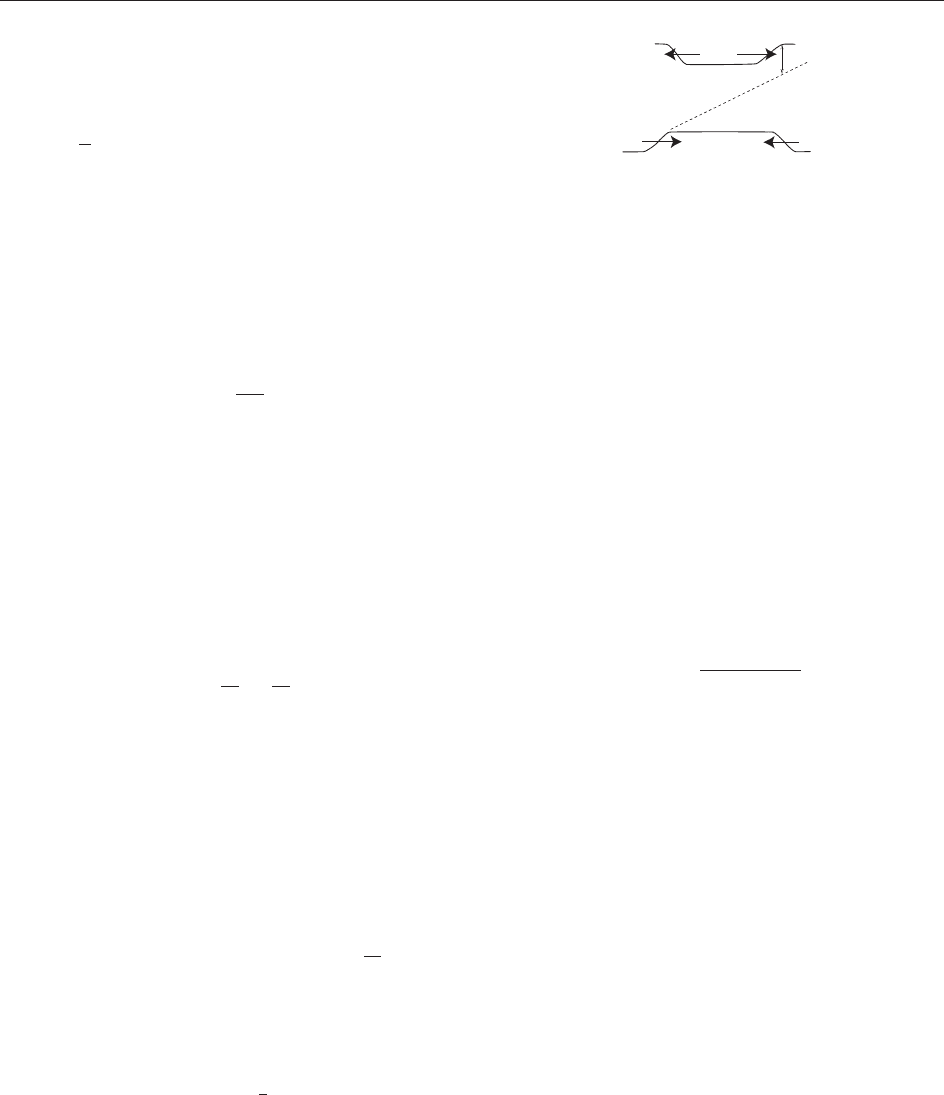
which we illustrate in Figure 1. We shall see that this
kind of simple scattering is a characteristic feature of
integrable field theories which extends to the
quantum theory. It reflects the enormous restriction
that the existence of the infinite set of integrals of
motion puts on the dynamics.
Integrability at the Quantum Level
In this section we turn to the particular implications
of integrability for the field theories at the quantum
level. In discussing theories in 1 þ 1 dimensions it is
convenient, as in [12], to use the rapidity. The
energy and momentum of a particle of mass m are
E = m cosh and p = m sinh , respectively.
The sinh- and sine-Gordon theory, and their affine
Toda generalizations, are scalar field theories with a
well-behaved potential and as such they can be
quantized in the conventional manner. It can be
shown that integrability survives quantization and we
now address its consequences. The key observation is
that having an infinite set of higher-spin conserved
quantities is very restrictive on the possible quantum
processes. Assuming that the theory has a mass gap,
the asymptotic states ja, i are particles with rapidity
Δt
Figure 1 Classical scattering of a kink and an antikink. The
final velocities equal the initial velocities and the only effect is to
introduce a velocity-dependent time delay as shown.
52 Integrability and Quantum Field Theory
and additional quantum numbers needed to specify
the state are indicated by the label a. These states are
eigenstates of the conserved charges,
Q
s
ja;i¼q
s
ðaÞe
s
ja;i½22
Here, s is the spin of the charge which ranges over
some infinite subset of the integers. Since the charges
must commute with the S-matrix, it follows imme-
diately that if an incoming state of n particles has a
set of rapidities {
1
, ...,
n
} then the outgoing state
must also have n particles with the same set
{
1
, ...,
n
}: there is consequently no particle crea-
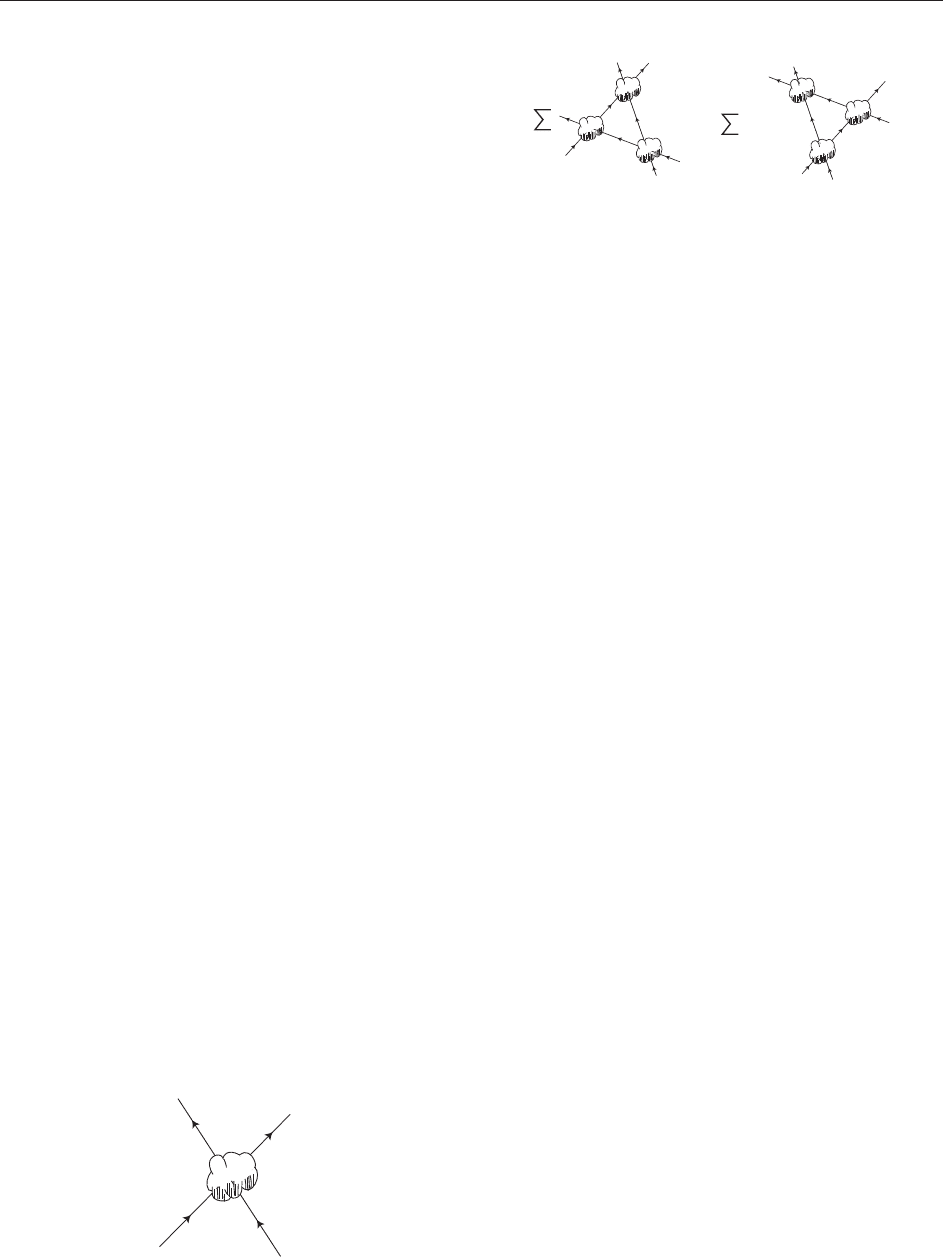
tion! For example, we have illustrated the scat tering
of two particles in Figure 2. The two -particle
S-matrix element will be denoted as
S
cd
ab
ð
1
2
Þ: ja;
1
; b;
2
i!jc;
2
; d;
1
i½23
Note that masses of the incoming particles must match
the outgoing ones: m
a
= m
d
and m
b
= m
c
.Wehave
already seen this kind of behavior with the classical
scattering of solitons in the sine-Gordon theory. In
spite of the fact that the scattering is purely elastic, it
can be nontrivial for two reasons: if there are mass
degeneracies in the theory, the quantum numbers
{a
1
, ..., a
n
} can change and, in addition, the S-matrix
element can depend nontrivially on the momenta.
The fact that the incoming and outgoing states
have the same set of momenta leads to the notion of
factorizability. To see what this means, consid er the
case of three particles. Let us imagine that we
prepare the initial state to consist of three fairly
narrow wave packets in position space with
momenta smeared in accordance with the uncer-
tainty principle. The key to the following argument
is the fact that the infinite set of higher-spin
conserved charges (with commute with the S-matrix)
allow one to move the positions of the three
particles relative to each other in an arbitrary way.
In addition, the theory has a mass gap, so interac-
tions have a finite range. By using this freedom, we
can arrange for particles 1 and 2 to interact first,
well before they come within interaction range of
the third. Subsequently, the first two particles
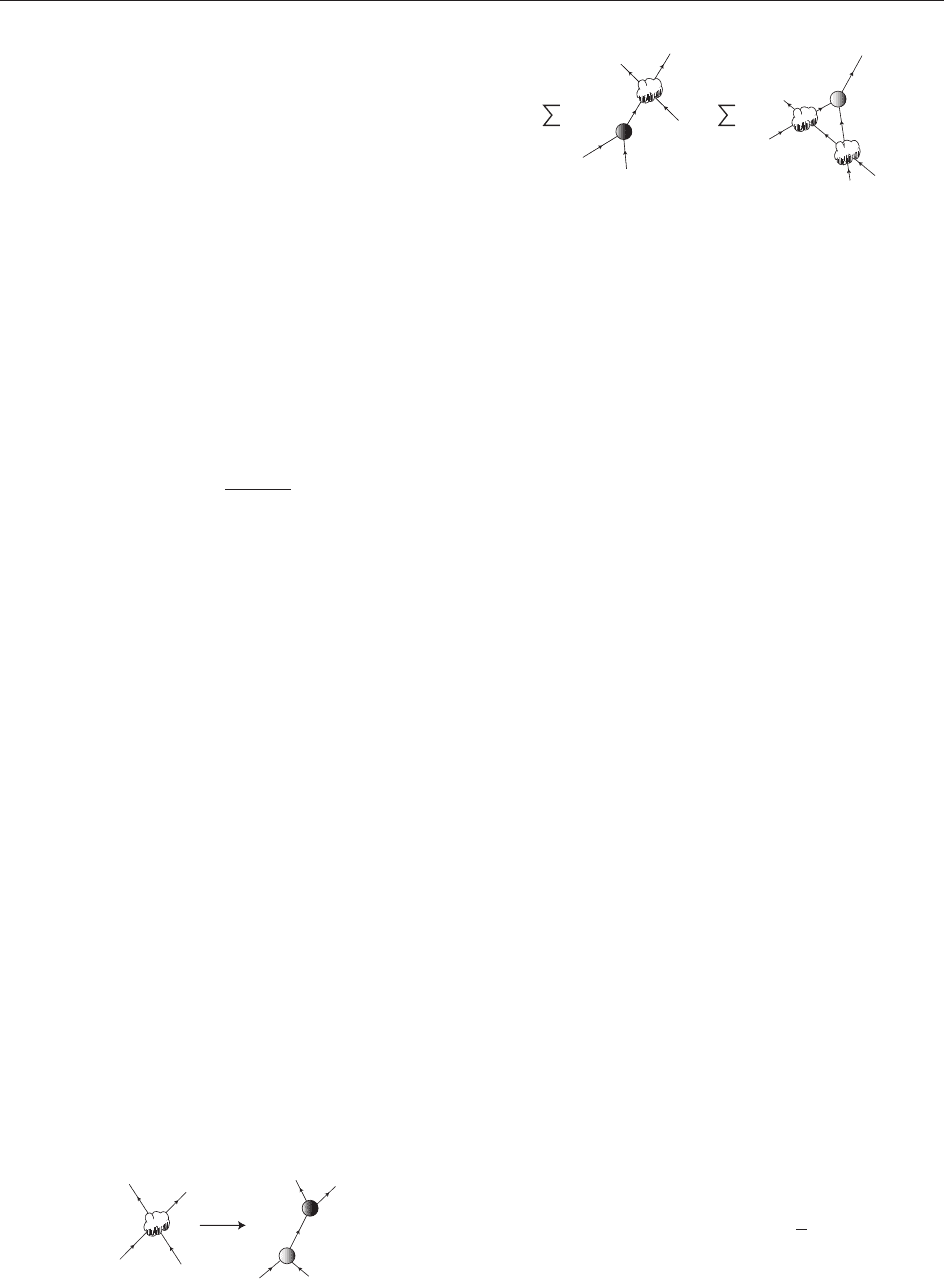
interact with the third as on the right-hand side of
Figure 3. This ability to move the wave packets
around using the symmetries means that the three-
particle S-matrix element must ‘‘factorize’’ into a
product of three two-particle elements:
S
def
abc
ð
1
;
2
;
3
Þ
¼
X
ghi
S
gh
ab
ð
1
2
ÞS
if
hc
ð
1
3
ÞS
de
gi
ð
2
3
Þ½24
However, we could also use the symmetries afforded
by the conserved charges to shift the positions of the
particles so that particle 2 and 3 interact first, as on
the left-hand side of Figure 3. Since the charges
commute with the S-matrix, the result must the
same; hence, there is a nontrivial consistency
condition:
X
ghi
S
hi
bc
ð
2
2
ÞS
dg
ah
ð
1
3
ÞS
ef
gi
ð
2
3
Þ
¼
X
ghi
S
gh
ab
ð
1
2
ÞS
if
hc
ð
1
3
ÞS
de
gi
ð
2
3
Þ½25
This is the celebrated Yang–Baxter equation. Notice
that it is only nontrivial if there are mass degen-
eracies, otherwise the particles on internal lines are
determined by the external particles.
The factorization of the S-matrix extends readily to
the case of more particles in an obvious way. An
n-body element factorizes into a two-body element
for each pair of particles. One might think that
considerations of the n-particle S-matrix would lead
to additional constraints; however, it can readily be
shown that this is not the case and that the Yang–
Baxter equation acts as a basic ‘‘move’’ which allows
one to reorder the n-particle S-matrix into an
arbitrary order. Further conditions on the S-matrix
come from the axioms of analytic S-matrix theory:
(i) Unitarity
X
ef
S
ef
ab
ðÞS
cd
ef
ðÞ¼
ac
bd
½26
a
b
c
d
Figure 2 The two particle S-matrix with particles a and b in the
initial state and c and d in the final state. For consistency,
m
a
= m
d
and m
b
= m
c
.
a
b
c
d
e
f
g
h
i
a
b
c
d
e
f
g
h
i
g
hi
ghi
=
Figure 3 The scattering of three particles can factorize in two
distinct ways as illustrated, leading to a nontrivial condition: the
Yang–Baxter equation.
Integrability and Quantum Field Theory 53
(ii) Crossing symmetry Each particle a has an
antiparticle
a and
S
cd
ab
ðÞ¼S
ac
b
d
ði Þ½27
(iii) Analyticity The S-matrix is a meromorphic
function of on the physical strip, 0 Im .
Singularities in most instances occur along the
imaginary axis and the simple poles correspond to
direct or cross-channel resonances. In this case, if
S
de
ab
() has a simple pole at = iu
c
ab
(necessarily a
nonphysical rapidity difference) in the direct chann el
there exists a bound state of a and b of mass
m
2
c
¼ m
2
a
þ m
2
b
þ 2m
a
m
b
cos u
c
ab
½28
The situation is illustrated in Figure 4.Thenew
particle must itself be included in the particle spectrum.
The S-matrix elements at the pole have the form
S
de
ab
ðÞ¼
X
c
P
c
ab
ir
c
ab
iu
c
ab
P
c
d
e
þ ½29
where P
c
ab
can be though t of as a kind of projection
operator with
X
ab
P
c
ab
P
d
b
a
¼
cd
½30
Unitarity of the QFT requires that r
c
ab
is real and
positive, although there are also examples of
nonunitarity theories with exact S-matrices. If
ab !c can occur then so can a
c !
b and b
c !
a.
From [28], we deduce the following identity:
u
c
ab
þ u
b
a
c
þ u
a
b
c
¼ 2 ½31
The data {u
c
ab
} for any given scattering theory are
known as the fusing angles.
(iv) The Bootstrap equations These give a non-
linear relation between S-matrix elements. The basic
idea is that if particle c appears as a resonance in the
scattering of a and b then the S-matrix element of c
with another state d can be deduced in terms of the
scattering of d with a and b.Thisisillustratedin
Figure 5.Using[30], we can write the resulting
equation for the S-matrix element of c and d directly:
S
ef
cd
ðÞ¼
X
ghi
P
c
a
b
S
eg
ah
i
u
b
a
c
S
hi
bd
þ i
u
a
b
c
P
f
gi
½32
The bootstrap constraints are very powerful because
they allow one to extract the S-matrix elements of new
particles that appear as bound states. This leads to the
philosophy of the ‘‘bootstrap program’’ where one
attempts to build consistent S-matrices starting from
the S-matrix for a subset of particles which act as a
seed for the algorithm. The process is quite an art, but
at the end one has to be satisfied that the complete
analytic structure is consistent with all the axioms. The
key is to be able to account for all the poles in a
consistent way, either in terms of bound states, as
above, or in terms of the Coleman–Thun mechanism.
This allows some poles to be interpreted in ways other
than the existence of a bound state. The bootstrap
algorithm is very complicated in general and at the
present time a complete classification of solutions is
not known. However, there are a large number of
known solutions which appear to be intimately related
to Lie algebras and associated structures known as
Yangians and quantum groups. Below we describe
some of the simplest known solutions.
Minimal S-Matrices
These scattering theories are in some sense the
simplest. The particle spectrum is generally non-
degenerate and so the Yang–Baxter equation is
trivial. As is ubiquitous in the subject of IQFT, the
classification of the theories is related to Lie
algebras, although what seems to be important is
not so much the algebra in question but rather the
details of the associated root system. In this case the
appropriate algebras are the sim ply laced algebras of
ADE type. The number of particles is equal to the
rank r of the Lie algebra and the masses are given by
the r elements of one of the eigenvectors of the
Cartan matrix of the algebra g :
X
r
b¼1
C
ab
m
b
¼ 2 2 cos
h
m
a
½33
where h is the Coxeter number of g. The conserved
charges have spins corresponding to the exponents
of g modulo h. We briefly explain how the complete
a
b
c
d
e
f
a
b
d
e
f
g
h
i
c ghi
=
Figure 5 The bootstrap equations result from considering the
interaction of a particle d with the bound state c of a and b in two
distinct ways as illustrated.
a
b
d
e
ab
d
e
c
Figure 4 Near a direct channel pole, the scattering of a and b
is dominated by the bound state c.
54 Integrability and Quantum Field Theory

S-matrix can be written down in terms of properties
of the root system of g .LetF be the set of roots of g,
and a
a
, a = 1, ..., r, a set of simple roots, as in the
last section. In terms of these, C
ab
= 2a
a
a
b
=a
2
b
. Let
w
a
, a = 1, ..., r, be a corresponding set of funda-
mental weights, a
a
w
b
=
ab
.
Key to defining the theories is the notation of the
Weyl group of g, the group generated by reflections
in the simple roots:
R
a
ðaÞ¼a
2a a
a
a
2
a
a
a
½34
The element w = R
1
R
2
R
r
is known as a Coxeter
element of the Weyl group, and it has special
properties that are significant in the present context.
In particular, its eigenval ues are of the form
exp (2is
a
=h), where h is the Coxeter numb er of g
and the integers s
a
are the exponents of the alge bra
as in [8]. Note that there is always a pair with s
1
= 1
and s
r
= h 1. Clearly, w acts as a rotation in the
two-dimensional space spanned by the two corre-
sponding eigenvectors. We can define an antisym-
metric function u(a, b) on roots to be h= times the
(signed) angle between the projections of a and b
onto this two-dimensional eigenspace. In prepara-
tion for what follows, it is useful to also define the
roots
f
a
¼ R
r
R
r1
R
aþ1
ða
a
Þ½35
We can now present P Dorey’s amazingly compac t
formula for the complete S-ma trix. For the scatter-
ing of particle a with particle b,
S
ab
ðÞ¼
Y
b2G
b
f1 þ uðf
a
; bÞg
w
a
b
½36
In this formula
b
is the set of positive roots of g
which lie in the orbit of f
b
under w. We have also
defined the building block
fxg¼ðx þ 1Þðx 1Þ
ðxÞ¼
sinh
2
þ
ix
h
sinh
2
ix
h
½37
The fusing rules are also particularly elegant in
the language of root systems. There is a three-point
coupling between a
i
, i = 1, 2, 3, if there exist three
roots a
(i)
2
a
i
such that a
(1)
þ a
(2)
þ a
(3)
= 0.
Furthermore, the fusing occurs in the a
1
, a
2
channel
at rapidity difference
iu
a
3
a
1
a
2
¼
i
h
uða
ð1Þ
; a
ð2Þ
Þ½38
This is Dorey’s fusing rule.
For the case of A
n1
, the S-matrices are particu-
larly simple. The mass spectrum is
m
a
¼ m sin
a
n
; a ¼ 1; ...; n 1 ½39
and Dorey’s rule gives the possible fusings as
ab !(a þ b)mod n, which occur at the rapidity
values
¼ iu
ab
¼
i
a þ b
n
a þ b < n
i2
a þ b
n
a þ b n
8
>
>
<
>
>
:
½40
The charge conjugation operator maps a !
a = n a
and the explicit form for the S-matrix elements is
S
ab
ðÞ¼fa þb 1gfa þb 3gfja bjþ1g½41
The element S
ab
() has one direct channel pole at
= iu
ab
corresponding to the exchange of the
particle a þb mod n, and a cross-channel pole at
= iu
a
b
corresponding to the exchange of particle
a b mod n.
Affine Toda Theories
The bootstrap program has been solved for all the
affine Toda theories. For the simply laced theories
described earlier, the result is directly related to
the minimal S-matrices constructed above. The
only difference i s that there are additional factors
which depend on the coupling of the Toda
theory but which do not introduce any additional
poles onto the physical s trip. These CDD factors
are included by simply changing the basic building
block [37]:
fxg!fxg
Toda
¼
ðx þ 1Þðx 1Þ
ðx 1 þ BÞðx þ 1 BÞ
½42
where
B ¼
1
2
2
1 þ
2
=4
½43
The S-matrix structure for the Toda theories
based on the nonsimply lace d algebras is a good
deal more complicated. Integrability is only main-
tained in the quantum theory if the ratios of the
physical masses of the pa rticles depend on the
coupling constant is some very special way.
The Sine-Gordon Theory
We have seen that the sine-Gordon theory has
solitons at the classical level. At the quantum level,
Integrability and Quantum Field Theory 55
we expect that these kinks become bona fide particle
states, in addition to the particle corresponding to
the quantum fluctuat ions of the field . Focusing on
the solitons, we expect a degenerate doublet
corresponding to the kink and antikink. For the
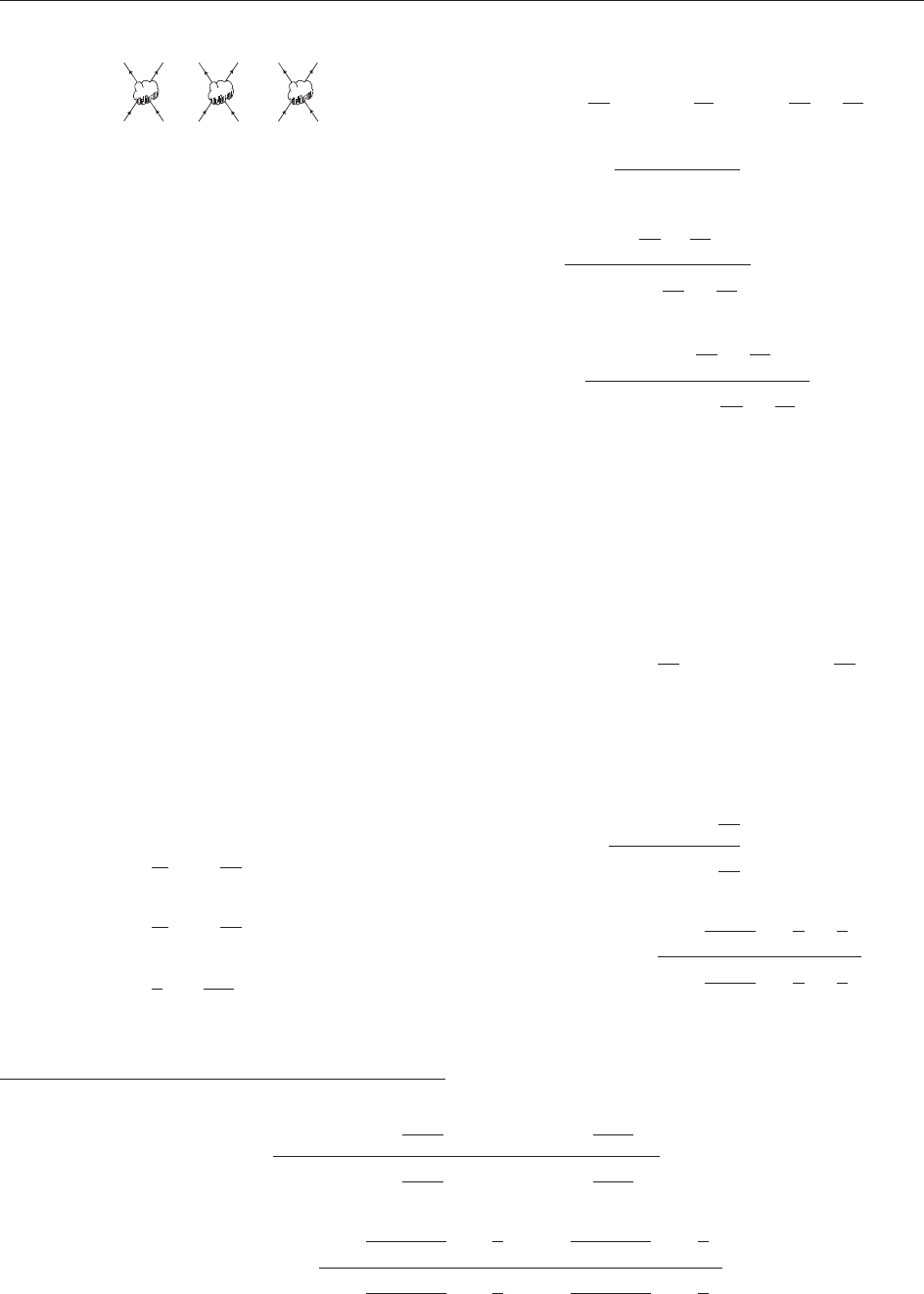
scattering of two solitons, there are six allowed
processes illustrated in Figure 6. Unitarity [26] leads
to the constraints
SðÞSðÞ¼1
S
T
ðÞS
T
ðÞþS
R
ðÞS
R
ðÞ¼1
S
T
ðÞS
R
ðÞþS
R
ðÞS
T
ðÞ¼0
½44
while crossing symmetry [27] (using the fact that the
soliton and antisoliton are antiparticles) gives
Sði Þ¼S
T
ðÞ; S
R
ði Þ¼S
R
ðÞ½45
By themselves, these constraints are rather mild;
however, the complete soliton S-matrix must also
satisfy the Yang–Baxter equation [25].Thesolu-
tion to all the constraints is not unique, however,
the Zamolodchikovs conjectured that the exact
answer is
SðÞ¼
1
i
sinh
8
ði Þ
UðÞ
S
T
ðÞ¼
1
i
sinh
8
UðÞ
S
R
ðÞ¼
1
sin
8
2
UðÞ
½46
with
UðÞ¼
8
1 þ i
8
1
8
i
8
Y
1
n¼1
R
n
ðÞRði Þ
R
n
ð0ÞR
n
ðiÞ
R
n
ðÞ¼
2n
8
þ i
8
ð 2n þ 1Þ
8
þ i
8
1 þ 2n
8
þ i
8
1 þð2n 1Þ
8
þ i
8
½47
where =
2
(1
2
=8)
1
. The reason for confi-
dence in the conjecture is that from the soliton
S-matrix one can complete the bootstrap program
and account for all the poles in terms of particles in
the theory. In particular, there is a finite set of
bound states of the soliton and antisoliton, called
breathers, with masses
m
k
¼ 2M sin
k
16
; k ¼ 1; 2; ... <
8
½48
Here, M is the soliton mass. The bootstrap
equations give the S-matrix for the scattering of a
soliton or antisoliton with the kth breather,
S
k
ðÞ¼
sinh þ i cos
k
16
sinh i cos
k
16
Y
k1
j¼1
sin
2
k 2j
32
4
þ i
2
sin
2
k 2j
32
4
i
2
½49
while, for the scattering of breath er k with l,
S
kl
ðÞ¼
sinh
2
þ i sin
k þ l
16
sinh þ i sin
k l
16
sinh
2
i sin
k þ l
16
sinh i sin
k l
16
Y
l1
j¼1
sin
2
k l 2j
32
þ i
2
cos
2
k þ l 2j
32
þ i
2
sin
2
k l 2j
32
i
2
cos
2
k þ l 2j
32
i
2
½50
ss
s
ss ′
s
′sss ′
s
′s
s
S
R
S
T
S
Figure 6 Soliton scattering processes. s and s
0
are the kink
and antikink, respectively, or vice versa.
56 Integrability and Quantum Field Theory