
Francoise J.-P., Naber G.L., Tsun T.S. (editors) Encyclopedia of Mathematical Physics
Подождите немного. Документ загружается.


well as a universal Poisson structure for the system;
Donagi and Markman (1996) realized it as a
generalized Hitchin system.
More classically, elliptic potentials were the subject
of much study, in particular by Lame´andHermitein
the nineteenth century and Ince in the twentieth; a
sample result due to Ince makes one feel like Alice in
Wonderland, who ‘‘knelt down and looked along the
passage into the loveliest garden you ever saw’’: the
Lame´operatorL = @
2
þ a(a þ 1)}(x x
0
)with
real, smooth potential is finite gap (namely, almost
all the periodic eigenvalues are double) iff a 2 Z (if a
is positive the number of gaps is a). A generalization
to several variables (due to Chalykh and Veselov),
L ¼ þ
X
2R
þ
g
}ðh; xiÞ
where R
þ
is the set of positive roots for a simple complex
Lie algebra of rank n, h, i is some scalar product in
R
n
, invariant under the action of the Weyl group, and
g
= m
(m
þ 1)h, ifor some m
2 Z,providesone
of the few known examples of quantum completely
integrable rings of differential operators in several
variables. Roughly speaking, this means that the
centralizer of L contains n operators with functionally
independent symbols, where n is the number of variables.
What is more, Chalykh et al. (2003) combine
differential Galois theory and elliptic function
theory to characterize (under some mild assump-
tions) the generalized Lame´ operators that are
algebraically completely integrable: the differential
Galois group of the solutions is abelian.
Duality, Fourier–Mukai Transform, and Bispectrality
Duality is a concept imported from mathematical
physics; as a mathematical phenomenon, it has not
reached theoretical maturity. First observed in exam-
ples, as in Fock et al. (2000), where different definitions
of dual ACI Hamiltonian systems were given (action-
angle, action–action, and quantum), it resurfaced for
the Hitchin system, in more than one guise, whether it
be an interchange of position and momentum variables
(Gawe¸ dzki and Tran-Ngoc-Bich 1998) or a duality
between the Lagrangian tori that fiber two such
systems, coming from a Fourier–Mukai transform,
namely a twist by the (universal) Picard line bundle:
P
#
JacðXÞðH
0
ðX; KÞ¼T
JacðXÞÞ
Notably, the Picard bundle was used by Nakayashiki
to give a spectacular generalization of the Burchnall–
Chaundy result for a genus-2 curve X (more generally,
Jac(X) is replaced by a generic abelian variety in the
statement): the coordinate ring of Jac(X)
X
is the
common spectrum of a ring of commuting (g! g!)
matrix partial differential operators in g variables. The
Fourier transform allowed him to extend Sato’s corre-
spondence @
1
$ z and give F a unique (free, rank-g!)
D
Jac(X)
-module structure, where F is a suitable coherent
sheaf over Jac(X) generalizing the Baker function.
In this model, the interchange of the x and z
variables is known as bispectrality (cf. Gru¨ nbaum
(2001)): a somewhat narrower question is a char-
acterization of the differential operators L in x for
which there exists a differential operator B in k and
a common eigenfunction:
L ðx; kÞ¼f ðkÞ ðx; kÞ
B ðx; kÞ¼ðxÞ ðx; kÞ
(
for some functions f , , typically polynomial. This
question proved to be related with the KP hierarchy
and isomonodromy deformations. When to a hier-
archy there is associated an ACI Hamiltonian system
(as in the Neumann case shown above), bispectrality
may produce a dual system, in a sense related to the
ones discussed, but somewhat mysteriously so.
Conclusion
Many important mathematical topics and individual
contributions regrettably have to go unmentioned in
an article of this length. The aim was to illustrate
by simplest examples the geometric nature of
integrable systems and equations, in the areas of
spectral curves, moduli of vector bundles over them,
Grassmann manifolds, special functions, Poisson
geometry, representation theory, as well as mention
constructions that are not yet complete, such as
spectral varieties of higher dimension, dualities
sweeping vaster moduli spaces, and quantization.
See also: Billiards in bounded convex domains;
@-Approach to Integrable Systems; Functional Equations
and Integrable Systems; Integrable Systems and
Discrete Geometry; Integrable Systems and Recursion
Operators on Symplectic and Jacobi Manifolds;
Integrable Systems and the Inverse Scattering Method;
Integrable Systems in Random Matrix Theory; Integrable
Systems: Overview; Multi-Hamiltonian Systems;
Recursion Operators in Classical Mechanics; Riemann–
Hilbert Methods in Integrable Systems; Solitons and Kac–
Moody Lie Algebras.
Further Reading
Adams MR, Harnad J, and Previato E (1988) Isospectral
Hamiltonian flows in finite and infinite dimension. Commu-
nications in Mathematical Physics 117: 451–500.
Adler M and van Moerbeke P (1980) Completely integrable
systems, Euclidean Lie algebras and curves. Linearization of
Hamiltonian systems, Jacobian varieties and representation
theory. Advances in Mathematics 38: 267–379.
Integrable Systems and Algebraic Geometry 77

Babelon O, Bernard D, and Talon M (2003) Introduction to Classical
Integrable Systems. Cambridge: Cambridge University Press.
Baker HF (1907) An Introduction to the Theory of Multiply-
Periodic Functions. Cambridge: Cambridge University Press.
Chalykh O, Etingof P, and Oblomkov A (2003) Generalized
Lame´ operators. Communications in Mathematical Physics
239(1–2): 115–153.
Dickey LA (2003) Soliton Equations and Hamiltonian Systems,
Advanced Series in Mathematical Physics, vol. 26, 2nd edn.
River Edge, NJ: World Scientific.
Donagi R and Markman E (1996) Spectral covers, algebraically
completely integrable Hamiltonian systems, and moduli of
bundles. In: Integrable Systems and Quantum Groups, Lecture
Notes in Mathematics, pp. 1–119. Berlin: Springer (Monteca-
tini Terme, 1993).
Dubrovin BA, Krichever IM, and Novikov SP (2001) Integrable
Systems I, Dynamical Systems IV, Encyclopaedia of Mathe-
matical Science, vol. 4, pp. 177–332. Berlin: Springer.
Fock V, Gorsky A, Nekrasov N, and Rubtsov V (2000) Duality in
integrable systems and gauge theories. Journal of High Energy
Physics No. 7, pp. 40.
Franc¸oise JP (1987) Monodromy and the Kovalevskaya top.
Aste´rique 150–151; 87–108.
Gawe¸ dzki K and Tran-Ngoc-Bich P (1998) Self-duality of the SL
2
Hitchin integrable system at genus 2. Communications in
Mathematical Physics 196(3): 641–670.
Gru¨ nbaum FA (2001) The bispectral problem: an overview. In Special
Functions 2000: Current Perspective and Future Directions
(Tempe, AZ), 129–140, NATO Science Series II: Mathematics,
Physics, and Chemistry, vol. 30. Dordrecht: Kluwer Academic.
Hitchin N (1982) Monopoles and geodesics. Communications in
Mathematical Physics 83(4): 579–602.
Hitchin N (1987) Stable bundles and integrable systems. Duke
Mathematical Journal 54(1): 91–114.
McKean H and Moll V (1997) Elliptic Curves. Function
Theory, Geometry, Arithmetic. Cambridge: Cambridge
University Press.
Moser J (1980) Geometry of quadrics and spectral theory. In:
The Chern Symposium 1979, pp. 147–188. New York–Berlin:
Springer.
Mulase M (1984) Complete integrability of the Kadomtsev–
Petviashvili equation. Advances in Mathematics 54(1): 57–66.
Mumford D (1984) Tata Lectures on Theta II, Progr. Math.,vol.43.
Boston: Birkha¨user.
Nekrasov N (1996) Holomorphic bundles and many-body systems.
Communications in Mathematical Physics 180(3): 587–603.
Neumann C (1859) De problemat quodam mechanico quad ad
primam integralium ultraellipticorum classem revocatur.
J. reine angew Math. 56: 46–63.
Ol’shanetski
˘
i MA, Perelomov AM, Re
˘
iman AG, and Semenov-
Tyan-Shanski
˘
i MA (1987) Integrable systems, II. Current
Problems in Mathematics. Fundamental Directions, vol. 16,
pp. 86–226, 307; Itogi Nauki i Tekhniki, Akad. Nauk SSSR,
Vsesoyuz. Inst. Nauchn. i Tekhn. Inform., Moscow.
Siegel CL (1969) Topics in Complex Function Theory, vol. 1.
New York: Wiley.
Treibich A (2001) Hyperelliptic tangential covers, and finite-gap
potentials. Uspekhi Matematicheskikh Nauk 56(6): 89–136.
van Geemen B and Previato E (1996) On the Hitchin system.
Duke Mathematical Journal 85(3): 659–683.
Integrable Systems and Discrete Geometry
A Doliwa, University of Warmia and Mazury
in Olsztyn, Olsztyn, Poland
P M Santini, Universita
`
di Roma ‘‘La Sapienza,’’
Rome, Italy
ª 2006 Elsevier Ltd. All rights reserved.
Introduction
Although the main subject of this article is the
connection between integrable discrete systems and
geometry, we feel obliged to begin with the
differential part of the relation.
Classical Differential Geometry
and Integrable Systems
The oldest (1840) integrable nonlinear partial
differential equation recorded in literature is the
Lame´ system
@
2
H
i
@u
j
@u
k
1
H
j
@H
j
@u
k
@H
i
@u
j
1
H
k
@H
k
@u
j
@H
i
@u
k
¼ 0;
i; j; k distinct ½1
@
@u
k
1
H
k
@H
j
@u
k
þ
@
@u
j
1
H
j
@H
k
@u
j
þ
1
H
2
i
@H
j
@u
i
@H
k
@u
i
¼ 0 ½2
describing orthogonal coordinates in the three-
dimensional Euclidean space E
3
(indices i, j, k range
from 1 to 3). Already in 1869, it was found by
Ribaucour that the nonlinear Lame´systempossessesa
discrete symmetry enabling to construct, in a linear
way, new solutions of the system from the old ones. He
gave also a geometric interpretation of this symmetry
in terms of certain spheres tangent to the coordinate
surfaces of the triply orthogonal system. In 1918,
Bianchi showed that the result of superposition of the
Ribaucour transformations is, in a certain sense,
independent of the order of their composition.
Such properties of a nonlinear equation are
hallmarks of its integrability, and indeed, the Lame´
system was solved using soliton techniques in
1997–98. The above example illustrates the close
connection between the modern theory of integrable
partial differential equations and the differential
geometry of the turn of the nineteenth and twentieth
centuries. A remarkable property of certain para-
metrized submanifolds (and then of the correspond-
ing equations) studied that time is that they allow
for transformations which exhibit the so-called
‘‘Bianchi permutability property.’’ Such transforma-
tions called, depending on the context, the Darboux,
Calapso, Christoffel, Bianchi, Ba¨ cklund, Laplace,
78 Integrable Systems and Discrete Geometry
Koenigs, Moutard, Combescure, Le´vy, Goursat,
Ribaucour, or the fundamental transformation of
Jonas, can be geometrically described in terms of
certain families of lines called line congruences.
In the connection between integrable systems and
differential geometry, a distinguished role is played
by the multidimensional conjugate nets, described by
the Darboux system, which is just the first part [1] of
the Lame´ system with indices ranging form 1 to N
3. On the level of integrable systems, this dominant
role has the following explanation: the Darboux
system, together with equations describing isoconju-
gate deformations of the net, forms the multicompo-
nent Kadomtsev–Petviashvilii (KP) hierarchy, which
is viewed as a master system of equations in soliton
theory. In fact, in appropriate variables, the whole
multicomponent KP hierarchy can be rewritten as an
infinite system of the Darboux equations.
Transition to the Discrete Domain
The recent progress in studying discrete integrable
systems showed that, in many respects, they should be
considered as more fundamental than their differential
counterparts. Consequently, the natural problem of
extending the geometric interpretation of integrable
partial differential equations to the discrete domain
arose, leading not only to the transition to the discrete
domain of many results on the connection between the
differential geometry and integrable systems, but also –
and this seems to be even more important – to the
descriptionofintegrabilityinaveryelementaryand
purely geometric way.
At the level of integrable equations, the transition
‘‘from differential to discrete’’ often makes formulas
more complicated and longer. On the contrary, at the
geometric level, in such a transition the properties of
discrete submanifolds, relevant to their integrability,
become simpler and more transparent. Indeed, the
mathematics necessary to understand the basic ideas of
the integrable discrete geometry does not exceed the
‘‘ruler and compass constructions,’’ and many proofs
can be performed using elementary incidence geometry.
We will concentrate our attention on the multi-
dimensional lattice made from planar quadrilaterals,
which is the discrete analog of a conjugate net. Together
with the discussion of its properties, which are the core
of the geometric integrability, we briefly present the
analytic methods of construction of these lattices and
we also describe some basic multidimensional integr-
able reductions of them. Then we discuss integrable
discrete surfaces; some of them have been found in the
early period of the ‘‘case-by-case’’ studies. We shall
however try to present them, from a unifying perspec-
tive, as reductions of the quadrilateral lattice (QL).
Multidimensional Integrable Lattices
The Quadrilateral Lattice
An N-dimensional lattice x : Z
N
!R
M
is a lattice
made from planar quadrilaterals, or a quadrilateral
lattice (QL) in short, if its elementary quadrilaterals
{x, T
i
x, T
j
x, T
i
T
j
x} are planar; that is, iff the follow-
ing system of discrete Laplace equations is satisfied:
i
j
x ¼ðT
i
A
ij
Þ
i
x þðT
j
A
ji
Þ
j
x;
i 6¼ j; i; j ¼ 1; ...; N ½3
where A
ij
: Z
N
!R are functions of the discrete
variable; here T
i
is the translation operator in the ith
direction, and
i
= T
i
1 is the corresponding
difference operator. For simplicity, we work here
in the affine setting neglecting projective geometric
aspects of the theory.
The geometric integrability scheme In the case
N = 2 the definition [3] allows one to uniquely
construct, given two discrete curves intersecting in a
common vertex and two functions A
12
, A
21
: Z
2
!R,
a quadrilateral surface. For N > 2theplanarity
constraints [3] are instead compatible if and only if
the geometric data A
ij
satisfy the nonlinear system
k
A
ij
þðT
k
A
ij
ÞA
ik
¼ðT
j
A
jk
ÞA
ij
þðT
k
A
kj
ÞA
ik
i; j; k distinct ½4
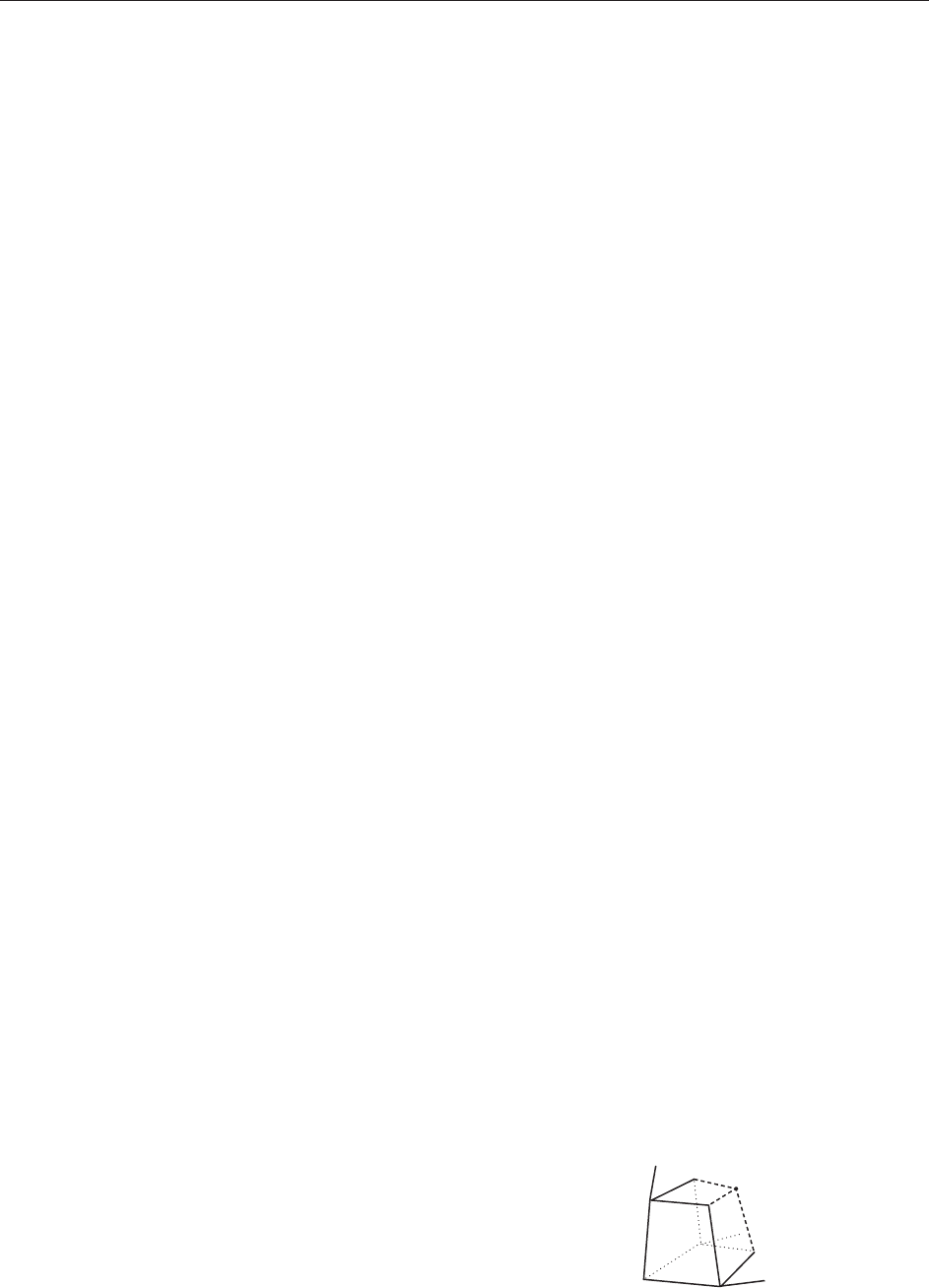
This constraint has a very simple interpretation: in
building the elementary cube (see Figure 1), the
seven points x, T
i
x, T
j
x, T
k
x, T
i
T
j
x, T
i
T
k
x, and
T
j
T
k
x (i, j, k are distinct) determine the eighth point
T
i
T
j
T
k
x as the unique intersection of three planes in
the three-dimensional space.
The connection of this elementary geometric point
of view with the classical theory of integrable
systems is transparent: the planarity constraint
corresponds to the set of linear spectral problems
[3] and the resulting QL is characterized by the
nonlinear equations [4], arising as the compatibility
conditions for such spectral problems. Since the QL
equations [4] are a master system in the theory of
integrable equations, planarity can be viewed as the
elementary geometric root of integrability. The idea
T
i
x
x
T
k
x
T
j
x
T
i
T
j
x
T
i
T
j
T
k
x
Figure 1 The geometric integrability scheme.
Integrable Systems and Discrete Geometry 79

that integrability be associated with the consistency
of a geometric (and/or algebraic) property when
increasing the dimensionality of the system is
recurrent in the theory of integrable systems.
Other forms of the Darboux system The i $ j
symmetry of the RHS of eqns [4] implies the
existence of the potentials H
i
: Z
N
!R (the Lame´
coefficients) such that
A
ij
¼
j
H
i
H
i
; i 6¼ j ½5
and then eqns [4] take the form
k
j
H
i
T
j
k
H
j
H
j
j
H
i
T
k
j
H
k
H
k
k
H
i
¼ 0; i; j; k distinct ½6
which is the discrete version of the first part [1] of
the Lame´ system.
The Lame´ coefficients allow to define the suitably
normalized tangent vectors X
i
: Z
N
!R
M
by equations
i
x ¼ðT
i
H
i
ÞX
i
½7
and the functions Q
ij
: Z
N
!R, i 6¼ j, (the rotation
coefficients) by equations
i
H
j
¼ðT
i
H
i
ÞQ
ij
; i 6¼ j ½8
Then eqns [3] and [6] can be rewritten in the first-
order form
j
X
i
¼ðT
j
Q
ij
ÞX
j
; i 6¼ j ½9
k
Q
ij
¼ðT
k
Q
ik
ÞQ
kj
; i; j; k distinct ½10
The discrete Darboux system [10] implies the
existence of other potentials
i
defined by the
compatible equations
T
j
i
i
¼ 1 ðT
i
Q
ji
ÞðT
j
Q
ij
Þ; i 6¼ j ½11
The i $ j symmetry of the RHS of eqns [11] implies
the existence of yet another potential : Z
N
!R,
i
¼
T
i
½12
which is called the -function of the QL. In terms of
the -function, and of the functions
ij
¼ Q
ij
; i 6¼ j ½13
whose geometric interpretation will be given in a
later section, the discrete Darboux equations take
the following Hirota-type form:
ðT
i
T
j
Þ ¼ðT
i
Þ T
j
ðT
i
ji
ÞT
j
ij
; i 6¼ j ½14
ðT
k
ij
Þ ¼ðT
k
Þ
ij
þðT
k
ik
Þ
kj
; i; j; k distinct ½15
Analytic Methods
We will show how one can construct large classes of
solutions of the discrete Darboux equations and the
corresponding QLs using two basic analytical
methods of the soliton theory: the
@-dressing
method and the algebro-geometric techniques.
The
@-dres sing method Consider the nonlocal
@-problem
@ðzÞþð
^
RÞðzÞ¼
@ðzÞ
lim
jzj!1
ðzÞðzÞðÞ¼0
½16
where
@ = @=@
z,
^
R is the integral operator
ð
^
RÞðzÞ¼
Z
C
Rðz; z
0
Þðz
0
Þdz
0
^ d
z
0
and (z) is a given rational function of z.
Let Q
i
2 C, i = 1, ..., N be pairs of distinct points
of the complex plane, which define the dependence
of the kernel R on the discrete variable n 2 Z
N
:
Rðz; z
0
; nÞ¼
Y
N
i¼1
z Q
þ
i
z Q
i
n
i
R
0
ðz; z
0
Þ
Y
N
i¼1
z
0
Q
i
z
0
Q
þ
i
n
i
We consider only kernels R
0
(z, z
0
) such that the
nonlocal
@-problem is uniquely solvable. If (z; n)is
the unique solution with the canonical normal-
ization = 1, then the function
ðz; nÞ¼ðz; nÞ
Y
N
i¼1
z Q
i
z Q
þ
i
n
i
satisfies the system of the Laplace equations [3] with
the Lame´ coefficients given by
H
i
ðnÞ¼ lim
z!Q
þ
i
z Q
þ
i
z Q
i
n
i
ðz; nÞ
By construction, the system of such Laplace equa-
tions is compatible, therefore the Lame´ coefficients
satisfy eqns [6]. To various n-independent measures
d
a
on C there correspond coordinates
x
a
ðnÞ¼
Z
C
ðz; nÞd
a
ðzÞ
of a QL x, having H
i
(n) as the Lame´ coefficients. To
have real lattices, the kernel R
0
, the points Q
i
, and
the measures d
a
should satisfy certain additional
conditions.
One can find a similar interpretation of the
normalized tangent vectors X
i
and of the rotation
80 Integrable Systems and Discrete Geometry

coefficients Q
ij
.If
i
(z; n) are the unique solutions of
the nonlocal
@-problem [16] with the normalizations
i
ðz; nÞ¼
Q
þ
i
Q
i
z Q
þ
i
Y
N
k¼1;k6¼i
Q
þ
i
Q
þ
k
Q
þ
i
Q
k
!
n
k
then the functions
i
(z; n), defined by
i
ðz; nÞ¼
Y
N
k¼1
z Q
k
z Q
þ
k
!
n
k
i
ðz; nÞ
satisfy the direct analog of the linear problem [9],
j
i
ðz; nÞ¼ðT
j
Q
ij
ðnÞÞ
j
ðz; nÞ; i 6¼ j ½17
where
Q
ij
ðnÞ¼ lim
z!Q
þ
j
z Q
þ
j
z Q
j
!
n
j
i
ðz; nÞ
!
Again, by construction, eqns [17] are compatible
and the functions Q
ij
(n) satisfy the discrete Darboux
equations [10]. The functions
X
a
i
ðnÞ¼
Z
C
i
ðz; nÞd
a
ðzÞ
are coordinates of the normalized tangent vectors X
i
of the QL x constructed above.
The algebro-geometric techniques Given a compact
Riemann surface R of genus g, consider a nonspecial
divisor D =
P
g
= 1
P
. Choose N pairs of points Q
i
2
R and the normalization point Q
1
.Givenn 2 Z
N
,
there exists a unique Baker–Akhiezer function (n),
defined as a meromorphic function on R,withthe
following analytical properties: (1) as a function of P 2
Rn[
N
i = 1
Q
i
, (n) may have as singularities only
simple poles in the points of the divisor D;(2)inthe
points Q
i
function (n) has poles of the order n
i
;and
(3) in the point Q
1
function (n) is normalized to 1.
When z
i
(P) is a local coordinate on R centered at
Q
i
, then condition (2) implies that the function (n)
in a neighborhood of the point Q
i
is of the form
ðP; nÞ¼ z
i
ðPÞ
n
i
X
1
s¼0
i
s;
ðnÞ z
i
ðPÞ
s
!
½18
The Baker–Akhiezer function, as a function of the
discrete variable n 2 Z
N
, satisfies the system of
Laplace equations [3] with the Lame´ coefficients
H
i
(n) =
i
0, þ
(n).
Again, by construction, the Lame´ coefficients
satisfy eqns [6]. To various n-independent measures
d
a
on R there correspond coordinates
x
a
ðnÞ¼
Z
R
ðP; nÞd
a
ðPÞ
of a QL x.
We present the expression of the Baker–Akhiezer
function and of the -function of the QL in terms of
the Riemann theta functions. Let us choose on R the
canonical basis of cycles {a
1
, ..., a
g
, b
1
, ..., b
g
} and
the dual basis {!
1
, ..., !
g
} of holomorphic differen-
tials on R, that is,
H
a
j
!
k
=
jk
. Then the matrix B of
b-periods defined as B
jk
=
H
b
j
!
k
is symmetric and
has positively defined imaginary part. Denote by
!
PQ
the unique differential holomorphic in
Rn{P, Q} with poles of the first order in P, Q and
residues, correspondingly, 1 and 1, which is
normalized by conditions
H
a
j
!
PQ
= 0. The Riemann
function (z; B), z 2 C
g
, is defined by its Fourier
expansion
ðz; BÞ¼
X
m2Z
g
exp ihm; Bmiþ2ihm; zi
fg
where h, i denotes the standard bilinear form in C
g
.
Finally, the Abel map A is given by A(P) =
(
R
P
P
0
!
1
, ...,
R
P
P
0
!
g
), where P
0
2R, and the Riemann
constants vector K is given by
K
j
¼
1 þ B
jj
2
X
k6¼j
I
a
k
!
k
ðPÞA
j
ðPÞ!
j
;
j ¼ 1; ...; g
The explicit form of the vacuum Baker–Akhiezer
function can be written down with the help of the
theta functions as follows:
ðn; PÞ¼
AðPÞþ
P
N
k¼1
n
k
AQ
k
AQ
þ
k
þ Z
AðQ
1
Þþ
P
N
k¼1
n
k
AQ
k
AQ
þ
k
þ Z
AðQ
1
ÞþZðÞ
AðPÞþZðÞ
exp
X
N
k¼1
n
k
Z
P
Q
1
!
Q
k
Q
þ
k
!
where Z =
P
g
j = 1
A(P
j
) K.
Denote by r
kj
and s
kj
the constants in the
decomposition of the abelian integrals near the
point Q
j
Z
P
P
0
!
Q
k
Q
þ
k
¼
P!Q
j
kj
log z
j
ðPÞþr
kj
þ Oz
j
ðPÞ
Z
P
P
0
!
Q
1
Q
þ
k
¼
P!Q
j
kj
þ
log z
j
ðPÞþs
kj
þ Oz
j
ðPÞ
Then the expression of the -function of the QL within
the subclass of algebro-geometric solutions reads
ðnÞ
¼
X
N
k¼1
n
k
AQ
k
AQ
þ
k
þ AðQ
1
ÞþZ
!
Y
N
k;j¼1
n
k
n
j
kj
Y
N
k¼1
n
k
k
Integrable Systems and Discrete Geometry 81
where
kj
¼ exp
r
kj
r
þ
kj
2
!
¼
jk
k
¼
1
kk
AQ
þ
k
þ Z
AQ
k
þ Z
exp s
kk
s
þ
kk
Finally, we remark that the geometric integrability
scheme and the algebro-geometric methods work
also in the finite fields setting, giving solutions of the
corresponding integrable cellular automata.
The Darboux-Type Transformations
We present the basic ideas and results of the theory
of the Darboux-type transformations of the multi-
dimensional QL.
Line congruences and the fundamental transformation
To define the transformations we need to define
first N-dimensional line congruences (or, simply,
congruences), which are families of lines in R
M
labeled by points of Z
N
with the property that any
two neighboring lines l and T
i
l, i = 1, ..., N, are
coplanar and therefore (eventually in the projective
extension P
M
of R
M
) intersect.
The QL F(x) is a fundamental transform of the QL
x if the lines connecting the corresponding points of
the lattices form a congruence. The superposition of a
number of fundamental transformations can be
compactly formulated in the vectorial fundamental
transformation. The data of the vectorial fundamental
transformation are: (1) the solution Y
i
: Z
N
!V, V
being a linear space, of the linear system [9]; (2) the
solution Y
i
: Z
N
! V
, V
being the dual of V,ofthe
linear system [8]. These allow to construct the linear
operator-valued potential W(Y, Y
):Z
N
!L(V),
defined by the following analog of eqn [7]:
i
WðY; Y
Þ¼Y
i
T
i
Y
i
; i ¼ 1; ...; N ½ 19
Similarly, one defines W(X, Y
):Z
N
!L(V, R
M
) and
W(Y, H):Z
N
!V. The transforms of the lattice x
and other related functions are given by
FðxÞ¼x WðX; Y
ÞWðY; Y
Þ
1
WðY; HÞ
FðH
i
Þ¼H
i
Y
i
WðY; Y
Þ
1
WðY; HÞ;
i ¼ 1; ...; N
FðX
i
Þ¼X
i
WðX; Y
ÞWðY; Y
Þ
1
Y
i
;
i ¼ 1; ...; N
FðQ
ij
Þ¼Q
ij
Y
j
WðY; Y
Þ
1
Y
i
;
i; j ¼ 1; ...; N; i 6¼ j
Fð
i
Þ¼
i
1 þ T
i
Y
i
WðY; Y
ÞY
i
;
i ¼ 1; ...; N
FðÞ¼ det Wð Y; Y
Þ
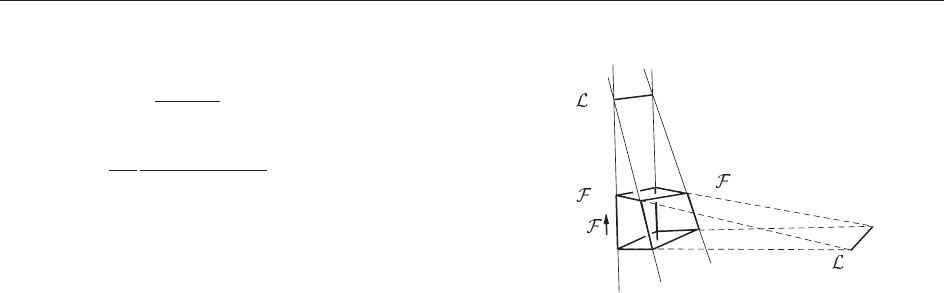
Notice that, by the coplanarity of any two neighbor-
ing lines of the congruence, also the quadrilaterals
{x, T
i
x, F(x), F(T
i
x)} are planar (see Figure 2). Then
the construction of the transformed lattice mimics
the geometric integrability scheme. In consequence,
any quadrilateral
{x; F
1
ðxÞ; F
2
ðxÞ; F
1
F
2
ðxÞðÞ= F
2
F
1
ðxÞðÞ}
is planar as well. Therefore, on the discrete level,
there is no difference between the lattice coordinate
directions and the fundamental transformation direc-
tions. The distinction becomes visible in the limit
from the QL to the conjugate net. Therefore, the
vectorial description of the superposition of the
fundamental transformations not only implies their
permutability but also provides the explanation of the
validity of the practical rule of ‘‘integrable discretiza-
tion by Darboux transformations.’’
The Le´vy and Combescure transformations It is
easy to see that the family t
i
of lines passing through
the points x and T
i
x of a QL forms a congruence,
called the ith tangent congruence of the lattice.
When the congruence of the transformation is the
ith tangent congruence of the lattice x, then the
corresponding reduction of the fundamental trans-
formation is called the ‘‘Le´vy transformation’’ L
i
.
It turns out that, for a generic congruence l, the lattice
made from intersection points of the lines l and T
1
i
l is a
QL, called the ith focal lattice of the congruence. When
the fundamental transform of the lattice x is the ith focal
lattice of the transformation congruence, then the
corresponding reduction of the fundamental transfor-
mation is called the ‘‘adjoint Le´vy transformation’’ L
i
.
Both Le´vy transformations use only a half of the
fundamental transformation data, and the corre-
sponding reduction formulas (in the scalar case) for
the lattice points read as follows:
L
i
ðxÞ¼x X
i
ðY
i
Þ
1
WðY; HÞ
L
i
ðxÞ¼x WðX; Y
ÞðY
i
Þ
1
H
i
x
T
i
x
l
T
i
l
(x)
T
i i
(x)
T
i
T
j
(x
)
i
(x
)
*
Figure 2 The fundamental transformation as the binary
transformation.
82 Integrable Systems and Discrete Geometry
Notice that the composition of the Le´vy and the
adjoint Le´vy transformations gives (see Figure 2) the
fundamental transformation, also called, for this
reason, the binary transformation.
Another reduction of the fundamental transforma-
tion, important from a technical point of view, is the
‘‘Combescure transformation,’’ in which the tangent
lines of the transformed lattice C(x) are parallel to those
of the lattice x. The transformation formula reads
CðxÞ¼x WðX; Y
Þ
where only the solution Y
of the adjoint linear
system [8], necessary to build the transformation
congruence, is needed.
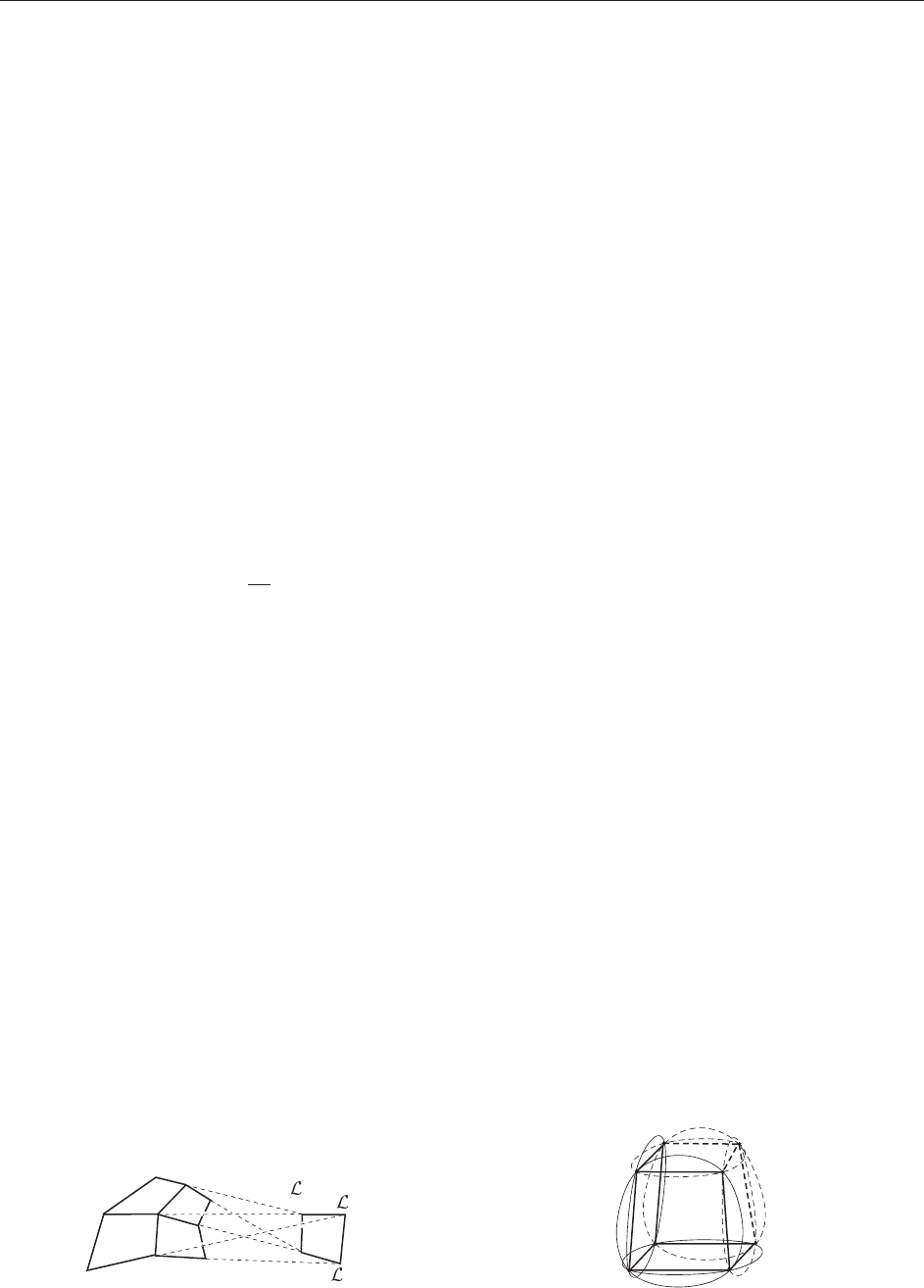
The Laplace transformations and the geometric
meaning of the Hirota equation The Laplace
transform L
ij
(x), i 6¼ j, of the QL x is the jth focal
lattice of its ith tangent congruence (see Figure 3). It
is uniquely determined once the lattice x is given.
The transformation formulas of the lattice points
and of the -function read as follows:
L
ij
ðxÞ¼x
1
A
ji
i
x ½20
L
ij
ðÞ¼
ij
¼ Q
ij
½21
The superpositions of Laplace transformations
satisfy the following identities
L
ij
L
ji
¼ id
L
jk
L
ij
¼L
ik
L
ki
L
ij
¼L
kj
which allow to identify them with the Schlesinger
transformations of the monodromy theory.
In the simplest case N = 2 one obtains the
so-called Laplace sequence of two-dimensional QLs
x
‘
¼L
‘
12
ðxÞ;
‘
¼L
‘
12
ðÞ
L
1
12
¼L
21
;‘2 Z
Equations [14] and [21] imply that the -functions
of the Laplace sequence satisfy the celebrated Hirota
equation (the fully discrete Toda system)
‘
T
1
T
2
‘
¼ðT
1
‘
ÞðT
2
‘
ÞðT
1
‘1
ÞðT
2
‘þ1
Þ
Distinguished Integrable Reductions
We will present here basic reductions of the multi-
dimensional QL. The geometric criterion for their
integrability is the compatibility with the geometric
integrability scheme.
The circular lattices and the Ribaucour congruences
QLs Z
N
!E
M
for which each quadrilateral is
inscribed in a circle are called ‘‘circular’’ lattices.
They are the integrable discrete analogs of submani-
folds parametrized by curvature coordinates (e.g.,
the orthogonal coordinate systems described by the
Lame´equations [1]–[2]).
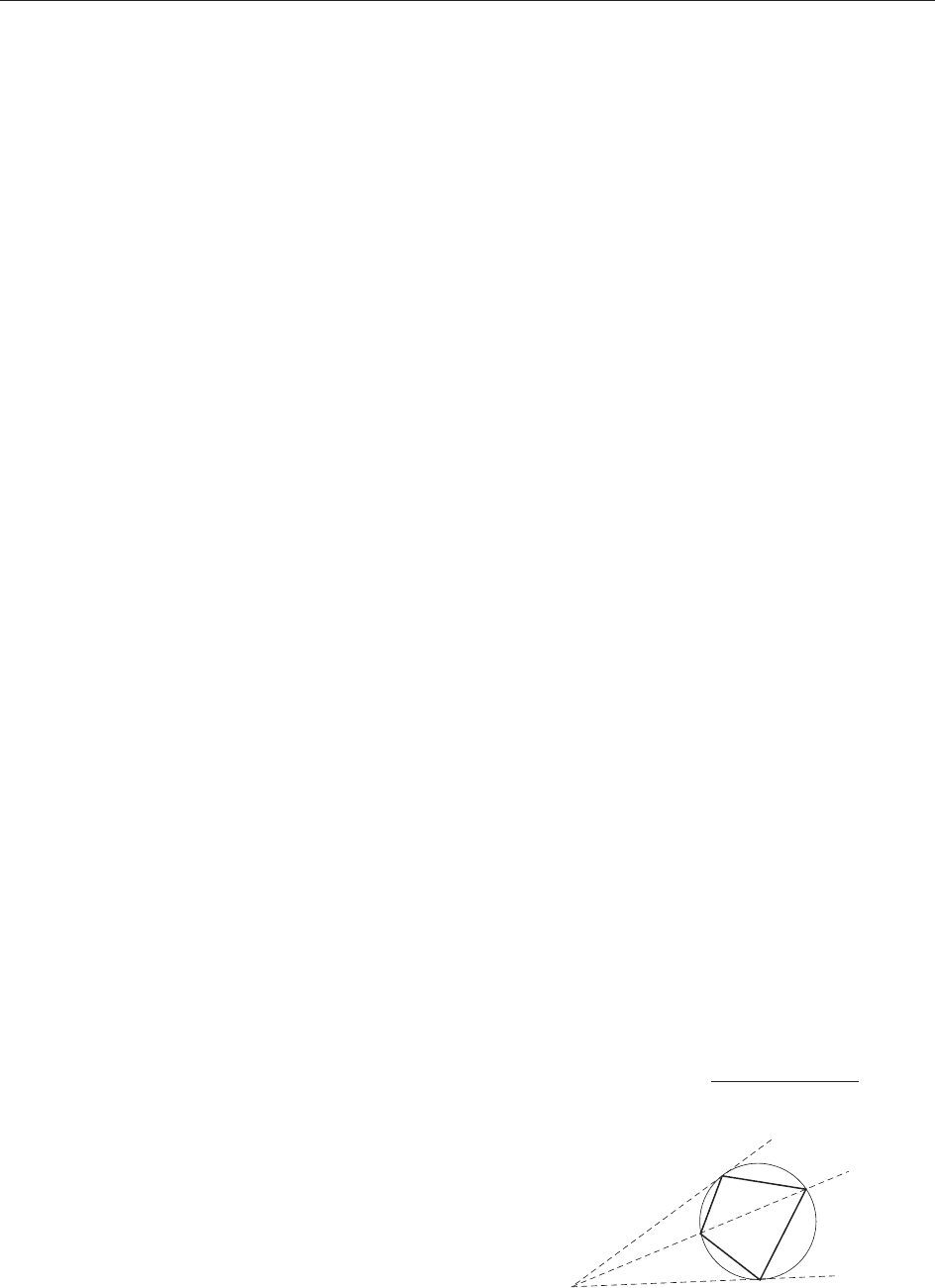
The integrability of circular lattices is the consequence
ofthefactthatifthethree‘‘initial’’ quadrilaterals
{x, T
i
x, T
j
x, T
i
T
j
x}, {x, T
i
x, T
k
x, T
i
T
k
x}, {x, T
j
x, T
k
x,
T
j
T
k
x} are circular, then also the three new quadri-
laterals constructed by adding the vertex T
i
T
j
T
k
x
are circular as well (see Figure 4). In fact, all the
eight vertices belong to a sphere, and, in consequence,
all the vertices of any K-dimensional, K = 2, ..., N,
elementary cell belong to a (K 1)-dimensional sphere.
There are various equivalent algebraic descrip-
tions of the circular lattices:
1. the normalized tangent vectors X
i
satisfy the
constraint
X
i
T
i
X
j
þ X
j
T
j
X
i
¼ 0; i 6¼ j
2. the scalar function x x : Z
N
!R satisfies the
Laplace equations [3] of the lattice x;
3. the functions X
i
= (x þ T
i
x) X
i
: Z
N
!R satisfy
the same linear system [9] as the normalized
tangent vectors X
i
; and
4. the functions X
i
X
i
: Z
N
!R satisfy eqns [11]
and thus can serve as the potentials
i
.
The Ribaucour transformation R is the restriction
of the fundamental transformation to the class of
circular lattices such that also the ‘‘side’’ quadrilat-
erals {x, T
i
x, R(x), R(T
i
x)} are circular. Again there
is no geometric difference between the lattice
directions and the Ribaucour transformation direc-
tion. Moreover, the quadrilaterals {x, R
1
(x),
ij
(x)
T
i ij
(x
)
T
i
x
T
j
x
T
i
T
j
x
T
j ij
(x )
T
j
x
x
–1
Figure 3 The Laplace transformation L
ij
.
T
i
x
T
j
x
T
i
T
j
x
T
k
x
x
T
i
T
j
T
k
x
Figure 4 The geometric integrability of circular lattices.
Integrable Systems and Discrete Geometry 83
R
2
(x), R
1
(R
2
(x)) = R
2
(R
1
(x))} are circular as well.
In consequence, the vertices of the elementary K-cells,
K = 2, ..., N, of the circular lattice and the correspond-
ing vertices of its Ribaucour transform are contained in
a K-dimensional sphere. Finally, for K = N, one obtains
a special Z
N
family of N-dimensional spheres, called
the Ribaucour congruence of spheres.
Algebraically, the Ribaucour transformation
needs only a half of the data (necessary to build
the congruence) of the fundamental transformation.
The data of the vectorial Ribaucour transformation
consists of the solution Y
i
: Z
N
!V
, of the linear
system [8]. Then, because of the circularity con-
straint, Y
i
: Z
N
!V given by
Y
i
¼ WðX; Y
ÞþT
i
WðX; Y
ÞðÞ
T
X
i
is a solution of the linear system [9], and the constraints
WðY; HÞþWðX
; Y
Þ
T
¼ 2 WðX; Y
Þ
T
x
WðY; Y
ÞþWðY; Y
Þ
T
¼ 2 WðX; Y
Þ
T
WðX; Y
Þ
are admissible.
We remark that the above constraints have a simple
geometric meaning when one considers the circular
lattices in E
M
as the stereographic projections of QLs
in the Mo¨ bius sphere S
M
; that is, as a special case of
QLs subjected to quadratic constraints.
The symmetric lattice Given a QL x with rotation
coefficients Q
ij
and potentials
i
given by [11], then
the functions
~
Q
ij
, defined by equation
j
T
j
~
Q
ij
¼
i
T
i
Q
ji
; i 6¼ j
and called, because of their geometric interpretation,
the backward rotation coefficients, satisfy the
Darboux system [10] as well. A QL is called
symmetric if its forward rotation coefficients Q
ij
are also its backward rotation coefficients. Again the
constraint is compatible with the geometric integr-
ability scheme, that is, it propagates in the construc-
tion of the lattice. One can show that a QL is
symmetric if and only if its rotation coefficients
satisfy the following trilinear constraint:
ðT
i
Q
ji
ÞðT
j
Q
kj
ÞðT
k
Q
ik
Þ¼ðT
j
Q
ij
ÞðT
i
Q
ki
ÞðT
k
Q
jk
Þ
i; j; k distinct
To obtain the corresponding reduction of the
fundamental transformation we again need only half
of the data. Given a solution Y
i
: Z
N
!V
, of the
linear system [8], then, because of the symmetric
constraint, Y
i
: Z
N
!V, defined by
Y
i
¼
i
ðT
i
Y
Þ
T
is the solution of the linear system [9]; notice that,
equivalently, we could start from Y
i
. The constraint
WðY; Y
Þ¼WðY; Y
Þ
T
is then admissible and gives a new symmetric lattice.
There are other multidimensional reductions of
the QL like, for example, the D -invariant and
Egorov lattices or discrete versions of immersions
of spaces of constant negative curvature. We remark
that the transformations and reductions discussed
above have also a clear interpretation on the level of
the analytic methods.
Integrable Discrete Surfaces
In this section we present some distinguished examples
of discrete integrable surfaces. Notice that, although
the geometric integrability scheme is meaningless for
N = 2, it can be applied indirectly, by considering the
discrete surfaces, together with their transformations,
as sublattices of multidimensional lattices.
We remark also that one can consider integrable
evolutions of discrete curves, which give equations
of the Ablowitz–Ladik hierarchy, and the corre-
sponding integrable spin chains.
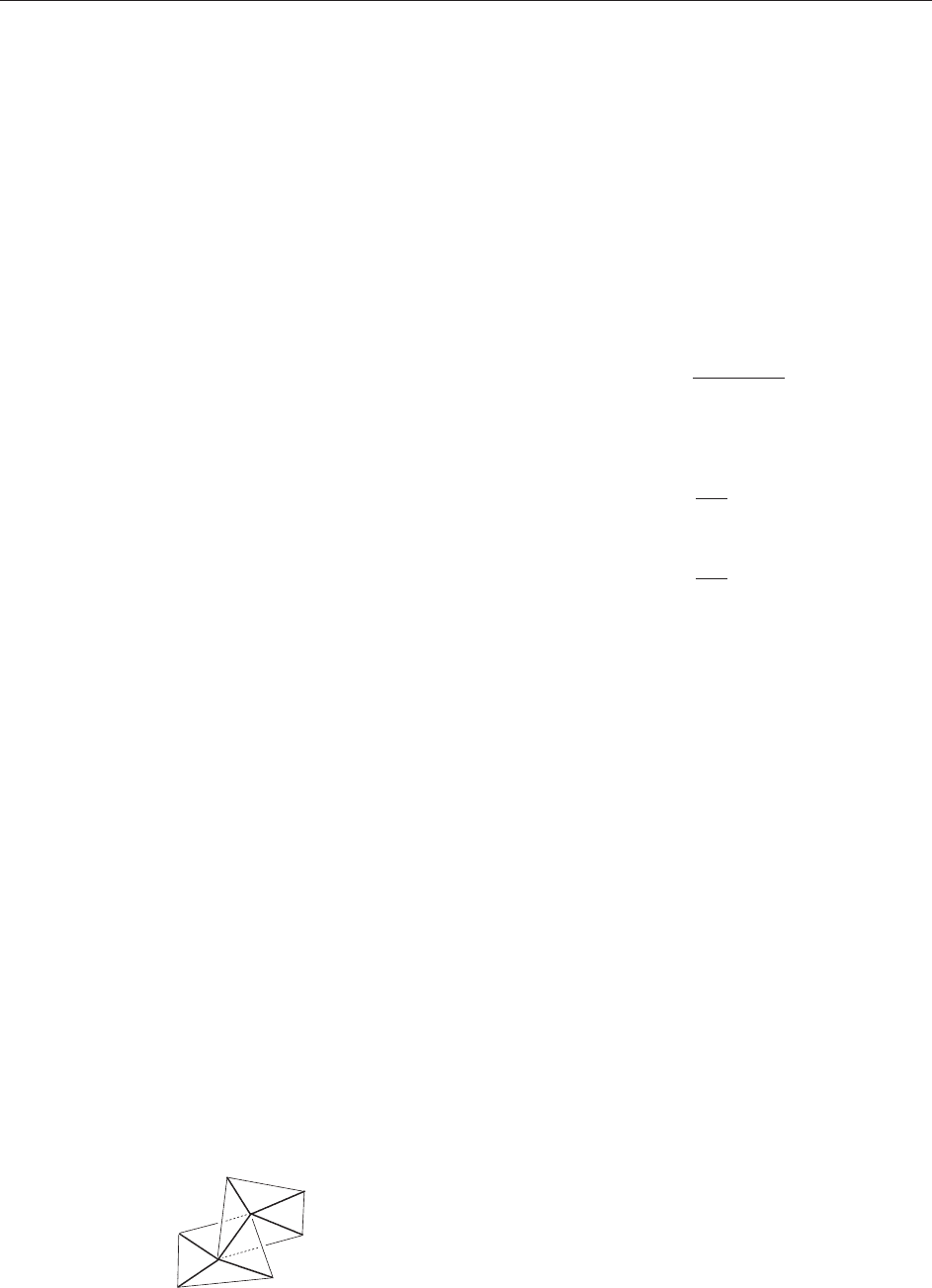
Discrete Isothermic Nets
An isothermic lattice is a two-dimensional circular
lattice x : Z
2
!E
M
with harmonic quadrilaterals;
that is, given x, T
1
x and T
2
x, then the point T
1
T
2
x
is the intersection of the circle (passing through
x, T
1
x and T
2
x) and the line passing through x and
the meeting point of the tangents to the circle at T
1
x
and T
2
x (see Figure 5). Therefore, given two discrete
curves intersecting in the common vertex x
0
, the
unique isothermic lattice can be found using the
above ‘‘ruler and compass’’ construction.
Algebraically the reduction looks as follows. Any
oriented plane in E
M
canbeidentifiedwiththe
complex plane C. Given any four complex points
z
1
, z
2
, z
3
,andz
4
, their complex cross-ratio is defined by
qðz
1
; z
2
; z
3
; z
4
Þ¼
ðz
1
z
2
Þðz
3
z
4
Þ
ðz
2
z
3
Þðz
4
z
1
Þ
x
T
1
x
T
1
T
2
x
T
2
x
Figure 5 Elementary quadrilaterals of the isothermic lattice.
84 Integrable Systems and Discrete Geometry
One can show that the cross-ratio is real if and only
if the four points are cocircular or collinear. In
particular, a harmonic quadrilateral with vertices
numbered anticlockwise has cross-ratio equal to 1.
Therefore, abusing the notation (it can be forma-
lized using Clifford algebras), the isothermic lattice
is defined by the condition
qðx; T
1
x; T
1
T
2
x; T
2
xÞ¼1
We remark that the definition of isothermic lattices
can be slightly generalized allowing for the above
cross-ratio to be a ratio of two real functions of
single discrete variables.
The restriction of the Ribaucour transformation
to the class of isothermic lattices, named after
Darboux who constructed it for isothermic surfaces,
has as its data a real parameter and the starting
point D(x
0
), and can be described as follows. Given
the elementary quadrilateral {x, T
1
x, T
2
x, T
1
T
2
x}
of the isothermic lattice, and given the point D(x),
then the points D(T
1
x) and D(T
2
x) belong to the
corresponding planes and are constructed from
equations
qðx; Dðx Þ; DðT
1
xÞ; T
1
xÞ¼
qðx; Dðx Þ; DðT
2
xÞ; T
2
xÞ¼
It turns out that the point D(T
1
T
2
x), constructed by
the application of the geometric integrability
scheme, is such that the quadrilateral {D(x),
D(T
1
x), D(T
2
x), D(T
1
T
2
x)} is harmonic. Moreover,
the construction of the Darboux transformation is
compatible; that is, the new side quadrilaterals have
the correct cross-ratios and .
There are various integrable reductions of the
isothermic lattice, for example, the constant mean
curvature lattice and the minimal lattice.
Asymptotic Lattices and Their Reductions
An asymptotic lattice is a mapping x : Z
2
!R
3
such
that any point x of the lattice is coplanar with its
four nearest neighbors T
1
x, T
2
x, T
1
1
x, T
1
2
x (see
Figure 6). Such a plane is called the tangent plane
of the asymptotic lattice in the point x.
It can be shown that any asymptotic lattice x can
be recovered from its suitably rescaled normal (to
the tangent plane) field N : Z
2
!R
3
via the discrete
analog of the Lelieuvre formulas
1
x ¼ðT
1
NÞN;
2
x ¼ N ðT
2
NÞ½22
By the compatibility of the Lelieuvre formulas, the
normal field N satisfies the discrete Moutard
equation
T
1
T
2
N þ N ¼ FðT
1
N þ T
2
NÞ½23
for some potential F : Z
2
!R.
Given a scalar solution of the Moutard equation
[23], a new solution M(N) of the Moutard
equation, with the new potential
MðFÞ¼
ðT
1
ÞðT
2
Þ
ðT
1
T
2
Þ
F
can be found via the Moutard transformation
equations
MðT
1
NÞN ¼
T
1
ðMðNÞT
1
NÞ½24
MðT
2
NÞN ¼
T
2
ðMðNÞT
2
NÞ½25
Now, via the Lelieuvre formulas [22], one can
construct a new asymptotic lattice M(x) = x
M(N) N. The lines connecting corresponding points
of the asymptotic lattices x and M(x)aretangentto
both lattices. Such a Z
2
-family of lines in R
3
is called
Weingarten (or W for short) congruence. Notice that
this is not a congruence as considered earlier.
Various integrable reductions of asymptotic lat-
tices are known in the literature: pseudospherical
lattices, asymptotic Bianchi lattices and isothermally
asymptotic (or Fubini–Ragazzi) lattices, and discrete
(proper and improper) affine spheres.
Formally, the Moutard transformation is a reduc-
tion of the (projective version of the) fundamental
transformation for the Moutard reduction of the
Laplace equation. However, the geometric relation
between asymptotic lattices and QLs is more subtle
and the geometric scenery of this connection is the line
geometry of Plu¨ cker. Straight lines in R
3
P
3
are
considered there as points of the so-called Plu¨cker
quadric Q
P
P
5
. A discrete asymptotic net in P
3
,
viewed as the envelope of its tangent planes, corre-
sponds to a congruence of isotropic lines in Q
P
,whose
focal lattices represent the asymptotic directions. The
discrete W-congruences are represented by two-
dimensional QLs in the Plu¨cker quadric.
The Koenigs Lattice
A two-dimensional QL x : Z
2
!P
M
is called a
Koenigs lattice if, for every point x of the lattice,
T
1
x
x
T
1
x
T
2
x
–1
T
2
x
–1
Figure 6 Asymptotic lattices.
Integrable Systems and Discrete Geometry 85
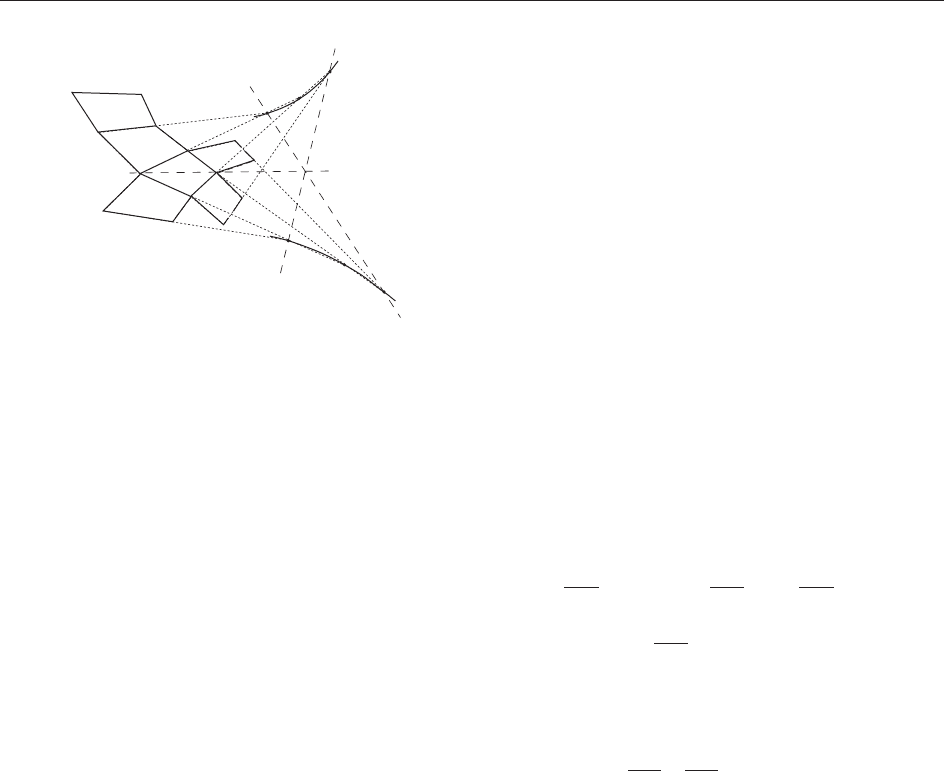
the six points x
1
, T
i
x
1
, T
2
i
x
1
, i = 1, 2, of its
Laplace transforms belong to a conic (see Figure 7).
The nonlinear constraint in definition of the Koenigs
lattice can be linearized, with the help of the Pascal
‘‘mystic hexagon’’ theorem, to the form that the line
passing through x and T
1
T
2
x, the line passing
through x
1
and T
2
1
x
1
, and the line passing through
x
1
and T
2
2
x
1
intersect in a point.
Algebraically, the geometric Koenigs lattice con-
dition means that the Laplace equation of the lattice
in homogeneous coordinates x : Z
2
!R
Mþ1
can be
gauged into the form
T
1
T
2
x þ x ¼ T
1
ðFxÞþT
2
ðFxÞ½26
It turns out that, if N is a solution of the Moutard
equation [23], then x = T
1
N þ T
2
N satisfies the
Koenigs lattice equation. Therefore, the algebraic
theory of the discrete Koenigs lattice equation [26],
its (Koenigs) transformation, and the permutability
of the superpositions of such transformations is
based on the corresponding theory for the Moutard
equation [23].
Geometrically, the Koenigs lattices are selected
from the QLs as follows. Given a two-dimensional
QL x : Z
2
!P
M
and given a congruence l with lines
passing through the corresponding points of the
lattice. Denote by y
i
= T
1
i
l \ l, i = 1, 2, points of the
focal lattices of the congruence. For every line l,
denote by { the unique projective involution exchan-
ging y
i
with T
i
y
i
. If, for every congruence l, the
lattice K(x):Z
2
!P
M
, with points K(x) = {(x), is a
QL, then the lattice x is a Koenigs lattice. The above
construction gives also the corresponding reduction
of the fundamental transformation.
A distinguished reduction of the Koenigs lattice is
the quadrilateral Bianchi lattice. The natural con-
tinuous limit of the corresponding equation is
equivalent to the Bianchi (or hyperbolic Ernst)
system describing the interaction of planar gravita-
tional waves.
Discrete Two-Dimensional Schro¨ dinger Equation
In the previous sections we have discussed examples
of integrable discrete geometries described by
equations of hyperbolic type. Below we present
some results associated with the elliptic case; it is
remarkable that the QL provides a way to connect
these two subjects.
Consider a solution N : Z
2
!R
3
of the general self-
adjoint five-point scheme on the star of the Z
2
lattice
aT
1
N þ T
1
1
ðaNÞþbT
2
N þ T
1
2
ðbNÞcN ¼0 ½27
then the lattice x : Z
2
!R
3
obtained by the
Lelieuvre type formulas
1
x ¼ T
1
2
b
N T
1
2
N
2
x ¼ T
1
1
a
N T
1
1
N
½28
is a QL having N as normal (to the planes of
elementary quadrilaterals) vector field.
The following gauge-equivalent form of eqn 27,
namely
T
1
T
1
þ T
1
1
T
1
þ
T
2
T
2
þ T
1
2
T
2
q ¼0 ½29
an integrable discretization of the Schro¨ dinger
equation
@
2
@x
2
1
þ
@
2
@x
2
2
Q ¼0
is also the Lax operator associated with an integrable
generalization of the Toda law to the square lattice.
The five-point scheme [27] is also a distinguished
illustrative example of the sublattice theory. Indeed,
it can be obtained restricting to the even sublattice
Z
2
e
the discrete Cauchy–Riemann equations
T
1
T
2
¼iGðT
1
T
2
Þ½30
Because of the equivalence (on the discrete level!)
between eqn [30] and the discrete Moutard equation
[23], the five-point scheme [27] inherits integrability
properties (Darboux-type transformations, superpo-
sition formulas, analytic methods of solution) from
the corresponding (and simpler) integrability proper-
ties of the discrete Moutard equation.
See also: Ba
¨
cklund Transformations;
@-Approach to
Integrable Systems; Integrable Discrete Systems;
Integrable Systems and Algebraic Geometry; Integrable
Systems and the Inverse Scattering Method; Integrable
Systems: Overview; Nonlinear Schro
¨
dinger Equations;
Sine-Gordon Equation; Stability Theory and KAM; Toda
Lattices.
x
1
x
T
1
x
T
2
x
T
2
x
1
T
2
x
1
T
1
x
–1
T
2
x
–1
2
T
1
x
–1
x
–1
2
T
1
x
–1
Figure 7 The Koenigs lattice.
86 Integrable Systems and Discrete Geometry