
Francoise J.-P., Naber G.L., Tsun T.S. (editors) Encyclopedia of Mathematical Physics
Подождите немного. Документ загружается.


Quantum Field Theory in Curved Spacetime
B S Kay, University of York, York, UK
ª 2006 B S Kay. Published by Elsevier Ltd.
All rights reserved.
Introduction and Preliminaries
Quantum Field Theory (QFT) in curved spacetime
is a hybrid approximate theory in which quantum
matter fields are assumed to propagate in a fixed
classical background gravitational field. Its basic
physical prediction is that strong gravitational
fields can polarize the vacuum and, when time
dependent, lead to pair creation j ust as a strong
and/or time-dependent electromagnetic field can
polarize the vacuum and/or give rise to pair
creation of charged particles. One expects it to
be a good approximation to full quantum gravity
provided the typical frequencies of the gravita-
tional background are very much less than
the Planck frequency (c
5
=Gh)
1=2
10
43
s
1
)and
provided, with a suitable measure for energy, the
energy of created particles is very much less than
the energy of the background gravitational field or
of its matter sources. Undoubtedly, the most
important prediction of the theory is the Hawking
effect, according to which a, say spherically
symmetric, classical black hole of mass M will
emit therm al radiation at the Hawking tempera-
ture T = (8M)
1
(here and from now on, we use
Planck units where G, c, h and, k (Boltzmann’s
constant) are all taken to be 1).
On the mathematical side, the need to formulate the
laws and derive the general properties of QFT on
nonflat spacetimes forces one to state and prove results
in local terms and, as a byproduct, thereby leads to an
improved perspective on flat-spacetime QFT too. It is
also interesting to formulate QFT on idealized space-
times with particular global geometrical features.
Thus, QFT on spacetimes with bifurcate Killing
horizons is intimately related to the Hawking effect;
QFT on spacetimes with closed timelike curves is
intimately related to the question whether the laws of
physics permit the manufacture of a time machine.
As is standard in general relativity, a curved
spacetime is modeled mathem atically as a
(paracompact, Hausdorff) manifold M equipped
with a pseudo-Riemannian metric g of signature
( , þþþ) (we follow the conventions of the
standard text by Misner et al. (1973)). We shall
also assume, except where otherwise stated, our
spacetime to be globally hyperbolic,thatis,that
M admits a global time coordinate,bywhichwe
mean a global coordinate t such that each constant-t
surface is a smooth Cauchy surface, that is, a
smooth spacelike 3-surface cut exactly once by each
inextendible causal curve. (Without this default
assumption, extra problems arise for QFT which
we shall briefly mention in connection with the
‘‘time machine’’ question discussed later.) In view
of this definition, globally hyperbolic spacetimes
are clearly time-orientable and we shall assume a
choice of time-orientation has been made so we can
talk about the ‘‘future’’ and ‘‘past’’ directions.
Modern formulations of the subjec t take, as the
fundamental mathematical structure modeling the
quantum field, a -algebra A (with identity I)
together with a family of local sub -algebras
A(O) labeled by bounded open regions O of the
spacetime (M, g) and satisfying the isot ony or net
condition that O
1
O
2
implies A(O
1
) is a subalge-
bra of A(O
2
) as well as the condition that when ever
two bounded open r egions O
1
and O
2
are spacelike
separated, t hen A(O
1
)andA(O
2
)commute.
Standard concepts and techniques from algebraic
quantum theory are then applicable: In particular,
states are defined to be positive (this means
!(A
A) 0 8A 2A) normalized (this means !(I) = 1)
linear functionals on A. One distinguishes between pure
states and mixed states, only the latter being writable
as nontrivial convex combinations of other states. To
each state, !,theGNS construction associates a
representation,
!
,ofA on a Hilbert space H
!
together with a cyclic vector 2H
!
such that
!ðAÞ¼hj
!
ðAÞi
(and the GNS triple (
!
, H, )isuniqueupto
equivalence). There are often technical advantages
in formulating things so that the -algebra is a
C
-algebra. Then the GNS representation is as every-
where-defined bounded operators and is irreducible if
and only if the state is pure. A useful concept, due to
Haag, is the folium of a given state ! which may be
defined to be the set of all states !
which arise in the
form tr(
!
()), where ranges over the density
operators (trace-class operators with unit trace) on H
!
.
Given a state, !, and an automorphism, , which
preserves the state (i.e., ! = !) then there will be
a unitary operator, U,onH
!
which implements in
the sense that
!
((A)) = U
1
!
(A)U and U is
chosen uniquely by the condition U=.
On a stationary spacetime, that is, one which
admits a one-parameter group of isometries
whose integral curves are everywhere timelike,
the algebra will inherit a one-parameter group (i.e.,
satisfying (t
1
) (t
2
) = (t
1
þ t
2
)) of time-translation
202 Quantum Field Theory in Curved Spacetime

automorphisms, (t), and, given any stationary
state (i.e., one which satisfies ! (t) = ! 8t 2 R),
these will be implemented by a one-parameter
group of unitaries, U(t), on its GNS Hilbert space
satisfying U(t)=.IfU( t) is strongly continuous
so that it takes the form e
iHt
and if the
Hamiltonian, H, is positive, then ! is said to be
a ‘‘ground state.’’ Typically one expects ground
states to exist and often be unique.
Another important class of stationary states for
the algebra of a stationary spacetime is the class of
KMS states, !
, at inverse temperature ; these have
the physical interpretation of thermal equilibrium
states. In the GNS representation of one of these, the
automorphisms are also implemented by a strongly
continuous unitary group, e
iHt
, which preserves
but (in place of H positive) there is a complex
conjugation, J,onH
!
such that
e
H=2
!
ðAÞ ¼ J
!
ðA
Þ ½1
for all A 2A. An attractive feature of the subject is
that its main qualitative features are already present
for linear field theories and, unusually in compar-
ison with other questions in QFT, these are
susceptible of a straightforward explicit and rigor-
ous mathematical formulation. In fact, as our
principal example, we give, in the next section a
construction for the field algebra for the quantized
real linear Klein–Gordon equation
ð&
g
m
2
VÞ ¼ 0 ½2
of mass m on a globally hyperbolic spacetime (M, g).
Here, &
g
denotes the Laplace–Beltrami operator
g
ab
r
a
@
b
(= (jdet (g)j)
1=2
@
a
((jdet (g)j
1=2
g
ab
@
b
)). We
include a scalar external background classi cal field,
V, in addition to the external gravitational field
represented by g. In case m is zero, taking V to equal
R=6, where R denotes the Riemann scalar, makes the
equation conformally invariant.
The main new feature of QFT in curved spacetime
(present already for linear field theories) is that, in a
general (neither flat nor stationary) spacetime there
will not be any single preferred state but rather a
family of preferred states, members of which are best
regarded as on an equal footing with one another. It
is this feature which makes the above algebraic
framework particularly suitable, indeed essential, to
a clear formulation of the subject. Conceptually, it is
this feature which takes the most getting used to. In
particular, one must realize that, as we shall explain
later, the interpretation of a state as having a
particular ‘‘particle content’’ is in general problematic
because it can only be relative to a particular choice
of ‘‘vacuum’’ state and, depending on the spacetime
of interest, there may be one state or several states or,
frequently, no states at all which deserve the name
‘‘vacuum’’ and even when there are states which
deserve this name, they will often only be defined in
some approximate or asymptotic or transient sense or
only on some subregion of the spacetime.
Concomitantly, one does not expect global obser-
vables such as the ‘‘particle number’’ or the quantum
Hamiltonian of flat-spacetime free-field theory to
generalize to a curved spacetim e context, and for
this reason local observables play a central role in
the theory. The quantized stress–energy tensor is a
particularly natural and important such local obser-
vable and the theory of this is central to the whole
subject. A brief introduction to it is given in a later
section.
This is followed by a further section on the
Hawk ing and Unruh effects and then a brief section
on the problems of extending the theory beyond the
‘‘default’’ setting, to nonglobally hyperbolic space-
times. Finally, we briefly mention a number of other
interesting and active areas of the subject as well as
issuing a few warnings to be borne in mind when
reading the literature.
Construction of -Algebra(s) for a Real
Linear Scalar Field on Globally
Hyperbolic Spacetimes and Some
General Theorems
On a globally hyperbolic spacetime, the classical
equation [2] admits well-defined advanced and
retarded Green functions (strictly bidistributions)
A
and
R
and the standard covariant quantum
free real (or ‘‘Hermitian’’) scal ar field commutation
relations familiar from Minkow ski spacetime free-
field theory naturally generalize to the (heuristic)
equation
½
^
ðxÞ;
^
ðyÞ ¼ iðx; yÞI
where is the Lichne´rowicz commutator function
=
A
R
. Here, the ‘‘^’’ on the quantum field
ˆ
serves to distinguish it from a classical solution .In
mathematical work, one does not assign a meaning
to the field at a point itself, but rather aims to assign
meaning to smeared fields
ˆ
(F) for all real-valued
test functions F 2 C
1
0
(M) which are then to be
interpreted as standing for
R
M
ˆ
(x)f (x)jdet (g)j
1=2
d
4
x.
In fact, it is straightforward to define a minimal
field algebra (see below ) A
min
generated by such
ˆ
(F) which satisfy the suitably smeared version
½
^
ðFÞ;
^
ðGÞ ¼ ið F; GÞI
Quantum Field Theory in Curved Spacetime 203

of the above commutation relations together with
Hermiticity (i.e.,
ˆ
(F)
=
ˆ
(F)), the property of being a
weak solution of eqn [2] (i.e.,
ˆ
((&
g
m
2
V)F) =
0 8F 2 C
1
0
(M)) and linearity in test functions. There
is a technically different alternative formulation of this
minimal algebra, which is known as the Weyl algebra,
which is constructed to be the C
-algebra generated by
operators W(F) (to be interpreted as standing for
exp (i
R
M
ˆ
(x)f (x)jdet (g)j
1=2
d
4
x)satisfying
WðF
1
ÞWðF
2
Þ¼ expðiðF
1
; F
2
Þ=2ÞWðF
1
þ F
2
Þ
together with W(F)
= W(F)andW((&
g
m
2
V)F) = I. With either the minimal algebra or the
Weyl algebra one can define, for each bounded open
region O, subalgebras A(O) as generated by the
ˆ
()
(or the W()) smeared with test functions supported
in O and verify that they satisfy the above ‘‘net’’
condition and commutativity at spacelike separation.
Specifying a state, !,onA
min
is tantamount to
specifying its collection of n-point distributions (i.e.,
smeared n-point functions) !(
ˆ
(F
1
) ...
ˆ
(F
n
)). (In the
case of the Weyl algebra, one restricts attention to
‘‘regular’’ states for which the map F !!(W(F)) is
sufficiently often differenti able on finite-dimensional
subspaces of C
1
0
(M) and defines the n-point
distributions in terms of derivatives with respect to
suitable parameters of expectation values of suitable
Weyl algebra elements.) A particular role is played
in the theory by the quasifree states for which all the
truncated n-point distributions except for n = 2
vanish. Thus, all the n-point distributions for odd n
vanish while the four-point distribution is made out
of the two-point distribution according to
!ð
^
ðF
1
Þ
^
ðF
2
Þ
^
ðF
3
Þ
^
ðF
4
ÞÞ
¼ !ð
^
ðF
1
Þ
^
ðF
2
ÞÞ!ð
^
ðF
3
Þ
^
ðF
4
ÞÞ
þ !ð
^
ðF
1
Þ
^
ðF
3
ÞÞ!ð
^
ðF
2
Þ
^
ðF
4
ÞÞ
þ !ð
^
ðF
1
Þ
^
ðF
4
ÞÞ!ð
^
ðF
2
Þ
^
ðF
3
ÞÞ
etc. The anticommutator distribution
GðF
1
; F
2
Þ¼!ð
^
ðF
1
Þ
^
ðF
2
ÞÞ þ !ð
^
ðF
2
Þ
^
ðF
1
ÞÞ ½3
of a quasifree state (or indeed of any state) will
satisfy the following condit ions (for all test functions
F, F
1
, F
2
, etc.):
C1. Symmetry
GðF
1
; F
2
Þ¼GðF
2
; F
1
Þ
C2. Weak bisolution property
Gðð&
g
m
2
VÞF
1
; F
2
Þ¼0
¼ GðF
1
; ð&
g
m
2
VÞF
2
Þ
C3. Positivity
GðF; FÞ0 and GðF
1
; F
1
Þ
1=2
GðF
2
; F
2
Þ
1=2
jðF
1
; F
2
Þj
and it can be shown that, to every bilinear
functional G on C
1
0
(M) satisfying (C1)–(C3),
there is a quasifree state with two-point distri-
bution (1=2)(G þ i). One further declares a
quasifree state to be physically admissible only if
(for pairs of points in sufficiently small convex
neighborhoods)
C4. Hadamard condition
‘‘Gðx
1
; x
2
Þ¼
1
2
2
uðx
1
; x
2
ÞP
1
þvðx
1
; x
2
Þlog jjþwðx
1
; x
2
Þ
’’
This last condition expresses the requirement that
(locally) t he two-point distribution actually ‘‘is’’
(in the usual sense in which one says that a
distribution ‘‘is’’ a function) a smooth function for
pairs of non-null-separated points. At the same
time, it requires that the two-point distribution be
singular at pairs of null-separated points and
locally specifies the nature of the singularity for
such pairs of points with a leading ‘‘principal part
of 1=’’ type singularity and a subleading ‘‘log jj’’
singularity, where denotes the square of the
geodesic distance between x
1
and x
2
. u (which
satisfies u(x
1
, x
2
) = 1whenx
1
= x
2
)andv are certain
smooth two-point functions determined in terms of
the local geometry and the local values of V by
something called the Hadamard procedure while the
smooth two-point function w depends on the state.
We shall omit the details. The important point is
that this Hadamard condition on the two-point
distribution is believed to be the correct general-
ization to a curved spacetime of the well-known
universal short-distance behavior shared by the
truncated two-point distributions of all physically
relevant states for the special case of our theory
when the spacetime is flat (and V vanishes). In the
latter case, u reduces to 1, and v to a simple power
series
P
1
n = 0
v
n
n
with v
0
= m
2
=4, etc.
Actually, it is known (this is the content of ‘‘Kay’s
conjecture’’ which was proved by M Radzikowski in
1992) that (C1)–(C4) together imply that the two-
point distribution is nonsingular at all pairs of (not
necessarily close together) spacelike separated
points. More important than this result itself is a
reformulation of the Hadamard condition in terms
of the concepts of microlocal analysis which
Radzikowski originally introduced as a tool towards
its proof.
204 Quantum Field Theory in Curved Spacetime

C4
0
. Wave front set (or microlocal) spectrum condition
WFðG þiÞ
¼fðx
1
; p
1
; x
2
; p
2
Þ2T
ðMMÞn0jx
1
and x
2
lie on a single null geodesic, p
1
is tangent to
that null g eodesic and future pointi ng, and
p
2
when parallel transported along that null
geodesic from x
2
to x
1
equals p
1
g
For the gist of what this means, it suffices to know that
to say that an element (x, p) of the cotangent bundle of
a manifold (excluding the zero section 0)isinthewave
front set, WF, of a given distribution on that manifold
may be expressed informally by saying that that
distribution is singular at the point x in the direction
p. (And here the notion is applied to G þ i,thought
of as a distribution on the manifold MM.)
We remark that generically (and, e.g., always if the
spatial sections are compact and m
2
þ V(x)isevery-
where positive) the Weyl algebra for eqn [2] on a given
stationary spacetime will have a unique ground state
and unique KMS states at each temperature and these
will be quasifree and Hadamard.
Quasifree states are important also because of a
theorem of R Verch (1994, in verification of another
conjecture of Kay) that (in the Weyl algebra frame-
work) on the algebra of any bounded open region,
the folia of the qua sifree Hadamard states coincide.
With this result one can extend the notion of
physical admissibility to not-necessarily-quasi free
states by demanding that, to be admissible, a state
belong to the resulting common folium when
restricted to the algebra of each bounded open
region; equivalently, that it be a locally normal state
on the resulting natural extension of the net of local
Weyl algebras to a net of local W
-algebras.
Particle Creation and the Limitations
of the Particle Concept
Global hyperbolicity also entails that the Cauchy
problem is well posed for the classical field equation
[2] in the sense that for every Cauchy surface, C, and
every pair (f , p) of Cauchy data in C
1
0
(C), there
exists a unique solution in C
1
0
(M) such that
f = j
C
and p = jdet (g)j
1=2
g
ab
@
b
j
C
. Moreover, has
compact support on all other Cauch y surfaces.
Given a global time coordinate t, increasing towards
the future, foliating M into a family of constant-t
Cauchy surfaces, C
t
, and given a choice of global
timelike vector field
a
(e.g.,
a
= g
ab
@
b
t) enabling
one to identify all the C
t
, say with C
0
, by identifying
points cut by the same integral curve of
a
, a single
such classical solution may be pictured as a family
{(f
t
, p
t
): t 2 R} of time-evolving Cauchy data on C
0
.
Moreover, since [2] implies, for each pair of classi cal
solutions,
1
,
2
, the conservation (i.e., @
a
j
a
= 0) of
the current j
a
= jdet (g)j
1=2
g
ab
(
1
@
b
2
2
@
b
1
), the
symplectic form (on C
1
0
(C) C
1
0
(C))
ððf
1
t
; p
1
t
Þ; ðf
2
t
; p
2
t
ÞÞ ¼
Z
C
0
ðf
1
t
p
2
t
p
1
t
f
2
t
Þd
3
x
will be conserved in time.
Corresponding to this picture of classical
dynamics, one expects there to be a description of
quantum dynamics in terms of a family of sharp-
time quantum fields (’
t
,
t
)onC
0
, satisfying
heuristic canonical comm utation relations
½’
t
ðxÞ;’
t
ðyÞ ¼ 0
½
t
ðxÞ;
t
ðyÞ ¼ 0
½’
t
ðxÞ;
t
ðyÞ ¼ i
3
ðx; yÞI
and evolving in time according to the same
dynamics as the Cauchy data of a classical solution.
(Both these expectati ons are correct because the field
equation is linear.) An elegant way to make rigor ous
mathematical sense of these expectations is in terms
of a -algebra with identity generated by Hermitian
objects ‘‘((’
0
,
0
); (f , p))’’ (‘‘symplectically smeared
sharp-time fields at t = 0’’) satisfying linearity in f
and p together with the commutation relations
½ðð’
0
;
0
Þ; ðf
1
; p
1
ÞÞ;ðð’
0
;
0
Þ; ðf
2
; p
2
ÞÞ
¼ iððf
1
; p
1
Þ; ðf
2
; p
2
ÞÞI
and to define (symplectically smeared) time-t sharp-
time fields by demanding
ðð’
t
;
t
Þ; ðf
t
; p
t
ÞÞ ¼ ðð’
0
;
0
Þ; ðf
0
; p
0
ÞÞ
where (f
t
, p
t
) is the classical time-evolute of (f
0
, p
0
).
This -algebra of sharp-time fields may be identified
with the (minimal) field -algebra of the previous
section, the
ˆ
(F) of the previous section being
identified with ((’
0
,
0
); (f , p)), where (f , p) are
the Cauchy data at t = 0of F. (This identifica-
tion is of course many–one since
ˆ
(F) = 0 whenever
F arises as (&
g
m
2
V)G for some test function
G 2 C
1
0
(M).)
Specializing momentarily to the case of the free
scalar field (& m
2
) = 0(m 6¼ 0) in Minkowski
space with a flat t = 0 Cauchy surface, the ‘‘sym-
plectically smeared’’ two-point function of the usual
ground state (‘‘Minkowski vacuum state’’), !
0
,is
given, in this formalism, by
!
0
ððð’; Þ; ðf
1
; p
1
ÞÞðð’; Þ; ðf
2
; p
2
ÞÞÞ
¼
1
2
ðhf
1
jf
2
iþhp
1
j
1
p
2
i
þ iððf
1
; p
1
Þ; ðf
2
; p
2
ÞÞÞ ½4
Quantum Field Theory in Curved Spacetime 205
where the inner products are in the one-particle
Hilbert space H= L
2
C
(R
3
) and = (m
2
r
2
)
1=2
. The
GNS representation of this state may be concretely
realized on the familiar Fock space F(H) over H by
0
ððð’; Þ; ðf ; pÞÞÞ ¼ ið
^
a
y
ðaÞð
^
a
y
ðaÞÞ
Þ
where a denotes the element of H:
a ¼
ð
1=2
f þ i
1=2
pÞ
ffiffiffi
2
p
(we note in passing that, if we equip H with the
symplectic form 2 Imhji,thenK :(f , p) 7!aisa
symplectic map) and
^
a
y
(a) is the usual smeared creation
operator (= ‘‘
R
^
a
y
(x)a(x)d
3
x”) on F(H) satisfying
½ð
^
a
y
ða
1
ÞÞ
;
^
a
y
ða
2
Þ ¼ ha
1
ja
2
i
H
I
The usual (smeared) annihilation operator,
^
a(a), is
(
^
a
y
(Ca))
, where C is the natural complex conjuga-
tion, a 7!a
on H. Both of these operators annihilate
the Fock vacuum vector
F
. In this representation,
the one-parameter group of time-translation
automorphisms
ðtÞ: ðð’
0
;
0
Þ; ðf ; pÞÞ7!ðð’
t
;
t
Þ; ðf ; pÞÞ ½5
is implemented by exp (iHt) wher e H is the second
quantization of (i.e., the operator otherwise
known as
R
(k)
^
a
y
(k)
^
a(k)d
3
k)onF(H).
The most straightforward (albeit physically artifi-
cial) situation involving ‘‘particle creation’’ in a curved
spacetime concerns a globally hyperbolic spacetime
which, outside of a compact region, is isometric to
Minkowski space with a compact region removed –
that is, to a globally hyperbolic spacetime which is flat
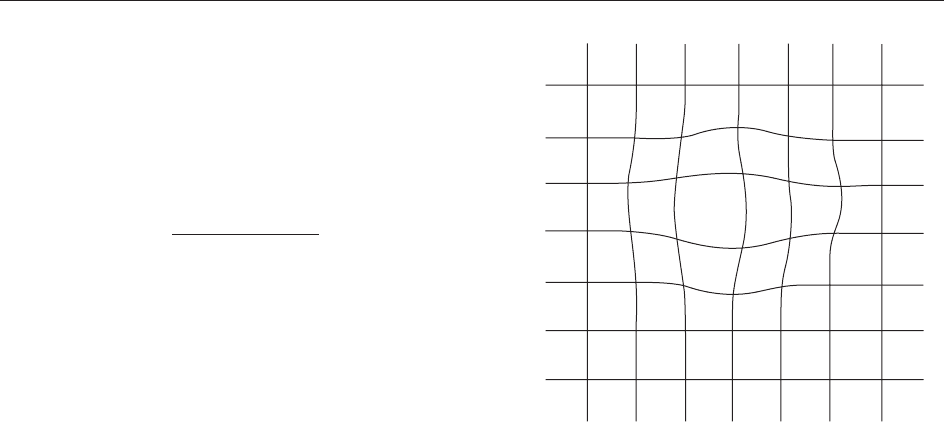
except inside a localized ‘‘bump’’ of curvature (see
Figure 1). (One could also allow the function V in [2]
to be nonzero inside the bump.) On the field algebra
(defined as in the previous section) of such a spacetime,
there will be an ‘‘in’’ vacuum state (which may be
identified with the Minkowski vacuum to the past of
the bump) and an ‘‘out’’ vacuum state (which may be
identified with the Minkowski vacuum to the future of
the bump) and one expects, for example, the ‘‘in
vacuum’’ to arise as a many-particle state in the GNS
representation of the ‘‘out vacuum’’ corresponding to
the creation of particles out of the vacuum by the
bump of curvature.
In the formalism of this section, if we choose our
global time coordinate on such a spacetime so that,
say, the t = 0 surface is to the past of the bump and
the t = T surface to its future, then the single
automorphism (T) (defined as in [5]) encodes the
overall effect of the bump of curvature on the
quantum field and one can ask whether it is
implemented by a unitary operator in the GNS
representation of the Minkowski vacuum state [4].
This question may be answered by referring to the
real linear map T : H!H which sends a
T
= 2
1=2
(
1=2
f
T
þ i
1=2
p
T
)toa
0
= 2
1=2
(
1=2
f
0
þ i
1=2
p
0
).
By the conservation in time of and the symplec-
ticity, noted in passi ng above, of the map
K :(f , p) 7!a, this satisfies the defining relation
ImhT a
1
jT a
2
i¼Imha
1
ja
2
i
of a classical Bogoliubov transformation. Splitting T
into its complex-linear and complex-antilinear parts
by writing
T¼ þ C
where and are co mplex-linear operators, this
relation may alternatively be expressed in terms of
the pair of relations
¼ I;
¼
where
= CC,
= CC.
We remark that there is an easy-to-visualize
equivalent way o f defining and in terms of
the analysis, to the past of the bump, into
positive- and negative- frequency parts of complex
solutions to [2] which are purely positive f re-
quency to the future of the bump. In fact, if, for
any element a 2H, we identify the positive-
frequency solution to the Minkowski-spac e
Klein–Gordon equation
pos
out
ðt; xÞ¼ðð2Þ
1=2
expðitÞaÞðxÞ
with a complex solution to [2] to the future of the
bump, then (it may easily be seen) to the past of the
bump, this same solution will be identifiable with
t = T
t
= 0
Figure 1 A spacetime which is flat outside of a compact bump
of curvature.
206 Quantum Field Theory in Curved Spacetime
the (partly positive-frequency, partly negative-
frequency) Minkowski-space Klein–Gordon solution
in
ðt; xÞ¼ ð2Þ
1=2
expðitÞa
ðxÞ
þð2Þ
1=2
expðitÞ
a
ðxÞ
and this could be taken to be the defining equation
for the operators and .
It is then known (by a 1962 theorem of Shale)
that the automorphism [5] (strictly, its Weyl algebra
counterpart) will be unita rily implemented if and
only if is a Hilbert–Schmidt operat or on H. Wald
(1979, in case m 0) and Dimock (1979, in case
m 6¼ 0) have verified that this condition is satisfied
in the case of our bump-of-curvature situation. In
that case, if we denote the unitary implementor by
U, we have the following results:
R1. The expectation value hUjN (a)Ui
F(H )
of the
number operator, N(a) =
^
a
y
(a)
^
a(a), where a is a
normalized element of H, is equal to ha jai
H
.
R2. First note that there exists an orthonormal basis
of vectors, e
i
,(i = 1 ...1), in H such that the
(Hilbert–Schmidt) operator
1
has the
canonical form
P
i
i
hCe
i
jije
i
i. We then have
(up to an undetermined phase)
U ¼ N exp
1
2
X
i
i
^
a
y
ðe
i
Þ
^
a
y
ðe
i
Þ
!
where the normalization constant N is chosen
so that kUk= 1. This formu la makes manifest
that the particles are created in pairs.
We remark that, identifying elements, a, of H with
positive-frequency solutions (below, we shall call
them ‘‘modes’’) as explained above, result (R1) may
alternatively be expressed by saying that the
expectation value, !
in
(N(a)), in the in-vacuum state
of the occupation number, N(a), of a normalized
mode, a, to the future of the bump, is given by
hajai
H
.
This formalism and the results, (R1) and (R2)
above, will generalize (at least heuristically, and
sometimes rigorously – see especially the rigorous
scattering-theoretic work in the 1980s by Dimock
and Kay and more recently by A Bachelot and others)
to more realistic spacetimes which are only asympto-
tically flat or asymptotically stationary. In favorable
cases, one will still have notions of classical solutions
which are positive frequency asymptotically towards
the future/past, and, in consequence, one will have
well-defined asymptotic notions of ‘‘vacuum’’ and
‘‘particles.’’ Also, in, for example, cosmological,
models where the background spacetime is slowly
varying in time, one can define approximate adia-
batic notions of classical positive-frequency solutions,
and hence also of quantum ‘‘vacuum’’ and ‘‘particles’’
at each finite value of the cosmological time. But, at
times where the gravitational field is rapidly varying,
one does not expect there to be any sensible notion of
‘‘particles.’’ And, in a rapidly time-varying back-
ground gravitational field which never settles down,
one does not expect there to be any sensible particle
interpretation of the theory at all. To understand
these statements, it suffices to consider the (1 þ 0)-
dimensionalKlein–Gordonequationwithanexternal
potential V:
d
2
dt
2
m
2
VðtÞ
!
¼ 0
which is of course a system of one degree of
freedom, mathematically equivalent to the harmonic
oscillator with a time-varying angular frequency
$(t ) = (m
2
þ V(t))
1=2
. One could of course express
its quantum theory in terms of a time-evolving
Schro¨ dinger wave function (’, t) and attempt to
give this a particle interpretation at each time, s,by
expanding ( ’, s) in terms of the ha rmonic oscilla-
tor wave functions for a harmonic oscillator with
some particular choice of angular frequency. But the
problem is, as is easy to convince oneself, that there
is no such good choice. For example, one might
think that a good choice would be to take, at time s,
the set of harmonic oscillator wave functions with
angular freque ncy $(s). (This is sometimes known
as the method of ‘‘instantaneous diagonalization of
the Hamiltonian.’’) But suppose we were to apply
this prescription to the case of a smooth V() which
is constant in time until time 0 and assume the
initial state is the usual vacuum state. Then at some
positive time s, the number of particles predicted to
be present is the same as the number of particles
predicted to be present on the same prescription at
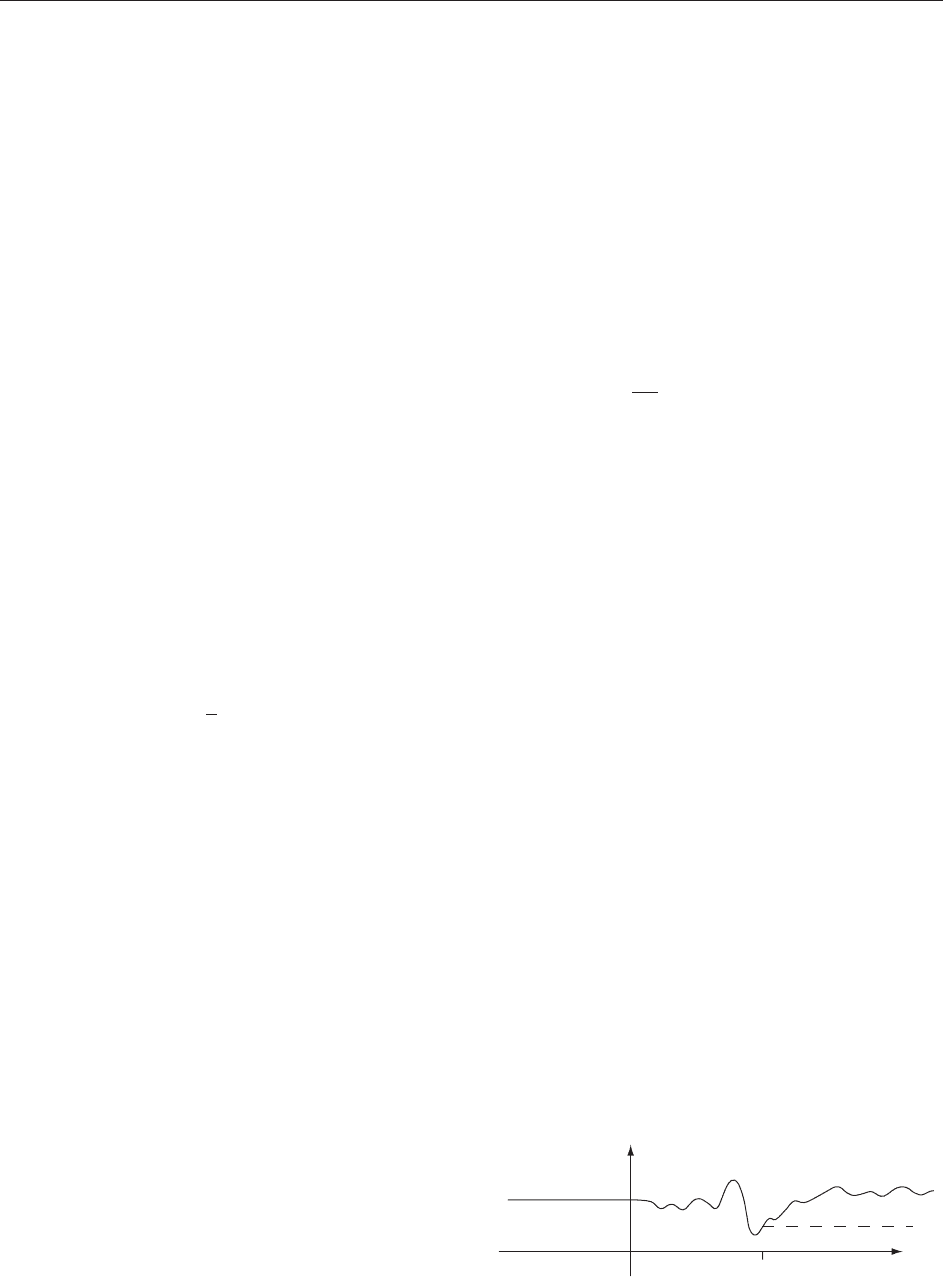
all times after s for a
^
V() which is equal to V()up
to time s and then takes the constant value V(s) for
all later times (see Figure 2). But
^
V() will
generically have a sharp corner in its graph (i.e., a
s
0
t
Figure 2 Plots of $ against t for the two potentials V (continuous
line) and
^
V (continuous line upto s andthendashedline)whichplay
a role in our critique of ‘‘instantaneous diagonalization.’’
Quantum Field Theory in Curved Spacetime 207

discontinuity in its time derivative) at time s, and
one would expect a large part of the particle
production in the latter situation to be accounted
for by the presence of this sharp corner – and
therefore a large part of the predicted particle
production in the case of V() to be spurious.
Back in 1 þ 3 dimensions, even where a good
notion of particl es is possible, it depends on the
choice of time evolution, as is dramatically illu-
strated by the Unruh effect discussed in the relevant
section.
Theory of the Stress–Energy Tensor
To orient ideas, consider first the free (minimally
coupled) scalar field, (& m
2
) = 0, in Minkowski
space. If one quantizes this system in the usual
Minkowski-vacuum representation, then the expec-
tation value of the renormalized stress-energy tensor
(which in this case is the same thing as the normal
ordered stress–energy tensor) in a vector state in
the Fock space will be given by the formal point-
splitting expression
hjT
ab
ðxÞi
¼ lim
ðx
1
;x
2
Þ!ðx;xÞ
@
1
a
@
2
b
1
2
ab
ð
cd
@
1
c
@
2
d
þ m
2
Þ
hj
0
ððx
1
Þðx
2
ÞÞið
h
F
j
0
ððx
1
Þðx
2
ÞÞ
F
iÞ ½6
where
ab
is the usual Minkowski metric. A
sufficient condition for the limit here to be finite
and well defined would, for example, be for to
consist of a (normalized) finite superposition of
n-particle vectors of form
^
a
y
(a
1
), ...,
^
a
y
(a
n
)
F
where the smearing functions a
1
, ...,a
n
are all
C
1
elements of H (i.e., of L
2
C
(R
3
). The reason this
works is that the two-point function in such states
shares the same short-distance singularity as the
Minkowski-vacuum two-point function. For exactly
the same reason, one obtains a well-defined finite
limit if one defines the expectation value of
the stress–energy tensor in any physically admissible
quasifree state by the expression
!ðT
ab
ðxÞÞ
¼ lim
ðx
1
;x
2
Þ!ðx;xÞ
@
1
a
@
2
b
1
2
ab
ð
cd
@
1
c
@
2
d
þm
2
Þ
!ððx
1
Þðx
2
ÞÞ !
0
ððx
1
Þðx
2
ÞÞðÞ½7
This latter point-splitting form ula generalizes to a
definition for the expectation value of the
renormalized stre ss–energy tensor for an arbitrary
physically admissible quasifree state (or indeed
for a n arbitrary state whose two-point function
has Hadamard form – i.e., whose anticommutator
function satisfies condition (C4)) on the minimal
field algebra and to other linear field theories
(including the stress tensor for a conformally
coupled linear scalar field) on a general globally
hyperbolic spacetime (and the result obtained
agrees with that obtained by other methods,
including dimensional regularization and zeta-
function regularization). However, the general-
ization to a curved spacetime involves a number
of important new fe atures which we now brie fly
list (see Wald (1978) for details).
First, the subtraction term which replaces
!
0
((x
1
)(x
2
)) is, in general, not the expectation
value of (x
1
)(x
2
) in any particular state, but
rather a particular locally constructed Hadamard
two-point function whose physical interpretation is
more subtle; the renormal ization is thus in general
not to be regarded as a normal ordering. Second, the
immediate result of the resulting limiting process
will not be covariantly conserved and, in order to
obtain a covariantly conserved quantity, one needs
to add a particular local geometrical correction
term. The upshot of this is that the resulting
expected stress–energy tensor is covariantly con-
served but possesses a (state-independent) anoma-
lous trace. In particular, for a massless conformally
coupled linear scal ar field, one has (for all physically
admissible quasifree states, !) the trace anomaly
formula
!ðT
a
a
ðxÞÞ ¼ ð2880
2
Þ
1
C
abcd
C
abcd
þR
ab
R
ab
1
3
R
2
plus an arbitrary multiple of &R. In fact, in general,
the thus-defined renormalized stress–energy tensor
operator (see below) is only defined up to a finite
renormalization ambiguity which consists of the
addition of arbitrary multiples of the functional
derivatives with respect to g
ab
of the quantities
I
n
¼
Z
M
F
n
ðxÞjdetðgÞj
1=2
d
4
x
where n ranges from 1 to 4 with F
1
= 1, F
2
= R,
F
3
= R
2
, and F
4
= R
ab
R
ab
. In the Minkowski-space
case, only the first of these ambiguities arises and it
is implicitly resolved in the formulas [6], [7]
inasmuch as these effectively incorporate the
renormalization condition that !
0
(T
ab
) = 0. (For the
same reason, the locally flat example we give below
has no ambiguity.)
One expects, in both flat and curved cases, that,
for test functions, F 2 C
1
0
(M), there will exist
operators T
ab
(F) which are affiliated to the net of
208 Quantum Field Theory in Curved Spacetime
local W
-algebras referred to earlier and that it is
meaningful to write
Z
M
!ðT
ab
ðxÞÞFðxÞjdetðgÞj
1=2
d
4
x ¼ !ðT
ab
ðFÞÞ
provided that, by ! on the right-hand side, we
understand the extension of ! from the Weyl algebra
to this net. (T
ab
(F ) is however not expected to
belong to the minimal algebra or be affiliated to the
Weyl algebra.)
An interesting simple exampl e of a renormalized
stress–energy tensor calculation is the so-called
Casimir effect calculation for a linear scalar field
on a ( for further simplicity, (1 þ 1)-dimensional)
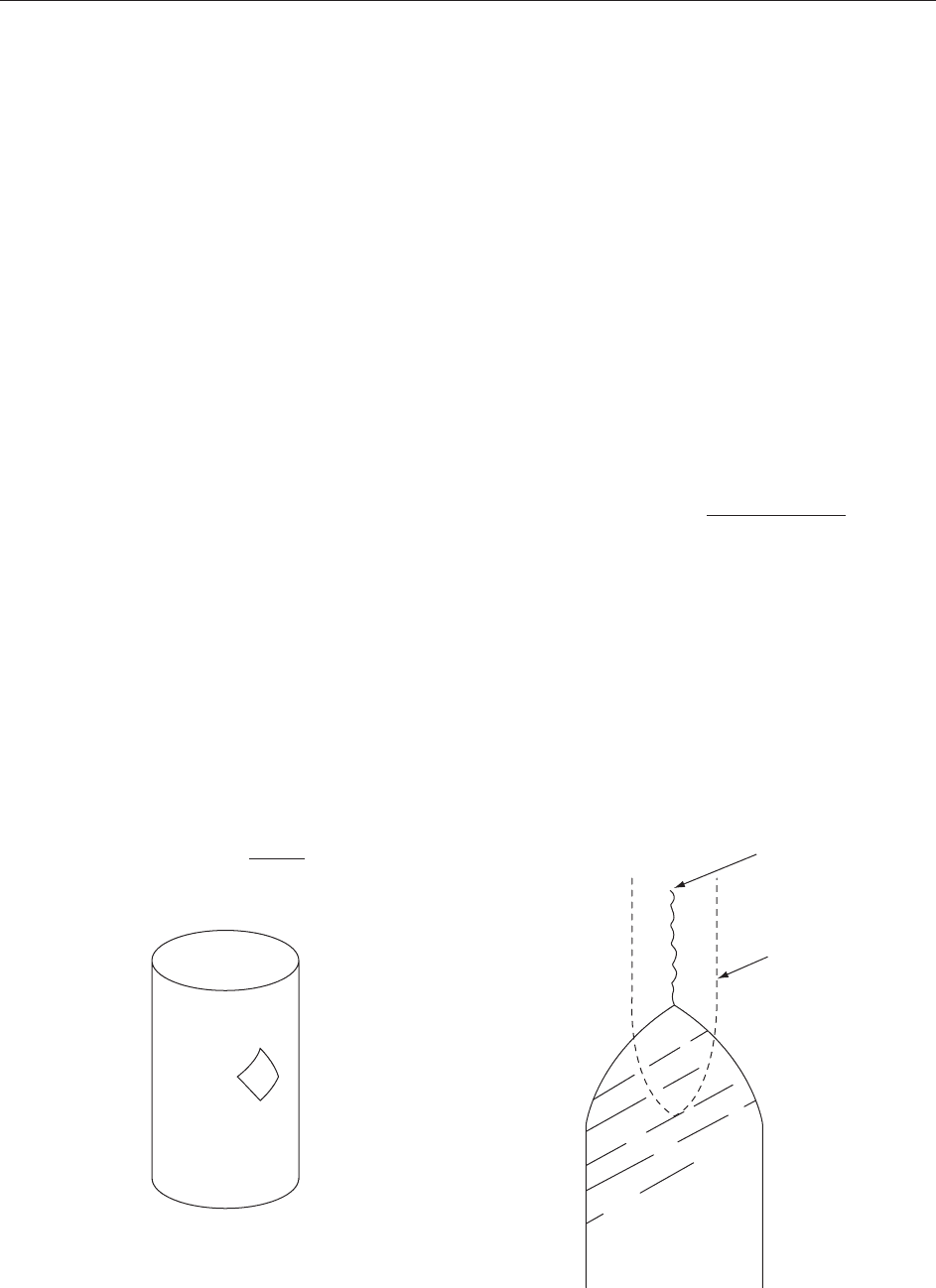
timelike cylinder spacetime of radius R (see
Figure 3). This spacetime is globally hyperbolic
and stationary and, while locally flat, globally
distinct from Minkowski space. As a result, while –
provided the regions O are sufficiently small
(such as the diamond region in Figure 3) – elements
A(O) of the minimal net of local algebras on this
spacetime will be identifiable, in an obvious way,
with elements of the minimal net of local algebras
on Minkowski space, the stationary ground state
!
cylinder
will, when restricted to such thus-identified
regions, be distinct from the Minkowski vacuum
state !
0
. The resulting renormalized stress–energy
tensor (as first pointed out in Kay (1979)),
definable, once the above identification has been
made, exactly as in [7]) turns out, in the massless
case, to be nonzero and, interestingly, to have a (in
the natural coordinates, constant) negative ene r gy-
density T
00
. I n fact, in this massless case,
!
cylinder
ðT
ab
Þ¼
1
24R
2
ab
Hawking and Unruh Effects
The original calculation by Hawking (1975) con-
cerned a model spacetime for a star which collapses
to a black hole. For simplicity, we shall only discuss
the spherically symmetric case (see Figure 4). Adopt-
ing a similar ‘‘mode’’ viewpoint to that mentioned
after results (R1) and (R2) discussed earlier, the
result of the calculation may be stated as follows:
For a real linear scalar field satisfying [2] with m = 0
(and V = 0) on this spacetime, the expectation value
!
in
(N(a
$, ‘
)) of the occupation number of a one-
particle outgoing mode a
$, ‘
) localized (as far as a
normalized mode can be) around $ in angular-
frequency space and about retarded time v, and with
angular mom entum ‘‘quantum number’’ ‘, in the in-
vacuum state (i.e., on the minimal algebra for a real
scalar field on this model spacetime) !
in
is, at late
retarded times, given by the formu la
!
in
ðNða
$;‘
ÞÞ ¼
ð$; ‘Þ
expð8M$Þ1
where M is the mass of the black hole and the
absorption factor (alternatively known as gray-body
factor) ($, ‘) is equal to the norm-sq uared of that
part of the one-particle mode a
$, ‘
which, viewed as
a complex positive-frequency classical solution
propagating backwards in time from late retarded
times, would be absorbed by the black hole. (Note
the independence of the right-hand side of this
formula from the retarded time, v.) This calculation
can be understood as an app lication of result (R1)
Figure 3 The timelike cylinder spacetime of radius R with a
diamond region isometric to a piece of Minkowski space. See
Kay (1979). Casimir effect in quantum field theory. (Original title:
The Casimir effect without magic.) Physical Review D 20:
3052–3062. Reprinted with permission ª 1979 by the American
Physical Society.
Interior of
star
Singularity
Horizon
Figure 4 The spacetime of a star collapsing to a spherical
black hole.
Quantum Field Theory in Curved Spacetime 209
(even though the spacetime is more complicated than
one with a localized ‘‘bump of curvature’’ and even
though the relevant overall time evolution will not be
unitarily implemented, the result still applies when
suitably interpreted) and the heart of the calculation
is an asymptotic estimate of the relevant ‘‘’’
Bogoliubov coefficient which turns out to be depen-
dent on the geometrical optics of rays which pass
through the star just before the formation of the
horizon. This result suggests that the in-vacuum state
is indistinguishable at late retarded times from a state
of blackbody radiation at the Hawking temperature,
T
Hawking
= 1=8M, in Minkowski space from a
blackbody (gray body) with the same absorption
factor. This was confirmed by further work by many
authors. Much of that work, as well as the original
result of Hawking was partially heuristic but later
work by Dimock and Kay (1987), by Fredenhagen
and Haag (1990), and by Bachelot (1999) and others
has put different aspects of it on a rigorous
mathematical footing. The result generalizes to
nonzero mass and higher spin fields to interacting
fields as well as to other types of black hole and the
formula for the Hawking temperature generalizes to
T
Hawking
¼ =2
where is the surface gravity of the black hole.
This result suggests that there is something funda-
mentally ‘‘thermal’’ about quantum fields on black-
hole backgrounds and this is confirmed by a number of
mathematical results. In particular, the theorems in the
two papers Kay and Wald (1991) and Kay (1993),
combined together, tell us that there is a unique state
on the Weyl algebra for the maximally extended
Schwarzschild spacetime (a.k.a. Kruskal–Szekeres
spacetime)(seeFigure 5) which is invariant under the
Schwarzschild isometry group and whose two-point
function has Hadamard form. Moreover, they tell us
that this state, when restricted to a single wedge (i.e.,
the exterior Schwarzschild spacetime) is necessarily a
KMS state at the Hawking temperature. This unique
state is known as the Hartle–Hawking–Israel state.
These results in fact apply more generally to a wide
class of globally hyperbolic spacetimes with bifurcate
Killing horizons including de Sitter space – where the
unique state is sometimes called the Euclidean and
sometimes the Bunch–Davies vacuum state – as well as
to Minkowski space, in which case the unique state is
the usual Minkowski vacuum state, the analog of the
exterior Schwarzschild wedge is a so-called Rindler
wedge, and the relevant isometry group is a one-
parameter family of wedge-preserving Lorentz boosts.
In the latter situation, the fact that the Minkowski
vacuum state is a KMS state (at ‘‘temperature’’ 1=2)
when restricted to a Rindler wedge and regarded with
respect to the time evolution consisting of the wedge-
preserving one-parameter family of Lorentz boosts is
known as the Unruh effect (1975). This latter property
of the Minkowski vacuum in fact generalizes to
general Wightman QFTs and is in fact an immediate
consequence of a combination of the Reeh–Schlieder
theorem (applied to a Rindler wedge) and the
Bisognano–Wichmann theorem (1975). The latter
theorem says that the defining relation [1] of a KMS
state holds if, in [1], we identify the operator J with the
complex conjugation which implements wedge reflec-
tion and H with the self-adjoint generator of the
unitary implementor of Lorentz boosts. We remark
that the Unruh effect illustrates how the concept of
‘‘vacuum’’ (when meaningful at all) is dependent on
the choice of time evolution under consideration.
Thus, the usual Minkowski vacuum is a ground state
with respect to the usual Minkowski time evolution
but not (when restricted to a Rindler wedge) with
respect to a one-parameter family of Lorentz boosts;
with respect to these, it is, instead, a KMS state.
Nonglobally Hyperbolic Spacetimes
and the ‘‘Time Machine’’ Question
Hawking (1992) argued that a spacetime in which a
time machine gets manufactured should be modeled
(see Figure 6) by a spacetime with an initial globally
Future singularity
(Schwarzschild case)
Past singularity
(Schwarzschild case)
Exterior
Schwarzschild
wedge/
Rindler wedge
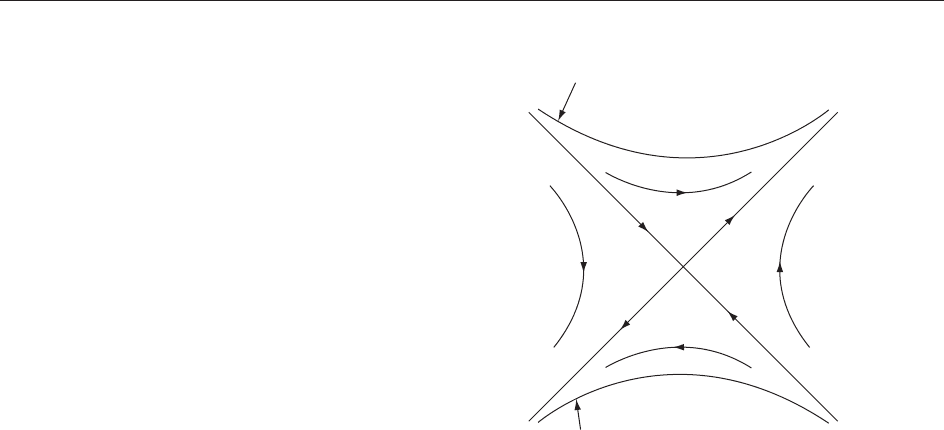
Figure 5 The geometry of maximally extended Schwarzschild
(/or Minkowski) spacetime. In the Schwarzschild case, every
point represents a 2-sphere (/in the Minkowski case, a 2-plane).
The curves with arrows on them indicate the Schwarzschild time
evolution (/one-parameter family of Lorentz boosts). These
curves include the (straight lines at right angles) event horizons
(/Killing horizons).
210 Quantum Field Theory in Curved Spacetime

hyperbolic region with a region containing closed
timelike curves to its future and such that the future
boundary of the globally hyperbolic region is a
compactly generated Cauchy horizon. On such a
spacetime, Kay et al. (1997) proved that it is
impossible for any distributional bisolution which
satisfies (even a certain weakened version of) the
Hadamard condition on the initial globally hyper-
bolic region to continue to satisfy that condition on
the full spacetime – the (weakened) Hadamard
condition being necessarily violated at at least one
point on the Cauchy horizon. This result implies
that, however one extends a state, satisfying our
conditions (C1)–(C4), on the minimal algebra for [2]
on the initial globally hyperbolic region, the expec-
tation value of its stress–energy tensor must neces-
sarily become singular on the Cauchy horizon. This
result, together with many heuristic results and
specific examples considered by many other authors
appears to support the validity of the (Hawking
1992) chronology protection conjecture to the effect
that it is impossible in principle to manufacture a time
machine. However, there are potential loopholes in the
physical interpretation of this result as pointed out by
Visser (1997), as well as other claims by various authors
that one can nevertheless violate the chronology
protection conjecture. For a recent discussion on this
question, we refer to Visser (2003).
Other Related Topics and Some
Warnings
There is a vast computational literature, calculating
the expectation values of stress–energy tensors in
states of interest for scalar and higher spin linear
fields (and also some work for interacting fields) on
interesting cosmological and black-hole backgrounds.
QFT on de Sitter and anti-de Sitter space is a big
subject area in its own right with recent renewed
interest because of its relevance to string theory and
holography. Also important on black-hole back-
grounds is the calculation of gray-body factors,
again with renewed interest because of relevance to
string theory and to brane-world scenarios.
There are many further mathematically rigorous
results on algebraic and axiomatic QFT in a curved
spacetime setting, including versions of PCT, spin-
statistics and Reeh–Schlieder theorems and also
rigorous energy inequalities bounding the extent to
which expected energy densities can be negative, etc.
There is much mathematical work controlling
scattering theory on black holes, partly with a view
to further elucidating the Hawking effect.
Perturbative renormalization theory of interacting
quantum fields in curved spacetime is also now a
highly developed subject.
Beyond QFT in a fixed curved spacetime is
semiclassical gravity which takes into account the
back-reaction of the expectation value of the stress–
energy tensor on the classical gravitational back-
ground. There are also interesting condensed matter
analogs of the Hawking effect such as dumb holes.
Readers exploring the wider literature, or doing
further research on the subject should be aware that
the word ‘‘vacuum’’ is sometimes used to mean
‘‘ground state’ ’ and sometimes just to mean ‘‘quasifree
state.’’ They should be cautious of attempts to define
particles on Cauchy surfaces in instantaneous diag-
onalization schemes (cf. the remarks at the end of the
section ‘‘Particle creation and the limitations of the
pa rti cle c onc ept’’ ). W he n s tudy ing ( or pe rfor ming )
calculations of the ‘‘expectation value of the stress–
energy tensor’’ it is always important to ask oneself
with respect to which state the expectation value is
being taken. It is also important to remember to check
that candidate two-point (anticommutator) functions
satisfy the positivity condition (C3) discussed earlier.
Typically, two-point distributions obtained via mode
sums automatically satisfy condition (C3) (and condi-
tion (C4)), but those obtained via image methods do
not always satisfy it. (When they do not, the presence
of nonlocal spacelike singularities is often a tell-tale
sign as can be inferred from Kay’s conjecture/Radzi-
kowski’s theorem discussed earlier.) There are a
number of apparent implicit assertions in the literature
that some such two-point functions arise from ‘‘states’’
when of course they cannot. Some of these concern
proposed analogs to the Hartle–Hawking–Israel state
for the (appropriate maximal globally hyperbolic
portion of the maximally extended) Kerr spacetime.
That they cannot belong to states is clear from a
theorem in Kay and Wald (1991) which states that
there is no stationary Hadamard state on this space-
time at all. Others of them concern claimed ‘‘states’’ on
spacetimes such as those discussed in the previous
section which, if they really were states would seem to
be in conflict with the chronology protection con-
jecture. Finally, beware states (such as the so-called -
vacua of de Sitter spacetime) whose two-point
Region with closed
timelike curves
Initial
g
lobally hyperbolic re
g
ion
Cauchy
horizon
Figure 6 The schematic geometry of a spacetime in which a
time machine gets manufactured.
Quantum Field Theory in Curved Spacetime 211