
Francoise J.-P., Naber G.L., Tsun T.S. (editors) Encyclopedia of Mathematical Physics
Подождите немного. Документ загружается.


This result is strongly related to data compression.
When ! is interpreted as a stationary quantum source
(with possible memory), then efficient and reliable
data compression needs a subspace of small dimension
and the range of Q
n
can play this role. The entropy
density is the maximal rate of reliable compression.
It is interesting that one can impose further
requirements on the high-probability projections
and the statement of the theorem remains true.
1. The partial trace of Q
nþ1
over A
nþ1
is Q
n
;
2. e
n(s")
tr Q
n
e
n(sþ")
if n is large enough; and
3. if q Q
n
is a minimal projection (in A
[1, n]
), then
!(q) e
n(s")
if n is large enough.
In (2) and (3) s stands for s(!). Let D
n
be the density
matrix of the restriction of ! to A
[1, n]
. It follows
that for an eigenvalue of Q
n
D
n
Q
n
the inequality
s "
log
n
holds.
From the point of view of data compression, it is
important if the sequence Q
n
2A
[1, n]
works uni-
versally for many states. Indeed, in this case the
compression algorithm can be universal for several
quantum sources.
Theorem 8 Let R > 0. There is a projection
Q
n
2A
[1, n]
such that
lim sup
n
1
n
log trQ
n
R ½24
and for any ergodic state ! on A such that s(!) < R
the relation
lim
n
!ðQ
n
Þ¼1 ½25
holds.
In the simplest quantum hypothesis testing prob-
lem, one has to decide between two states of a
system. The state
0
is the null hypothesis and
1
is
the alternative hypothesis. The problem is to decide
which hypothesis is true. The decision is performed
by a two-valued measurement {T, I T}, where
0 T I is an observable. T corresponds to
the acceptance of
0
and I T corresponds to the
acceptance of
1
. T is called a test. When the
measurement value is 0, the hypothesis
0
is
accepted, otherwise the alternat ive hypothesis
1
is
accepted. The quantity [T] = tr
0
(I T) is inter-
preted as the probability that the null hypothesis is
true but the alternative hypothesis is accepted. This
is the error of the first kind. Similarly, [T] = tr
1
T
is the probability that the alternative hypothesis is
true but the null hypothesis is accepted. It is called
the error of the second kind.
Now we fix a formalism for an asymptotic theory
of the hypothesis testing. Suppose that a sequence
(H
n
) of Hilbert spaces is given, (
(n)
0
)and(
(n)
1
)are
density matrices on H
n
. The typical example we have
in mind is
(n)
0
=
0
0
0
and
(n)
1
=
1
1
1
. A positive contraction T
n
2B(H
n
)is
considered as a test on a composite system. Now the
errors of the first and second kind depend on n:
n
[T
n
] = tr
(n)
0
(I T
n
)and
n
[T
n
] = tr
(n)
1
T
n
.
Set
ðn;"Þ¼infftr
ðnÞ
1
A
n
g½26
where the infimum is over all A
n
2B(H
n
) such that
0 A
n
I and tr
(n)
0
(I A
n
) ". In other words,
this is the infimum of the error of the second kind
when the error of the first kind is at most ". The
importance of this quantity is in the customary
approach to hypothesis testing .
The following result is the quantum Stein lemma.
Theorem 9 In the above setting, the relation
lim
n!1
1
n
log
ðn;"Þ¼Sð
0
k
1
Þ
holds for every 0 <"<1.
Bibliographic Notes
A book about entropy in several contexts is Greven
et al. (2003). The role of von Neumann in the
mathematization of the quantum entropy is
described in Petz et al. (2001); this work contains
also his gedanken experiment.
The first proof of the strong subadditivity appeared
in Lieb and Ruskai (1973) and a didactical elementary
approach is in Nielsen and Petz (2005). The structure
of the case of equality was obtained in Hayden et al.
(2004). The quantum relative entropy was introduced
by Umegaki in 1962 and their properties and its
axiomatization are contained in the monograph by
Ohya and Petz (1993). The monotonicity of the
relative entropy is called Uhlmann’s theorem, see
Uhlmann (1977) and Ohya and Petz (1993).
The rigorous and comprehensive treatment of
quantum lattice systems was one of the early
successes of the algebraic approach to quantum
statistical thermodynamics. The subject is well
summarized in Bratteli and Robinson (1981). The
book by Sewell (1986) contains more physics and
has less in mathematical technicalities. For many
interesting entropy results concerning mean field
systems, see, for example, Ragio and Werner (1991).
The high probability subspace theorem is due to
Ohya and Petz – Petz (1992) and Ohya and Petz
(1993) for product states – and was extended to
182 Quantum Entropy

some algebraic and Gibbs states by Hiai and Petz.
The application to data compression was first
observed by Schumacher (1995). The chained
property of the high-probability subspaces was
studied in Bjelakovic
´
et al. (2003) and the univers-
ality is from Kaltchenko and Yang (2003).
A weak form of the quantum Stein lemma was
proved in Hiai and Petz (1991) and the stated form
is due to Nagaoka and Ogawa (2000). An extension
to the case where
(n)
0
is not a product was given in
Bjelakovic
´
and Siegmund-Schultze (2004).
Other surveys about quantum entropy are Petz
(1992) and Schumacher and Westmor eland (2002).
See also: Asymptotic Structure and Conformal Infinity;
Capacities Enhanced by Entanglement; Channels in
Quantum Information Theory; Entropy and Qualitative
Transversality; Positive Maps on C
-Algebras; von
Neumann Algebras: Introduction, Modular Theory and
Classification Theory; von Neumann Algebras: Subfactor
Theory.
Further Reading
Bjelakovic
´
I, Kru¨ ger T, Siegmund-Schultze R, and Szko
´
la A
(2003) Chained typical subspaces – a quantum version of
Breiman’s therem. Preprint.
Bjelakovic
´
I and Siegmund-Schultze R (2004) An ergodic theorem
for the quantum relative entropy. Communications in Math-
ematical Physics 247: 697–712.
Bratteli O and Robinson DW (1981) Operator Algebras and
Quantum Statistical Mechanics. 2. Equilibrium States. Models
in Quantum Statistical Mechanics, Texts and Monographs in
Physics, (2nd edn., 1997). Berlin: Springer.
Greven A, Keller G, and Warnecke G (2003) Entropy. Princeton
and Oxford: Princeton University Press.
Hayden P, Jozsa R, Petz D, and Winter A (2004) Structure of
states which satisfy strong subadditivity of quantum entropy
with equality. Communications in Mathematical Physics 246:
359–374.
Hiai F and Petz D (1991) The proper formula for relative entropy
and its asymptotics in quantum probability. Communications
in Mathematical Physics 143: 99–114.
Kaltchenko A and Yang E-H (2003) Universal compression of
ergodic quantum sources. Quantum Information and Compu-
tation 3: 359–375.
Lieb EH and Ruskai MB (1973) Proof of the strong subadditivity
of quantum mechanical entropy. Journal of Mathematical
Physics 14: 1938–1941.
Nielsen MA and Petz D (2005) A simple proof of the strong
subadditivity inequality. Quantum Information and Computa-
tion 5: 507–513.
Ogawa T and Nagaoka H (2000) Strong converse and Stein’s
lemma in quantum hypothesis testing. IEEE Transactions on
Information Theory 46: 2428–2433.
Ohya M and Petz D (1993) Quantum Entropy and Its Use, Texts
and Monographs in Physics, (2nd edn., 2004). Berlin:
Springer.
Petz D (1992) Entropy in quantum probability. In: Accardi L (ed.)
Quantum Probability and Related Topics VII, pp. 275–297.
Singapore: World Scientific.
Petz D (2001) Entropy, von Neumann and the von Neumann
entropy. In: Re´dei M and Sto¨ltzner M (eds.) John von Neumann
and the Foundations of Quantum Physics. Dordrecht: Kluwer.
Raggio GA and Werner RF (1991) The Gibbs variational
principle for inhomogeneous mean field systems. Helvetica
Physica Acta 64: 633–667.
Schumacher B (1995) Quantum coding. Physical Review A 51:
2738–2747.
Schumacher B and Westmoreland MD (2002) Relative entropy in
quantum information theory. In: Quantum Computation and
Information, (Washington, DC, 2000), Contemp. Math. vol.
305, pp. 265–289. Providence, RI: American Mathematical
Society.
Sewell GL (1986) Quantum Theory of Collective Phenomena,
New York: Clarendon.
Uhlmann A (1977) Relative entropy and the Wigner–Yanase–
Dyson–Lieb concavity in an interpolation theory. Commu-
nications in Mathematical Physics 54: 21–32.
von Neumann J (1932) Mathematische Grundlagen der Quanten-
mechanik
. Berlin: Springer. (In English: von Neumann J,
Mathematical Foundations of Quantum Mechanics. Princeton:
Princeton University Press.)
Quantum Ergodicity and Mixing of Eigenfunctions
S Zelditch, Johns Hopkins University, Baltimore,
MD, USA
ª 2006 Elsevier Ltd. All rights reserved.
Quantum ergodicity and mixing belong to the field
of quantum chaos, which studies quantizations of
‘‘chaotic’’ classi cal Hamiltonian systems. The basic
question is: how does the chaos of the classical
dynamics impact on the eigenvalues/eigenfunctions
of the quantum Hamiltonian
^
H and on long-time
dynamics generated by
^
H?
These problems lie at the foundations of the
semiclassical limit, that is, the limit as the Planck
constant h !0 or the energy E !1. More generally,
one could ask what impact any dynamical feature of a
classical mechanical system (e.g., complete integrabil-
ity, KAM, and ergodicity) has on the eigenfunctions
and eigenvalues of the quantization.
Over the last 30 years or so, these questions have
been studied rather systematically by both mathe-
maticians and physicists. There is an extensive
literature comparing classical and quantum
dynamics of model systems, such as comparing the
geodesic flow and wave group on a compact (or
finite-volume) hyperbolic surface, or comparing
classical and quantum billiards on the Sinai billiard
or the Bunimovich stadium, or comparing the
Quantum Ergodicity and Mixing of Eigenfunctions 183

discrete dynamical system generated by a hyperbolic
torus automorphism and its quantization by the
metaplectic representation. As these models indicate,
the basic problems and phenomena are richly
embodied in simple, low-dimensional examples in
much the same way that two-dimensional toy
statistical mechanical models already illustrate com-
plex problems on phase transitions. The principles
established for simple models should apply to far
more complex systems such as atoms and molecules
in strong magnetic fields.
The conjectural picture which has emerged from
many computer experiments and heuristic argu-
ments on these simple model systems is roughly
that there exists a length scale in which quantum
chaotic systems exhibit universal behavior. At this
length scale, the eigenvalues resemble eigenvalues of
random matrices of large size and the eigenfunctions
resemble random waves. A small sample of the
original physics articl es sugges ting this picture is
Berry (1977), Bohigas et al. (1984), Feingold and
Peres (1986),andHeller (1984).
This article reviews some of the rigorous mathe-
matical results in quantum chaos, particularly those
on eigenfunctions of quantizations of classically
ergodic or mixing systems. They support the
conjectural picture of random waves up to two
moments, that is, on the level of means and
variances. A few results also exist on higher
moments in very special cases. But from the
mathematical point of view, the conjectural links
to random matrices or random waves remain very
much open at this time. A key difficulty is that the
length scale on which universal behavior should
occur is far below the resolving power of any known
mathematical techniques, even in the simplest model
problems. The main evidence for the random
matrix and random wave connections comes from
numerous computer experiments of model cases in
the physics literature. We will not review numerical
results here, but to get a well-rounded view of the
field, it is important to understand the computer
experiments (see, e.g., Ba¨ cker et al. (1998a, b) and
Barnett (2005)).
The model quantum systems that have been most
intensively studied in mathematical quantum chaos
are Laplacians or Schro¨ dinger operators on com-
pact (or finite-volume) Riemannian manifolds, with
or without boundary, and quantizations of sym-
plectic maps on compact Ka¨hl er manifolds. Similar
techniques and results apply in both settings, so for
thesakeofcoherenceweconcentrateonthe
Laplacian on a compact Riemannian manifold
with ‘‘chaotic’’ geodesic flow and only briefly
allude to the setting of ‘‘quantum maps.’’
Additionally, two main kinds of methods are in
use: (1) methods of semiclassical (or m icrolocal)
analysis, which apply to general Laplacians (and
more general Schro¨ dinger operators), and (2)
methods of number theory and automorphic
forms, which apply to arithmetic models such as
arithmetic hyperbolic manifolds or quantum cat maps.
Arithmetic models are far more ‘‘explicitly solvable’’
than general chaotic systems, and the results obtained
for them are far sharper than the results of semiclassi-
cal analysis. This article is primarily devoted to the
general results on Laplacians obtained by semiclassical
analysis; see Arithmetic Quantum Chaos for results by
J Marklov. For background on semiclassical analysis,
see Heller (1984).
Wave Group and Geodesic Flow
The model quantum Hamiltonians we will discuss
are Laplacians on compact Riemannian mani-
folds (M, g) (with or without boundary). The
classical phase space in this setting is the cotangent
bundle T
M of M , equipped with i ts canonical
symplectic form
P
i
dx
i
^d
i
. The metric defines
the Hamiltonian
Hðx;Þ¼jj
g
¼
ffiffiffiffiffiffiffiffiffiffiffiffiffiffiffiffiffiffiffiffiffiffiffiffiffiffi
X
n
ij¼1
g
ij
ðxÞ
i
j
v
u
u
t
on T
M, where
g
ij
¼ g
@
@x
i
;
@
@x
j
[g
ij
] is the inverse matrix to [g
ij
]. We denote the
volume density of (M, g) by dVol and the corre-
sponding inner product on L
2
(M)byhf , g i. The unit
(co-) ball bundle is denoted B
M = {(x, ):jj1}.
The Hamiltonian flow
t
of H is the geodesic
flow. By definition,
t
(x, ) = (x
t
,
t
), where (x
t
,
t
)is
the terminal tangent vector at time t of the unit
speed geodesic starting at x in the direction . Here
and below, we often identify T
M with the tangent
bundle TM using the metric to simplify the
geometric description. The geodesic flow preserves
the energy surfaces {H = E} which are the co-sphere
bundles S
E
M. Due to the homogeneity of H,
the flow on any energy surface {H = E} is equivalent
to that on the co-sphere bundle S
M = {H = 1}.
(This homogeneity could be broken by adding a
potential V 2 C
1
(M) to form a semiclassical
Schro¨ dinger operator h
2
þ V, whose underlying
Hamiltonian flow is generated by jj
2
g
þ V(x).) See
h-Pseudodifferential Operators and Applications.
184 Quantum Ergodicity and Mixing of Eigenfunctions

The quantization of the Hamiltonian H is the
square root
ffiffiffiffi
p
of the positive Laplacian
¼
1
ffiffiffi
g
p
X
n
i;j¼1
@
@x
i
g
ij
g
@
@x
j
of (M, g ). Here, g = det [g
ij
]. We choose to work
with
ffiffiffiffi
p
rather than since the former generates
the wave
U
t
¼ e
it
ffiffiffi
p
which is the quantization of the geodesic flow
t
.
By the last statement we mean that U
t
is related to
t
in several essentially equivalent ways:
1. singularities of waves, that is, solutions U
t
of
the wave equation, propagate along geodesics;
2. U
t
is a Fourier integral operator (= quantum
map) associated to the canonical relation defined
by the graph of
t
in T
M T
M;and
3. Egorov’s theorem holds.
We only define the latter since it plays an important
role in studying eigenfunctions. As with any quantum
theory, there is an algebra of observables on the
Hilbert space L
2
(M, dvol
g
) which quantizes T
M.
Here, dvol
g
is the volume form of the metric. The
algebra is that
(M) of pseudodifferential operators
DO’s of all orders, though we often restrict to the
subalgebra
0
of DO’s of order zero. We denote by
m
(M) the subspace of pseudodifferential operators of
order m. The algebra is defined by constructing a
quantization Op from an algebra of symbols a 2
S
m
(T
M) of order m (polyhomogeneous functions on
T
Mn0) to
m
. The map Op is not unique. In the
reverse direction is the symbol map
A
:
m
!
S
m
(T
M) which takes an operator Op(a)tothe
homogeneous term a
m
of order m in a.
Egorov’s theorem for the wave group concerns the
conjugations
t
ðAÞ:¼U
t
AU
t
; A 2
m
ðMÞ½1
Such a conjugation defines the quantum evolution of
observables in the Heisenberg picture, and, since the
early days of quantum mechanics, it was known to
correspond to the classical evolution
V
t
ðaÞ:¼a
t
½2
of observables a 2 C
1
(S
M). Egorov’s theorem is
the rigorous version of this correspondence: it states
that
t
defines an order-preserving automorph ism of
(M), that is,
t
(A) 2
m
(M)ifA 2
m
(M), and
that
U
t
AU
t
ðx;Þ¼
A
ð
t
ðx;ÞÞ:¼V
t
ð
A
Þ;
ðx;Þ2T
Mn0 ½3
This formula is almost universally taken to be the
definition of quantization of a flow or map in the
physics literature.
The key difficulty in quantum chaos is that it
involves a comparison between long-time dynamical
properties of
t
and U
t
through the symbol map and
similar classical limits. The classical dynamics
defines the ‘‘principal symbol’’ behavior of U
t
and
the ‘‘error’’ U
t
AU
t
Op(
A
t
) typically grows
exponentially in time. This is just the first example
of a ubiquitous ‘‘exponential barrier’’ in the subject.
Eigenvalues and Eigenfunctions of
The eigenvalue problem on a compact Riemannian
manifold
’
j
¼
2
j
’
j
; h ’
j
;’
k
i¼
jk
is dual under the Fourier transform to the wave
equation. Here, {’
j
} is a choice of orthonormal basis
of eigenfunctions, which is not unique if the
eigenvalues have multiplicities > 1. The individual
eigenfunctions are difficult to study directly, and so
one generally forms the spectral projections kernel,
Eð; x; yÞ¼
X
j :
j
’
j
ðxÞ’
j
ðyÞ½4
Semiclassical asymptotics is the study of the !1
limit of the spectral data {’
j
,
j
}orofE(, x, y). The
(Schwartz) kernel of the wave group can be
represented in terms of the spect ral data by
U
t
ðx; yÞ¼
X
j
e
it
j
’
j
ðxÞ’
j
ðyÞ
or equivalently as the Fourier transform
R
R
e
it
dE(, x, y) of the spectral projections. Hence,
spectral asymptotics is often studied through the
large-time behavior of the wave group.
The link between spectral theory and geometry,
and the source of Egorov’s theorem for the wave
group, is the construction of a parametrix (or WKB
formula) for the wave kernel. For small times t, the
simplest is the Hadamard parametrix,
U
t
ðx; yÞ
Z
1
0
e
iðr
2
ðx;yÞt
2
Þ
X
1
k¼0
U
k
ðx; yÞ
ððd3Þ=2Þk
d
ðt < injðM; gÞÞ ½5
where r(x, y) is the distance between points,
U
0
(x, y) =
1=2
(x, y) is the volume 1/2-density,
inj(M, g) is the injectivity radius, and the higher
Hadamard coefficients are obtained by solving
transport equations along geodesics. The parametrix
is asymptotic to the wave kernel in the sense of
Quantum Ergodicity and Mixing of Eigenfunctions 185

smoothness, that is, the difference of the two sides of
[5] is smooth. The relation [5] may be iterated using
U
tm
= U
m
t
to obtain a parametrix for long times.
This is obviously complic ated and not necessarily
the best long-time parametrix construction, but it
illustrates again the difficulty of a long-time
analysis.
Weyl Law and Local Weyl Law
A fundamental and classical result in spectral
asymptotics is Weyl’s law on counting eigenvalues:
NðÞ¼#fj :
j
g
¼
jB
n
j
ð2Þ
n
VolðM; gÞ
n
þ Oð
n1
Þ½6
Here, jB
n
j is the Euclidean volume of the unit ball
and Vol(M, g) is the volume of M with respect to the
metric g. An equivalent formula which emphasizes
the correspondence between classical and quantum
mechanics is
trE
¼
Volðjj
g
Þ
ð2Þ
n
½7
where Vol is the symplectic volume measure relative
to the natural symplectic form
P
n
j = 1
dx
j
^ d
j
on
T
M. Thus, the dimension of the space where
H =
ffiffiffiffi
p
is is asym ptotically the volume where
its symbol jj
g
.
The remainder term in Weyl’s law is sharp on the
standard sphere, where all geodesics are periodic, but
is not sharp on (M, g) for which the set of periodic
geodesics has measure zero (Duistermaat–Guillemin,
Ivrii) (see Semiclassical Spectra and Closed Orbits).
When the set of periodic geodesics has measure zero
(as is the case for ergodic systems), one has
NðÞ¼#fj :
j
g
¼
jB
n
j
ð2Þ
n
VolðM; gÞ
n
þ oð
n1
Þ½8
The remainder is then of smaller order than the
derivative of the principal term, and one then has
asymptotics in shorter intervals:
Nð½; þ 1Þ ¼ #fj :
j
2½; þ 1g
¼ n
jB
n
j
ð2Þ
n
VolðM; gÞ
n1
þ oð
n1
Þ½9
Physicists tend to write h
1
and to average over
intervals of this width. Then mean spacing between
the eigenvalues in this interval is C
n
Vol(M, g)
1
(n1)
, where C
n
is a constant depending on the
dimension.
An important generalization is the ‘‘local Weyl law’’
concerning the traces trAE(), where A 2
m
(M).
It asserts that
X
j
hA’
j
;’
j
i
¼
1
ð2Þ
n
Z
B
M
A
dx d
n
þ Oð
n1
Þ½10
There is also a pointwise local Weyl law:
X
j
j’
j
ðxÞj
2
¼
1
ð2Þ
n
jB
n
j
n
þ Rð; xÞ½11
where R(, x) = O(
n1
) uniformly in x. Again,
when the periodic geodesics form a set of measure
zero in S
M, one could average over the shorter
interval [, þ 1]. Combining the Weyl and local
Weyl law, we find the surface average of
A
is a
limit of traces:
!ðAÞ:¼
1
ðS
MÞ
Z
S
M
A
d
¼ lim
!1
1
NðÞ
X
j
hA’
j
;’
j
i½12
Here, is the ‘‘Liouville measure’’ on S
M, that is,
the surface measure d = dx d=dH induced by the
Hamiltonian H = jj
g
and by the symplectic volume
measure dx d on T
M.
Problems on Asymptotics Eigenfunctions
Eigenfunctions arise in quantum mechanics as
stationary states, that is, states for which the
probability measure j (t, x)j
2
dvol is constant in time
where (t, x) = U
t
(x) is the evolving state. This
follows from the fact that
U
t
’
k
¼ e
it
k
’
k
½13
and that je
it
k
j= 1. They are the basic modes of the
quantum system. One would like to know the
behavior as
j
!1 (or h !0 in the semiclassical
setting) of invariants such as:
1. matrix elements hA’
j
, ’
j
i of observables in this
state;
2. transition elements hA’
i
, ’
j
i between states;
3. size properties as measured by L
p
norms k’
j
k
L
p
;
4. value distribution as measured by the distribution
function Vol{x 2 M : j’
j
(x)j
2
> t}; and
5. shape properties, for example, distribution of
zeros and critical points of ’
j
.
Let us introduce some problems which have
motivated much of the work in this area.
186 Quantum Ergodicity and Mixing of Eigenfunctions

Problem 1 Let Q denote the set of ‘‘quantum
limits,’’ that is, weak
limit points of the sequence
{
k
} of distributions on the classical pha se space
S
M, defined by
Z
X
a d
k
:¼hOpðaÞ’
k
;’
k
i
where a 2 C
1
(S
M).
The set Q is independent of the definition of Op.
It follows almost immediately from Egorov’s theo-
rem that QM
I
, where M
I
is the convex set of
invariant probability measures for the geodesic flow.
Furthermore, they are time-reversal invariant, that
is, invariant under (x, ) !(x, ) since the eigen-
functions are real valued.
To see this, it is helpful to introduce the linear
functionals on
0
:
k
ðAÞ¼hOpðaÞ’
k
;’
k
i½14
We observe that
k
(I) = 1,
k
(A) 0ifA 0,
and that
k
U
t
AU
t
¼
k
ðAÞ½15
Indeed, if A 0 then A = B
B for some B 2
0
and we can move B
to the right-hand side.
Similarly, [15] is proved by moving U
t
to the right-
hand side and using [13]. These properties mean
that
j
is an ‘‘invariant state’’ on the algebra
0
.
More precisely, one should take the closure of
0
in
the operator norm. An invariant state is the analog
in quantum statistical mechanics of an invariant
probability measure.
The next important fact about the states
k
is that
any weak limit of the sequence {
k
}on
0
is an
invariant probability measure on C(S
M), that is,
a positive linear functional on C(S
M) rather than
just a state on
0
. This follows from the fact that
hK’
j
, ’
j
i!0 for any compact operator K, and so any
limit of hA’
k
, ’
k
i is equally a limit of h(A þ K)’
k
, ’
k
i.
Hence, any limit is bounded by inf
K
kA þ Kk (the
infimum taken over compact operators), and for any
A 2
0
, k
A
k
L
1
= inf
K
kA þ Kk.Hence,anyweak
limit is bounded by a constant times k
A
k
L
1
and is
therefore continuous on C(S
M). It is a positive
functional since each
j
, and hence any limit, is a
probability measure. By Egorov’s theorem and the
invariance of the
k
,anylimitof
k
(A) is a limit of
k
(Op(
A
t
)) and hence the limit measure is
invariant.
Problem 1 is thus to identify which invariant
measures in M
I
show up as weak limits of the
functionals
k
or equivalently the dist ributions d
k
.
The weak limits reflect the concentration and
oscillation properties of eigenfunctions. Here are
some possibilities:
1. Normalized Liouville measure. In fact, the func-
tional ! of [12] is also a state on
0
for the
reason explained above. A subsequence {’
k
j
}of
eigenfunctions is considered diffuse if
k
j
!!.
2. A periodic orbit measure
defined by
ðAÞ¼
1
L
Z
A
ds
where L
is the length of . A sequence of
eigenfunctions for which
k
j
!
obviously con-
centrates (or strongly ‘‘scars’’) on the closed
geodesic.
3. A finite sum of periodic orbit measures.
4. A delta-function along an invariant Lagrangian
manifold S
M. The associated eigenfunctions
are viewed as ‘‘localizing’’ along .
5. A more general invariant measure which is
singular with respect to d.
All of these possibilities can and do happen in
different examples . If d
k
j
!!, then in particular
we have
1
VolðMÞ
Z
E
j’
k
j
ðxÞj
2
dVol !
VolðEÞ
VolðMÞ
for any measurable set E whose boundary has
measure zero. Interpreting j’
k
j
(x)j
2
dVol as the
probability density of finding a particle of energy
2
k
at x, this result means that the sequence of
probabilities tends to uniform measure.
However, d
k
j
!! is much stronger since it says
that the eigenfunctions become diffuse on the energy
surface S
M and not just on the configuration space
M. As an example, consider the flat torus R
n
=Z
n
.
An orthonormal basis of eigenfunctions is furnished
by the standard exponentials e
2ihk, xi
with k 2 Z
n
.
Obviously, je
2ihk, xi
j
2
= 1, so the eigenfunctions are
already diffuse in configuration space. On the other
hand, they are far from diffuse in phase space, and
localize on invariant Lagrangian tori in S
M. Indeed,
by definition of pseudodifferential operator,
Ae
2ihk, xi
= a(x, k)e
2ihk, xi
, where a(x, k) is the com-
plete symbol. Thus,
hAe
2ihk;xi
; e
2ihk;xi
i¼
Z
R
n
=Z
n
aðx; kÞdx
Z
R
n
=Z
n
A
x;
k
jkj
dx
A subsequ ence e
2ihk
j
, xi
of eigenfunctions has a weak
limit if and only if k
j
=jk
j
j tends to a limit vector
0
in
the unit sphere in R
n
. In this case, the associated
Quantum Ergodicity and Mixing of Eigenfunctions 187
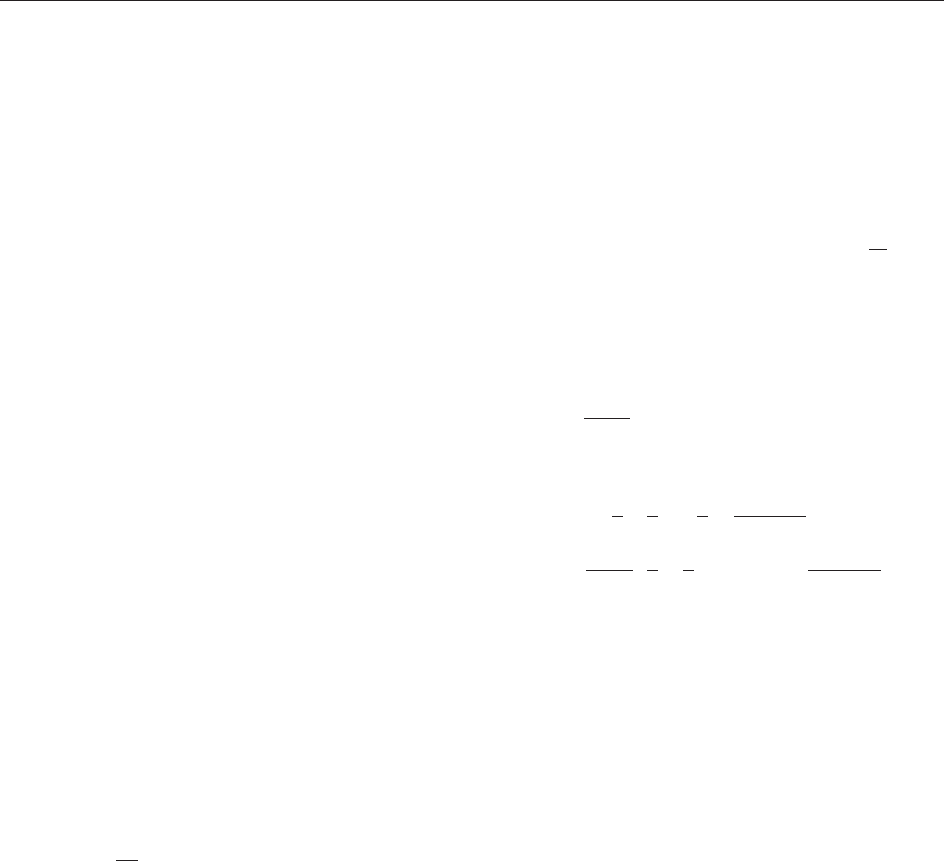
weak
limit is
R
R
n
=Z
n
A
(x,
0
)dx, that is, the delta-
function on the invariant torus T
0
S
M defined
by the constant momentum condition =
0
. The
eigenfunctions are said to localize on this invariant
torus for
t
.
The flat torus is a model of a completely
integrable system on both the classical and quantum
levels. Another example is that of the standard
round sphere S
n
. In this case, the author and
D Jakobson showed that absolutely any invariant
measure 2M
I
can arise as a weak limit of a
sequence of eigenfunctions. This reflects the huge
degeneracy (multiplicities) of the eigenvalues.
On the other hand, if the geodesic flow is ergodic,
one would expect the eigenfunctions to be diffuse in
phase space. In the next section, we will discuss the
rigorous results on this problem.
Off-diagonal matrix elements
jk
ðAÞ¼hA’
i
;’
j
i½16
are also important as trans ition amplitudes between
states. They no longer define states since
jk
(I) = 0,
are positive, or invariant. Indeed,
jk
(U
t
AU
t
) =
e
it(
j
k
)
jk
(A), so they are eigenvectors of the
automorphism
t
of [1]. A sequence of such matrix
elements cannot have a weak limit unless the
spectral gap
j
k
tends to a limit 2 R. In this
case, by the same discussion as above, any weak
limit of the functionals
jk
will be an eigenmeasure
of the geodesic flow which transforms by e
it
under
the action of
t
. Examples of such eigenmeasures
are orbital Fourier coefficients
1
L
Z
L
0
e
it
A
ð
t
ðx;ÞÞdt
along a periodic orbit. Here, 2 (2=L
)Z.We
denote by Q
such eigenmeasures of the geodesic
flow. Problem 1 has the following extension to off-
diagonal elements:
Problem 2 Determine the set Q
of ‘‘quantum
limits,’’ that is, weak
limit points of the sequence
{
kj
} of distributions on the classical phase space
S
M, defined by
Z
X
ad
kj
:¼hOpðaÞ’
k
;’
j
i
where
j
k
= þ o(1) and where a 2 C
1
(S
M), or
equivalently of the functionals
jk
.
As will be disc ussed in the section ‘‘Quantum
weak mixing, ’’ the asymp totics of off-diag onal
elements depends on the weak mixing properties of
the geodesic flow and not just its ergodicity.
Matrix elements of eigenfunctions are quadratic
forms. More ‘‘nonlinear’’ problems involve the
L
p
-norms or the distribution functions of eigenfunc-
tions. Estimates of the L
1
-norms can be obtained
from the l ocal Weyl law [10].Sincethejumpin
the lef t-hand side at is
P
j :
j
=
j’
j
(x)j
2
and the
jump in the right-hand side is the jump of R( , x),
this im plies
X
j:
j
¼
j’
j
ðxÞj
2
¼ Oð
n1
Þ¼)jj’
j
jj
L
1
¼ Oð
n1
2
Þ½17
For general L
p
-norms, the following bounds were
proved by C Sogge for any compact Riemannian
manifold:
k’
j
k
p
k’k
2
¼Oð
ðpÞ
Þ; 2 p 1 ½18
where
ð pÞ¼
n
1
2
1
p
1
2
;
2ðn þ 1Þ
n 1
p 1
n 1
2
1
2
1
p
; 2 p
2ðn þ 1Þ
n 1
8
>
>
<
>
>
:
½19
These estimates are sharp on the unit sphere S
n
R
nþ1
. The extremal eigenfunctions are the zonal
spherical harmonics, which are the L
2
-normalized
spectral projection kernels
N
(x, x
0
)=k
N
( , x
0
)k
centered at any x
0
. However, they are not sharp
for generic (M, g), and it is natural to ask how
‘‘chaotic dynamics’’ might influence L
p
-norms.
Problem 3 Improve the estimates k’
j
k
p
=k’k
2
=
O(
(p)
) for (M, g) with ergodic or mixing geodesic
flow.
C Sogge and the author have proved that if a
sequence of eigenfunctions attains the bounds in
[17], then there must exist a point x
0
so that a
positive measure of geodesics starting at x
0
in S
x
0
M
returns to x
0
at a fixed time T. In the real analyt ic
case, all return so x
0
is a perfect recurrent point. In
dimension 2, such a perfect recurrent point cannot
occur if the geodesic flow is ergodic; hence
k’
j
k
L
1
= o(
(n1)=2
) on any real analytic surface
with ergodic geodesic flow. This shows that none
of the L
p
-estimates above the critical index are sharp
for real analytic surfaces with ergodic geodesic flow,
and the proble m is the extent to which they can be
improved.
The random wave model (see the section ‘‘Random
waves and or thonormal bases’’) p redicts that e igen-
functions of Riemannian manifolds with chaotic
geodesic flow should have the bounds k’
k
L
p
= O(1)
for p < 1 and that k’
k
L
1
<
ffiffiffiffiffiffiffiffiffiffi
log
p
.Butthereare
188 Quantum Ergodicity and Mixing of Eigenfunctions

no rigorous estimates at this time close to such
predictions. The best general estimate to date on
negatively curved compact manifolds (which are
models of chaotic geodesic flow) is just the logarithmic
improvement
jj’
j
jj
L
1
¼ O
n1
log
on the standard remainder term in the local Weyl
law. This was known for compact hyperbolic
manifolds from the Selbe rg trace formula, and
similar estimates hold manifolds without conjugate
points (P Be´rard). The exponential growth of the
geodesic flow again causes a barrier in improving
the estimate beyond the logarithm. In the analogous
setting of quantum ‘‘cat maps,’’ which are models of
chaotic classical dynamics, there exist arbitrarily
large eigenvalues with multiplicities of the order
O(
n1
=log ); the L
1
-norm of the L
2
-normalized
projection kernel onto an eigenspace of this multi-
plicity is of order of the square root of the
multiplicity (Faure et al. 2003). This raises doubt
that the logarithmic estimate can be improved by
general dynamical arguments. Further discussion of
L
1
-norms, as well as zeros, will be given at the end
of the next section for ergodic systems.
Quantum Ergodicity
In this section, we discuss results on the problems
stated above when the geodesic flow of (M, g)is
assumed to be ergodic. Let us recall that this means
that Liouville measure is an ergodic measure for
t
.
This is a spectral property of the operator V
t
of [2]
on L
2
(S
M,d), namely that V
t
has 1 as an
eigenvalue of multiplicity 1. That is, the only
invariant L
2
-functions (with respect to Liouville
measure) are the constant functions. This implies
that the only invariant sets have Liouville measure 0
or 1 and (Birkhoff’s ergodic theorem) that time
averages of functions are constant almost every-
where (equal to the space average).
In this case, there is a general result which
originated in the work of Schnirelman and was
developed into the following theorem by Zelditch,
Colin de Verdie` re, and Sunada (manifolds without
boundary), and Ge´rard–Leichtnam and Zelditch–
Zworski (manifolds with boundary). The following
discussion is based on the articles (Zelditch
1996b, c, Zelditch and Zworski 1996), which
contain further references to the literature.
Theorem 1 Let ( M, g) be a compact Riemannian
manifold (possibly with boundary), and let {
j
, ’
j
}
be the spectral data of its Laplacian . Then the
geodesic flow G
t
is ergodic on (S
M,d) if and only
if, for every A 2
o
(M), we have:
(i) lim
!1
1
N()
P
j
j(A’
j
, ’
j
) !(A)j
2
= 0.
(ii) (8)(9) lim sup
!1
1
N()
P
j6¼k :
j
,
k
j
j
k
j<
j(A’
j
, ’
k
)j
2
<.
This implies that there exists a subsequence {’
j
k
}
of eigenfunctions whose indices j
k
have counting
density 1 for which hA’
j
k
, ’
j
k
i!!(A). We will call
the eigenfunctions in such a sequence ‘‘ergodic
eigenfunctions.’’ One can sharpen the results by
averaging over eigenvalues in the shorter interval
[, þ 1] rather than in [0, ].
There is also an ergodicity result for boundary values
of eigenfunctions on domains with boundary and with
Dirichlet, Neumann, or Robin boundary conditions
(Ge´rard–Leichtnam, Hassell–Zelditch, Burq). This cor-
responds to the fact that the billiard map on B
@M
is ergodic.
The first statement (i) is essentially a convexity
result. It remains true if one replaces the square by
any convex function ’ on the spectrum of A,
1
NðEÞ
X
j
E
’ðhA’
k
;’
k
i!ðAÞÞ!0 ½20
Before sketching a proof, we point out a some-
what heuristic ‘‘picture proof’’ of the theorem.
Namely, ergodicity of the geodesic flow is equivalent
to the statement that Liouville measure is an
extreme point of the compact con vex set M
I
.In
fact, it further implies that ! is an extreme point of
the compact convex set E
R
of invariant states for
t
of eqn [1]; see Ruelle (1969) for background. But
the local Weyl law says that ! is also the limit of the
convex combination
1
NðEÞ
X
j
E
j
An extreme point cannot be written as a convex
combination of other states unless all the states in the
combination are equal to it. In our case, ! is only a
limit of convex combinations so it need not (and does
not) equal each term. However, almost all terms in the
sequence must tend to !, and that is equivalent to [1].
Sketch of Proof of Theorem 1(i) As mentioned
above, this is a convexity result and with no
additional effort we can consider more general
sums of the form. We then have
X
j
E
’ðhA’
k
;’
k
i!ðAÞÞ
¼
X
j
E
’ðhhAi
T
!ðAÞ’
k
;’
k
iÞ ½21
Quantum Ergodicity and Mixing of Eigenfunctions 189

where
hAi
T
¼
1
2T
Z
T
T
U
t
AU
t
dt
We then apply the Peierls–Bogoliubov inequality
X
n
j¼1
’ððB’
j
;’
j
ÞÞ tr ’ðBÞ
with B =
E
[hAi
T
!(A)]
E
to get
X
j
E
’ðhhAi
T
!ðAÞ’
k
;’
k
iÞ
tr ’ð
E
½hAi
T
!ðAÞ
E
Þ½22
Here,
E
is the spectral projection for
^
H corre-
sponding to the interval [0, E]. From the Berezin
inequality we then have (if ’(0) = 0):
1
NðEÞ
tr ’ð
E
½hAi
T
!ðAÞ
E
Þ
1
NðEÞ
tr
E
’ð½hAi
T
!ðAÞÞ
E
! !
E
ð’ðhAi
T
!ðAÞÞÞ; as E !1
As long as ’ is smooth, ’(hAi
T
!(A)) is a
pseudodifferential operator of order zero with
principal symbol ’(h
A
i
T
!(A)). By the assump-
tion that !
E
!! we get
lim
E!1
1
NðEÞ
X
j
E
’ðhA’
k
;’
k
i!ðAÞÞ
Z
fH¼1g
’ðh
A
i
T
!ðAÞÞd
where
h
A
i
T
¼
1
2T
Z
T
T
A
t
dt
As T !1 the right-hand side approaches ’(0) = 0
by the dom inated convergence theorem and by
Birkhoff’s ergodic theorem. Since the left-hand side
is independent of T, this implies that
lim
E!1
1
NðEÞ
X
j
E
’ðhA’
k
;’
k
i!ðAÞÞ ¼ 0
for any smooth convex ’ on Spec(A) with ’(0) = 0.
&
As mentioned above, the statement of Theorem 1(i)
is equivalent to saying that there is a subsequence
{’
j
k
} of counting density 1 for which
j
k
!!.The
above proof does not and cannot settle the question
whether there exist exceptional sparse subsequences
of eigenfunctions of density zero tending to other
invariant measures. To see this, we observe that
the proof is so general that it applies to seemingly very
different situations. In place of the distributions
{
j
}wemayconsidertheset
of periodic orbit
measures for a hyperbolic flow on a compact manifold
X.Thatis,
ðf Þ¼
1
T
Z
f for f 2 CðXÞ
where is a closed orbit and T
is its period.
According to the Bowen–Marguli s equidistribution
theorem for closed orbits of hyperbolic flows, we
have
1
ðTÞ
X
:T
T
1
jdetðI P
Þj
!
where as above is the Liouvi lle measure, where P
is the linear Poincare´ map and where (T) is the
normalizing factor which makes the left side a
probability measure, that is, defined by the integral
of 1 against the sum. An exact repetition of the
previous argument shows that up to a sparse
subsequence of ’s,
! individually. Yet clearly,
the whole sequence does not tend to d: for
instance, one could choose the sequence of iterates
k
of a fixed closed orbit.
Quantum Ergodicity in Terms of Operator Time
and Space Averages
The first part of the result above may be reformu-
lated as a relation between operator time and space
averages.
Definition Let A 2
0
be an observable and define
its time average to be:
hAi :¼ lim
T!1
1
2T
Z
T
T
U
t
AU
t
dt
and its space average to be scalar operat or
!ðAÞI
Here, the limit is taken in the weak operator
topology (i.e., one matrix ele ment at a time). To see
what is involved, we consider matrix elements with
respect to the eigenfunctions. We have
1
2T
Z
T
T
U
t
AU
t
dt’
i
;’
j
¼
sin Tð
i
j
Þ
Tð
i
j
Þ
ðA’
i
;’
j
Þ
from which it is clear that the matrix element tends
to zero as T !1 unless
i
=
j
. However, there is
no uniformity in the rate at which it goes to zero
since the spacing
i
j
could be uncontrollably
small.
190 Quantum Ergodicity and Mixing of Eigenfunctions

In these terms, Theorem 1(i) states that
hAi¼!ðAÞI þ K; where lim
!1
!
ðK
KÞ!0 ½23
where !
(A) = tr E()A. Thus, the time average
equals the space average plus a term K which
is semiclassically small in the sense that its
Hilbert–Schmidt norm square kE
Kk
2
HS
in the span
of the eigenfunctions of eigenvalue is o(N()).
This is not exactly equivalent to Theorem 1(i)
since it is independent of the choice of orthonormal
basis, while the previous result depends on the
choice of basis. However, when all eigenvalues have
multiplicity 1, then the two are equivalent. To see
the equivalence, note that hAi commutes with
ffiffiffiffi
p
and hence is diagonal in the basis {’
j
} of joint
eigenfunctions of hAi and of U
t
. Hence, K is the
diagonal matrix with entries h A’
k
,’
k
i!(A). The
condition is therefore equivalent to
lim
E!1
1
NðEÞ
X
j
E
jhA’
k
;’
k
i!ðAÞj
2
¼ 0
Since all the terms are positive, no cancellation is
possible and this condition is equivalent to the
existence of a subset SN of density 1 such that
Q
S
:= {d
k
: k 2S} has only ! as a weak
limit
point. As above, one says that the sequence of
eigenfunctions is ergodic.
One could take this restatement of Theorem 1(i)
as a semiclassical defi nition of quantum ergodicity.
Two natural questions arise. First:
Problem 4 Suppose the geodesic flow
t
of (M, g)
is ergodic on S
M. Is the operator K in
hAi¼!ðAÞþK
a compact operator? In this case,
ffiffiffiffi
p
is said to be
quantum uniquel y ergodic (QUE). If ergodicity is
not sufficient for the QUE property, what extra
conditions need to be added?
Compactness would imply that hK’
k
,’
k
i!0,
hence hA’
k
,’
k
i!!(A) along the entire sequence.
Quite a lot of attention has been focused on this
problem in the last decade. It is probable that
ergodicity is not by itself sufficient for the QUE
property of general Riemann manifold. For instance,
it is believed that there exis t modes of asymptotic
bouncing ball type which concentrate on the
invariant Lagrangian cylinder (with bounda ry)
formed by bouncing ball orbits of the Bunimovich
stadium (see e.g., Heller (1984) for more on such
‘‘scarring’’). Further, Faure et al. (2003) have shown
that QUE does not hold for the hyperbolic system
defined by a quantum cat map on the torus. Since
the methods applicable to eigenfunctions of
quantum maps and of Laplacians have much in
common, this negative result shows that there
cannot exist a universal structural proof of QUE.
The principal positive result available at this time
is the recent proof by Lindenstrauss of the QUE
property for the orthonormal basis of Laplace–
Hecke eigenfunctions on arithmetic hyperbolic sur-
faces. It is genera lly believed that the spectrum of
the Laplac e eigenvalues is of multiplicity 1 for such
surfaces, so this should imply QUE completely for
these surfaces. Earlier partial results on Hecke
eigenfunctions are due to Rudnick–Sarnak, Wolpert,
and others. For references and further discussion onf
Hecke eigenfunctions, see Rudnick and Sarnak
(1994) (see Arithmetic Quan tum Chaos).
So far we have not mentioned Theorem 1(ii). In
the next section, we will describe a similar but more
general result for mixing systems and the relevance
of (ii) will become clear. An interesting open
problem is the extent to which (ii) is actually
necessary for the equivalence to classical ergodicity.
Problem 5 Converse QE: What can be said of the
classical limit of a quantum ergodic system, that is, a
system for which hAi= !(A) þ K, where K is
compact? Is it necessarily ergodic?
Very little is known on this converse problem at
present. It is known that if there exists an open set in
S
M filled by periodic orbits, then the Laplacian
cannot be quantum ergodic (see Marklof and
O’Keefe (2005) for rece nt results and references).
But no proof exists at this time that KAM systems,
which have Cantor-like positive measure invariant
sets, are not quantum ergodic. It is known that there
exists a positive proportion of approximate eigen-
functions (quasimodes) which localize on the invari-
ant tori, but it has not been proved that a positive
proportion of actual eige nfunctions has this localiza-
tion property.
Further Problems and Results on Ergodic
Eigenfunctions
Ergodicity is also known to have an impact on
the distribution of z eros. The complex zeros in
Ka¨ hler phase spaces of ergodic eigenfunctions of
quantum ergodic maps become uniformly distrib-
uted with respect to the Ka¨hler volume form
(Nonnenmacher–Voros, Shiffman–Zelditch). An inter-
esting problem is whether the real analog is true:
Problem 6 Ergodicity and equidistribution of
nodal sets. Let N
’
j
M denote the nodal set (zero
set) of ’
j
, and equip it with its hypersurface volume
form dH
n1
induced by g. Let (M, g) have ergodic
geodesic flow, and suppose that {’
j
} is an ergodic
Quantum Ergodicity and Mixing of Eigenfunctions 191