
Francoise J.-P., Naber G.L., Tsun T.S. (editors) Encyclopedia of Mathematical Physics
Подождите немного. Документ загружается.


precision in Z was obtained by ever-finer estimates;
presently, one knows that
EðZÞ¼E
TF
Z
7=3
þ
1
4
Z
2
þ C
DS
Z
5=3
þ oðZ
5=3
Þ½14
where the leading contribution E
TF
Z
7=3
is the
Thomas–Fermi energy, (1=4)Z
2
is the Scott correc-
tion, and C
DS
Z
5=3
is the Dirac–Schwinger term. The
computation of this last term requires semiclassical
analys is sketc hed in the sect ion ‘‘Quan tization and
semiclass ical limit.’’
For more details, see Cycon et al. (1987), Rauch
and Simon (1997), Thirring (1997), and Solovej
(2003). See also the article Stability of Matter in this
encyclopedia.
Scattering Theory
The study of the properties of the propagator
exp(itH ) of a self-adjoint operator H = H
,as
t !1, is the concern of scattering theory. To
obtain a well-defined mathematical object in this
limit, it is necessary to compose e xp(itH)with
the inverse of some expli citly accessible com par-
ison dynamics before passing to the limit t !1.If
V is a short-range potential, that is, V is relatively
H
0
-compact and jV( x)jCjxj
,forsome>1
and C < 1, then the comparison dynamics appro-
priate for H
V
is generated by H
0
:thewave
operators
are defined as the strong limits
:¼ lim
t!1
e
itH
V
e
itH
0
½15
A general technique in scattering theory to prove the
existence of such limits is Cook’s argument, which
formally amounts to an application of the funda-
mental theorem of calculus. For example, for the
existence of
þ
, one writes
þ
1 ¼
Z
1
0
dt
d
dt
e
itH
V
e
itH
0
¼i
Z
1
0
dt fe
itH
V
V e
itH
0
g½16
and additionally proves the absolute integrability of
t 7!e
itH
V
Ve
itH
0
’, for ’ in a dense subset of H, like
dom(H
0
) = dom(H
V
).
Research in scattering theory in the past two
decades or so was focused around the question of
asymptotic completeness, which is a mathematically
precise formulation
Ran
þ
¼ Ran
¼H
?
pp
ðH
V
Þ½17
of the physical expectation that the states in H are
either bound states (eigenvectors) of H
V
or
scattering states (states in the range of
)ofH
V
.
The intertwining property H
V
=
H
0
(which
easily follows from [15]) implies that the restriction
of H
V
to Ran
is unitarily equivalent to H
0
, hence
Ran
H
ac
(H
V
) H
?
pp
(H
V
). The difficult part of
the proof of asymptotic completeness is to show that
H
?
pp
(H
V
) Ran
.
Much effort has been spent to prove asymptotic
completeness for N-body Schro¨ dinger operators on
H
(N)
:=
N
N
n = 1
L
2
(R
3
) of the form
H
N
ðVÞ¼
X
N
n¼1
n
2 m
n
þVðxÞ
with VðxÞ :¼
X
1m<nN
V
mn
ðx
m
x
n
Þ½18
where each pair potential V
mn
obeys j@
y
V
mn
(y)j
C(1 þjy j)
jj
,with 2 N
d
0
being a multi-index. If
>1 for all m 6¼ n then V is called a short-range
potential. Conversely, if 0 < 1thenV is a long-
range potential. Note that even though each V
mn
decays at infinity, jxj
2
= x
2
1
þ x
2
2
þþx
2
n
!1
alone does not imply that V(x) !1.Infact,physical
intuition tells us that for a cluster C of N particles,
whose dynamics is generated by H
N
(V), several
scenarios for the long-time asymptotic behavior of
the evolution are possible:
1. The N particles stay together in their cluster C
whose center of mass moves in space at constant
velocity.
2. The cluster breaks up into two (or even more)
subclusters, C
1
and C
2
,ofN
1
and N
2
= N N
1
particles, respectively, whose centers of mass drift
apart from each other at constant velocities (in
the short-range case). For each subcluster C
1
and
C
2
, both scenarios may appear again, after wait-
ing sufficiently longer.
3. In the lim it t !1, possibly after going through
(1) and (2) several times, the initial cluster C is
broken up into 1 K N subclusters
C
1
, ..., C
K
, w hose centers of mass drift apart
from each other at constant velocities according
to a free and independent dynamics of their
centers of mass.
In some sense, asymptotic completeness says that
nothing else than (1)–(3) can possibly happen.
(Strictly speaking, asymptotic completeness is a
statement about the limit t !1 and only
involves (3) – the actual behavior of exp [itH
V
]
at intermediate times in terms of (1)–(3) is beyond
the reach of current mathematics.) It is a key
insight of scattering theory that the asymptotics of
the time evolution in the sense of (3) is completely
492 Schro¨ dinger Operators

characterized by the asymptotic velocity defined
by the strong limit
P
þ
:¼ lim
t!1
e
itH
N
ðVÞ
x
t
e
itH
N
ðVÞ
½19
It is a nontrivial fact that P
þ
exists, commutes with
H
N
(V), and that bound states are precisely the states
with zero asymptotic velocity, while states with
nonzero asymptotic velocity are scattering states in
Ran
. This then implies asymptotic completeness
for short-range potentials. The proof of this dichot-
omy builds essentially upon positive commutator or
Mourre estimates. Given an interval J localized (in
energy) away from any eigenvalue of any possible
subcluster configuration C
1
, ..., C
K
(called thresh-
olds), the Mourre estimate asserts the existence of a
positive constant M > 0 and a compact operator
R 2B(H
(N)
) such that
1
J
i½H
N
ðVÞ; A1
J
M1
J
R ½20
as a quadratic form, for some suitable operator
A. This operat or A is often chosen to be the
dilation generator A = (1=2){p x þ x p} or a var-
iant thereof.
Again, the proof of asymptotic compl eteness for
long-range potentials is still more difficult and has
been carried out only for >
ffiffiffi
3
p
1. The addi-
tional problem is the comparison dynamics of the
relative motion of the clusters C
1
and C
2
in (2),
which is not the free one; the clusters rather
influence each other even at large distances.
For more details, see Reed and Simon (1980c) and
Derezinski and Ge´rard (1997). See also the articles
Scattering in Relativistic Quantum Field Theory:
Fundamental Concepts and Tools, Scattering,
Asymptotic Completeness and Bound States in this
encyclopedia.
Random Schro¨ dinger Operators
Schro¨ dinger operators H(V
!
)onL
2
(R
d
)or‘
2
(Z
d
)
with a random potential V
!
are called random
Schro¨ dinger operators. (If H(V
!
)actson‘
2
(Z
d
),
then the (continuum) Laplacian is replaced by the
discrete Laplacian on Z
d
defined by [
disc
f ](x)=
P
d
=1
{2f (x) f (x e
) f (x þe
).) More precisely,
given a probability space (,P,) and a random
variable 3!7!V
!
, the family {H(V
!
)}
!2
defines
an operator-valued random variable that we refer to
as a random Schro¨ dinger operator. Random quantum
systems are physically relevant as models for amor-
phous materials, and for solids in very heterogenous
external fields or coupled to quantized fields. Suitable
ergodicity assumptions on ! !V
!
ensure that the
domain of H
!
and even many spectral properties (in
particular, the spectrum (H(V
!
)) R itself) are
independent of ! P-almost surely. For example,
assuming an independent, identical distribution
(i.i.d.) of V
!
in the discrete case on Z
d
, one arrives
at the Anderson model, which has been most
thoroughly studied. Its counterpart for continuum
models is a Poisson-distributed V
!
. A model which
also has ergodic properties, although deterministic, is
the Hofstadter or the Mathieu problem. Most
research has been focused on localization, that is,
spatial decay properties of the resolvent {H(V
!
)
E}
1
(x,y)ofH(V
!
), as jx yj!1,andparticularly
the question of presence or absence of exponential
decay (localization), as this is an important indicator
for the transport properties of the material under
consideration. Exponential localization of eigenstates
has been established for d=1 or strong disorder or
sufficiently high energies E 1. Localization is also
intimately related to bounds on moments of the form
kx
=2
t
kC
t
. The study of the asymptotic dis-
tribution of eigenvalues close to the lowest threshold
leads to the so-called Lifshitz tails.
The reader is referred to Figotin and Pastur
(1992), Cycon et al. (1987),andStollmann (2001).
(Pseudo)relativistic Schro¨ dinger
Operators
Schro¨ dinger operators of the form H(V) = p
2
þ V(x)
do not observe the invariance principles of (special)
relativity, as their derivation is based in classical
(Newtonian) mechanics. The free Dirac operator
D := a p þ m (here,
and are self-adjoint
4 4 matrices) possesses the desired relativistic
invariance, but it is not semibounded, and the
definition of an interacting Dirac operator is
notoriously difficult (and unsolved). The replace-
ment of the kinetic energy (1=2m)p
2
by the Klein–
Gordon operator
ffiffiffiffiffiffiffiffiffiffiffiffiffiffiffiffiffi
p
2
þ m
2
p
is a step towards
relativistic invariance, which, at the same time,
yields a positive operator. This replacement may
also be viewed as the restriction of the free Dirac
operator to its positive-energy subspace. The virtue
of this replacement is that it immediately allows for
the study of interacting N-particle operators,
H
rel
N
ðZ; RÞ¼
X
N
n¼1
ffiffiffiffiffiffiffiffiffiffiffiffiffiffiffiffiffiffiffiffiffiffi
n
þ m
2
p
X
K
k¼1
Z
k
jx
n
R
k
j
()
þ
X
1‘<nN
1
jx
‘
x
n
j
½21
much like in [12]. Since
ffiffiffiffiffiffiffiffiffiffiffiffiffiffiffiffiffi
p
2
þ m
2
p
jpj,asp !1,
the pseudorelativistic kinetic energy
ffiffiffiffiffiffiffiffiffiffiffiffiffiffiffiffiffi
p
2
þ m
2
p
can
Schro¨ dinger Operators 493

balance only less severe local singularities of the
potential V than the nonrelativistic kinetic energy
(1=2m)p
2
. Indeed, already the qua dratic form
ffiffiffiffiffiffiffiffiffiffiffiffiffiffiffiffiffi
p
2
þ m
2
p
gjxj
1
on C
1
0
(R
3
) associated to a hydro-
gen-like atom is unbounded from below if g > 2=.
Hence, the stability of matter becomes a more subtle
property of pseudorelativistic matter. The relaxation
of the restriction onto the positive subspace of the free
Dirac operator also got into the focus of research.
For more details, we refer the reader to Thirring
(1997).
See also: Deformation Quantization; Elliptic Differential
Equations: Linear Theory; h-Pseudodifferential Operators
and Applications; Localization for Quasiperiodic
Potentials; Nonlinear Schro
¨
dinger Equations; Normal
Forms and Semiclassical Approximation; N-Particle
Quantum Scattering; Quantum Hall Effect; Quantum
Mechanical Scattering Theory; Scattering, Asymptotic
Completeness and Bound States; Stability of Matter;
Stationary Phase Approximation.
Further Reading
Amrein W, Hinz A, and Pearson D (2005) Sturm–Liouville
Theory – Past and Present. Boston: Birkha¨user.
Cycon H, Froese R, Kirsch W, and Simon B (1987) Schro¨ dinger
Operators, 1st edn. Berlin: Springer.
Derezinski J and Ge´rard C (1997) Scattering Theory of Classical
and Quantum N-Particle Systems, Text and Monographs in
Physics. Berlin: Springer-Verlag.
Dimassi M and Sjo¨strand J (1999) Spectral Asymptotics in
the Semi-Classical Limit. London Mathematical Society
Lecture Notes Series, vol. 268. Cambridge: Cambridge
University Press.
Erdo¨ s L and Solovej JP (2004) Uniform Lieb–Thirring inequality
for the three-dimensional Pauli operator with a strong
non-homogeneous magnetic field. Annales Henri Poincare´ 5:
671–741.
Figotin A and Pastur L (1992) Spectra of Random and Almost-
Periodic Operators. Grundlehren der Mathematischen
Wissenschaften, vol. 297. Berlin: Springer-Verlag.
Kato T (1976) Perturbation Theory of Linear Operators, 2 edn.,
Grundlehren der mathematischen Wissenschaften, vol. 132.
Berlin: Springer-Verlag.
Messiah A (1962) Quantum Mechanics, 1st edn., vol. 2. Amsterdam:
North-Holland.
Rauch J and Simon B (eds.) (1997) Quasiclassical Methods.IMA
Volumes in Mathematics and Its Applications, vol. 95. Berlin:
Springer-Verlag.
Reed M and Simon B (1978) Methods of Modern Mathematical
Physics IV. Analysis of Operators, 1st edn., vol. 4. San Diego:
Academic Press.
Reed M and Simon B (1980a) Methods of Modern Mathematical
Physics: I. Functional Analysis, 2nd edn., vol. 1. San Diego:
Academic Press.
Reed M and Simon B (1980b) Methods of Modern Mathematical
Physics: II. Fourier Analysis and Self-Adjointness, 2nd edn.,
vol. 2. San Diego: Academic Press.
Reed M and Simon B (1980c) Methods of Modern Mathematical
Physics: III. Scattering Theory, 2nd edn., vol. 3. San Diego:
Academic Press.
Robert D (1987) Autour de l’Approximation Semi-Classique,
1st edn. Boston: Birkha¨ user.
Schro¨ dinger E (1926) Quantisierung als Eigenwertproblem.
Annalen der Physik 79: 489.
Simon B (1979) Functional Integration and Quantum Physics,
Pure and Applied Mathematics. New York: Academic Press.
Simon B (2000) Schro¨ dinger operators in the twentieth century.
Journal of Mathematical Physics 41: 3523–3555.
Solovej JP (2003) The ionization conjecture in Hartree–Fock
theory. Annals of Mathematics 158: 509–576.
Stollmann P (2001) Caught by Disorder. Progress in Mathema-
tical Physics, vol. 20. Boston: Birkha¨ user.
Thirring W (ed.) (1997) The Stability of Matter: From Atoms to
Stars – Selecta of Elliott H. Lieb, 2 edn. Berlin: Springer-
Verlag.
Schwarz-Type Topological Quantum Field Theory
R K Kaul and T R Govindarajan, The Institute of
Mathematical Sciences, Chennai, India
P Ramadevi, Indian Institute of Technology Bombay,
Mumbai, India
ª 2006 Elsevier Ltd. All rights reserved.
Introduction
Topological quantum field theories (TQFTs) provide
powerful tools to probe topology of manifolds,
specifically in low dimensions. This is achieved by
incorporating very large gauge symmetries in the
theory which lead to gauge-invariant sectors with
only topological degrees of freedom. These theories
are of two kinds: (1) Schwarz type and (2) Witten
type.
In a Witten-type topological field theory, action is a
BRST exact form, so is the stress energy tensor T
so
that their functional averages are zero (Witten 1988).
The BRST charge is associated with a certain shift
symmetry. The topological observables form cohomo-
logical classes and semiclassical approximation turns
out to be exact. In four dimensions, such theories
involving Yang–Mills gauge fields provide a field-
theoretic representation for Donaldson invariants.
On the other hand, Schwarz-type TQFTs are
described by local action functionals which are not
total derivatives but are explicitly independent of
metric (Schwarz 1978, 1979, 1987, Witten 1989).
494 Schwarz-Type Topological Quantum Field Theory

The examples of such theories are topological
Chern–Simons (CS) theories and BF theories.
Metric independence of the action S of a Schwarz-
type gauge theory implies that stress–energy tensor
is zero:
S
g
T
¼ 0
More generally, in the gauge-fixed version of such
theories, stress–energy can be BRST exact, where
BRST charge corresponds to gauge fixing in contrast
to Witten-type theories where corresponding BRST
charge corresponds to a combination of shift
symmetry and gauge symmetry. There are no local
propagating degrees of freedom; the only degrees of
freedom are topological. Expectation values of
metric-independent operators W are also indepen-
dent of the metric:
hWi
g
¼ 0
Three-dimensional CS theories are of particu lar
interest, for these provide a framework for the study
of knots and links in any 3-manifold. Pioneering
indications of the fact that topological invariants
can be found in such a setting came in very early
when A S Schwarz demonstrated that a particular
topological invariant, Ray–Singer analytic torsion
(which is equiva lent to combinatorial Reidemeister–
Franz torsion) can be interpreted in terms of the
partition funct ion of a quantum gauge field theory
(Schwarz 1978, 1979). In particular, in the weak-
coupling limit of CS theory of gauge group G on a
manifold M, contribution from each topologically
distinct flat connection (characterized by the equiva-
lence classes of homomorphisms:
1
(M) !G) to the
partition function is given by metric-independent
Ray–Singer torsion of the flat connection up to a
phase. This phase factor is also a topological
invariant of framed 3-manifold M (Witten 1989).
It was Schwarz who first discussed CS theory as a
topological field theory and also conjectured that
the well-known Jones polynomial may be related to
it (Schwarz 1987). In his famous paper Witten
(1989) not only demonstrated this connection, but
also set up a general field-theoretic framework to
study the topological properties of knots and links in
any arbitrary 3-ma nifold. In addition, this frame-
work provides a method of obtai ning some new
manifold invariants. As discussed by A Achu´caro
and P K Townsend, CS theory also describes gravity
in three-dimensional spacetime (Carlip 2003).
BF theories in three dimensions provide another
framework for field-theoreti c description of
topological properties of knots and links. These
theories with bilinear action in fields can also be
defined in higher dimensions. In particular in D = 4,
BF theory, besides describing two-dimensional gen-
eralizations of knots and links, also provides a field-
theoretic interpretation of Donaldson invariants.
This provides a connection of these theories with
Witten-type TQFT s of Yang–Mills gauge fields. We
shall not discuss BF theories in the following and
refer to the article BF Theories in this Encyclopedia.
Witten (1995) has also formulated CS theories in
three complex dimensi ons described in terms of
holomorphic 1-forms. Such a theory on Calabi–Yau
spaces can be interpreted as a string theory in terms
of a Witten- type topological field theory of a sigma
model coupled to gravity. General topological sigma
models in Batalin–Vilkovisky formalism have been
constructed by Alexandrov et al. (1997). This is a
Schwarz-type theory. However, in its gauge-fixed
version, it can also be interpreted as a Witten-type
theory. This construction provides a general for-
mulation from which numerous topological field
theories emerge. In particular, the Witten A and B
models and also multidimensional CS theories are
special cases of this construction.
In the following, we shall survey three-dimensional
CS theory as a description of knots/links, indicate
how manifold invariants can be constructed from
invariants for framed links, and also discuss its
application to three-dimensional gravity.
Three-Dimensional CS Theory with
Gauge Group U(1)
The simplest Schwarz-type topological field theory is
the U(1) CS theory described by the action:
S ¼
1
8
Z
M
A dA ½1
where A is a connection 1-form A = A
dx
and M is
the 3-manifold, which we shall take to be S
3
for the
discussion below. The action ha s no dependence on
the metric. Besides being the U(1) gauge invariant, it
is also general coordinate invariant.
In quantum CS field theory, we are interested in
the functional averages of gauge-invariant and
metric-independent functionals W[A]:
hW½Ai ¼
1
Z
Z
½DAW½AexpfikSg
Z¼
Z
½DAexpfikSg
½2
This theory captures some of the simple, but
interesting, topological properties of knots and links
in three dimensions. For a knot K, we associate a knot
Schwarz-Type Topological Quantum Field Theory 495

operator
H
K
A which is gauge invariant and also does
not depend on the metric of the 3-manifold. Then for
a link made of two knots K
1
and K
2
, we have the loop
correlation function h
H
K
1
A
H
K
2
Ai, which can be
evaluated in terms of two-point correlator
hA
(x)A
(y)i in R
3
(with flat metric). This correlator
in Lorentz gauge (@
A
= 0) is:
hA
ðxÞA
ðyÞi¼
i
k
ðx yÞ
jx yj
3
so that for two distinct knots K
1
and K
2
I
K
1
A
I
K
2
A
¼
4i
k
LðK
1
; K
2
Þ½3
where
LðK
1
; K
2
Þ¼
1
4
I
K
1
I
K
2
dx
dy
ðx yÞ
jx yj
3
This integral is the well-known topological invariant
called ‘‘Gauss linking number’’ of two distinct
closed curves. It is an integer measuring the number
of times one knot K
1
goes through the other knot
K
2
. Linking number does not depend on the
location, size, or shape of the knots. In electro-
dynamics, it has the physical interpretation of work
done to move a monopole around a knot while
electric current runs through the other knot.
Abelian CS theory also provides a field-theoretic
representation for another topological quantity
called ‘‘self-linking number,’’ also known as ‘‘fram-
ing number,’’ of the knot. It is related to the
functional average of h
H
K
A
H
K
Ai where two loop
integrals are over the same knot. Coincidence
singularity is avoided by a topological loop-splitting
regularization. For a knot K given by x
(s) para-
metrized along the length of the knot by s,we
associate another closed curve K
f
given by
y
(s) = x
(s) þ n
(s), where is a small parameter
and n
(s) is a principal normal to the curve at s. The
coincidence limit is then obtained at the end by
taking the limit !0. Such a limiting procedure is
called framing and knot K
f
is the ‘‘frame’’ of knot K.
Linking number of the knot K and its frame K
f
is the
self-linking number of the knot:
SLðK; n
Þ¼
1
4
II
dx
dy
ðx yÞ
jx yj
3
Hence coincidence two loop correlator is
I
K
A
I
K
A
¼
4i
k
SLðK; n
Þ½4
Notice that the self-linking number of a knot is
independent of the regularization parameter ,but
does depend on the topological character of the
normal vector field n
(s). It is also related to two
geometric quantities called ‘‘twist’’ T(K) and ‘‘writhe’’
w(K) through a theorem due to Calugareanu:
SLðKÞ¼TðKÞþ!ðKÞ½5
where
TðKÞ¼
1
2
I
K
ds
dx
ds
n
dx
ds
!ðKÞ¼
1
4
I
K
ds
I
K
dt
de
ds
de
dt
e
Here
e
ðs; tÞ¼
y
ðtÞy
ðsÞ
jyðtÞyðsÞj
is a unit map from K K ! S
2
and n
(s) is a normal
unit vector field. T(K)and!(K) are not in general
integers and represent the amount of twist and coiling
of the knot. These are not topological invariants but
their sum, self-linking number, is indeed always an
integer and a topological invariant. This result has
found interesting applications in the studies of the
action of enzymes on circular DNA.
Nonabelian CS Theories
Nonabelian CS theories provide far more informa-
tion about the topological properties of the mani-
folds as well as knots and links.
Nonabelian CS theory in a 3-manifold M (which
as in last section is taken to be S
3
) is described by
the action functional
S ¼
1
4
Z
M
tr A ^ dA þ
2
3
A ^ A ^ A
½6
where A is a gauge field 1-form which takes its value
in the Lie algebra LG of a compact semisimple Lie
group G. For example, we may take this group to be
SU(N) and A = A
a
T
a
, where T
a
is the fundamental
N-dimensional representation with trT
a
T
b
= 1=2
ab
.
Under homotopically nontrivial gauge transforma-
tions this action is not invariant, but changes by an
amount 2n where integers n are the winding
numbers characterizing the gauge transformations
which fall in homotopic classes given by
3
(G) = Z
for a compact semisimple group G. However, for
quantum theory what is relevant is exp[ikS] which
is invariant even under homotopically nontrivial
gauge transformations provided the coupling k
takes integer values. This quantized nature of the
coupling was pointed out by Deser et al. (1982a,b)
(and also they were first to introduce the non-
abelian CS term as a gauge-invariant topological
496 Schwarz-Type Topological Quantum Field Theory
mass term in gauge theories). So for integer k, the
quantum field theory we discuss here is gauge
invariant.
The topological operators are Wilson loop opera-
tors for an oriented knot K:
W
R
½K¼tr P exp
I
K
A
R
½7
where A
R
= A
a
T
a
R
with T
a
R
as the representation
matrices of a finite-dimensional representation R of
the LG. P stands for the path ordering of the
exponential. The observable Wilson link operator
for a link L =
S
n
1
K
i
, carrying representations R
i
on
the respective component knots, is
W
R
1
R
2
R
n
L½¼
Y
n
1
W
R
i
½K
i
½8
Expectation values of these operators are:
V
R
1
;R
2
R
n
½L¼
R
½DAW
R
1
R
n
½Le
ikS
R
½DAe
ikS
½9
The measure [DA] has to be metric independent.
These expectation values depend not only on the
isotopy of the link L but also on the set of the
representations {R
i
}. These can be evaluated in
principle nonperturbatively. For example, when
LG= su(N) and each of the component knot of the
links carries the fundamental N-dimensional repre-
sentation, the Wilson link expectati on va lues satisfy
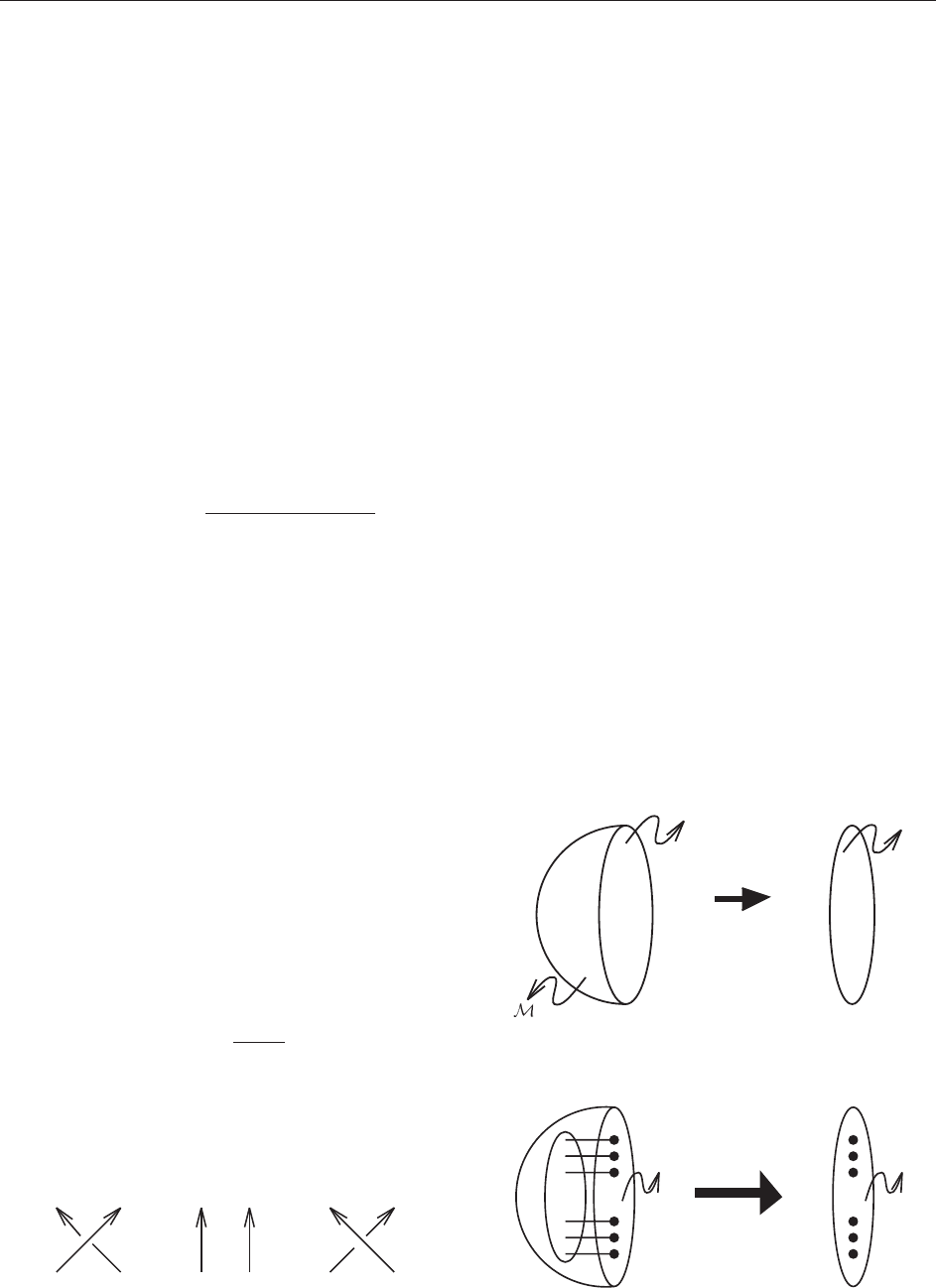
a recursion relation involving three link diagrams
which are identical except for one cross ing where
they differ as over crossing (L
þ
), under crossing
(L
), and no crossing (L
0
) as shown in the Figure 1.
The expectation values of these links are related
as (Witten 1989):
q
N=2
V
N
½L
þ
q
N=2
V
N
½L
¼ q
1=2
q
1=2
V
N
½L
0
½10
where
q ¼ exp
2i
k þ N
This is precisely the well-known skein relation for
the HOMFLY polynomial. The famous Jones one-
variable polynomial (whose two-variable
generalization is the HOMFLY polynomial) corre-
sponds to the case of spin-1/2 representation of
SU(2) CS theory: V
2
[L] = Jones polynomial [L], up
to an overall normalization. These skein relations
are sufficient to recursively find all the expectation
values of links with only fundamental representation
on the components. To obtain invariants for any
other representation, more general methods have to
be developed. A complete and explicit solution of
the CS field theory is thus obtained. One such
method has been reviewed in Kaul (1999). The
method makes use of the following important
statement:
Proposition: CS theory on a 3-manifold M
with boundary is described by a WZNW
(Wess–Zumino–Novikov–Witten) conformal field
theory (CFT) on the boundary (Figure 2).
Using the same identification, functional average
for Wilson lines ending at n points on the boundary
is obtained from WZNW field theory on the
boundary with n punctures carrying repre sentations
R
i
(Figure 3):
We can represent CS functional integral as a
vector (Witten 1989) in the Hilbert space H
associated with the n-point vacuum expectation
values of primary fields in WZNW conformal field
theory on the boundary . Next, to obtain a
complete and explicit nonperturbative solution of
the CS theory, the theory of knots and links and
their connection to braids is invoked.
L
+
L
0
L
–
Figure 1 Skein related links.
Σ
Σ
CS
W
Z
W
N
Figure 2 Relation of CS to CFT.
Σ
Σ
Figure 3 CS functional integrals with Wilson lines and CFT on
punctured boundary.
Schwarz-Type Topological Quantum Field Theory 497
Knots/Links and Braids
Braids have an intimate connection with knots and
links which can be summarized as follows:
1. An n-braid is a collection of nonintersecting
strands connecting n points on a horizontal rod
to n points on another horizontal rod below
strictly excluding any backward traversing of the
strands. A general braid can be written as a word
in terms of elementary braid generators.
2. We associate representations R
i
of the group with
the strands as their colors. We also put an
orientation on each strand. When all the repre-
sentations are identical and also all strands are
unoriented, we get ordinary braids, otherwise we
get colored oriented braids.
3. The colored oriented braids form a groupoid
where product of the different braids is obtained
by joining them with both colors and orientations
matching on the joined strands. Unoriented
monochromatic braids form a grou p.
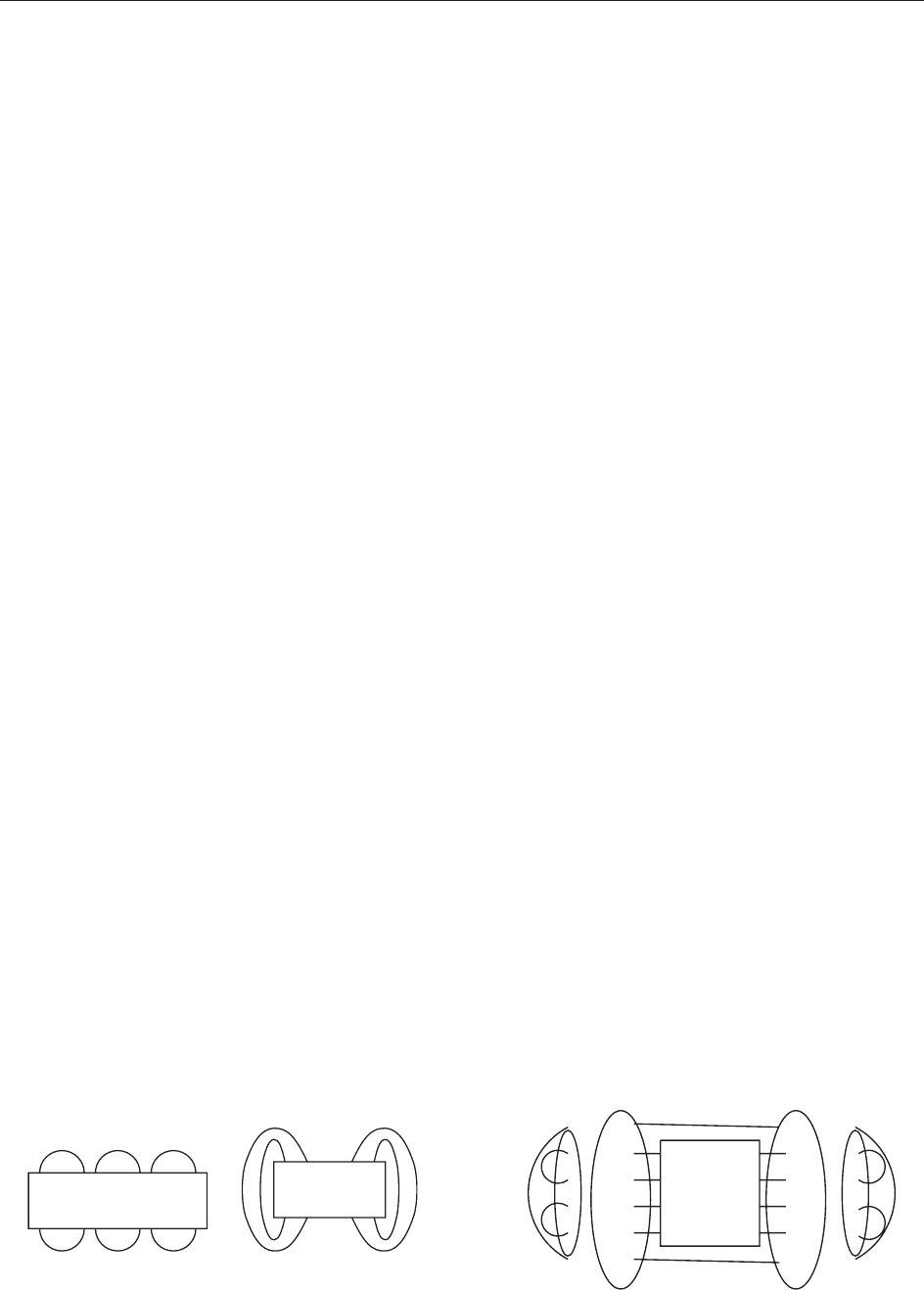
4. A knot/link can be formed from a given braid by
a process called platting. We connect adjacent
strands namely the (2i þ 1)th strand to 2ith
strand carrying the same color and opposite
orientations in both the rods of an even-strand
braid (Figure 4a).
There is a theorem due to Birman which states
that all colored oriented knots/links can be
obtained through platting. This construction is
not unique.
5. There is another construction associated with
braids which relates them to knots and links. We
obtain a closure of a braid by connecting the ends
of the first, second, third, ... strands from above
to those of the respe ctive first, second, third, ...
strands from below as shown in the Figure 4b.
There is theorem due to Alexander which states
that any knot or link can be obtained as a closure
of a braid, though again not uniquely.
Link Invariants
This connection of braids to knots and links can be
used to construct link invariants, say in S
3
.Todoso,
two nonintersecting 3-balls are removed from the
3-manifold S
3
to obtain a manifold with two S
2
boundaries. Then we arrange 2n Wilson lines of, say
SU(N) CS theory, as a 2n-strand oriented braid
carrying representations R
i
in this manifold. The CS
functional integral over this manifold is a state in
the tensor product of the Hilbert spaces H
1
H
2
associated with conformal field theory on the two
boundaries. These boundaries have 2n punctures
carrying the set of representations {R
i
} and {R
0
i
},
respectively, the two sets being permutations of each
other. This state can be expanded in terms of some
convenient basis given by the conformal blocks for
the 2n -point correlation functions of SU(N)
k
WZNW conformal field theory. The duality of
these correlation functions represents the transfor-
mation between different bases for the Hilbert
space. Their monodromy properties allow us to
write down representations of the braid generators.
Since an arbitrary braid is just a word in terms of
these generators, this construction provides us a
matrix representation B({R
i
}, {R
0
j
}) for the colored
oriented braid in the manifold with two S
2
bound-
aries. Then we plat this braid by gluing two balls B
1
and B
2
with Wilson lines as shown in Figure 5.
Each of the two caps again represent s a state
j ({R
j
})i in the Hilbert space associated with the
conformal field theory on punctured boundary (S
2
).
Platting of the braid then simply is the matrix
element of braid representation B({R
i
}, {R
0
j
}) with
respect to these states j ({R
i
})i and j ({R
0
j
})i corre-
sponding to two caps B
1
, B
2
. Thus, for a link in S
3
the invariant is given by the following theorem:
Theorem The vacuum expectation value of Wilson
loop operator of a link L constructed from platting
of a colored oriented 2n braid with representation
B({R
i
}, {R
0
j
}) is given by (Kaul 1999):
V½L¼h ðfR
i
gÞjBðfR
i
g; fR
0
j
gÞj ðfR
0
j
gÞi ½11
This theorem can be used to calculate the
invariant for any arbitrary link. For an unknot U
(a) (b)
Figure 4 (a) Platting and (b) closure of braids.
B({R
i
}, {R
i
})
′
B
1
B
2
ψ({R
j
})〉
′
〈ψ({R
j
})
⏐⏐
Figure 5 Construction of the link invariant.
498 Schwarz-Type Topological Quantum Field Theory

carrying an N-dimensional representation in an
SU(N) CS theory, the knot invariant is:
V
N
½U¼½N; where ½N¼
q
N=2
q
N=2
q
1=2
q
1=2
Wilson link expectation values calculated this way
depend on the regularization, that is, the definition
of framing used in defining coincident loop correla-
tors. One such regularization usually used is the
standard framing, where the frame for every knot is
so chosen that its self-linking number is zero.
The procedure outlined here has been used for
explicit computations of knot/link invariants. This
has led to answers to several questions of knot
theory. One such question relates to distinguishing
chirality of knots (Kaul 1999). In this context, newer
invariants constructed with arbitrary representations
living on the knots are more powerful than the older
polynomial invariants. For example, invariants with
spin-3/2 representation in an SU(2) CS theory are
sensitive to chirality of many knots which otherwise
is not detected by Jones, HOMFLY, and Kauffman
polynomials. However, invariants obtained from CS
theories do not distinguish all chiral knots. There is
a class of links known as ‘‘mutants’’ which are not
distinguished by CS link invariants (Kaul 1999). A
mutant link is obtained by removing a portion of
weaving pattern in a link and then gluing it back
after rotating it about any one of three orthogonal
axes by an amount .
The CS invariants of knots and links can also be
used to constru ct special 3-manifold invariants.
Hence, CS theory provides an important tool to
study these.
Manifold Invariants from CS Theory
Different 3-manifolds can be constructed through a
procedure called ‘‘surgery of framed knots and
links’’ in S
3
(Lickorish–Wallace theorem). This
construction is not unique. That is, there are many
framed knots and link s which give the same
manifold. However , rules of this equivalence are
known: these are called ‘‘Kirby moves.’’
Classification of 3-manifolds would involve find-
ing a method of associating a quantity with the
manifold obtained by surgery on the corresponding
framed knot/link on S
3
. If the Kirby moves on the
framed knot/link leave this quantity unchanged,
then it is a 3-manifold invariant. Knot/link invar-
iants of nonabelian CS theories provide a method of
finding such 3-manifold invariants. Equivalently,
this procedure gives an algebraic meaning to the
surgery construction of 3-manifolds. Detai ls of this
method for generating manifold invariants are given
in Kaul (1999) and Kaul and Ramadevi (2001).
Surgery of Framed Knots/Links and Kirby Moves
As discussed earlier, fram e of a knot K is an
associated closed curve K
f
going along the length
of the knot wrapping around it certain number of
times. Self-linking number (also called framing
number) is equal to the linking number of the knot
with its frame. There are several ways of fixing this
framing. The ‘‘standard’’ framing is one in which the
frame number of the knot, that is, the linking
number of the knot and its frame is zero. On the
other hand, ‘‘vertical’’ framing is obtained by
choosing the frame vertically above the knot
projected on to a plane. In such a frame, the framing
number of a knot is the same as its crossing number.
In constructing the 3-manifold invariants from CS
theories, we need vertical framing. The framing
number may be deno ted by writing the integer by
the side of knot. We denote a framed r-component
link by [L, f ] where framing f = (n(1), n(2), ..., n(r))
is a set of integers denoting the framing number of
component knots K
1
, K
2
, ..., K
r
in the link L.
According to the Lickorish–Wallace theorem,
surgery over links with vertical framing in S
3
yields
all the 3-manifolds. This surgery is performed in the
following way.
Take a framed r-component link [L, f ]inS
3
.
Thicken the component knots K
1
, K
2
, ..., K
r
such
that the solid tubes N
1
, N
2
, ..., N
r
so obtained are
nonintersecting. Then the compliment S
3
(N
1
þ N
2
þþN
r
) will have r toral boundaries.
On the ith toral boundary, we imagine an
appropriate curve winding n(i) times around the
meridian and once along the longitude. Perform a
modular transformation so that this curve bounds
a disk. This construction is done w ith each of the
toral boundaries. The tubes N
1
, N
2
, ..., N
r
are
thengluedbackintotherespectivegaps.This
surgery thus yields a new 3-manifold. This
construction is not unique. The rules of equiva-
lence for surgery on framed knots/links in S
3
are
two independent Kirby moves.
Kirby move I Take an arbitrary r-component
framed link [L, f ]inS
3
and consider a curve C
with framing number þ1 going around the unlinked
strands of L as in Figure 6a. We refer to this (r þ 1)-
component link as H[X], where X represents a
weaving pattern of the strands. Kirby move I
consists of twisting the disk enclosed by C in the
clockwise direction from below by an amount 2.
This twisting thereby introduces new crossings
Schwarz-Type Topological Quantum Field Theory 499
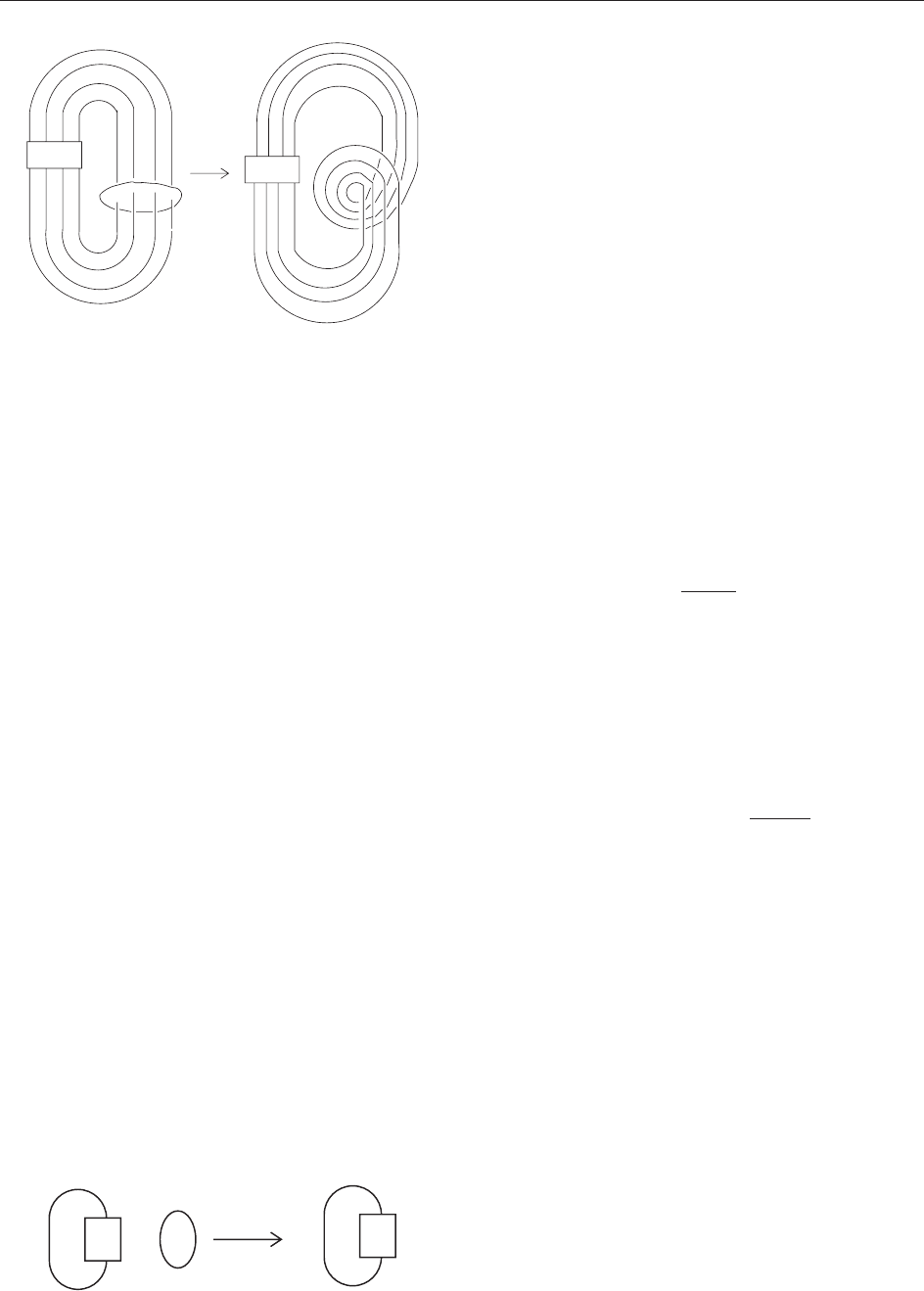
between the curve C and the strands enclosed by it.
Then the curve C is removed giving us a new
r-component link U[X]ofFigure 6b. Framing
numbers n
0
(i) of the component knots in link U[X]
are related to the framing number n(i) of framed link
[L, f ]asn
0
(i) = n(i) (L(K
i
, C))
2
, where L(K
i
, C)is
the linking number of knot K
i
and closed curve C.
The surgery of the framed links in Figures 6a and 6b
will give the same 3-manifold.
Inverse Kirby move I involves removal of a curve
C with framing number 1 (instead of þ1) after
making one complete anticlockwise twist from
below on the disk enclosed by C. In the process the
unlinked strands get twisted in the anticlockwise
direction leading to changed framing number s
n
0
(i) = n(i) þ (L(K
i
, C))
2
of the component knots K
i
.
Kirby move II This move consists of removing a
disjoint unknot C with framing 1 from framed link
[L, f ] without changing the rest of the link as in
Figure 7. Surgery of the two links in Figure 7 will
give the same manifold.
Inverse Kirby move II involves removal of a
disjoint unknot with framing þ1 (instead of 1)
from a framed link.
3-Manifold Invariants
Now a 3-manifold invariant can be constructed by
an appropriate combination of the invariants of
framed links in such a way that this algebraic
expression is unchanged under the Kirby moves. We
need for this purpose invariants for links in S
3
with
vertical framing.
Let M be the manifold obtained from surgery
of an r-component framed link [L, f ]inS
3
. Then
a manifold invariant
^
F
(G)
[M] is given as a linear
combination of the framed link invariants V
(G)
R
1
,..., R
r
[L, f ], with representations R
1
, R
2
, ..., R
r
living on
component knots, obtained from CS theory based
on a compact semisimple group G:
^
F
ðGÞ
½M ¼
½L;f
X
R
1
;... R
r
Y
r
i¼1
R
i
!
V
ðGÞ
R
1
;R
2
;...; R
r
½L; f ½12
Here [L, f ] is the signature of the linking matrix
and
R
i
= S
0R
i
, = e
ic=4
, where c is the central
charge of the associated WZNW conformal field
theory and S
0R
i
denotes the matrix element of the
modular matrix S. General S-matrix elements for
any compact group are given by
S
R
1
R
2
¼ðiÞ
ðdrÞ=2
jL
!
=Lj
1=2
ðk þC
v
Þ
1=2
X
!2W
ð!Þexp
2i
k þC
v
ð!ð
R
1
þÞ;
R
2
þÞ
where W denotes the Weyl group and its elements !
are words constructed using the generator s
i
–that
is, ! =
Q
i
s
i
and (!) = (1)
‘(!)
with ‘(!)aslengthof
the word. Here
R
i
’s denotes the highest weights of
the representations R
i
’s and is the Weyl vector. The
action of the Weyl generator s
on a weight
R
is
s
ð
R
Þ¼
R
2
ð
R
;Þ
ð; Þ
and j L
!
=Lj is the ratio of weight and coroot lattices
(equal to the determinant of the Cartan matrix for
simply laced algebras). Also C
v
is quadratic Casimir
invariant for the adjoint representation.
It is important to stress that the expression
^
F
(G)
[M] is unchanged under both Kirby moves I
and II (for detailed proof, see Kaul (1999) and Kaul
and Ramadevi (2001)). Notice that for every
compact gauge group, we have a new 3-manifold
invariant.
Few examples of 3-manifolds Table 1 lists the
algebraic expressions of this invariant calculated
explicitly from the formula in eqn [12] for a few
3-manifolds. All these examples can be constructed
by surgery on an unknot U(f ) with differe nt frame
numbers f.
In Table 1 L[p, q] stands for Lens spaces of the
type (p, q) and C
R
is the quadratic Casimir invariant
X
+1
C
n(i )
X
n ′(i )
H [X ] U [X ]
(b)(a)
Figure 6 Kirby move I.
Z
Z
C
–1
Figure 7 Kirby move II.
500 Schwarz-Type Topological Quantum Field Theory
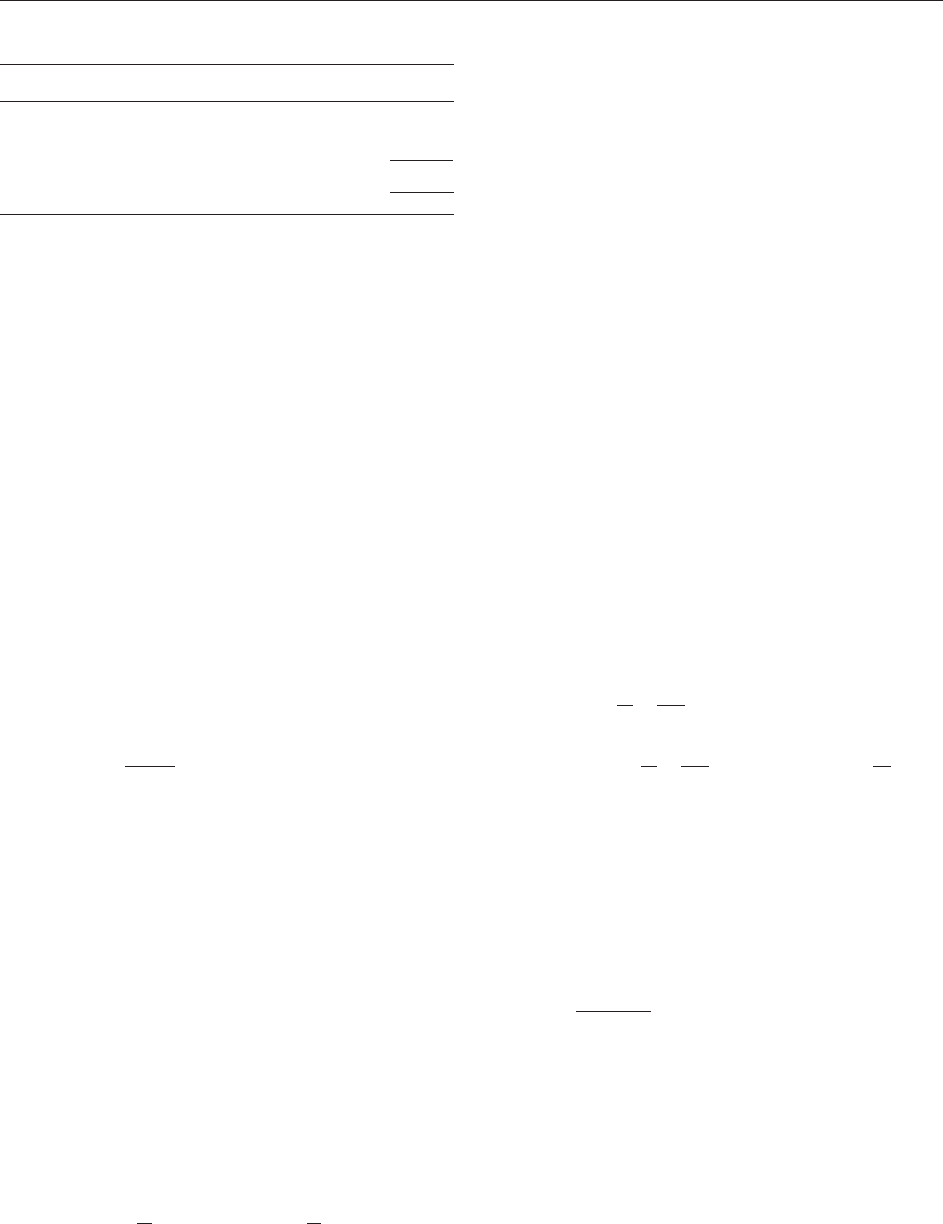
for representation R of the Lie algebra of the gauge
group G.
Partition function of a CS theory on M is also an
invariant characterizing the 3-manifold. This has
been calculated for several manifolds by differe nt
methods. Invariant
^
F
(G)
[M] listed above for various
manifolds is related to the CS partition function
Z
(G)
[M]:
^
F
(G)
[M] = S
1
00
Z
(G)
[M]. So the method of
constructing 3-manifold invariants above can also
be used to calculate the partition function of CS
theories.
3D Gravity and CS Theory
Three-dimensional CS theory also provides a
description of gravity. The 3D gravity including
cosmological constant has been first discussed by
Deser and Jackiw (1984). The action with cosmolo-
gical constant =1=‘
2
is:
S ¼
1
16G
Z
M
d
3
x
ffiffiffiffiffiffiffi
g
p
R 2ðÞ½13
G is the Newton’s constant, g
is the metric on the
3-manifold M, and R is scalar curvature. Solutions
of Einstein equations of motion have a consta nt
positive (negative) curvature if is positive (nega-
tive). It is also well known that there are no
dynamical degrees of freedom for gravity in dimen-
sions D 3; it is indeed described by topological
field theories. The gravity action above can be
rewritten as a CS gauge theory in first-order
formulation (Carlip 2003). For triads e
a
and spin
connection !
a
of Euclidean gravi ty, we define
1-forms e = e
a
T
a
dx
, ! = !
a
T
a
dx
, which have
values in the Lie algebra of SU(2) whose generators
are T
a
= i
a
=2 with
a
as three Pauli matrices.
In terms of these we define two gauge field 1-forms
A and
A as:
A ¼
ie
‘
þ !
;
A ¼
ie
‘
!
Then the Euclidean gravity action can be written
in terms of two CS actions, S
CS
[A] and S
CS
[
A], as
S ¼ kS
CS
½AkS
CS
½
A½14
where the coupling constant k = ‘=(4G) for negative
cosmological constant =1=‘
2
. The gauge group
for this theory is SL(2, C). Infinitesimal diffeo-
morphisms are described by field-dependent gauge
transformations. The corresponding gauge group for
Minkowski gravity with negative cosmological con-
stant is SO(2, R) SO(2, R). For positive , one
gets SO(3, 1) and SO(4) for Minkowski and Euclidean
metrics, respectively. For =0, we have ISO(2, 1)
(ISO(3)) as the gauge group for Minkowski
(Euclidean) gravity. Hence, the sign of cosmological
constant determines the gauge group of the CS
theory.
Identification of 3D gravity with CS theory can be
used with some advantag e to find the partition
function for a black hole in 3D gravity with negative
cosmological constant. This in turn yields an
expression for entropy of the black hole.
BTZ Black Hole and Its Partition Function
Only for neg ative we have a black hole solution of
the Einstein’s equations. This solution, known as the
BTZ black hole (Carlip 2003), in Euclidean gravity
is given by the metric
ds
2
E
¼M þ
r
2
l
2
J
2
4r
2
d
2
þM þ
r
2
l
2
J
2
4r
2
1
dr
2
þ r
2
d
J
2r
d
2
It is specified by two parameters M and J (the mass
and angular momentum). By a coordinate transfor-
mation, this metric can be rewritten as ds
2
E
=
(l
2
=z
2
)(dx
2
þ dy
2
þ dz
2
), with z > 0. This is the 3D
upper-half hyperbolic space and can be rewritten
using spherical polar coordinates as
ds
2
E
¼
l
2
R
2
sin
2
dR
2
þ R
2
d
2
þ R
2
sin
2
d
2
We have the identifications (R, , ) (R exp {2r
þ
=l},
þ {2r
=l}, ) where r
þ
and r
are the outer and
inner horizon radii, respectively. It is clear from this
identification that topologically the metric corre-
sponds to a solid torus. Functional integral over
this manifold represents a state in the Hilbert space
specified by the mass and angular momentum. It is
the microcanonical ensemble partition function and
its logarithm is the entropy of the black hole.
To evaluate this partition function, the connection
1-form is kept at a constant value on the toroidal
boundary through a gauge transformation. We
Table 1 Invariants for some simple manifolds
U(f ) M
^
F
(G)
[M]
U(0) S
2
S
1
1=S
00
U(1) S
3
1
U(þ2) RP
3
1
P
R
S
0R
q
2C
R
S
0R
S
00
U(þp) L[p,1]
1
P
R
S
0R
q
pC
R
S
0R
S
00
Schwarz-Type Topological Quantum Field Theory 501