
Francoise J.-P., Naber G.L., Tsun T.S. (editors) Encyclopedia of Mathematical Physics
Подождите немного. Документ загружается.


define local coordinates on the torus boundary
z = x þ y such that
R
a
dz = 1,
R
b
dz = , where
a (b ) stands for the contractible (noncontractible)
cycle of solid torus and =
1
þ i
2
is the modular
parameter of the boundary torus. Then connection
describing the black hole is
A ¼
i
~
u
2
dz þ
i u
2
dz
T
3
½15
where u and
~
u are canonically conjugate with
commutation relation: [
~
u, u] = (2=)
2
(k þ 2)
1
.
These are related to black hole parameters
through holonomies of gauge field A around the
a- and b-cycles (for a classical black hole solution
=2):
u ¼
i
2
i þ
2ðr
þ
þ ijr
jÞ
l
~
u ¼
i
2
i þ
2ðr
þ
þ ijr
jÞ
l
For a fixed value of connection, namely u, the
functional integral is described by a state
0
with no
Wilson line in the bulk. The states with Wilson line
carrying spin j=2 are give n by Labastida and
Ramallo:
j
ðu;Þ¼exp
k
4
2
u
2
j
ðu;Þ
where the Weyl–Kac characters for affine su(2)
j
ðu;Þ¼
ðkþ2Þ
jþ1
ðu;Þ
ðkþ2Þ
j1
ðu;Þ
2
1
ðu;Þ
2
1
ðu;Þ
and functions are defined by
k
ðu;Þ¼
X
n2Z
exp 2iknþ
2k
2
þ n þ
2k
u
Given the collection of states
j
, we write the
partition function by choosi ng an appropriate
ensemble for fixed mass and angular momentum.
This black hole partition function is:
Z
BH
¼
Z
dð; Þ
X
k
j¼0
ð
j
ð0;ÞÞ
j
ðu;Þ
2
where modular invariant measure is d(, ) =
d d=
2
2
. This integral can be worked out for large
black hole mass and zero angular momentum in
saddle-point approximation. The computation yields
(Govindarajan et al. 2001):
Z
BH
¼
l
2
r
2
þ
ffiffiffiffiffiffiffiffiffiffiffiffi
8r
þ
G
l
2
r
exp
2r
þ
4G
þ ½16
This gives not only the leading Bekenstein–Hawking
behavior of the black hole entropy S but also a
subleading logarithmic term:
S ¼ ln Z
BH
¼
2r
þ
4G
3
2
ln
2r
þ
4G
þ
This is an interesting application of CS theory to
3D gravity. In fact, three-dimensional CS theory also
has applications in the study of black holes in four-
dimensional gravity: the boundary degrees of free-
dom of a black hole in 4D are also described by an
SU(2) CS theory. This allows a calculation of the
degrees of freedom of, for example, Schwarzschild
black hole. For large area black holes, this in turn
results in an expression for the entropy which, besides
a Bekenstein–Hawking area term, has a logarithmic
area correction with same coefficient 3=2 as above.
This suggests a universal, dimension-independent,
nature of the these logarithmic corrections.
See also: BF Theories; The Jones Polynomial; Knot
Theory and Physics; Large-N and Topological Strings;
Quantum 3-Manifold Invariants; Topological Quantum
Field Theory: Overview.
Further Reading
Alexandrov M, Konstsevich M, Schwarz A, and Zaboronsky O
(1997) The geometry of the master equations and topological
quantum field theory. International Journal of Modern
Physics A 12: 1405–1430.
Atiyah M (1989) The Geometry and Physics of Knots.
Cambridge: Cambridge University Press.
Carlip S (2003) Quantum Gravity in 2 þ 1 Dimensions,
Cambridge Monographs on Mathematical Physics,
Cambridge: Cambridge University Press.
Deser S and Jackiw R (1984) Three-dimensional cosmological
gravity: dynamics of constant curvature. Annals of Physics
153: 405–416.
Deser S, Jackiw R, and Templeton S (1982a) Three-dimensional
massive gauge theory. Physical Review Letters 48: 975–978.
Deser S, Jackiw R, and Templeton S (1982b) Topological massive
gauge theories. Annals of Physics NY 140: 372–411.
Govindarajan TR, Kaul RK, and Suneeta V (2001) Logarithmic
correction to the Bekenstein–Hawking entropy of the BTZ
black hole. Classical and Quantum Gravity 18: 2877–2886.
Kaul RK (1999) Chern–Simons theory, knot invariants, vertex
models and three-manifold invariants. In: Kaul RK, Maharana J,
Mukhi S, and Kalyana Rama S (eds.) Frontiers of Field Theory,
Quantum Gravity and Strings, Horizons in World Physics,
vol. 227, pp. 45–63. New York: NOVA Science Publishers.
502 Schwarz-Type Topological Quantum Field Theory

Kaul RK and Ramadevi P (2001) Three-manifold invariants from
Chern–Simons field theory with arbitrary semi-simple gauge
groups. Communications in Mathematical Physics 217:
295–314.
Schwarz AS (1978) The partition function of degenerate quadratic
functional and Ray–Singer invariants. Letters in Mathematical
Physics 2: 247–252.
Schwarz AS (1979) The partition function of a degenerate
functional. Communications in Mathematical Physics 67:
1–16.
Schwarz AS (1987) New Topological Invariants in the Theory of
Quantized Fields. Abstracts in the Proceedings of International
Topological Conference, Baku, Part II.
Witten E (1988) Topological quantum field theory. Communica-
tions in Mathematical Physics 117: 353–386.
Witten E (1989) Quantum field theory and the Jones polynomial.
Communications in Mathematical Physics 121: 351–399.
Witten E (1995) Chern–Simons gauge theory as a string theory.
Progress in Mathematics 133: 637–678.
Seiberg–Witten Theory
Siye Wu, University of Colorado, Boulder, CO, USA
ª 2006 Elsevier Ltd. All rights reserved.
Introduction
Gauge theory is the cornerstone of the standard
model of elementary particles. The original motiva-
tion for studying supersymmetric gauge theories was
phenomenological (such as the hierarchy problem).
They display a large number of interesting phenom-
ena and become the models for the dynamics of
strongly coupled field theories. They also offer
valuable insights to nonsupersymmetric models. In
N = 1 gauge theory, the low-energy effective super-
potential is holomorphic both in the superfields and
in the coupling constants. This powerful holomor-
phy principle, together with symmetry and various
limits, often determines the effective superpotential
completely. Such theories often have quantum
moduli spaces where the classical singularities are
smoothed out, continuous interpolation between
Higgs and confinement phases, massless composite
mesons and baryons, and dual theori es weakly
coupled at low energy. For N = 2 pure gauge theory,
the low-energy effective theory is an abelian gauge
theory in which both the kinetic term and the
coupling constant are determined by a holomorphic
prepotential. The electric–magnetic duality is in the
ambiguity of the low-energy description. Much
physical information, such as the coupling constant,
the Ka¨ hler metric on the quantum moduli, the
monodromy around the singularities, can be incor-
porated in a family of elliptic curves. This low-
energy exact solution is also useful to topological
field theory that can be obtained from the N = 2
theory by twisting. Much of the above was the work
of Seiberg and Witten in the mid-1990s. In this
article, we review some of the fascinating aspects of
N = 1 and N = 2 supersymmetric gauge theories.
N = 1 Gauge Theory and Seiberg Dualities
N = 1 Yang–Mills Theory and QCD
Let G be a compact Lie group and let P be a principal
G-bundle over the Minkowski space R
3, 1
. In pure
gauge theory, the dynamical variable is a connection A
in P; two connections are equivalent if they are related
by a gauge transformation. Let F 2
2
(R
3, 1
,adP)be
the curvature of A. It decomposes into the self-dual and
anti-self-dual parts, that is, F = F
þ
þ F
,where
F
= (1=2)(F
ffiffiffiffiffiffi
1
p
F). With a suitably normalized
nondegenerate bilinear form h,i on the Lie algebra g,
the classical action is
S
YM
½A¼
Z
R
3;1
1
2g
2
hF ^Fiþ
16
2
hF ^ Fi
¼
Z
R
3;1
8
hF
þ
^ F
þ
i
8
hF
^ F
i
Here g > 0 is the coupling constant and 2 R, the
angle, and
¼
2
þ
4
ffiffiffiffiffiffiffi
1
p
g
2
is a complex number in the upper-half plane that
incorporates both. Classically, the theory is con-
formally invariant and the dynamics is independent
of the -term. At the quantum level, (mod2)
appears in the path integral and parametrizes
inequivalent vacua. The coupling constant runs as
energy varies, satisfying the renormalization group
equation
dg
d
¼
b
0
ð4Þ
2
g
3
þoð g
5
Þ
where the right-hand side is called the -function
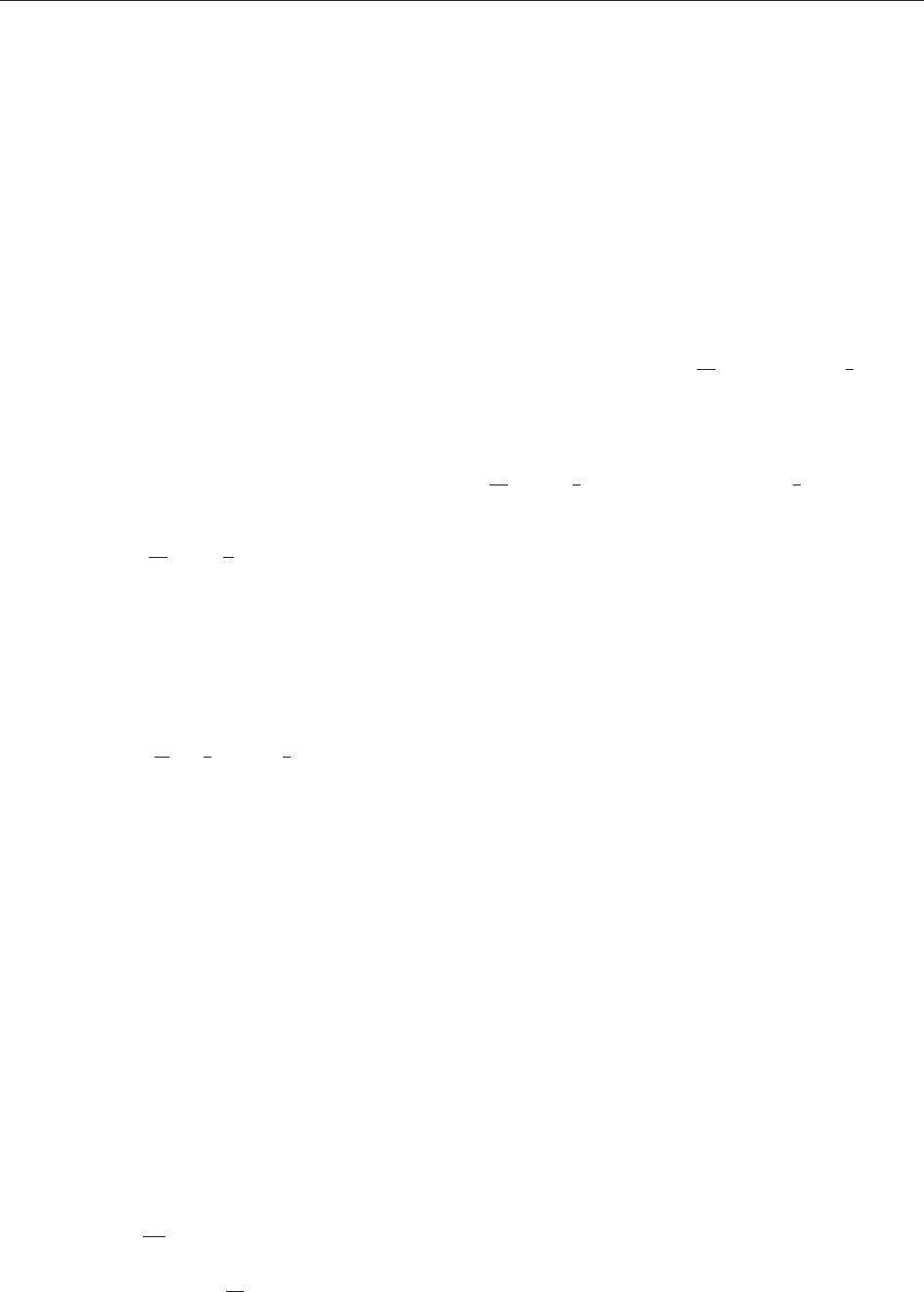
(g). This introduces, when b
0
6¼ 0, a mass scale
given by
ð=Þ
b
0
¼e
8
2
=gðÞ
2
Seiberg–Witten Theory 503
up to one-loop. Consequently, the classical scale
invariance is lost. It is convenient to redefine as a
complex quantity such that
ð=Þ
b
0
¼e
2
ffiffiffiffiffi
1
p
ðÞ
For pure gauge theory, b
0
= (11=3)
h, where
h is the
dual Coxeter number of g. At high energy ( !1),
the coupling becomes weak (g !0); this is known as
asymptotic freedom. On the contrary, the interac-
tion becomes strong at low energy. It is believe d that
the theory exhibits confinement and has a mass gap.
QCD, or quantum chromodynamics, is gauge
theory coupled to matter fields. Suppose the boson
and the fermion are in the (complex) representa-
tions R
b
and R
f
of G, respectively. That is, 2
(P
G
R
b
), or is a section of the bundle P
G
R
b
,
and 2 (S (P
G
R
f
)), where S is the spinor
bundle over R
3, 1
. The classical action is
S
QCD
½A;; ¼S
YM
½A
þ
1
g
2
Z
d
4
x
1
2
jrj
2
þ
ffiffiffiffiffiffiffi
1
p
ð ;r= Þþ
where r is the covariant derivative, r= is the Dirac
operator coupled to A, and we have omitted possible
mass and potential terms. The quantum theory
depends sensitively on the representations R
b
and
R
f
. In the -function, we have
b
0
¼
11
3
h
1
6
ðR
b
Þ
2
3
ðR
f
Þ
where (R ) is the Dynkin index of a representation
R.Ifb
0
< 0, the theory is free in the infr ared but
strongly interacting in the ultraviolet. If b
0
> 0, the
converse is true; in particular, the theory exhibits
asymptotic freedom. If b
0
= 0, the situation depends
on the sign of the two or higher-loop contributions.
Pure N = 1 supersymmetric gauge theory is one on
the superspace R
3, 1j(2, 2)
with a constraint that the
curvature vanishes in the odd directions. The
dynamical variables are in the superfield strength
W,a1j(1, 0)-form valued in ad P. In components,
the theory is gauge field coupled to a Majorana or
Weyl fermion in the adjoint representation. Let S
be spinor bundles of positive (negative) chiralities,
respectively, and let be a section of S
þ
adP. The
action, written both in sup erspace and in ordinary
spacetime, is
S
N¼1
SYM
½A;¼
1
4
Im
Z
d
4
x d
2
hW; Wi
¼ S
YM
½Aþ
1
g
2
Z
d
4
x
ffiffiffiffiffiffiffi
1
p
h
; r=
þ
i
Since b
0
= 3
h, the theory is asymptotically free but
strongly coupled at low energy. Classically, the
theory has a U(1)
R
chiral symmetry. However, due
to anomal y, only the subgroup Z
2
h
survives at the
quantum level. Instanton effect yields gaugino
condensation hi
3
. The symmetry is thus
further broken to Z
2
, resulting
h inequivalent vacua.
The N = 1 QCD has additional chiral superfields
in a representation R, including the bosons 2
(P
G
R) and the fermions 2 ( S
þ
(P
G
R)).
In the absence of superpotential, the action is
S
N¼1
SQCD
½A;;; ¼ S
N ¼1
SYM
½A;
þ
1
g
2
Z
d
4
x d
2
d
2
1
2
jj
2
In components, the second term is
1
g
2
Z
d
4
x
1
2
jrj
2
þ
ffiffiffiffiffiffiffi
1
p
ð ; r=
þ
Þ
1
2
jDj
2
þ
where D : R !g
is the moment map of the
Hamiltonian G-action on R, and we have omitted
other terms containing fermionic fields. The
moduli space of classical vacua is the symplectic
quotient D
1
(0)=G = R== G.Itisthesameasthe
Ka¨hler quotient R
s
=G
C
, where the stable subset
R
s
= { 2 RjG
C
\ D
1
(0) 6¼;} is open and dense in
R. Again, the quantum theory depends on the
representation R.Sinceb
0
= 3
h (1=2)(R ), the theory
is asymptotically free, infrared free, scale invariant (to
one-loop) when (R) < 6
h, (R) > 6
h, (R) = 6
h,
respectively. The moduli space may be lifted by a
superpotential or modified by other quantum effects.
SU(N
c
) Theories at Low Energy
We now consider N = 1 QCD with G = SU(N
c
); N
c
is the num ber of colors. The matter field con sists of
N
f
copies of quarks Q
i
(1 i N
f
) in the funda-
mental representation of SU(N
c
)andN
f
copies of
antiquarks Q
0
i
0
(1 i
0
N
f
) in the conjugate repre-
sentation. Using the isomorphism of su(N
c
) with its
dual, the moment map is
DðQ; Q
0
Þ¼traceless part of
ffiffiffiffiffiffiffi
1
p
ðQQ
y
Q
0
Q
0y
Þ
So (Q, Q
0
) 2 D
1
(0) if and only if QQ
y
Q
0y
= cI
N
c
for some c 2 R.IfN
f
< N
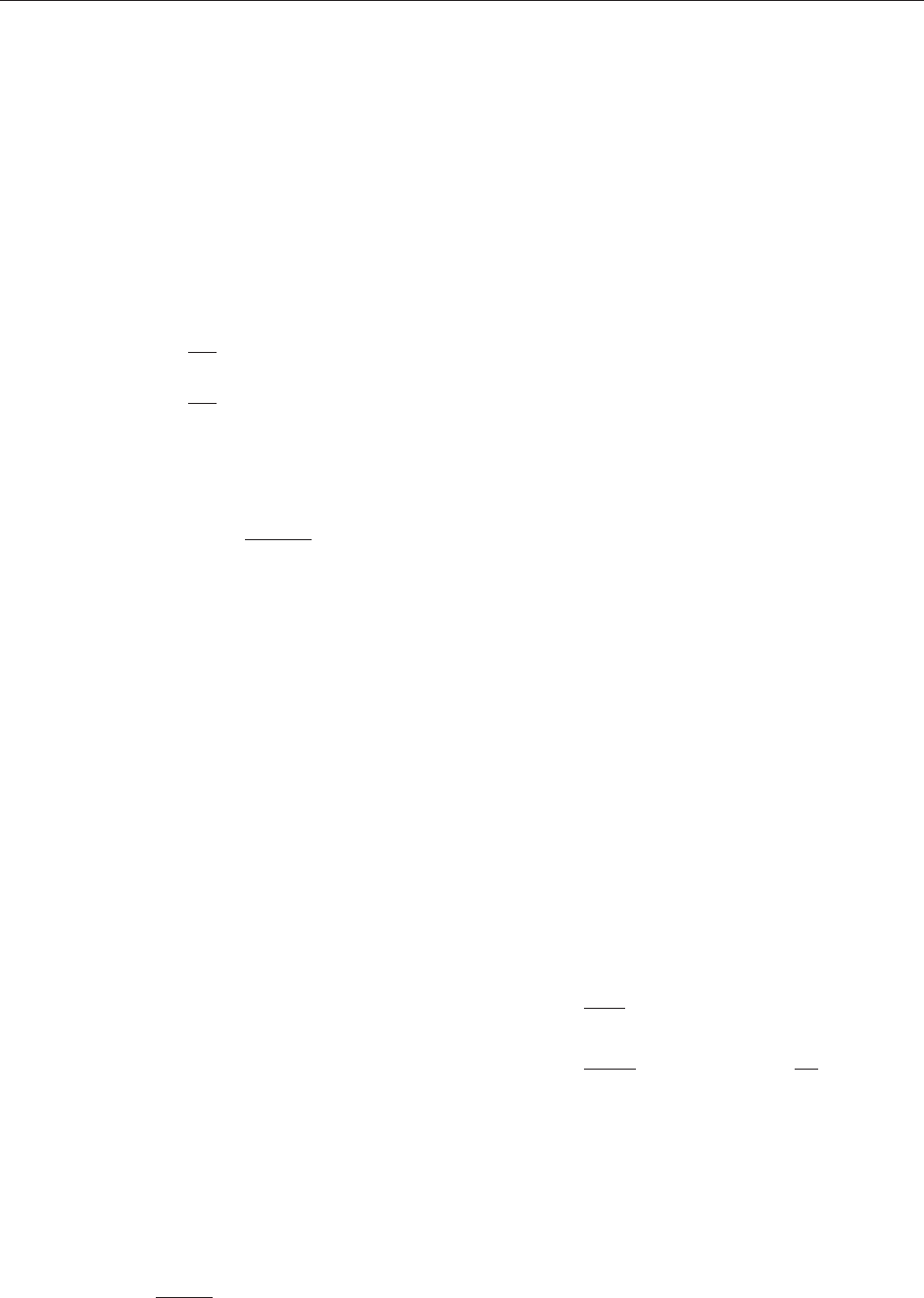
c
, then c = 0 and
Q; Q
0
a
1
.
.
.
a
N
f
0
B
B
@
1
C
C
A
504 Seiberg–Witten Theory
for some a
k
0. Generically, these a
k
> 0 and the
gauge group SU(N
c
) is broken to SU(N
c
N
f
). If
N
f
N
c
, then
Q
a
1
.
.
.
a
N
c
0
B
@
1
C
A
; Q
0
a
0
1
.
.
.
a
0
N
c
0
B
@
1
C
A
where a
k
, a
0
k
0 satisfy a
2
k
a
0
k
2
= c for some c 2 R.
The gauge group is completely broken. The low-
energy superfields are the mesons M
i
i
0
= Q
i
Q
0
i
0
and, if
N
f
N
c
, the baryons
B
i
N
c
þ1
i
N
f
¼
1
N
c
!
i
1
i
N
f
Q
i
1
Q
i
N
c
B
0
i
0
N
cþ1
...i
0
N
f
¼
1
N
c
!
i
0
1
i
0
N
f
Q
0
i
0
1
Q
0
i
0
N
c
When N
f
< N
c
, Affleck et al. (1984) found a
dynamically generated superpotential
W
eff
ð
^
MÞ¼ðN
c
N
f
Þ
3N
c
N
f
det M
1=ðN
c
N
f
Þ
generated by instanton effect when N
f
= N
c
1andby
gaugino condensation in the unbroken SU(N
c
N
f
)
theory when N
f
< N
c
1. It is also the unique super-
potential (up to a multiplicative constant) that is
consistent with the global and supersymmetry. The
potential pushes the vacuum to infinity. Therefore,
contrary to the classical picture, theories with N
f
< N
c
do not have a vacuum at the quantum level.
When N
f
3N
c
, the theory is not strongly inter-
acting at low energy, and perturbation methods are
reliable. (When N
f
= 3N
c
, the two-loop contribution
to the -function is ne gative.) We now look at the
range N
c
N
f
< 3N
c
. The cases N
f
= N
c
, N
c
þ 1
and N
c
þ 2 N
f
< 3N
c
were studied in Seiberg
(1994) and Seiberg (1995), respectively.
When N
f
= N
c
, the classical moduli space is
det M = BB
0
. The quantum theory at low energy
consists of the fields M, B, B
0
satisfying the
constraint det M BB
0
=
2N
c
. The quantum moduli
space is smooth everywhere, and there are no
additional massless particles. So the gluons are
heavy throughout the moduli space. This is due to
confinement near the origin, where the interaction is
strong, and due to the Higgs mechanism far out in
the flat direction, where the classical picture is a
good approximation. We see a smooth transition
between these two effects.
When N
f
= N
c
þ 1, there is a dynamically gener-
ated superpotential
W
eff
¼
1
2N
c
1
ðB
0
MB det MÞ
The stationary points of W
eff
are at BB
0
^
N
c
M = 0,
BM = 0, MB
0
= 0; these are precisely the constraints
that the classical configuration satisfies. However,
the moduli space is interpreted differently: it is
embedded into a larger space, and the constraints
are satisfied only at stationary points. At the
singularity hMi= 0, the whole global symmetry
group is unbroken, and B, B
0
are the new massless
fields resolving the singularity. So we have a
continuous transition between confinement (without
chiral symmetry breaking) and the Higgs mechanism
in the semiclassical regime.
When N
c
þ 2 N
f
(3=2)N
c
, the original theory,
called the electric theory, is still strongly coupled in
the infrared. Seibe rg (1995) proposed that there is a
dual, magnetic theory, which is infrared free. The
two theories are different classically, but are
equivalent at the qua ntum level. The dual theory
is an N = 1SU(
~
N
c
) gauge theory with
~
N
c
= N
f
N
c
,
coupled to dual quarks
~
Q
i
,
~
Q
0i
0
, where 1 i; i
0
N
f
are flavor indices. In addition, the mesons M
i
i
0
become fundamental fields. They are not coupled to
the SU(
~
N
c
) gauge field but interact with the dual
quarks through the superpotential
W ¼
1
M
i
i
0
~
Q
i
~
Q
0i
0
Thetwotheorieshavethesameglobalsymmetry
and the same gauge-invariant operators. The dual
quarks are fundamental i n the magnetic theory but
are solitonic excitations in the electric theory. At
high energy, the electric theory is asymptotically
free, while the m agnetic theory is strongly coupled.
At low energies, the converse is true. Therefore,
reliable perturbative calculations can be performed
by choosing an appropriate weakly coupled
theory.
When (3=2)N
c
< N
f
< 3N
c
, the theory has a
nontrivial infrared fixed point. This is because up
to two-loop,
ðgÞ¼
g
3
16
2
ð3N
c
N
f
Þ
þ
g
5
128
4
2N
c
N
f
3N
2
c
N
f
N
c
þ oðg
7
Þ
There is a solution g
> 0to(g) = 0. We have
(g) < 0 when 0 <g<g
, (g) > 0 when g>g
.In
the infrared limit, the coupling constant flows to
g = g
, where we have a nontrivial, interacting
superconformal theory in four dimensions. The
conformal dimension becomes anomalous and is
equal to 3/2 of the charge of the chiral U(1)
R
; for
example, that of the meson
1
M is 3(N
f
N
c
)=N
f
> 1 in this range.
Seiberg–Witten Theory 505
Other Classical Gauge Groups
We now consider N = 1 supersymmetric gauge
theory and QCD with gauge groups Sp(N
c
) and
SO(N
c
). The Sp(N
c
) theories, studied by Intriligator
and Pouliot (1995), are the simplest examples of
the N = 1 theories. We take 2N
f
chiral superfields
Q
i
(i = 1, ...,2N
f
) in the fundamental representation
C
2N
c
ffi H
N
c
of Sp(N
c
). The number of copies must
be even so that the quantum theory is free from
global gauge anomaly. The gauge-invariant quanti-
ties are the mesons M
ij
= Q
a
i
Q
b
j
!
ab
, where ! is
the symplectic form on C
2N
c
, subject to a constraint
1,...,2N
c
þ2
M
1, 2
M
2N
c
þ1, 2N
c
þ2
= 0. Using the
decomposition u (2N
c
) = sp(N
c
)
ffiffiffiffiffiffi
1
p
{H-self-adjoint
matrices}, the moment map D(Q) is the projection of
ffiffiffiffiffiffi
1
p
QQ
y
on sp (N
c
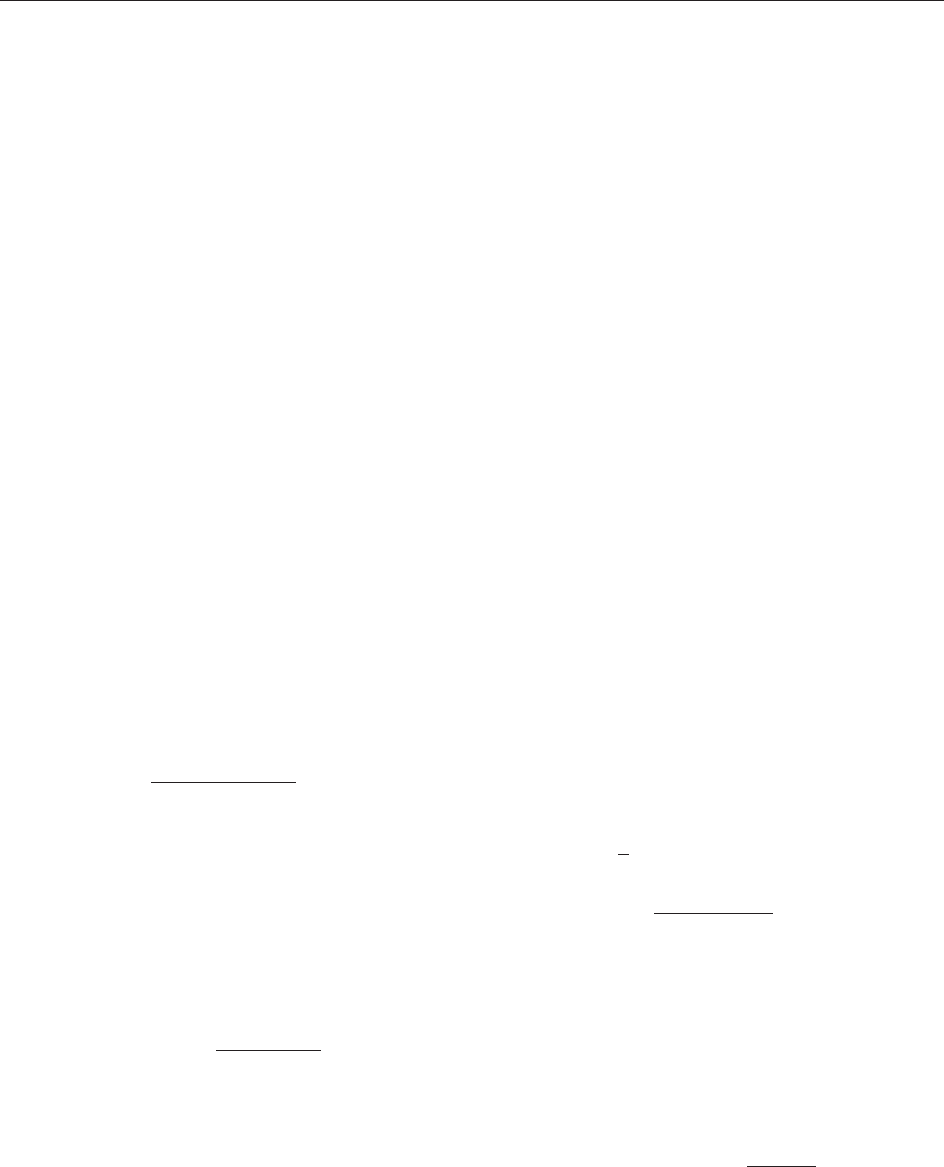
). So D(Q) = 0 implies
Q
a
1
.
.
.
a
minfN
c
;N
f
g
0
B
@
1
C
A
10
01
where a
k
0. At a generic point of the classical
moduli space, the gauge group is broken to Sp(N
c
N
f
)ifN
c
> N
f
; it is completely broken if N
c
N
f
.
Since b
0
= 3(N
c
þ 1) N
f
, the quantum theory is
infrared free if N
f
3(N
c
þ 1). (When b
0
= 0, the
two-loop -function is negative.) When N
f
N
c
,
there is a dynamically generated superpotential
W
eff
¼ðN
c
þ 1 N
f
Þ
2
N
c
1
3ðN
c
þ1ÞN
f
Pf M
1=ðN
c
þ1N
f
Þ
pushing the vacuum to infinity.
When N
f
= N
c
, the classical moduli space PfM = 0
has singularities. The quantum moduli space is
Pf M = 2
N
c
1
2(N
c
þ1)
. The singularity is smoothed
out and there are no light fields other than the
mesons M. When N
f
= N
c
þ 1, all components of M
become dynamical in the low-energy theory, and
there is a superpotential
W
eff
¼
Pf M
2
N
c
1
2N
c
þ1
At the most singular point hMi= 0, the global
symmetry is unbroken, and all the light fields in M
become massless. In both cases, there is a transition
between confinement and Higgs mechanism.
When N
c
þ 3 N
f
(3=2)(N
c
þ 1), there is a
dual, magnetic theory which is free in the infrared.
The dual theory has 2N
f
quarks
~
Q
i
in the funda-
mental representation of Sp(
~
N
c
), where
~
N
c
= N
f
N
c
2. In addition, the mesons M
ij
become elemen-
tary and couple to
~
Q through a superpotential
W = (2)
1
M
ij
~
Q
ia
~
Q
jb
˜
!
ab
, where
˜
! is the symplectic
form on C
2
~
N
c
.When(3=2)(N
c
þ 1) < N
f
< 3(N
c
þ 1),
the theory flows to an interacting superconformal field
theory in the infrared.
Theories with the SO(N
c
) gauge group were
studied by Seiberg (1995) and by Intriligator and
Seiberg (1995). Since the fundamental representa-
tion is real, there is no constraint on the number N
f
of quarks Q
i
(1 i N
f
). The gauge invariants are
the mesons M
ij
= Q
i
a
Q
j
b
ab
and, if N
f
N
c
, the
baryons B
i
N
c
þ1
i
N
f
=
i
1
i
N
f
Q
i
1
Q
i
N
c
=N
c
! They
satisfy rank M N
c
and BB = ^
N
c
M.Usingthe
decomposition u (N
c
) = so(N
c
)
ffiffiffiffiffiffi
1
p
{R-self-adjoint
matrices}, the moment map D(Q) is the projection
ffiffiffiffiffiffi
1
p
QQ
y
on so(N
c
). If D(Q) = 0, then up to gauge
and global symmetries, Q is of the form
Q
a
1
.
.
.
a
r
0
B
B
B
@
1
C
C
C
A
where a
1
, ..., a
r
> 0ifr = rank Q N
c
and
a
1
, ..., a
N
c
1
> 0 and a
N
c
6¼ 0ifr = N
c
. Generically,
the gauge group is broken to SO(N
c
N
f
)ifN
c
N
f
þ 2 and is totally broken if N
c
< N
f
þ 2.
We have b
0
= 3(N
c
2) N
f
if N
c
5. For
N
c
= 4, the group is (SU(2) SU(2))=Z
2
and
b
0
= 6 N
f
for each SU(2) factor. If N
c
= 3, the
group is SU(2)=Z
2
b
0
= 6 2N
f
. The theory is
asymptotically free if N
f
> 3(N
c
2) and infrared
free if N
f
3(N
c
2).
When N
f
N
c
5, there is a dynamically gener-
ated superpotential
W
eff
¼
1
2
ðN
c
2 N
f
Þ
16
3ðN
c
2ÞN
f
det M
1=ðN
c
2N
f
Þ
lifting the classical vacuum degeneracy. The coeffi-
cient is fixed by mass deformation and by matching
the SU(4) theory when N
c
= 6.
When N
f
= N
c
4, the unbroken gauge group is
SO(4) = (SU(2) SU(2))=Z
2
on the generic point of
the moduli space. The superpotential of the original
theory is
W
eff
¼ 2ð
þ
þ
Þ
2ðN
c
1Þ
det M
1=2
where the choices
þ
,
= 1 correspond to the fact
that each of the SU(2) theory has two vacua. There
are two physically inequivalent branches:
þ
=
and
þ
=
.For
þ
=
, the superpotential pushes
the vacuum to infinity. For
þ
=
,W
eff
= 0. In the
quantum theory, the singularity is smoothed out and
506 Seiberg–Witten Theory

all the massless fermions are in M, even at the origin
of the moduli space. Hence the quarks are confined.
When N
f
= N
c
3, the unbroken gauge group is
SO(3) and the theory has two branches with
W
eff
¼ 4ð1 þ Þ
2N
c
3
det M
where = 1. For = 1, the quantum theory has no
vacuum. For = 1, W
eff
= 0, but there are addi-
tional light fields
~
Q
i
coupling to M via the super-
potential W (2)
1
M
ij
~
Q
i
~
Q
j
near M = 0.
When N
f
= N
c
2, the low-energy theory is related
to the N = 2 gauge theory and will be addressed in the
subsection ‘‘Seiberg–Witten’s low-energy solution.’’
When N
f
N
c
1, we define a dual, magnetic
theory whose gauge group is SO(
~
N
c
), where
~
N
c
= N
f
N
c
þ 4. There are N
f
dual quarks
~
Q
i
(1
i N
f
) in the fundamental representation. This
theory is infrared free if N
f
(3=2)(N
c
2). In the
effective theory , the mesons M
ij
become fundamen-
tal and couple with the dual quarks through a
superpotential W = (2)
1
M
ij
~
Q
i
~
Q
j
if N
f
N
c
; there
is an additional term det M=64
2N
c
5
if N
f
= N
c
1.
When (3=2)(N
c
2) < N
f
< 3(N
c
2), the theory
flows to an interacting superconformal field theory in
the infrared.
N = 2 Gauge Theory and Seiberg–Witten
Duality
N = 2 Yang–Mills Theory
Pure N = 2 supersymmetric gauge theory is a special
case of N = 1 QCD when R = g
C
is the (complex-
ified) adjoint representation of G. The moment map
is D() = (1=2
ffiffiffiffiffiffi
1
p
)[,
] 2 g ffi g
( 2 g). Since the
fermionic fields and are sections of the same
bundle, there is a second set of supersymmetry
transformations by interchanging the roles of and
. This makes the theory N = 2 supersymmetric.
The classical action is
S
N¼2
SYM
½A;; ;¼S
YM
½A
þ
1
g
2
Z
d
4
x
ffiffiffiffiffiffiffi
1
p
ðh
; r=i
þh
; r= iÞ þ
1
2
jrj
2
þ
ffiffiffiffiffiffiffi
1
p
ðh
; ½ ; i þ h; ½
;
iÞ
1
8
j½;
j
2
The energy reaches the minimum when takes a
constant value 2 g
C
that can be conjugated by G
to the Cartan subalgebra t
C
.(t is the Lie algebra of
the maximal torus T.) The classical moduli space is
g
C
=G
C
= t
C
=W, where W is the Weyl group. At a
generic 2 t
C
, the gauge group is broken to T by
the Higgs mecha nism. Classically, the massless
degrees of freedom are excitations of and
components of the gauge field in t. So the low-
energy physics can be described by these massless
fields. However, the moduli space is singul ar when
is on the walls of the Weyl chambe rs. At these
values, the unbroken gauge group is larger and there
are extra massless fields that resolve the
singularities.
Since b
0
= 2
h > 0, the quantum theory is asymp-
totically free but strongly interacting at low energy.
It can be shown that N = 1 supersymmetry already
forbids a dynamically generated superpotential on
t
C
=W. Therefore, the vacuum degeneracy is not
lifted and the quantum moduli sp ace is still a
continuum. However, there are corrections to the
part of classical moduli space where strong interac-
tions occur. The quantum theory has a dynamically
generated mass scale . We pick the renormalization
scale to be jj, the typical energy scale where
spontaneous symmetry breaking occurs. Far away
from the origin, that is, when jjjj, the theory is
weakly interacting and the classical description of
the moduli space is a good approximation. How-
ever, when jj is comparable to jj, the classical
language and perturbation methods fail due to
strong interaction. At = 0, the full gauge symmetry
is restored classically. But since the theory becomes
strongly interacting at low energy, it cannot be the
low-energy solution of the original theory.
The classical U(1)
R
symmetry extends to U(2)
R
,
mixing and . The U(1)
R
subgroup in U(2)
R
is
anomalous except for a subgroup Z
4
h
.Sowehavea
global SU(2)
R
Z
2
Z
4
h
symmetry at the quantum
level. This is consistent with a continuous moduli
space of vacua, if the group SU(2)
R
is to act
nontrivially. Also, the space is not a single orbit of
the global symmetry group. The generator of Z
4
h
acts on t
C
by a phase e
ffiffiffiffi
1
p
=
h
. The group Z
4
h
is
spontaneously broken to the subgroup which
acts trivially on t
C
=W.
We study the general form of low-energy effective
Lagrangian that is consistent with N = 2 super-
symmetry. We assume that the quantum effect does
not modify the topology of the moduli space t
C
=W,
though it may alter the singularity and its nature.
Suppose U is the quantum moduli. At a generic
point in U, the residual gauge group is T. In the
N = 1 language, the theory is a supers ymmetric
gauged sigma model with target space U. It con tains
N = 1 vector multiplets W
I
and chiral multiplets
I
,
where 1 I r, r = dim T being the rank of G.
N = 1 supersymmetr y requires that U is Ka¨ hler, with
Seiberg–Witten Theory 507

possible singularities where the effective theory
breaks down. N = 2 supersymmetry requires further
that U is special Ka¨hler, that is, there is a flat,
torsion-free connection r on TU such that the
Ka¨ hler form ! is parallel and such that d
r
J = 0,
where the complex structure J is viewed as a 1-form
valued in TU. See, for example, Freed (1999).
Locally, there is a holomorphic prepotential F and
special coordinates {z
I
}. Let
~
z
I
= @F=@z
I
be the dual
coordinates and let
IJ
= @
2
F=@z
I
@z
J
= @
~
z
I
=@z
J
. Then
K = Im(
~
z
I
z
I
)isaKa¨hler potential and ! = (
ffiffiffiffiffiffi
1
p
=2)
Im(
IJ
)dz
I
^ d
z
J
is the Ka¨ hler form. The effective
action is
S
N¼2
eff
½W; ¼
1
4
Im
Z
d
4
x d
2
1
2
IJ
ðÞðW
I
; W
J
Þ
þ
Z
d
4
x d
2
d
2
KðÞ
Note that both the coupling constants
IJ
and the
metric Im
IJ
on U are determined by a holomorphic
function F, which is the hallmark of N = 2
supersymmetry.
In the bare theory with abelian gauge group T, the
action is given by choosing F
0
() = (1=2)
IJ
h
I
,
J
i,
where the
IJ
(and hence the metric Im
IJ
) are
constants. Due to one-loop and instanton effects,
F is no longer quadratic in the effective theory.
Since varies on U, it cannot be holomorphic
(except at a few singular points), single value d, and
having a positive-definite imaginary part. The
solution to this apparent contradiction is that each
set of special coordi nates and the expression of F is
valid only in part of U . Solving the N = 2 gauge
theory at low energy means understanding the
singularity of U in the strong coupling regime and
obtaining the explicit form of F or
IJ
in various
regions of the moduli space.
Seiberg–Witten’s Low-Energy Solution
We consider N = 2 gauge theory with G = SU(2).
The Cartan subalgebra is t ffi C; each a 2 C deter-
mines an element = (1=2)
a 0
0 a
in t. The Weyl
group W ffi Z
2
acts on C by a 7!a. The moduli
space of classical vacua is the u-plane C=Z
2
parametrized by u = tr
2
= (1=2)a
2
. When u 6¼ 0,
the gauge group is broken to U(1). The generator
of Z
4
h
= Z
8
U(1)
R
acts as a 7!
ffiffiffiffiffiffi
1
p
a, u 7!u.
The Z
8
symmetry is broken to Z
4
; the quotient
Z
2
= Z
8
=Z
4
acts on the u-plane by u 7!u.
Abelian gauge theory and N = 4 supersymmetric
gauge theory exhibit exact electric–magnetic duality
in the sense that the quantum theories are identical
if the coupling constant undergoes an SL(2, Z)
transformation. Seiberg and Witten (1994a, b)
proposed that this is so for the low-energy effective
theory of the N = 2 gauge theory. An SL(2, Z)
transformation maps one description of the low-
energy theory to another, exchanging electricity and
magnetism. It is however not an exact duality of the
full SU(2) theory. Rather, duality is in the ambiguity
of the choice of the low-energy description. More
precisely, is a section of a flat SL(2, Z) bundle over
U. Thus, is multivalued and exists as a function in
local charts only. So we must use different Lagran-
gians in different regions of the u-plane. Around the
singularities where is not defined, nontrivial
monodromy can appear.
Away from infinity, the electric theory is strongly
interacting but the magnetic theory is infrared free.
The dual field is
~
a = dF(a)=da, and
eff
(u) = d
~
a=da.
The group SL(2, Z) is generated by
P ¼
10
0 1
; S ¼
01
10
T ¼
11
01
To see its action on
~
a
a
, we use the central
extension of the N = 2 super- Poincare´ algebra. In
the classical theory, the central charge is Z = (n
e
þ
n
m
)a from the boundary terms at infinity. As the
electric–magnetic duality transformation S inter-
changes n
e
and n
m
, we have for any 2 SL(2, Z),
:(n
m
, n
e
) 7!(n
m
, n
e
)
1
. When n
m
= 0, the classical
formula Z = n
e
a is valid. Invariance of Z under
SL(2, Z) requires that Z = n
m
~
a þ n
e
a at the quan-
tum level and that SL(2, Z )actson
~
a
a
homo-
geneously as a column vector.
When u = (1=2)a
2
is large, perturbation is reliable.
The classical and one-loop results are a(u)
ffiffiffiffiffiffi
2u
p
,
~
a (
ffiffiffiffiffiffi
1
p
=)a log a
2
.Asu goes around infinity,
the fields transforms as a 7!a,
~
a 7!
~
a þ 2a. The
monodromy is M
1
= PT
2
. The mass M of a
monopole state is bounde d by M
2
= P
P
jZj
2
,
which is precisely the Bogomol’nyi bound. Now as a
consequence of the N = 2 supersymmetry, it rece ives
no quantum corrections as long as supersymmetry is
not broken at the quantum level. The states that
saturate the bound are the BPS states. The BPS
spectrum at u 2 U is a subset of H
1
(E
u
, Z) ffi Z
2
containing the pairs (n
m
, n
e
) realized by the dy on
charges. Near infinity, the condition is that either
n
e
= 1, n
m
= 0 (for W
particles) or n
m
= 1 (for
monopoles or dyons). This spectrum is invariant
under the monodromy M
1
.
The nontrivial holonomy at infinity implies the
existence of at least one singularity at a finite value
u = u
0
, where extra particles become massless.
Seiberg and Witten (1994a, b) propose that these
508 Seiberg–Witten Theory
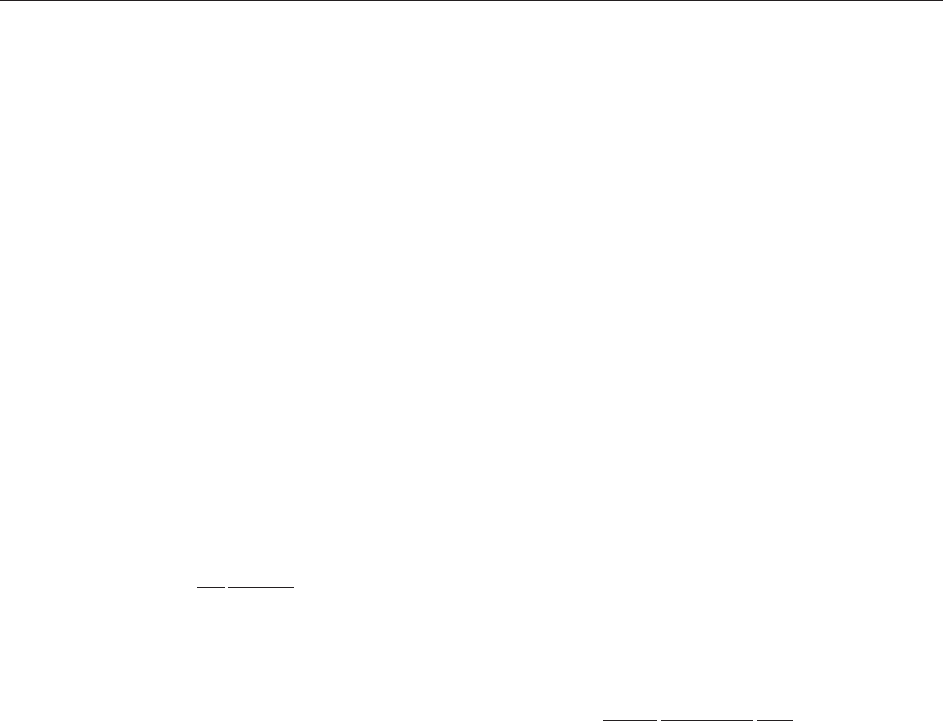
particles are collective excitations in the perturbative
regime. Suppose along a path connecting u
0
and
some base point near infinity, a monopole of charges
(1, n
e
) = (0, 1)(T
n
e
S
1
)
1
becomes massless at u
0
.
Then by the renormalization group analysis
and duality, the monodromy at u
0
is M
u
0
= (T
n
e
S
1
)
T
2
(T
n
e
S
1
)
1
. It turns out that there are two
singularities u =
2
with monodromies M
2
=
ST
2
S
1
and M
2
= (TS)T
2
(TS)
1
. The particles that
become massless at
2
are of charges (n
m
, n
e
) = (1, 0)
and (1, 1), respectively. The only BPS states in the
strong coupling regime are those which become
massless at the singularities; the others decay as u
deforms towards strong interaction.
The monodromies M
2
, M
1
(or any two of
them) generate the subgroup (2). The family of
elliptic curves with these monodromies can be
identified with y
2
= (x
2
)(x þ
2
)(x u) called
the Seiberg–Witten curve. The singularities are at
u =
2
and u = 1, where the curve degenerates.
Let
¼
ffiffiffi
2
p
2
ydx
x
2
4
be the Seiberg–Witten differential (of second kind on
the total space E). Then in a suitable basis (, )of
H
1
(E
u
=U, Z), we have a =
R
,
~
a =
R
.Ata
singularity, if = n
m
þ n
e
is a vanishing cycle,
then the dyon of charges (n
m
, n
e
) becomes massless.
This is because its central charge is Z = n
m
~
a þ
n
e
a =
R
. The monodromy at a singularity where
is a vanishing cycle is given by the Picard–Lefshetz
formula M: 7! 2( ).Atu =
2
, the van-
ishing cycles are and , respectively.
We return to the N = 1 SO(N
c
) gauge theory with
N
f
= N
c
2. At a generic point in the moduli space,
the gauge group is broken to SO(2), which is
abelian. Much of the above discussion applies to
this case. By N = 1 supersymmetry, the effective
coupling
eff
is holomorphic in M but is not single
valued. In fact,
eff
depends on u = det M, which is
invariant under the (anomaly free) SU(N
f
) symme-
try. For large u, we have e
2
ffiffiffiffi
1
p
eff
=
4N
c
8
=u
2
and
the monodromy around infinity is M
1
= PT
2
.
On the other hand, a large expectation value
of M of rank N
c
3 breaks the gauge group to
SO(3) and the theory is the N = 2 theory discussed
earlier. Using these facts, Intriligator and Seiberg
(1995) identified the family of elliptic curves as
y
2
= x(x 16
2N
c
4
)(x u). There are two singula-
rities with inequivalent physics. At u = 0, the mono-
dromy is ST
2
S
1
. A pair of monopoles
~
Q
becomes
massless. They couple with M through the super-
potential W (2)
1
M
ij
~
Q
i
~
Q
j
.Atu = 16
2N
c
4
,the
monodromy is (T
2
S)T
2
(T
2
S)
1
. A pair of dyons E
of
charges 1 become massless. The effective action is
W
eff
(u 16
2N
c
4
)E
þ
E
.
Topological gauge theory is a twisted version of
N = 2 Yang–Mills theory in which the observables
at high energy are the Donaldson invariants. The
work of Seiberg and Witten (1994a, b) yields new
insight to it and has a tremendous impact on the
geometry of 4-manifolds. See Witten (1994) for the
initial steps.
After the work of Seiberg and Witten (1994a, b),
there has been much progress on theories with other
gauge groups. If the gauge group is a compact Lie
group of rank r, the u-plane is replaced by t
C
=W;
the singularities are modified by quantum effects.
The duality group is Sp(2r, Z ) or its subgroup of
finite index, acting on the coupling matrix = (
IJ
)
by fractional linear transformations. For example, for
G = SU(N
c
), the moduli space is parametrized by
gauge invariants u
2
, ..., u
N
c
defined by det (xI ) =
x
N
c
P
N
c
i = 2
u
i
x
N
c
i
= P
N
c
(x, u
i
). Classically, the sin-
gular locus is a simple singularity of type A
N
c
1
.At
the quantum level, the singularity consists of two
copies of such locus shifted by
n
in the u
n
direction. The monodromies correspond to a family
of hyperelliptic curves y
2
= P
N
c
(x, u
i
)
2
2N
c
of
genus N
c
1. The Seiberg–Witten differential is
¼
ffiffiffi
2
p
ffiffiffiffiffiffiffi
1
p
@P
N
c
ðx; u
i
Þ
@x
x dx
y
þ @ðÞ
The N
c
1 independent eigenvalues a
i
of and
their duals
~
a
i
= @F=@a
i
are the periods of along
the 2N
c
2 homology cycles in the curve. For more
details, the reader is referred to Klemm et al. (1995)
and Argyes and Faraggi (1995).
N = 2 QCD
N = 2 supersymmetric QCD is N = 2 Yang–Mills
theory coupled to N = 2 matter. The latter consists
of N = 1 superfields Q that form a quarternionic
representation R of the gauge group G. The space R
has a G-invariant hyper-Ka¨ hler structure. The
hyper-Ka¨hler moment map
H
: R !g
Im H con-
sists of a real moment map
R
: R !g
for the
Ka¨ hler structure and a complex moment map
C
: R !(g
)
C
for the holomorphic symplectic
structure. As an N = 1 theory, the matter superfields
are valued in R g
C
with a D-term D( Q, ) =
R
(Q) þ (1=2
ffiffiffiffiffiffi
1
p
)[,
] and a superpotential
W(Q, ) =
ffiffiffi
2
p
h
C
(Q), iþm(Q), where the mass
term m is a G-invariant quadratic form on R. The
classical moduli space of vacua has two branches.
On the Coulomb branch where Q = 0and 6¼ 0,
the unbroken gauge group is abelian and the
Seiberg–Witten Theory 509

photons are massless. If Q 6¼ 0 exists in the flat
directions, the gauge group is broken according to
the value of Q; these are the Higgs branches. If
m = 0, the moduli space of classical vacua is the
hyper-Ka¨hler quotient
1
H
(0)=G. The branches of
two types touch at the origin, where the full gauge
group is restored, and at other subvarieties in R. The
global symmetry is the subgroup of U(R) that
commutes with the G-action on R and preserves
m; it contains U(2)
R
.
Quantum mechanically, such a theory is free
from local gauge anomalies. Consistency under large
gauge transformations puts a torsion condition on R,
such as (R) = 0(mod 2). Since b
0
= 2
h (1=2)(R ),
the theory is asymptotically free if (R) < 4
h.If
(R) = 4
h, the quantum theory is scale invariant up
to one-loop (and hence to all loops), and is expected
to be so nonperturbatively. If (R) > 4
h,thequan-
tum theory may not be defined but it can be the low-
energy solution of another asymptotically free theory.
Due to the axial anomaly, the U(2)
R
global symmetry
reduces to the subgroup SU(2)
R
Z
2
Z
4
h(R)
.The
metric on the Coulomb branch can be corrected by
quantum effects, but those on the Higgs branches do
not change because of the uniqueness of the hyper-
Ka¨hler metric. In the quantum theory, the Higgs
branches still touch the Coulomb branch, but the
photons of the Coulomb branch are the only massless
gauge bosons at the point where they meet.
When G = SU(N
c
) we take N
f
quarks
Q
i
(i = 1, ..., N
f
) in the fundamental representation
and N
f
antiquarks
~
Q
i
(i = 1, ..., N
f
) in the complex-
conjugate representation. The moment map is the
same as in N = 1 QCD whereas the superpotential
is W =
ffiffiffi
2
p
~
Q
i
Q
i
þ
P
i
m
i
~
Q
i
Q
i
. Consider the case
G = SU(2) as in Seiberg and Witten (1994b). Since
b
0
= 4 N
f
, the asymptotically free theories have
N
f
3 whereas the N
f
= 4 theory is scale invariant.
As the representations on Q
i
and
~
Q
i
are isomorphic ,
the classical global symmetry is O(2N
f
) U(2)
R
when all m
i
= 0. The appearance of the even number
of fundamental representations is necessary for the
consistency of the theory at the quantum level. The
U(1)
R
symmetry is anomalous if N
f
6¼ 4. When N
f
> 0,
SO(2N
f
) is anomaly free, whereas O(2N
f
)=SO(2N
f
) =
Z
2
is anomalous. The anomaly free subgroup of Z
2
U(1)
R
is Z
4(4N
f
)
.ItsZ
2
subgroup acts in the same way
as Z
2
Z(SO(2N
f
)). A nonzero expectation value of
u = tr
2
further breaks the symmetry to Z
4
.The
quotient group that acts effectively on the u-plane (the
Coulomb branch) is Z
4N
f
if N
f
> 0andZ
2
if N
f
= 0.
When N
f
= 4, the U(1)
R
symmetry is anomaly free but
Z
2
= O(8)=SO(8) is still anomalous.
The N
f
= 0 theory is the N = 2 pure gauge theory.
In order to compare it to the N
f
> 0 theories, we
multiply n
e
by 2 so that it has integer values on Q
i
and
~
Q
i
, and divide a by 2 to preserve the formula
Z = n
m
~
a þ n
e
a. The monodromies around the singu-
larities become M
2
= STS
1
, M
2
= (T
2
S)T(T
2
S)
1
,
M
1
= PT
4
. They generate the subgroup
0
(4) of
SL(2, Z). The coupling constant is
¼
þ
8
ffiffiffiffiffiffiffi
1
p
g
2
The Seiberg–Witten curve is y
2
= x
3
ux
2
þ
(1=4)
4
0
x, related to the earlier one y
2
= (x u)(x
2
4
0
) by an isogeny. Here and below,
N
f
is the
dynamically generated scal e.
For N
f
> 0, we consider the case with zero bare
masses. The simplest BPS-saturated states are the
elementary quarks with mass
ffiffiffi
2
p
jaj, which form
the vector representation of SO(2N
f
). In addition, the
quarks have fermion zero modes in the monopole
background. When n
m
= 1, each SU(2) doublet of
quarks has one zero mode. With N
f
hypermultiplet,
there are 2N
f
zero modes in the vector representation
of SO(2N
f
). Upon quantization, the quantum states
are in the spinor representation. So the flavor
symmetry is really Spin(2N
f
). The spectrum may
also include states with n
m
> 1. For N
f
= 2, 3, 4, the
center Z(Spin(2N
f
)) are Z
2
Z
2
, Z
4
, Z
2
Z
2
,
whose generators act on states of charges (n
m
, n
e
)
by ((1)
n
e
þn
m
,(1)
n
e
),
ffiffiffiffiffiffi
1
p
n
m
þ2n
e
,((1)
n
m
,(1)
n
e
),
respectively.
Suppose at a singularity on the u-plane, the low-
energy theory is QED with k hypermu ltiplets. Let m
i
be the bare mass and S
i
, the U(1) charge of the ith
hypermultiplet. With the expectation value of , the
actual masses are j
ffiffiffi
2
p
a þ m
i
j(1 i k). As the states
form a small representation of the N = 2 algebra, the
central charge is modified as Z = n
m
~
a þ n
e
a þ S
m=
ffiffiffi
2
p
, where m = (m
1
, ..., m
k
)andS = (S
1
, ..., S
k
).
Under a duality transformation M 2 SL(2, Z), the
column vector (m=
ffiffiffi
2
p
,
~
a, a) is multiplied by a matrix
of the form
^
M =
I
k
0
M
. (For example, if M = T,
^
M
can be derived by one-loop analysis.) So the row
vector W = (S, n
m
, n
e
) transforms as W 7!W
^
M
1
. The
transformation on ( n
m
, n
e
) is not homogeneous when
there are hypermultiplets. This phenomenon persists
even when all the bare masses m
i
are zero.
When N
f
= 1, the global symmetry of the u-plane
is Z
3
. There are three singularities related by this
symmetry, where monopoles with charges (n
m
, n
e
) =
(1, 0), (1, 1), and (1, 2) become massless. The low-
energy theory at each singularity is QED with a
single light hypermultiplet. Besides the photon, no
other flat directions exist. This is consistent with the
absence of Higgs branch in the original theory.
The monodromies at the singularities are STS
1
,
510 Seiberg–Witten Theory
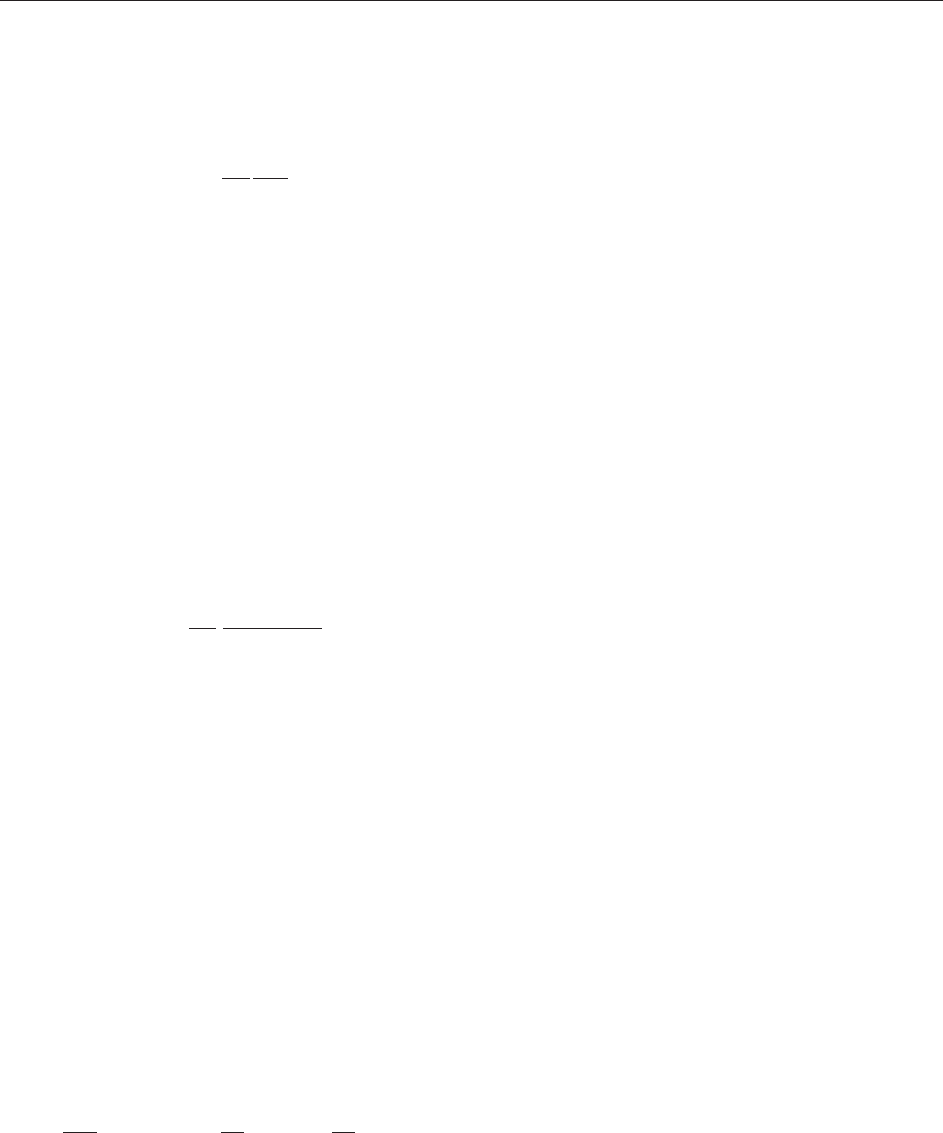
(TS)T(TS)
1
,(T
2
S)T(T
2
S)
1
, respectively, and the
corresponding Seiberg–Witten family of curves is
y
2
= x
2
(x u) (1=64)
6
1
. The Seiberg–Witten dif-
ferential is
¼
ffiffiffi
2
p
4
y dx
x
2
When N
f
= 2, there are two singularities related by
the global symmetry Z
2
of the u-plane. The massless
states at one singularity have (n
m
, n
e
) = (1, 0) and
form a spinor representation of SO(4) while those at
the other have (n
m
, n
e
) = (1, 1) and form the other
spinor representation. The low-energy theory at each
singularity is QED with two light hypermultiplets.
There are additional flat directions along which
SO(4) SU(2)
R
is broken. They form the two Higgs
branches that touch the u-plane at the two singula-
rities rather than at the origin. The metric and pattern
of symmetry breaking are the same as classically.
The monodromies are ST
2
S
1
,(TS)T
2
(TS)
1
.The
Seiberg–Witten curve is y
2
= (x
2
u) (1=64)
4
2
)
(x u) and the differential is
¼
ffiffiffi
2
p
4
y dx
x
2
4
2
=64
When N
f
= 3, the u-plane has no global symme-
try. There are two singularities. At one of them, a
single monop ole bound state with (n
m
, n
e
) = (2, 1)
becomes massless and there are no other light
particles. At the other singularity, the massless states
have (n
m
, n
e
) = (1, 0) and form a (four -dimensional)
spinor representation of SO(6) with a definite
chirality. Thus, the low-energy theory is QED with
four light hypermultiplets. Along the fla t directions,
the SO(6) SU(2)
R
symmetry is further broken.
This corresponds to a single Higgs branch touching
the u-plane at the singularity. Again, the metric on
the Higgs branch is not modified by quantum
effects. The monodromies at the two singularities
are (ST
2
S)T(ST
2
S)
1
and ST
4
S
1
, respectively. The
Seiberg–Witten curve is y
2
= x
2
(x u) (1=64)
2
3
(x u)
2
and the differential is
¼
ffiffiffi
2
p
3
log y þ
ffiffiffiffiffiffiffi
1
p
3
8
x u
32
2
3
x
2
dx
When N
f
= 4, the theory is characterized by
classical coupling constant , and there are no
corrections to a = (1=2)
ffiffiffiffiffiffi
2u
p
,
~
a = a. There is only
one singularity at u = 0, where the monodromy is P.
Seiberg and Witten (1994b) postulate that the full
quantum theory is SL(2, Z) invariant, just like the
N = 4 pure gauge theory. The elementary
hypermultiplet has (n
m
, n
e
) = (0, 1) and form the
vector representation v of SO(8). Fermion zero
modes give rise to hypermultiplets with
(n
m
, n
e
) = (1, 0), (1, 1) that transform under the spinor
representations s, c of Spin(8). SL(2, Z)actsonthe
spectrum via a homomorphism onto the outer-auto-
morphism group S
3
of Spin(8), which then permutes v,
s,andc. So duality is mixed in an interesting way with
the SO(8) triality. In v, s,andc, the center Z
2
Z
2
acts as ((1)
n
m
,(1)
n
e
) = (1, 1), (1, 1), (1, 1),
respectively. The full SL(2, Z) invariance predicts the
existence of multimonopole bound states: for every
pair of relatively prime integers (p, q), there are eight
states with (n
m
, n
e
) = (p, q) that form a representation
of Spin(8) on which the center acts as ((1)
p
,(1)
q
).
Solutions when the bare masses are nonzero are
also obtained by Seiberg and Witten (1994b). The
masses can be deformed to relate theories with
different values of N
f
. N = 2 QCD with a general
classical gauge group has also been studied. By
adding to these theories a mass term m tr
2
that explicitly breaks the supersymmetry to N = 1,
the dualities of Seiberg can be recovered. For
SU(N
c
), SO(N
c
) and Sp(2N
c
) gauge groups,
see Hanany and Oz (1995), Argyes et al. (1996),
Argyes et al. (1997) and references therein.
See also: Anomalies; Brane Construction of Gauge
Theories; Donaldson–Witten Theory; Duality in
Topological Quantum Field Theory; Effective Field
Theories; Electric–Magnetic Duality; Floer Homology;
Gauge Theories from Strings; Gauge Theory:
Mathematical Applications; Nonperturbative and
Topological Aspects of Gauge Theory; Quantum
Chromodynamics; Topological Quantum Field Theory:
Overview; Supersymmetric Particle Models.
Further Reading
Affleck I, Dine M, and Seiberg N (1984) Dynamical super-
symmetric breaking in supersymmetric QCD. Nuclear Physics
B 241: 493–534.
Argyes PC and Faraggi AE (1995) Vacuum structure and
spectrum of N = 2 supersymmetric SU(n) gauge theory.
Physical Review Letters 74: 3931–3934.
Argyes PC, Plesser MR, and Seiberg N (1996) The moduli space
of vacua of N = 2 SUSY QCD and duality in N = 1 SUSY
QCD. Nuclear Physics B 471: 159–194.
Argyes PC, Plesser MR, and Shapere AD (1997) N = 2 moduli
spaces and N = 1 dualities for SOðn
c
Þ and USpð2n
c
Þ super-
QCD. Nuclear Physics B 483: 172–186.
Freed DS (1999) Special Ka¨ hler manifolds. Communications in
Mathematical Physics 203: 31–52.
Hanany A and Oz Y (1995) On the quantum moduli space of
vacua of N = 2 supersymmetric SUðN
c
Þ gauge theories.
Nuclear Physics B 452: 283–312.
Klemm A, Lerche W, Yankielowicz S, and Theisen S (1995)
Simple singularities and N = 2 supersymmetric Yang–Mills
theory. Physics Letters B 344: 169–175.
Seiberg–Witten Theory 511