
Francoise J.-P., Naber G.L., Tsun T.S. (editors) Encyclopedia of Mathematical Physics
Подождите немного. Документ загружается.


(ii) The potential V satisfies the following system of
linear second-order PDEs
ð
i
j
Þ@
i
@
j
V =
ij
ð2 þ<ÞV ¼ 0
i; j ¼ 1; ...; n; i 6¼ j ½19
i
@
i
=
jk
V þ
j
@
j
=
ki
V þ
k
@
k
=
ij
V ¼ 0
all i; j; k different ½20
where =
ij
= q
i
@
j
q
j
@
i
, <=
P
n
r = 1
q
r
@
r
.
(iii) The Hamilton – Jacobi equation for H is separ-
able in the generalized elliptic coordinates [16]
with parameters
i
.
Remark 9 Equations [19]–[20] follow from the
compatibility conditions that mixed derivatives of
k
i
(q) calculated from the conditions {H, K
r
} = 0, are
equal. This leads to an overdetermined system [19]–[20]
of PDEs for V(q). Equations [19]–[20] are not linearly
independent but we keep both sets [19]–[20] in the
formulation of this theorem because eqns [19] give rise
to the basic Bertrand–Darboux equations [21] used in
the criterion of separability while eqns [20] give rise to
cyclic Bertrand–Darboux equations [22] used for testing
the level of spherical symmetry in the potential.
For testing elliptic separability of any given potential
V(q), it is necessary to introduce into eqns [19] and
[20] the freedom of choice of the Euclidean reference
frame (as described by the Euclidean transformation
e
q = A
t
(q b), A 2 SO(n), b 2 R
n
). By substituting it
into [19]–[20], omitting tildes and summing over one
of the indices, we obtain new equations
0 ¼
X
n
k¼1
q
i
q
k
þ
i
q
k
þ
k
q
i
þ
ik
ðÞ@
k
@
j
V
q
j
q
k
þ
j
q
k
þ
k
q
j
þ
jk
@
k
@
i
V
þ3 q
i
þ
i
ðÞ@
j
V q
j
þ
j
@
i
V
i; j ¼ 1; ...; n; i 6¼ j ½21
0 ¼
X
n
l¼1
il
q
j
jl
q
i
@
k
@
l
V þ
jl
q
k
kl
q
j
@
i
@
l
V
þ
kl
q
i
il
q
k
ðÞ@
j
@
l
V
½22
with the new coefficients ,
i
,
ij
that are uncon-
strained despite that the orthogonal matrix A
satisfies the quadratic algebrai c constraint AA
t
= I.
Theorem 8 provides the following test of elliptic
separability for a potential V(q) given in Cartesian
coordinates.
1. Insert V(q) into the Bertrand–Darboux equations
[21]. This gives a system of linear, homogeneous,
algebraic equations for the unknown parameters
,
i
,
ij
.If = 0, then V(q) is not separable in
elliptic coordinates.
2. If 6¼ 0, set b =
1
, S = bb
t
1
and
diagonalize S: S = A diag(
1
, ...,
n
)A
t
. If some
eigenvalues
i
coincide, then V(q) is not separ-
able in elliptic coordinates. Otherwise V(q)is
separable in the elliptic coordinates
x = (x
1
, ..., x
n
) given by
1 þ
X
n
i¼1
ð
e
q
i
Þ
2
ðz
i
Þ
Q
j
ðz x
j
Þ
Q
i
ðz
i
Þ
(compare with [16]), where q = A
e
q þ b, with b and
A found as above.
If = 0, 6¼ 0, then there exists a similar
algorithm for separability in generalized parabolic
coordinates and for = 0, = 0, 6¼ tI,we
have separability in Cartesian coordinates if all
i
are different. For giving an idea of what happens
when degenerations occur, consider the case
= 0, = 0. Then the Bertrand–Darboux equations
[21] are Euclidean equivalent to the canonical form
(
i
j
) @
i
@
j
V = 0 and if all
i
are different,
then equations @
i
@
j
V = 0 imply that V(q)isa
sum of functions of one variable only:
V(q) =
P
n
i = 1
V
i
(q
i
).
The main problem is to handle all possible
degenerations when certain ’s coincide. Let
1
= =
j
<
jþ1
< <
n
, where 1 < j < n.
Then V(q) = V
j
(q
1
, ..., q
j
) þ V
jþ1
(q
jþ1
) þþ
V
n
(q
n
) which means that variables q
jþ1
, ..., q
n
separate off while the potential V
j
(q
1
, ..., q
j
) has to
be tested again on R
j
with the use of eqns [21].
Degenerations for 6¼ 0or 6¼ 0 are more compli-
cated and the cyclic Bertrand–Darboux equations
[22] have to be used. They unfold the level of
spherical degeneracy of spheres and embedded sub-
spheres. A complete analysis of all possible degenera-
tions is technical. It requires considering of all possible
degenerations of the sequences
1
< <
n
and of
the related equations [21]–[22] for the potential V(q).
It has been proved by Waksjo¨and
Rauch-Wojciechowski (2003) that there is a one-to-
one correspondence between all possible sets of PDEs
[21]–[22] characterizing separable potentials and all
possible types of Riemannian metrics (in the Kalnins
and Miller (1986) classification of all separable
coordinates on R
n
and S
n
)sothatnocompletely
separable case is missed. The most important is that
after maximally n steps separation coordinates are
always determined (if they exist) by a sequential use of
the Bertrand–Darboux and cyclic Bertrand–Darboux
equations [21]–[22].
532 Separation of Variables for Differential Equations

Separation of Eigenvalues Problems
Eigenvalues problems (in a given domain D) of the
form
wðqÞþðqÞ wð qÞ¼0;>0 ½23
(where is the Laplace operator) arise when sepa-
rating the wave equation (q)u
tt
=u and the diffu-
sion equation (q)u
t
=u (Courant and Hilbert 1989).
The multiplicative ansatz u(q, t) = w(q)g(t)yields
eqn [23] together with
€
g = g or
_
g = g. The problem
[23] is also used for solving the inhomogeneous
equation u = f with the zero boundary condition
uj
@D
= 0. In general, the properties of the eigenvalues
i
and of the corresponding eigenfunctions w
i
of the
problem [23] depend on the regularity requirements for
w
i
and on the boundary conditions at @D.
For the zero boundary conditions w(q)j
@D
= 0, one
seeks a nontri vial (w 6¼ 0) solution having in the
region D continuous first- and second-order deriva-
tives. General theorems (Courant and Hilbert 1989)
state that for such problems there exists a growing
sequence {
i
}
n
i = 1
of positive eigenvalues
i
such that
i
!1 as i increases, and that there is a related
sequence of normalized eigenfunctions
ffiffiffi
p
w
1
,
ffiffiffi
p
w
2
, ... that form a complete weighted-orthogonal
(in the sense that
R
D
w
i
w
j
=
ij
, i, j = 1, 2, ...)system
of functions so that every regular initial function
(q)with(q)j
@D
= 0 may be expanded in terms of
the eigenfunctions w
m
in an absolutely and uni-
formly convergent series (q) =
P
1
m = 1
c
m
w
m
(q)with
c
m
=
R
D
w
m
. This makes it possible to express a
solution of the IBVP for the wave or for the diffusion
equation with zero boundary conditions:
ðqÞu
tt
¼ u respectively ðqÞu
t
¼ u
uðq; tÞj
@D
¼ 0; uðq; t ¼ 0Þ¼ðqÞ½24
as a convergent infinite series u(q, t) =
P
1
m = 1
c
m
w
m
(q)g
m
(t), where g
m
(t) satisfy
€
g = g
respectively
_
g = g. Further determination of proper-
ties of the eigenfunctions w
n
is possible only in
special domains D when the problem [23] can be
reduced to one-dimensional eigenvalue problems by
separating variables in some suitable coordinates.
Example 10 Consider the spherical domain
r
2
= x
2
þ y
2
þ z
2
1. Equation [23] with ¼ 1
attains in the spherical coordinates (r, ’, ) the form
w þ w
1
r
2
sin
@
r
ðr
2
sin @
r
wÞþ@
’
1
sin
@
’
w
þ @
ðsin @
wÞ
þ w ¼ 0
The ansatz w = f (r)Y(, ’) gives the separated
equation
r
2
f
0
0
þr
2
f
f
¼
1
Y sin
@
’
1
sin
@
’
Y
þ@
sin @
YðÞ
so that its both sides must be equal to a constant .
Continuity of Y implies that it has to be periodic in ’
(with period 2)andregularat = 0, = .Itcan
only be satisfied for = n(n þ 1). The left-hand side of
the above equation yields then (r
2
f ‘
0
)
0
n(n þ 1)f þ
r
2
f = 0. Solutions that are regular at r = 0arethe
Bessel functions (1=
ffiffi
r
p
)J
nþ(1=2)
(
ffiffiffi
p
r). The equation for
spherical harmonics
1
Y sin
@
’
1
sin
@
’
Y
þ @
sin @
YðÞ
þ nðn þ 1ÞY ¼ 0
can be further multiplicatively separated by assum-
ing Y =()(’). The function P(z = cos ) =()
satisfies then the Legendre equation
1 z
2
P
0
ðzÞ
0
þ nðn þ 1Þ
1 z
2
PðzÞ¼0
P(z) is regular at z = 1 only when = k
2
,
k = 0, 1, 2, .... The function (’) satisfies then
00
= k
2
with solut ions
k
(’) = a
k
cos (k’) þ b
k
sin (k’). The full solution of the eigenvalue problem
w þ w = 0 has the form of an infinite series
w
m
ðr;’;Þ¼
X
1
n¼0
1
ffiffi
r
p
J
nþð1=2Þ
ffiffiffiffiffiffiffiffiffi
m;n
p
r
a
n;0
Pðcos Þ
þ
X
n
k¼1
a
n;k
cosðkÞþb
n;k
sinðkÞ
P
n;k
ðcos Þ
where the constants
m, n
, m = 1, 2, ...,aredetermined
by the transcendental equation J
nþ(1=2)
(
ffiffiffi
p
) = 0that
follows from the boundary condition u(q, t)j
@D
= 0.
Almost all BVPs that can be reduced to one-
dimensional eigenvalue problems may be considered
as a special or limiting case of the Lame problem
where the boundary @D is given by pieces of confocal
quadrics corresponding to some separation coordi-
nates. If D = {q(x) 2 R
3
: x
0
i
x
i
x
1
i
, i = 1, 2, 3} is a
domain defined by parametrizing q with the elliptic
coordinates x
i
given by [16], then the eigenvalue
problem w þ w = 0 splits into three one-
dimensional equations of the form
’ðsÞY
00
ðsÞþ
1
2
’
0
ðsÞY
0
ðsÞþðs þ ÞYðsÞ¼0
Separation of Variables for Differential Equations 533

where ’(s) = 4(s e
1
)(s e
2
)(s e
3
)ande
i
are para-
meters of the elliptic coordinates. This is the Lame
equation; its solutions define new transcendental func-
tions that depend on the choice of the constants , .
The approach presented here extends to diverse
modifications such as vibrations with forcing term
w(q) þ w(q) = f (q), vibrations of a nonhomogen-
eousmedium w(q) þ (q)w(q) = 0, the stationary
Schro¨ dinger equation w(q) þ V(q)w(q) = w(q)
whenever the functions (q), f (q), V(q) are compatible
with the separation coordinates.
Separation equations for the second-order BVP
are the source of one-dimensional eigenvalue pro-
blems of the Sturm–Liouville type
pðsÞu
0
ðÞ
0
qðsÞu þ ðsÞu ¼ 0
with singularities that may occur at the endpoints of
the fundamental domain. Majority of orthogonal
polynomials and special functions appearing in math-
ematical physics are solutions of Sturm–Liouville
problems.
In the complex domain the study of singularities
of Laurent series solutions of the same equations led
to development of theory of linear ODEs with
singular points of the Fuchs class and the Bo¨ cher
class.
Constructive Approach to Separability
of Liouville Integrable Systems
In the constructive approach to separability, one
considers simultaneously all Hamilton–Jacobi equa-
tions following from a set of n, functionally
independent, commuting integrals H
1
(x, y), ...,
H
n
(x, y), {H
i
, H
j
} = 0, that define a Liouville inte-
grable system (Sklyanin 1995).
One starts with the separation equations, a set
of n decoupled ODEs for the functions W
i
(x
i
, )
depending on one variable x
i
and parametric
2 R
n
:
f
i
x
i
; y
i
¼
@W
i
ðx
i
;Þ
@x
i
;
¼ 0 ½25
Assume that the dependence on
i
is essential (i.e.,
that det(@f
i
=@
j
) 6¼ 0) so that we can resolve eqns
[25] w.r.t.
i
so that
i
= H
i
(x, y) for some functions
H
i
. If the functions W
i
(x
i
, ) solve [25] identically
w.r.t. x and , then the function W(x, ) =
P
n
i = 1
W
i
(x
i
, ) is simultaneously an additively
separable solution of eqns [25] and of the equa tions
i
x;
H
i
x; y ¼
@Wðx;Þ
@x
; i ¼ 1; ...; n ½26
since solving [25] w.r.t. is a purely algebraic
operation. We can treat eqns [26] as a set of
simultaneously separable (in the canonical variables
(x, y)) Hamilton–Jacobi equations related to the
Hamiltonians H
i
. Assume now that
det
@
2
W
@x
i
@
j
¼ det
@
2
W
i
@x
i
@
j
6¼ 0
i.e. that W is a complete integral for [26]. Then the
Hamiltonians H
i
(x, y) =
i
Poisson-commute since
i
can be treated as new canonical variables
obtained by the canonical transformation (x, y) !
(, ) given by
y ¼
@Wðx;Þ
@x
;¼
@Wðx;Þ
@
Thus, any solvable w.r.t. set of separation relations
[25] defines a Liouville integrable system.
If we perform a canonical transformation from
(x, y) to new variables (q, p), then the new set of
commuting Hamiltonians
e
H
i
(q, p) = H
i
(x(q, p),
y(q, p)) is also called separable.
The main problem for any given set of commu ting
Hamiltonians
e
H
i
(q, p) is to decide if there exis ts a
canonical transformation (q, p) ! (x, y) to the
separation variables (x, y) so that the related
Hamilton–Jacobi equations [26] are simultaneously
separable. An answer to this problem is known for
integrable Hamiltonians solvable through the spec-
tral curve method (Sklyanin 1995) and for the whole
class of natural Hamiltonians discussed earlier.
This approach brings new, wider perspective to the
classical separability mechanism stated in the Sta¨ckel
theorem. It contains majority of all known separable
Hamiltonian systems. For example, if we specify the
separation relations [25] to be affine in
i
,
X
n
k¼1
f
ik
ðx
i
; y
i
Þ
k
¼ g
i
ðx
i
; y
i
Þ; i ¼ 1; ...; n ½27
then [27] are called generalized Sta¨ckel separability
conditions. To recover the explicit form of Hamilto-
nians H
k
=
k
, it is enough to solve relations [27] w.r.t.
k
. It has been proved that the Sta¨ckel Hamiltonians in
[27] constitute a quasi-bi-Hamiltonian chain. If we
specify further relations [27] by assuming that func-
tions f
ik
do not depend on y
i
and functions g
i
are
quadratic in y
i
, then we obtain the classical Sta¨ckel
separability conditions (see Theorem 1)
X
n
k¼1
f
ik
ðx
i
Þ
k
¼
1
2
g
i
ðx
i
Þy
2
i
þ h
i
ðx
i
Þ½28
534 Separation of Variables for Differential Equations

that can be solved for
k
yielding
k
ðx; yÞ¼
1
2
X
n
i¼1
1
ik
y
2
i
þ
h
i
ðx
i
Þ
g
i
ðx
i
Þ
that is, the Sta¨ckel Hamiltonians [14] with the Sta¨ckel
matrix =[’
ik
], where ’
ik
= f
ik
(x
i
)=g
i
(x
i
). By speci-
fying [28] further, we obtain separation relations
x
n1
i
1
þ x
n2
i
2
þþ
n
¼
1
2
gðx
i
Þy
2
i
þ hðx
i
Þ
which give the so-called Benenti systems associated
with conformal Killing tensors and cofactor pair
systems.
Relations [27], with g
i
(x
i
, y
i
) depending exponen-
tially on momenta y, contain sever al well-known
systems such as periodic Toda lattice, the KdV
dressing chain, and the Ruijsenaar–Schneider sys-
tem. Relations with g
i
cubic in momenta y yield
stationary flows of Boussinesq hierarchy and integr-
able systems on the loop algebra sl(3).
See also: Boundary-Value Problems for Integrable
Equations; Calogero–Moser–Sutherland Systems of
Nonrelativistic and Relativistic Type; Elliptic Differential
Equations: Linear Theory; Evolution Equations: Linear
and Nonlinear; Integrable Systems: Overview; Multi-
Hamiltonian Systems; Ordinary Special Functions;
Recursion Operators in Classical Mechanics; Toda Lattices.
Further Reading
Benenti S (1997) Intrinsic characterization of the variable
separation in the Hamilton–Jacobi equation. Journal of
Mathematical Physics 38(12): 6578–6602.
Courant R and Hilbert D (1989) Methods of Mathematical
Physics. vol. II. Partial Differential Equations, Wiley Classics
Library. A Wiley-Interscience Publication. New York: Wiley.
Eisenhart LP (1934) Separable systems of Sta¨ckel. Annals of
Mathematics 35(2): 284–305.
Fourier J (1945) The Analytical Theory of Heat. New York:
G. E. Stechert and Co.
Jacobi CGJ (1884) Vo¨ rlesungen u¨ ber Dynamik. Herausgegeben
A. Clebsch., ch. 26. Berlin: Verlag von G. Reimer.
Kalnins EG and Miller W Jr. (1980) Killing tensors and variable
separation for Hamilton–Jacobi and Helmholtz equations.
SIAM Journal on Mathematical Analysis 11(6): 1011–1026.
Kalnins EG and Miller W Jr. (1986) Separation of variables on
n-dimensional Riemannian manifolds. I. The n-sphere S
n
and
Euclidean n-space R
n
. Journal of Mathematical Physics 27(7):
1721–1736.
Landau LD and Lifshitz EM (1976) Course of Theoretical
Physics. vol. 1. Mechanics, Third Edition. Translated from
the Russian by JB Sykes and JS Bell. Oxford–New York–
Toronto, Ont: Pergamon Press.
Levi-Civita T (1904) Sulla integrazione della equazione di
Hamilton-Jacobi per separazione di variabili. Mathematische
Annalen 59: 383–397.
Miller W Jr. (1983) The technique of variable separation for
partial differential equations. In: Wolf BK (ed.) Nonlinear
Phenomena (Oaxtepec, 1982), Lecture Notes in Physics,
vol. 189, pp. 184–208. Berlin: Springer.
Sklyanin EK (1995) Separation of variables. New trends. Progress
in Theoretical Physics 118: 35–60.
Sta¨ckel P (1897) U
¨
ber die Integration der Hamilton’schen
Differentialgleichung mittelst Separation der Variabeln. Math.
Ann. 49(1): 145–147.
Waksjo¨ C and Rauch-Wojciechowski S (2003) How to find
separation coordinates for the Hamilton–Jacobi equation: a
criterion of separability for natural Hamiltonian systems.
Mathematical Physics, Analysis and Geometry 6(4): 301–348.
Wojciechowski S (1986) Review of the recent results on
integrability of natural Hamiltonian systems. In: Winternitz P
(ed.) Syste`mes dynamiques non line´aires: inte´grabilite´
et comportement qualitatif,Se´m. Math. Sup, vol. 102,
pp. 294–327. Montreal, QC: Presses Univ. Montre´al.
Separatrix Splitting
D Treschev, Moscow State University, Moscow,
Russia
ª 2006 Elsevier Ltd. All rights reserved.
Separatrices are asymptotic manifolds in dynamical
systems. However, this term is applied usually in the
case of a small dimension of the phase space, where
these manifolds are hypersurfaces. In the context of
separatrix splitting manifolds asymptotic to hyper-
bolic tori are usually considered, where tori of
dimension 0 and 1 are called equilibrium positions
and periodic trajectories, respectively. A separatrix
can be stable (asymptotic as t !þ1) and unstable
(asymptotic as t !1).
In this article we consider the case of systems with
finite-dimensional phase space. Basically we deal with
nonautonomous Hamiltonian systems 2-periodic in
time. However, it is useful to keep in mind the fact
that the cases of autonomous Hamiltonian systems
and symplectic maps are dynamically the same. Some
results for non-Hamiltonian perturbations will also
be presented. Hamiltonian systems with one-
and-a-half or two degrees of freedom as well as
area-preserving two-dimensional maps are especially
important for us because the results on the separatrix
splitting in this case are more clear and complete.
Dynamics in such systems is essentially the same.
Below we call these systems two dimensional.
We assume that all systems are at least C
1
-smooth.
Separatrix Splitting 535

Poincare´ Integral
Consider a Liouville integrable Hamiltonian system.
Then any separatrix either goes to infinity or joins
two hyperbolic tori. From a dynamical point of
view, the latter case is more interesting. If these tori
are different, the situation is called heteroclinic,
otherwise homoclinic. Poincare´ was the first to
notice that after a generic perturbation stable and
unstable separatrices become different submanifolds
of the phase space. This phenomenon is called the
separatrix splitting.
Poincare´ (1987) considered perturbations of
separatrices homoclinic to a periodic solution in a
Hamiltonian system with one-and-a-half degrees of
freedom. In this case the system has the form
_
x ¼
@H
@y
;
_
y ¼
@H
@x
; ð x; yÞ2D R
2
½1
where D is an open domain and
Hðx; y; t;"Þ¼H
0
ðx; yÞþ"H
1
ðx; y; tÞþOð"
2
Þ½2
We assume that H is 2-periodic in t and " is a
small parameter. Let (x
0
, y
0
) 2D be an equilibrium
position for the unperturbed (" = 0) system:
grad H
0
(x
0
, y
0
) = 0. Without loss of generality,
(x
0
, y
0
) = 0. In the extended phase space D T
(T = {t mod 2} is a one-dimensional torus) instead
of the equilibrium we have a 2-periodic solution
0 T. Suppose that the equilibrium (and therefore,
the periodic solution) is hyperbolic and the corre-
sponding stable and unstable separatrices
s, u
are
doubled:
s
=
u
=. Let (t) be a natural para-
metrization of , that is, (x(t), y(t)) = (t)isa
solution of eqns [1]. In the extended phase space,
we have the asymptotic surface
ððt þ Þ; tÞ; t 2T;2R
For small values of ", the perturbed system has a
hyperbolic periodic solution (
"
(t), t),
"
(t) = O(") 2D
and the separatrices
ð
s;u
"
ðt;Þ; tÞ;
s;u
0
ðt;Þ¼ðt þ Þ
Since the addition to the Hamiltonian of a function,
depending only on t and ", does not change the
dynamics, without loss of generality we can assume
that H
1
(0, 0, t) 0. Hence the Poincare´ integral
PðÞ¼
Z
þ1
1
H
1
ððt þ Þ; tÞdt
converges. The function P carries all information on
the separatrix splitting in the first approximation
in ".
Periodicity of H
1
in t implies 2-periodicity of
P(). There is also the following obvious identity:
dPðÞ
d
¼
Z
þ1
1
fH
0
; H
1
gððt þ Þ; tÞdt
where { , } is the Poisson bracket.
Melnikov Integral
Melnikov (1963) considered general (not necessarily
Hamiltonian) 2-periodic in t perturbations:
_
x ¼
@H
0
@y
þ "v
1
ðx; y; tÞþOð"
2
Þ
_
y ¼
@H
0
@x
þ "v
2
ðx; y; tÞþOð"
2
Þ
In this case, information on the separatrix splitting
in the first approximation is contained in the
Melnikov integral
MðÞ¼
Z
þ1
1
vH
0
ððt þ Þ; tÞdt
where vH
0
= v
1
@H
0
=@x þv
2
@H
0
=@y.
Note that if the vector field v is Hamiltonian and
H
1
is the corresponding Hamiltonian function, we
have: vH
0
= {H
0
, H
1
}. Hence in Hamiltonian
systems we have: M() = dP()=d.
A multidimensional version of the Melnikov
integral is presented in Wiggins (1988).
Geometric Meaning of M()
Let
T
be a compact piece of the unperturbed
separatrix
T
¼fðx; yÞ2D: ðx; yÞ¼ðtÞ; jtjTg
Then for any T > 0 there exists a neighborhood U of
T
and symplectic coordinates (time–energy coordi-
nates) , h on U such that the section of the perturbed
separatrices
s, u
"
by the plane {t = 0} is as follows:
s;u
"
j
t¼0
¼fð;hÞ : h ¼ h
s;u
"
ðÞg
where
1. h
u
"
() = O("
2
),
2. h
s
"
() = "M() þO("
2
).
Moreover, let g
t
"
: D !D be the phase flow of
the perturbed system. The map g
2
"
is called the
Poincare´ map. The follow ing statement holds.
3. For any two points z
0
, z
1
2U such that z
1
= g
2
"
(z
0
),
let (
0
, h
0
)and(
1
, h
1
) be their time–energy
coordinates. Then
1
¼
0
þ 2 þ Oð"Þ; h
1
¼ h
0
þ Oð"Þ
536 Separatrix Splitting
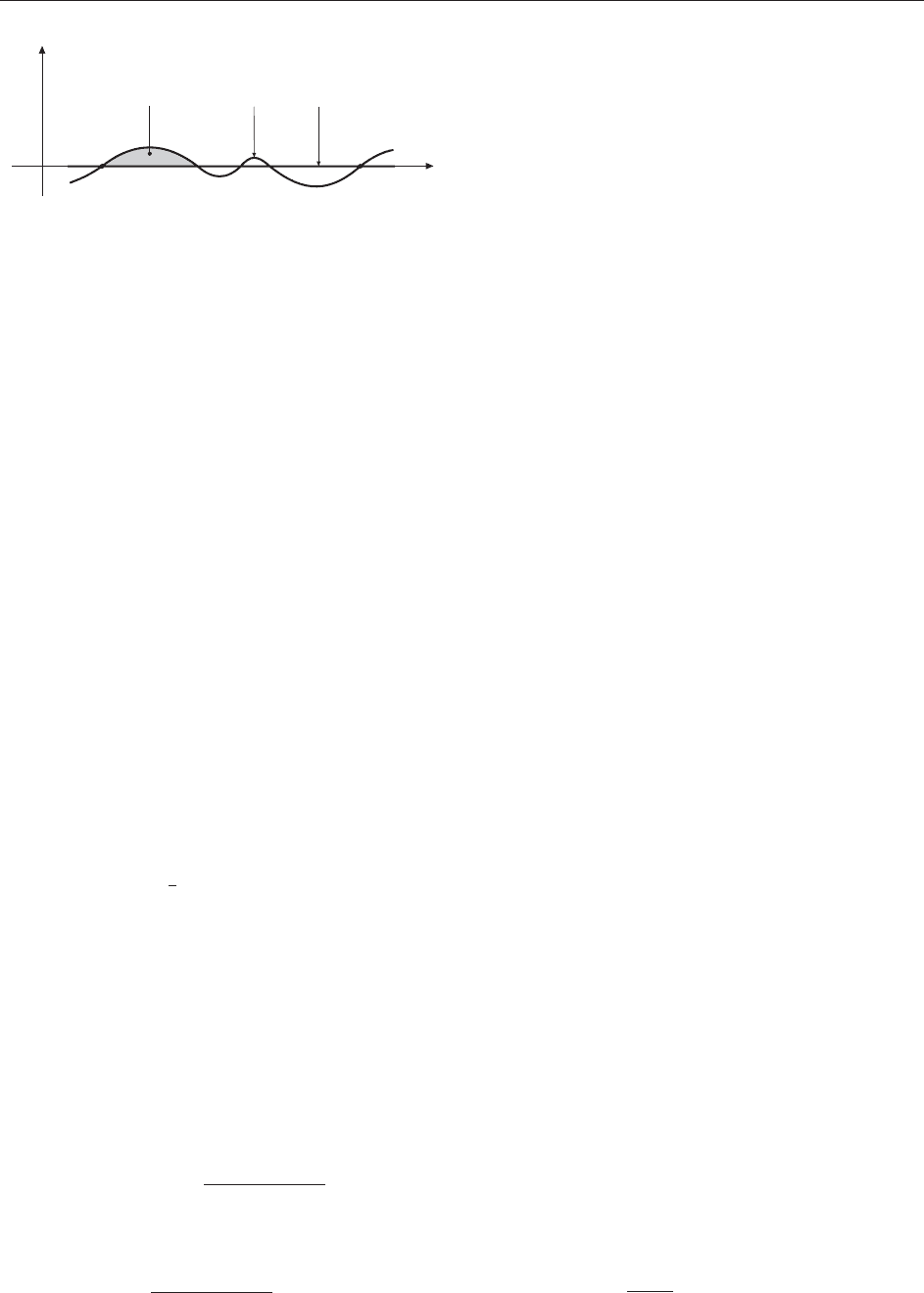
Existence of such coordinates has several
corollaries.
If P is not identically constant, the separatrices
split and this splitting is of the first order in ".
Let
be a simple zero of M. Then the
perturbed separatri ces intersect transversally at
a point z
(") with time–energy coordinates
(
þO("), O("
2
), t = 0). Such a point z
(")is
called a transversal homoclinic point. It gen-
erates a doubly asymptotic solution in the
perturbed system.
Consider a lobe domain L(
, ") bounded by two
segments of separatrices on the section { t = 0}
(see Figure 1). Let another ‘‘corner point’’ of the
lobe L(
, ") correspond to the simple zero
0
of
M. Then the symplectic area of L(
, ")equals
A
L
ð
;"Þ¼"
Z
0
MðÞd þ Oð"
2
Þ
A Standard Example
Consider as an example a pendulum with periodi-
cally oscillating suspension point. The Hamiltonian
of the system can be presented in the form
Hðx; y; t;"Þ¼
1
2
y
2
þ
2
cos x þ "ðtÞcos x ½3
where is the ‘‘internal’’ frequency of the pendulum.
The function is 2 -periodic in time. Hence the
frequency of the suspension point oscillation equals
1. In this case, the unperturbed homoclinic solution
(t) can be computed explicitly. In particular,
cosðxðtÞÞ ¼ 1 2 cosh
2
ðtÞ
Therefore, P() =
R
þ1
1
(t)(cos (x(t þ)) 1) dt. For
example, if (t) = cos t, we have
PðÞ¼
2 cos
2
sinhð=2Þ
In this case, different lobes have the same area
A
L
¼
4"
2
sinhð=2Þ
þ Oð"
2
Þ
Multidimensional Case
Multidimensional generalization of the Poincare´–
Melnikov construction is strongly connected to the
concept of a (partially) hyperbolic torus. Let
(M, !, H) be a Hamiltonian system on the 2m-
dimensional symplectic manifold (M, !).
An invariant n-torus N M (0 n < m) is called
hyperbolic if there exist coordinates x, y, z on M in a
neighborhood of N such that
1. y = (y
1
, ..., y
n
), x = (x
1
, ..., x
n
) mod 2,
z = (z
s
, z
u
), z
s, u
= (z
s, u
1
, ..., z
s, u
l
), l þn = m;
2. ! = dy ^ dx þdz
u
^ dz
s
;
3. N = {(x, y, z):y = 0, z = 0}; and
4. H = h, yiþ(1=2)hAy, yiþhz
u
, (x)z
s
iþO
3
(y, z),
where 2R
n
is a constant vector, A is a constant
n n matrix, is an l l matrix such that
(x) þ
T
(x) is positive definite for any x mod 2,
the symbol O
3
denotes terms of order not less than
3, and ha, bi=
P
a
j
b
j
.
If det A 6¼ 0, the torus is called nondegenerate. If
is Diophantine, that is, for some , >0 and any
0 6¼ k 2Z
n
jh;kij jkj
the torus N is called Diophantine. The coordinates
(x, y, z) are called canonical for N.
Now suppose that the Hamiltonian H depends
smoothly on the parameter ":
H ¼ H
0
þ "H
1
þ Oð"
2
Þ
and for " = 0 the system is Liouville integrable with
the commuting first integrals F
1
, ..., F
m
:
fF
j
; F
k
g¼0; 1 j; k m
Let M
0
= {F
1
= = F
m
= 0} M be their zero
common level and let N M be an n-dimensional
nondegenerate Diophantine hyperbolic torus. The
torus N generates the invariant Lagrangian asymp-
totic manifolds
s, u
M. Suppose that the separa-
trices are doubled, that is, there is a Lagrangian
manifold
s
\
u
.
Consider the perturbed Hamiltonian H = H
0
þ
"H
1
þO("
2
). The torus N as well as the asymptotic
manifolds
s, u
survive the perturbation. Let N
"
be the
corresponding hyperbolic torus in the perturbed
system and
s, u
"
its asymptotic manifolds: N
"
and
s, u
"
depend smoothly on " and N
0
= N,
s, u
0
=
s, u
.
Let the function (x) satisfy the equ ation
h;@ðxÞ=@xiþH
1
ðx; 0 ; 0Þ
¼
1
ð2Þ
n
Z
T
n
H
1
ðx; 0; 0Þdx
Lobe
h
τ
Λ
s
Λ
u
τ
∗
Figure 1 Perturbed separatrices in time–energy coordinates.
Separatrix Splitting 537

This equation has a smooth solution unique up to an
additive constant.
Consider a solution of the unperturbed Hamiltonian
equations (t) .LetI
j
, I
j, l
,1 j, l m be the
following quantities (Treschev 1994):
I
j
¼ lim
T!þ1
Z
T
T
fF
j
; H
1
gððtÞÞdt
þfF
j
;gððTÞÞ fF
j
;gððTÞÞ
I
j;l
¼ lim
T!þ1
Z
T
T
fF
j
; fF
l
; H
1
ggððtÞÞdt
þfF
j
fF
l
;ggððTÞÞ
fF
j
fF
l
;ggððTÞÞ
The numbers I
j
, I
j, l
play the role of the first and
second derivatives of the Poincare´ integral at some
point.
If any of the quantities I
j
, I
j, l
does not vanish,
the asymptotic manifolds
s, u
split. Moreover, sup-
pose that I
1
= = I
m
= 0 and the rank of the matrix
(I
j, l
) equals m 1. Then for small values of ",the
manifolds
s
and
u
intersect transversally on the
energy level at points of the solution
"
(t), where
"
! as " !0.
Poincare´ Integral in Multidimensional
Case
Suppose that the Hamiltonian from the previous
section equals
Hðx; y; u; v; t;"Þ¼H
0
ðy; u; vÞþ"H
1
ðx; y; u; v; tÞ
þ Oð"
2
Þ
Here x = (x
1
, ..., x
n
)mod2, y = (y
1
, ..., y
n
) 2R
n
,and
(u, v) 2R
2
. The symplectic structure ! = dy ^dx þ
dv ^du.
We assume that in the unperturbed integrable
system the variables separate:
H
0
ðy; u; vÞ¼FðyÞþf ðu; vÞ
and the system with one degree of freedom and
Hamiltonian f has a hyperbolic eq uilibrium
(u, v) = 0 with a homoclinic solution (t). Any torus
Nðy
0
Þ¼fðx; y; u; v; tÞ: y ¼ y
0
; u ¼ v ¼ 0g
is a hyperbolic torus of the unperturbed system with
frequency vector
ðy
0
Þ
1
0
@
1
A
;ðyÞ¼@F =@y
Suppose that N = N(0) is Diophantine and non-
degenerate. Then in the perturbed system there is
smooth in " hyperbolic torus N
"
, N
0
= N. Consider
the Poincare´ function
Pð; Þ¼
Z
þ1
1
H
1
ð þ ðt þ Þ; 0;ðt þ Þ; tÞ
H
1
ð þ ðt þ Þ; 0; 0; 0; tÞ
dt
Obviously, P(, )is2-perio dic in and .
If P is not identically constant, asymptotic
surfaces of N
"
split in the first approximation in ".
Nondegenerate critical points of P correspond to
transversal homoclinic solutions of the perturbed
system.
Other results on the splitting of multidimensional
asymptotic manifolds are presented in Arnol’d et al.
(1988) and Lochak et al. (2003).
Exponentially Small Separatrix Splitting
If in the unperturbed (integrable) system there are no
asymptotic manifolds, they can appear after a
perturbation. Consider, for example, perturbation
of a real-analytic Liouville integrable system near a
simple resonance:
_
x ¼
@H
@y
;
_
y ¼
@H
@x
; x 2T
m
; y 2D R
m
Hðx; y; t;"Þ¼H
0
ðyÞþ"H
1
ðx; y; t;"Þ
As usual, we assume 2-periodicity in t. A simple
resonance corresponds to a value of the action
variable y = y
0
such that the frequency vector
^
¼
0
1
0
@
1
A
;
0
¼
@H
0
@y
ðy
0
Þ2R
m
(here 1 is the frequency, corresponding to the time
variable) admits only one resonance. More precisely,
there exists a nonzero
^
k 2Z
m þ1
, satisfying h
^
k,
^
i= 0
and any k 2Z
m þ1
such that hk,
^
i= 0 is collinear
with
^
k.
Without loss of generality, we can assume that
y
0
= 0 and
0
=
0
e
,
e
2R
m1
. Then the vector
=
e
1
2R
m
is nonresonant.
In a
ffiffiffi
"
p
-neighborhood of the resonance we have a
system with fast variables X = (x
2
, ..., x
m
, t) mod 2
and slow variables Y = (x
1
, "
1=2
y
1
, ..., "
1=2
y
m
)
variables:
_
Y ¼ Oð
ffiffiffi
"
p
Þ;
_
X ¼
þ Oð
ffiffiffi
"
p
Þ½4
If the frequency vector
is Diophantine, by using
the Neishtadt averaging procedure, we can reduce
the dependence of the right-hand sides of eqns [4] on
538 Separatrix Splitting

the fast variables to exponentially small in " terms.
This means that there exist new symplectic variables
P ¼ Y þ Oð
ffiffiffi
"
p
Þ; Q ¼ X þ Oð
ffiffiffi
"
p
Þ
(new time coincides with the old one) such that
system [4] takes the form
_
P ¼
ffiffiffi
"
p
FðP ;
ffiffiffi
"
p
ÞþO
expða"
b
Þ
_
Q ¼
þ
ffiffiffi
"
p
GðP;
ffiffiffi
"
p
ÞþO
expða"
b
Þ
with positive constants a, b.
If we neglect the expo nentially small reminders,
the system turns out to be integrable. Generically, it
has a family of hyperbolic m-tori of the form
{(P, Q): P = const.} with doubled asymptotic mani-
folds. However, the terms O(exp (a"
b
)) generic-
ally cannot be remov ed completely. They produce
an exponentially small splitting of the asymptotic
manifolds. This splitting implies nonintegrability,
chaotic behavi or, Arnol’d diffusion, and other
dynamical effects.
It is imp ortant to note that exponentially small
splitting appears only in the analytic case. In smooth
systems the splitting is much strong er.
Unfortunately, at present there are no quantitative
methods for studying such splittings except obvious
upper estimates and the case of two-dimensional
systems.
Exponentially Small Splitting
in Two-Dimensional Systems
The main results on exponentially small separatrix
splitting were obtained by Lasutkin and his students
(Gelfreich and others). Another effective approach
was proposed by Treschev. There are no general
theorems in this situation; however, many examples
were studied. We discuss the splitting in the
pendulum with rapidly oscillating suspension point.
The Hamiltonian of the system has the form
H ¼
1
2
y
2
þð1 þ 2b cosðt="ÞÞcos x
(cf. [3]). For any value of " the circle
{(x, y, t): x = y = 0} is a period ic trajectory. For
small ">0 the trajectory is hyperbolic.
Poincare´ integral can be formally written in this
system. It predicts the area of lobes 16b"
1
e
(2")
1
.
However, there is no reason to expect that this
asymptotics of the splitting is correct. Indeed, its
value is exponentially small in ", while the error of the
Poincare´ –Melnikov method is in general quadratic in
the perturbation. To obtain correct asymptotics of the
separatrix splitting, one has to study singularities of
the solutions with respect to complex time. Area of
lobes in this system equals (Treschev 1997)
A
L
¼ 4bf ðb;"Þ"
1
e
ð2"Þ
1
Here f (b, "), " 0 is a smooth function. The func-
tion f (b, 0) is even and entire. It can be comput ed
numerically as a solution of a problem which does
not contain ". The value f(0, 0) = 4 corresponds to
the Poincare´ integral, but the function f ( b, 0) is not
constant. It is possible to prove that f can be
expanded in a power series in ". Apparently, this
series diverges for any b 6¼ 0.
Separatrix Splitting and Dynamics
1. Separatrix splitting can be regarded as an obstacle
to the integrability of the perturbed system. How-
ever, this statement needs some comments.
Doubled asymptotic surfaces in an integrable
Hamiltonian system can have self-intersections. In
the case of equilibrium, such intersections can even
be transversal. In the literature, there is no general
result saying that separatrix splitting implies non-
integrability. Some particular cases (studied by
Kozlov, Ziglin, Bolotin, and others) are presented
in Arnol’d et al. (1989). For example, in the two-
dimensional case, this is seen to be true.
2. Conceptual reason for the nonintegrability, dis-
cussed in the previous item, is a complicated
dynamics near the splitted separatrices. In many
situations, it is possible to find in this domain a
Smale horseshoe. This implies positive topological
entropy, existence of nontrivial hyperbolic sets,
symbolic dynamics, etc.
3. Consider a near-integrable area-preserving two-
dimensional map. In the perturbed system in the
vicinity of the splitted separatrices of a hyperbolic
fixed point z
"
the so-called stochastic layer is
formed. Here we mean the domain bounded by
invariant curves, closest to the separatrices. An
important quantity, describing the rate of chaos, is
the area of the stochastic layer A
SL
("). It turns out
(Treschev 1998b)thatA
SL
(") is connected with the
area of the largest lobe A
L
(") by the simple formula
c
1
A
SL
ð"Þ <
A
L
ð"Þlog A
L
ð"ÞðÞ
log
2
< c
2
A
SL
ð"Þ
with some constants c
1
, c
2
> 0, where is the
largest multiplier (Lyapunov exponent) of the fixed
point z
0
.
4. Let
^
z be a hyperbolic fixed point of an area-
preserving two-di mensional map. The point
^
z
Separatrix Splitting 539

divides the co rresponding separa trices
s, u
in 4
branches
s
1, 2
and
u
1, 2
. Suppose that the pair of
branches
s
j
and
u
l
satisfies the following
conditions:
s
j
and
u
l
lie in a compact invariant domain;
s
j
and
u
l
do not coincide and intersect at a
homoclinic point.
Then the closures
s
j
,
u
l
are compact invariant
sets. Very little is known about these sets. For
example, it is not known if their measure is positive.
However, by using the Poincare´ recurrence theorem,
it is possible to prove ( Treschev 1998a) that
s
j
=
u
l
.
See also: Averaging Methods; Billiards in Bounded Convex
Domains; Hamiltonian Systems: Obstructions to Integrability;
Hamiltonian Systems: Stability and Instability Theory.
Further Reading
Arnol’d V, Kozlov V, and Neishtadt A (1988) Mathematical
aspects of classical and celestial mechanics. In: Encyclopaedia
of Mathematical Sciences, vol. 3. Berlin: Springer.
Lochak P, Marco J-P, and Sauzin D (2003) On the splitting of
invariant manifolds in multidimensional near-integrable
Hamiltonian systems. Memoirs of the American Mathematical
Society 163(775): viiiþ145.
Melnikov V (1963) On the stability of the center for time-periodic
perturbations. Trudy Moskovskogo Metern. Obschestva 12:
3–52 (Russian). (English transl.: Trans. Moscow Math. Soc.
1963, pp. 1–56 (1965).)
Poincare´ H (1987) Les me´thodes nouvelles de la Me´ canique
Ce´leste, vols. 1–3. Paris: Gauthier–Villars, (Original publica-
tion: 1892, 1893, 1899). New Printing: Librairie Scientifique
et Technique Albert Blanchard 9, Rue Medecin 75006, Paris.
Treschev D (1994) Hyperbolic tori and asymptotic surfaces in
Hamiltonian systems. Russian Journal of Mathematical
Physics 2(1): 93–110.
Treschev D (1997) Separatrix splitting for a pendulum with
rapidly oscillating suspension point. Russian Journal of
Mathematical Physics 5(1): 63–98.
Treschev D (1998a) Closures of asymptotic curves in a two-
dimensional symplectic map. J. Dynam. Control Systems 4(3):
305–314.
Treschev D (1998b) Width of stochastic layers in near-integrable
two-dimensional symplectic maps. Physica D 116(1–2): 21–43.
Wiggins S (1988) Global Bifurcations and Chaos. Analytical
Methods. Applied Mathematical Sciences, vol. 73, 494pp
New York: Springer.
Several Complex Variables: Basic Geometric Theory
A Huckleberry, Ruhr-Universita
¨
t Bochum, Bochum,
Germany
T Peternell, Universita
¨
t Bayreuth, Bayreuth, Germany
ª 2006 Elsevier Ltd. All rights reserved.
Introduction
The rubric ‘ ‘several complex variables’’ is attached to a
wide area of mathematics which involves the study of
holomorphic phenomena in dimensions higher than
one. In this area there are viewpoints, methods and
results which range from those on the analytic side,
where analytic techniques of partial differential equa-
tions (PDEs) are involved, to those of algebraic geometry
which pertain to varieties defined over finite fields. Here
we outline selected basic methods which are aimed at
understanding global geometric phenom ena. D etailed
presentations of most results discussed here can be
found in the basic texts (Demailly, Grauert and
Fritzsche 2001, Griffiths and Harris 1978, Grauert et
al. 1994, Grauert and Remmert 1979, 1984).
Domains in C
n
Complex analysis begins with the study of
holomorphic functions on domains D in C
n
.
These are smooth complex-valued functions f
which satisfy
@f :¼
X
@f
@
z
i
d
z
i
¼ 0
Some results from the one-dimensional theory extend
to the case where n > 1. However, even at the early
stages of development, one sees that there are many
new phenomena in the higher-dimensional setting.
Extending Results from the One-Dimensional
Theory
For local results one may restrict consi derations to
functions f which are holomorphic in a neighbor-
hood of 0 2 C
n
. The restriction of f to, for example,
any complex line through 0 is holomorphic, and
therefore the maximum principle can be immedi-
ately transferred to the higher-di mensional setting.
The zero-set V(f ) of a nonconstant holomorphic
function is one-codimensional over the complex
numbers (two-codimensional over the reals). Thus
the identity principle must be formulated in a
different way from its one-dimensional version. For
example, under the usual connectivity assumptions,
if f vanishes on a set E with Hausdorff dimension
bigger than 2n 2, then it vanishes identically. Here
540 Several Complex Variables: Basic Geometric Theory

is another useful version: if M is a real submanifold
such that the real tangent space T
z
M generates the
full complex tangent space at one of its points, that
is, T
z
M þ iT
z
M = T
z
C
n
, and f jM 0, then f 0.
In the one-dimensional theory, after choosing
appropriate holomorphic coordinates, f (z) = z
k
for
some k. This local normal form implies that
nonconstant holomorphic functions are open map-
pings. Positive results in the mapping theory of
several complex variables are discussed below. The
simple example F : C
2
! C
2
,(z, w) ! (z, zw), shows
that the open mapping theorem cannot be trans-
ferred without further assumptions.
The local normal-form theorem in several com-
plex variables is called the ‘‘Weierstraß preparation
theorem.’’ It states that after appropriate normal-
ization of the coordinates, f is locally the product of
a nonvanishing holomorphic function with a
‘‘polynomial’’
Pðz; z
0
Þ= z
k
þ a
k1
ðz
0
Þz
k1
þþa
0
ðz
0
Þ
where z is a single complex variable, z
0
denotes the
remaining n 1 variables, and the coefficients are
holomorphic in z
0
. This is a strong inductive device
for the local theory.
If D is a product D = D
1
D
n
of relatively
compact domains in the complex plane C,then
repeated integration transfers the one-variable
Cauchy integral formula from the D
i
to D.The
resulting integral is over the product bd(D
1
)
bd(D
n
) of the boundaries which is topologically a
small set in bd(D). Complex analytically it is, however,
large in the sense of the above identity principle.
It follow s from, for example, the n-variable
Cauchy integral formula that holomorphic functions
agree with their convergent power series dev elop-
ments. As in the one-variable theory, the appro-
priate topology on the space O(D) of holomorphic
functions on D is that of uniform convergence on
compact subsets. In this way O(D) is equipped with
the topology of a Fre´chet space.
First Theorems on Analytic Continuation
Analytic continuation is a fundamental phen omenon
in complex geometry. One type of continuation
theorem which is known in the one-variable theory
is of the following type: If E is a small closed set in
D and f 2O(DnE) is a holomorphic function which
satisfies some growth condition near E, then it
extends holomorphically to D. The notion ‘‘small’’
can be discussed in terms of measure, but it is more
appropriate to discuss it in complex analytic terms.
An analytic subset A of D is locally the common
zero set {a 2 D; f
1
(a) = = f
m
(a) = 0} of finitely
many holomorphic functions. A function g on A is
said to be holomorphic if at each a 2 A it is the
restriction of a holomorphic function on some
neighborhood of a in D. There is an appropriate
notion of an irreducible component of A.IfA is
irreducible, it contains a dense open set A
reg
, which
is a connected k-dimensional complex manifold,
that is, at each of its points a there are functions
f
1
, ..., f
k
which define a map F := (f
1
, ..., f
k
), which
is a holomorphic diffeomorphism of A
reg
onto an
open set in C
k
. The boundary A
sing
is the set of
singular points of A, which is a lower-dimensional
analytic set. The dimension of an analytic set is the
maximum of the dimensions of its irreducible
components.
Here are typical examples of theorems on con-
tinuing holomorphic functions across small analytic
sets E. If codim E 2, then every function which is
holomorphic on DnE extends to a holomorphic
function on D. The same is true of meromorphic
functions, that is, functions which are locally
defined as quotients m = f =g of holomorphic func-
tions. If f is holomorphic on D, then g := 1=f is
holomorphic outside the analytic set E := V(f ).
Thus g cannot be holomorphically continued across
this one-codimensional set. However, Riemann’s
Hebbarkeitssatz is valid in several complex vari-
ables: if f is locally bounded outside an analytic
subset E of any positive codimension, then it extends
holomorphically to D.
With a bit of care, continuation results of this type
can be proved for (reduced) complex spaces. These
are defined as paracompact Hausdorff spaces which
possess charts (U
, ’
), where the local home-
omorphism ’
identifies the open set U
with a
closed analytic subset A
of a domain D
in some
C
n
. As indicated above, a continuous function on
A
is holomorphic if at each point it can be
holomorphically extended to some neighborhood of
that point in D
. Finally, just as in the case of
manifolds, the compatibility between charts is guar-
anteed by requiring that coordinate change
’
: U
! U
is biholomorphic, that is, it is a
homeomorphism so that it and its inverse are given by
holomorphic functions as F = (f
1
, ..., f
m
). The discus-
sion of irreducible compon ents, sets of singularities,
and dimension for complex spaces goes exactly in the
same way as that above for analytic sets.
If E is everywhere at least two-codimensional,
then the above result on continuation of mero-
morphic functions holds in complete generality. The
Hebbarkeitssatz requires the additional condition
that the complex space is normal. In many situa tions
this causes no problem at all, because, in general,
there is a canonically defined associated normal
Several Complex Variables: Basic Geometric Theory 541