
Francoise J.-P., Naber G.L., Tsun T.S. (editors) Encyclopedia of Mathematical Physics
Подождите немного. Документ загружается.

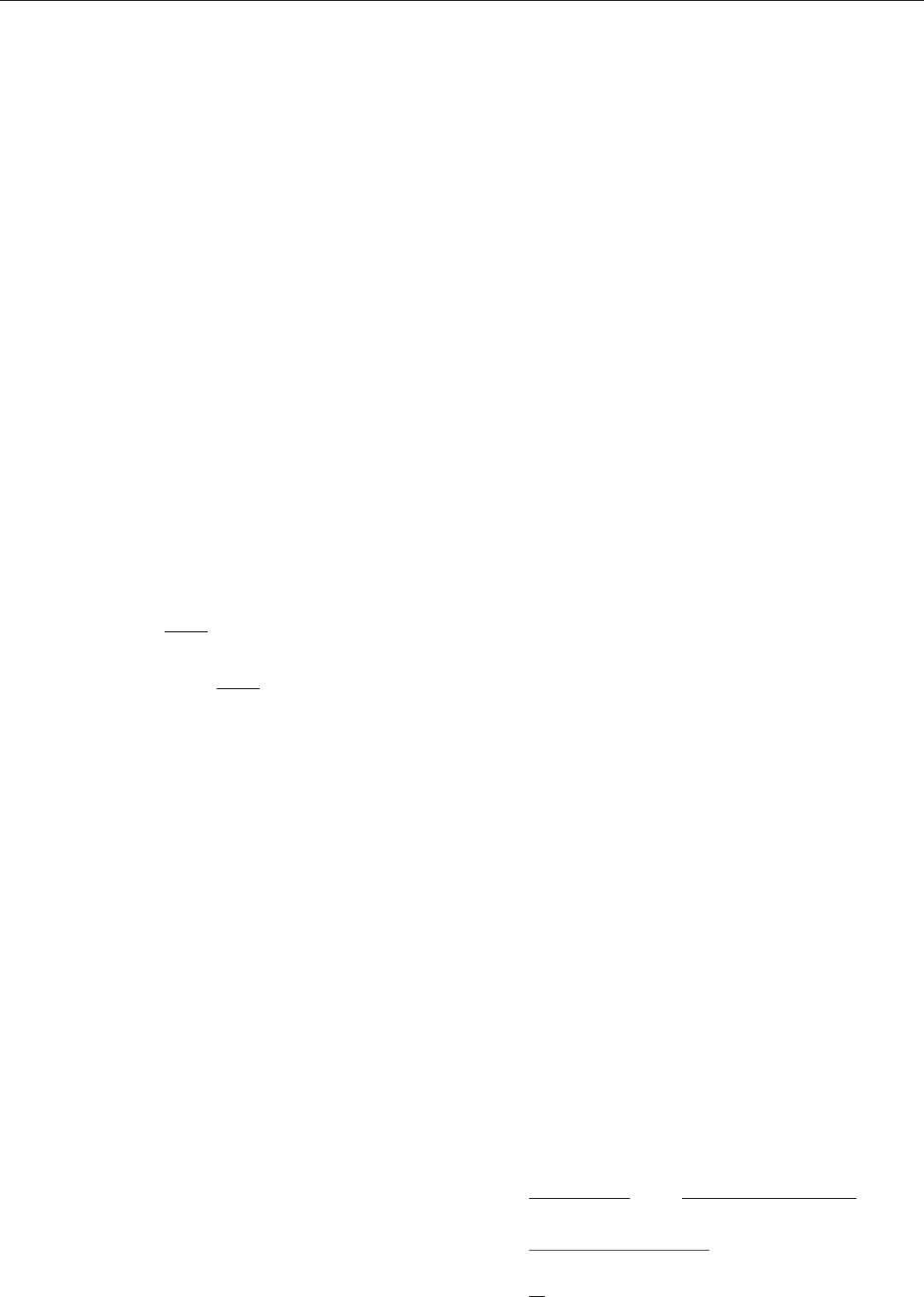
ones. In the vacuum region, these are all given by the
Schwarzschild family. A theorem of Birkhoff shows
that in the vacuum region any spherically symmetric
metric, even without assuming stationarity, belongs to
the family of Schwarzschild metrics, parametrized by a
positive mass parameter m. Thus, regardless of
possible motions of the matter, as long as they remain
spherically symmetric, the exterior metric is the
Schwarzschild one for some constant m. This has the
following consequence for stellar dynamics: imagine
following the collapse of a cloud of pressureless fluid
(‘‘dust’’). Within Newtonian gravity, this dust cloud
will, after finite time, contract to a point at which the
density and the gravitational potential diverge. How-
ever, this result cannot be trusted as a sensible physical
prediction because, even if one supposes that New-
tonian gravity is still valid at very high densities, a
matter model based on noninteracting point particles
is certainly not. Consider, next, the same situation in
the Einstein theory of gravity: here a new question
arises, related to the form of the Schwarzschild metric
outside of the spherically symmetric body:
g ¼V
2
dt
2
þ V
2
dr
2
þ r
2
d
2
;
V
2
¼ 1
2Gm
rc
2
;
t 2 R; r 2
2Gm
c
2
; 1
½2
Here d
2
is the line element of the standard
2-sphere. Since the metric [2] seems to be singular as
r = 2m is approached (from now on, we use units in
which G = c = 1), there arises the need to understand
what happens at the surface of the star when the
radius r = 2m is reached. One thus faces the need of
a careful study of the geometry of the metric [2]
when r = 2m is approached, and crossed.
The first key feature of the metric [2] is its
stationarity, of course, with Killing vector field X
given by X = @
t
. A Killing field, by definition, is a
vector field the local flow of which generates isome-
tries. A spacetime (the term spacetime denotes a
smooth, paracompact, connected, orientable, and
time-orientable Lorentzian manifold) is called station-
ary if there exists a Killing vector field X which
approaches @
t
in the asymptotically flat region (where r
goes to 1; see below for precise definitions) and
generates a one-parameter group of isometries. A
spacetime is called static if it is stationary and if the
stationary Killing vector X is hypersurface orthogonal ,
that is, X
[
^ dX
[
= 0, where X
[
= X
dx
= g
X
dx
.
A spacetime is called axisymmetric if there exists a
Killing vector field Y, which generates a one-parameter
group of isometries and which behaves like a rotation
in the asymptotically flat region, with all orbits
2-periodic. In asymptotically flat spacetimes, this
implies that there exists an axis of symmetry, that is, a
set on which the Killing vector vanishes. Killing vector
fields which are a nontrivial linear combination of a
time translation and of a rotation in the asymptotically
flat region are called stationary rotating, or helical.
There exists a technique, due independently to
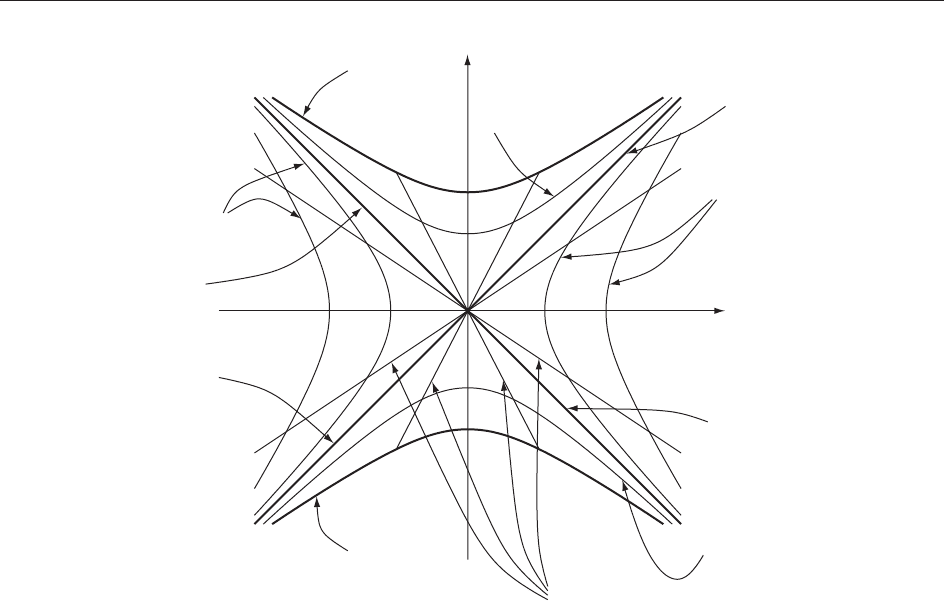
Kruskal and Szekeres, of attaching together two
regions r > 2m and two regions r < 2m of the
Schwarzschild metric, as in Figure 1, to obtain a
manifold with a metric which is smooth at r = 2m.
In the extended spacetime, the hypersurface {r = 2 m}
is a null hypersurface e, the Schwarzschild event
horizon. The stationary Killing vector X = @
t
extends to a Killing vector in the extended spacetime
which becomes tangent to and null on e. The global
properties of the Kruskal–Szekeres extension of the
exterior Schwarzschild spacetime make this spacetime
a natural model for a nonrotating black hole. It is
worth noting here that the exterior Schwarzschild
spacetime [2] admits an infinite number of noniso-
metric vacuum extensions, even in the class of
maximal, analytic, simply connected ones. The
Kruskal–Szekeres extension is singled out by the
properties that it is maximal, vacuum, analytic, simply
connected, with all maximally extended geodesics
either complete, or with the area r of the orbits of the
isometry groups tending to zero along them.
We can now come back to the problem of the
contracting dust cloud according to the Einstein
theory. For simplicity, we take the density of the
dust to be uniform – the so-called Oppenheimer–
Snyder solution. It then turns out that, in the course
of collapse , the surface of the dust will eventually
cross the Schwarzschild radius, leav ing behind a
Schwarzschild black hole. If one follows the dust
cloud further, a singularity will eventually form, but
will not be visible from the ‘‘outside regi on’’ where
r > 2m. For a collapsing body of the mass of the
Sun, say, one has 2m = 3 km. Thus, standard
phenomenological matter models such as that for
dust can still be trusted, so that the previous
objection to the Newtonian scenario does not apply.
There is a rotating generalization of the Schwarz-
schild metric, namely the two-parameter family of
exterior Kerr metrics, whi ch in Boyer–Lindquist
coordinates takes the form
g ¼
a
2
sin
2
dt
2
2asin
2
ðr
2
þa
2
Þ
dt d’
þ
ðr
2
þa
2
Þ
2
a
2
sin
2
sin
2
d’
2
þ
dr
2
þ d
2
½3
Stationary Black Holes 39
with 0 a < m. Here =r
2
þa
2
cos
2
,=r
2
þa
2
2mr and r
þ
< r < 1 where r
þ
= m þ(m
2
a
2
)
1=2
.
When a= 0, the Kerr metric reduces to the
Schwarzschild metric. The Kerr metric is again a
vacuum solution, and it is stationary with X= @
t
the
asymptotic time translation, as well as axisymmetr ic
with Y = @
’
the generator of rotations. Similarly to
the Schwarzschild case, it turns out that the metric
can be smoothly extended across r= r
þ
, with {r= r
þ
}
being a smooth null hypersurface e in the extension.
The null generator K of e is the limit of the
stationary-rotating Killing field X þ!Y, where
!= a=(2mr
þ
). On the other hand, the Killing vector
X is timelike only outside the hypersurface {r = m þ
(m
2
a
2
cos
2
)
1=2
}, on which X becomes null. In the
region between r
þ
and r= m þ(m
2
a
2
cos
2
)
1=2
,
which is called the ergore gion, X is spacelike. It is
also spacelike on and tangent to e, except where the
axis of rotation meets e, where X is null. Based on
the above properties, the Kerr family provides
natural models for rotating black holes.
Unfortunately, as opposed to the spherically
symmetric case, there are no known explicit collap-
sing solutions with rotating matter, in particular no
known solutions having the Kerr metric as final
state.
The aim of the theory outlined below is to
understand the general geometrical features of
stationary black holes, and to give a classification
of models satisfying the field equations.
Model-Independent Concepts
Some of the notions used informally in the
introductory section will now be made more
precise. The mathematical notion of black hole is
meant to capture the idea of a region of spacetime
which cannot be seen by ‘‘outside observers.’’ Thus,
at the outset, one assumes that there exists a family
of physically preferred observers in the spacetime
under consideration. When considering isolated
physical systems, it is na tural to define the ‘‘exterior
observers’’ as observers which are ‘‘very far’’ away
from the system under consideration. The standard
way of making this mathematically precise is by
using conformal completions, discussed in more
detail in the article about asymptotic structure in
this encyclopedia: a pair (
~
m,
~
g) is called a con-
formal completion at infinity, or simply conformal
completion, of (m, g)if
~
m is a manifold with
boundary such that:
1. m is the interior of
~
m;
2. there exists a function , with the property that
the metric
~
g, defined as
2
g on m, extends by
continuity to the boundary of
~
m, with the
r = constant > 2m
r = constant > 2
m
r = constant < 2m
r
= constant < 2m
t
= constant
X
T
Singularity (r
= 0)
Singularity (r
= 0)
r
= 2m
r
= 2m
r
= 2m
r
= 2m
I
II
III
IV
Figure 1 The Kruskal–Szekeres extension of the Schwarzschild solution. (Adapted with permission from Nicolas J-P (2002) Dirac fields
on asymptotically flat space-times. Dissertationes Mathematicae 408: 1–85.)
40 Stationary Black Holes

extended metric remaining of Lorentzian signa-
ture; and
3. is positive on m, differentiable on
~
m, vanishes
on the boundary
i :¼
~
m n m
with d nowhere vanishing on i.
The bounda ry i of
~
m is called Scri, a phonic
shortcut for ‘‘script I.’’ The idea here is the
following: forcing to vanish on i ensures that i
lies infinitely far away from any physical object – a
mathematical way of capturing the notion ‘‘very far
away.’’ The condition that d does not vanish is a
convenient technical condition which ensures that i
is a smooth three-dimensional hypersurface, instead
of some, say, one- or two-dimensional object, or of a
set with singularities here and there. Thus, i is an
idealized description of a family of observers at
infinity.
To distinguish between various points of i, one
sets
i
þ
¼fpoints in i which are to the futur e of the
physical spacetimeg
i
¼fpoints in i which are to the past of the
physical spacetimeg
(Recall that a point q is to the future, respectively to
the past, of p if there exists a future directed,
respectively past directed, cau sal curve from p to q.
Causal curves are curves such that their tangent
vector
˙
is causal everywhere, g(
_
,
˙
) 0.) One
then defines the black hole region b as
b :¼fpoints in m which are
not in the past of i
þ
g
½4
By definition, points in the black hole region cannot
thus send information to i
þ
; equivalently, observers
on i
þ
cannot see points in b. The white-hole region
w is defined by changing the time orientation in [4].
A key notion related to the concept of a black hole is
that of future (e
þ
) and past (e
) event horizons,
e
þ
:¼ @b; e
:¼ @w ½5
Under mild assumptions, event horizons in station-
ary spacetimes with matter satisfying the null-energy
condition,
T
‘
‘
0 for all null vectors ‘
½6
are smooth null hypersurfaces, analytic if the metric
is analytic.
In order to develop a reasonable theory, one
also needs a regularity condition for the interior of
spacetime. This has to be a condition which does not
exclude singularities (otherwise the Schwarzschild
and Kerr black holes would be excluded), but which
nevertheless guarantees a well-behaved exterior
region. One such condition, assumed in all the
results described below, is the existence in m of an
asymptotically flat spacelike hypersurface s with
compact interior. Further, either s has no boundary
or the boundary of s lies on
e
þ
[ e
. To make
things precise, for any spacelike hypersurface let g
ij
be the induced metric, and let K
ij
denote its extrinsic
curvature. A spacelike hypersurface s
ext
diffeo-
morphic to R
3
minus a ball will be called asympto-
tically flat if the fields (g
ij
, K
ij
) satisfy the fall-off
conditions
jg
ij
ij
jþrj@
‘
g
ij
jþþr
k
j@
‘
1
‘
k
g
ij
j
þ rjK
ij
jþþr
k
j@
‘
1
‘
k1
K
ij
jCr
1
½7
for some constants C, k 1. A hypersurface s (with
or without boundary) will be said to be asymptotically
flat with compact interior if s is of the form s
int
[
s
ext
,withs
int
compact and s
ext
asymptotically flat.
There exists a canonical way of constructing a
conformal completion with good global properties
for stationary spacetimes which are asymptotically
flat in the sense of [7], and which are vacuum
sufficiently far out in the asymptotic region. This
conformal completion is referred to a s the standard
completion and will be assumed from now on.
Returning to the event horizon e = e
þ
[ e
,
it is not very difficult to show that every Killing
vector field X is necessarily tangent to e. Since
the latter set is a null Lipschitz hypersurface, it
follows that X is either null or spacelike on e. This
leads to a preferred class of event horizons, called
Killing horizons. By definition, a Killing horizon
associated with a Killing vector K is a null hypersur-
face which coincides with a connected component of
the set
HðKÞ :¼fp 2 m: gðK; KÞðpÞ¼0; KðpÞ 6¼ 0g½8
A simple example is provided by the ‘‘boost Killing
vector field’’ K = z@
t
þ t@
z
in Minkowski spacetime:
H(K) has four connected components,
H
:¼ft ¼ z;t > 0g;;2f1g
The closure
H of H is the set {jtj= jzj}, which is not
a manifold, because of the crossing of the null
hyperplanes {t = z}att = z = 0. Horizons of this
type are referred to as bifurcate Ki lling horizons,
with the set {K(p) = 0} being called the bifurcation
surface of H(K). The bifurcate horizon structure in
the Kruszkal–Szekeres–Schwarzschild spacetime can
be clearly seen in Figures 1 and 2.
Stationary Black Holes 41
The Vishveshwara–Carter lemma shows that if a
Killing vector K is hypersurface orthogonal, K
[
^
dK
[
= 0, then the set H(K ) defined in [8] is a union
of smooth null hypersurfaces, with K being
tangent to the null geodesics threading H (‘‘H is
generated by K’’), and so is indeed a Kill ing
horizon. It has been shown by Carter t hat the
same conclusion can be reached if the hypothesis
of hypersurface orthogonality is replaced by that
of existence of two linearly independent Killing
vector fields.
In stationary-axisymmetric spacetimes, a Killing
vector K tangent to the generators of a Killing
horizon H can be normalized so that K = X þ !Y,
where X is the Killing vector field which asymptotes
to a time translation in the asymptotic region, and Y
is the Killing vector field which generates rotations
in the asymptotic region. The constant ! is called
the angular velocity of the Killing horizon H.
On a Killing horizon H(K), one necessarily has
r
ðK
K
Þ¼2K
½9
Assuming the so-called dominant-energy condition
on T
(see Positive Energy Theorem and Other
Inequalities in GR), it can be shown that is constant
(recall that Killing horizons are always connected in
the terminology used in this article); it is called the
surface gravity of H. A Killing horizon is called
degenerate when = 0, and nondegenerate other-
wise; by an abuse of terminology, one similarly talks
of degenerate black holes, etc. In Kerr spacetimes we
have = 0 if and only if m = a. A fundamental
theorem of Boyer shows that degenerate horizons
are closed. This implies that a horizon H(K) such that
K has zeros in
H is nondegenerate, and is of bifurcate
type, as described above. Further, a nondegenerate
Killing horizo n with complete geodesic generators
always contains zeros of K in its closure. However, it
is not true that existence of a nondegenerate horizon
implies that of zeros of K : take the Killing vector field
z@
t
þ t@
z
in Minkowski spacetime from which the
2-plane {z = t = 0} has been removed. The universal
cover of that last spacetime provides a spacetime in
which one cannot restore the points which have been
artificially removed, without violating the manifold
property.
The domain of outer communications (DOC) of a
black hole spacetime is defined as
hhmii :¼ m nfb [ wg½10
Thus, hhmii is the region lying outside of the white-
hole region and outside of the black hole region ; it is
the region which can both be seen by the outside
observers and influenced by those.
The subset of hhmii where X is spacelike is called
the ergoregion. In the Schwarzschild spacetime,
! = 0 and the ergoregion is empty, but neither of
these is true in Kerr with a 6¼ 0.
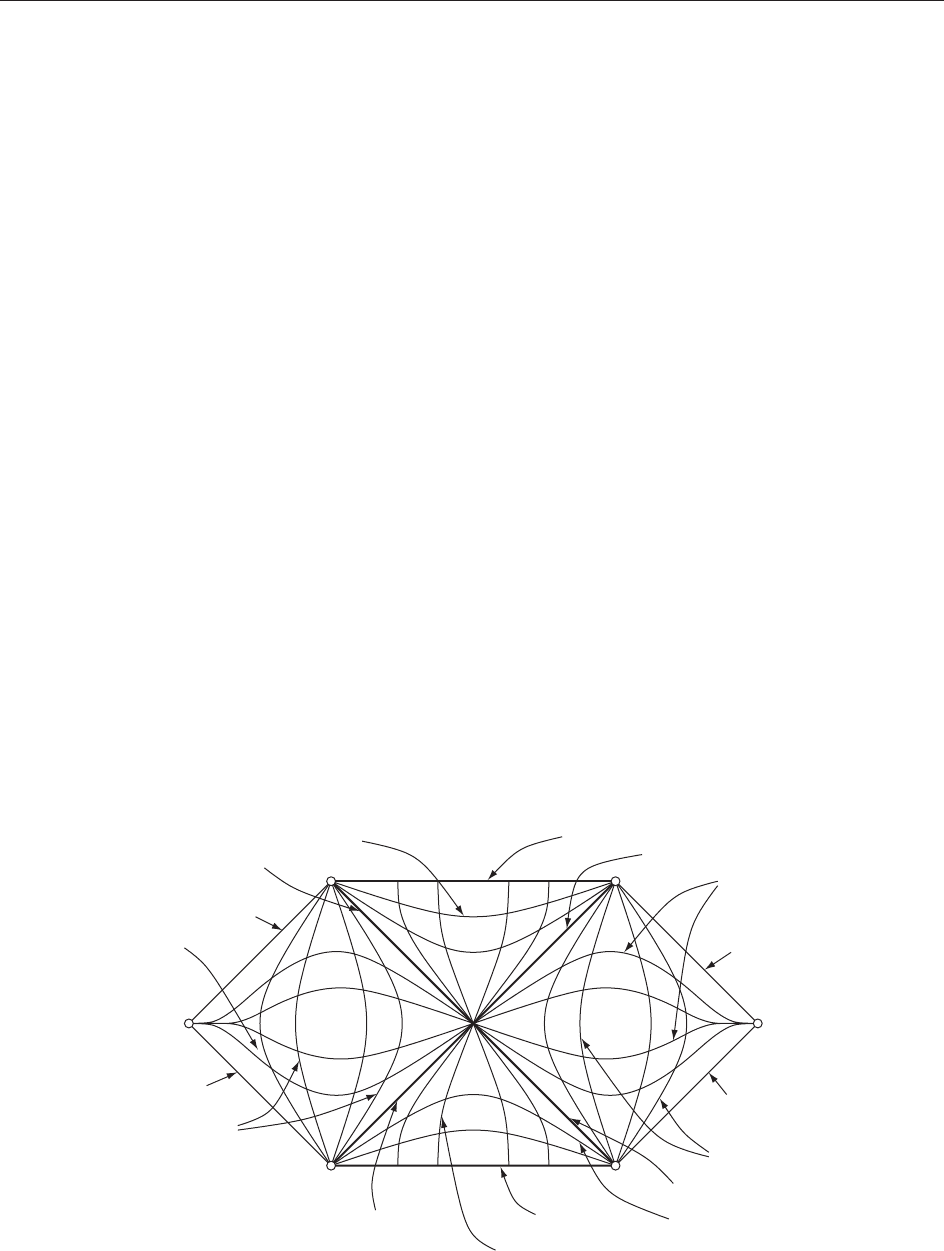
A very convenient method for visualizing the
global structure of spacetimes is provided by the
Carter–Penrose diagrams. An example of such a
diagram is given in Figure 2.
i
–
i
–
i
+
i
+
i
0
i
0
Singularity (r = 0)
Singularity (r
= 0)
I
II
III
IV
r = constant < 2M
r
= constant > 2M
r
= constant < 2M
r
= constant > 2
M
r = 2M
r
= 2M
r = 2M
r
= 2M
r
= infinity
r
= infinity
r
= infinity
r = infinity
t = constant
t
= constant
t
= constant
Figure 2 The Carter–Penrose diagram for the Kruskal–Szekeres spacetime. There are actually two asymptotically flat regions, with
corresponding i
and e
defined with respect to the second region, but not indicated on this diagram. Each point in this diagram represents
a two-dimensional sphere, and coordinates are chosen so that light cones have slopes 1. Regions are numbered as in Figure 1.(Adapted
with permission from Nicolas J-P (2002) Dirac fields on asymptotically flat space-times. Dissertationes Mathematicae 408: 1–85.)
42 Stationary Black Holes

A corollary of the topological censorship theorem
of Friedman, Schleich, and Witt is that DOCs of
regular black hole spacetimes satisfying the domi-
nant-energy condition are simply connected. This
implies that connected components of event hor-
izons in stationary spacetimes have R S
2
topology.
The discussion of t he conc epts as soci ated with
stationary-black hole spacetimes can be concluded
by summarizing the properties of the Schwarzs-
child and Kerr geometries: the extended
Kerr spacetime with m > a is a black hole space-
time with the hypersurface {r = r
þ
} forming a
nondegenerate, bifurcate Killing horizon generated
by the vector field X þ !Y and surface gravity
given by
¼
ðm
2
a
2
Þ
1=2
2m½m þðm
2
a
2
Þ
1=2
In the case a = 0, where the angular velocity !
vanishes, X is hypersurface orthogonal and becomes
the generator of H. The bifurcation surface in this
case is the totally geodesic 2-sphere, along which the
four regions in Figure 1 are joined.
Classification of Stationary Solutions
(‘‘No-Hair Theorems’’)
We confine attention to the ‘‘outside region’’ of
black holes, the DOC. (Except f or the degenerate
case discussed later, the ‘‘inside’’(black hole)
region is not stationary, so that this r estriction
already follows from the requirement of stationar-
ity.) For reasons of space, we only consider
vacuum solutions; there exists a similar t heory
for electro-vacuum black holes. (There is a some-
what less developed theory f or black hole space-
times in the presence of nonabelian gauge fields.)
In connection with a collapse scenario, the vacuum
condition begs the question: collapse of what? The
answer is twofol d: firs t, the re a re large classes of
solutions of Einstein equations describing pure
gravitational waves. It is believed that sufficiently
strong such solutions will form black holes.
(Whether or not they will do that is related to the
cosmic censorship conjecture, see Spacetime Toplogy,
Casual Structure and Singularities.) Consider, next, a
dynamical situation in which matter is initially present.
The conditions imposed in this section correspond
then to a final state in which matter has either been
radiated away to infinity, or has been swallowed by
the black hole (as in the spherically symmetric
Oppenheimer–Snyder collapse described above).
Based on the facts below, it is expected that the
DOCs of appropriately regular, stationary, vacuum
black holes are isometrically diffeomorphic to those
of Kerr black holes:
1. The rigidity theorem (Hawking). Event horizons in
regular, nondegenerate, stationary, analytic
vacuum black holes are either Killing horizons for
X, or there exists a second Killing vector in hhmii.
2. The Killing horizons theorem (Sudarsky–Wald).
Nondegenerate stationary vacuum black holes
such that the event horizon is the union of Killing
horizons of X are static.
3. The Schwarzschild black holes exhaust the family
of static regular vacuum black holes (Israel,
Bunting – Masood-ul-Alam, Chrus
´
ciel).
4. The Kerr black holes satisfying
m
2
> a
2
½11
exhaust the family of nondegenerate, stationary-
axisymmetric, vacuum, connected black holes.
Here m is the total Arnowitt–Deser–Misner
(ADM) mass, while the product am is the total
ADM angular momentum. (Of course, these
quantities generalize the constants a and m
appearing in the Kerr metric.) The framework
for the proof has been set up by Carter, and the
statement above is due to Robinson.
The above results are collectively known under
the name of no-hair theorems, and they have not
provided the final answer to the problem so far.
There are no a priori reasons known for the
analyticity hypothesis in the rigidity theorem.
Further, degener ate horizons have been completely
understood in the static case only.
Yet another key open question is that of the
existence of nonconnected regular stationary-
axisymmetric vacuum black holes. The following
result is due to Weinstein: let @s
a
, a = 1, ..., N,be
the connected components of @s.LetX
[
= g
X
dx
,
where X
is the Killing vector field which asymptoti-
cally approaches the unit normal to s
ext
. Similarly, set
Y
[
= g
Y
dx
, Y
being the Killing vector field
associated with rotations. On each @s
a
, there exists
aconstant!
a
such that the vector X þ !
a
Y is tangent
to the generators of the Killing horizon intersecting
@s
a
.Theconstant!
a
is called the angular velocity of
the associated Killing horizon. Define
m
a
¼
1
8
Z
@s
a
dX
[
½12
L
a
¼
1
4
Z
@s
a
dY
[
½13
Stationary Black Holes 43

Such integrals are called Komar integrals. One
usually thinks of L
a
as the angular momentum of
each connected component of the black hole. Set
a
¼ m
a
2!
a
L
a
½14
Weinstein shows that one necessarily has
a
> 0.
The problem at hand can be reduced to a harmonic-
map equation, also known as the Ernst equation,
involving a singular map from R
3
with Euclidean
metric to the two-dimensional hyperbol ic space.
Let r
a
> 0, a = 1, ..., N 1, be the distance in R
3
along the axis between neighboring black holes as
measured with respect to the (unphysical) metric .
Weinstein proved that for nondegenerate regular
black holes the inequality [11] holds, and that the
metric on hhmii is determined up to isometry by the
3N 1 parameters
ð
1
; ...;
N
; L
1
; ...; L
N
; r
1
; ...; r
N1
Þ½15
just described, with r
a
,
a
> 0. These results by
Weinstein contain the no-hair theorem of Carter
and Robinson as a special case. Weinstein also
shows that, for every N 2 and for every set of
parameters [15] with
a
, r
a
> 0, there exists a
solution of the problem at hand. It is known that
for some sets of parameters [15] the solutions will
have ‘‘strut singularities’’ between some pairs of
neighboring black holes, but the existence of the
‘‘struts’’ for all sets of parameters as above is not
known, and is one of the main open problems in our
understanding of stationary-axisymmetric electro-
vacuum black holes. The existence and uniqueness
results of Weinstein remain valid when strut
singularities are allowed in the metric at the outset,
although such solutions do not fall into the category
of regular black holes discussed here.
Acknowledgments
This work was partially supported by a Polish
Research Committee grant 2 P03B 073 24 and by
the Erwin Schroedinger Institute, Vienna.
See also: Asymptotic Structure and Conformal Infinity;
Black Hole Mechanics; Critical Phenomena in
Gravitational Collapse; Einstein Equations: Exact
Solutions; Einstein Equations: Initial Value Formulation;
Geometric Flows and the Penrose Inequality; Spacetime
Topology, Causal Structure and Singularities.
Further Reading
Carter B (1973) Black hole equilibrium states. In: de Witt C and
de Witt B (eds.) Black Holes, Proceedings of the Les Houches
Summer School. New York: Gordon and Breach.
Chrus
´
ciel PT (2002) Black holes. In: Friedrich H and
Frauendiener J (eds.) Proceedings of the Tu¨ bingen Workshop
on the Conformal Structure of Space-Times, Springer Lecture
Notes in Physics, vol. 604, pp. 61–102 (gr-qc/0201053).
Springer: Heidelberg.
Hawking SW and Ellis GFR (1973) The Large Scale Structure of
Space–Time. Cambridge: Cambridge University Press.
Heusler M (1996) Black Hole Uniqueness Theorems. Cambridge:
Cambridge University Press.
Heusler M (1998) Stationary black holes: uniqueness and beyond.
Living Reviews Relativity 1 (http://www.livingreviews.org/
lrr-1988-6).
Nicolas J-P (2002) Dirac fields on asymptotically flat space-times.
Dissertationes Mathematicae 408: 1–85.
O’Neill B (1995) The Geometry of Kerr Black Holes. Wellesley,
MA: A.K. Peters.
Volkov MS and Gal’tsov DV (1999) Gravitating non-abelian
solitons and black holes with Yang–Mills fields. Physics
Reports 319: 1–83 (hep-th/9810070).
Wald RM (1984) General Relativity. Chicago: University of
Chicago Press.
Stationary Phase Approximation
J J Duistermaat, Universiteit Utrecht, Utrecht,
The Netherlands
ª 2006 Elsevier Ltd. All rights reserved.
Introduction
An oscillatory integral is an integral of the form
Ið!Þ¼
Z
e
i!’ðÞ
aðÞd ½1
Here the integration is over a smooth k-dimensional
manifold which is provided with a smooth density
d. The real variable ! plays the role of a frequency
variable, whereas the real-valued smooth function ’ on
is called the phase function. The amplitude function a
is assumed to be a compactly supported complex
(vector-) valued smooth function on .Thetopicof
this article is the asymptotic behavior of the oscillatory
integral I(!) as the frequency ! tends to infinity.
When the manifold is not compact and the
amplitude function is not compactly supported, then a
smooth cutoff function may be used to write the
integral as the sum of an integral with a compactly
supported amplitude and one with an amplitude which
is equal to zero in a large compact subset of .The
44 Stationary Phase Approximation

latter integral can be studied if suitable assumptions
are made about the asymptotic behavior of the phase
function and the amplitude at infinity, but this is not
the subject of this article. The use of the exponential
function with purely imaginary argument instead of
the sine and the cosine is just a matter of convenience.
The first observation abou t oscillatory integrals in
the next section is the principle of stationary phase,
which states that the contributions to the integral
which are not rapidly decreasing as ! !1 only
come from the stationary points of ’,thepoints 2
where the total derivative d’()of’ is equal to zero.
This principle is closely related to the observation that
a superposition of waves is maximal at points where
the waves are in phase, an observation which goes
back to Huygens (1690).
Assume that
0
is a nondegenerate stationary point of
’.Thatis,d’(
0
) = 0andtheHessianD
2
’(
0
)of’ at
0
is nondegenerate. Then
0
is an isolated stationary
point of ’, and the contribution to I(!) of a neighbor-
hood of
0
has an asymptotic expansion of the form
Ið!Þe
i!’ð
0
Þ
X
1
r¼0
c
r
!
k=2r
; r !1
Here the leading coefficient c
0
is the product of a(
0
)
with a nonzero constant which only depends on
D
2
’(
0
) and the density d at
0
. For increasing r the
coefficients c
r
depend on the derivatives of ’ and a
at
0
of increasi ng ord er (see the sect ion ‘‘The
metho d of stationar y pha se’’).
Usually, even if all the objects are analytic in a
neighborhood of
0
, the asymptotic power series
does not converge. However, there are exceptional
cases where the stationary phase approximation is
exact. Assume, for instance, that is a compact
manifold provided with a symplectic form , ’ is the
Hamiltonian function of a Hamiltonian circle action
on with isolated fixed points, and a()d =
k
=k!.
Then the stationary points of ’ are the fixed points
of the circle action, each stationar y point of ’ is
nondegenerate and I(!) is equal to the sum over the
finitely many stationary points of only the leading
terms of the asymptotic expansions at the stationary
points. This Duistermaat–Heckman formula is a
consequence of a more general localization formula
in equivaria nt cohomolo gy (see the sect ion ‘‘Exact
stationar y phase’’).
For the purpose of applications, but also in the
analysis of oscillatory integrals, it is worthwhile to
allow complex-valued phase functions, but with a
local minimum for the imaginary part at the
stationary point
0
of the real parts. That is, the
real part of the exponent i!’() has a local
maximum at
0
. An extreme case occurs when
’() = i () for a real-valued function which has a
nondegenerate local minimum at
0
, in which case
the integrand is a sharply peaking Gaussian density
at
0
. When ’ and a are analytic near
0
, then the
method of steepest descent consists of deforming the
path of integration in the complex domain in such a
way that the integrand becomes such a sharply
peaking Gaussian density. During the deformation,
the integral does not change because of Cauchy’s
integral theorem.
An important extension of the theory occurs if the
real-valued phase function and the amplitude are
allowed to depend smoothly on additional para-
meters x, which vary in an n-dimensional smooth
manifold M. The amplitude is also allowed to
depend on !, with an asymptotic expansion of
the form
aðx;;!Þ
X
1
r¼0
a
r
ðx;Þ!
mþðk=2Þr
as ! !1 ½2
The expansion is supposed to be locally uniformly in
(x, ) and to allow termwise differentiations of any
order with respect to the variables (x, ). Then the
integral
Iðx;!Þ¼
Z
e
i!’ðx;Þ
aðx;;!Þd
is called an oscillatory integral of order m. Here the
function x 7!I(x, !) is viewed as a continuous
superposition of the -dependent family of oscilla-
tory functions x 7!e
i!’(x, )
a(x, ).
The example which formed the point of departure
of Airy (1838) is that e
i!’(x, )
a(x, , !) is the wave
which arrives at the points x in spacetime which is
sent out by a point on a reflecting mirror. That is,
at x one collects (= integrates over ) all the waves
sent out by the vari ous points of the mirror . The
main point of the theory, however, is that in great
generality the solutions of linear partial differential
equations, such as classical wave equations or
quantum mechanical Schro¨ dinger equations, can be
represented, as functions of x, as oscillatory inte-
grals. This construction has led to decisive progress
in the general theory of linear partial differential
equations with smoothly varying coefficients.
According to the principle of stationary phase, the
main asymptotic contributions to the integral come
from the points such that @’(x, )=@ = 0. The
phase function ’ 2 C
1
(M ) is called nondegene-
rate if the (n þ k) k-matrix
@
2
’ðx;Þ
@ðx;Þ@
has rank k when
@’ðx;Þ
@
¼ 0 ½3
Stationary Phase Approximation 45

This is the natural condition to ensure that the set
S
’
:¼ðx;Þ2M
@’ðx;Þ
@
¼ 0
is a smooth n-dimensional submanifold of M .
The condition [3], moreover, implies that the mapping
’
: S
’
3ðx;Þ7! x;
@’ðx;Þ
@x
2T
M
is a smooth immersion from S
’
into the cotangent
bundle T
M of M. Note that = @’(x, )=@x is
coordinate invariantly defined as a linear form on
the tangent space T
x
M of M at the point x. That
is, 2 (T
x
M)
= the dual space of T
x
M, and (T
x
M)
is the fiber of T
M over x. In classical mechanics,
T
M is the phase space of the position space M,
and a linear form on T
x
M is called a momen-
tum vector at the position x.If denotes the cano-
nical symplectic form on T
M, then
’
= 0. The
immersion
’
locally embeds S
’
onto a smooth
n-dimensional submanifold
’
of M, which is a
Lagrangian manifold in T
M, which by definition
means that
’
= 0.
Oscillatory integrals with very different phase
functions and amplitudes can define the same
!-dependent functions on M. The theory of
Ho¨ rmander (1971, section 3.1) says that the germs
of the Lagrangian manifolds
’
and
are the same
if and only if ’ and define the same class of
oscillatory integrals. Moreover, every Lagrangian
submanifold of T
M is locally of the form
’
for some nondegenerate phase function ’. In this
way, the mapping ’ 7!
’
defines a bij ection
between the set of equivalence classes of germs of
nondegenerate phase functions and the set of germs
of Lagrangian submanifolds of T
M.Let be an
immersed Lagrangian submani fold of T
M.A
global oscillatory integral of order m on M, defined
by , is a locally finite sum u(x, !) of oscillatory
integrals of order m with nondegenerate phase
functions ’ such that
’
. The leading terms of
the amplitudes correspond to a section s of a
canonically defined complex line bundle over ,
which is called the principal symbol of u (see the
section ‘‘The princ ipal symbol on the Lagrangi an
manifol d’’).
If P is a linear partial differential operator, such as
the wave operators, in which the coefficients may
depend in a smooth way on x and in a polynomial
way on !, then the co ndition that Pu is asymptoti-
cally small implies that p = 0on, in which p is a
smooth function on T
M, called the principal
symbol of P. Because is a Lagrangi an manifold,
the equation p = 0 implies that is invariant under
the flow of the Hamiltonian system with Hamilton
function equal to p. Furthermore, the principal
symbol s of u satisfies a homogeneous first-order
ordinary differential equation along the solution
curves of the Hamiltonian system. Conversely, these
properties can be used to construct global oscillatory
integrals u which asymptotically satisfy Pu = 0 and
have prescribed initial values. This theory, due to
Maslov (1972), may be viewed as a far reaching
generalization of the WKB method.
Let :T
M !M :(x, ) 7!x denote the canonical
projection from T
M onto M. The projections into
M of the solution curves in a Lagrangian submani-
fold of T
M, of a Hamiltonian system which
leaves invariant, are the ray bundles of geome-
trical optics. If is not transversal to the fiber of
T
M at (x, ), then the ray bundle exhibits a caustic
at the point x 2 M, and the oscillatory integral is
asymptotically of larger order than !
m
near x.
Applying the theory of unfoldings of singularities
to the phase function, one can determine the
structurally stable caustics and obtain normal
forms of the oscillatory integrals in the structurally
stable cases (see the section ‘‘Caustics ’’).
If we also integrate over the frequency variable !,
then we obtain the Fourier integral distributions u of
Ho¨ rmander (1971, sections 1.2 and 3.2). In this case
the corresponding Lagrangian manifold is conic in
the sense that if (x, ) 2 , then (x, ) 2 for every
>0. The wave front set of u, which is the
microlocal singular locus of the distribution u,is
contained in , with equality if the principal symbol
of u is not equal to zero at the corresponding
stationary points of the phase function. Fourier
integral operators are defined as the linear operators
acting on distributions, of which the distribution
kernels are Fourier integral distributions. Under a
suitable transversality con dition for the Lagrangian
manifolds of the distribution kernels, the composi-
tion of two Fourier integral operators is again a
Fourier integral operator, and the principal symbol
of the composition is a product of the principal
symbols. The proof is an application of the method
of stationary phase. Fourier integral operators are a
very powerful tool in the analysis of linear partial
differential operators with smooth ly varying co effi-
cients (see Ho¨ rmander (1985)).
The Principle of Stationary Phase
The principle of stationary phase says that if the
phase function ’ has no stationary points in
the support of the amplitude function a, then the
46 Stationary Phase Approximation
oscillatory integral [1] is rapidly decreasing, in the
sense that for every N we have I(!) = O(!
N
)as
! !1. For the proof, one introduces a vect or field v
on such that v’ = 1 on a neighborhood of the
support of a. Then e
i!’
= (i!)
1
v(e
i!’
), and an
integration by parts in [1] yields that
Ið!Þ¼
1
i!
Z
e
i!’ðÞ
ð
t
vaÞðÞd
where
t
v denotes the transposed of the linear partial
differential operator v. Iterating this, the rapid
decrease of I(!) follows.
Using cutoff functions, I(!) is, modulo a rapidly
decreasing function, equal to an oscillatory integral
with phase function ’ and an amplitude which
has support in an arbitrarily small neighborhood of
the set of stationary points of ’. In this sense,
the contributions to the integral which are not
rapidly decreasing come only from the stationary
points of ’.
The Method of Stationary Phase
Assume that
0
is a nondegenerate stationary point
of ’. Then
0
is an isolated stationary point of ’.
Using local coordinates near
0
, the contribution to
[1] from the neighborhood of
0
can be written as an
oscillatory integral with =R
k
and a pase function
’ which has a nondegenerate stationary point at 0.
Write Q = D
2
’(0). According to the Morse lemma,
there is smooth substitution of variables = T(y)
such that T(0) = 0, DT(0) = I, and ’(T()) = ’(0) þ
hQy, yi=2 for all y in a neighborhood of 0 in R
k
.
Applying this substitution of variables to [1] we
obtain
Ið!Þ¼e
i!’ð0Þ
Z
R
k
e
i!hQy;yi=2
bðyÞdy
where b is a compactly supported smooth function
on R
k
with b(0) = a(0). Now the Fourier transform
of the funct ion y 7!e
i!hQy, yi=2
is equ al to the function
7! det
!
2i
Q
1=2
e
i!
1
hQ
1
;i=2
½4
Both in the definition of the square root of the
determinant and in the proof one uses the analytic
continuation to the domain of complex-valued
symmetric bilinear forms Q for which the imaginary
part of Q is positive definite. For purely imaginary
Q we have the familiar formula for the Fourier
transform of a Gaussian density (see Ho¨ rmander
(1990, theore m 7.6.1)). The Taylor expansion of the
exponential factor in [4] then yields that
Z
R
k
e
i!hQy;yi=2
bðyÞdy
det
!
2i
Q
1=2
X
1
r¼0
ð2i!Þ
r
1
r!
Q
1
@
@y
;
@
@y
r
bðyÞ
y¼0
as ! !1(see Ho¨ rmander (1990, lemma 7.7.3)).
It is important for the applications that, if the
phase function and amplitude depend smoothly on
parameters, all the constructions can be made to
depend smoothly on the parameters.
Exact Stationary Phase
Suppose that we have given an action of a Lie group
G on the manifold . Let g denote the Lie algebra of
G. For any g 2 G and X 2 g the corresponding
diffeomorphism of and vector field on is
denoted by g
and X
, respectively. If () denotes
the algebra of smooth differential forms on , then
we consider the algebra Sg
() of all ()-
valued polynomials on g, where Sg
denotes the
algebra of all polynomial functions on g.OnSg
() we have the action of g 2 G which sends to
X 7!g
((Ad gX)). Let A = (Sg
())
G
denote
the subalgebra of all G-invariant elements of Sg
(). The equivariant exterior derivative D is
defined by
ðDÞðXÞ¼dððXÞÞ i
X
ððXÞÞ
If is homogeneous as a differential form of degree p
and homogeneous as a polynomial on g of degree q,
then r = p þ 2q is called the total degree of .LetA
r
denote the space of sums of such 2 A of total degree r.
Then D
r
= D: A
r
!A
rþ1
and D
r
D
r1
= 0. The space
H
r
G
():= ker D
r
=Im D
r1
is called the equivariant
cohomology in degree r,inthemodelofCartan (1950).
Assume that is compact and oriented, and that
the action of G preserves the orientation. If 2 A,
then we denote by (X )
[k]
the volume part of the
differential form (X), and
Z
ðXÞ:¼
Z
ðXÞ
½k
; X 2 g
defines an Ad G-invariant function
R
on g.Now
= D implies that (X)
[k]
id equal to the exterior
derivative of (X )
[k1]
, and therefore
R
= 0, in view
of Stokes’ theorem. It follows that integration over
yields a linear mapping
R
from H
G
()to(Sg
)
Ad G
,
which is called integration in equivariant cohomology.
Stationary Phase Approximation 47

Now assume that also the Lie group G is
compact, and let X 2 g. Then the zero-set Z
X
of
X
in has finitely many connected components F,
each of which is a smooth and compact submanifold
of . In general, the F’s can have different
dimensions. The linearization LX of the vector
field X
along F acts linearly on the normal bundle
NF of F.If is the curvature form of NF, then
"ðXÞ : ¼ det
C
i
2
ðLX Þ
is called the equivariant Euler form of NF. "(X)isan
invertible element in the algebra
even
(F ). The
localization formula of Berline–Vergne (1982) and
Atiyah–Bott (1984) now says that if D = 0 then
Z
ðXÞ¼
X
F
Z
F
i
F
ðXÞ="ðXÞ
½dim F
Assume that is a symplectic form on , which
implies that k = 2l is even. Furthermore, assume that
the infinitesimal action of g on is Hamiltonian,
which means that there exists a G -equivariant
smooth mapping : !g
, called the momentum
mapping, such that i
X
= d((X)) for every X 2 g.
Here is viewed as an element of (g
0
())
G
A.
Then b(X):= (X) defines an element b 2 A such
that Db = 0. In turn, this implies that the form
ðXÞ:¼e
i!bðXÞ
¼ e
i!ðXÞ
X
l
r¼0
ði!Þ
r
=r!
is equivariantly closed, and the localization formula
of equivariant cohomology applied to this case
yields the Duistermaat–Heckman (1982, 1983)
formula. Because (X)
[k]
= e
i!(X)
(i!)
l
=l!, its inte-
gral over is an oscillatory integral with phase
function (X). The stationary points of (X) are the
zeros of X
and the stationary points of (X) are
nondegenerate if and only if the zeros of X
are
isolated. It follows that in this case the oscillatory
integral is equal to the leading term in the
stationary-phase approximat ion.
The Principal Symbol on the
Lagrangian Manifold
Let u( x, !) be a global oscillatory integral of order m
defined by , and let (x
0
,
0
) 2 . One way to define
the principal symbol of u at (x
0
,
0
) 2 is to test u
with an oscillatory function of the form e
i! (x)
b(x),
in which d (x
0
) =
0
, the support of b is contained
in a small neighborhood of x
0
, and b(x
0
) = 1. If u is
locally represented by the phase function ’ and
amplitude a, and (x
0
,
0
) =
’
(x
0
,
0
), then the phase
function ’(x, ) (x) in the oscillatory integral
hu; e
i
bi¼
Z
M
Z
e
ið’ðx;Þ ðxÞ
aðx;ÞbðxÞd dx
has a stationary point at (x
0
,
0
), which means that
and d intersect at (x
0
,
0
). Her e the 1-form d on
M, which is a section of :T
M !M, is viewed as a
submanifold of T
M. Locally the Lagrangian sub-
manifolds of T
M which are transversal to the fibers
of :T
M !M are precisely the manifolds of the
form d . The stationary point of ’ is non-
degenerate if and only if L := T
(x
0
,
0
)
and
L
:= T
(x
0
,
0
)
(d ) are transversal. In this case, the
method of stationary phase can be applied in order
to obtain an asymptotic expansion in terms of
powers of !. The coefficient of the leading term of
order !
m
depends only on the Lagrangian plane L
,
which is transversal to both L and the tangent space
of the fiber of T
M, and not on the other data of
and b.IfL denotes the set of all Lagrangian planes
in T
(x
0
,
0
)
(T
M) which are transversal to both L and
the fiber, then the complex-valued functions on L
which arise in this way form a one-dimensional
complex vector space L
(x
0
,
0
)
. The L
(x
0
,
0
)
for
(x
0
,
0
) 2 form a complex line bundle over
which is canonically isomorphic to the tensor
product of the line bundle of half-densities and the
Maslov line bundle, a line bundle with structure
group Z=4Z (see Duistermaat (1974, section 1.2)).
In this way, the principal symbol s of u can be
viewed as a section of the line bundle over .
Caustics
Let (x
0
,
0
) be a point in the Lagrangian submanifold
of T
M. The restriction to of the projection
:T
M !M is a diffeomorphism from an open
neighborhood of (x
0
,
0
)in onto an open neigh-
borhood of x
0
in M, if and only if is transversal
to the fiber of T
M at (x
0
,
0
). If =
’
for a
nondegenerate phase function ’,(x
0
,
0
) 2 S
’
and
(x
0
,
0
) =
’
(x
0
,
0
), then this condition is in turn
equivalent to the condition that
0
is a nondegenerate
stationary point of 7!’(x
0
, ). An application of the
method of stationary phase shows that in this case the
oscillatory integral is equal to a progressing wave of
the form e
i! (x)
b(x, !). Here (x) = ’(x, ( x)), where
(x) is the stationary point of 7!’(x, ), and b(x, !)
has an asymptotic expansion as in [2] with k = 0.
If
0
is a degenerate stationary point of
7!’(x
0
, ) and a
0
(x
0
,
0
) 6¼ 0, then the oscillatory
integral is not of order O(!
m
). That is, it is of larger
order than at points where we have a nondegenerate
48 Stationary Phase Approximation