
Francoise J.-P., Naber G.L., Tsun T.S. (editors) Encyclopedia of Mathematical Physics
Подождите немного. Документ загружается.

the value at (i
1
, i
2
) of the associated function is
(i
1
, i
2
) = i
3
.
The proof that the SOS model with the boundary
condition () has a roughening transition is a highly
nontrivial result due to Fro¨ hlich and Spencer. When
is small enough, the fluctuations of are of order
ffiffiffiffiffiffiffiffiffi
ln L
p
(in a cubic box of side L).
Moreover, other interface models, with additional
conditions on the allowed microscopic interfaces,
are exactly solva ble. The BCSOS (body-centered
SOS) model, introduced by van Beijeren, belongs to
this class. It is, in fact, the first model for which the
existence of a roughening transition has been
proved. More recently, also the TISOS (triangular
Ising SOS) model, introduced by Blo¨ te and Hilhorst
and further studied by Nienhuis and co-workers, has
been considered in this context.
The interested reader can find more information
and references, concerning the subject of this
section, in the review article by Abraham (1986).
Wetting Phenomena
Next we consider the Ising model over a plane
horizontal substrate (also called a wall) and study
the difference of surface tensions which governs the
wetting properties of this system.
We first describe the approach developed by
Fro¨ hli ch and Pfister (1987) and briefly report some
results of their study. We consider the model on the
semi-infinite lattice
L
0
¼fi 2 Z
3
: i
3
0g½12
A magnetic field, K 0, is added on the boundary
sites, i
3
= 0, which describes the interaction with the
substrate, supposed to occupy the complementary
region LnL
0
.
We constrain the model in the finite box
0
=\L
0
,
with as above, and impose the value of the spins
outside. The Hamiltonian becomes
H
w
0
ð
0
jÞ¼J
X
hi;ji\
0
6¼;
ðiÞðjÞK
X
i2
0
;i
3
¼0
ðiÞ½13
Here
0
represents the configuration inside
0
, the
pairs hi, ji are contained in L
0
,and(i) =(i) when
i 62
0
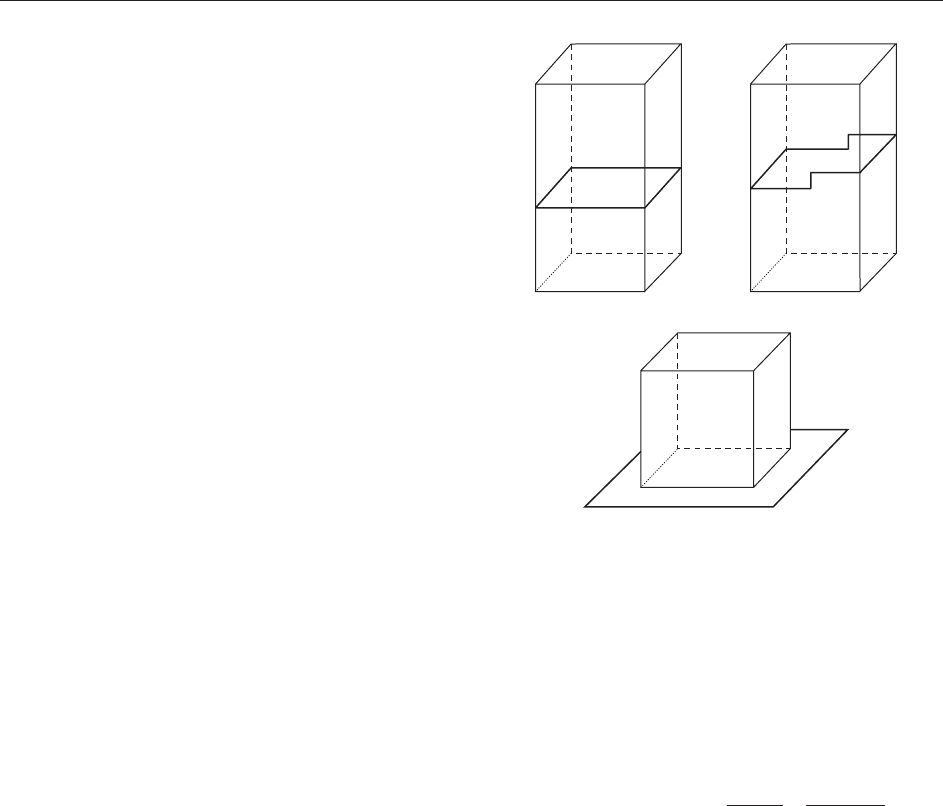
, the configuration being the given boundary
condition (see Figure 2). The corresponding parti-
tion function is denoted by Z
w
(
0
).
Since there are two pure phases in the model, we
must consider two surface free energies, or surfaces
tensions,
wþ
and
w
, between the wall and the
positive or negative phase present in the bulk. They
are defined through the choice of the boundary
condition, (i) = 1or(i) = 1, for all i 2L
0
. Let us
consider first the case of the () boundary condition.
The surface free energy contribution per unit area
due to the presence of the wall, when we have the
negative phase in the bulk, is
w
ð; KÞ
¼ lim
L
1
;L
2
!1
lim
L
3
!1
1
L
1
L
2
ln
Z
w
ð
0
Þ
Z
ðÞ
1=2
½14
The division by Z
()
1=2
allows us to subtract from
the total free energy, ln Z
w
(
0
), the bulk term and
all boundary terms which are not related to the
presence of the wall. The existence of limit [14]
follows from correlation inequalities, and we have
w
0.
One can prove, as well, the existence of the Gibbs
state
w
of the semi-infinite system, associated to
the () boundary condition. This state is the limit of
the finite volume Gibbs measures
0
(
0
j())
defined by the Ham iltonian [13]. It describes the
local equilibrium properties of the system near
the wall, when deep inside the bulk the system is
in the negative phase. Similar definitions give the
surface tension
wþ
and the Gibbs state
wþ
,
corresponding to the boundary condition (i) = 1,
for all i 2
0
.
We remark that the states
wþ
and
w
are invariant
by translations parallel to the plane i
3
= 0, and
introduce the magnetizations, m
w
(z) =
w
((z)),
where z denotes the site (0, 0, z), m
w
= m
w
(0), and
–
–
K
W
+
+
–
–
+
+
–
–
Figure 2 Boundary conditions for the cubic lattice. Above, the
box with the () and (step) boundary conditions. Below, the
box
0
and the wall W with the (w ) boundary conditions.
Statistical Mechanics of Interfaces 59

similarly m
wþ
(z)andm
wþ
. Their connection with
the surface free energies is given by the formula
w
ð; KÞ
wþ
ð; KÞ
¼
Z
K
0
ðm
wþ
ð; sÞm
w
ð; sÞÞds ½15
We mention in the following theorem some
results of Fro¨ hlich and Pfister’s study. Here
is,
as before, the usual surface tension between the
two pure phases of the system, for a horizontal
interface.
Theorem 3 With the above definitions, we have
w
ð; KÞ
wþ
ð; KÞ
ðÞ½16
m
wþ
ð; KÞm
w
ð; KÞ0 ½17
and the difference in [17] is a monotone decreasing
function of the parameter K. Moreover, if m
wþ
= m
w
,
then the Gibbs states
wþ
and
w
coincide.
The proof is a subtle application of correlation
inequalities. Since, from Theorem 3, the integrand in
eqn [15] is a positive and decreasing function, the
difference =
w
wþ
is a monotone increasing
and concave (and hence continuous) function of the
parameter K. On the other hand, one can prove that
=
,ifK J. This justifies the following
definition:
K
w
ðÞ¼minfK:ð; KÞ¼
þ
ðÞg ½18
In the thermodynamic description of wetting, the
partial-wetting regime is characterized by the strict
inequality in [16]. Equivalently, by K < K
w
(). We
must have then m
wþ
6¼ m
w
, because of eqn [15].
This shows that, in the case of partial wetting,
wþ
and
w
are different Gibbs states.
The complete-wetting regime is characterized by the
equality in [16],thatis,byK K
w
(). Then, we have
m
wþ
= m
w
, and taking into account the last statement
in Theorem 3,also
wþ
=
w
. This last result implies
that there is only one Gibbs state. Thus, complete
wetting correspond s to unicity of the Gibbs state.
In this case, we also have lim m
w
(z) = m
, when
z !1, because this is always true for m
wþ
(z). This
indicates that we are in the positive phase of the
system although we have used the () bounda ry
condition, so that the bulk ne gative phase cannot
reach the wall anymore. The film of positive phase,
which wets the wall completely, has an infinite
thickness with respect to the unit lattice spacing, in
the thermodynamic limit.
When = 1, only a few particular ground con-
figurations contribute to the partition functions,
such as the configuration (i) = 1 for the partition
function Z
w
, etc., and we obtain = 2K and
= 2J. For nonzero but low temperatures, the
small perturbations of these ground states have to be
considered, a problem that can be treated by the
method of cluster expansions. In fact, the corre-
sponding defects can be described by closed con-
tours as in the case of pure phases.
Theorem 4 For K < J, the functions
w
(, K)
and
wþ
(, K) are analytic at low temperatures,
that is, provided that (J K) c
2
, where c
2
is a
given constant. Moreover, m
wþ
(z) and m
w
(z) tend,
respectively, to m
and to m
, when z !1,
exponentially fast.
The last statement in Theorem 4 tells us that the
wall affects only a layer of finite thickness (with
respect to the lattice spacing). From a macroscopic
point of view, the negative phase reaches the wall,
and we are in the partial-wetting regime. Indeed, a
strict inequality holds in [16].
Thus, for K < J there is always partial wetting at
low temperatures. Then the following question arises:
Question 2 Is there a situation of complete wetting
at higher temperatures? It is understood here that K
takes a fixed value, characteristic of the substrate,
such that 0 < K < J.
This is known to be the case in dimension d = 2,
where the exact value of K
w
() can be obtained
from Abraham’s solution of the model:
cosh 2K
w
¼ cosh 2J e
2J
sinh 2J
Then complete wetting occurs for in the interval
c
<
w
(K), where
c
is the critical inverse
temperature and
w
(K) is the solution of K
w
() = K.
The case d = 2 has been reviewed in Abraham
(1986).
To our knowledge, the above question remains an
open problem for the Ising model in dimension
d = 3. The problem has, however, been solved for
the simpler case of a SOS interface model. In this
case, a nice and rather brief proof of the following
result has been given by Chalker (1982): one has
m
wþ
= m
w
, and hence complete wetting, if
2ðJ KÞ< lnð1 e
8J
Þ
It is very plausible that a similar statement is valid
for the semi-infinite Ising model and, also that
Chalker’s method could play a role for extending the
proof to this case, provided an additional assum p-
tion is made. Namely, that is sufficiently large,
and hence J K small enough, in order to insure the
convergence of the cluster expansions and to be able
to use them.
60 Statistical Mechanics of Interfaces
Equilibrium Crystals
The shape of an equilibrium crystal is obtained,
according to thermodynamics, by minimizing the
surface free energy between the crystal and the
medium, for a fixed volume of the crystal phase.
Given the orientation-dependent surface tension
(n), the solution to this variational problem,
known under the name of Wulff constru ction, is
the following set:
W¼fx 2 R
3
: x n ðnÞ for all ng½19
Notice that the problem is scale invariant, so that if we
solve it for a given volume of the crystal, we get the
solution for other volumes by an appropriate scaling.
We notice also that the symmetry (n) = (n)isnot
required for the validity of formula [19].Inthepresent
case, (n) is obviously a symmetric function, but
nonsymmetric situations are also physically interesting
and appear, for instance, in the case of a drop on a wall
discussed in the last section.
The surface tension in the Ising model between
the positive and negative phases has been defined in
eqn [7]. In the two-dimensional case, this function
(n) has (as shown by Abraham) an exact expression
in terms of some Onsager’s function. It follows (as
explained in Miracle-Sole (1999)) that the Wulff
shape W, in the plane (x
1
, x
2
), is given by
cosh x
1
þ cosh x
2
cosh
2
2J= sinh 2J
This shape reduces to the empty set for
c
, since
the critical
c
satisfies sinh 2J
c
= 1. For >
c
,itis
a strictly convex set with smooth boundary.
In the three-dimens ional case, only certain inter-
face models can be exactly solved (see the section
‘‘Gibbs states an d interfa ces’’). Consi der the Ising
model at zero temperature. The ground configura-
tions have only one defect, the microscopic interface
, imposed by the bounda ry condition (, n). Then,
from eqn [9], we may write
ð nÞ¼ lim
L
1
;L
2
!1
n
3
L
1
L
2
ðE
ðnÞ
1
N
ðnÞÞ ½20
where E
= 2Jjj is the energy (all ha ve the
same minimal area) and N
the number of
ground states. Every such has the property of
being cut only once by all straight lines orthogo-
nal to the diagonal plane i
1
þ i
2
þ i
3
= 0, provided
that n
k
> 0, for k = 1, 2, 3. Each can then be
described by an integer function defined on a
triangular plane lattice, the projection of the
cubic lattice L on the diagonal plane. The model
defined by t his set of admissible microscopic
interfaces is preci sely the T ISOS model. A sim ilar
definition can be given for the BCSOS model that
describes the ground configurations on the body-
centered cubic lattic e.
From a macroscopic point of view, the roughness
or the rigidity of an interface should be apparent
when considering the shape of the equilibrium
crystal associated with the system. A typical equili-
brium crystal at low temperatures has smooth plane
facets linked by rounded edges and corners. The
area of a particular facet decreases as the tempera-
ture is raised and the facet finally disappears at a
temperature characteristic of its orientation. It can
be argued that the disappearance of the facet
corresponds to the roughening transition of the
interface whose orientation is the same as that of the
considered facet.
The exactly solvable interface models mentioned
above, for which the function (n) has been
computed, are interesting examples of this behavior,
and provide a valuable informat ion on several
aspects of the roughening transition. This subject
has been reviewed by Abraham (1986), van Beijeren
and Nolden (1987),andKotecky (1989).
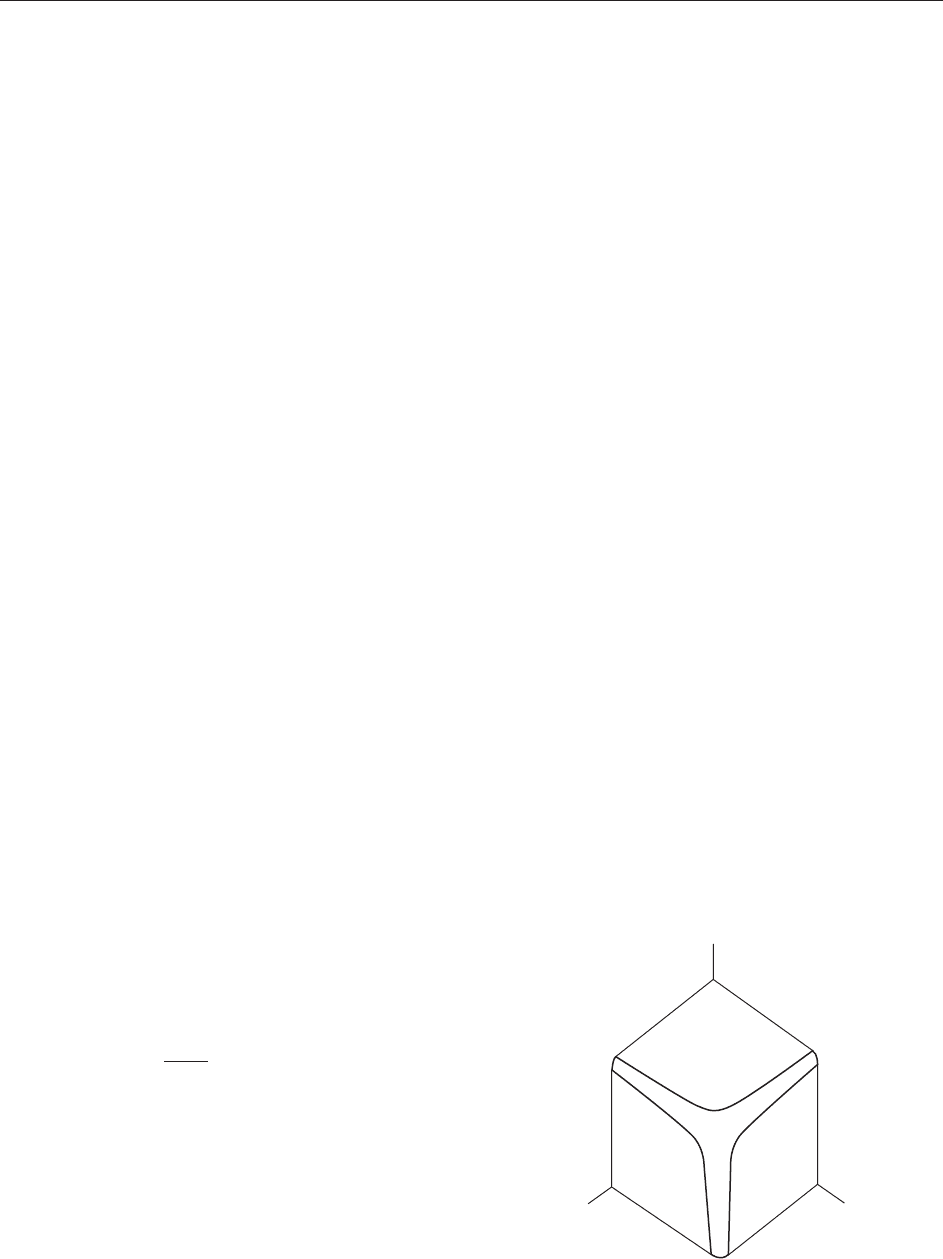
For example, we show in Figure 3 the shape
predicted by the TISOS model (one-eighth of the
shape because of the condition n
k
> 0). In this
model, the interfaces orthogonal to the three
coordinate axes are rigid at low temperatures.
For the three-dimensional Ising model at positive
temperatures, the description of the microscopic
interface, for any orientation n, appears as a very
difficult problem. It has been possib le, however,
to analyze the interfaces which are very near to
the particular orientations n
0
, discussed in the
3
21
Figure 3 Cubic equilibrium crystal shown in a projection
parallel to the (1,1,1) direction. The three regions (1, 2, and 3)
indicate the facets and the remaining area represents a curved
part of the crystal surface.
Statistical Mechanics of Interfaces 61

section ‘‘Gibbs states and interfa ces.’’ This analys is
allows us to determine the shape of the facets in a
rigorous way.
We first observe that the appearance of a facet
in the equilibrium crystal shape is related, according
to the Wulff construction, to the existence of a
discontinuity in the derivative of the surface
tension with respect to the orientation. More
precisely, assume that the surface tension satisfies
the convexity co ndition of Theorem 1, and let this
function (n) = (, ) be expressed in terms of the
spherical coordinates of n, the vector n
0
being taken
as the x
3
-axis. A facet orthogonal to n
0
appears in
the Wulff shape if and only if the derivative
@ (, )=@ is discontinuous at the point = 0,
for all . The facet F@W consists of the points
x 2 R
3
belonging to the plane x
3
= (n
0
) and such
that, for all between 0 and 2,
x
1
cos þ x
2
sin @ ð; Þ=@j
¼0
þ
½21
The step free energy is expected to play an
important role in the facet formation. It is defined
as the free energy associated with the introduction
of a step of height 1 on the interface, and can be
regarded as an order parameter for the roughening
transition. Let be a parallelepiped as in the section
‘‘Pure phases an d surface tension, ’’ and intr oduce
the (step, m) boundary conditions (see Figure 2),
associated to the unit vectors m = ( cos , sin ) 2
R
2
,by
ðiÞ¼
1ifi > 0orifi
3
¼ 0and
i
1
m
1
þ i
2
m
2
0
1 otherwise
8
>
<
>
:
½22
Then, the step free energy per unit length for a step
orthogonal to m (with m
2
> 0) on the horizontal
interface, is
step
ðÞ
¼ lim
L
1
!1
lim
L
2
!1
lim
L
3
!1
cos
L
1
ln
Z
step;m
ðÞ
Z
;n
0
ðÞ
½23
A first result concerning this point was obtained
by Bricmont and co-workers, by proving a correla-
tion inequality which establish
step
(0) as a lower
bound to the one-sided derivative @ (,0)=@ at
= 0
þ
(the inequality extends also to 6¼ 0). Thus,
when
step
> 0, a facet is expected.
Using the perturbation theory of the horizontal
interface, it is possible to also study the microscopic
interfaces associated with the (step, m) boundary
conditions. When considering these configurations,
the step may be viewed as an additional defect on
the rigid inte rface described in the section ‘‘Pure
phases and surface tension .’’ It is, in fact , a long wall
going from one side to the other side of the box .
The step structure at low temperatures can then be
analyzed with the help of a new cluster expansion.
As a consequence of this analysis, we have the
following theorem.
Theorem 5 If the temperature is low enough, that
is, if J c
3
, where c
3
is a given constant, then the
step free energy,
step
(), exists, is strictly positive,
and extends by positive homogeneity to a strictly
convex function. Moreover,
step
() is an analytic
function of = e
2J
, for which an explicit conver-
gent series expansion can be found.
Using the above results on the step structure,
similar methods allow us to evaluate the increment
in surface tension of an interface tilted by a very
small angle with respect to the rigid horizontal
interface. This increment can be expressed in terms
of the step free energy, and one obtains the
following relation.
Theorem 6 For J c
3
, we have
@ ð; Þ=@j
¼0
þ
¼
step
ðÞ½24
This relation, together with eqn [21], implies that
one obtains the shape of the facet by means of the
two-dimensional Wulff construction applied to the
step free energy. The reader will find a detailed
discussion on these points, as well as the proofs of
Theorems 5 and 6,inMiracle-Sole (1995).
From the properties of
step
stated in Theorem 5,
it follows that the Wulff equilibrium crystal presents
well-defined boundary lines, smooth and without
straight segments, between a rounded part of the
crystal surface and the facets parallel to the three
main lattice planes.
It is expected, but not proved, that at a higher
temperature, but before reaching the critical
temperature, the facets associated with the Ising
model undergo a roughening transition. It is then
natural to believe that the equality [24] is true for
any larger than
R
, allowing us to determine the
facet shape from eqns [21] and [24], and that for
R
, both sides in this equality vanish, and
thus, the disappearance of the facet is involved.
However, the condition that the temperature is
low enough is needed in the proofs of Theorems 5
and 6.
See also: Dimer Problems; Phase Transitions in
Continuous Systems; Phase Transition Dynamics;
Two-Dimensional Ising Model; Wulff Droplets.
62 Statistical Mechanics of Interfaces

Further Reading
Abraham DB (1986) Surface structures and phase transitions. In:
Domb C and Lebowitz JL (eds.) Critical Phenomena, vol. 10,
pp. 1–74. London: Academic Press.
Chalker JT (1982) The pinning of an interface by a planar defect.
Journal of Physics A: Mathematical and General 15:
L481–L485.
Fro
¨
hlich J and Pfister CE (1987) Semi-infinite Ising model. I.
Communications in Mathematical Physics 109: 493–523.
Fro¨ hlich J and Pfister CE (1987) Semi-infinite Ising model. II.
Communication in Mathematical Physics 112: 51–74.
Gallavotti G (1999) Statistical Mechanics: A Short Treatise.
Berlin: Springer.
Kotecky R (1989) Statistical mechanics of interfaces and
equilibrium crystal shapes. In: Simon B, Truman A, and
Davies IM (eds.) IX International Congress of Mathematical
Physics, pp. 148–163. Bristol: Adam Hilger.
Lebowitz JL and Pfister CE (1981) Surface tension and phase
coexistence. Physical Review Letters 46: 1031–1033.
Messager A, Miracle-Sole S, and Ruiz J (1992) Convexity
properties of the surface tension and equilibrium crystals.
Journal of Statistical Physics 67: 449–470.
Miracle-Sole S (1995) Surface tension, step free energy and facets
in the equilibrium crystal shape. Journal of Statistical Physics
79: 183–214.
Miracle-Sole S (1999) Facet shapes in a Wulff crystal. In: Miracle-
Sole S, Ruiz J, and Zagrebnov V (eds.) Mathematical Results
in Statistical Mechanics, pp. 83–101. Singapore: World
Scientific.
van Beijeren H and Nolden I (1987) The roughening transition.
In: Schommers W and von Blackenhagen P (eds.) Topics in
Current Physics, vol. 43. pp. 259–300. Berlin: Springer.
Widom B (1991) Interfacial phenomena. In: Hansen JP, Levesque D,
and Zinn-Justin J (eds.) Liquid, Freezing and the Glass
Transition, pp. 506–546. Amsterdam: North-Holland.
Wolf PE, Balibar S, and Gallet F (1983) Experimental observa-
tions of a third roughening transition in hcp
4
He crystals.
Physical Review Letters 51: 1366–1369.
Stochastic Differential Equations
F Russo, Universite
´
Paris 13, Villetaneuse, France
ª 2006 Elsevier Ltd. All rights reserved.
Introduction
Stochastic differential equ ations (SDEs) appear
today as a modeling tool in several sciences as
telecommunications, economics, finance, biology,
and quantum field theory.
An SDE is essentially a classical differential
equation which is perturbed by a random noise.
When nothing else is specified, SDE means in fact
ordinary SDE; in that case it corresponds to the
perturbation of an ordinary differential equation.
Stochastic partial differential equations (SPDEs) are
obtained as random perturbation of partial differ-
ential equations (PDEs).
One of the most important differe nce between
deterministic and stochastic ordinary differential
equations is described by the so-called Peano type
phenomenon. A classical differential equation with
continuous and linear growth coefficients admits
global existence but not uniqueness as classical
calculus text books illustrate studying equations of
the type
dX
dt
ðtÞ¼
ffiffiffiffiffiffiffiffiffiffi
XðtÞ
p
; Xð0Þ¼0
However, if one perturbs the right member of the
equality with an additive Gaussian white noise (
t
)
(even with very small intensity), then the problem
becomes well stated. A similar phenomenon happens
with linear PDEs of evolution type perturbed with a
spacetime white noise.
SDEs constitute a vast subject and account for an
incredible amount of relevant contributions. We try
to orientate the reader about the main axes trying to
indicate references to the different subfields. We will
prefer to refer to monographs when available,
instead of articles.
Motivation and Preliminaries
In the whole article T will be a strictly positive real
number. Let us consider continuous functions
b : R
þ
R
d
!R
d
, a : R
þ
R
dm
!R
d
and x
0
2 R
d
.
We consider a differential problem of the following
type:
dX
t
dt
¼ bðt; X
t
Þ
X
0
¼x
0
½1
Let (, F, P) be a complete probability space.
Suppose that previous equation is perturbed by a
random noise (
t
)
t0
. Because of modeling reasons it
could be reasonable to suppose (
t
)
t0
satisfying the
following properties.
1. It is a family of independent random variables
(r.v.’s)
2. (
t
)
t0
is ‘‘stationary’’, that is, for any posit ive
integer n, positive reals h, t
0
, t
1
, ..., t
n
, the law of
(
t
0
þh
, ...,
t
n
þh
) does not depend on h.
Stochastic Differential Equations 63

More precisely we perturb eqn [1] as follows:
dX
t
dt
¼ bðt; X
t
Þþaðt; X
t
Þ
t
X
0
¼ x
0
½2
We suppose for a moment that d = m = 1. In reality no
reasonable real-valued process (
t
)
t0
fulfilling pre-
vious assumptions exists. In particular, if process (
t
)
exists (resp. (
t
) exists and each
t
is a square-
integrable r.v.), then the process cannot have contin-
uous paths (resp. it cannot be measurable with respect
to R
þ
). However, suppose that such a process
exists; we set B
t
=
R
t
0
s
ds. In that case, properties (1)
and (2) can be translated into the following on (B
t
).
(P1) It has independent increments, which means
that for any t
0
, ..., t
n
, h 0, B
t
1
þh
B
t
0
þh
, ...,
B
t
n
þh
B
t
n1
þh
are independent r.v.’s.
(P2) It has stationary increments, which means that
for any t
0
, ..., t
n
, h 0, the law of (B
t
1
þh
B
t
0
þh
,...,B
t
n
þh
B
t
n1
þh
) does not depend on h.
On the other hand, it is natural to require that
(C1) B
0
= 0 a.s.,
(C2) it is a continuous process, that is, it has
continuous paths a.s.
Equation [2] should be rewritten in some integral form
X
t
¼ X
0
þ
Z
t
0
bðs; X
s
Þds
þ
Z
t
0
aðs; X
s
ÞdB
s
½3
Clearly the paths of process (B
t
) cann ot be differ-
entiable, so one has to give meaning to integral
R
t
0
a(s, X
s
)dB
s
. This will be intended in the ‘‘Itoˆ’’
sense, see considerations below.
An important result of probability theory says
that a stochastic process (B
t
) fulfill ing properties P1,
P2 and C1, C2 is esse ntially a ‘‘Brownian motion’’.
More precisely, there are real constants b, such
that B
t
= bt þ W
t
, where (W
t
) is a classical Brow-
nian motion defined below.
Definition 1
(i) A (continuous) stochastic process (W
t
) is called
classical ‘‘Brownian motion’’ if W
0
= 0 a.s.,
it has independent increments and the law of
W
t
W
s
is a Gaussian N(0, t s) r.v.
(ii) A m-dimensional Brownian motion is a vector
(W
1
, ..., W
m
) of independent classical Brow-
nian motions.
Let (F
t
)
t0
be a filtration fulfilling the usual
conditions, see (Karatzas and Shreve (1991, section 1.1).
There one can find basic concepts of the theory of
stochastic processes as the concept of adapted,
progressively measurable proces s. An adapted pro-
cess is also said to be nonanticipating towards the
filtration (F
t
) which represents the state of the
information at each time t. A process (X
t
) is said to
be adapted if for any t, X
t
is F
t
-measurable. The
notion of progressively measurable process is a slight
refinement of the notion of adapted process.
Definition 2
(i) A (continuous) (F
t
) adapted process (W
t
) is called
(classical) (F
t
)-Brownian motion if W
0
= 0, if
for any s < tW
t
W
s
is an N(0, t s ) distrib-
uted r.v. which is independent of F
s
.
(ii) An (F
t
)-m-dimensional Brownian motion is a
vector (W
1
, ..., W
m
)of(F
t
)-classical indepen-
dent Brownian motions.
From now on, we will consider a probability
space (, F, P) equipped with a filtration (F
t
)
t0
fulfilling the usual conditions. From now on all the
considered filtrations will have that property.
Let W = (W
t
)
t0
be an (F
t
)
t0
-m-dimensional clas-
sical Brownian motion. In Karatzas and Shreve (1991,
chapter 3) and Revuz and Yor (1999, chapter 4), one
introduces the notion of stochastic Itoˆintegral
announced before. Let Y = (Y
1
, ..., Y
m
)beaprogres-
sively measurable m-dimensional process such that
R
T
0
kY
s
k
2
ds < 1, then the Itoˆintegral
R
T
0
Y
s
dW
s
is well
defined. In particular the indefinite integral
R
0
Y
s
dW
s
is
an (F
t
)-progressively measurable continuous process.
If Y is an R
dm
matrix-valued process, the integral
R
t
0
Y
s
dW
s
is componentwise defined and it will be a
vector in R
d
. The analogous of differential calculus in
the framework of stochastic processes is Itoˆ calculus,
see again Karatzas and Shreve (1991, chapter 3) and
Revuz and Yor (1999, chapter 4). Important tools are
the concept of quadratic variation [X]ofastochastic
process when it exists. For instance, the quadratic
variation [W]
t
of a classical Brownian motion equals t.
If M
t
=
R
t
0
Y
s
dW
s
,then[M]
t
=
R
t
0
kY
s
k
2
ds. One cele-
brated theorem of P Le´vy states the following: if (M
t
)
defines a continuous (F
t
)-local martingale such that
[M
t
] t,thenM is an (F
t
)-classical Brownian motion.
That theorem is called the ‘‘Le´vy characterization
theorem of Brownian motion.’’ Itoˆ formula constitutes
the natural generalization of fundamental theorem of
differential calculus to the stochastic calculus. Another
significant tool is Girsanov theorem; it states essen-
tially the following: suppose that the following so-
called ‘‘Novikov condition’’ is verified:
E exp
1
2
Z
T
0
kY
t
k
2
dt
< 1
64 Stochastic Differential Equations

Then the process
~
W
t
= W
t
þ
R
t
0
Y
s
ds, t 2 [0, T]is
again an m-dimensional (F
t
)-classical Brownian
motion under a new probability measure Q on
(, F
T
) defined by
dQ ¼ dP exp
Z
t
0
Y
s
dW
s
1
2
kY
s
k
2
ds
Let be an F
0
-measurable r.v., for instance,
x 2 R
d
. We are interested in the SDE
dX
t
¼aðt; X
t
ÞdW
t
þ bðt; X
t
Þdt
X
0
¼
½4
Definition 3 A progressively measurable process
(X
t
)
t2[0, T]
is said to be solution of [4] if a.s.
X
t
¼ Z þ
Z
t
0
aðt; X
t
ÞdW
t
þ
Z
t
0
bðt; X
t
Þdt
8t 2½0; T
½5
provided that the right-hand side member makes
sense. In particular, such a solution is continuous.
The function a (resp. b) is called the diffusion (drift)
coefficient of the SDE. a and b may sometimes be
allowed to be random; however, this dependence
has to be progressively measurable. Clearly, we can
define the notion of solution (X
t
)
t0
on the whole
positive real axis.
We remark that those equations are called Itoˆ
SDEs. A solution of previous equation is named
diffusion process.
The Lipschitz Case
The most natural framework for studyi ng the
existence and uniqueness for SDEs appears when
the coefficients are Lipschitz.
A function : [0, T] R
m
! R
d
is said to have
‘‘polynomial growth’’ (with respect to x uniformly in
t), if for some n there is a constant C > 0 with
sup
t2½0;T
kðt; xÞk Cð1 þkxk
n
Þ½6
The same function is said to have ‘‘linear growth’’ if
[6] holds with n = 1. A function : R
þ
R
m
!R
d
is
said to be ‘‘locally Lipschitz’’ (with respect to
x uniformly in t), if for every t 2 [0, T], K > 0,
j[0, T][K, K]
is Lipsch itz (with respect to x uniformly
with respect to t).
Let a : R
þ
R
dm
! R
d
, b : R
þ
R
d
! R
d
,be
Borel functions, an R
d
-valued r.v. F
0
-measurable
and (W
t
)
t0
be a m-dimensional (F
t
)-Brownian
motion.
Classical fixed-point theorems allow to establish
the following classical result.
Theorem 1 We suppose a and b locally Lipschitz
with linear growth. Let be a square-integrable r.v.
that is F
0
-measurable. Then [4] has a unique
solution X. Moreover,
E sup
tT
jX
t
j
2
!
< 1
Remark 1
(i) Equation [4] can be settle d similarly by putting
initial con dition x at some time s. In that case
the problem is again well stated. If x is a
deterministic point of R
d
, then we will often
denote by X
s, x
the solution of that problem.
(ii) If the coefficients are only locally Lipschitz, the
equation may be solved until a stopping time. If
d = 1, it is possible to state necessary and sufficient
conditions for nonexplosion (Feller test).
(iii) The theorem above admits several generaliza-
tions. For instance, the Brownian motion can be
replaced by general semimartingales, (possibly
with jumps as Le´vy processes) .
An important role of diffusion processes is the fact
that they provide probabilistic representatio n to
PDEs of parabolic (and even elliptic) type. We will
only mention here the parabolic framework.
We denote A(t, x) = a(t, x)a(t, x)
, where means
transposition for matrices. (t, x) !A(t, x) = (A
ij
(t, x))
is a d d matrix-valued function. Let us consider also
continuous functions k : [0, T] R
d
!R
d
, g : [0, T]
R
d
!R
d
with polynomial growth or non-negative.
Given a solution of [4], we can associate its
generator (L
t
, t 2 [0, T]) setting
L
t
f ðxÞ¼
1
2
X
d
i;j¼1
A
ij
ðt; xÞ@
2
ij
f ðxÞþbðt; xÞrf ðxÞ
Feynman–Kac theorem is stated below and it
provides probabilistic representation of an asso-
ciated parabolic linear PDEs.
Theorem 2 Suppose there is a function v : [0, T[
R
d
!R
d
continuous with polynomial growth of
class C
1, 2
([0, T] R
d
) satisfying the following
Cauchy problem:
ð@
t
v þ L
t
Þv kv ¼ g
vðT; xÞ¼f ðxÞ
½7
Then
vðs; xÞ¼EfðX
T
Þexp
Z
T
s
kð; X
Þd
Z
T
s
gðt; X
t
Þexp
Z
t
s
kð; X
Þd
dt
Stochastic Differential Equations 65

for (s, x) 2 [0, T] R
d
, where X = X
s, x
. In particu-
lar, such a solution is unique.
Remark 2
(i) In order to obtain ‘‘classical solutions’’ of the
above Cauchy problem, one needs some condi-
tions. It is the case, for instance, when the
following ellipticity condition holds on A:
9c > 0; 8ðt;xÞ2½0;TR
n
; 8ð
1
;...;
n
Þ2R
n
X
d
i;j
A
ij
ðt;xÞ
i
j
c
X
d
i¼1
j
i
j
2
½8
In the degenerate case, it is possible to deal with
viscosity solutions, in the sense of P L Lions.
This theorem establishes an important link
between deterministic PDEs and SDEs.
(ii) A natural generalization of Feynman–Kac theo-
rem comes from the system of forward–backward
SDEs in the sense of Pardoux and Peng.
(iii) Other types of probabilistic representation do
appear in stochastic control theory through the
so-called verification theorems, see for instance,
Fleming and Soner (1993) and Yong and Zhou
(1999). In that case, the (nonlinear) Hamilton–
Jacobi–Bellmann deterministic equation is
represented by a controlled SDE.
(iv) Another bridge between nonlinear PDEs and
diffusions can be provided in the framework of
interacting particle systems with chaos propaga-
tion, see Graham et al. (1996) for a survey on
those problems. Among the most significant
nonlinear PDEs investigated probabilistically, we
quote the case of porous media equations. For
instance, for a positive integer m, a solution to
@
t
u ¼
1
2
@
2
xx
ðu
2mþ1
Þ½9
can be represented by a (nonlinear) diffusion of
the type, see Benachour et al. (19 96),
d X
t
¼ u
m
ðs; X
s
ÞdW
t
uðt; Þ ¼ law density of X
t
½10
Different Notions of Solutions
Let a and b as at the beginning of the previous
section. Let (, F, P) be a probability space, a
filtration (F
t
)
t0
fulfilling the usual conditions, an
(F
t
)
t 0
-cl assical Bro wnian motion (W
t
)
t 0
. Let be
an F
0
-me asurable r.v. In the section ‘‘Mot ivation
and preliminar ies,’’ we defined the notion of so lu-
tion of the following equation:
d X
t
¼ bðt; X
t
Þdt þ aðt; X
t
ÞdW
t
X
0
¼
½11
This equation will be denoted by E(a, b)(withoutinitial
condition). However, as we will see, the general
concept of solution of an SDE is more sophisticated
and subtle than in the deterministic case. We distin-
guish several variants of existence and uniqueness.
Definition 4 (Strong existence). We will say that
equation E(a, b) admits strong existenc e if the
following holds. Given any probability space
(, F, P), a filtration (F
t
)
t0
,an(F
t
)
t0
-Brownian
motion (W
t
)
t0
,anF
0
-measurable and square-
integrable r.v. , there is a process (X
t
)
t0
solution
to E(a, b) with X
0
= a.s.
Definition 5 (Pathwise uniqueness). We will say
that equation E(a, b) admits pathwise uniqueness if
the following property is fulfilled. Let (, F, P)bea
probability space, a filtration (F
t
)
t0
,an(F
t
)
t0
Brownian motion (W
t
)
t0
. If two processes X,
~
X are
two solutions such that X
0
=
~
X
0
a.s., then X and
~
X
coincide.
Definition 6 (Existence in law or weak existence).
Let be a probability law on R
d
. We will say that
E(a, b; ) admits weak existence if there is a
probability space (, F, P), a filtration (F
t
)
t0
,an
(F
t
)
t0
-Brownian motion (W
t
)
t0
, and a process
(X
t
)
t0
solution of E(a, b)with being the law of X
0
.
We say that E(a, b) admits weak existence if
E(a, b; ) admits weak existence for every .
Definition 7 (Uniqueness in law). Let be a
probability law on R
d
. We say that E(a, b; )hasa
unique solution in law if the following holds. We
consider an arbitrary probab ility space (, F, P) and
a filtration (F
t
)
t0
on it; we consider also another
probability space (
˜
,
~
F,
~
P) equipped with another
filtration (
~
F
t
)
t0
; we consider an (F
t
)
t0
-Brownian
motion (W
t
)
t0
, and an (
~
F
t
)
t0
-Brownian motion
(
~
W
t
)
t0
; we suppose having a process (X
t
)
t0
(resp. a
process (
~
X
t
)
t0
) solution of E(a, b) on the first (resp.
on the second) probability space such that both the
law of X
0
and
~
X
0
are identical to . Then X and
~
X
must have the same law as r.v. with values in
E = C(R
þ
) (or C[0, T]).
We say that E (a, b) has a unique solution in law if
E(a, b; ) has a unique solution in law for every .
There are important theorems which establish
bridges among the preceding notions. One of the
most celebrated is the following.
Proposition 1 (Yamada–Watanabe). Consider the
equation E(a, b).
(i) Pathwise uniqueness implies uniqueness in law.
(ii) Weak existence and pathwise uniqueness imply
strong existence.
66 Stochastic Differential Equations

A version can be stated for E(a, b; ) where is a
fixed probability law.
Remark 3
(i) If a and b are locally Lipschitz with linear
growth, Theorem [1] implies that E(a, b) admits
strong existence and pathwise uniqueness.
(ii) If a and b are only locally Lipschitz, then
pathwise uniqueness is fulfill ed.
Existence and Uniqueness in Law
A way to create weak solutions of E(1, b) when
(t, x) !b(t, x) is Borel with linear growth is the
Girsanov theorem. Suppose d = 1 for simplicity. Let
us consider an (F
t
)-classical Brownian motion (X
t
).
We set
W
t
¼ X
t
Z
t
0
bðs; X
s
Þds
Under some suitable probability Q,(W
t
)isan(F
t
)-
classical Brownian motion. Therefore, (X
t
) provides
a solution to E(1, b;
0
).
We continue with an example where E(a, b) does
not admit pathwise uniqueness, even though it
admits uniqueness in law.
Example 1 We consider the stochastic equation
X
t
¼
Z
t
0
signðX
s
ÞdW
s
½12
with
signðxÞ¼
1ifx 0
1ifx < 0
It corresponds to E(a, b;
0
) with b = 0and
a(x) = sign(x).
If (W
t
)
t0
is an (F
t
)-classical Brownian motion,
then (X
t
)
t0
is (F
t
)
t0
-continuous local martingale
vanishing at zero such that [X]
t
t. According to
Le´vy characterization theorem stated earlier, X is an
(F
t
)
t0
-classical Brownian motion. This shows in
particular that E(a, b;
0
) admits uniqueness in law.
In the sequel, we will show that E(a, b;
0
) also
admits weak existence.
Let now (, F, P) be a probability space, an
(F
t
)
t0
-classical Brownian motion with respect to a
filtration and (X
t
)
t0
such that [12] is verified. Then
~
X
t
= X
t
can also be shown to be a solution.
Therefore, E(a, b;
0
) does not admit pathwise
uniqueness.
We continue stat ing a result true in the multi-
dimensional case.
Proposition 3 (Stroo ck–Varadhan). Let be a
probability on R
d
such that
Z
R
kxk
2m
ðdxÞ < þ1 ½13
for a certain m > 1. We suppose that a, b are
continuous with linear growth. Then E(a, b; )
admits weak existence.
From now on, a function : [0, T] R
m
!R
d
will
be said Ho¨ lder-continuous if it is Ho¨ lder-continuous
in the space variable x 2 R
m
uniformly with respect
to the time variable t 2 [0, T].
Stroock and Varadhan (1979) also provide the
following result, which is an easy consequence of
their theorem 7.2.1.
Proposition 4 We suppose a, bbothHo¨ lder-
continuous, bounded such that condition; [8] is
fulfilled. Then SDE E(a, b; ) admits weak uniqueness.
Remark 4
(i) The Ho¨ lder condition and [8] in Proposition 4
may be relaxed and replaced with the solva-
bility of a Cauchy problem of a parabolic PDE
with suitable terminal value.
(ii) In the case d = 1, if a, b are bounded and just
Borel with [8] for x on each compact, then
E(a, b; ) admits weak existence and uniqueness
in law. See Stroock and Varadhan (1979,
exercises 7.3.2 and 7.3.3).
(iii) If d = 2, the same holds as at previous point
provided that moreover a does not depend on
time.
We proceed with some more specifically unidi-
mensional material stating some results from
K J Engelbert and W Schmidt, who furnished
necessary an d sufficient conditions for weak exis-
tence and uniqueness in law of SDEs.
For a Borel function : R !R, we first define
ZðÞ¼fx 2 Rjð xÞ¼0g
then we define the set I(
) as the set of real numbers
x such that
Z
xþ"
x"
dy
2
ðyÞ
¼1; 8">0
Proposition 5 (Engelbert–Schmidt criterion). Sup-
pose that a : R !R, that is, does not depend on time
and we consider the equation without drift E(a, 0).
(i) E(a,0) admits weak existence (without explo-
sion) if and only if
IðaÞZða Þ½14
Stochastic Differential Equations 67

(ii) E(a,0) admits weak existence and uniqueness in
law if and only if
IðaÞ¼Zða Þ½15
Remark 5
(i) If a is continuous then, [14] is always verified.
Indeed, if a(x) 6¼ 0, there is ">0 such that
jaðyÞj > 0; 8y 2½x "; x þ "
Therefore, x cannot belong to I(a).
(ii) Equation [14] is verified also for some discon-
tinuous functions as, for inst ance, a(x) =
sign(x). This confirm s what was affirmed
previously, that is, the weak existence (and
uniqueness in law) for E(a, 0).
(iii) If a(x) = 1
{0}
(x), [14] is not verified.
(iv) If a(x) = jxj
, 1=2, then
ZðaÞ¼Iða Þ¼f0g
So there is at most one solution in law for
E(a, 0).
(v) The proof is technical and makes u se of
Le´ vy character isation theor em of Brownian
motion.
Results on Pathwise Uniqueness
Proposition 6 (Yamada–Watanabe). Let a, b : R
þ
R !R and consider again E(a, b). Suppose b
globally Lipschitz and h : R
þ
!R
þ
strictly increas-
ing continuous such that
(i) h(0) = 0;
(ii)
R
"
0
(1/h
2
)(y)dy = 1, 8">0; and
(iii) ja(t, x) a(t, y )jh(x y).
Then pathwise uniqueness is verified.
Remark 6
(i) In Proposition 6, one typical choice is
h(u) = u
, >1=2.
(ii) Pathwise uniqueness for E(a, b) holds therefore
if b is globally Lipschitz and a is Ho¨ lder-
continuous with paramete r equal to 1/2.
Corollary 1 Suppose that the assumptions of
Proposition 6 are verified and a, b continuous with
linear growth. Then E(a, b; ) admits strong exis-
tence and pathwise uniqueness, whenever verifies
condition [13].
Proof It follows from Propositions 6 and 3
together with Proposition 1 (ii).
&
Remark 7 Suppose d = 1. Pathwise uniqueness for
E(a, b) also holds under the following assumptions.
(i) a, b are bounded, a is time independent and
a const. > 0, h as in Proposition 6. This result
has an analogous form in the case of spacetime
white noise driven SPDEs of parabolic type, as
proved by Bally, Gyongy, and Pardoux in 1994.
(ii) a independent on time, b bounded and a
const. > 0; moreover, ja(x) a( y )j
2
jf (y)
f (x)j and f is increasing and bounded.
For illustration we provide some significant
examples.
Example 2
X
t
¼
Z
t
0
jX
s
j
dW
s
; t 0 ½16
We set a(x) = jxj
,0<<1. This is equation
E(a, 0) with a(x) = jxj
. According to Engelbert–
Schmidt notations, we have Z(a) = {0}. Moreover
(i) If 1=2, then I(a) = {0}.
(ii) If <1=2 then I(a) = ;.
Therefore, according to Proposition 5, E(a,0) admits
weak existence. On the other hand, if 1=2,
jx
y
jhðjx yjÞ ½17
where h(z) = z
. According to Proposition 6, [16]
admits pathwise uniqueness and by Corollary [1],
also strong existence. The unique solution is X 0.
If <1=2, X 0 is always a solution. This is not
the only one; even uniqueness in law is not true.
Example 3 Let a (x) =
ffiffiffiffiffiffi
jxj
p
, b Lipschitz. Then
E(a, b) admits strong existence and pathwise unique-
ness. In fact, a is Ho¨ lder-continuous with parameter
1/2 and the second item of Remark 6 applies; so
pathwise uniqueness holds. Strong existence is a
consequence of Propositions 3 and 1 (ii).
An interesting particular case is provided by the
following equation. Let x
0
, , 0, k 2 R. The
following equation admits strong existence and
pathwise uniqueness.
Z
t
¼ x
0
þ
Z
t
0
ffiffiffiffiffiffiffiffi
jZ
s
j
p
dW
s
þ
Z
t
0
ð kX
s
Þds
t 2½0; T½18
Equation [18] is widely used in mathematical finance
and it constitutes the model of Cox–Ingersoll–Ross:
the solution of the mentioned equation represents the
short interest rate.
Consider now the particular case where k = 0,
= 2. According to some comparison theorem for
SDEs, the solution Z is always non-negative and
68 Stochastic Differential Equations