
Francoise J.-P., Naber G.L., Tsun T.S. (editors) Encyclopedia of Mathematical Physics
Подождите немного. Документ загружается.


DeWilde M and Lecomte PBA (1983) Existence of star-products
and of formal deformations of the Poisson Lie algebra of
arbitrary symplectic manifolds. Letters in Mathematical
Physics 7: 487–496.
Dito G and Sternheimer D (2002) Deformation quantization:
genesis, developments and metamorphoses. In: Halbout G
(ed.) Deformation Quantization, IRMA Lectures in Mathe-
matics and Theoretical Physics, vol. 1, pp. 9–54. Berlin:
Walter de Gruyter.
Fedosov BV (1986) Quantization and the index. Soviet Physics
Doklady 31(11): 877–878.
Gutt S (2000) Variations on deformation quantization. In: Dito G and
Sternheimer D (eds.) Confe´rence Moshe´ Flato 1999. Quantiza-
tion, Deformations, and Symmetries, Mathematical Physics
Studies, vol. 21, pp. 217–254. Dordrecht: Kluwer Academic.
Jurco B, Schupp P, and Wess J (2002) Noncommutative line
bundles and Morita equivalence. Letters of Mathematical
Physics 61: 171–186.
Kontsevich M (2003) Deformation quantization of Poisson
manifolds. Letters in Mathematical Physics 66: 157–216.
Nest R and Tsygan B (1995) Algebraic index theorem. Commu-
nications in Mathematical Physics 172: 223–262.
Omori H, Maeda Y, and Yoshioka A (1991) Weyl manifolds and
deformation quantization. Advanced Mathematics 85:
224–255.
Waldmann S (2002) On the representation theory of deformation
quantization. In: Halbout G (ed.) Deformation Quantization,
IRMA Lectures in Mathematics and Theoretical Physics,
vol. 1, pp. 107–133. Berlin: Walter de Gruyter.
Waldmann S (2005) States and representation theory in deforma-
tion quantization. Reviews of Mathematical Physics 17:
15–75.
Weinstein A and Xu P (1998) Hochschild cohomology and
characteristic classes for star-products. In: Khovanskij A,
Varchenko A, and Vassiliev V (eds.) Geometry of Differential
Equations, pp. 177–194. Dedicated to VI Arnol’d on the
occasion of his 60th birthday. Providence, RI: American
Mathematical Society.
Deformation Theory
M J Pflaum, Johann Wolfgang Goethe-Universita
¨
t,
Frankfurt, Germany
ª 2006 Elsevier Ltd. All rights reserved.
Introduction and Historical Remarks
In mathematical deformation theory one studies how
an object in a certain category of spaces can be varied
as a function of the points of a parameter space. In
other words, deformation theory thus deals with the
structure of families of objects like varieties, singula-
rities, vector bundles, coherent sheaves, algebras, or
differentiable maps. Deformation problems appear in
various areas of mathematics, in particular in algebra,
algebraic and analytic geometry, and mathematical
physics. According to Deligne, there is a common
philosophy behind all deformation problems in
characteristic zero. It is the goal of this survey to
explain this point of view. Moreover, we will provide
several examples with relevance for mathematical
physics.
Historically, modern deformation theory has its
roots in the work of Grothendieck, Artin, Quillen,
Schlessinger, Kodaira–Spencer, Kuranishi, Deligne,
Grauert, Gerstenhaber, and Arnol’d. The applica-
tion of deformation methods to quantization
theory goes back to Bayen–Flato–Fronsdal–
Lichnerowicz–Sternheimer, and has led to the
concept of a star product on symplectic and
Poisson manifolds. The existence of such star
products has been proved by de Wilde–Lecomte
and Fedosov for symplectic and by Kontsevich for
Poisson manifolds.
Recently, Fukaya and Kontsevich have found a
far-reaching connection between general deforma-
tion theory, the theory of moduli, and mirror
symmetry. Thus, deformation theory comes back to
its origins, which lie in the desire to construct
moduli spaces. Briefly, a moduli problem can be
described as the attempt to collect all isomorphism
classes of spaces of a certain type into one single
object, the moduli space, and then to study its
geometric and analytic properties. The observations
by Fukaya and Kontsevich have led to new insight
into the algebraic geometry of mirror varieties and
their application to string theory.
Basic Definitions and Examples
Deformation theory is based on the notion of a
ringed space, so we briefly recall its definition.
Definition 1 Let k be a field. By a k-ringed space
one understands a topological space X together with
a sheaf A of unital k-algebras on X. The sheaf A will
be called the structure sheaf of the ringed space. In
case each of the stalks A
x
, x 2 X, is a local algebra,
that is, has a unique maximal ideal m
x
, one calls
(X, A) a locally k-ringed space. Likewise, one defines
a commutative k-ringed space as a ringed space
such that the stalks of the structure sheaf are all
commutative.
Given two k-ringed spaces (X, A) and (Y, B), a
morphism from (X, A)to(Y, B) is a pair (f, ’), where
16 Deformation Theory
f : X !Y is a continuous mapping and ’ : f
1
B!Aa
morphism of sheaves of algebras. This means in
particular that for every point x 2 X there is a
homomorphism of algebras ’
x
: B
f (x)
!A
x
induced
by ’. Under the assumption that both ringed spaces
are local, (f , ’) is called a morphism of locally ringed
spaces, if each ’
x
is a homomorphism of local
k-algebras, that is, maps the maximal ideal of B
f (x)
to the one of A
x
.
Clearly, k-ringed spaces (resp. locally or commu-
tative k-ringed spaces) together with their morphisms
form a category. The following is a list of examples of
ringed spaces, in particular of those which will be
needed later.
Example 2
(i) Denote by C
1
the sheaf of smooth functions on
R
n
,byC
!
the sheaf of real analytic functions,
and let O be the sheaf of holomorphic functions
on C
n
. Then ( R
n
, C
1
), (R
n
, C
!
), and (C
n
, O) are
ringed spaces over R resp. C.
(ii) A differentiable manifold of dimension n can be
understood as a locally R-ringed space (M, C
1
M
)
which locally is isomorphic to (R
n
, C
1
). Likewise,
a real analytic manifold is a ringed space (M, C
!
M
)
which locally can be modeled by (R
n
, C
!
), and a
complex manifold is an (M, O
M
) which locally
looks like (C
n
, O).
(iii) Let D be a domain in C
n
, and J an ideal sheaf
in O
D
of finite type, which means that J is
locally finitely generated over O
D
. Let Y be the
support of the quotient sheaf O
D
=J. The pair
(Y, O
Y
), where O
Y
denotes the restriction of
O
D
=J to Y, then is a ringed space, called a
complex model space. A complex space now is
a ringed space (X, O
X
) which locally looks like
a complex model space (cf.
bi
Grauert and
Remmert 1984).
(iv) Let k be an algebraically closed field, and A
n
the affine space over k of dimension n. Then
A
n
, together with the sheaf of regular functions,
is a ringed space.
(v) Given a ring A, its spectrum Spec A together
with the sheaf of regular functions O
A
forms a
ringed space (cf. (
bi
Hartshorne (1997), section
II.2)). One calls (Spec A, O
A
) an affine scheme.
More genera lly, a scheme is a ringed space
(X, O
X
) which locally can be modeled by affine
schemes.
(vi) Finally, if A is a local k-algebra, the pair (, A)
can be understood as a locally ringed space.
With A the algebra of formal power series k[[t]]
over one variable t, this example plays an
important role in the theory of formal deforma-
tions of algebras.
Definition 3 A morphism (f , ’):(Y, B) ! (P, S)of
ringed spaces is called fibered, if the following
conditions are fulfilled:
(i) (P, S) is a comm utative locally ringed space;
(ii) f : Y ! P is surjective; and
(iii) ’
y
: S
f (y)
!B
y
maps S
f (y)
into the center of B
y
for each y 2 Y.
The fiber of (f , ’) over a point p 2 P then is the
ringed space (Y
p
, B
p
) defined by
Y
p
¼ f
1
ðpÞ; B
p
¼B
jf
1
ðpÞ
=m
p
B
jf
1
ðpÞ
where m
p
is the maximal ideal of S
p
which acts on
B
jf
1
(p)
via ’.
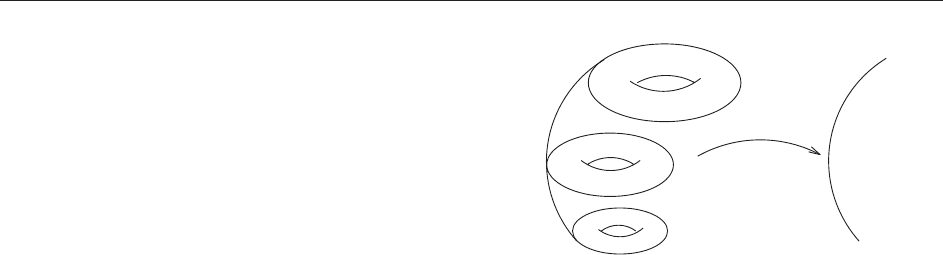
A fibered morphism of ringed spaces can be
pictured in Figure 1.
Additionally to this intuitive picture, conditions
(i)–(iii) imply that the stalks B
y
are central exten-
sions of B
y
=m
f (y)
B
y
by S
f (y)
.
Definition 4 Let (P, S) be a commutative locally
ringed space over a field k with P connected, let be
a fixed point in P, and (X, A)ak-ringed space.
A deformation of (X, A) over the parameter space
(P, S) with distinguished point then is a fibered
morphism (f , ’):(Y, B) !(P, S) over k together with
an isomorphism (i, ):(X, A) !(Y
, B
) such that for
all p 2 P and y 2 f
1
(p) the homomorphism
’
y
: S
p
!B
y
is flat.
The condition of flatness in the definition of a
deformation serves as a substitute for ‘‘local trivi-
ality’’ and works also in the presence of singularities.
(see
bi
Palamodov (1990), section 3) for a discussion of
this point.
In the remainder of this section, we provide a list
of some of the most important deformation pro-
blems in mathematics, and show how these can be
formulated within the above language.
Products of k-Ringed Spaces
Let (X, A) be any k-ringed space and (P, S)a
k-scheme. For any closed point 2P, the product
Y
f
p
P
Y
p
Figure 1 A fibered space.
Deformation Theory 17
(X P, B) = (X, A)
k
(P, S) then is a flat deforma-
tion of (X, A) with distinguished point . This can
be seen easily from the fact that B
(x, p)
= A
x
k
S
p
for
every x 2 X and p 2 P .
Families of Matrices as Deformations
Let (P, O
P
) be a complex space with distinguished
point and A
P
: P ! Mat(n n, C) a holomorphic
family of complex n n matrices over P. By the
following construction, A
P
can be understood as a
deformation, more precisely as a deformation of the
matrix A := A
P
(). Let Y be the graph of A
P
in the
product space P Mat(n n, C)andf : Y !P be
the restriction of the projection onto the first
coordinate. Define the sheaf B as the inverse image
sheaf f
1
S, and let ’ be the sheaf morphism which
for every y 2 Y is induced by the identity map
’
y
: S
f (y)
!B
y
:= S
f (y)
. It is then immediately clear
that (f , ’) is a deformation of the fiber f
1
() and
that this fiber coincides with the matrix A .
Now let A be an arbitrary complex n n-matrix,
and choose a GL(n, C)-slice through A, that is, a
submanifold P containing A which is transversal to the
GL(n, C)-orbit through A. Hereby, it is assumed that
GL(n, C) acts by the adjoint action on Mat(n n, C).
The family A
P
given by the canonical embedding
P ,!Mat(n n, C) now is a deformation of A.The
germ of this deformation at is versal in the sense
defined in the next section.
Deformation of a Scheme a` la Grothendieck
Assume that (P, S) is a connected scheme over k.A
deformation of a scheme (X, A) then is a deforma-
tion (f , ’):(Y, B ) ! (P, S) in the sense defined
above, together with the requirement that f : Y !P
is a proper map, that is, f
1
(K) is compact for every
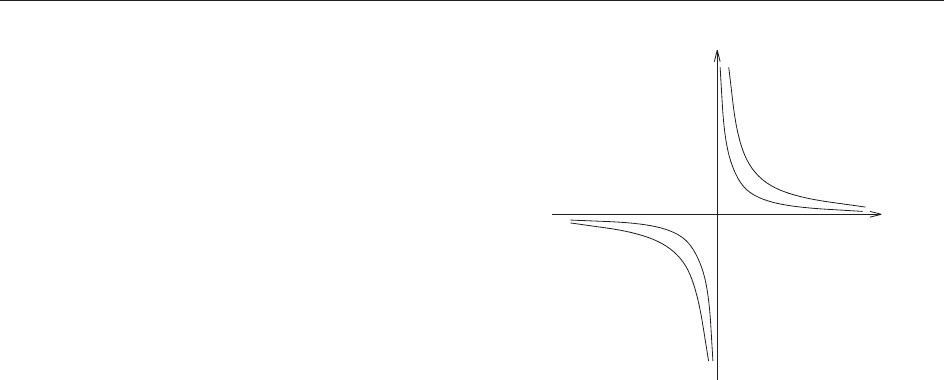
compact K P. As a particular example, consider
the k-scheme Y = Spec k[x, y, t]=(xy t]. It gives rise
to a fibration Y !Spec k[t], whose fibers Y
a
with
a 2 k are hyperbolas xy = a, when a 6¼ 0, and consist
of the two axes x = 0 and y = 0, when a = 0. For
k = R, this deformation can be illustrated as in
Figure 2.
For further information on this and similar
examples, see
bi
Hartshorne (1977), in particular
example 3.3.2.
Deformation of a Complex Space
According to Grothendieck, one understands by a
deformation of a complex space (X, A) a morphism
of complex spaces (f , ’):(Y, B) ! ( P , S) which is
both a proper flat morphism of complex spaces and
a deformation of (X, A) as a ringed space. In case
(X, A) and (P, S) are complex manifolds and if P is
connected, each of the fibers Y
p
is a compact
complex manifold. Moreover, the family (Y
p
)
p2P
then is a family of compact complex manifolds in
the sense of Kodaira–Spencer (cf.
bi
Palamodov
(1990)).
Deformation of Singularities
Let p be a point of some C
n
. Two complex spaces
(X, O
X
) (C
n
, O)and(X
0
, O
X
0
) (C
n
, O) with x 2
X \ X
0
arethencalledgermequivalentatx if there
exists an open neighborhood U 2 C
n
of x such that
X \ U = X
0
\ U.Obviously,germequivalenceatx is
an equivalence relation indeed. We denote the equiva-
lence class of X by [X]
x
.Clearly,if[X]
x
= [X
0
]
x
,then
one has O
X,x
= O
X
0
, x
for the stalks at x.Bya
singularity one understands a pair ([X]
x
, O
X, x
). In the
literature, such a singularity is often denoted by (X, x).
The singularity (X, x) is called nonsingular or regular if
O
X, x
is isomorphic to an algebra of convergent power
series C{z
1
, ..., z
d
}. A deformation of a complex
singularity (X, x) over a complex germ (P, )isa
morphism of ringed spaces ([Y]
x
, O
Y, x
) ! ([P]
, O
P,
)
which is induced by a holomorphic map and which is
a deformation of ([X]
x
, O
X, x
) as a ringed space. See
bi
Artin (1976) and the overview article by
bi
Greuel (1992)
for further details and a variety of examples.
First-Order Deformation of Algebras
Consider a k-algebra A and the truncated poly-
nomial algebra S = k["]="
2
k["]. Furthermore, let :
A A ! A be a Hochschild 2-cocycle of A; in other
words, assume that the relation
a
1
ða
2
; a
3
Þða
1
a
2
; a
3
Þþða
1
; a
2
a
3
Þ
ða
1
; a
2
Þa
3
¼ 0 ½1
holds for all a
1
, a
2
, a
3
2 A. Then one can define a
new k-al gebra B, whose underlying linear structure
y
x
a = 0.5
a
=1
a
= 0
Figure 2 Deformation of the coordinate axes.
18 Deformation Theory

is isomorphic to A
k
S and whose product is give n
by the following construction: any element b 2 B
can be written uniquely in the form b = a
0
þ a
1
",
with a
0
, a
1
2 A. Then the product of b = a
0
þ a
1
" 2 B
and b
0
= a
0
0
þ a
0
1
" 2 B is given by
b b
0
¼ a
0
a
0
0
þ ða
0
; a
0
0
Þþa
0
a
0
1
þ a
1
a
0
0
" ½2
By condition [1], this product is associative. One
thus obtains a flat deformation : S ! B of the
algebra A and calls it the first-order or infinitesimal
deformation of A along the Hochschild cocycle .
For further information on this and the connection
between deformation theory and Hochschild coho-
mology, see the overview article by
bi
Gerstenhaber
and Schack (1986).
Formal Deformation of an Algebra
Let us generalize the preceding example and explain
the concept of a formal deformation of an algebra
by Gerstenhaber. Assume again A to be an arbitrary
k-algebra and choose bilinea r maps
n
: A A ! A
for n 2 N such that
0
is the product on A and
1
is
a Hochschild cocycle. Furthermore, let S be the
algebra k[[t]] of formal power series in one variable
over k. Then define on the linear space B = A[[t]] of
formal power series in one variable with coefficients
in A the following bilinear map:
? : B B ! B
X
n2N
a
n
t
n
;
X
n2N
b
n
t
n
!
7!
X
n2N
X
k;l;m2N
kþlþm¼n
m
ða
k
; b
l
Þt
n
½3
If B together with ? becomes a k -algebra or, in other
words, if ? is associative, one can easily see that it
gives a flat deform ation of A over S = k[[t]]. In that
case, one says that B is a formal deformation of A
by the family (
n
)
n2N
. Contrarily to the preceding
example, there might not exist for every Hochschild
cocycle on A a formal deformation B of A defined
by a family (
n
)
n2N
such that
1
= . In case it
exists, we will say that the deformation B of A is in
the direction of . If the third Hochschild cohomol-
ogy group H
3
(A, A) vanishes, there exists for every
Hochschild cocycle on A a deformation B of A in
the direction of (see again
bi
Gerstenhaber and
Schack (1986) for further details).
Formal Deformation Quantization of Symplectic
and Poisson Manifolds
Let us consider the last two examples for the case
where A is the algebra C
1
(M) of smooth functions on
a symplectic or Poisson manifold M. Then the Poisson
bracket { , } gives a Hochschild cocycle on C
1
(M).
There exists a first-order deformation of C
1
(M) along
(1=2i){ , } and, even though HH
3
(A, A) might not
always vanish, a deformation quantization of M, that
means a formal deformation of C
1
(M) in the
direction of the Poisson bracket (1=2i){ , }. For the
symplectic case, this fact has been proved first by
deWilde–Lecomte using methods from Hochschild
cohomology theory. A more geometric and intuitive
proof has been given by
bi
Fedosov (1996) . The Poisson
case has been settle d in the work of
bi
Kontsevich
(2003 ) (see also the section ‘‘Defor mat ion quantiza-
tion of Poiss on mani folds’’).
Quantized Universal Enveloping Algebras
According to Drinfeld
A quantized universal enveloping algebra for a
complex Lie algebra g is a Hopf algebra A over
C[[t]] such that A is a topologically free C[[t]]-
module (i.e., A = (A=tA)[[t]] as left C[[t]]-module)
and A=tA is the universal enveloping algebra Ug of g.
Because A is a topologically free C[[t]]-module, A is a
flat C[[t]]-module and thus a deformation of Ug over
C[[t]]. See
bi
Drinfel’d (1986) and the monograph by
bi
Kassel (1995) for further details and examples of
quantized universal enveloping algebras.
Quantum Plane
Consider the tensor algebra T =
L
n2N
(R
2
)
n
of
the two-dimensional real vector space R
2
, and let
(x, y) be the canonical basis of R
2
. Then form the
tensor product sheaf T
C
= T
R
O
C
and let I
C
be
the ideal sheaf in T
C
generated by the relation
x y zy x ¼ 0 ½4
where z : C
! C is the identity function. The
quotient sheaf B= B
C
= T
C
=I
C
then is a sheaf of
C-algebras and an O
C
-module. Using eqn [4] now
move all occurrences of x in an element of B
C
to the
right of all y’s. Since 1/ z is an element of O(C
), one
can thus show that B
C
is a free O
C
-module. Hence,
B
C
is flat over O
C
. Further, it is easy to see that for
every q 2 C
the C-algebra A
q
= B
q
=m
q
B
q
is freely
generated by elements x, y with relations
x y qy x ¼ 0 ½5
We call A
q
the q-deformed quantum plane and
B = B(C
) the over C
universally deformed quan-
tum plane. Altogether, one can interpret B as
a deformation of A
q
over C
, in particular as a
deformation of A
1
= T
R
C = C[x, y], the alge bra
of complex polynomials in two generators.
In the same way, one can deform function
algebras on higher-dimensional vector spaces as
well as function algebras on certain Lie groups.
In this mann er, one obtains the quantum group
Deformation Theory 19

SU
q
(2) as a deformation of a Hopf algebra of
functions on SU(2). See, for example, the work of
bi
Faddeev–Reshetikhin–Takhtajan (1990),
bi
Manin (1988)
and
bi
Wess–Zumino (1990) for more information on
q-deformations of vector spaces, Lie groups, differ-
ential calculi, etc.
Versal Deformations
In this section, and the one s that follow, we consider
only germs of deformations, that is, deformations
over parameter spaces of the form (, S). This means
in particular that the structure sheaf only consists
of its stalk S at , a commutative local k-algebra. Let
us now suppose that the sheaf morphism
’ :(Y, B) ! (, S) (over the canonical map Y !)
is a deformation of the ringed space (X, A) and that
: T ! S is a homomorphism of commutative local
k-algebras. Then the sheaf morphism
’ : B
S
T !
T with (
’)
y
(t) = 1 t for y 2 Y and t 2 T is
a deformation of (X, A) over the parameter space
(, T). One says that the deformation
’ is induced
by the homomorphism .
Definition 5 A deformation ’ :(Y, B) ! S of
(X, A) is called versal if every (germ of a) deforma-
tion of (X, A) is isomorphic to a deformation germ
induced by a homomorphism of k-algebras :T ! S.
A versal deformation is called universal, if the
inducing homomorphism :T ! S is unique, and
miniversal if S is of minimal dimension.
Example 6
(i) In the section ‘‘Familie s of matrices as deforma-
tions,’’ the constr uction of a versa l deformat ion
of a complex matrix A has been sketched.
(ii) According to Kuranishi, every compact com-
plex manifold has a versal deformation by an
analytic germ. See
bi
Kuranishi (1971) for a
detaile d expositi on and the section ‘‘The
Kodaira–S pen cer alge bra controll ing deforma-
tions of compac t complex manifol ds’’ for a
description of the principal ideas.
(iii) Grauert has shown that for isolated singularities
there exists a versal analytic deformation.
(iv) By the work of Douady–Verdier, Grau ert, and
Palamodov one knows that for every compact
complex space there exists a miniversal analytic
deformation. One of the essential methods in
the existence proof hereby is Palamodov’s
construction of the cotangent complex (see
Palamodov (1990).
(v)
bi
Bingener (1987) has further established
Palomodov’s approach and thus has provided a
unified and quite general method for construct-
ing versal deformations in analytic geometry.
(vi) Fialowski–Fuchs have constructed miniversal
deformations of Lie algebras.
Schlessinger’s Theorem
According to Grothendieck, spaces in algebraic
geometry are represented by functors from a category
of commutative rings to the category of sets. In this
picture, an affine algebraic variety X over the base
field k and with coordinate ring A is equivalently
described by the functor Hom
alg
(A, ) defined on the
category of commutative k-algebras. As will be
shown by examples in the next section, versal
deformations are often encoded by functors repre-
senting spaces. More precisely, a deformation pro-
blem leads to a so-called functor of Artin rings, which
means a covariant functor F from the category of
(local) Artinian k-algebras to the category of sets such
that the set F(k) has exactly one element. The
question now arises as to under which conditions
the functor F is representable, that is, there exists
acommutativek-algebra A such that F ffi
Hom
alg
(A, ). In the work of
bi
Schlessinger (1968),
the structure of functors of Artin rings has been studied
in detail. Moreover, criteria have been established,
when such a functor is pro-presentable, which means
that it can be represented by a complete local
algebra
^
A, where ‘‘completeness’’ is understood
with respect to the m-adic topology. Because of its
importance for deformation theory, we will state
Schlessinger’s theorem in this section. Before we
come to its details, let us recall some notation.
Definition 7 By an Artinian k-algebra over a field k
one understands a commutative k-algebra R which
satisfies the following descending chain condition:
ðDecÞ Every descending chain I
1
I
k
I
kþ1
of ideals in R becomes stationary:
Among others, an Artinian algebra R has the
following properties:
1. R is Noetherian, that is, it satisfies the ascending
chain condition.
2. Every prime ideal in R is maximal.
3. (Chinese remainder theorem) R is isomorphic to
a finite product
n
i = 1
R
i
, where each R
i
is a local
Artinian algebra.
4. Every maximal ideal m of R is nilpotent, that is,
m
k
= 0 for some k 2 N.
5. Every quotient R=m
k
with m maximal is finite
dimensional.
20 Deformation Theory

Definition 8 Assume that f : B ! A is a surjective
homomorphism in the category k-Alg
l,Art
of local
Artinian k-algebras. Then f is called a small extension
if ker f is a nonzero principal ideal (b)inB such that
mb = (0), where m is the maximal ideal of B.
Theorem 9 (
bi
Schlessinger (1968, theorem 2.11)).
Let F be a functor of Artin rings (over the base field
k). Assume that A
0
! A and A
00
! A are morphisms
in k-Alg
l,Art
, and consider the map
FðA
0
A
A
00
Þ!FðA
0
Þ
FðAÞ
FðA
00
Þ½6
Then F is pro-representable if and only if F has the
following properties:
(H1) The map [6] is a surjection whenever A
00
! A
is a small extension.
(H2) The map [6] is a bijection, when A = k and
A
00
= k["].
(H3) One has dim
k
(t
F
) < 1 for the tangent space
t
F
:= F(k["]).
(H4) For every small extension A
0
! A, the map
FðA
0
A
A
0
Þ!FðA
0
Þ
FðAÞ
FðA
0
Þ
is an isomorphism.
Suppose that the functor F satisfies conditions
(H1)–(H4), and let
^
A be an arbitrary complete local
k-algebra. By Yoneda’s lemma, every element
¼ proj lim
n2N
n
2
^
A ¼ proj lim
n2N
^
A=m
n
^
A
induces a natural transformation
Hom
alg
ð
^
A; Þ ! F; u :
^
A ! R
7!Fðu
n
Þð
n
Þ½7
where n 2 N is chosen large enough such that the
homomorphism u :
^
A ! R factors through some
u
n
:
^
A=m
n
! R. This is possible indeed, since R is
Artinian. In the course of the proof of Schlessi nger’s
theorem,
^
A and the element 2
^
A are now con-
structed in such a way that [7] is an isomorphism.
Differential Graded Lie Algebras
and Deformation Problems
According to a philosophy going back to Deligne
‘‘every deformation problem in characteristic zero is
controlled by a differential graded Lie algebra, with
quasi-isomorphic differential graded Lie algebras
giving the same deformation theory’’ (cf.
bi
Goldman
and Millson (1988), p. 48). In the following, we will
explain the main idea of this concept and apply it to
two particular examples.
Differential Graded Lie Algebras
Definition 10 By a graded algebra over a field k
one understands a graded k-vector space A
=
L
k2Z
A
k
together with a bilinear map
: A
A
! A
; ð a ; bÞ7!a b ¼ ða; bÞ
such that A
k
A
l
A
kþl
for all k, l 2 Z. The graded
algebra A
is called associative if (ab)c = a(bc) for all
a, b, c 2 A
.
A graded subalgebra of A
is a graded subspace
B
=
L
k2Z
B
k
A
which is closed under ,a
graded ideal is a graded subalgebra I
A
such
that I
A
I
and A
I
I
.
A homomorphism between graded algebras A
and B
is a homogeneous map f : A
!B
of degree
0 such that f (a b) = f (a) f (b) for all a, b 2 A
.
From now on, assume that k has characteristic
6¼2, 3. A graded Lie algebra then is a graded
k-vector space g
=
L
k2Z
g
k
together with a bil inear
map
½; : g
g
! g
; ða; bÞ7!½a; b
such that the following axioms hold true:
1. [g
k
, g
l
] g
kþl
for all k, l 2 Z .
2. [, ] = (1)
kl
[, ] for all 2 g
k
, 2 g
l
.
3. (1)
k
1
k
3
[[
1
,
2
],
3
] þ (1)
k
2
k
1
[[
2
,
3
],
1
] þ
(1)
k
3
k
2
[[
3
,
1
],
2
] = 0forall
i
2 g
k
i
with
i = 1, 2, 3.
By axiom (1), it is clear that a graded Lie algebra is
in particular a graded algebra. So the above-defined
notions of a graded ideal, homomorphism, etc., apply
as well to graded Lie algebras.
Example 11 Let A
=
L
k2Z
A
k
be a graded asso-
ciative algebra. Then A
becomes a graded Lie
algebra with the bracket
½a; b¼ab ð1Þ
kl
ba for a 2 A
k
and b 2 A
l
The space A
regarded as a graded Lie algebra is
often denoted by lie
(A
).
Definition 12 A linear map D : A
! A
defined
on a graded algebra A
is called a derivation of
degree l if
DðabÞ¼ðDaÞb þð1Þ
kl
aðDbÞ
for all a 2 A
k
and b 2 A
A graded (Lie) algebra A
together with a
derivation d of degree 1 is called a differential
graded (Lie) algebra if d d = 0. Then (A
, d)
becomes a cochain complex. Since ker d is a graded
Deformation Theory 21

subalgebra of A
and im d a graded ideal in ker d,
the cohomology space
H
ðA
; dÞ¼ker d=im d
inherits the structure of a graded (Lie) algebra from A
.
Let f : A
! B
be a homomorphism of differen-
tial graded (Lie) algebras (A
, d)and(B
, @). Assume
further that f is a cochain map, that is, that f d =
@ f . Then one says that f is quasi-isomorphism or
that the differential graded (Lie) algebras A
and B
are quasi-isomorphic if the induced homomorphism
on the cohomology level f : H
(A
, d) ! H
(B
, @)is
an isomorphism. Finally, a differential graded (Lie)
algebra (A
, d)iscalledformalifitisquasi-
isomorphic to its cohomology (H
(A
, d), 0).
Maurer–Cartan Equation
Assume that (g
,[ , ], d) is a differential graded Lie
algebra over C. Define the space MC(g
)of
solutions of the Maurer–Cartan equation by
MCðg
Þ :¼f! 2 g
1
j d!
1
2
½!; !¼0g½8
In case the differential graded Lie algebra g
is
nilpotent, this space naturally possesses a groupoid
structure or, in other words, a set of arrows which are
all invertible. The reason for this is that, under the
assumption of nilpotency, the space g
0
is equipped
with the Campbell–Hausdorff multiplication
g
0
g
0
! g
0
; ð X; YÞ7! logðexp X; exp YÞ
and the group g
0
acts on g
1
by the exponential
function. More precisely, in this situation one can
define for two objec ts , 2MC(g
) the space of
arrows ! as the set of all 2 g
0
such that
exp = .
We have now the means to define for every
complex differential graded Lie algebra g
its
deformation functor Def
g
. This functor maps the
category of local Artinian C-algebras to the category
of groupoids and is defined on objects as follows:
Def
g
ðRÞ :¼MCðg
mÞ½9
Hereby, R is a complex local Artinian algebra, and
m its maximal ideal. Note that since R is Artinian,
g
m is a nilpotent differential graded Lie algebra,
hence Def
g
(R) carries a groupoid structure as
constructed above. Clearly, Def
g
is also a functor
of Artin rings as defined in the previous section.
With appropriate choices of the differential
graded Lie algebra g
, essentially all deformation
proble ms from the section ‘‘Basic definit ions and
exampl es’’ can be recove red via a functo r of the
form Def
g
. Below, we will show in some detail how
this works for two examples, namely the deforma-
tion theory of complex manifolds and the deforma-
tion quantization of Poisson manifolds. But before
we come to this, let us state a result which shows
how the deformation functor behaves under quasi-
isomorphisms of the underlying differential graded
Lie algebra. This resul t is crucial in a sense that it
allows to equivalently describe a deformation
problem with control ling g
by any other differential
graded Lie algebra within the quasi-isomorphism
class of g
. So, in particular in the case where the
differential graded Lie algebra is formal, one often
obtains a direct solution of the deformation
problem.
Theorem 13 (Deligne, Goldman–Millson). Assume
that f : g
! h
is a quasi-isomorphism of
differential graded Lie algebras. For every local
Artinian C-algebra R the induced functor f
:
Def
g
(R) !Def
h
(R) then is an equivalence of
groupoids.
The Kodaira–Spencer Algebra Controlling
Deformations of Compact Complex Manifolds
Let M be a compact complex n-dimensional mani-
fold. Recall that then the complexified tangent
bundle T
C
M has a decomposition into a holomor-
phic tangent bundle T
1, 0
M and an antiholomorphic
tangent bundle T
0, 1
M. This leads to a decomposi-
tion of the space of complex n-forms into the spaces
p, q
M of forms on M of type (p, q). More generally,
a smooth subbundle J
0, 1
T
C
M which induces a
decomposition of the form T
C
M = J
1, 0
J
0, 1
, where
J
1, 0
:= J
0, 1
, is called an almost complex struc ture on
M. Clearly, the decomposition of T
C
M into the
holomorphic and antiholomorphic part is an almost
complex structure, and an almost compl ex structure
which is induced by a complex structure is called
integrable. Assume that an almost complex structure
J
0, 1
is given on M and that it has finite distance to
the complex structure on M. The latter means that
the restriction %
0, 1
J
of the projection % : T
C
M !T
0, 1
M
along T
1, 0
M to the subbundle J
0,1
is an isomor-
phism. Denote by the inverse of %
0, 1
J
, and let ! 2
0, 1
(M, T
1, 0
M) be the composition % . One
checks immediately that every almost complex
structure with finite distance to the complex
structure on M is uniquely characterized by a
section ! 2
0, 1
(M, T
1, 0
M) and that every element
of
0, 1
(M, T
1, 0
M) comes from an almost complex
structure on M.
As a consequence of the Newlander–Nirenberg
theorem, one can now show that the almost
22 Deformation Theory

complex structure J
0, 1
resp. ! is integrabl e if and
only if the equation
@!
1
2
½!; !¼0 ½10
is fulfilled. But this is nothing else than the Maurer–
Cartan equation in the Kodaira–Spencer differential
graded Lie algebra
L
; @; ½;
¼
M
p2N
0;p
ðM; T
1;0
MÞ; @; ½;
!
Hereby,
0, p
(M, T
1, 0
M) denotes the T
1, 0
M-valued
differential forms on M of type (0, p),
@ :
0,p
(M, T
1, 0
M) !
0, pþ1
(M, T
1, 0
M) the Dolbeault
operator, and [ , ] is induced by the Lie bracket
of holomorphic vector fields. As a consequence of
these considerations, deformations of the complex
manifold M can equivalently be described by families
(!
p
)
p2P
L
1
which satisfy eqn [10] and !
= 0. Thus,
it remains to determine the associated deformation
functor Def
L
.
According to Schlessinger’s theorem, the functor
Def
L
is pro-representable. Henc e, there exists a
local C-algebra R
L
complete with respect to the
m-adic topology such that
Def
L
ðRÞ¼Hom
alg
ðR
L
; RÞ½11
for every local Artinian C-algebra R. Moreover, by
Artin’s theorem, there exists a ‘‘convergent’’ solution
of the Maurer–Cartan equation, that is, R
L
can be
replaced in eqn. [11] by a ring R
L
representing an
analytic germ.
Theorem 14 (Kodaira–Spencer, Kuranishi). The
ringed space (
R
L
, (0)) is a miniversal deformation
of the complex structure on M.
Deformation Quantization of Poisson Manifolds
Let A be an associative k-algebra with char k = 0.
Put for every integer k 1
g
k
:¼ Hom
k
ðA
ðkþ1Þ
; AÞ
Then g
becomes a graded vector space. Let us
impose a differential and a bracket on g
. The
differential is the usual Hochschild coboundary
b : g
k
! g
kþ1
,
bf ða
0
a
kþ1
Þ
:¼ a
0
f ða
1
a
kþ1
Þ
þ
X
k
i¼0
ð1Þ
iþ1
f ða
0
a
i
a
iþ1
a
kþ1
Þ
þð1Þ
k
f ða
0
a
k
Þa
kþ1
The bracket is the Gerstenhaber bracket
½; : g
k
1
g
k
2
! g
k
1
þk
2
½f
1
; f
2
:¼ f
1
f
2
ð1Þ
k
1
k
2
f
2
f
1
where
f
1
f
2
ða
0
a
k
1
þk
2
Þ
:¼
X
k
1
i¼0
ð1Þ
ik
2
f
1
a
0
a
i1
f
2
ða
i
a
iþk
2
Þ
a
iþk
2
þ1
a
k
1
þk
2
The triple (g
, b,[, ]) then is a differential graded
Lie algebra.
Consider the Maurer–Cartan equation b
(1=2)[, ] = 0ing
1
. Obviously, it is equivalent to
the equality
a
0
ða
1
; a
2
Þða
0
a
1
; a
2
Þþða
0
; a
1
a
2
Þða
0
; a
1
Þa
2
¼ ðða
0
; a
1
Þ; a
2
Þða
0
;ða
1
; a
2
ÞÞ
for a
0
; a
1
; a
2
2 A ½12
If one defines now for some 2 g
1
the bilinear map
m : A A ! A by m(a, b) = ab þ (a, b), then [12]
implies that m is associative if and only if satisfies
the Maurer–Cartan equation.
Let us apply these observations to the case where A
is the algebra C
1
(M)[[t]] of formal power series in one
variable with coefficients in the space of smooth
functions on a Poisson manifold M.By(avariantof)
the theorem of Hochschild–Kostant–Rosenberg and
Connes, one knows that in this case the cohomology of
(g
, b) is given by formal power series with coefficients
in the space
1
(
TM) of antisymmetric vector fields.
Now,
1
(
TM) carries a natural Lie algebra bracket
as well, namely the Schouten bracket. Thus, one
obtains a second differential graded Lie algebra
(
1
(
TM)[[t]], 0, [ , ]). Unfortunately, the projec-
tion onto cohomology (g
, b) !
1
(
TM)[[t]] does
not preserve the natural brackets, hence is not a quasi-
isomorphism in the category of differential graded Lie
algebras. It has been the fundamental observation by
Kontsevich that this defect can be cured as follows.
Theorem 15 (
bi
Kontsevich 2003). For every Poisson
manifold M the differential graded Lie algebra
(g
, b,[ , ]) is formal in the sense that there exists
a quasi-isomorphism (g
, b,[ , ]) !(
1
(
TM)
[[t ]], 0, [, ]) in the category of L
1
-algebras.
Note that the theorem only claims the existence of
a quasi-isomorphism in the category of L
1
-algebras
or, in other words, in the category of homotopy Lie
algebras. This is a notion somewhat weaker than a
differential graded Lie algebra, but Theorem 13 also
holds in the context of L
1
-algebras.
Deformation Theory 23

Since the solutions of the Maurer–Car tan equa-
tion in (
1
(
TM)[[t]], 0, [ , ]) are exactly the
formal paths of Poisson bivector fields on M,
Kontsevich’s formality theorem entails:
Corollary 16 Every Poisson manifold has a formal
deformation quantization.
See also: Deformation Quantization; Deformation
Quantization and Representation Theory; Deformations of
the Poisson Bracket on a Symplectic Manifold; Fedosov
Quantization; Holonomic Quantum Fields; Operads.
Further Reading
Artin M (1976) Lectures on Deformations of Singularities.
Lectures on Mathematics and Physics, vol. 54. Bombay: Tata
Institute of Fundamental Research. II.
Bayen F, Flato M, Fronsdal C, Lichnerowicz A, and Sternheimer D
(1978) Deformation theory and quantization, I and II. Annals
of Physics 111: 61–151.
Bingener J (1987) Lokale Modulra¨ ume in der analytischen Geometrie,
Band 1 und 2, Aspekte der Mathematik Braunschweig: Vieweg.
Drinfel’d VG (1986) Quantum Groups, Proc. of the ICM, 1986,
pp. 798–820.
Faddeev–Reshetikhin–Takhtjan (1990) Quantization of Lie groups
and Lie algebras. Leningrad Mathematical Journal 1(1): 193–225.
Fedosov B (1996) Deformation Quantization and Index Theory.
Berlin: Akademie-Verlag.
Grauert H and Remmert R (1984) Coherent Analytic Sheaves.
Grundlehren der Mathematischen Wissenschaften, vol. 265.
Berlin: Springer.
Gerstenhaber M and Schack S (1986) Algebraic cohomology
and deformation theory. De formation theory of algebras
and structures and applications, Nato Ad vanced Study
Institute, Castelvecchio-Pascoli/Italy. NATO ASI series,
C247: 11–264.
Goldman WM and Millson JJ (1988) The Deformation Theory
of Representations of Fundamental Groups of Compact
Ka¨hler Manifolds, Publ. Math. Inst. Hautes E
´
tud. Sci,
vol. 67, pp. 43–96.
Greuel G-M (1992) Deformation und Klassifikation von Singu-
larita¨ten und Moduln, Jahresbericht der DMV, Jubila¨ umstag.,
100 Jahre DMV, Bremen/Dtschl. 1990, 177–238.
Hartshorne R (1977) Algebraic Geometry. Graduate Texts in
Mathematics, vol. 52. Berlin: Springer.
Kassel Ch (1995) Quantum Groups, Graduate Texts in Mathe-
matics, vol. 155. New York: Springer.
Kontsevich M (2003) Deformation quantization of Poisson
manifolds. Letters in Mathematical Physics 66(3): 157–216.
Kuranishi M (1971) Deformations of Compact Complex Mani-
folds,Se´minaire de Mathe´matiques Supe´rieures. E
´
te´ 1969
Montreal: Les Presses de l’Universite´ de Montreal.
Manin (1988) Quantum Groups and Non-Commutative Geome-
try. Montreal: Les Publications CRM.
Palamodov VP (1990) Deformation of complex spaces. In:
Gindikin SG and Khenkin GM (eds.) Several Complex
Variables IV, Encyclopaedia of Mathematical Sciences,
vol. 10. Berlin: Springer.
Schlessinger M (1968) Functors of Artin rings. Transactions of the
American Mathematical Society 130: 208–222.
Wess–Zumino (1990) Covariant differential calculus on the
quantum hyperplane. Nuclear Physics B, Proceedings Supple-
ment 18B: 302–312.
Deformations of the Poisson Bracket on a Symplectic Manifold
S Gutt, Universite
´
Libre de Bruxelles, Brussels,
Belgium
S Waldmann, Albert-Ludwigs-Universita
¨
t Freiburg,
Freiburg, Germany
ª 2006 Elsevier Ltd. All rights reserved.
Introduction to Deformation Quantization
The framework of classical mechanics, in its
Hamiltonian formulation on the motion space,
employs a symplectic manifold (or more generally a
Poisson manifold). Observables are families of
smooth functions on that manifold M.Thedynamics
is defined in terms of a Hamiltonian H 2 C
1
(M)and
the time evolution of an observable f
t
2 C
1
(M R)
is governed by the equation: (d=dt)f
t
= {H, f
t
}.
The quantum-mechanical framework, in its usual
Heisenberg’s formulation, employs a Hilbert space
(states are rays in that space). Observables are
families of self-adjoint operators on the Hilbert
space. The dynamics is defined in terms of a
Hamiltonian H, which is a self-adjoint operator,
and the time evolution of an observable A
t
is
governed by the equation dA
t
=dt = (i=h)[H, A
t
].
Quantization of a classical system is a way to pass
from classical to quantum results. A first idea for
quantization is to define a correspondence
Q : f 7!Q(f ) mapping a function f to a self-adjoint
operator Q(f) on a Hilbert space H in such a way
that Q(1) = Id and [Q(f ), Q(g)] = i hQ({f , g}). Unfor-
tunately, there is no such correspondence defined on
all smooth functions on M when one puts an
irreducibility requirement (which is necessary not
to violate Heisenberg’s principle).
Different mathematical treatments of quantization
have appeared:
Geometric quantization of Kostant and Souriau:
first, prequantization of a symplectic manifold
(M, !) where one builds a Hilbert space and a
correspondence Q defined on all smooth functions
on M but with no irreducibility; second, polariza-
tion to ‘‘cut down the number of variables.’’
Berezin’s quantization where one builds on a
particular class of symplectic manifolds (some
24 Deformations of the Poisson Bracket on a Symplectic Manifold

Ka¨ hler manifolds) a family of associative algebras
using a symbolic calculus, that is, a dequantiza-
tion procedure.
Deformation quantization introduced by Flato,
Lichnerowicz, and Sternheimer in 1976 where
they ‘‘suggest that quantization be understood as
a deformation of the structure of the algebra of
classical observables rather than a radical change
in the nature of the observables.’’
This deformation approach to quantization is part
of a general deformation approach to physics
(a seminal idea stresse d by Flato): one looks at
some level of a theory in physics as a deformation of
another level.
Deformation quantization is defined in terms of a
star product which is a formal de formation of the
algebraic structure of the space of smooth functions
on a Poisson manifold. The associative structure
given by the usual product of functions and the Lie
structure given by the Poisson bracket are simulta-
neously deformed.
In this article we concentrate on some mathema-
tical results concerning deformations of the Poisson
bracket on a symplectic manifold, classification of
star products on symplectic manifolds, group actions
on star products, convergence properties of some
star products, and star products on cotangent
bundles.
Deformations of the Poisson Bracket
on a Symplectic Manifold
Definition 1 A Poisson bracket defined on the
space of smooth functions on a manifold M is an
R-bilinear map on C
1
(M), (u, v) 7!{u, v} such that
for any u, v, w 2 C
1
(M):
(i) {u, v} = {v, u};
(ii) {{u, v}, w} þ {{v, w}, u} þ {{w, u}, v} = 0;
(iii) {u, vw} = {u, v}w þ {u, w}v.
A Poisson bracket is given in terms of a contra-
variant skew-symmetric 2-tensor P on M (called
the Poisson tensor) by {u, v} = P(du ^ dv). The
Jacobi identity for the Poisson bracket is equiva-
lent to the vanishing of the Schouten bracket
[P, P] = 0. (The Schouten bracket is the extension –
as a graded derivation for the exterior product –
of the bracket of vector fields to skew-symmetric
contravariant tensor fields.) A Poisson manifold
(M, P) is a manifold M with a Poisson bracket
defined by P.
A particular c lass of Poisson manifolds, essential
in classical mechanics, is the clas s of ‘‘symplectic
manifolds.’’ If (M
, !) is a symplectic manifold (i.e.,
! is a closed nondegenerate 2-form on M)andif
u, v 2 C
1
(M), the Poisson bracket of u and v is
fu; vg :¼ X
u
ðvÞ¼!ðX
v
; X
u
Þ
where X
u
denotes the Hamiltonian vector field
corresponding to the function u, that is, such that
i(X
u
)! = du. In coordinates the components of the
Poisson tensor P
ij
form the inverse matrix of the
components !
ij
of !.
Duals of Lie algebras form the class of linear
Poisson manifolds. If g is a Lie algebra, then its dual
g
is endowed with the Poisson tensor P defined by
P
(X, Y):= ([X, Y]) for X, Y 2 g = (g
)
(T
g
)
.
Definition 2 A Poisson deformation of the Poisson
bracket on a Poisson manifold (M, P ) is a Lie
algebra deform ation of (C
1
(M), { , }) which is a
derivation in each argument, that is, of the form
{u, v}
= P
(du,dv), where P
= P þ
P
k
P
k
is a
series of skew-symmetric contravariant 2-te nsors
on M (such that [P
, P
] = 0).
Two Poisson deformations P
and P
0
of the
Poisson bracket P on a Poisson manifold (M, P)
are equivalent if there exists a formal path in the
diffeomorphism group of M, starting at the identity,
that is, a series T = exp D = Id þ
P
j
(1=j!)D
j
for
D =
P
r1
r
D
r
where the D
r
are vector fields on M,
such that
Tfu; vg
¼fTu; Tvg
0
where {u, v}
= P
(du,dv)and{u, v}
0
= P
0
(du,dv).
Proposition 3 (Flato et al. 1975, Lecomte 1987).
On a symplectic manifold (M, !), any Poisson
deformation of the Poisson bracket corresponds to
a series of closed 2-forms on M,
= ! þ
P
r>0
r
!
r
and is given by
fu; vg
¼ P
ðdu; dvÞ¼
X
u
; X
v
with i(X
u
)
= du. The equivalence classes of Poisson
deformations of the Poisson bracket P are
parametrized by H
2
(M; R)[[]].
Poisson deformations are used in classical
mechanics to express some constraints on the
system. To deal with quantum mechanics, Flato
et al. (1976) introduced star products. These give,
by skew-symmetrization, Lie deformations of the
Poisson bracket.
Definition 4 A ‘‘star product’’ on (M, P)isan
R_-bilinear associative product on C
1
(M)_
given by
u v ¼ u
v :¼
X
r0
r
C
r
ðu; vÞ
Deformations of the Poisson Bracket on a Symplectic Manifold 25