
Francoise J.-P., Naber G.L., Tsun T.S. (editors) Encyclopedia of Mathematical Physics
Подождите немного. Документ загружается.


if there are two double null directions. The
equivalent tensor equations are simplest for type N:
C
k
¼ 0; C
C
¼ 0;
C
C
¼ 0
½5
where C
= (1=2)
C
, is the Levi-Civita
pseudotensor.
Classification According to Symmetries
Most of the available solutions have some exact
continuous symmetries which preserve the metric.
The corresponding group of motions is characterized
by the number and properties of its Killing vectors
satisfying the Killing equation (£
g)
=
;
þ
;
= 0
(£ is the Lie derivative) and by the nature (spacelike,
timelike, or null) of the group orbits. For example,
axisymmetric, stationary fields possess two commuting
Killing vectors, of which one is timelike. Orbits of the
axial Killing vector are closed spacelike curves of finite
length, which vanishes at the axis of symmetry. In
cylindrical symmetry, there exist two spacelike com-
muting Killing vectors. In both cases, the vectors
generate a two-dimensional abelian group. The two-
dimensional group orbits are timelike in the stationary
case and spacelike in the cylindrical symmetry.
If a timelike
is hypersurface orthogonal,
=
,
for some scalar functions , , the spacetime
is ‘‘static.’’ In coordinates with = @
t
, the metric is
g ¼e
2U
dt
2
þ e
2U
ik
dx
i
dx
k
½6
where U,
ik
do not depend on t. In vacuum, U satisfies
the potential equation U
:a
:a
= 0, the covariant derivatives
(denoted by :) are with respect to the three-dimensional
metric
ik
. A classical result of Lichnerowicz states that
if the vacuum metric is smooth everywhere and U !0
at infinity, the spacetime is flat (for refinements, see
Anderson (2000)).
In cosmology, we are interested in groups whose
regions of transitivity (points can be carried into
one another by symmetry operations) are three-
dimensional spacelike hypersurfaces (homogeneous
but anisotropic models of the universe). The three-
dimensional simply transitive groups G
3
were
classified by Bianchi in 1897 according to the
possible distinct sets of structure constants but
their importance in cosmology was discovered only
in the 1950s. There are nine types: Bianchi I to
Bianchi IX models. The line element of the Bianchi
universes can be expressed in the form
g ¼dt
2
þ g
ab
ðtÞ!
a
!
b
½7
where the time-independent 1-forms !
a
= E
a
dx
satisfy the relations d!
a
= (1=2)C
a
bc
!
b
^ !
c
, d is
the exterior derivative and C
a
bc
are the structure
constants (see Cosmology: Mathematical Aspects for
more details).
The standard Friedmann–Lema
ˆ
ıtre–Robertson–
Walker (FLRW) models admit in addition an
isotropy group SO(3) at each point. They can be
represented by the metric
g ¼dt
2
þ½aðtÞ
2
dr
2
1 kr
2
þ r
2
ðd
2
þsin
2
d’
2
Þ
½8
in which a(t), the ‘‘expansion factor,’’ is determined by
matter via EEs, the curvature index k= 1,0, þ1, the
three-dimensional spaces t =const. have a constant
curvature K=k=a
2
;r 2[0,1] for closed (k= þ1) uni-
verse, r 2[0,1)inopen(k= 0, 1) universes (for
another description (see Cosmology: Mathematical
Aspects).
There are four-dimensional spacetimes of constant
curvature solving EEs [2] with T
= 0: the Minkowski,
de Sitter, and anti-de Sitter spacetimes. They admit the
same number [10] of independent Killing vectors, but
interpretations of the corresponding symmetries differ
for each spacetime.
If
satisfies £
g
= 2g
, =const., it is called a
homothetic (Killing) vector. Solutions with proper
homothetic motions, 6¼ 0, are ‘‘self-similar.’’ They
cannot in general be asymptotically flat or spatially
compact but can represent asymptotic states of more
general solutions. In Stephani et al. (2003), a summary
of solutions with proper homotheties is given; their
role in cosmology is analyzed by Wainwright and Ellis
(eds.) (1997); for mathematical aspects of symmetries
in general relativity, see Hall (2004).
There are other schemes for invariant classifica-
tion of exact solutions (reviewed in Stephani et al.
(2003)): the algebraic classification of the Ricci
tensor and energy–momentum tensor of matter; the
existence and properties of preferred vector fields
and corresponding congruences; local isometric
embeddings into flat pseudo-Euclidean spaces, etc.
Minkowski (M), de Sitter (dS),
and Anti-de Sitter (AdS) Spacetimes
These metrics of constant (zero, positive, negative)
curvature are the simplest solutions of [2] with T
= 0
and =0, > 0, < 0, respectively. The standard
topology of M is R
4
. The dS has the topology R
1
S
3
and is best represented as a four-dimensional hyper-
boloid v
2
þ w
2
þ x
2
þ y
2
þ z
2
= (3=)inafive-
dimensional flat space with metric g = dv
2
þ dw
2
þ
dx
2
þ dy
2
þ dz
2
. The AdS has the topology S
1
R
3
;it
is a four-dimensional hyperboloid v
2
w
2
þx
2
þy
2
þz
2
= (3=), < 0, in flat five-dimensional space
166 Einstein Equations: Exact Solutions
with signature ( , , þ , þ, þ). By unwrapping the
circle S
1
and considering the universal covering space,
one gets rid of closed timelike lines.
These spacetimes are all conformally flat and can
be conformally mapped into portions of the Einstein
universe (see Asymptotic Structure and Conformal
Infinity). However, their conformal structure is
globally different. In M, one can go to infinity
along timelike/null/spacelike geodesics and reach
five qualitatively different sets of points: future/past
timelike infinity i
, future/past null infinity I
, and
spacelike infinity i
0
. In dS, there are only past and
future conformal infinities I
, I
þ
, both being space-
like (on the Einstein cylinder, the dS spacetime is a
‘‘horizontal strip’’ with I
þ
=I
as the ‘‘upper/lower
circle’’). The conformal infinity in AdS is timelike.
As a consequence of spacelike I
in dS, there
exist both particle (cosmological) and event horizons
for geodesic observers (Hawking and Ellis 1973). dS
plays a (doubly) fundamental role in the present-day
cosmology: it is an approximate model for infla-
tionary paradigm near the big bang and it is also the
asymptotic state (at t !1) of cosmological models
with a positive cosmological constant. Since recent
observations indicate that > 0, it appears to
describe the future state of our universe. AdS has
come recently to the fore due to the ‘‘holographic’’
conjecture (see AdS/CFT Correspondence).
Christodoulou and Klainermann, and Friedrich
proved that M, dS, and AdS are stable with respect
to general, nonlinear (though ‘‘weak’’) vacuum
perturbations – result not known for any other
solution of EEs (see Stability of Minkowski Space).
Schwarzschild and Reissner–Nordstro¨m
Metrics
These are spherically symmetric spacetimes – the
SO
3
rotation group acts on them as an isometry
group with spacelike, two-dimensional orbits. The
metric can be brought into the form
g ¼e
2
dt
2
þ e
2
dr
2
þ r
2
ðd
2
þ sin
2
d’
2
Þ½9
(t, r), (t, r)mustbedeterminedfromEEs.Invacuum,
we are led uniquely to the Schwarzschild metric
g ¼ 1
2M
r
dt
2
þ 1
2M
r
1
dr
2
þ r
2
ðd
2
þ sin
2
d’
2
Þ½10
where M = const. has to be interpreted as mass, as
test particle orbits show. The spacetime is static at
r > 2M, that is, outside the Schwarzschild radius at
r = 2M, and asymptotically (r !1) flat.
Metric [10] describes the exterior gravitational field
of an arbitrary (static, oscillating, collapsing, or
expanding) spherically symmetric body (spherically
symmetric gravitational waves do not exist). It is the
most influential solution of EEs. The essential tests of
general relativity – perihelion advance of Mercury,
deflection of both optical and radio waves by the Sun,
and signal retardation – are based on [10] or rather on
its expansion in M=r. Space missions have been
proposed that could lead to measurements of ‘‘post-
post-Newtonian’’ effects (see General Relativity:
Experimental Tests, and Misner et al. (1973)). The full
Schwarzschild metric is of importance in astrophysical
processes involving compact stars and black holes.
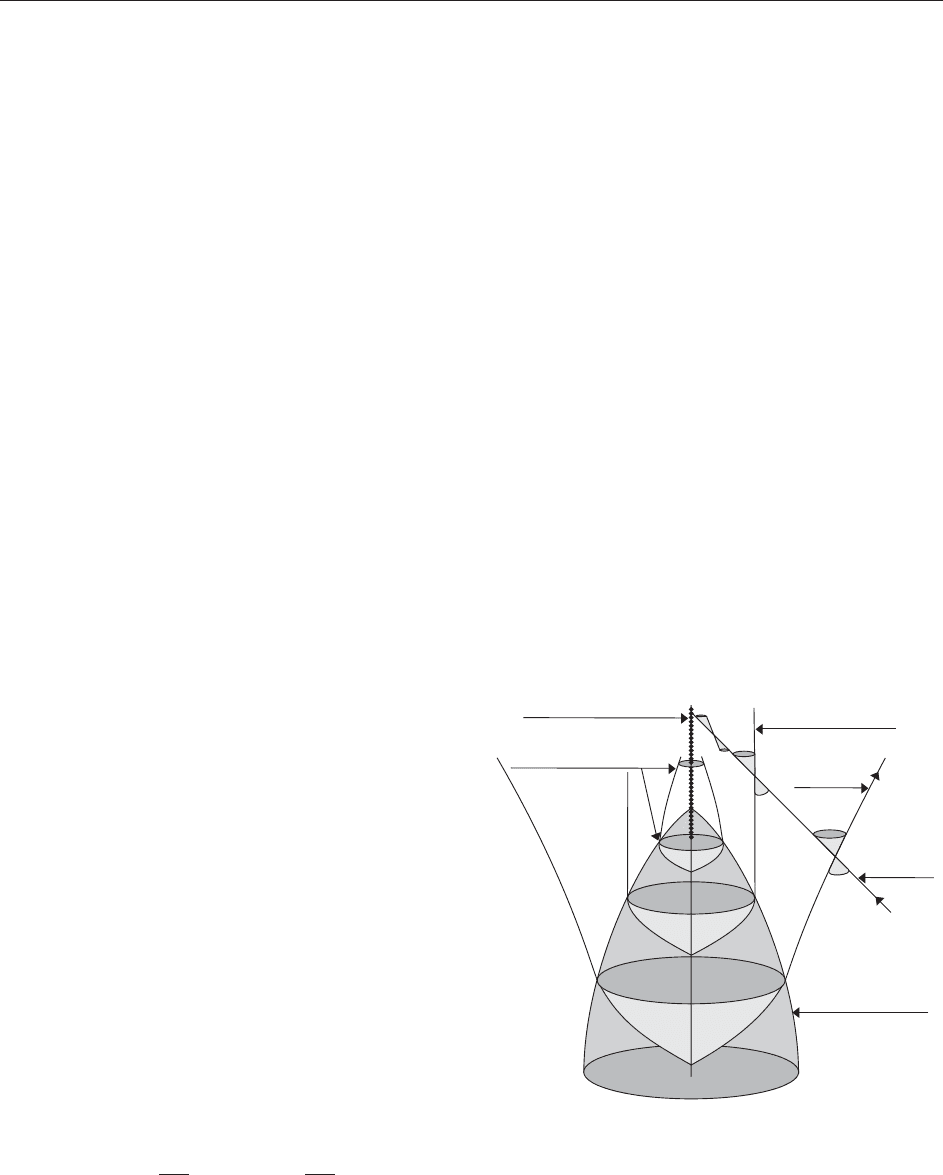
Metric [10] describes the spacetime outside
a spherical body collapsing through r = 2M into
a spherical black hole. In Figure 1, the formation
of an event horizon and trapped surfaces is indicated
in ingoing Eddington–Finkelstein coordinates
(v, r, , ’) where v = t þ r þ 2M log (r=2M 1) so
that (v, , ’) = const. are ingoing radial null geodesics.
The interior of the star is described by another metric
(e.g., the Oppenheimer–Snyder collapsing dust solu-
tion – see below). The Kruskal extension of the
Schwarzschild solution, its compactification, the con-
cept of the bifurcate Killing horizon, etc., are analyzed
Event horizon
Trapped surfaces
Surface of star
Singularity r = 0
O
P
Q
Outgoing
photon
Infalling
photon
ν = const.
r = 2M
Figure 1 Gravitational collapse of a spherical star (the interior of
the star is shaded). The light cones of three events, O, P, Q,atthe
center of the star, and of three events outside the star are illustrated.
The event horizon, the trapped surfaces, and the singularity formed
during the collapse are also shown. Although the singularity appears
to lie along the direction of time, from the character of the light cone
outside the star but inside the event horizon we can see that it has a
spacelike character. Reproduced from Bic
ˇ
a
´
k J (2000) Selected
solutions of Einstein’s field equations: their role in general relativity
and astrophysics. In: Schmidt BG (ed.) Einstein’s Field Equations
and their physical Implications, Lecture Notes in Physics, vol. 540, pp.
1–126. Heildelberg: Springer, with permission from Springer-Verlag.
Einstein Equations: Exact Solutions 167
in Stationary Black Holes and in Misner et al. (1973),
Hawking and Ellis (1973),andBic
ˇ
a´k (2000).
The Reissner–Nordstro¨ m solution describes the
exterior gravitational and electromagnetic fields of a
spherical body with mass M and charge Q. The
energy-momentum tensor on the right-hand side of
EE [2] is that of the electromagnetic field produced
by the charge; the field satisfies the curved-space
Maxwell equations. The metric reads
g ¼ 1
2M
r
þ
Q
2
r
2
dt
2
þ 1
2M
r
þ
Q
2
r
2
1
dr
2
þ r
2
ðd
2
þ sin
2
d’
2
Þ½11
The analytic extension of the electrovacuum metric
[11] is qualitatively different from the Kruskal exten-
sion of the Schwarzschild metric. In the case Q
2
> M
2
there is a ‘‘naked singularity’’ (visible from r !1)at
r = 0 where curvature invariants diverge. If Q
2
< M
2
,
the metric describes a (generic) static charged black
hole with two event horizons at r = r
= M (M
2
Q
2
)
1=2
. The Killing vector @=@t is null at the horizons,
timelike at r > r
þ
and r < r
, but spacelike between
the horizons. The character of the extended spacetime
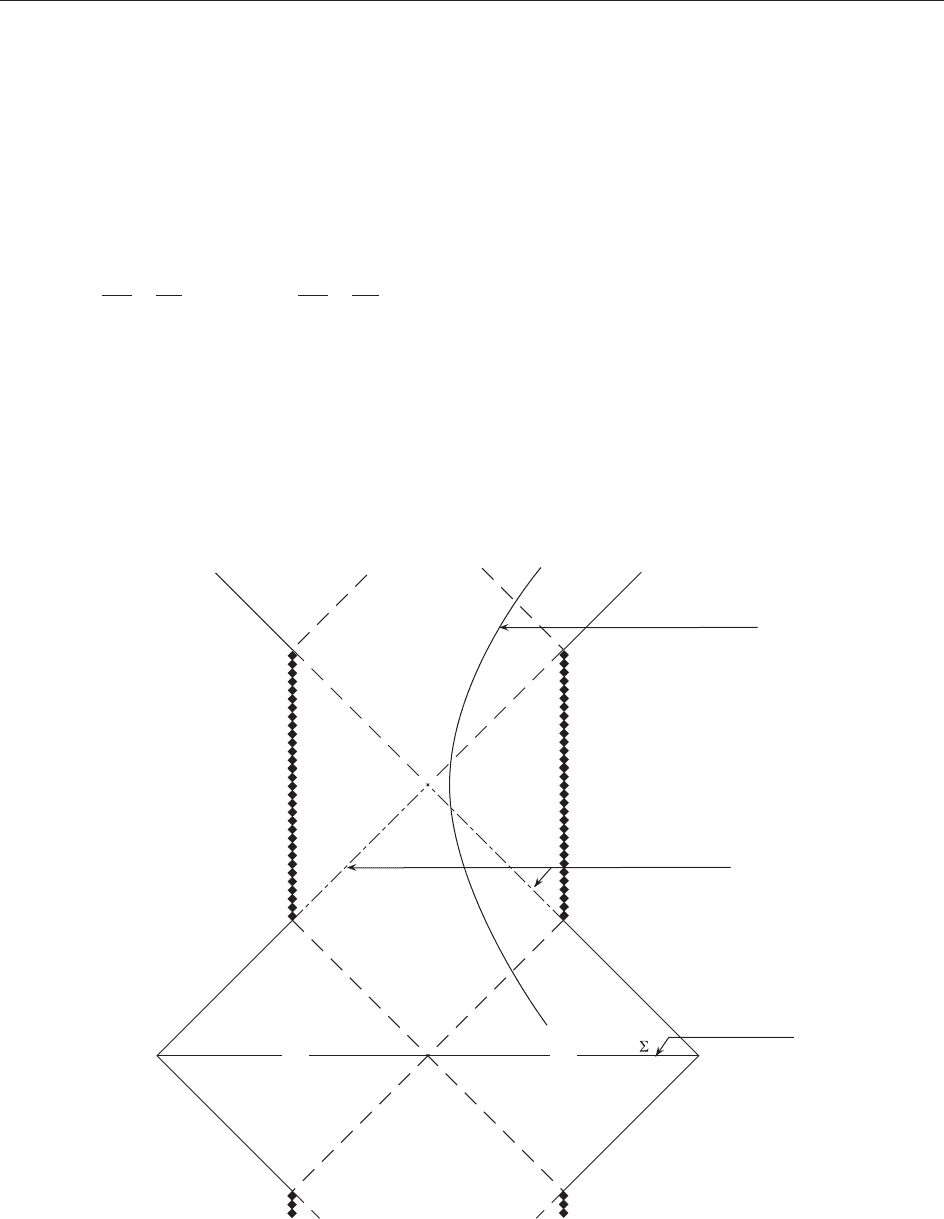
is best seen in the compactified form, Figure 2,in
which world-lines of radial light rays are 45
lines.
Again, two infinities (right and left, in regions I and III)
arise (as in the Kruskal–Schwarzschild diagram, see
Stationary Black Holes), however, the maximally
extended geometry consists of an infinite chain of
asymptotically flat regions connected by ‘‘wormholes’’
between the singularities at r = 0. In contrast to
the Schwarzschild singularity, the singularities are
timelike – they do not block the way to the future.
The inner horizon r = r
represents a Cauchy horizon
for a typical initial hypersurface like (Figure 2): what
is happening in regions V is in general influenced not
only by data on but also at the singularities. The
Cauchy horizon is unstable (for references, see Bic
ˇ
a´k
(2000) and recent work by Dafermos (2005)).
i
–
I
–
i
–
I
–
I
+
i
+
I
+
i
+
i
–
I
–
I
–
i
–
I
II
III
IV
V
V
IV
′
I ′
III
′
Spacelike
hypersurface t
= 0
Cauchy horizon for Σ
r = 0
(Singularity)
r
= 0
(Singularity)
r = r
–
r =
r
–
r = r
–
r =
r
–
r
= r
+
r =
r
+
r
=
r
+
r
=
r
+
i
0
i
0
(r
=
∞)
(r
=
∞)
(r
=
∞)
(r
=
∞)
r
=
r
+
r
=
r
+
(r
= ∞)
(r
=
∞)
World line of a shell
Figure 2 The compactified Reissner–Nordstro
¨
m spacetime representing a non-extreme black hole consists of an infinite chain of
asymptotic regions (‘‘universes’’) connected by ‘‘wormholes’’ between timelike singularities. The world-line of a shell collapsing from
‘‘universe’’ I and re-emerging in ‘‘universe’’ I
0
is indicated. The inner horizon at r = r
is the Cauchy horizon for a spacelike hypersurface
: It is unstable and thus it will very likely prevent such a process. Reproduced from Bic
ˇ
a
´
k J (2000) Selected solutions of Einstein’s
field equations: their role in general relativity and astrophysics. In: Schmidt BG (ed.) Einstein’s Field Equations and their Physical
Implications, Lecture Notes in Physics, vol. 540, pp. 1–126. Heildelberg: Springer, with permission from Springer-Verlag.
168 Einstein Equations: Exact Solutions

For M
2
= Q
2
the two horizons coincide at r
þ
=
r
= M. Metric [11] describes extreme Reissner–
Nordstro¨ m black holes. The horizon becomes
degenerate and its surface gravity vanishes (see
Stationary Black Holes). Extreme black holes play
a significant role in string theory (Ortı´n 2004).
Stationary Axisymmetric Solutions
Assume the existence of two commuting Killing
vectors – timelike
and axial
(
<0,
> 0),
normalized at (asymptotically flat) infinity,
at
the rotation axis. They generate two-dimensional orbits
of the group G
2
. Assume there exist 2-spaces orthogo-
nal to these orbits. This is true in vacuum and also in
case of electromagnetic fields or perfect fluids whose
4-current or 4-velocity lies in the surfaces of transitivity
of G
2
(e.g., toroidal magnetic fields are excluded). The
metriccanthenbewritteninWeyl’scoordinates
(t,,’,z)
g ¼e
2U
ðdt þ Ad’Þ
2
þ e
2U
½e
2k
ðd
2
þ dz
2
Þþ
2
d’
2
½12
U, k, and A are functions of , z.
The most celebrated vacuum solution of the form
[12] is the Kerr metric for which U, k, A are ratios
of simple polynomials in spheroidal coordinates
(simply related to (, z)). The Kerr solution is
characterized by mass M and specific angular
momentum a. For a
2
> M
2
, it describes an asymp-
totically flat spacetime with a naked singularity. For
a
2
M
2
, it represents a rotating black hole that has
two horizons which coalesce into a degenerate
horizon for a
2
= M
2
– an extreme Kerr black hole.
The two horizons are located at r
= M (M
2
a
2
)
1=2
(r being the Boyer–Lindquist coordinate (see
Stationary Black Holes)). As with the Reissner–
Nordstro¨ m black hole, the singularity inside is
timelike and the inner horizon is an (unstable)
Cauchy horizon. The analytic extension of the Kerr
metric resembles Figure 2 (see Frolov and Novikov
(1998), Hawking and Ellis (1973), Misner et al.
(1973), Ortı´n (2004), Semera´k et al. (2002),
Stephani et al. (2003),andWald (1984) for details).
Thanks to the black hole uniqueness theorems (see
Stationary Black Holes), the Kerr metric is the unique
solution describing all rotating black holes in vacuum.
If the cosmic censorship conjecture holds, Kerr black
holes represent the end states of gravitational collapse
of astronomical objects with supercritical masses.
According to prevalent views, they reside in the nuclei
of most galaxies. Unlike with a spherical collapse,
there are no exact solutions available which would
represent the formation of a Kerr black hole. However,
starting from metric [12] and identifying, for example,
z = b = const. and z = b (with the region b < z < b
being cut off), one can construct thin material disks
which are physically plausible and can be the sources
oftheKerrmetricevenfora
2
> M
2
(see Bic
ˇ
a´k (2000)
for details).
In a general case of metric [12], EEs in vacuum
imply the ‘‘Ernst equation’’ for a complex function f
of and z:
ð<f Þ f
;
þ f
;zz
þ
1
f
;
¼f
2
;
þ f
2
;z
½13
or, equivalently, (<f )4f = (rf )
2
,wheref = e
2U
þ ib,
U enters [12],andb(, z) is a ‘‘potential’’ for A (, z):
A
,
= e
4U
b
,z
, A
,z
= e
4U
b
,
; k(, z)in[12] can
be determined from U and b by quadratures.
Tomimatsu and Sato (TS) exploited symmetries of
[13] to construct metrics generalizing the Kerr metric.
Replacing f by = (1 f )=(1 þ f ), one finds that in
case of the Kerr metric
1
is a linear function in the
prolate spheroidal coordinates, whereas for TS
solutions is a quotient of higher-order polynomials.
A number of other solutions of eqn [13] were found
but they are of lower significance than the Kerr
solution (cf. Stephani et al. (2003),Chapter20).
These solutions inspired ‘‘solution-generating meth-
ods’’ in general relativity. The Ernst equation can be
regarded as the integrability condition of a system of
linear differential equations. The problem of solving
such a system can be reformulated as the Riemann–
Hilbert problem in complex function theory (see
Riemann–Hilbert Problem and Integrable Systems:
Overview). We refer to Stephani et al. (2003) and
Belinski and Verdaguer (2001) where these techniques
using Ba¨ cklund transformations, inverse-scattering
method, etc., are also applied in the nonstationary
context of two spacelike Killing vectors (waves,
cosmology). In the stationary case, all asymptotically
flat, stationary, axisymmetric vacuum solutions can, in
principle, be generated. It is known how to generate
fields with given values of multipole moments, though
the required calculations are staggering. By solving the
Riemann–Hilbert problem with appropriate boundary
data, Neugebauer and Meinel constructed the exact
solution representing a rigidly rotating thin disk of
dust (cf. Stephani et al. (2003) and Bic
ˇ
a´k (2000)).
A subclass of metrics [12] is formed by static Weyl
solutions with A = b = 0. Equation [13] then
becomes the Laplace equation U = 0. The non-
linearity of EEs enters only the equations for k: k
,
=
(U
2
,
U
2
,z
), k
,z
= 2U
,
U
,z
. The class contains some
explicit solutions of interest: the ‘‘linear super-
position’’ of collinear particles with string-like
singularities between them which keep the system
in static equilibrium; solutions representing external
Einstein Equations: Exact Solutions 169

fields of counter-rotating disks, for example, those
which are ‘‘inspired’’ by galactic Newtonian potentials;
disks around black holes and some other special
solutions (Stephani et al. 2003, Bonnor 1992, Bic
ˇ
a´k
2000, Semera´k et al. 2002).
There are solutions of the Einstein–Maxwell equa-
tions representing external fields of masses endowed
with electric charges, magnetic dipole moments, etc.
(Stephani et al. 2003). Best known is the Kerr–
Newman metric characterized by parameters M, a,
and charge Q. For M
2
a
2
þ Q
2
it describes a
charged, rotating black hole. Owing to the rotation,
the charged black hole produces also a magnetic field
of a dipole type. All the black hole solutions can be
generalized to include a nonvanishing (for various
applications, see Semera´k et al. 2002)). Other general-
izations incorporate the so-called Newman–Unti–
Tamburino (NUT) parameter (corresponding to a
‘‘gravomagnetic monopole’’) or an ‘‘external’’ mag-
netic/electric field or a parameter leading to ‘‘uniform’’
acceleration (see Stephani et al. (2003) and Bic
ˇ
a´k
(2000)). Much interest has recently been paid to black
hole (and other) solutions with various types of gauge
fields and to multidimensional solutions. References
Frolov and Novikov (1998) and Ortı´n (2004) are two
examples of good reviews.
Radiative Solutions
Plane Waves and Their Collisions
The best-known class are ‘‘plane-fronted gravita-
tional waves with parallel rays’’ (pp-waves) which
are defined by the condition that the spacetime
admits a covariantly constant null vector field
k
: k
;
= 0. In suitable null coordinates u, v such
that k
= u
,
, k
= (@=@v)
, and complex coordinate
which spans the wave 2-surfaces u = const., v =
const. with Euclidean geometry, the metric reads
g ¼ 2dd
2dudv 2Hðu;;
Þdu
2
½14
H(u, ,
) is a real function. The vacuum EEs imply
H
,
= 0sothat2H = f (u, ) þ
f (u,
), f is an arbitrary
function of u,analyticin. The Weyl tensor satisfies
eqns [5] – the field is of type N as is the field of plane
electromagnetic waves. In the null tetrad
{k
, l
, m
(complex)} with l
k
= 1, m
m
= 1, all
other products vanishing, the only nonzero projection
of the Weyl tensor, =C
l
m
l
m
= H
,
,
describes the transverse component of a wave propa-
gating in the k
direction. Writing =Ae
i
, the real
A > 0 is the amplitude of the wave, describes
polarization. Waves with =const. are called linearly
polarized. Considering their effect on test particles,
one finds that plane waves are transverse.
The simplest waves are homogeneous in the sense
that is constant along the wave surfaces. One gets
f (u, ) = (1=2)A(u)e
i(u)
2
. Instructive are ‘‘sandwich
waves,’’ for example, waves with a ‘‘square
profile’’: A= 0foru < 0andu > a
2
, A= a
2
= const.
for 0 u a
2
. This example demonstrates, within
exact theory, that the waves travel with the speed of
light, produce relative accelerations of test particles,
focus astigmatically generally propagating parallel rays,
etc. The focusing effects have a remarkable conse-
quence: there exists no global spacelike hypersurface on
which initial data could be specified – plane wave
spacetimes contain no global Cauchy hypersurface.
‘‘Impulsive’’ plane waves can be generated by
boosting a ‘‘particle’’ at rest to the velocity of light by
an appropriate limiting procedure. The ultrarelativistic
limit of, for example, the Schwarzschild metric (the so-
called Aichelburg–Sexl solution) can be employed as a
‘‘limiting incoming state’’ in black hole encounters (cf.
monograph by d’Eath (1996)). Plane-fronted waves
have been used in quantum field theory. For a review
of exact impulsive waves, see Semera´k et al. (2002).
A collision of plane waves represents an exceptional
situation of nonlinear wave interactions which can be
analyzed exactly. Figure 3 illustrates a typical case in
which the collision produces a spacelike singularity. The
initial-value problem with data given at v = 0andu = 0
canbeformulatedintermsoftheequivalentmatrix
Riemann–Hilbert problem (see Riemann–Hilbert
Problem); it is related to the hyperbolic counterpart of
the Ernst equation [13]. For reviews, see Griffiths
(1991), Stephani et al. (2003),andBic
ˇ
a´k (2000).
Cylindrical Waves
Discovered by G Beck in 1925 and known today as the
Einstein–Rosen waves (1937), these vacuum solutions
helped to clarify a number of issues, such as energy loss
due to the waves, asymptotic structure of radiative
I
II III
IV
u
ν
u
=
1
v =
1
v
= 0
u
=
0
Figure 3 A spacetime diagram indicating a collision of two plane-
fronted gravitational waves which come from regions II and III, collide
in region I, and produce a spacelike singularity. Region IV is flat.
Reproduced from Bic
ˇ
a
´
kJ(2000)Selected solutions of Einstein’s
field equations: their role in general relativity and astrophysics. In:
Schmidt BG (ed.) Einstein’s Field Equations and their Physical
Implications, Lecture Notes in Physics, vol. 540, pp. 1–126.
Heildelberg: Springer, with permission from Springer-Verlag.
170 Einstein Equations: Exact Solutions
spacetimes, dispersion of waves, quasilocal mass–
energy, cosmic censorship conjecture, or quantum
gravity in the context of midisuperspaces (see Bic
ˇ
a´k
(2000) and Belinski and Verdaguer (2001)).
In the metric
g ¼ e
2ð Þ
ðdt
2
þ d
2
Þþe
2
dz
2
þ
2
e
2
d’
2
½15
(t, ) satisfies the flat-space wave equation and (, t)
is given in terms of by quadratures. Admitting a
‘‘cross term’’ !(t, ) dz d, one acquires a second
degree of freedom (a second polarization) which
makes all field equations nonlinear.
Boost-Rotation Symmetric Spacetimes
These are the only explicit solutions available which
are radiative and represent the fields of finite sources.
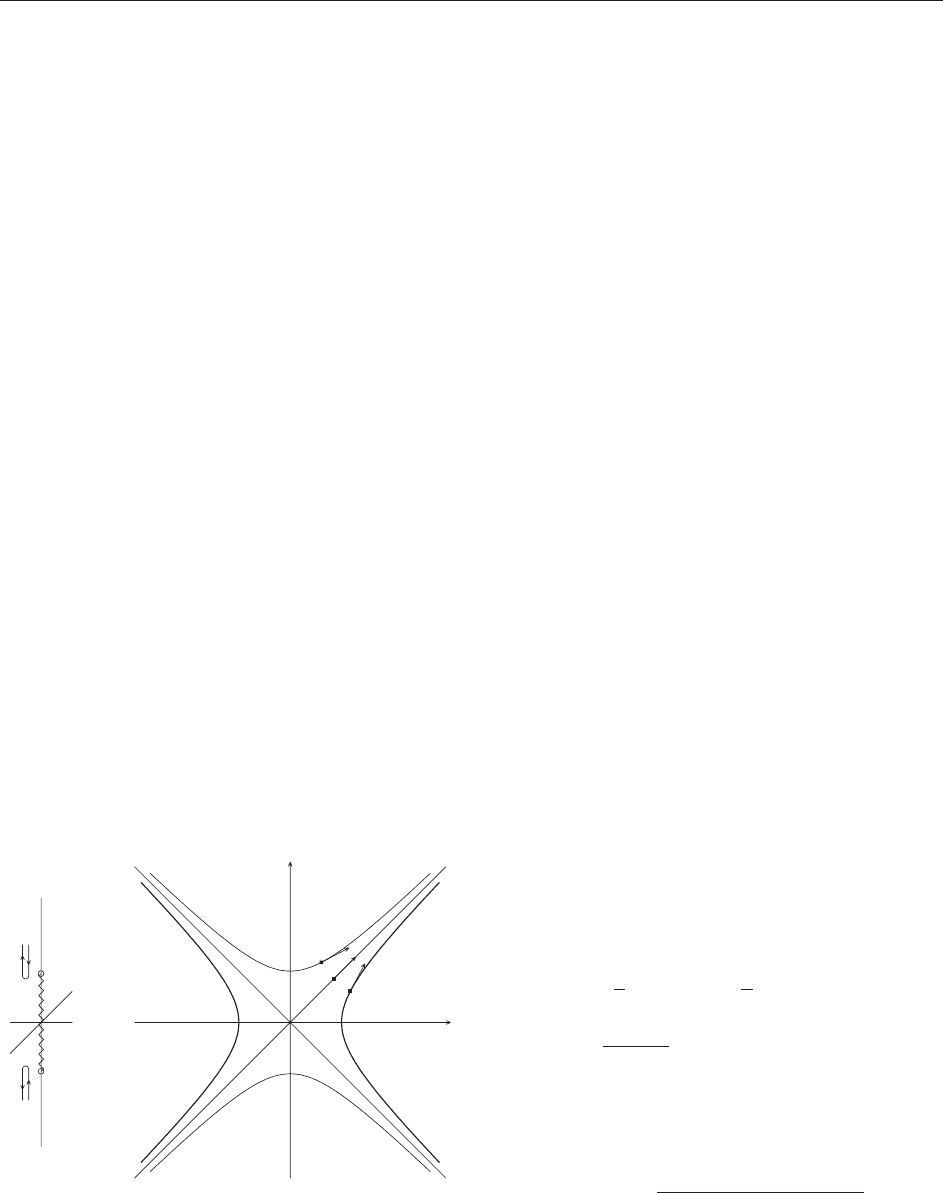
Figure 4 shows two particles uniformly accelerated in
opposite directions. In the space diagram (left), the
‘‘string’’ connecting the particles is the ‘‘cause’’ of the
acceleration. In ‘‘Cartesian-type’’ coordinates and the
z-axis chosen as the symmetry axis, the boost Killing
vector has a flat-space form, = z(@=@t) þ t(@=@z), the
same is true for the axial Killing vector. The metric
contains two functions of variables
2
x
2
þ y
2
and
2
z
2
t
2
. One satisfies the flat-space wave equa-
tion, the other is determined by quadratures.
The unique role of these solutions is exhibited by the
theorem which states that in axially symmetric, locally
asymptotically flat spacetimes, in the sense that a null
infinity (see Asymptotic Structure and Conformal
Infinity) exists but not necessarily globally, the only
additional symmetry that does not exclude gravitational
radiation is the boost symmetry. Various radiation
characteristics can be expressed explicitly in these
spacetimes. They have been used as tests in numerical
relativity and approximation methods. The best-known
example is the C-metric (representing accelerating black
holes, in general charged and rotating, and admitting ),
see Bonnor et al. (1994), Bic
ˇ
a´k (2000), Stephani et al.
(2003),andSemera´k et al. (2002).
Robinson–Trautman Solutions
These solutions are algebraically special but in general
they do not possess any symmetry. They are governed
byafunctionP(u, ,
)(u is the retarded time, a
complex spatial coordinate) which satisfies a fourth-
order nonlinear parabolic differential equation. Stud-
ies by Chrus
´
ciel and others have shown that RT
solutions of Petrov type II exist globally for all positive
‘‘times’’ u and converge asymptotically to a Schwarzs-
child metric, though the extension across the
‘‘Schwarzschild-like’’ horizon can only be made with
a finite degree of smoothness. Generalization to the
cases with > 0 gives explicit models supporting the
cosmic no-hair conjecture (an exponentially fast
approach to the dS spacetime) under the presence of
gravitational waves. See Bonnor et al. (1994), Bic
ˇ
a´k
(2000),andStephani et al. (2003).
Material Sources
Finding physically sound material sources in an
analytic form even for some simple vacuum metrics
remains an open problem. Nevertheless, there are
solutions representing regions of spacetimes filled
with matter which are of considerable interest.
One of the simplest solutions, the spherically
symmetric Schwarzschild interior solution with
incompressible fluid as its source, represents ‘‘a
star’’ of uniform density, =
0
= const.:
g ¼
3
2
ffiffiffiffiffiffiffiffiffiffiffiffiffiffiffiffiffiffi
1 AR
2
p
1
2
ffiffiffiffiffiffiffiffiffiffiffiffiffiffiffiffi
1 Ar
2
p
2
dt
2
þ
dr
2
1 Ar
2
þ r
2
ðd
2
þ sin
2
d’
2
Þ½16
A = 8
0
=3 = const., R is the radius of the star.
The equation of hydrostatic equilibrium yields
pressure inside the star:
8p ¼ 2A
ffiffiffiffiffiffiffiffiffiffiffiffiffiffiffiffi
1 Ar
2
p
ffiffiffiffiffiffiffiffiffiffiffiffiffiffiffiffiffiffi
1 AR
2
p
3
ffiffiffiffiffiffiffiffiffiffiffiffiffiffiffiffiffiffi
1 AR
2
p
ffiffiffiffiffiffiffiffiffiffiffiffiffiffiffiffi
1 Ar
2
p
½17
Solution [16] can be matched at r = R,wherep = 0,
to the exterior vacuum Schwarzschild solution [10]
if the Schwarzschild mass M = (1=2)AR
3
. Although
‘‘incompressible fluid’’ implies an infinite speed of
sound, the above solution provides an instructive
+
+
z
–z
y
x
t
z
ξ
Figure 4 Two particles uniformly accelerated in opposite
directions. Orbits of the boost Killing vector (thinner hyperbolas)
are spacelike in the region t
2
> z
2
: Reproduced from Bic
ˇ
a
´
kJ
(2000) Selected solutions of Einstein’s field equations: their role
in general relativity and astrophysics. In: Schmidt BG (ed.)
Einstein’s Field Equations and their Physical Implications,
Lecture Notes in Physics, vol. 540, pp. 1–126. Heildelberg:
Springer, with permission from Springer-Verlag.
Einstein Equations: Exact Solutions 171

model of relativistic hydrostatics. A Newtonian star of
uniform density can have an arbitrarily large radius
R =
ffiffiffiffiffiffiffiffiffiffiffiffiffiffiffiffiffiffiffiffi
3p
c
=2
2
0
q
and mass M = (p
c
=
2
0
)
ffiffiffiffiffiffiffiffiffiffiffiffiffi
6p
c
=
p
, p
c
is
the central pressure. However, [17] implies that (1) M
and R satisfy the inequality 2M=R 8=9, (2) equality
is reached as p
c
-becomes infinite and R and M attain
their limiting values R
lim
= (3
0
)
1=2
= (9=4)M
lim
.For
a density typical in neutron stars,
0
= 10
15
gcm
3
,we
get M
lim
¼
:
3.96M
(M
solar mass) – even this simple
model shows that in Einstein’s theory neutron stars can
only be a few solar masses. In addition, one can prove
that the ‘‘Buchdahl’s inequality’’ 2M=R 8=9 is valid
for an arbitrary equation of state p = p(). Only a
limited mass can thus be contained within a given
radius in general relativity. The gravitational redshift
z = (1 2M=R)
1=2
1 from the surface of a static
star cannot be higher than 2.
Many other explicit static perfect fluid solutions
are known (we refer to Stephani et al. (2003) for a
list), however, none of them can be considered as
really ‘‘physical.’’ Recently, the dynamical systems
approach to relativistic spherically symmetric static
perfect fluid models was developed by Uggla and
others which gives qualititative characteristics of
masses and radii.
The most significant nonstatic spacetime describing
a bounded region of matter and its external field is
undoubtedly the Oppenheimer–Snyder model of
‘‘gravitational collapse of a spherical star’’ of uniform
density and zero pressure (a ‘‘ball of dust’’). The model
does not represent any new (local) solution: the interior
of the star is described by a part of a dust-filled FLRW
universe (cf. [8]), the external region by the Schwarzs-
child vacuum metric (cf. eqn [10], Figure 1).
Since Vaidya’s discovery of a ‘‘radiating Schwarzs-
child metric,’’ null dust (‘‘pure radiation field’’) has
been widely used as a simple matter source. Its
energy–momentum tensor, T
= %k
k
, where
k
k
= 0, may be interpreted as an incoherent
superposition of waves with random phases and
polarizations moving in a single direction, or as
‘‘lightlike particles’’ (photons, neutrinos, gravitons)
that move along k
. The ‘‘Vaidya metric’’ describing
spherical implosion of null dust implies that in case
of a ‘‘gentle’’ inflow of the dust, a naked singularity
forms. This is relevant in the context of the cosmic
censorship conjecture (cf., e.g., Joshi (1993)).
Cosmological Models
There exist important generalizations of the stan-
dard FLRW models other than the above-mentioned
Bianchi models, particularly those that maintain
spherical symmetry but do not require homogeneity.
The best known are the Lemaıˆtre–Tolman–Bondi
models of inhomogeneous universes of pure dust,
the density of which may vary (Krasin
´
ski 1997).
Other explicit cosmological models of principal
interest involve, for example, the Go¨ del universe – a
homogeneous, stationary spacetime with < 0 and
incoherent rotating matter in which there exist
closed timelike curves through every point; the
Kantowski–Sachs solutions – possessing homo-
geneous spacelike hypersurfaces but (in contrast to
the Bianchi models) admitting no simply transitive
G
3
; and vacuum Gowdy models (‘‘generalized
Einstein–Rosen waves’’) admitting G
2
with compact
2-tori as its group orbits and representing cosmolo-
gical models closed by gravitational waves. See
Cosmology: Mathematical Aspects and references
Stephani et al. (2003), Belinski and Verdaguer
(2001), Bic
ˇ
a´k (2000), Hawking and Ellis (1973),
Krasin
´
ski (1997) and Wainwright and Ellis (1997).
See also: AdS/CFT Correspondence; Asymptotic
Structure and Conformal Infinity; Cosmology:
Mathematical Aspects; Dirac Fields in Gravitation and
Nonabelian Gauge Theory; Einstein Manifolds; Einstein’s
Equations with Matter; General Relativity: Experimental
Tests; General Relativity: Overview; Hamiltonian
Reduction of Einstein’s Equations; Integrable Systems:
Overview; Newtonian Limit of General Relativity;
Pseudo-Riemannian Nilpotent Lie Groups;
Reimann–Hilbert Problem; Spacetime Topology, Causal
Structure and Singularities; Spinors and Spin
Coefficients; Stability of Minkowski Space; Stationary
Black Holes; Twistor Theory: Some Applications.
Further Reading
Anderson MT (2000) On the structure of solutions to the static
vacuum Einstein equations. Annales Henri Poincare´ 1: 995–1042.
Belinski V and Verdaguer E (2001) Gravitational Solitons.
Cambridge: Cambridge University Press.
Bic
ˇ
a´k J (2000) Selected solutions of Einstein’s field equations:
their role in general relativity and astrophysics. In: Schmidt
BG (ed.) Einstein’s Field Equations and Their Physical
Implications, Lecture Notes in Physics, vol. 540, pp. 1–126,
(see also gr-qc/0004016). Heidelberg: Springer.
Bonnor WB (1992) Physical interpretation of vacuum solutions of
Einstein’s equations. Part I. Time-independent solutions.
General Relativity and Gravitation 24: 551–574.
Bonnor WB, Griffiths JB, and MacCallum MAH (1994) Physical
interpretation of vacuum solutions of Einstein’s equations.
Part II. Time-dependent solutions. General Relativity and
Gravitation 26: 687–729.
Dafermos M (2005) The interior of charged black holes and the
problem of uniqueness in general relativity. Communications
on Pure and Applied Mathematics LVIII: 445–504.
D’Eath PD (1996) Black Holes: Gravitational Interactions.
Oxford: Clarendon Press.
Frolov VP and Novikov ID (1998) Black Hole Physics.
Dordrecht: Kluwer Academic.
Griffiths JB (1991) Colliding Plane Waves in General Relativity.
Oxford: Oxford University Press.
172 Einstein Equations: Exact Solutions

Hall GS (2004) Symmetries and Curvature Structure in General
Relativity. Singapore: World Scientific.
Hawking SW and Ellis GFR (1973) The Large Scale Structure of
Space-Time. Cambridge: Cambridge University Press.
Joshi PS (1993) Global Aspects in Gravitation and Cosmology.
Oxford: Clarendon.
Krasin
´
ski A (1997) Inhomogeneous Cosmological Models.
Cambridge: Cambridge University Press.
Misner C, Thorne KS, and Wheeler JA (1973) Gravitation.
San Francisco: WH Freeman.
Ortı´n T (2004) Gravity and Strings. Cambridge: Cambridge
University Press.
Semera´k O, Podolsky´ J, and Z
ˇ
ofka M (eds.) (2002)
Gravitation: Following the Prague Inpiration. Singapore:
World Scientific.
Stephani H, Kramer D, MacCallum MAH, Hoenselaers C, and
Herlt E (2003) Ex act Soluti on s of Einstein’s Field Equa-
tions – Second Edition. Cambridge: Cambridge University
Press.
Wainwright J and Ellis GFR (eds.) (1997) Dynamical Systems in
Cosmology. Cambridge: Cambridge University Press.
Wald RM (1984) General Relativity. Chicago: The University of
Chicago Press.
Einstein Equations: Initial Value Formulation
J Isenberg, University of Oregon, Eugene, OR, USA
ª 2006 Elsevier Ltd. All rights reserved.
Introduction
Einstein’s theory of gravity models a gravitating
physical system S using a spacetime (M
4
, g, ) which
satisfies the Einstein field equations
G
ðgÞ¼T
ðg; Þ½1
Fðg; Þ¼0 ½2
Here, M
4
is a four-dimensional spacetime manifold, g
is a Lorentz signature metric on M, represents the
nongravitational (‘‘matter’’) fields of interest, G
:=
R
(1=2)g
R is the Einstein curvature tensor, is a
constant, T
is the stress–energy tensor for the field ,
and F = 0 represents the nongravitational field equa-
tions (e.g., r
F
= 0 for the Einstein–Maxwell theory).
By far the most widely used way to obtain and to
study spacetime solutions (M
4
, g, ) of equations
[1]–[2] is via the initial-value (or Cauchy) formula-
tion. The idea is as follows:
1. One chooses a set of initial data D which consists of
geometric as well as matter information on a
spacelike slice of M
4
. This data must satisfy a system
of constraint equations, which comprise a portion of
the field equations [1]–[2], and are analogous to the
Maxwell constraint equation rE = 0.
2. One fixes a time and coordinate choice to be used in
evolving the fields into the spacetime (e.g., maximal
time slicing and zero shift). This choice should result
in a fixed set of evolution equations for the data.
3. Using the evolution equations, one evolves the data
into the future and the past. From the evolved data,
one constructs the spacetime solution (M
4
, g, ).
Why is this procedure so popular? First, because
we have known for over 50 years that at least for
a short time, it works. That is, as shown by
Choquet-Bruhat (Foures-Bruhat 1952), the Cauchy
formulation is well posed. Second, because it fits with
the way we like to model physical systems. That is,
we first specify what the system is like now, and we
then use the equations to determine the behavior of
the system as it evolves into the future (or the past).
Third, because the formulation is eminently amenable
to numerical treatment. Indeed, virtually all numer-
ical simulations of colliding black hole systems as
well as of most other relativistic astrophysical systems
are done using some version of the initial-value
formulation. Finally, because the initial-value formu-
lation casts the Einstein equations into a form which
is readily accessible to many of the tools of geometric
analysis. Questions such as cosmic censorship are
turned into conjectures which can be analyzed and
proved mathematically, and the proofs of both the
positivity of mass and the Penrose mass inequality
rely on an initial-value interpretation.
There are of course drawbacks to the Cauchy
formulation. Foremost, Einstein’s theory of general
relativity is inherently a spacetime-covariant theory;
why break spacetime apart into space plus time when
covariance has played such a key role in the theory’s
success? As well, we have learned over and over again
that null cones and null hypersurfaces play a major
role in general relativity; the initial-value formulation
is not especially good at handling them. These draw-
backs show that there are analyses in general relativity
for which the initial-value formulation may not be well
suited. However, there is a preponderance of applica-
tions for which this formulation is an invaluable tool,
as evidenced by its ubiquitous use.
A complete treatment of the initial-value formula-
tion for Einstein’s equations would include discus-
sion of each of the following topics:
1. A statement and proof of well-posedness theo-
rems, including a discussion of the regularity of
the data needed for such results.
2. A space þ time decomposition of the fields, and a
formal derivation of the Einstein constraint
equations and the Einstein evolution equations.
Einstein Equations: Initial Value Formulation 173

3. An outline of the Hamiltonian version of the
initial-value formulation.
4. A listing of those choices of field variables and
gauge choices for which the system is manifestly
hyperbolic.
5. A description of the known methods for finding
and parametrizing solutions of the Einstein
constraint equations.
6. A comparison of the virtues and drawbacks of
various choices of time foliation and coordinate
threading.
7. A compendium of results concerning long-time
behavior of solutions.
8. An account of the difficulties which arise in
attempts to construct solutions numerically
using the Cauchy formulation.
9. A recounting of cases in which the initial-value
formulation has been used to model physically
interesting systems.
10. A note regarding the extent to which the initial-
value formulation (and the various aspects of it
just enumerated) generalize to dimensions other
than 3 þ 1 (three space and one time).
11. A determination of which nongravitational
fields may be coupled to Einstein’s theory in
such a way that the resulting coupled theory
admits an initial-value formulation.
We do not have the space here for such a
complete treatment. So we choose to focus on
those topics directly related to the Einstein con-
straint equations. Generalizing a bit to the Einstein–
Maxwell theory (thereby including representative
nongravitational fields), we first carry out the space
plus time ‘‘3 þ 1’’ decomposition of the gravitational
and electromagnetic fields. Then, applying the
Gauss–Codazzi–Mainardi equations to the space-
time curvature, we turn the spacetime-covariant
Einstein–Maxwell equations into a set of constraint
equations restricting the choice of initial data
together with a set of evolution equations develop-
ing the data in time. Next, we discuss the most
widely used approach for obtaining sets of initial
data which satisfy the constraint equations: the
conformal method. We include in this discussion
an account of some of what is known about the
extent to which the equations which are produced
by the conformal method admit solutions in various
situations (e.g., working on a closed manifold, or
working with asymptotically Euclidean data). We
then discuss alternate procedures which have been
used to obtain and analyze solutions of the
constraints, including the conformal thin sandwich
approach, the quasispherical method, and various
gluing procedures. Finally, we make concluding
remarks. For more details on some of the topics
discussed here, and for treatment of some of the
other topics listed above, see the recent review paper
of Bartnik and Isenberg (2004).
Space þ Time Field Decomposition
and Derivation of the Constraint
Equations
To understand what sort of initial data one needs to
choose in order to construct a spacetime via the initial-
value formulation, it is useful to consider a spacetime
(M
4
, g) which satisfies the Einstein (–Maxwell) field
equations and contains a Cauchy surface i
0
:
3
!M
4
.
We note that the existence of a Cauchy surface in
(M
4
, g, A) is not automatic; if one exists, the spacetime
is said to be (by definition) ‘‘globally hyperbolic.’’
1
Among its other properties, a Cauchy surface is a
spacelike embedded submanifold of a Lorentz
geometry. It immediately follows that the spacetime
(M
4
, g, A) induces on
3
a Riemannian metric ,
a timelike normal vector field e
?
, an intrinsic
(-compatible) covariant derivative r, and a sym-
metric ‘‘extrinsic curvature’’ tensor field K (second
fundamental form). It also follows that certain
components of the spacetime curvature tensor can
be written in terms of these Cauchy surface
quantities (, e
?
, r, K) along with other geometric
quantities related to them, such as the spatial
curvature R corresponding to the induced covariant
derivative r (Gauss–Codazzi equations).
To complete the curvature 3 þ 1 decomposition (i.e.,
to carry it out for all components of the spacetime
curvature), we need not just one Cauchy surface, but
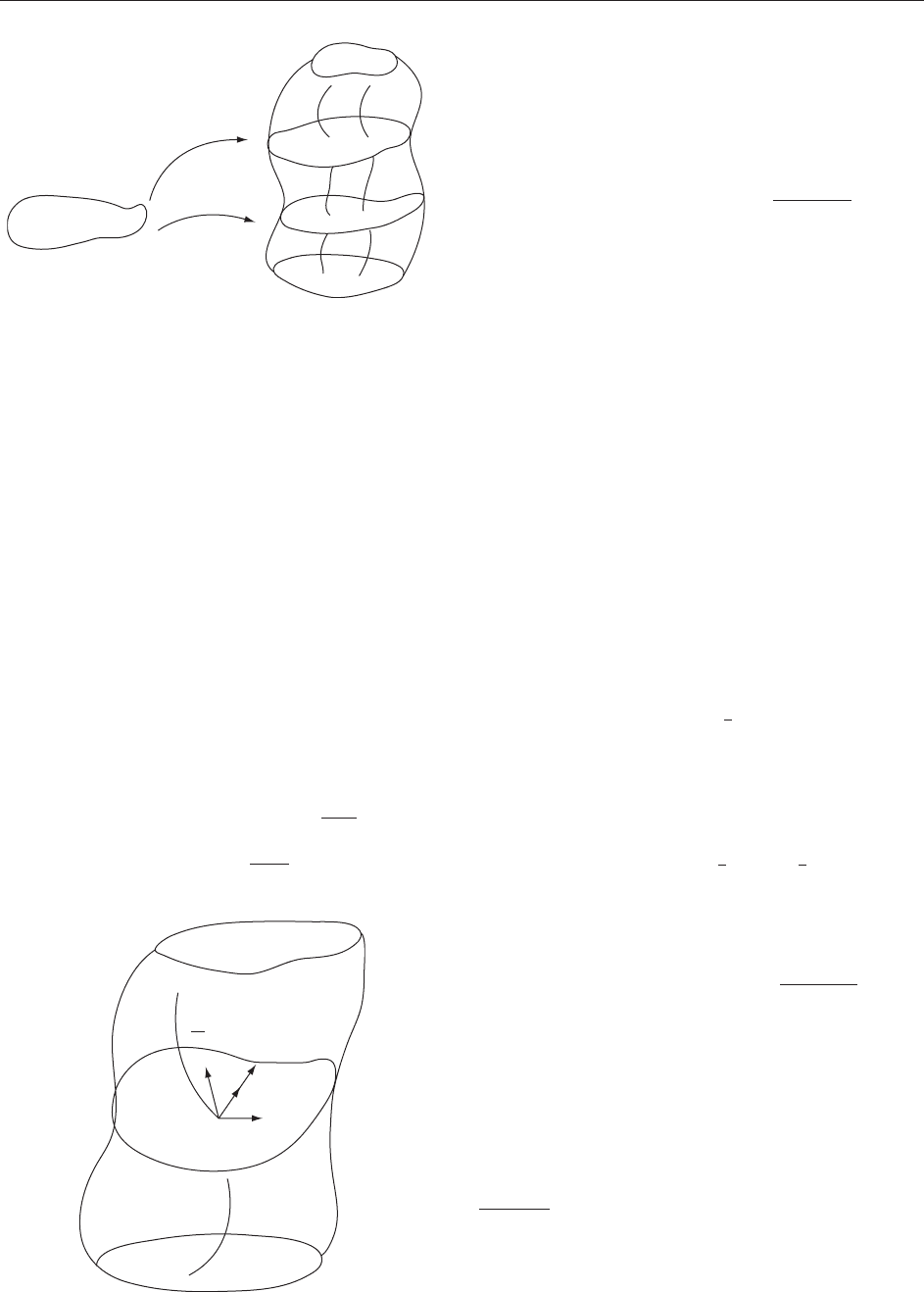
rather a full local foliation i
t
:
3
! M
4
of the spacetime
by such submanifolds. This foliation allows one to
define e
?
as a smooth vector field on an open
neighborhood of the Cauchy surface i
0
(
3
)inM
4
.It
also results in a threading of spacetime by a congruence
of timelike paths (see Figure 1). This threading may be
viewed as a spacetime-filling family of observers. It also
defines for the spacetime a set of coordinates relative to
which one can measure and calculate the dynamics of
the spacetime geometry.
It is useful for later purposes to note that at each
spacetime point p 2
t
M
4
(Here
t
:= i
t
(
3
).) the
vector @=@t tangent to the threading path through p
may be decomposed as
@
@t
¼Ne
?
þX ½3
1
The Taub–NUT spacetime is an example of a spacetime which is
not globally hyperbolic.
174 Einstein Equations: Initial Value Formulation
with the ‘‘shift vector’’ X tangent to the surface (X 2
T
p
t
), and with the ‘‘lapse’’ N a scalar (see Figure 2).
Using these quantities, we can write the spacetime
metric in the form
g ¼
?
?
¼
ab
ðdx
a
þX
a
dt Þðdx
b
þX
b
dtÞN
2
dt
2
½4
where
?
is the unit length timelike 1-form which
annihilates all vectors tangent to the hypersurfaces
of the foliation.
Relying on the following 3 þ 1 decomposition of
the spacetime-covariant derivative
4
r (Here {@
a
}isa
coordinate basis for the vectors tangent to the
hypersurfaces of the foliation; {@
a
, e
?
} constitutes a
basis for the full set of spacetime vectors at p.):
4
r
@
a
@
b
¼r
@
a
@
b
K
ab
e
?
½5
4
r
@
a
e
?
¼K
m
a
@
m
½6
4
r
e
?
@
b
¼K
m
b
@
m
þ½e
?
;@
b
þ
@
b
N
N
e
?
½7
4
r
e
?
e
?
¼
mn
@
m
N
N
@
n
½8
one readily derives the (Gauss–Codazzi–Mainardi)
3 þ 1 decomposition of the curvature:
2
4
R
e
abc
¼R
e
abc
þ K
ac
K
e
b
K
ab
K
e
c
½9
4
R
?
abc
¼r
@
c
K
ab
r
@
b
K
ac
½10
4
R
?
a?b
¼L
e
?
K
ab
K
am
K
m
b
þ
r
@
a
r
@
b
N
N
½11
where L denotes the surface-projected Lie derivative.
Since we are interested here in the 3 þ 1 formula-
tion of the Einstein–Maxwell system, we need a 3 þ 1
decomposition for the electromagnetic as well as the
gravitational field. The spacetime 1-form ‘‘vector
potential’’
4
A pulls back on each Cauchy surface
t
to a spatial 1-form A. One may then write
4
A ¼ A þ
?
¼ A
b
dx
b
þðN þA
b
X
b
Þdt ½12
for a scalar . Based on this decomposition, one has
the following 3 þ 1 decomposition for the electro-
magnetic 2-form F:
4
F
?a
¼
ac
E
c
½13
4
F
ab
¼r
@
a
A
b
r
@
b
A
a
½14
where E
c
is the electric vector field.
We may now use all of these decomposition
formulas to write out the 14 field equations for the
Einstein–Maxwell theory
4
G
¼F
F
1
4
g
F
F
½15
4
r
4
F
¼0 ½16
in terms of the spatial fields (, K, N, X; A, E, ) and
their derivatives. We obtain
R K
mn
K
mn
þðtr KÞ
2
¼
1
2
E
m
E
m
þ
1
2
B
m
B
m
½17
r
m
K
m
a
r
@
a
ðtr KÞ¼
amn
E
m
B
n
½18
L
e
?
K
ab
¼R
ab
2K
m
a
K
mb
þðtr KÞK
ab
þE
a
E
b
þB
a
B
b
r
@
a
r
@
b
N
N
½19
r
@
m
E
m
¼0 ½20
L
e
?
E
a
¼
amn
r
@
m
B
n
½21
where
abc
is the alternating Levi-Civita symbol
(component representation of the Hodge dual), and
where we have used B
a
:=
mn
a
(r
@
m
A
n
r
@
n
A
m
)asa
convenient shorthand.
∂
∂t
Ne
⊥
e
⊥
X
Figure 2 Decomposition of the time evolution vector field @=@t.
2
Here and throughout this article, we use the Misner–Thorne–
Wheeler (MTW) (Misner et al. 1973) conventions for the
definition of the Riemann curvature, for the signature þþþ
of the metric, for the index labels (Greek indices run over
{0, 1, 2, 3} while Latin indices run over {1, 2, 3}), etc.
i
t
2
i
t
1
M
4
Σ
3
Figure 1 3 þ 1 Foliation and threading of spacetime.
Einstein Equations: Initial Value Formulation 175