
Francoise J.-P., Naber G.L., Tsun T.S. (editors) Encyclopedia of Mathematical Physics
Подождите немного. Документ загружается.

with quark masses booked as O(p
2
) like the two-
derivative term in [22].
The effective chiral Lagrangian in Table 1
contains the following parts:
1. strong interactions: L
p
2 , L
p
4 , L
odd
p
6
, L
p
6 þ S
WZW
;
2. nonleptonic weak interact ions to first order in
the Ferm i coupling constant G
F
: L
S = 1
G
F
p
2
,
L
S = 1
G
8
p
4
, L
S = 1
G
27
p
4
;
3. radiative corrections for strong processes:
L
em
e
2
p
0
, L
em
e
2
p
2
;
4. radiative corrections for nonleptonic weak
decays: L
emweak
G
8
e
2
p
0
, L
emweak
G
8
e
2
p
2
;and
5. radiative corrections for semileptonic weak
decays: L
leptons
e
2
p
.
Beyond the leading order, unitarity and analyticity
require the inclusion of loop contributions. In the
purely strong sector, calculations have been per-
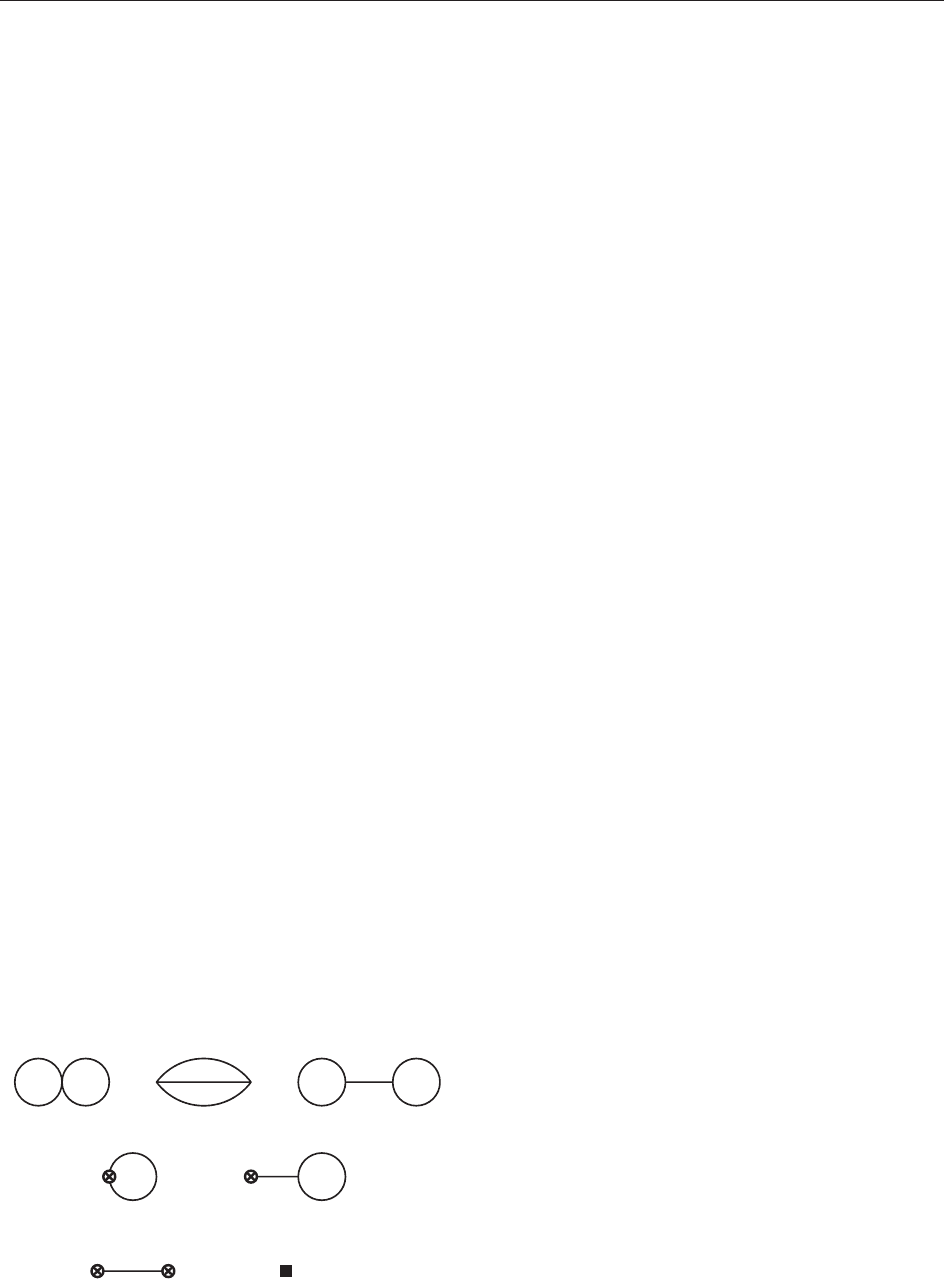
formed up to next-to-next-to-leading order. Figure 1
shows the corresponding skeleton diagrams of O(p
6
),
with full lowest-order tree structures to be attached
to propagators and vertices. The coupling constants
of the various Lagrangians in Table 1 absorb the
divergences from loop diagrams leading to finite
renormalized Green functions with scale-dependent
couplings, the so-called low-energy constants (LECs).
As in all EFTs, the LECs parametrize the effect of
‘‘heavy’’ degrees of freedom that are not represented
explicitly in the EFT Lagrangian. Determination of
those LECs is a major task for CHPT. In addition to
phenomenological information, further theoretical
input is needed. Lattice gauge theory has already
furnished values for some LECs. To bridge the gap
between the low-energy domain of CHPT and the
perturbative domain of QCD, large-N
c
motivated
interpolations with meson resonance exchange have
been used successfully to pin down some of the LECs.
Especially in cases where the knowledge of LECs is
limited, renormalization group methods provide
valuable information. As in renormalizable quantum
field theories, the leading chiral logs ( ln M
2
=
2
)
L
with a typical meson mass M, renormalization scale
and loop order L can in principle be determined from
one-loop diagrams only. In contrast to the renorma-
lizable situation, new derivative structures (and quark
mass insertions) occur at each loop order preventing a
straightforward resummation of chiral logs.
Among the many applications of CHPT in the
meson sector are the determination of quark mass
ratios and the analysis of pion–pion scattering where
the chiral amplitude of next-to-next-to-leading order
has been combined with dispersion theory (Roy
equations). Of increasing importance for precision
physics (CKM matrix elements, (g 2)
, ...) are
isospin-violating corrections including radiative cor-
rections, where CHPT provides the only reliable
approach in the low-energy region. Such corrections
are also essential for the analysis of hadronic atoms
like pionium, a
þ
bound state.
CHPT has also been applied extensively in the
single-baryon sector. There are several differences to
the purely mesonic case. For instance, the chiral
expansion proceeds more slowly and the nucleon
mass m
N
provides a new scale that does not vanish in
the chiral limit. The formulation of heavy-baryon
CHPT was modeled after HQET integrating out the
nucleon modes of O(m
N
). To improve the conver-
gence of the chiral expansion in some regions of phase
space, a manifestly Lorentz-invariant formulation has
been set up more recently (relativistic baryon CHPT).
Many single-baryon processes have been calculated to
fourth order in both approaches, for example, pion–
nucleon scattering. With similar methods as in the
mesonic sector, hadronic atoms like pionic or kaonic
hydrogen have been investigated.
Nuclear Physics
In contrast to the meson and single-baryon sectors,
amplitudes with two or more nucleons do not vanish
in the chiral limit when the momenta of Goldstone
mesons tend to zero. Consequently, the power
counting is different in the many-nucleon sector.
Multinucleon processes are treated with different
EFTs depending on whether all momenta are smaller
or larger than the pion mass.
In the very low energy regime j
~
pjM
, pions or
other mesons do not appear as dynamical degrees of
freedom. The resulting EFT is called ‘‘pionless EFT’’
and it describes systems like the deuteron, where the
typical nucleon momenta are
ffiffiffiffiffiffiffiffiffiffiffiffiffi
m
N
B
d
p
’ 45 MeV
(B
d
is the binding energy of the deuteron). The
Lagrangian for the strong interactions between two
nucleons has the form
L
NN
¼ C
0
N
>
P
i
N
y
N
>
P
i
N þ ½24
Figure 1 Skeleton diagrams of O(p
6
).: Normal vertices are
from L
p
2 , crossed circles and the full square denote vertices
from L
p
4 and L
p
6 , respectively.
146 Effective Field Theories

where P
i
are spin–isospin projectors and higher-
order terms contain derivatives of the nucleon fields.
The existence of bound states implies that at least
part of the EFT Lagrangian must be treated
nonperturbatively. Pionless EFT is an extension of
effective-range theory that has long been used in
nuclear physics. It has been applied successfully
especially to the deuteron but also to more compli-
cated few-nucleon systems like the Nd and n
systems. For instance, precise results for Nd scatter-
ing have been obtained with parameters fully
determined from NN scattering. Pionless EFT has
also been applied to the so-called halo nuclei, where
a tight clus ter of nucleons (like
4
He) is surrounded
by one or more ‘‘halo’’ nucleons.
In the regime j
~
pj > M
, the pion must be included as
a dynamical degree of freedom. With some modifica-
tions in the power counting, the corresponding EFT is
based on the approach of Weinberg (1990, 1991), who
applied the usual rules of the meson and single-nucleon
sectors to the nucleon–nucleon potential (instead of
the scattering amplitude). The potential is then to be
inserted into a Schro¨ dinger equation to calculate
physical observables. The systematic power counting
leads to a natural hierarchy of nuclear forces, with
only two-nucleon forces appearing up to next-to-
leading order. Three- and four-nucleon forces arise at
third and fourth order, respectively.
Significant progress has been achieved in the
phenomenology of few-nucleon systems. The two-
and n-nucleon (3 n 6) sectors have been pushed to
fourth and third order, respectively, with encouraging
signs of ‘‘convergence.’’ Compton scattering off the
deuteron, d scattering, nuclear parity violation, solar
fusion, and other processes have been investigated in
the EFT approach. The quark mass dependence of the
nucleon–nucleon interaction has also been studied.
See also: Anomalies; Electroweak Theory; High T
c
Superconductor Theory; Noncommutative Geometry
and the Standard Model; Operator Product Expansion
in Quantum Field Theory; Perturbation Theory and its
Techniques; Quantum Chromodynamics; Quantum
Electrodynamics and its Precision Tests;
Renormalization: General Theory; Seiberg–Witten
Theory; Standard Model of Particle Physics; Symmetries
and Conservation Laws; Symmetry Breaking in Field
Theory.
Further Reading
Appelquist T and Carazzone J (1975) Infrared singularities and
massive fields. Physical Review D 11: 2856.
Bedaque PF and van Kolck U (2002) Effective field theory for few
nucleon systems. Annual Review of Nuclear and Particle
Science 52: 339 (nucl-th/0203055).
Brambilla N, Pineda A, Soto J, and Vairo A (2004) Effective field
theories for quarkonium. Reviews of Modern Physics (in
press) (hep-ph/0410047).
Buchmu¨ ller W and Wyler D (1986) Effective Lagrangian analysis
of new interactions and flavour conservation. Nuclear Physics
B 268: 621.
Colangelo G, Gasser J, and Leutwyler H (2001) scattering.
Nuclear Physics B 603: 125 (hep-ph/0103088).
D’Hoker E and Weinberg S (1994) General effective actions.
Physical Review D 50: 6050 (hep-ph/9409402).
Ecker G (1995) Chiral perturbation theory. Progress in Particle
and Nuclear Physics 35: 1 (hep-ph/9501357).
Feruglio F (1993) The chiral approach to the electroweak
interactions. International Journal of Modern Physics A
8: 4937 (hep-ph/9301281).
Gasser J and Leutwyler H (1984) Chiral perturbation theory to
one loop. Annals of Physics 158: 142.
Gasser J and Leutwyler H (1985) Chiral perturbation theory:
expansions in the mass of the strange quark. Nuclear Physics
B 250: 465.
Hinchliffe I, Kersting N, and Ma YL (2004) Review of the
phenomenology of noncommutative geometry. International
Journal of Modern Physics A 19: 179 (hep/0205040).
Hoang AH (2002) Heavy quarkonium dynamics. In: Shifman M
(ed.) At the Frontier of Particle Physics/Handbook of QCD,
vol. 4. Singapore: World Scientific. (hep-ph/0204299).
Leutwyler H (1994) On the foundations of chiral perturbation
theory. Annals of Physics 235: 165 (hep-ph/9311274).
Mannel T (2004) Effective Field Theories in Flavour Physics ,
Springer Tracts in Modern Physics, vol. 203. Berlin:
Springer.
Manohar AV and Wise MB (2000) Heavy quark physics. Camb.
Monogr. Part. Phys. Nucl. Phys. Cosmol. 10: 1.
Meißner U (2005) Modern theory of nuclear forces. Nuclear
Physics A 751: 149 (nucl-th/0409028).
Pich A (1999) Effective field theory. In: Gupta R et al. (eds.) Proc.
of Les Houches Summer School 1997: Probing the Standard
Model of Particle Interactions. Amsterdam: Elsevier. (hep-ph/
9806303).
Scherer S (2002) Introduction to chiral perturbation theory.
Advances in Nuclear Physics 27: 277 (hep-ph/0210398).
Weinberg S (1979) Phenomenological Lagrangians. Physica A
96: 327.
Weinberg S (1990) Nuclear forces from chiral Lagrangians.
Physics Letters B 251: 288.
Weinberg S (1991) Effective chiral L agrangians for nucleon–
pion interactions and nuclear force s. Nuclear Physics B
363: 3.
Effective Field Theories 147

Eigenfunctions of Quantum Completely Integrable Systems
J A Toth, McGill University, Montreal, QC, Canada
ª 2006 Elsevier Ltd. All rights reserved.
Introduction
This article is an introduction to eigenfunctions of
quantum completely integrable (QCI) systems. For
these systems, one can understand asymptotics of
eigenfunctions better than for other systems, so it is
natural to study them. It is useful to begin the
discussion with the most important geometric exam-
ple given by the quantum Hamiltonian, P
1
=
ffiffiffiffi
p
.
We fix a basis of eigenfunctions, ’
j
, j = 1, 2, ...,with
ffiffiffiffi
p
’
j
¼
j
’
j
; h’
i
;’
j
i¼
ij
and assume that there exist functionally independent
(pseudo)differential operators P
2
, ..., P
n
with the
property that
½P
i
; P
j
¼0; i; j ¼ 1; ...; n
In this case, P
1
is said to be QCI and the operators,
P
k
, k = 1, ..., n, can be simultaneously diagonalized. It
is therefore natural to study the special basis of Laplace
eigenfunctions which are joint eigenvectors of the P
0
k
s.
From now on, the
j
’s are always assumed to be
joint eigenfunctions of the commuting operators,
P
k
, k = 1, ..., n. The classical observables correspond-
ing to the operators P
k
, k = 1, ..., n, are the respective
principal symbols, p
k
2 C
1
(T
M), j = 1, ..., n.In
particular, the bicharacteristic flow of p
1
(x, ) = jj
g
is the classical ‘‘geodesic flow’’
G
t
:T
M ! T
M
Examples of manifolds with QCI Laplacians include
tori and spheres of revolution, Liouville metrics on tori
and spheres, large families of metrics on homogeneous
spaces, as well as hyperellipsoids with distinct axes in
arbitrary dimension. There are also many inhomoge-
neous QCI examples (see the next section). It is of
interest to understand the asymptotics of both eigen-
values and eigenfunctions. There is a large literature
devoted to eigenvalue asymptotics, including trace
formulas and Bohr–Sommerfeld rules (see Colin de
Verdiere (1994a, b), Helffer and Sjoestrand (1990),
and Colin de Verdiere and Vu Ngoc (2003)). We will
concentrate here on the corresponding problem of
determining eigenfunction asymptotics. The key prop-
erty of eigenfunctions in the QCI case is localization in
phase space, T
M. This allows one to study more
effectively the concentration and blow-up properties
than in any other setting. It is important to contrast
this with, for example, the situation in the ergodic
case. Moreover, in the QCI case, there is a particularly
strong connection between dynamics of the geodesic
flow, G
t
: T
M !T
M, and the asymptotics of indi-
vidual eigenfunctions. In the general case, one can
usually only relate the dynamics to spectral averages,
such as in the trace formula (Duistermaat and
Guillemin 1975).
For the most part, the literature on eigenfunction
asymptotics addresses the following basic problems:
1. determining sharp uppe r and lower bounds for ’
j
as
j
!1 and
2. describing the link between the blow-up proper-
ties of ’
j
as
j
!1 and the dynamics of the
geodesic flow, G
t
.
The starting point in the study of eigenfunction
asymptotics in the QCI case is the fact that the joint
eigenfunctions, ’
j
, have masses that localize on the
level sets, P
1
(b):= {(x, ) 2 T
M; p
j
(x, ) = b
j
, j =
1, ..., n}. Moreover, by the Liouville–Arnol’d theo-
rem, for generic levels (indexed by b 2 R),
P
1
ðbÞ¼
X
m
k¼1
k
ðbÞ½1
where the
k
(b) T
M are Lagrangian tori. The
affine symplectic coordinates in a neighborhood of
k
(b) are called ‘‘action-angle variables’’ (
(k)
1
, ...,
(k)
n
; I
(k)
1
, ..., I
(k)
n
) 2 T
n
R
n
. Written in terms of
these coordinates, the classical Hamilton equations
defining the geodesic flow assume the form
d
dt
¼ FðIÞ;
dI
dt
¼ 0
and this system of ordinary differential equa tions
(ODEs) is solved by quadrature. This explains why
one refers to such systems as completely integrable.
At the quantum level, one can construct semiclassi-
cal Lagrangian distributions,
ðxÞ:¼
Z
R
n
e
i’
ðkÞ
ðx;Þ
aðx;; Þd ½2
which microlocally concentrate on
(k)
(b)as !1
and satisfy P
j
= b
j
þO(
1
)inL
2
(M). An
important fact is that the actual joint eigenfunctions,
’
j
, are approximated to O(
1
)-accuracy in L
2
(M)by
suitable linear combinations of the quasimodes,
.
However, there are subtleties underlying this correspon-
dence which are often neglected in the physics literature:
3. The actual joint eigenfunctions
j
localize on the
level sets P
1
(b) which usually consist of many
148 Eigenfunctions of Quantum Completely Integrable Systems

connected components. Consequently, the eigen-
functions are approximated by (sometimes large)
linear combinations of Lagrangian quasimodes
attached to the different component tori. The
precise splitting of mass amongst these different
components is a difficult and, in general,
unsolved problem in microlocal tunneling.
4. The local torus foliation given by action-angle
variables tends to degenerate and Lagrangian
quasimodes are no longer approximate solutions
to the (joint) eigenvalue equations near the
singularities of the foliation. The singularities and
their relative configurations can be complicated
(Colin de Verdiere and Vu Ngoc 2003) and most
of the interesting asymptotic blow-up properties
of eigenfunctions tend to be associated with these
degeneracies. The main tool for studying joint
eigenfunctions near degeneracies is the quantum
analog of the Eliasson normal form (Eliasson
1984, Vu Ngoc 2000). We will refer to this as the
‘ ‘quantum Birkhoff normal form’’ (QBNF).
Background on QCI Systems
Let (M
n
, g) be a compact, closed Riemannian
manifold an d P
1
:= Op
h
(p
1
) be a formally self-
adjoint, elliptic (in the classical sense) h-pseudodif-
ferential operator. In local coordinates, the Schwarz
kernel of P
1
is of the form,
P
1
ðx; y;hÞ¼ð2hÞ
n
Z
R
n
e
ihxy;i=h
p
1
ðx;;hÞd
where p
1
(x, ; h) 2 S
0, m
cl
(T
M); that is, p
1
(x, ; h)
P
1
j = 0
p
1,j
(x, )h
j
with @
x
@
p
1,j
(x, ) = O
,
hi
mjjj
(Dimassi and Sjoestrand 1999). It is often conve-
nient to work with h-pseudodifferential operators
rather than their classical counterparts. In the
homogeneous case, one chooses h
1
2 Spec
ffiffiffiffi
p
.
P
1
2 Op
h
(S
0, m
cl
) is said to be QCI if there exist self-
adjoint P
j
= Op
h
(p
j
) 2 Op
h
(S
0, m
0
cl
), j = 2, ..., n, for
some m
0
with [P
i
, P
j
] = 0, i, j = 1, ..., n, such that
dp
1
^^dp
n
6¼ 0 on a dense open subset,
reg
T
M, and P
2
1
þþP
2
n
is elliptic in the classical
sense. There are many inhomogeneous QCI examples
including quantum Euler, Lagrange, and Kowalevsky
tops together with quantum Neumann and Rosocha-
tius oscillators in arbitrary dimension.
Since {p
i
, p
j
} = 0, the joint Hamilton flow of the
p
i
’s induces a symplectic R
n
-action on T
M:
t
: T
M !T
M
t
ðx;Þ¼exp t
1
H
p
1
exp t
1
H
p
n
ðx;Þ
t ¼ðt
1
; ...; t
n
Þ2R
n
The associated moment map is just
P: T
M 0 !R
n
; P¼ðp
1
; ...; p
n
Þ
We denote the image P(T
M 0) by B, the regular
values (resp. singular value s) by B
reg
(resp. B
sing
)of
the moment map.
To establish bounds for the joint eigenfunctions of
P
1
, ..., P
n
, one imposes a ‘‘finite-complexity’’ assump-
tion (Toth and Zelditch 2002) on the classical integrable
system. This condition holds for all systems of interest in
physics. To describe it, for each b = (b
(1)
, ..., b
(n)
) 2B,
let m
cl
(b) denote the number of R
n
-orbits of the joint
flow
t
on the level set P
1
(b). Then, the finite-
complexity condition says that for some M
0
> 0,
m
cl
ðbÞ < M
0
ð8b 2BÞ
In addition, when P is proper,
P
1
ðbÞ¼
X
m
cl
ðbÞ
k¼1
k
ðbÞ½3
for any b 2B
reg
, where the
k
(b) are Lagrangian tori.
The starting point for analyzing joint eigenfunctions
is the following correspondence principle (Zelditch
1990) which makes the eigenfunction localization
alluded to in the introduction more precise:
Theorem 1 Let Op
h
(a) 2 Op
h
(S
0
cl
)(T
M) and P
j
, j =
1, ..., n, be a QCI system of commuting operators.
Then, for every b 2B
reg
, there exists a subsequence of
joint eigenfunctions ’
(x):= ’(x; (h)) with h 2 (0, h
0
]
and joint eigenvalues (h) = (
1
(h), ...,
n
(h)) 2
Spec(P
1
, ..., P
n
) with j(h) bj= O (h) such that
hOp
h
ðaÞ’
;’
i¼jcðhÞj
2
Z
ðbÞ
aðx;Þd
b
þOðhÞ
Here,d
b
denotes Lebesgue measure on the torus, (b).
The proof of Theorem 1 follows from the h-microlocal,
regular quantum normal construction near (b)(see
the section ‘ ‘Birkhoff normal forms’ ’).
Blow-Up of Eigenfunctions:
Qualitative Results
Before discussing quantitative bounds for joint
eigenfunctions, it is useful to prove qualitative results.
Here, we review only the homogeneous case where
P
1
=h
ffiffiffiffi
p
, although the general case can be dealt
with similarly (Toth and Zelditch 2002). Two well-
known QCI examples which exhibit extremes in
eigenfunction concentration are the round sphere and
the flat torus. In the case of the sphere, the zonal
harmonics blow-up like
1=2
at the poles, whereas, in
the case of the flat torus, all the joint eigenfunctions
are uniformly bounded. The rest of the article will be
Eigenfunctions of Quantum Completely Integrable Systems 149

essentially devoted to understanding these extreme
blow-up properties (and intermediate ones) more
systematically. When discussing blow-up of eigen-
functions, it is natural to start with the following:
Question Do there exist QCI manifolds (other
than the flat torus) for which all eigenfunctions are
uniformly bounded in L
1
?
Toth and Zelditch (2002) have proved that, up to
coverings, the flat torus is the only example with
uniformly bounded eigenfunctions. Their argument
used the correspondence principle in Theorem 1
combined with some deep results from symplectic
geometry. To deal with the issue of multiplicities, it
is convenient to define
L
1
ð; gÞ¼sup
’2V
k’k
L
1
where V
= {’; P
1
’
= ’
} and it is assumed that
k’k
L
2
= 1.
Theorem 2 (Toth and Zelditch 2002). Suppose
that P
1
=
ffiffiffiffi
p
is QCI on a compact, Riemannian
manifold (M, g) and suppose that the corresponding
moment map satisfies the finite-complexity condi-
tion. Then, if L
1
(, g) = O(1), (M, g) is flat.
The proof of Theorem 2 follows by contradiction:
that is, one assumes that all eigenfunctions are
uniformly bounded. There are two main steps in the
proof of Theorem 2: the first is entirely analytic and
uses the correspondence principle in Theorem 1 and
uniform boundedness to determine the topology of
M. The second step uses two deep results from
symplectic topology/geometry to determine the
metric, g, up to coverings.
Using a local Weyl law argument and the finite-
multiplicity assumption, it can be shown that for
each b 2B
reg
, there exists a subsequence, ’
, of joint
eigenfunctions such that Prop osition 1 holds with
jcðh; bÞj
2
1
C
where C > 0 is a uniform constant not depending
on b 2B
reg
. With this subsequence, one applies Theo-
rem 1 with a(x, ) = V(x) 2 C
1
(M). It then easily
follows by the boundedness assumption that for h
sufficiently small and appropriate constants C
0
, C
1
> 0,
Z
ðbÞ
ðbÞ
V
d
b
1
C
0
Z
M
jVðxÞjj’
ðxÞj
2
dVolðxÞ
1
C
1
Z
M
jVðxÞjdVolðxÞ½4
where
(b)
denotes the restriction of the canonical
projection : T
M !M to the Lagrangian (b). The
estimate in [4] is equivalent to the statement,
ð
ðbÞ
Þ
ðd
b
ÞdVolðxÞ
where given two Borel measures d and d, one
writes d d if d is absolutely continuous with
respect to d. Consequently,
(b)
: (b) !M has no
singularities and thus, up to coverings, M is
topologically a torus (since (b) is).
Since there are many QCI systems on n-tori, it still
remains to determine how the uniform-boundedness
condition constrains the metric geometry of (M, g).
First, by a classical result of Mane, if T
M possesses
a C
1
-foliation by Lagrangians, (M, g) cannot have
conjugate points. By the first step in the proof, it
follows that under the uniform-boundedness
assumption, M is a topological torus and T
M
possesses a smooth foliation by Lagrangian tori.
Consequently, (M, g) has no conjugate points.
Finally, the Burago–Ivanov proof of the Hopf
conjecture says that metric tori without conjugate
points are flat. Therefore, (M, g) is flat.
Consistent with Theorem 2, one can show (Toth
and Zelditch 2003, Lerman and Shirokova 2002)that
if (M, g) is integrable and not a flat torus, then there
must exist a compact
t
-orbit (i.e., an orbit of the joint
flow of X
p
j
, j = 1, ..., n)withdim = k < n. In the QCI
case, these ‘‘singular’’ orbits trap eigenfunction mass
for appropriate subsequences. To understand this
statement in detail, it is necessary to review QBNF
constructions in the context of QCI systems.
Birkhoff Normal Forms
There are several excellent expositions on the topic
of Birkhoff normal forms in the literature (see, e.g.,
Guillemin (1996), Iatchenk o et al. (2002),and
Zelditch (1998)), which discuss both the classical
and quantum constructions. Here, we discuss the
aspects which are most relevant for QCI systems.
Consider the Schro¨ dinger operator, P(x; hD
x
) =
h
2
(d
2
=dx
2
) þ V(x) with V(x þ 2) = V(x) acting
on C
1
(R=2Z). Assume that the potent ial, V(x), is
Morse and that x = 0 is a potential minimum with
V(0) = V
0
(0) = 0 and T
(S
1
) an open neighbor-
hood containing (0, 0). In its simplest incarnation,
the classical Birkhoff normal-form theorem says that
for smal l enough , there exists a symplectic
diffeomorphism,
1
:(; (0, 0)) !(; (0, 0));
1
:
(x, ) 7!(y, ), and a (locally defined) function F
0
2
C
1
(R) such that
ðp Þðy;Þ¼F
0
ð
2
þ y
2
Þ½5
150 Eigenfunctions of Quantum Completely Integrable Systems

provided (y, ) 2 . At the quantum level, the
analogous QBNF expansion says that there exist
microlocally unitary h-Fourier integral operators,
U(h):C
1
() !C
1
() and a classical symbol
F(x , h)
P
1
j = 0
F
j
(x)h
j
, such that
UðhÞ
PðhÞU ðhÞ¼
Fð
^
I
e
;hÞ½6
with
^
I
e
=h
2
D
2
y
þ y
2
. Given two h-pseudos P and Q,
the notation P =
Q means that k(P Q)k
L
2
k
0
=
O(h
1
) and k(P Q)k
0
= O(h
1
), for any 2
C
1
0
(). Since it can be easily shown that eigenfunc-
tions ’
, with (h) = O(h
), 0 < 1, localize very
sharply near x = 0, from the h-microlocal unitary
equivalence in [6], the eigenfunction and eigenvalue
asymptotics (including trace formulas) can all be
determined by working with the model operator on
the right-hand side (RHS) of [6]. Moreover, on the
model side , the eigenfunctions and eigenvalues are
explicitly known.
At a potential maximum, there exist classical and
quantum normal forms analogous to [5] and [6] (see
Helffer and Sjoestrand (1990) and Colin de Verdiere
and Parisse (1994a)) except that the harmonic
oscillator action operator,
^
I
e
, is replaced by the
hyperbolic action operator,
^
I
h
¼ hyD
y
þ
1
2
½7
The 1D Schro¨ dinger operator is the simplest
example of a QCI system where (0, 0) 2 T
S
1
is a
nondegenerate critical point of the classical Hamil-
tonian, H(x, ) =
2
þ V(x). Under a mild nonde-
generacy hypothesis (Vu Ngoc 2000), there is an
analogous normal form for arbitrary QCI systems
which is valid near nondegenerate rank k < n orbits
of the joint flow,
t
. At the classical level, this result
is due to Eliasson (1984) and the quantum analog is
due to Vu-Ngoc (2000). To state the result is
general, one has to define the appropriate model
operators: these are
^
I
e
and
^
I
h
together with the
loxodromic model operators <
^
I
ch
=hD
, =
^
I
ch
=
hD
þ h=i, where (, ) den ote polar coordinates
in R
2
. The local model phase space for a rank k < n
orbit, O
k
, is just T
(T
k
) T
(R
nk
). In this case, the
QBNF says that, for a sufficiently small neighbor-
hood, G
k
of O
k
, there exists a family of h-Fourier
integral operators, U
: C
1
(G
k
) !C
1
(T
(T
k
) T
(R
nk
)) and symbols f
j
(h)
P
1
j = 0
f
j
h
j
, such that
U
P
j
U
¼
G
k
M
h
ðQ
1
f
1
ðhÞ; ...; Q
n
f
n
ðhÞÞ
U
U
¼
G
k
Id
½8
Here, M
h
is a microlocally invertible matrix of
h-pseudodifferential operators commuting with the
Q
j
’s, and the Q
j
’s are to be chosen from the list of
model operators {
^
I
ch
,
^
I
h
,
^
I
e
,
^
I
reg
}, where
^
I
reg
=
(hD
1
, ..., hD
k
) denotes the regular model operator
acting along the k-dimensional orbit, O
k
. Moreover,
if (y
1
, ..., y
nk
,
1
, ...,
nk
) 2 T
(R
nk
) denote the
symplectic model coordinates, then the Q
j
’s act in
separate, complementary (y
1
, ..., y
nk
)-variables.
The main point here is that [8] is actually a
convergent normal norm in h in the sense that
error terms in [8] are O(h
1
). In contrast (Guillemin
1996, Iatchenko et al. 2002, Zelditch 1998), the
general Birkhoff normal form is only formal in the
sense that error terms vanish to successively higher
orders along the orbit, O
k
, but are not necessarily
small in terms of the spectral parameter, h.
Using [8], it can be shown that the joint
eigenfunctions, ’
, are microlocally determined in
terms of the h-Fourier integral operators, U
, and
certain model eigenfunctions. More precisely,
U
’
ð; y;hÞ¼
G
k
cðhÞe
im
½u
h
u
ch
u
e
ðy;hÞ
½9
where m 2 Z þ 1=4, c(h) 2 C(h). The generalized
eigenfunctions of the model operators,
^
I
h
,
^
I
ch
,
^
I
e
,acting
transversely to the orbit O
k
are u
h
(y; , h) =
c
þ
(h)jyj
1=2þi=h
þ
þ c
(h)jyj
1=2þi=h
, u
ch
(, ; t, k, h) =
it=h1
e
ik
and u
e
(y; n, h) = H
n
(h
1=2
y), where H
n
(y)is
the nth Hermite function.
Eigenfunction Lower Bounds:
Quantitative Results
Let O
k
be a singular rank k<n orbit as in the
previous section. From the qualitative results of the
first section, it follows that there must exist joint
eigenfunctions, ’
, of the commuting operators,
P
j
, j = 1, ..., n, which blow up along the orbit, O
k
.
To obtain quantitative results, one could try to
determine the L
p
!L
q
mapping properties of the
h-Fourier integral operator, U
. However, since the
canonical transformation to normal form can be
complicated, this method is quite cumbersome. To
avoid this complication (Toth and Zelditch 2003 ), it
suffices to compute L
2
-masses only, but on scales of
order h
where 0<1=2. Let (G
k
(h
)) be the
configuration space projection of the h
-radius tube
G
k
(h
) O
k
. Since
k’
k
2
L
1
VolððG
k
ðh
ÞÞÞ
Z
G
k
ðh
Þ
j’
j
2
dVol ½10
one is reduced to estimating
R
G
k
(h
)
j
j
2
dVol from
below. To bound this integral from below, it suffices to
1. reduce the estimate to one involving only the
model eigenfunctions in the Birkhoff normal
form and
2. estimate the normalizing h-dependent constant
c(h)in[9].
Eigenfunctions of Quantum Completely Integrable Systems 151

To prove (1) one introduces a cutoff function
(x, ; h
) 2 C
1
0
(G
k
(h
)) and is identically equal to
one near O
k
. Then, since
1
((G
k
(h
))) G
k
(h
),
from the Garding inequality, it follows that
Z
G
k
ðh
Þ
j’
j
2
dVol hOp
h
ððx;;h
ÞÞ’
;’
i½11
In light of the QBNF result in [8], the computa-
tion of the mat rix element on the RHS of [11] is
reduced to a corresponding computation for the L
2
-
normalized model eigenfunctions. Since the U
’s are
microlocally unitary, it follows that
hOp
h
ððx;;h
ÞÞ’
;’
i
h!0
þ
CðÞjcðhÞj
2
½12
Here, the constant C()> 0 depends only on the
scale of the cutoff function. It finally remains to deal
with (2). Bounding the size of jc(h)j from below
amounts to estimating the L
2
-mass of the joint
eigenfunction ’
which must be trapped near
the orbit, O
k
. Using a local (singular) Weyl
law argument, it is shown in Toth and Zelditch
(2003) that
jcðhÞj
2
jlog hj
½13
where >0 indexes the number of hyperbolic and
loxodromic model operators. The final result quan-
tifies blow-up along a compact orbit:
Theorem 3 (Toth and Zelditch 2003). Let O
k
be a
rank k < n orbit of the joint flow
t
. If this orbit is
compact and nondegenerate, then there exists a
subsequence of L
2
-normalized joint eigenfunctions
’
j
k
, k = 1, 2, ..., of the QCI system P
j
, j = 1, ..., n,
such that for any >0,
k’
j
k
k
L
1
ðnk=4Þ
j
k
By using the semiclassical scale h
1=2
jlog hj
1=2
, one
can (slightly) improve the lower bound in Theorem
3 to k’
j
k
k
L
1
nk=4
j
k
jlog
j
k
j
for some 0 (see
Sogge et al. (2005)).
When (M, g) is not flat, there must exist a
singular, compact orbit of dimension k with 1k
n 1 and so, as an immediat e corollary of Theorem
3, it follows that for some 0,
L
1
ð; gÞ
1=4
jlog j
½14
Since the bound in [14] is highly dependent on
dimension, establishing the existence of high-
codimension singular orbits would strengthen the
estimate substantially. However, this appears to be a
difficult and open problem.
Maximal Blow-Up of Modes
and Quasimodes
We review here a number of converses to a recent
result of Sogge and Zelditch (2002) on Riemannian
manifolds (M, g) with maximal eigenfunction
growth. These authors proved that if there exists a
sequence of L
2
-normalized eigenfunctions of the
Laplacian of (M, g) whose L
1
-norms are compa-
rable to zonal spherical harmonics on S
n
, then there
must exist a point comparable to the north pole of
S
n
, that is, a recurrent point z such that a positive
measure of geodesics emanating from z return to it
at a fixed time T. The most extreme kind of
recurrent point is a ‘‘blow-down point’’ of period
T, where by definition all geodesics leaving z retur n
to z at time T, that is, form geodesic loops. Poles of
surfaces of revolution are blow-down points where
all geodesic loops at z are smoothly closed, while
umbilic points of triaxial ellipsoids are examples of
blow-down points where all but two geodesic loops
are not smoothly closed. On real-analytic manifolds,
all recurrent points are blow-down points. The
converse question is the following: what kind of
mode (eigenfunction) or quasimode growth must
occur when a blow-down point exists?
Sogge et al. (2005) proved that maximal qua si-
mode growth (Colin de Verdiere 1977) implies the
existence of a blow-down point. This generalizes the
main result of Sogge and Zeldi tch (2002) from
modes (which one rarely understands) to quasi-
modes (which one often understands better). Con-
versely, existence of a blow-down point insures
near-maximal quasimode growth, that is, here,
maximal up to logarithmic factors. If one assumes
that the geodesic flow G
t
: T
M !T
M of (M, g)is
completely integrable and that dim M = 2, then the
results of Sogge et al. (2005) show that actual
eigenfunctions have near maximal blow-up. Examples
show that, in general, blow-up points do not neces-
sarily cause modes to have near-maximal blow-up.
An important geometric invariant of a blow-down
point is the first-return map to the cotangent fiber
over the blow-down point:
G
T
z
:S
z
M !S
z
M ½15
G
T
z
is also an important analytic invariant: the blow-
up rate of modes or quasimodes, specifically the
occurrence of the logarithmic factors, depends on
the fixed-point structure of this map. When all
geodesic loops at z are smoothly closed, that is,
when the first-return map is the identity, then there
exist quasimodes of maximal growth. When the
first-return map has fixed points, the maximal
growth is modified by logarithmic factors.
152 Eigenfunctions of Quantum Completely Integrable Systems

To put these results in context, we first recall
the local Weyl law of Avakum ovich–Levitan
(Duistermaat and Guillemin 1975), which states that
X
j’
ðxÞj
2
¼ð2Þ
n
Z
pðx;Þ
d þ Rð; xÞ½16
with uniform remainder bounds
jRð; xÞj C
n1
x 2 M
It follows that
L
1
ð; gÞ¼0ð
ðn1Þ=2
Þ½17
on any compact Riemannian manifold. Riemannian
manifolds for which the equality
L
1
ð; gÞ¼ð
ðn1Þ=2
Þ½18
is achieved for some subsequence of eigenfunctions
are sai d to be of maximal eigenfunction growth. In
addition to modes, and almost inseparable from
them, are the quasimodes of the Laplacian (Colin
de Verdiere 1977). As the name suggests, quasi-
modes are approximate eigenfunctions. The crudest
type of quasimode is quasimode {
k
}oforder0,
namely a sequence of L
2
-normalized functions
which solve
kð
k
Þ
k
k
L
2
¼ Oð1Þ
for a sequence of quasieigenvalues
k
. By the
spectral theorem, it follows that there must exist
true eigenvalues in the interval [
k
,
k
þ ] for
some >0. (M , g) is said to have maximal 0-order
quasimode growth if there exists a sequence of
quasimodes of order 0 for which k
k
k
L
1
=
(
(n1)=2
). There are analogous definit ions for
more refined quasimodes, for example, quasimodes
of higher order or (most refined) quasimodes defined
by oscillatory integrals. It is natural to include
quasimodes in this study because they often reflect
the geometry and dynamics of the geodesic flow
more strongly than actual modes. For quasimodes,
there is the following result:
Theorem 4 (Sogge et al. 2005). Let (M
n
, g) be a
compact Riemannian manifold with Laplacian .
Then:
(i) If there exists a quasimode sequence {(
k
,
k
)}
of order 0 with k
k
k
L
1
=(
(n1)=2
k
), then there
exists a recurrent point z 2 M for the geodesic
flow. If (M, g) is real analytic, then there exists
a blow-down point.
(ii) Conversely, if there exists a blow-down point
and if the map G
T
z
= id, then there exists a
quasimode sequence {(
k
,
k
)} of order 0 with
k
k
k
L
1
=(
n1
k
).
(iii) Let n = 2 and (M
n
, g) be real analytic. Then,
if G
T
z
has a finite number of nondegenerate
fixed points, there exists a quasimode sequence
{(
k
,
k
)} of order 0 with k
k
k
L
1
=(
1=2
k
jlog
k
j
1/2
).
The assumption that G
T
z
= idisthesameas
saying that all geodesics leaving z smooth close up
at z again. As mentioned above, poles of surfaces
of revolution have this property. On the contrary,
the umbilic points of triaxial ellipsoids in R
3
are
blow-down points for which G
T
z
6¼ id. That is,
every geodesic leaving an umbilic point returns at
the same time, but only two closed geodesics in
this family are closed, and they give rise to f ixed
points of G
t
z
. One can show (see T oth 1996) that
there exists a sequence of eigenfunctions in this
case for w hich L
1
(g, )
1=2
jlog j
1/2
.Hence,
the above result is sharp. Moreover, it is clear
from the proof that the fixed points are respon-
sible for the logarithmic correction to maximal
eigenfunction growth: they cause a change in the
normal form of the Laplacian near the blow-down
point.
Theorem 4 illustrates the intimate connection
between maximal blow-up of quasimodes and
existence of blow-down points. It is natural to ask,
however, when blow-down points cause blow-up in
modes, that is, actual eigenfunctions. As mentioned
above, this is not generally the case and some further
mechanism is needed to ensure it. In the case of QCI
surfaces, one can prove:
Theorem 5 (Sogge et al. 2005). Let (M, g) be a
smooth, compact surface, P
1
=
ffiffiffiffi
p
, P
2
be an Elias-
son nondegenerate QCI system on M and ’
k
be an
L
2
-normalized joint eigenfunct ion of P
1
, P
2
with
ffiffiffiffi
p
’
k
=
k
’
k
. Suppose that there exists a blow-
down point z 2 M for the geodesic flow
G
t
:= exp tX
p
1
. Then, there exists a subsequence of
(joint) Laplace eigenfunctions, ’
j
k
, k = 1, 2, ..., such
that for any >0,
k’
j
k
k
L
1
ð1=2Þ
j
k
The role of complete integrability is to force joint
eigenfunctions to localize on level sets of the
moment map and thus to blow up at blow-down
points. The proofs of Theorems 4 and 5 are similar.
To prove the latter, by the same reasoning as in the
orbit case (Theorem 3), one needs to bound from
below the integral
Z
Bðz;h
Þ
j’
j
2
dVol ½19
Eigenfunctions of Quantum Completely Integrable Systems 153

for an appropriate subsequence of ’
s, where B(z; h
)
denotes a ball of radius h
centered at the blow-down
point, z 2 M. The blow-down condition implies that
S
z
M P
1
(b) for some b 2B. The relevant sub-
sequence of eigenfunctions, ’
, are the ones with
joint eigenvalues satisfying j( h) bj= O(h). Since the
eigenfunctions ’
are microlocally concentrated on the
set P
1
(b), by Ga¨ rding,
Z
Bðz;h
Þ
j’
j
2
dVol hOp
h
ððx;;h
ÞÞ’
;’
i½20
where (x, , h
) is a cutoff localized on an
h
-neighborhood of =
1
(z) \P
1
(b). The matrix
elements on the RHS of [20] are estimated by passing
to QBNF. The subtlety here lies in the choice of scale,
. For 0 <<1=2, the h-pseudodifferential operators
Op
h
((x, ; h
)) are contained in a standard calculus
(Dimassi and Sjoestrand 1999) and so they automati-
cally satisfy the h-Egorov theorem. In particular, the
passage to normal form by conjugating with the U
’s
is automatic. The crucial point here is that to obtain
the (near)-maximal blow-up near a blow-down point
z 2 M, one needs to able to choose 0 <1. Using
second-microlocal methods similar to the ones in
Sjoestrand and Zworski (1999),itisshowninSogge
et al. (2005) that the blow-down geometry implies that
the microlocal cutoffs are contained in an h-pseudo-
differential operator calculus and, in particular, the
relevant h-Egorov theorem needed to pass to QBNF is
satisfied for any 0 <1. Then, by explicit compu-
tation for the model eigenfunctions, one can show that
Op
h
ððx;;h
ÞÞ’
;’
i
h
½21
for any with 0<<1. The result in Theorem 5
then follows from the bound
k’
k
2
L
1
VolðBðz;h
1
ÞÞ
h
½22
where one takes arbitrarily close to 1. By analyzing
the U
s carefully (Sogge et al. 2005), the lower
bound in Theorem 5 can be improved slightly by
replacing the
by jlog j
for some >0,
although the sharp constant, >0, appears to be
difficult to determine in general. In cases where the
geometry of the first-return map, G
T
z
, is particularly
simple, one can sometimes get sharp jlog j-power
improvements in Theorem 5 (see Theorem 4 (iii)).
Eigenfunction Upper Bounds:
Quantitative Results
In light of the -bounds in Theorem 5, it is natural
to ask whether there are analogous upper bounds
for L
1
(; g) in the QCI case. The following result
holds in the case of real-analytic surfaces:
Theorem 6 (Sogge et al. 2005). Let (M, g) be a
real-analytic Riemannian 2-manifold and P
1
=
ffiffiffiffi
p
and P
2
be a QCI system on (M, g) where, the
principal symbol, p
2
, of P
2
is a metric form on T
M.
(i) If M ffi T
2
,
L
1
ð; gÞ¼Oð
1=4
Þ
(ii) If M ffi S
2
, let M
rec
be the set of completely
recurrent points for the geodesic flow,
G
t
: T
M !T
M and let
rec
M be an open
neighborhood of M
rec
. Then,
L
1
ð; gÞj
M
rec
¼Oð
1=4
Þ
An old result of Kozlov says that if the surface
(M, g) is analytic, then topologically either M ffi S
2
or M ffi T
2
, so that the estimates in Theorem 6 cover
all possible cases in two dimensions. The assump-
tions in Theorem 6 are satisfied in many examples
including surfaces of revolution, Liouville surfaces,
and ellipsoids with distinct axes in R
3
.
The proof of Theorem 6 follows from a pointwise
(joint) trace formula argument (Duistermaat and
Guillemin 1975). Namely, in Sogge et al. (2005),it
is shown that if there are no blow-down points for
G
t
, then for appropriate 2S(R) with 0 and
ˆ
2 C
1
0
(R),
X
1
j¼1
h
1
ð1Þ
j
ðhÞb
1
hi
h
1
ð2Þ
j
ðhÞb
2
hi
j’
ðx;hÞj
2
¼Oðh
1=2
Þ½23
where the estim ate in [23] is uniform in x 2 M and
locally uniform in b = (b
1
, b
2
) 2B. Part (ii) follows
from this. To prove part (i), one applies a simple
homological argument to show that if M ffi T
2
, there
cannot exist blow-down points for the geodesic flow
(see also Sogge and Zelditch (2002) ).
Open Problems
Most questions related to eigenfunction blow-up are
completely open and general results are rare (Sogge
and Zelditch 2002). Specific results/conjectures in
the ergodic case can be found in Quantum Ergodi-
city and Mixing of Eigenfunctions. We would like to
point out here some specific questions related to the
above results in the QCI case:
1. All the known examples with blow-down points
turn out to be integrable. Is this necessarily
always the case?
2. Does the maximal bound L
1
(; g)
(n1)=2
necessarily imply that (M, g) is QCI?
154 Eigenfunctions of Quantum Completely Integrable Systems

3. At the other extreme, does the minimal bound
L
1
(; g) 1 necessarily imply that ( M, g) is flat,
or do there exist nonflat manifolds (which are
necessarily not QCI) satisfying L
1
(; g) 1?
Acknowledgmnt
The research of J A Toth was partially supported
by NSERC grant OGP0170280 and a William
Dawson Fellowship.
See also: Functional Equations and Integrable Systems;
Quantum Ergodicity and Mixing of Eigenfunctions.
Further Reading
Colin de Verdiere Y and Parisse B (1994a) Equilibre instable en
re´gime semi-classique I: concentration microlocale. Commu-
nications in Partial Differential Equations 19: 1535–1563.
Colin de Verdiere Y and Parisse B (1994b) Equilibre instable en
re´gime semi-classique II: conditions de Bohr–Sommerfeld.
Ann. Inst. Henri Poincare´. Phys. Theor. 61(3): 347–367.
Colin de Verdiere Y and Vu Ngoc S (2003) Singular Bohr–
Sommerfeld rules for 2D integrable systems. Annales Scienti-
fiques de L’e´cole Normale Supe´rieure 4(36): 1–55.
Colin de Verdiere Y (1977) Quasi-modes sur les varie´te´s Rieman-
niennes compactes. Inventiones Mathematicae 43: 15–52.
Dimassi M and Sjoestrand J (1999) Spectral Asymptotics in the
Semi-Classical Limit. London Math. Soc. Lecture Notes,
vol. 1. 268. Cambridge: Cambridge University Press.
Duistermaat J and Guillemin V (1975) The spectrum of positive
elliptic operators and periodic bicharacteristics. Inventiones
Mathematicae 29: 39–79.
Eliasson LH (1984) Hamiltonian Systems with Poisson Commut-
ing Integrals. Ph.D. thesis, University of Stockholm.
Guillemin V (1996) Wave-trace invariants. Duke Mathematical
Journal 83(2): 287–352.
Helffer B and Sjoestrand J (1990) Semiclassical analysis of
Harper’s equation III. Bull. Soc. Math. France,Me´moire
No. 39 (1990).
Iatchenko A, Sjoestrand J, and Zworski M (2002) Birkhoff
normal forms in semi-classical inverse problems. Mathemati-
cal Research Letters 9(2–3): 337–362.
Lerman E and Shirokova N (2002) Completely integrable torus
actions on symplectic cones. Mathematical Research Letters
9(1): 105–115.
Sjoestrand J and Zworski M (1999) Asymptotic distribution of
resonances for convex obstacles. Acta Mathematica
183: 191–253.
Sogge CD, Toth JA, and Zelditch S (2005) Blow-up of modes and
quasimodes at blow-down points. Preprint.
Sogge CD and Zelditch S (2002) Riemannian manifolds with
maximal eigenfunction growth. Duke Mathematical Journal
114(3): 387–437.
Toth JA (1996) Eigenfunction localization in the quantized rigid
body. Journal of Differential Geometry 43(4): 844–858.
Toth JA and Zelditch S (2002) Riemannian manifolds with
uniformly bounded eigenfunctions. Duke Mathematical Jour-
nal 111(1): 97–132.
Toth JA and Zelditch S (2003) L
p
-norms of eigenfunctions in the
completely integrable case. Annales Henri Poincare´ 4: 343–368.
Vu-Ngoc S (2000) Formes normales semi-classiques des syste` mes
comple` tement integrables au voisinage d’un point critique de
l’application moment. Asymptotic Analysis 24(3–4): 319–342.
Zelditch S (1990) Quantum transition amplitudes for ergodic and
completely integrable systems. Journal of Functional Analysis
94: 415–436.
Zelditch S (1998) Wave invariants for non-degenerate closed
geodesics. Geometric and Functional Analysis 8: 179–217.
Eight Vertex and Hard Hexagon Models
P A Pearce, University of Melbourne, Parkville, VIC,
Australia
ª 2006 Elsevier Ltd. All rights reserved.
Introduction
The go al of statistical mechanics is to calculate the
macroscopic properties of matter from a knowledge
of the fundamental interactions between the con-
stituent microscopic components. For simplicity, let
us assume discrete states. The mathematical prob-
lem, as formulated by Gibbs, is then to calculate the
partition function
Z
N
¼
X
states
e
HðÞ
½1
where = 1=k
B
T is the inverse temperature, k
B
is
the Boltzmann constant, and the Hamiltonian H
describes the interaction energy of the state of the
N constituent degrees of freedom. The formidable
nature of the problem ensues from the fact that Z
N
is needed in the limit of an arb itrarily large system
to obtain the bulk free energy (T) or partition
function per site in the thermodynamic limit
ðTÞ¼ lim
N!1
1
N
log Z
N
¼ log ½2
This limit generally exists because the free energy of a
finite system is extensive, that is, it grows proportion-
ally with the system size. Once the bulk free energy is
known, the other thermodynamic potentials are
obtained, in principle, by taking derivatives with
respect to the temperature T and other thermodynamic
fields such as the volume V or the external magnetic
field h. Phase transitions and the accompanying critical
phenomena are associated with singularities of the
bulk free energy as a function of the thermodynamic
fields. Up until the beginning of the 1970s, there were
Eight Vertex and Hard Hexagon Models 155