
Francoise J.-P., Naber G.L., Tsun T.S. (editors) Encyclopedia of Mathematical Physics
Подождите немного. Документ загружается.

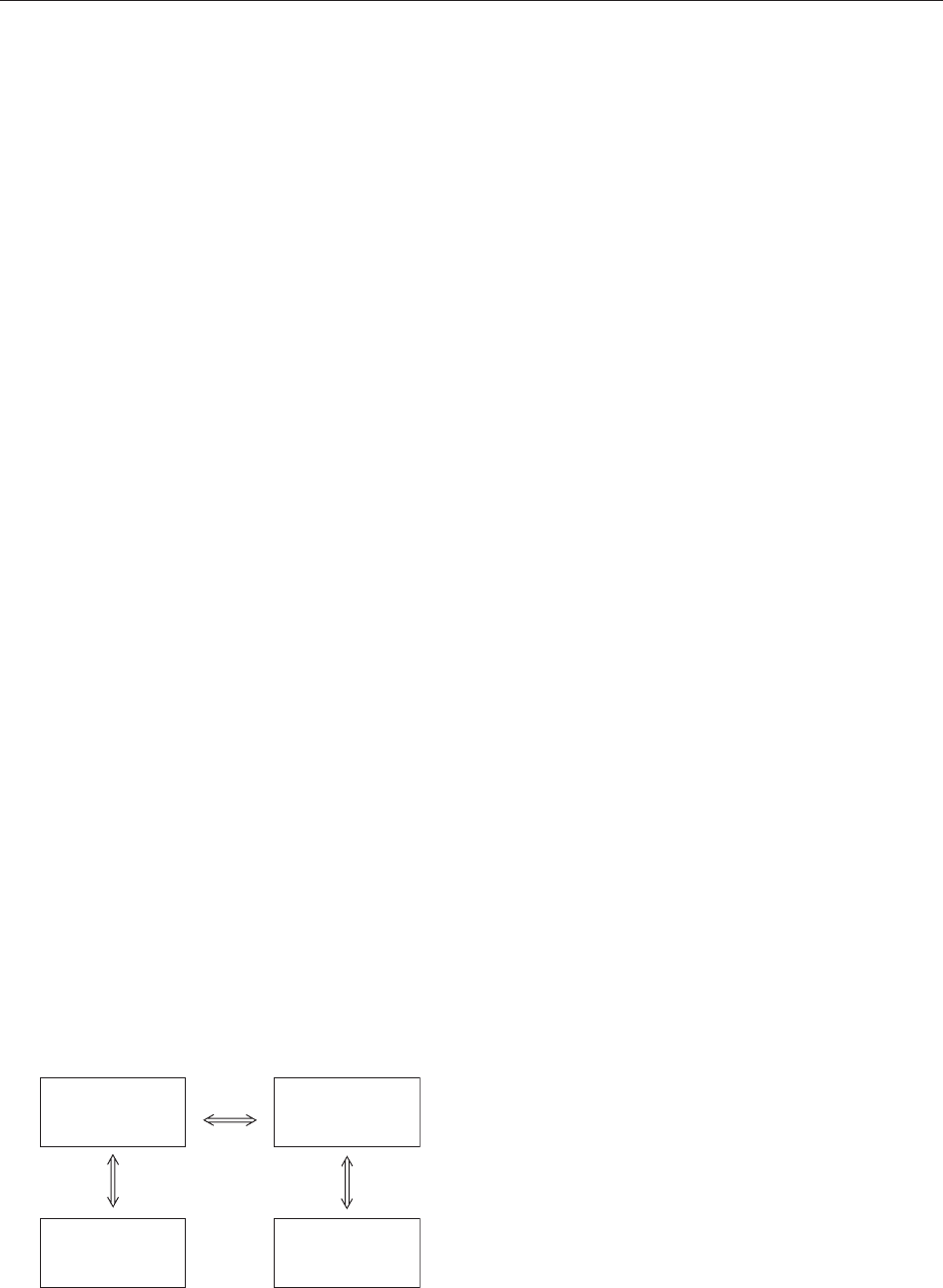
identity [46] are not dual-symmetric, because the
correct dual of the Yang–Mills equation ought to be
given by eqn [47], where
˜
D
is the covariant
derivative corresponding to a dual potential:
D
F
¼ 0 ½45
D
F
¼ 0 ½46
~
D
F
¼ 0 ½47
Secondly, the Yang–Mills equation, unlike its
abelian counterpart [27], says nothing about
whether the 2-form
F is closed or not. Nor is the
relation [11] about exactness at all. In other words,
the Yang–Mills equation does not guarantee the
existence of a dual potential, in contrast to the
Maxwell case. In fact, Gu and Yang have con-
structed a counterexample. Because the true vari-
ables of a gauge theory are the potentials and not
the fields, this means that Yang–Mills theory is not
symmetric under the Hodge star operation [3].
Nevertheless, electric–magnetic duality is a very
useful physical concept, so one may wish to seek a
more general duality transform (~), satisfying the
following properties:
1. ( )
~~
= ().
2. Electric field F
!
magnetic field
˜
F
.
3. Both A
and
˜
A
exist as potentials (away from
charges).
4. Magnetic charges are monopoles of A
,and
electric charges are monopo les of
˜
A
.
5. ~ reduces to
in the abelian case.
One way to do this is to study the Wu–Yang
criterion more closely. This reveals the concept of
charges as topological constraints to be crucial
even in the pure field case, as can be seen in
Figure 1. The point to stress is that, in the above
abelian case, the condition for the absence of a
topological charge (a monopole) exactly removes
the redundancy of the variables F
, and hence
recovers the potential A
.
Now the nonabelian monopole charge was defined
topologically as an element of
1
(G), and this
definition also holds in the abelian case of U(1), with
1
(U(1)) = Z. So the first task is to write down a
condition for the absence of a nonabelian monopole.
To fix ideas, let us consider the group SO(3),
whose monopole charges are elements of Z
2
, which
can be denoted by a sign . The vacuum, charge (þ)
(that is, no monopole) is represented by a closed
curve in the group manifold of even winding
number, and the monopole charge () by a closed
curve of odd winding number. It is more convenient,
however, to work in SU(2), which is the double
cover of SO(3) and which has the topology of S
3
,as
sometimes it is useful to identify the fundamental
group of SO(3) with the center of SU(2) and hence
consider the monopole charge as an element of this
center. There the charge (þ) is represented by a
closed curve, and the charge () by a curve that
winds an odd number of ‘‘half-times’’ round the
sphere S
3
. Since these charges are defined by clos ed
curves, it is reasonable to try to write the constraint
in terms of loop variables. The treatment presented
below is not as rigorous as some others, but the
latter are not so well adapted to the problem in
hand. Furthermore, it is important to emphasize that
this approach aims to generalize electric–magnetic
duality to Yang–Mills theory in direct and close
analogy to duality in electromagnetism, without any
further symmetries with which it may be expedient
to enrich the theory. Other approaches are referred
to in the next section.
Consider the gauge-invariant Dirac phase factor
(or holonomy) (C) of a loop C, which can be
written symbollically as a path-ordered exponential:
½¼P
s
exp ig
Z
2
0
dsA
ððsÞÞ
_
ðsÞ½48
In eqn [48], we parametrize the loop C as is eqn [49]
and a dot denotes differentiation with respect to the
parameter s.
C: f
ðsÞ: s ¼ 0 ! 2; ð0Þ¼ð2Þ¼
0
g½49
We thus regard loop variables in general as
functionals of continuous piecewise smooth func-
tions of s. In this way, loop derivatives and loop
integrals are just functional derivatives
and functional integrals. This means that loop
derivatives
(s) are defined by a regularization
procedure approximating delta functions with
finite bump functions and then taking limits in a
definite order. For functional integrals, there exist
various regularization procedures, which are treated
elsewhere in this Encyclopedia.
Geometry
Physics
Gauss
Poincaré
Defining constraint
∂
µ
F
µv
= 0
[dF = 0]
*
A
µ
exists as
potential for F
µv
[F = dA]
Principal A
µ
bundle trivial
No magnetic
monopole e
~
Figure 1
206 Electric–Magnetic Duality
Polyakov (1980) introduces the logarithmic loop
derivative of []:
F
½js¼
i
g
1
½
ðsÞ½½50
This acts as a kind of ‘‘connection’’ in loop space
since it tells us how the phase of [] changes from
one loop to a neighbouring loop . One can go a step
further and define its ‘‘curvature’’ in direct analogy
with F
(x)by
G
½js¼
ðsÞF
½js
ðsÞF
½js
þ ig½F
½js ; F
½js ½51
It can be shown that by using the F
[js] we can
rewrite the Yang–Mills action as eqn [52], where the
normalization factor
¯
N is an infinite constant:
A
0
F
¼
1
4
N
Z
Z
2
0
ds trfF
½jsF
½js gj
_
ðsÞj
2
½52
However, the true variables of the theory are still
the A
. They represent 4 functions of a real variable,
whereas the loop connections represent 4 functionals
of the real function (s). Just as in the case of the F
,
these F
[js] have to be constrained so as to recover
A
, but this time much more severely.
It turns out that, in pure Yang–Mills theory, the
constraint that says there are no monopoles ([53])
also removes the redundancy of the loop variables,
exactly as in the abelian case,
G
½js¼0 ½53
That this condition is necessary is easy to see by
simple algebra. The proof of the converse of this
‘‘extended Poincare´ lemma’’ is fairly lengthy. Granted
this, we can now apply the Wu–Yang criterion to the
action [52] and derive the Polyakov equation [54],
which is the loop version of the Yang–Mills equation:
ðsÞF
½js ¼0 ½54
In the presence of a monopole charge (), the
constraint [53] will have a nonzero right-hand side,
G
½js ¼J
½js ½55
The loop current J
[js] can be written down
explicitly. However, its global form is much easier
to understand. Recall that F
[js] can be thought of
as a loop connection, for which we can form its
‘‘holonomy.’’ This is defined for a closed (spatial)
surface (enclosing the monopole), parametrized by
a family of closed curves
t
(s), t = 0 !2. The
‘‘holonomy’’
is then the total change in phase
of [
t
]ast ! 2, and thus equals the charge ().
To formulate an electric–magnetic duality that is
applicable to nonabelian theory, one defines yet
another set of loop variables. Instead of the Dirac
phase factor [] for a complete curve [48],we
consider the parallel phase transport for part of a
curve from s
1
to s
2
:
ðs
2
; s
1
Þ¼P
s
exp ig
Z
s
2
s
1
dsA
ððsÞÞ
_
ðsÞ½56
Then the new variables are defined by [57].
E
½js¼
ðs; 0ÞF
½js
1
ðs; 0Þ½57
These are not gauge invariant like F
[js] and may
not be as useful in general, but seem more
convenient for dealing with duality.
Using these variables, we now define their dual
˜
E
[jt] according to
!
1
ððtÞÞ
~
E
½jt!ððtÞÞ
¼
2
N
"
_
ðtÞ
Z
dsE
½js
_
ðsÞ
_
2
ðsÞ
ððsÞðtÞÞ ½58
In eqn [58], !(x) is a (local) rotation matrix
transforming from the frame in which the orientation
in internal symmetry space of the fields E
[js]are
measured to the frame in which the dual fields
˜
E
[jt]
are measured. It can be shown that this dual transform
satisfies all five of the required conditions listed earlier.
Electric–magnetic duality in Yang–Mills theory is
now fully reestablished using this genera lized dua-
lity. We have the dual pairs of equations [59]–[60]
and [61]–[62]:
E
E
¼ 0 ½59
E
¼ 0 ½60
~
E
¼ 0 ½61
~
E
~
E
¼ 0 ½62
Equation [59] guarantees that the potential A
exists, and so is equivalent to [53], and hence is the
nonabelian analog of [26]; while equation [60] is
equivalent to the Polyakov version of Yang–Mills
equation [54], and hence is the nonabelian analog of
[27]. Equation [61] is equivalent by duality to [59]
and is the dual Yang–Mills equation. Similarly
equation [62] is equivalent to [60], and guarantees
the existence of the dual potential
˜
A.
The treatment of charges using the Wu–Yang
criterion also follows the abelian case, and will not
be further elaborated here. For this and further
details, the reader is referred to the orginal papers
(Chan and Tsou 1993, 1999).
Electric–Magnetic Duality 207

Also, just as in the abelian case, the gauge
symmetry is doubled: from the group G we deduce
that the full gauge symmetry is in fact G
˜
G, but that
the physical degrees of freedom remain the same.
The above exposition establishes electric–magnetic
duality in Yang–Mills theory only for classical fields.
A hint that this duality persists at the quantum level
comes from the work of ’t Hooft (1978) on confine-
ment. There he introduces two loop quantities A(C)
and B(C) that are operators in the Hilbert space of
quantum states satisfying the commutation relation
[63] for an SU(N) gauge theory, where n is the linking
number between the two (spatial) loops C and C
0
:
AðCÞBðC
0
Þ¼BðC
0
ÞAðCÞexpð2in=NÞ½63
The order or Wilson operator is given explicitly by
A(C) = tr (C). These two operators play dual roles
in the sense of electric–magnetic duality:
A(C) measures the magnetic flux through C and
creates electric flux along C.
B(C) measures the electric flux through C and
creates magnetic flux along C.
By defining the disorder operator B(C) as the
Wilson operator corresponding to the dual potential
˜
A obtained above, one can prove the commutation
relation [63], thus showing that these classical fields,
when promoted to operators, retain their duality
relation. Furthermore, there is a remarkable relation
between the two (abstractly identical) gauge groups,
in that if one is confined then the dual must be
broken (that is, in the Higgs phase). This result is
known as ’t Hooft’s theorem.
The doubling of gauge symmetry, together with
’t Hooft’s theorem, has been applied to the confined
colour group SU(3) of quantum chromodynamics
(QCD), in the Dualized Standard Model, to solve the
puzzle of the existence of exactly three generations of
fermions, with good observational support, by
identifying the (necessarily broken) dual SU(3) with
the generation symmetry (Chan and Tsou, 2002).
Other Treatments of Nonabelian Duality
Since Yang–Mills theory is not symmetric under the
Hodge
-operation, there are several routes one can
take to generalize the concept of electric–magnetic
duality to the nonabelian case. What was presented
in the last section is a modification of the
-operation so as to restore this symmetry for
Yang–Mills theory, keeping to the original gauge
structure as much as possible. However, Yang–Mills
theory as used today in particle and field theories are
usually embedded in theories with more structures.
In the simplest case we have the Standar d Model of
Particle Physics, which describes all of particle
interactions (except gravity) and which has the
gauge group usually written as SU(3) SU(2)
U(1), corresponding to the SU(3) of strong interac-
tion and SU(2) U(1) of electroweak interaction.
[Strictly speaking, it is (SU(3) SU(2) U(1))=Z
6
,if
we have the standard particle spectrum.] However,
the former group is confined and the latter broken.
The breaking is usually effected by introducing
scalar fields called Higgs fields into the theory.
Besides the experimentally well-tested Standard
Model, there are many theoretically popular models
of gauge theory in which supersymmetry is postu-
lated, thereby introducing extra symmetries into the
theory. Many of these are remnants of string theory,
and are usually envisaged as gauge theories in a
spacetime dimension higher than 4.
Because of the extra structures and increased
symmetries in these theories, there is quite a
proliferation of concepts of duality, which could all
be thought of as generalizations of abelian electric–
magnetic duality (Schwarz, 1997). They come under
the names of Seiberg–Witten duality, S-duality,
T-duality, mirror symmetry, and so on. All these
other aspects of duality have their own entries in this
Encyclopedia.
See also: AdS/CFT Correspondence; Duality in
Topological Quantum Field Theory; Four-Manifold
Invariants and Physics; Large-N Dualities; Measure on
Loop Spaces; Mirror Symmetry: a Geometric Survey;
Nonperturbative and Topological Aspects of Gauge
Theory; Seiberg–Witten theory; Standard Model of
Particle Physics.
Further Reading
Chan Hong-Mo and Tsou Sheung Tsun (1993) Some Elementary
Gauge Theory Concepts. Singapore: World Scientific.
Chan Hong-Mo and Tsou Sheung Tsun (1999) Nonabelian
generalization of electric–magnetic duality – a brief review.
International Journal of Modern Physics A14: 2139–2172.
Chan Hong-Mo and Tsou Sheung Tsun (2002) Fermion genera-
tions and mixing from dualized standard model. Acta Physica
Polonica B33(12): 4041–4100.
Polyakov AM (1980) Gauge fields as rings of glue. Nuclear
Physics B164: 171–188.
Schwarz John H (1997) Lectures on superstring and M theory
dualities. Nuclear Physics Proceedings Supplements 55B: 1–32.
’t Hooft G (1978) On the phase transition towards permanent
quark confinement. Nuclear Physics B138: 1–25.
Wu Tai Tsun and Yang Chen Ning (1976) Dirac monopoles
without strings: classical Lagrangian theory. Physical Review
D14: 437–445.
Yang Chen Ning and Mills RL (1954) Conservation of isotopic
spin and isotopic gauge invariance. Physical Review
96: 191–195.
208 Electric–Magnetic Duality

Electroweak Theory
K Konishi, Universita
`
di Pisa, Pisa, Italy
ª 2006 Elsevier Ltd. All rights reserved.
Introduction
The discovery of the electroweak theory crowned
long years of investigation on weak interactions.
The key earlier developments included Fermi’s
phenomenological four-fermion interactions for the
-decay, discovery of parity violation and establish-
ment of V A structure of the weak currents, the
Feynman–Gell–Mann conserved vector current (CVC)
hypothesis, current algebra and its beautiful applica-
tions in the 1960s, Cabibbo mixing and lepton–hadron
universality, and finally, the proposal of intermediate
vector bosons (IVBs) to mitigate the high-energy
behavior of the pointlike Fermi’s interaction theory.
It turned out that the scattering amplitudes in IVB
theory still generally violated unitarity, due to the
massive vector boson propagator,
g
þ q
q
=M
2
q
2
M
2
þ i
The electroweak theory, known as Glashow–
Weinberg–Salam (GWS) theory (Weinberg 1967,
Salam 1968, Taylor 1976), was born through the
attempts to make the hypothesis of IVBs for the
weak interactions such that it is consistent with
unitarity.
The GWS theory contains, and is in a sense a
generalization of, quantum electrodynamics (QED)
which was earlier successfully established as the
quantum theory of electromagnetism in interaction
with matter. GWS theory describes the weak and
electromagnetic interactions in a single, unified
gauge theory with gauge group
SU
L
ð2ÞUð1Þ½1
Part of this gauge symmetry is realized in the
so-called ‘‘spontaneously broken’’ mode; only a
U
EM
(1) SU
L
(2) U(1) subgroup, corresponding
to the usual local gauge symmetry of the electro-
magnetism, remains manifest at low energies , with a
massless gauge boson (photon). The other three
gauge bosons W
, Z, are massive, with masses
80.4 and 91.2 GeV, respectively.
The theory is renormalizable, as conjectured by
S Weinberg and by A Salam, and subsequently
proved by G ’t Hooft (1971), and makes well-
defined predictions order by order in perturbation
theory.
Since the experimental observation of neutral
currents (a characteristic feature of the Weinberg–
Salam theory which predicts an extra, neutral
massive vector boson, Z, as compared to the naive
IVB hypothesis) at Gargamelle bubble chamber at
CERN (1973), the theory has passed a large number
of experimental tests. The first basic confirmation
also included the discovery of various new particles
required by the theory: the charm quark (SLAC,
BNL, 1974), the bottom quark (Fermilab, 1977),
and the tau () lepton (SLAC, 1975). The heaviest
top quark, having mass about two hundred times
that of the proton, was found later (Fermilab, 1995).
The direct observation of W and Z vector bosons
was first made by UA1 and UA2 experiments at
CERN (1983).
The GWS theory is today one of the most precise
and successful theories in physics. Even more
important, perhaps, together with quantum chro-
modynamics (QCD), which is a SU(3) (color) gauge
theory describing the strong interactions (which
bind quarks into protons and neutrons, and the
latter two into atomic nuclei), it describes correctly –
within the present experimental and theoretical
uncertainties – all the presentl y known fundamental
forces in Nature, except gravity. The SU(3)
QCD
(SU
L
(2) U(1))
GWS
theory is known as the standard
model (SM).
Both the electroweak (GSW) theory and QCD
are gauge theories with a nonabelian (noncom-
mutative) gauge group. This type of theories,
known as Yang–Mills theories, can be constructed
by generalizing the well-known gauge principle
of QED to m ore general group transformations.
It is a truly remarkable fact that all of the
fundamental forces known today (apart from
gravity) are described by Yang–Mills theories,
and in this sense a very nontrivial unification
can be said to underlie the basic laws of Nature
(G ’t Hoof t).
There are further deep and remarkable conditions
(anomaly cancellations), satisfied by the structure of
the theory and by the charges of experimentally
known spin-1/2 elementary particles (see Tables 1
and 2), which guarantees the consistency of the
theory as a quantum theory.
It should be mentioned, however, that the recent
discovery of neutrino oscillations (SuperKamio-
kande (1998), SNO, K amLAND, K2K experi-
ments), which proved the neutrinos to possess
nonvanishing masses, clearly indicates that the
standard GWS t heory must be extended, in an as
yet unknown way.
Electroweak Theory 209

The following is a brief summary of the GWS
theory, its characteristic features, its implications to
the symmetries of Nature, the status of the precision
tests, and its possible extensions.
GWS Theory
All the presently known elementary particles (except
for the gauge bosons W
, Z, , the gluons, the
graviton, possibly right-handed neutrinos) are listed
in Tables 1–3 together with their charges with
respect to the SU
L
(2) U(1) gauge group.
A doublet of Higgs scalar particles is included
even though the physical component (which should
appear as an ordinary scalar particle) has not yet
been experimentally observed.
The Lagrangian is given by
L¼L
gauge
þL
quarks
þL
leptons
þL
Higgs
þL
Yukawa
þL
g:f:
þL
ghosts
The gauge kinetic terms are
L
gauge
¼
1
4
X
3
a¼1
F
a
F
a
1
4
G
G
where
F
a
¼ @
A
a
@
A
a
þ g
abc
A
b
A
c
G
¼ @
B
@
B
are SU
L
(2) U(1) gauge field tensors; L
g.f.
and L
FP
are the so-called gauge-fixing term and Faddeev–
Popov ghost term, needed to define the gauge-boson
propagators appropriately and to eliminate certain
unphysical contributions. The gauge invariance of the
theory is ensured by a set of identities (A Slavnov,
J C Taylor) . The quark kinetic terms have the form
L
quarks
¼
X
quarks
i
D
where D
are appropriate covariant derivatives,
D
q
L
¼ @
ig
2
A
ig
0
6
B
q
L
for the left-handed quark doublets,
D
u
R
¼ @
2ig
0
3
B
u
R
D
d
R
¼ @
þ
ig
0
3
B
d
R
and similarly for other ‘‘up’’ quarks c
R
(charm) and
t
R
(top), and ‘‘down’’ quarks, s
R
(strange), and b
R
(bottom). Analogously, the lepton kinetic terms are
given by
L
leptons
¼
X
3
i¼1
i
i
D
i
¼
X
3
i¼1
i
L
i
@
ig
a
A
a
2
þ
ig
0
2
B
i
L
þ
X
3
i¼1
i
R
i
@
þ ig
0
B
i
R
where
i
(i = 1, 2, 3) indicate the e, , lepton families;
finally, the parts involving the Higgs fields are
L
Higgs
¼D
D
þ Vð;
y
Þ
Vð;
y
Þ¼
2
y
ð
y
Þ
2
and
L
Yukawa
¼
X
3
i; j¼1
g
ij
d
q
i
L
þ
0
d
j
R
þ g
ij
u
q
i
L
0
!
u
j
R
#
þ h:c:
þ
X
3
i;j¼1
g
i
e
i
L
þ
0
i
R
þ h:c: ½2
Table 1 Quarks and their charges
Quarks SU
L
(2) U
Y
(1) U
EM
(1)
u
L
d
0
L
,
c
L
s
0
L
,
t
L
b
0
L
2
1
3
2
3
1
3
u
R
, c
R
, t
R
1
4
3
2
3
d
R
, s
R
, b
R
1
2
3
1
3
The primes indicate that the mass eigenstates are different from
the states transforming as multiplets of SU
L
(2) U
Y
(1): They
are linearly related by CKM mixing matrix.
Table 2 Leptons and their charges
Leptons SU
L
(2) U
Y
(1) U
EM
(1)
0
eL
e
L
,
0
L
L
,
0
L
L
2 1
0
1
e
R
,
R
,
R
1 2 1
The primes indicate again that the mass eigenstates are in
different from the states transforming as multiplets of SU
L
(2)
U
Y
(1), as required by the observed neutrino oscillations.
Table 3 Higgs doublet scalars and their charges
Higgs doublet SU
L
(2) U
Y
(1) U
EM
(1)
þ
0
21
1
0
210 Electroweak Theory

For
2
< 0, the Higgs potential has a minimum at
h
y
i¼hj
þ
j
2
þj
0
j
2
i¼
2
2
v
2
2
6¼ 0
By choosing conveniently the direction of the Higgs
field, its vacuum expectation value (VEV) is expressed as
þ
0
¼
0
v=
ffiffiffi
2
p
; v
ffiffiffiffiffiffiffiffiffiffi
2
r
½3
The physical properties of Higgs and gauge
bosons are best seen by choosing the so-called
unitary gauge,
ðxÞ¼
þ
0
¼ e
i
a
ðxÞ
2
=v
0
ðv þ ðxÞÞ=
ffiffiffi
2
p
UðÞ
0
ðxÞ
L
¼ UðÞ
0
L
;
R
¼
0
R
A
¼ UðÞ A
0
þ
i
g
@
U
1
ðÞ; A
a
A
a
2
and expressing everything in terms of primed
variables. It is easy to see that
1. There is one physical scalar (Higgs) particle
with mass,
m
¼
ffiffiffiffiffiffiffiffiffiffiffiffi
2
2
p
½4
2. The Higgs kinetic term (D
0y
)(D
0
) produces the
gauge-boson masses
M
2
W
¼
g
2
v
2
4
; M
2
Z
¼
v
2
4
ðg
2
þ g
02
Þ½5
3. The physical gauge bosons are the charged W
,and
two neutral vector bosons described by the fields
Z
¼ cos
W
A
3
sin
W
B
;
A
¼ sin
W
A
3
þ cos
W
B
where the mixing angle
W
¼ tan
1
g
0
g
sin
W
¼
g
0
ffiffiffiffiffiffiffiffiffiffiffiffiffiffiffiffi
g
2
þ g
02
p
!
is known as the Weinberg angle. The mass less A
field describes the photon.
Fermi Interactions and Neutral Currents
The fermions interact with gauge bosons through
the charge and neutral currents
L¼
g
2
J
W
þ
þ J
þ
W
þL
n:c:
½6
L
n:c:
¼ gJ
3
A
3
þ
g
0
2
J
Y
B
¼ eJ
em
A
þ
g
cos
W
J
0
Z
½7
where
J
þ
¼
X
L
þ
L
¼
1
2
X
þ
ð1
5
Þ
1
2
J
VA
þ
½8
corresponds to the standard charged current, and
J
0
¼ J
3
sin
2
W
J
em
½9
is the neutral current to which the Z boson is
coupled ( J
3
= (1=2)
P
L
3
L
and J
em
is the
electromagnetic current). The model thus predicts
the existence of neutral current processes, mediated
by the Z boson, such as
e !
e or
e !
e, with
cross section of the same order of that for the
charged current process,
e
e !
e
e, but with a
characteristic L–R asymmetric couplings depending
on the Weinberg angle. By eqn [9] appropriate ratios
of cross sections, such as (
e !
e)=(
e !
e),
can be used to measure sin
2
W
.
The exchange of heavy W bosons generates an
effective current–current interaction at low energies:
L
c:c
eff
¼
g
2
2M
2
W
J
J
þ
the well-known Fermi–Feynman–Gell-Mann Lagran-
gian
G
F
ffiffi
2
p
J
y
VA
J
VA
,with
G
F
ffiffiffi
2
p
¼
g
2
8M
2
W
This means that the Higgs VEV must be taken to be
v ¼ 2
1=4
G
1=2
F
’ 246 GeV ½10
Masses
It is remarkable that ‘‘all’’ known masses of the
elementary particles – except perhaps those of the
neutrino masses – are generated in GWS theory
through the spontaneous breakdown of SU
L
(2)
U(1) symmetry, through the Higgs VEV (eqns [3]
and [10]). The boson masses are given by [4] and
[5]. Note that the relation
¼
M
2
W
M
2
Z
cos
2
W
¼ 1 þ Oð Þ
reflects an accidental SO(3) symmetry present (note the
SO(4) symmetry of the Higgs potential in the limit
!0, before the spontaneous breaking) in the model,
called custodial symmetry. This is a characteristic,
model-dependent feature of the minimal model, not
Electroweak Theory 211

necessarily required by the gauge symmetry. This
relation is well met experimentally, although a quanti-
tative discussion requires the choice of the renormaliza-
tion scheme (including the definition of sin
W
itself)
and check of consistency with various other data.
The fermions get mass through the Yukawa
interactions (eqn [2]); the fermion masses are
arbitrary parameters of the model and cannot be
predicted within the GWS theory. An important
feature of this mechanism is that the coupling of the
physical Higgs particle to each fermion is propor-
tional to the mass of the latter. This should give a
clear, unambiguous experimental signature for the
Higgs scalar of the minimal GWS model.
The recent discovery of nonvanishing neutrino
masses requires the theory to be extended. Actually,
there is a natural way to incorporate such masses in the
standard GWS model, by a minimal extension. As the
right-handed neutrinos, if they exist, are entirely
neutral with respect to the SU
L
(2) U(1) gauge
symmetry, they do not need its breaking to have
mass. In other words,
R
may get Majorana masses,
M
R
R
R
, by some yet unknown mechanism, much
larger than those of other fermions (such a mechanism
is quite naturally present in some grand unified
models). If now the Yukawa couplings are introduced
as for the quarks and for the down leptons, then the
Dirac mass terms result upon condensation of the
Higgs field, and the neutrino mass matrix would take
the form, for one flavor (in the space of (
L
,
R
)):
0 m
D
m
D
M
R
½11
If the Dirac masses are assumed to be of the same
order of those of the quarks and if the right-handed
Majorana masses M
R
are far larger, for example,
of the order of the grand unified scale, O(10
16
GeV),
then diagonalization of the mass matrix would
give, for the physical masses of the left-handed
neutrinos, m
2
D
=M
R
m
D
, much smaller than other
fermion masses, quite naturally (‘ ‘see-saw’’ mechanism).
CKM Quark Mixing As there is a priori no reason
why the weak-interaction eigenstates should be
equal to the mass eigenstates, the Yukawa couplings
in eqn [2] are in general nondiagonal matrices in the
flavor. Suppose that the the weak base for the
quarks is given in terms of the mass eigenstates (in
which quark masses are made diagonal), by unitary
transformations
u
Li
¼
X
j
V
up
ij
~
u
Lj
; d
Li
¼
X
j
V
down
ij
~
d
Lj
then the interaction terms with W
bosons [6] can
be cast in the form (Kobayashi and Maskawa 1972)
L
W-exc
¼
u
i
L
W
þ
U
ðCKMÞ
ij
d
j
L
þ
d
k
L
W
U
ðCKMÞy
k‘
u
‘
L
½12
where U
CKM
ij
(V
upy
V
down
)
ij
is called Cabibbo–
Kobayashi–Maskawa (CKM) matrix. It can be
parametrized in terms of three Euler angles and
one phase
U ¼
U
ud
U
us
U
ub
U
cd
U
cs
U
cb
U
td
U
ts
U
tb
0
B
@
1
C
A
¼
c
12
c
13
s
12
c
13
s
13
e
i
13
s
12
c
23
c
12
s
23
s
13
e
i
13
c
12
c
23
s
12
s
23
s
13
e
i
13
s
23
c
13
s
12
s
23
c
12
c
23
s
13
e
i
13
c
12
s
23
s
12
c
23
s
13
e
i
13
c
23
c
13
0
B
@
1
C
A
½13
where c
12
= cos
12
, s
23
= sin
23
, etc. The require-
ment that charge–current weak processes are all
described by these matrix element s, satisfying the
unitarity relation,
X
‘
U
CKM
i‘
U
CKMy
‘k
¼
ik
½14
gives a very stringent test for the validity of the model.
CP Violation
CP (product of charge conjugation and parity
transformation) invariance is an approximate sym-
metry of Nature. Although it is known to be broken
by very tiny amounts only, the exact extent and the
nature of CP violation can have far-reaching
consequences.
Table 4 Quark masses
u (MeV) c (GeV) t (GeV) d (MeV) s (MeV) b (GeV)
1.5–4 1.15–1.35 174:3 5:1 4–8 80–130 4.1–4.4
Table 5 Leptons masses
e
(eV)
(MeV)
(MeV)
<3 < 0:19 <18:2
e (MeV) (MeV) (MeV)
0:510 998 92
4 10
8
105:658369
9 10
6
1776:99 0:26
Table 6 Gauge-boson masses
Photon Gluons W
(GeV) Z (GeV)
0080:425 0:038 91:1876 0:0021
212 Electroweak Theory
CP violation has first been discovered by Cronin
and Fitch (BNL, 1964) in the K-me son system; more
precise information on the nature of CP violation
from the neutral kaon decays has been obtained
more recently (2000) in NA48 (CERN) and KTeV
(Fermilab) experiments. CP violation has been
established in the B-meson systems as well, very
recently (2002), by Babar experiments at SLAC and
Belle experiments at KEK.
Through the so-called CPT theorem, CP invariance
(or violation) is closely related to the T (time-reversal
invariance) symmetry. Also, CP noninvariance is one
of the conditions needed in the cosmological baryon
number generation (baryogenesis).
In the GWS theory, with three families of quark
flavors (six quarks), there is just one source of CP
violation: the phase
13
appearing in the CKM
matrix (eqn [13]). For 6¼ 0, , W-excha nge inter-
actions [12] induce CP viol ation. The earlier and
more recent experimental data on K
0
K
0
mixing
and K
L, S
decay data appear to be compatible with
the CKM mechanism for CP violation, but a
quantitative comparison with the SM remains
somewhat hindered by the difficulty of estimating
certain strong interaction effects. The recent con-
firmation of CP violation in B systems is made in
the context of a global fit with the SM predictions
such as the ‘‘unitarity triangle’’ relations, for
example,
1 þ
U
ud
U
ub
U
cd
U
cb
þ
U
td
U
tb
U
cd
U
cb
¼ 0 ½15
(eqn [14]), and by combining data from kaon deays,
charmed meson decays, B meson decay and mixings,
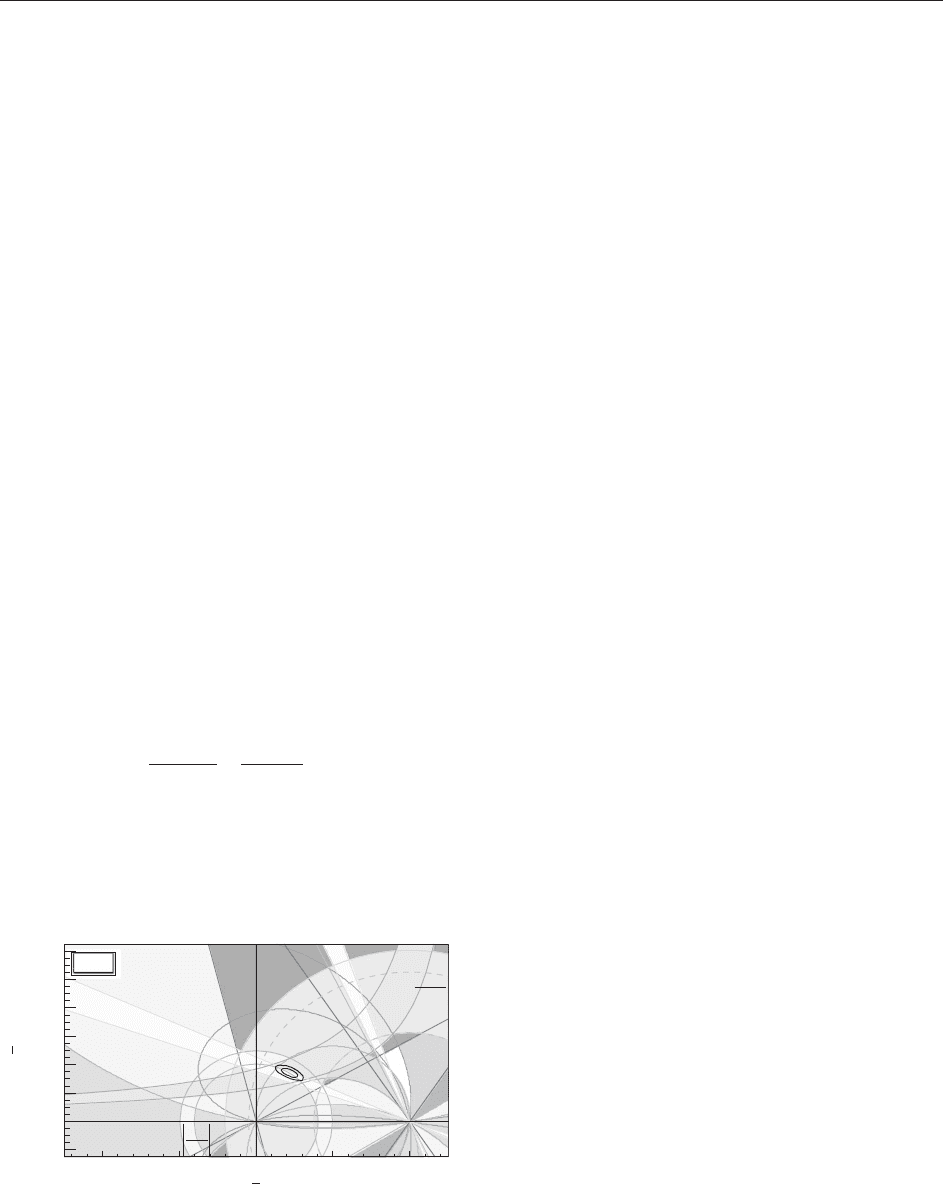
etc., and is a part of direct tests of the GWS
model, with nonvanishing CP violation CKM
phase (eqn [16] and Figure 1). Recent evidence for
nonzero neutrino masses and mixings opens the
way to possible CP violation in the leptonic
processes as well.
Finally, within the SM including strong interac-
tions, there is one more source of CP violation: the
so-called (vacuum) parameter of QCD.
B and L Nonconservation
Another set of approximate symmetries in Nature are
the baryon and lepton number conservations. In the
electroweak theory, these global symmetries are exact
to all orders of perturbation theory. Nonperturbative
effects (a sort of barrier penetration in gauge field
space) however violate both B and L; the combina-
tion B–L is conserved even nonperturbatively though.
The nonperturbative electroweak baryon number
violation is an extremely tiny effect, the amplitude
being proportional to the typical tunnel ing factor
e
2=
, but the process is unsuppressed at finite
temperatures as might have been experienced by the
universe at some early stage after big bang.
B or L nonconservation can also arise naturally at
high energy scales, if the electroweak theory is
embedded as the low-energy approximation in a
grand unified model. The experimental lower limit
of proton lifetime,
P
10
32
years, from Kamio-
kande experiments, however severely restricts accep-
table models of this type (the simplest SU(5) model
is already ruled out).
On the other hand, cosmological baryogenesis
requires sufficient amount of baryon number viola-
tion, at least in some stage of cosmological expan-
sion. Detailed analyses suggest that the standard
electroweak transition might not in itself explain the
baryon number n
P
=n
10
10
observed in the
present universe. Recen t observations of neutrino
oscillations suggest the right-handed Majorana-type
neutrino masses to be present, which violate the
lepton number L. In such a case it might be possible
that the correct amount of baryon number excess
would be generated, through the leptogenesis.
Global Fit
Various relations exist at the tree level among the
masses, scattering cross sections, decay rates,
various asymmetries, etc., which can be read off
or calculated from the formulas given earlier.
These quantities receive corrections at higher
orders, and the experimental checks of these
modified relations provide precision tests of the
model on the one hand, and possibly a hint for new
physics, if there is any discrepancy with the
prediction. Very often the amplitudes of interest
–1 –0.5 0 0.5 1
η
–0.2
0
0.2
0.4
0.6
0.8
1
1.2
sin2β
D
0
π
0
cos2β
α
2β + γ
γ
Δ
m
d
Δm
d
Δm
s
ε
K
V
cb
V
ub
ρ
UT
fit
Figure 1 Unitarity triangle test (Eq. (15)). The small ellipses
represent 68% and 95% probability zones for the apex
corresponding to U
ud
U
ub
/U
cd
U
cb
. Reproduced from M. Bona et
al. (2005) The 2004 UTfit collaboration report on the status of the
unitarity triangle in the standard model. Journal of High Energy
Physics. 0507: 028–059 (hep-ph/0501199), with permission from
IoP Publishing Ltd and the UTfit collaboration.
Electroweak Theory 213

receive important contributions due to strong
interactions, which are difficult to es timate.
The basic parameters of the model, apart from the
Higgs mass, and fermion masses and mixing
parameters, can be taken to be (1) the fine structure
constant, = 1=137.035 999 11(46); (2) the Fermi
constant G
F
= 1.166 37 10
5
GeV
2
(which can be
determined from the muon lifetime), and the Z-boson
mass, M
Z
= 91.1876 0.0021 GeV (observed directly
at LEP). M
W
and sin
2
W
are then calculable
numbers, in terms of these quantities, and depending
on m
t
(measured independently by CDF and D;
experiments at Fermilab) and on the unknown M
H
.
Such precision tests of the GWS model are being
made, combining the analyses of various decay rates
and asymmetries in B-meson systems at B factories
and in colliders, production and decays of Z and W
bosons, elastic e or
e scatterings, elastic p or
p
scatterings, deep inelastic lepton nucleon (or deu-
teron) scatterings, the muon anomalous magnetic
moment, atomic parity violatio n experiments, etc.
An overall fit to the data gives an excellent
agreement, with the input parameters
M
H
¼ 113
þ56
40
GeV; m
t
¼ 176:9 4:0 GeV;
s
ðM
Z
Þ¼0:1213 0:0018
For instance (in GeV),
M
W
¼ 80:390 0:018 vs: 80:412 0:042
(exp. value (LEP))
Z
¼ 2:4972 0:0012 vs: 2:4952 0:0023
(exp. value)
For sin
2
W
(defined in the so-called MS scheme) all
data give consistently the value
sin
2
W
¼ 0:231 20 0:000 15
(a slightly larger value is reported by an N
experiment at Fermilab).
The unitarity-triangle tests of the SM and deter-
mination of CKM matrix have already been men-
tioned. The results of global fit can be summarized
in Figure 1, and by the angles
s
12
¼ 0:2243 0:0016
s
23
¼ 0:0413 0:0015
s
13
¼ 0:037 0:0005
13
¼ 60
14
½16
For the muon anomalous gyromagnetic ratio (g 2),
the experimental data
a
exp
¼
g
2
2
¼ð1:116 5920ð37Þ0:78Þ10
9
is to be compared with the theoretical prediction
a
th
¼ð1:1165918ð83Þ0:49Þ10
9
which is slightly smaller (1.9), where the largest
theoretical uncertainty comes from the two-loop
hadronic contribution a
had
’ (69.63 0.72) 10
9
(the QED corrections to O(
5
) are included).
For further details of the analyses and the present
status of experimental tests of the electroweak theory,
see the reviews by J Erler and P Langacker, and by F
J Gilman et al., cited in ‘‘Further reading’’ (most of
numbers cited here come from these two reviews).
Need for Extension of the Model
In spite of such an impressive experimental con-
firmation, there are reasons to believe that the
electroweak theory, in its standard minimal form,
is not a complete story. As already mentioned,
neutrino oscillations, predicted earlier by Ponte-
corvo, have recently been experimentally confirmed,
giving uncontroversial evidence for nonvanishing
neutrino masses and their mixing. This is a clear
signal that the theory must be extended. If the mass
is instead taken in the form of eqn [11] but with
three neutrinos families, the diagonal ization in
general yields a mixing for the light neutrinos, as
for the quarks. Some of the experimental data on the
neutrinos are summarized in Table 7.
In addition, the Higgs sector of the theory (the
part of the interactions responsible for spontaneous
breaking SU
L
(2) U(1) ! U
EM
(1)) is still largely
untested. The theory predicts a physical scalar
particle, the Higgs particle, of unknown mass. The
present-day expectation for its mass, which com-
bines the experimental lower limit and an indirect
upper limit following from the analysis of various
radiative corrections, is
114 ðGeVÞ < m
H
< 250 ðGeVÞ
This particle should be observable either in the
Tevatron at Fermilab or in the coming LHC
Table 7 Neutrino mass square differences and mixing
e
12
m
2
= (6 9) 10
5
eV
2
23
m
2
= (1 3) 10
3
eV
2
Solar neutrinos and reactor (SNO, SuperKamiokande,
KamLAND) experiments give the first results. Atmospheric neutrino
data and the long baseline experiment (SuperKamiokande, K2K)
provide the second. The mixing angle relevant to the solar and
reactor neutrino oscillation is large, tan
2
12
0:40
þ0:10
0:07
, while the
one related to the atmospheric neutrino data is maximal,
sin
2
2
23
1: Cosmological considerations give
P
m
i
< O(1 eV):
214 Electroweak Theory

experiments at CERN; negative results would force
upon us a substantial modification of the electro-
weak theory.
Last, but not least, there are a few theoretical
motivations for an extension of the model to be
considered necessary. First, the structure of the GWS
theory is not entirely determined by the gauge
principle. The form of the Higgs self-interactions,
as well as their number and the Yukawa cou plings
of the Higgs scalar to the fermions, are uncon-
strained by any principle, and the particular,
minimal form assumed by Weinberg and Salam is
yet to be confirmed experimentally.
In addition, the theory is not really a unified
gauge theory: SU
L
(2) and U(1) gauge couplings are
distinct. One possibility is that the SU(3)
QCD
SU
L
(2) U(1) theory of the SM is actually a low-
energy manifestation of a truly unified gauge theory –
grand unified theory (GUT) – defined at some
higher mass scale. The simplest version of GUT
models based on SU(5) or SO(10) gauge groups has
however a difficulty with the proton decay rates,
and with the coupling-constant unification itself.
Supersymmetric GUTs appear to be more accepta-
ble both from the coupling-constant unification and
from the proton lifetime constraints.
A more subtle, but perhaps more severe theore-
tical problem, is the so-called naturalness problem.
At the quantum level, due to the quadratic diver-
gences in the scalar mass, the structure of the theory
turns out to be quite peculiar. If the ultraviolet
cutoff of the theory is taken to be the Planck mass
scale,
UV
m
Pl
10
19
GeV, at which gravity
becomes strongly coupled, the theory at
UV
would
have to possess parameters which are fine-tuned
with an excessive precision. The problem is known
also as a ‘‘hierarchy’’ problem.
A way to avoid having such a difficulty is to
introduce supersymmetry. In a supersymmetric
version of the standard theory – in fact, there are
phenomenologically well-acceptable models such
as the minimal supersymmetric standard model
(MSSM) – this problems is absent due to the
cancellation of bosonic and fermionic loop c on-
tributions typical of supersymmetric theories. As a
result, the properties of the theory at low ene rgies
are much less sensitive to those of the theory at the
Planck mass scale. Experiments at LHC (expected
to be performed after 2008, CERN) should be able
to produce a whole set of new particles associated
with supersym metry, if this is a part o f the physical
law beyond TeV energies.
At a deeper level, however, the hierarchy problem
in a more general sense persists, even in super-
symmetric models: why the masses of the order of
O(100 GeV) should appear at all in a theory with a
natural cutoff of the order of the Planck mass?
Furthermore, if the masses of the neutrinos turn out
to be of the order of O(10
3
–10
0
) eV, we are left
with the problem of understanding the large
disparities among the quark and lepton masses,
spanning the range of more than 13 orders of
magnitudes: another ‘‘hierarchy’’ problem.
It is also possible that the spacetime the physical
world lives in is actually higher dimensional: the usual
four-dimensional Minkowski spacetime times either
compactified or uncompactified ‘‘extra dimensions.’’
In theories of this type, some of the difficulties
mentioned above might find a natural solution. It is
yettobeseenwhetheraconsistenttheoryofthistype
can be constructed that correctly account for the
properties of the universe we inhabit.
Bibliographic Notes
A short but comprehensive introduction to the
Weinberg–Salam theory is found in Taylor (1976);
see also Abers and Lee (1973) and ’t Hooft and
Veltman (1973).
The reprint collection edited by Taylor (2001)
contains many of fundamental papers, e.g., on
Yang–Mills theories (by C N Yang, R L Mills,
R Shaw), on spontaneous symmetry breaking and
its application to gauge theories (by Y Nambu,
J Schwinger, P W Anderson, P W Higgs, F Englert,
R Brout, T W B Kibble) and on renormalization of
Yang–Mills theories and application to the electro-
weak theory (L D Faddeev, V N Popov , G ’t Hooft).
For up-to-d ate review on precision tests of the
GWS theory, and details of the analyses, see Erler
and Langacker (2004), and references cited therein.
For a recent review on neutrino experiments, see
Shirai (2005). For theory on neutrinos, see Fukugita
and Yanagida (2003).
For the unitarity triangle test of the GWS model and
determination of CKM matrix elements, see results
from the CKM fitter Group (Bret et al. 2005), the
UTfit Collaboration (Bona et al. 2005), and a review
by Gilman et al. (2005), and references cited therein.
See also: Abelian and Nonabelian Gauge Theories
using Differential Forms; Current Algebra; Effective
Field Theories; Finite Group Symmetry Breaking;
Noncommutative Tori, Yang–Mills, and String Theory;
Quantum Chromodynamics; Quantum Electrodynamics
and Its Precision Tests; Quantum Field Theory: A Brief
Introduction; Renormalization: General Theory; Standard
Model of Particle Physics; Symmetries and Conservation
Laws; Symmetry and Symmetry Breaking in Dynamical
Systems; Symmetry Breaking in Field Theory.
Electroweak Theory 215