
Francoise J.-P., Naber G.L., Tsun T.S. (editors) Encyclopedia of Mathematical Physics
Подождите немного. Документ загружается.


6. E
R
(Relative entropy of entanglement
[V, M, A
]) This measure (Vedral et al. 1997)
is motivated geometrically: it is simply the
relative entropy distance of to the separable
subset: E
R
() = inf
S(k), where ranges over
all separable states. E
R
is an upper bound to E
D
.
However, it can be improved by taking the
distance to the PPT states rather than the
separable states, and by combining with E
N
,in
the following way:
7. E
B
(The Rains bound [V, M, A
, C]) Following
Rains (2001),weset
E
B
ðÞ¼inf
SðkÞþE
N
ðÞðÞ
where the infimum is over all states . This is
still an upper bound to E
D
, although clearly
smaller than both E
R
(take only separable )
and E
N
(take = ). No example of E
D
() <
E
R
() is known, but any bound entangled non-
PPT state would be such an example.
8. E
S
(Squashed entanglement [V, M, A
, A
þþ
,
C, L]) This measure, introduced by Christandl
and Winter (2004), amazingly has all the good
properties, but is as difficult to compute as any
of the other measures. E
S
(
AB
) is the infimum
over the entropy combination
Sð
AC
ÞþSð
BC
ÞSð
ABC
ÞSð
C
Þ
over all extensions
ABC
of the given state
AB
to
a system enlarged by a part C, where the density
operators in the above expression are the
restrictions of
ABC
to the subsystems indicated.
9. E
K
(Key rate [V, M, A
]) The bit rate at which
secret key can be generated is certainly larger
than E
D
, since distillation is one way to do it. It
is, in general, strictly larg er, sinc e there are
undistillable states with positive key rate.
10. E
C
(Concurrence [ V]) This measure was
originally only defined for qubit pairs, as a
step in Wootter’s (1998 ) formula for E
F
in this
case. It has an extension to arbitrary dimensions
(Rungta et al. 2001), namely the convex hull of
the function c(j ih j) =
ffiffiffiffiffiffiffiffiffiffiffiffiffiffiffiffiffiffiffiffiffiffiffiffiffiffi
2(1 tr(
2
))
p
, where
= j ih j
A
is the reduced density operator.
Both upper and lower bounds exist in the
literature. The main interest in this measure
stems from the fact that it has interesting
extensions to the multipartite case.
To conclude, we would like to point out that
many of the themes discussed in this article were set
by Bennett et al. (1996); their article is worth
reading even today. Good review articles covering
entanglement measures, with more complete refer-
ences, are Plenio and Virmani (2005) , Bruß (2002),
and Donald et al. (2002).
See also: Entanglement; Entropy and Quantitative
Transversality; Quantum Channels: Classical Capacity.
Further Reading
Bennett CH, DiVincenzo DP, Smolin JA, and Woottes WK (1996)
Mixed-state entanglement and quantum error correction.
Physical Review A 54: 3824–3851.
Bruß D (2002) Characterizing entanglement. Journal of Mathe-
matical Physics 43: 4237.
Christandl M and Winter A (2004) Squashed entanglement – an
additive entanglement measure. Journal of Mathematical
Physics 45: 829–840.
Donald MJ, Horodecki M, and Rudolph O (2002) The unique-
ness theorem for entanglement measures. Journal of Mathe-
matical Physics 43: 4252–4272 and quant-ph/0105017.
Horodecki M, Horodecki P, and Horodecki R (2000) Unified
approach to quantum capacities: towards quantum noisy
coding theorem. Physical Review Letters 85: 433.
Nielsen M (1999) Conditions for a class of entanglement
transformations. Physical Review Letters 83: 436–439.
Plenio MB and Virmani S (2005) An introduction to entanglement
measures, quant-ph/0504163.
Rains E (2001) IEEE Trans. Inf. Theory 47: 2921–2933.
Rungta P et al. (2001) Universal state inversion and concurrence
in arbitrary dimensions. Physical Review A 64: 042315.
Vedral V, Plenio MB, Rippin MA, and Knight PL (1997)
Quantifying entanglement. Physical Review Letters 78: 2275.
Vollbrecht KGH and Werner RF (2001) Entanglement measures
under symmetry. Physical Review A 64: 062307.
Wootters WK (1998) Entanglement of formation of an
arbitrary state of two qubits. Physical Review Letters
80: 2245–2248.
236 Entanglement Measures

Entropy and Quantitative Transversality
G Comte, Universite
´
de Nice Sophia Antipolis,
Nice, France
ª 2006 Elsevier Ltd. All rights reserved.
Introduction
A mathematical law for a physical phenomenon,
describing the variation of a value y(2 R)interms
of parameters x
i
2 R, i 2 {1, ..., n}, is usually
given:
1. in the simplest cases (and hence in exceptional
cases), by an explicit functional equation
y = F(x
1
, ..., x
n
), or
2. by an implicit equation G(y, x
1
, ..., x
n
) = 0, or
3. more generally, by a partial differentiable
equation,
Hy;
@
j
1
j
y
@x
i
1
@x
i
1
; ...;
@
j
k
j
y
@x
j
1
@x
j
k
; x
1
; ...; x
n
!
¼ 0 þ initial values
In the first case, the exact equation y = F(x
1
, ..., x
n
)
fully describes the behavior of y as (x
1
, ..., x
n
)
vary, but in practice this information is too
substantive: using the Taylor formula, knowledge
of the value y
0
at some point (x
0
1
, ..., x
0
n
) and of the
value of
rF
x
0
1
;...;x
0
n
ðÞ
¼
@F
@x
1
; ...;
@F
@x
n
x
0
1
; ...; x
0
n
is enough to predict, with controlled accuracy, by
linear approximation, the behavior of y for para-
meters (x
1
, ..., x
n
) close to (x
0
1
, ..., x
0
n
).
In the case (2), both the parameters (x
1
, ..., x
n
) and
the value y belong to the set M = {( y , x
1
, ..., x
n
) 2
R
nþ1
; G(y, x
1
, ..., x
n
) = 0}, and we would like to
know whether or not this set may be (at least locally
around one of its point (y
0
, x
0
1
, ..., x
0
n
)) a graph of
some function (x
1
, ..., x
n
) 7!y = F(x
1
, ..., x
n
), as in
the case (1). Using the implicit function theorem, we
may try to reduce our equation to the explicit
equation of (1), and then perform a linear approx-
imation involving rF
(x
0
1
,..., x
0
n
)
. Assuming that a priori
we know a value y
0
such that for
(x
0
1
, ..., x
0
n
), ( y
0
, x
0
1
, ..., x
0
n
) 2 M, this reduction is
possible, locally around ( y
0
, x
0
1
, ..., x
0
n
), under the
condition that
@G
@y
y
0
; x
0
1
; ...; x
0
n
6¼ 0
In this situation
rF
x
0
1
;...; x
0
n
ðÞ
¼
@G
@x
1
; ...;
@G
@x
n
y
0
; x
0
1
; ...; x
0
n
.
@G
@y
y
0
; x
0
1
; ...; x
0
n
Now, as it is normally the case, when they come
from observation, the variables x
1
, ..., x
n
are known
with an estimate and one sees that the larger
@G
@x
1
; ...;
@G
@x
n
y
0
; x
0
1
; ...; x
0
n
.
@G
@y
y
0
; x
0
1
; ...; x
0
n
is, the worse the estimate on y near y
0
.
Furthermore, assuming that M is locally a graph
of a function (x
1
, ..., x
n
) 7!y = F(x
1
, ..., x
n
), for a
given (x
1
, ..., x
n
), the exact expression of
y = F(x
1
, ..., x
n
) and consequently the exact value
of r F
(x
1
,..., x
n
)
is not possible to obtain; we have to
approach it using an algorithm (classically the
Newton algorithm), and closer
@G
@y
y
0
; x
0
1
; ...; x
0
n
is to 0, the more such an algorithm is unstable.
Finally, in the case (3), skipping technical details,
we encounter the same type of difficulties: we have
to avoid small values for some gradient functions at
a given point, in order to obtain, locally at some
point (x
0
1
, ..., x
0
n
), in a stable way, reliable informa-
tion on y in terms of (x
1
, ..., x
n
).
To sum up, the prediction of a physical phenom-
enon by a mathematical law greatly depends not
only on the noncancellation of some gradient
functions, but, as we deal wi th approximations and
algorithms, on how different those gradient func-
tions are from zero.
This principle, of course, extends directly to
applied problems (see the last of our examples in
the final section): being close to singular values
essentially means that the control (e.g., of the
positions of some device by a manipulator) is poor.
The geometric counterpart of this analytic phe-
nomenmon is called ‘‘transversality,’’ the condition
for some function G to have a nonzero partial
derivative
@G
@y
y
0
; x
0
1
; ...; x
0
n
is equivalent to the condition
rG
y
0
; x
0
1
;...;x
0
n
ðÞ
Ox
1
x
n
¼ R
nþ1
Entropy and Quantitative Transversality 237
or to the condition
T
y
0
;x
0
1
;...; x
0
n
ðÞ
M Oy ¼ R
nþ1
where T
a
M is the tangent space of M at a 2 M.
We say that rG
(y
0
, x
0
1
,..., x
0
n
)
is transverse to the
space of parameters Ox
1
x
n
at (y
0
, x
0
1
, ..., x
0
n
), or
that M is transverse to Oy at (y
0
, x
0
1
, ..., x
0
n
).
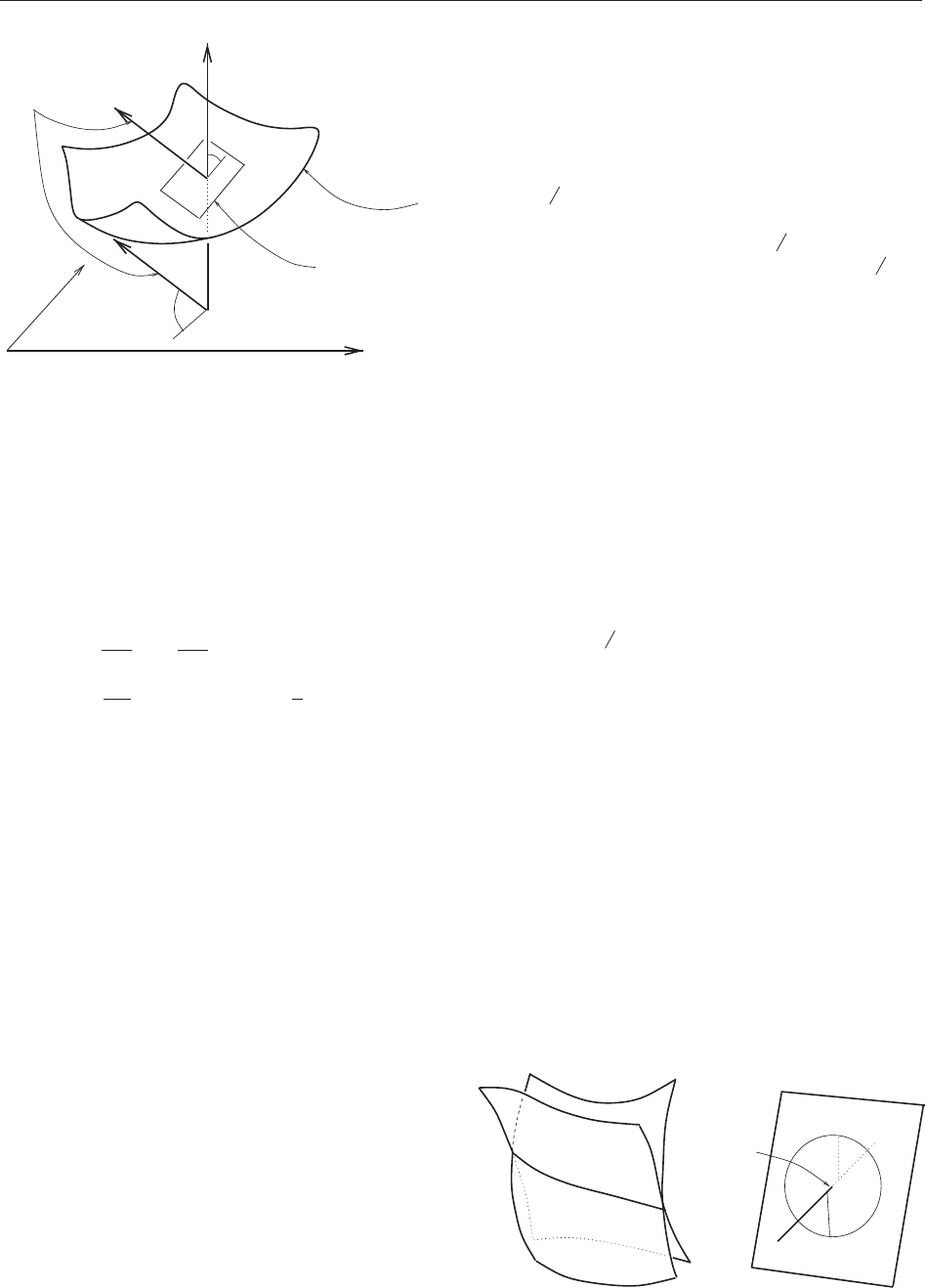
For some quantity >0, the condition that
@G
@x
1
; ...;
@G
@x
n
y
0
; x
0
1
; ...; x
0
n
.
@G
@y
y
0
; x
0
1
; ...; x
0
n
1
means that the angle = (rG
(y
0
, x
0
1
,..., x
0
n
)
,Ox
1
x
n
)
or the angle = (T
(y
0
, x
0
1
,
d
..., x
0
n
)
M, Oy) is smaller than
(see Figure 1).
Our purpose in the sequel is to indicate how we
can quantify the situations described above (the
defect of transversality), in order to generically or
almost generically avoid them with quantified
accuracy.
Quantifying Transversality
Given two submanifolds M and N of the Euclidean
space R
n
, we can measure the transversality defect
of (M, N)atx 2 R
n
with a differential criterion,
both analytical and geometric.
Let us first introduce some notations. For a given
linear map L : R
n
! R
p
, the image by L of the unit
ball of R
n
is an r-dimensional ellipsoid in R
p
with
semi-axes denoted as l
1
(L) l
r
(L), where r is
the rank of L. For r < p, we denote l
rþ1
(L) =
0, ..., l
p
(L) = 0.
Now, let x 2 M \ N;let : R
n
! T
x
N
?
be the
projection onto the orthogonal space of T
x
N, p = n
dim (N)and
jM
the restriction of to M.
Definitions
We say that (M, N) is transverse at x, and we denote
it by M \j
x
N, if and only if
jM
is a submersion at x,
that is, D
jM(x)
: T
x
M ! T
x
N
?
is onto.
For a given =(
1
, ...,
p
),
1
p
,wesay
that (M, N)is-nontransverse at x, and we denote it
by M \j
x
N, if and only if l
i
(D
jM(x)
)
i
,8 i 2 {1, ..., p}.
With these notations, we have: M \j
x
N (i:e:,(M, N)
nontransverse at x)ifandonlyifx 62 M \ N or M \j
x
N,
for some with
p
= 0, and the more (M, N)is-
nontransverse, with close to (
1
, ...,
p1
, 0), the less
the manifolds M and N seem transverse at x 2 M \ N
(see Figure 2).
The final step in our formalism to give a convenient
quantitative approach of transversality is the following:
let X, Y be two (real) Riemannian manifolds, f : X ! Y
a (smooth) mapping, N Y a submanifold of Y with
codimension p in N, y 2 N,and : O!R
p
a
submersion, where O is an open neighborhood of x in
Y, such that
1
({0}) = N \O. Then we say that (f , N)
is transverse at x, and we denote it by f \j
x
N, if and only
if f is submersive in x.
For a given =(
1
, ...,
p
),
1
p
, we say
that (f , N)is(, )-nontransverse at x, and we
denote it by f \j
(,)
x
N, if and only if l
i
(D[f ]
(x)
)
i
,8 i 2 {1, ..., p}.
Clearly, we recognize the definition of transvers-
ality and of -nontransversality of two submani-
folds M, N of R
n
by letting f : M ! R
n
be the
inclusion and =
jM
(for more details on transvers-
ality and stability, see, e.g., Golubitski and Guille-
min (1973)).
With the definitions and notations above, our
general problem may be posed as follow s:
For a C
k
-regular (k 2 N [ {1}) mapping f : R
n
! R
p
and a given =(
1
, ...,
p
), how large is the set
(f , B
r
, ) = f ((f , B
r
, )), where (f , B
r
, ) = {x 2
B
r
R
n
; l
i
(Df
(x)
)
i
, 8i 2 {1, ..., p}} and B
r
is a ball
of radius r in R
n
?
Oy
M
T
a
M
∇G(a)
Ox
1
. . . x
n
a
α
β
Figure 1 Transversality of the manifold M and Oy.
⊥
N
M
B
x
T
x
M
T
x
N
π
|
M
(B )
ε
1
Figure 2 Almost-nontransversality of M and N.
238 Entropy and Quantitative Transversality

The ‘‘bad’’ set (f , B
r
, ) is called the set of
-almost critical values of f (restricted to B
r
). Our
purpose is to show that one can control its size in
terms of k and . However, before explicitly stating
quantitative results, let us precise what we under-
stand by ‘‘big set’’ or by ‘‘size of a set.’’
Measure and Dimensions
We have a very natural way to measure a subset A
of a metric space. To do this, we consider 0a
real number and we denote
A
¼ðD
i
Þ
i2N
; A
[
i2N
D
i
and jD
i
j
()
where jD
i
j is the diameter of D
i
,
H
ðAÞ¼inf
X
i2N
jD
i
j
; ðD
i
Þ
i2N
2A
()
and
H
ðAÞ¼lim
!0
H
ðAÞ2R \ f1g
H
(A) is called the -dimensional Hausdorff
measure of A. It appears that when H
(A) 6¼1,
H
0
(A) = 0 for
0
>, and when H
(A) 6¼ 0,
H
0
(A) = 1 for
0
<. This gives rise to the
following definition of the Hausdorff dimension
of A:
dim
H
ðAÞ¼inff; H
ðAÞ¼0g
¼ supf; H
ðAÞ¼1g
The Hausdorff dimension generalizes the classical
notions of dimension, for instance, when A is a
subset of R
n
, dim
H
(A) n,ad-dimensional mani-
fold has Hausdorff dimension d, and H
n
(A) is the
same as the Lebesgue measure L
n
of A (for a very
large class of subset A, which we do not describe
here. For more details on geometric measure theory,
see Falconer (1986) and Federer (1969)).
Another convenient notion of dimensio n is the
(metric) entropy dimension. Let us brie fly define it.
For a bounded subset A in some metric space and a
real number >0, we denote M(, A) the minimal
number of closed balls of radius , covering A.
H
(A) = log
2
(M(, A)) is called the -entropy of the
set A. This terminology was introduced in
Kolmogorov and Tihomirov (1961) and reflects the
fact that H
(A) is the amount of information needed
to digitally memorize A with accuracy . The
entropy dimension of A, dim
e
(A), is the order of
M(, A )as ! 0. Precisely,
dim
e
ðAÞ¼lim sup
!0
logðMð; AÞÞ
logð1=Þ
¼ inff; Mð; AÞð1=Þ
;
for sufficiently small g
We clearly have
dim
H
ðAÞdim
e
ðAÞ
For any bounded set A in R
n
, we can bound M(, A)
from above by a polynomial in 1= (see Ivanov
(1975) and Yomdin and Comte (2004)):
Mð; AÞcðnÞ
X
n
i¼0
V
i
ðAÞð1=Þ
i
where c(n) only depends on n and V
i
(A) (the ith
variation of the set A) is the mean value, with
respect to P (for a suitable measure), of the number
of connected components of A \ P, with P an affine
(n i)-dimensional space of R
n
.
Since for A contained in a d-dimensional mani-
fold, V
i
(A) = 0 for i > d, we deduce from this
inequality that in this case M(, A) is bounded
from above by a polynomial of degree d in 1=.
Our goal is to explain that we can be more precise
than this general inequality when A is a set of
critical or almost-critical values of a C
k
mapping.
Transversality Is a Generic Situation
The results in this section concern critical values,
and not almost-critical values. They show that a
‘‘generic’’ point of the target space is not a critical
value, and the more regular, the mapping the
smaller the set of critical values. Such theorems
relating the regularity of a mapping and the size of
its critical values are called Morse–Sard type
theorems (see Sard (1942, 1958, 1965)). The
simplest theorem in this direction is the following:
Theorem 1 (C
1
Morse–Sard theorem) (Morse
1939, Sard 1942, Holm 1987). Let f : R
n
! R
p
be a C
1
-regular mapping. Then H
p
((f , B
r
)) = 0,
where (f , B
r
) = f ( (f, B
r
)) and (f , B
r
) is the set of
points x 2 B
r
where rank(Df
(x)
) < p.
The set (f , B
r
) is the image, under f, of the points
of the ball B
r
in the source space at which f is not
submersive, that is, the set of critical values of f.
Consequently, the Morse–Sard theorem ensures that
for almost all points y in the target space, f
1
({y}) is
either empty or a smooth submanifold of the source
space of dimension n p.
Entropy and Quantitative Transversality 239

Note that (f , B
r
) =(f , B
r
, ) for some conve-
nient =(
1
, ...,
p
) with
p
= 0, because
x 7!l
i
(Df
(x)
) is bounded on B
r
, for all i 2 {1, ..., p}.
Now, we can concentrate our attention on more
singular points than the critical ones, those at which
the rank of f is prescribed. Let us denote such
points by
(f , B
r
), for <p. By definition,
(f , B
r
) = f (
(f , B
r
)), where
(f , B
r
) = {x 2 B
r
R
n
; rank(Df
(x)
) }. With these notations, the result
for rank-r critical values is the following:
Theorem 2 (C
k
Morse–Sard theorem for rank-r
critical values) (Federer 1969). Let f : R
n
! R
p
be
a C
k
-regular mapping. Then H
þ(n)=k
(
(f , B
r
)) = 0. In particular,
dim
H
ð
ðf ; B
r
ÞÞ þ
n
k
One can produce examples sh owing that the
bound of Theo rem 2 is the sharpest one (see
Comte (1996), Whitney (1935), Grinberg (1985),
and Yomdin and Comte (2004)).
We note that Theorem 1 is a corollary of Theorem 2
(just replace k by 1 and by p 1inTheorem 2).
This result tells nothing about the entropy dimen-
sion of
(f , B
r
); in the next section, we will
bound the growth of entropy of almost-critical
values.
Almost-Transversality Is Almost Generic
In this section, f : R
n
! R
p
is a C
k
mapping. We
denote by K a Lipschitz consta nt of D
k1
f on B
r
and
by R
k
(f ) the quantity (K=(k 1)!) r
k
. We have:
Theorem 3 (C
k
quantitative Morse–Sard theorem)
(Yomdin 1983 Yomdin and Comte 2004). Let
f : R
n
! R
p
be a C
k
mapping, =(
1
, ...,
p
),
1
p
, and let us denote
0
= 1. We have
(for R
k
(f )):
Mð; ðf ; B
r
; ÞÞ
C
X
p
i¼0
0
i
r
i
R
k
ðf Þ
ðniÞ=k
where C is a constant depending only on n, p, and k.
As a corollary, one can bound the entropy
dimension of
(f , B
r
)by þ (n )=k, and hence
its Hausdorff dimension, again finding Theorem 2:
we just have to put
þ1
= 0 and
1
, ...,
large
enough, that is,
i
i
(Df
(x)
), for all x 2 B
r
,in
Theorem 3, to obtain:
Theorem 4 (C
k
entropy Morse–Sard theorem)
(Yomdin 1983 Yomdin and Comte 2004). Let
f : R
n
! R
p
be a C
k
mapping, let us denote
0
= 1
and
i
= sup {
i
(Df
(x)
); x 2 B
r
}, for i 2 {1, ..., }. We
have (for R
k
(f )):
Mð;
ðf ; B
r
ÞÞ C
X
i¼0
0
i
r
i
R
k
ðf Þ
ðniÞ=k
where C is a constant depending only on n, p, and k.
In particular,
dim
H
ð
ðf ; B
r
ÞÞ dim
e
ð
ðf ; B
r
ÞÞ þ
n
k
Again we have examples showing that this bound
is sharp (see Yomdin and Comte 2004).
Furthermore, the mapping f in Theorems 2–4 may
be of real differentiability class (Ho¨ lder smoothness
class C
k
), with the same conclusions in these
theorems. That is, k may be a real number written
as k = p þ with 2 [0, 1], p 2 Nn{0}, and f is C
k
means that f is p times differentiable and there exists
a constant C > 0 such that for all x, y 2 B
r
,kD
p
f
(x)
D
p
f
(y)
kC kx yk
(see Yomdin and Comte
(2004)).
Examples
Let us denote by A the set of real polynomial
mappings of degree d and of the following type:
x 7!Qða; xÞ¼1 þ
X
d
j¼1
a
j
x
j
with a = (a
1
, ..., a
d
) and kak1 (where kk is the
Euclidean norm of R
d
). We identify the set A with
B
d
(0, 1) = { a 2 R
d
; kak1}.
We want to bound the -entropy of the set of
such polynomials for which the real roots are
multiple or almost multiple.
We denote by V the set V = {(a, x) 2 R
dþ1
;
Q(a, x) = 0}. At points (a, x)ofV with rQ
(a, x)
6¼ 0,
V is a C
1
manifold of codimension 1 of R
dþ1
.
We denote by V
reg
= {(a, x) 2 V;rQ
(a,x)
6¼ 0}
and by V
sing
= {(a, x) 2 V; rQ
(a, x)
= 0} = V n V
reg
.
By Whitney (1957), V
sing
is a union of smooth
manifolds of dimension d 1.
A root x of a polynomial Q(a, ) is multiple if and
only if
Qða; xÞ¼
@Q
@x
ða; xÞ¼0
Consequently, the set A
of polynomials of A
with multiple roots is (V
sing
) [ (
jV
reg
), where
: R
dþ1
! R
d
is the standard projection (a, x) = a,
and (
jV
reg
) is the set {(a, x) 2 V
reg
; Ox T
(a,x)
V
reg
}
of critical values of
jV
reg
. By Sard’s theore m
240 Entropy and Quantitative Transversality
(Theorem 2), dim
H
((
jV
reg
)) d 1. Since
dim
H
((V
sing
)) d 1, we obtain: dim
H
(A
) d
1: thus, having distinct roots is a generic property.
Let, as above, =(
1
, ...,
d
) with
1
d
and
0
= 1. A root x of a polynomial Q(a, ) 2 A is
said to be -almost multiple if and only if
Q(a, x) = 0 and V \j
x
Ox, that is, (a, x) 2 V
sing
or
sin (T
(a, x)
V
reg
,Ox)
d
. This condition only con-
cerns
d
and we can take
1
= =
d1
= 1. We
denote A
,
to be the set of polynomials of A with
(at least) a -almost multiple root. By Theorem 3,
Mð; A
;
nðV
sing
ÞÞ C
X
d1
i¼0
1
i
þ
d
1
d
"#
But (V
sing
) being a finite union of manifolds of
dimension at most d 1, we finally obtain
Mð; A
;
ÞC
0
X
d1
i¼0
1
i
þ
d
1
d
"#
Thus, having no -almost multiple root is -almost
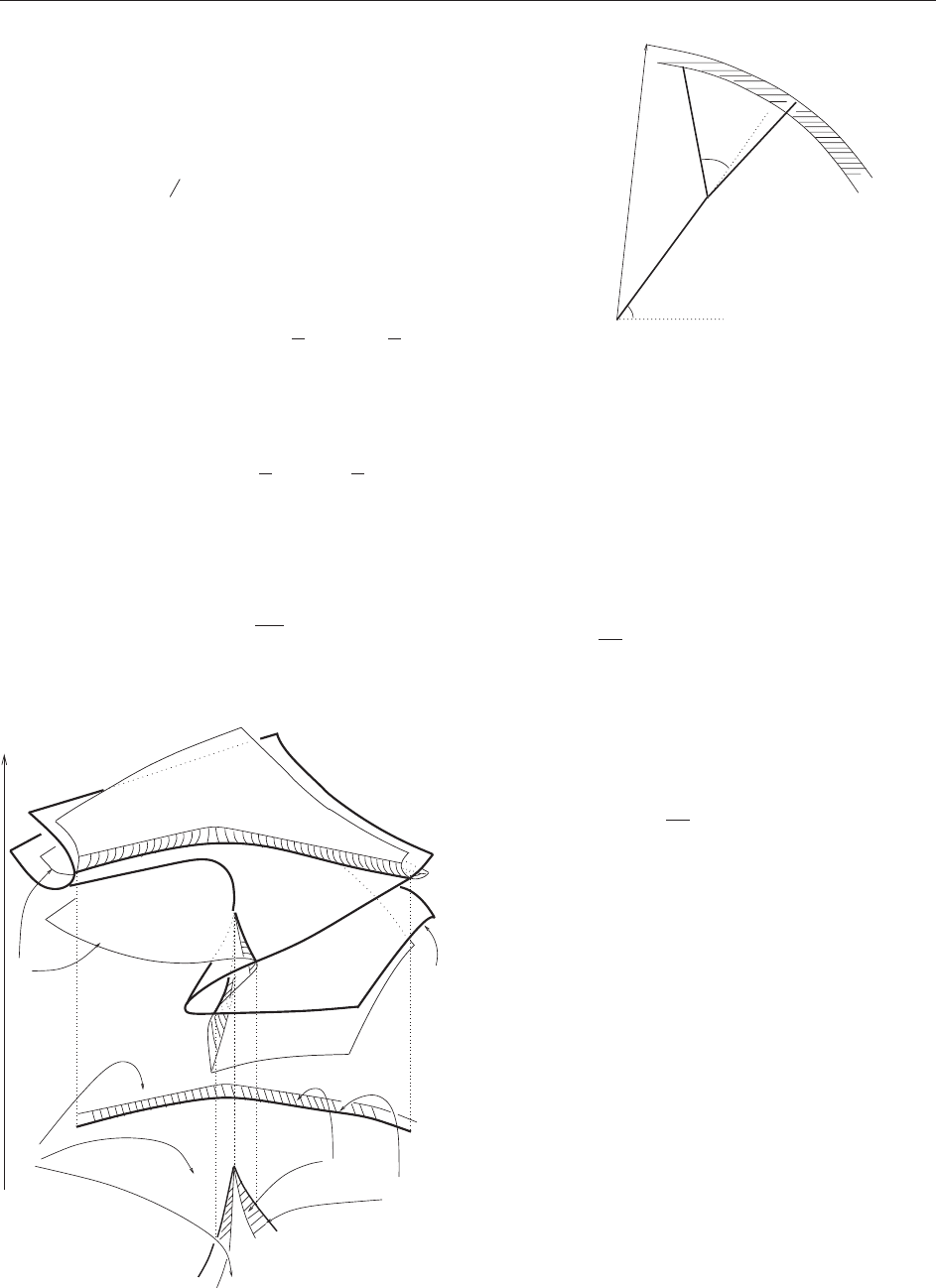
a generic property. In Figure 3, we represent V for
d = 3 and a
3
= 1,
W ¼ða ; xÞ2R
dþ1
;
@Q
@x
ða; xÞ¼0
The next example comes from robotics: let us
consider a planar robotic manipulator consisting of
two jointed bars of length a and b, as presented in
Figure 4. We may parametrize the positions of the
endpoint P of this device by the angles and (see
Figure 4). Now the distance r from the origin to P is
r
2
= kPk
2
= a
2
þ b
2
þ 2ab cos ( ). The critical points
of r are given by
dr
d
ð Þ¼2ab sinð Þ¼0
and correspond to the circle = 0. The critical value
of r is a þ b. Near these critical positions, the control
of r with respect to is poor; we would like to avoid
those near-critical values. Given >0, the condition
dr
d
ð Þ
implies j jarcsin(=2ab), and the -near-critical
values of r are
r
2
max
r
2
2ab½1 cosðarcsinð=2abÞÞ
where r
max
is a þ b; thus, they are contained in an
interval of length c
2
=(4ab r
max
), and
M(,(r, )) c
2
=(4ab r
max
)(Theorem 3
gives M(, (r, )) C(1 þ =).
See also: Entanglement; Entanglement Measures;
Quantum Entropy; Singularity and Bifurcation Theory.
Further Reading
Comte G (1996) Sur les hypothe` ses du the´ore` me de Sard pour le
lieu critique de rang 0. C. R. Academy of Science Paris
323(I): 143–146.
de Araujo Moreira CGT (2001) Hausdorff measures and
the Morse–Sard theorem. Publication Mathema` tiques
45(1): 149–162.
Ox
V
W
A
Σ
A
Σ,Λ
A\ A
Σ,Λ
Figure 3 The space of polynomials of type 1 þ a
1
x þ a
2
x þ x
3
with almost-multiple roots.
b
a
r
max
=
a
+
b
ψ
φ
Figure 4 Almost-critical points of the distance function of P to
the origin.
Entropy and Quantitative Transversality 241

Falconer KJ (1986) The Geometry of Fractal Sets, Cambridge Tracts
in Mathematics, vol. 85. Cambridge: Cambridge University Press.
Federer H (1969) Geometric Measure Theory, Grundlehren
Math. Wiss., vol. 153. Springer.
Golubitski V and Guillemin V (1973) Stable Mappings and Their
Singularities, Graduate Texts in Mathematics, vol. 14.
Springer.
Grinberg EL (1985) On the smoothness hypothesis in Sard’s
theorem. American Mathematical Monthly 92(10): 733–734.
Holm P (1987) The theorem of Brown and Sard. L’enseignement
Mathe´matiques 33: 199–202.
Ivanov LD (1975) In: Vituskin AG (ed.) Variazii mnozˆhestv i funktsii
(Russian) (Variations of Sets and Functions). Moscow: Nauka.
Kolmogorov AN and Tihomirov VM (1961) "-Entropy and
"-capacity of sets in functional space. American Mathematical
Society Translations 17: 277–364.
Morse AP (1939) The behavior of a function on its critical set.
Annals of Mathematics 40(1): 62–70.
Sard A (1942) The measure of the critical values of differentiable
maps. Bulletin of the American Mathematical Society
48: 883–890.
Sard A (1958) Images of critical sets. Annals of Mathematics
68: 247–259.
Sard A (1965) Hausdorff measure of critical images on Banach
manifolds. American Journal of Mathematics 87: 158–174.
Whitney H (1935) A function not constant on a connected set of
critical points. Duke Mathematical Journal 1: 514–517.
Whitney H (1957) Elementary structure of real algebraic varieties.
Annals of Mathematics 66: 545–556.
Yomdin Y (1983) The geometry of critical and near-critical values
of differentiable mappings. Mathematische Annalen
264(4): 495–515.
Yomdin Y and Comte G (2004) Tame Geometry with Applica-
tion in Smooth Analysis, Lecture Notes in Mathematics,
vol. 1834. Berlin: Springer.
Equivariant Cohomology and the Cartan Model
E Meinrenken, University of Toronto, Toronto, ON,
Canada
ª 2006 Elsevier Ltd. All rights reserved.
Introduction
If a compact Lie group G acts on a manifold M, the
space M/G of orbits of the action is usually a singular
space. Nonetheless, it is often possible to develop a
‘‘differential geometry’’ of the orbit space in terms of
appropriately defined equivariant objects on M. This
article is mostly concerned with ‘‘differential forms
on M/G.’’ A first idea would be to work with the
complex of ‘‘basic’’ forms on M, but for many
purposes this complex turns out to be too small.
A much more useful complex of equivariant differ-
ential forms on M was introduced by Cartan (1950).
In retrospect, Cartan’s approach presented a differ-
ential form model for the equivariant cohomology of
M, as defined by A Borel (1960). Borel’s construction
replaces the quotient M/G by a better-behaved (but
usually infinite-dimensional) homotopy quotient M
G
,
and Cartan’s complex shou ld be viewed as a model
for forms on M
G
.
One of the features of equivariant cohomology are
the localization formulas for the integrals of equivar-
iant cocycles. The first instance of such an integration
formula was the ‘‘exact stationary phase formula,’’
discovered by Duistermaat and Heckman. This
formula was quickly recognized by Berline and
Vergne (1983) and Atiyah and Bott (1984),asa
localization principle in equivariant cohomology.
Today, equivariant localization is a basic tool in
mathematical physics, with numerous applications.
This articl e begins with Borel’s topological defini-
tion of equivariant cohomology, then proceeds to
describe H Cartan’s more algebraic approach, and
concludes with a discussion of localization principles.
As additional references for the material covered
here, we particularly recommend books by Berline,
Getzler, and Vergne (1992) and Guillemin and
Sternberg (1999).
Borel’s Model of H
G
(M)
Let G be a topological group. A G-space is a
topological space M on which G acts by transforma-
tions g 7!a
g
, in such a way that the action map
a : G M ! M ½1
is continuous. An important special case of G-spaces
are principal G-bundles E ! B, that is, G-spaces
locally isomorphic to products U G.
Definition 1 A classifying bundle for G is a
principal G-bu ndle EG ! BG, with the following
universal property: for any principal G-bundle
E ! B, there is a map f : B ! BG, unique up to
homotopy, such that E is isomorphic to the pullback
bundle f
EG. The map f is known as a ‘‘classifying
map’’ of the principal bundle.
To be precise, the base spaces of the principal
bundles considered here must satisfy some technical
condition. For a careful discussion, see Husemoller
(1994). Classifying bundles exist for all G (by a
construction due to Milnor (1956)), and are unique
up to G-homotopy equivalence.
It is a basic fact that principal G-bundles with
contractible total space are classifying bundles.
242 Equivariant Cohomology and the Cartan Model

Examples 2
(i) The bundle R ! R=Z = S
1
is a classifying
bundle for G = Z.
(ii) Let H be a separable complex Hilbert space,
dim H= 1. It is known that unit sphere S(H)is
contractible. It is thus a classifying U(1)-bundle,
with the projective space P(H) as base. More
generally, the Stiefel manifold St(k, H) of unitary
k-frames is a classifying U(k)-bundle, with base
the Grassmann manifold Gr(k , H)ofk-planes.
(iii) Any compact Lie group G arises as a closed
subgroup of U(k), for k sufficiently large.
Hence, the Stiefel manifold St(k, H) also serves
as a model for EG.
(iv) The based loop group G = L
0
K of a connected Lie
group K acts by gauge transformations on the
space of connections A (S
1
) =
1
(S
1
, k). This is a
classifying bundle for L
0
K,withbaseK.The
quotient map takes a connection to its holonomy.
For any commutative ring R (e.g., Z, R, Z
2
), let
H( ; R) denote the (singular) cohomology with
coefficients in R. Recall that H( ; R) is a graded
commutative ring under cup product.
Definition 3 The equivariant cohomology H
G
(M) =
H
G
(M; R)ofaG-space M is the cohomology ring of
its homotopy quotient M
G
= EG
G
M:
H
G
ðM; RÞ¼HðM
G
; RÞ½2
Equivariant cohomology is a contravariant func-
tor from the category of G-spaces to the category of
R-modules. The G-map M ! pt induces an algebra
homomorphism from H
G
(pt) = H(BG)toH
G
(M). In
this way, H
G
(M) is a module over the ring H(BG).
Example 4 (Principal G-bundles). Suppose E ! B is
aprincipalG-bundle. The homotopy quotient E
G
may
be viewed as a bundle E
G
EG over B. Since the fiber
is contractible, there is a homotopy equivalence
E
G
’ B ½3
and therefore H
G
(E) = H(B).
Example 5 (Homogeneous spaces). If K is a closed
subgroup of a Lie group G, the space EG may be
viewed as a model for EK, with BK = EG=K = EG
K
(G=K). Hence,
H
G
ðG=KÞ¼HðBKÞ½4
Let us briefly describe two of the main techniques
for computing H
G
(M).
1. Leray spectral sequences.IfR is a field, the
equivariant cohomology may be computed as the
E
1
term of the spectral sequence for the fibration
M
G
! BG.IfBG is simply connected (as is the
case for all compact connected Lie groups), the
E
2
-term of the spectral sequence reads
E
p;q
2
¼ H
p
ðBGÞH
q
ðMÞ½5
2. Mayer–Vietoris sequences.IfM = U
1
[ U
2
is a
union of two G-invariant open subsets, there is a
long exact sequence
!H
k
G
ðMÞ!H
k
G
ðU
1
ÞH
k
G
ðU
2
Þ!
! H
k
G
ðU
1
\ U
2
Þ!H
kþ1
G
ðMÞ!
More generally, associated to any G-invariant open
cover, there is a spectral sequence converging to
H
G
(M).
Example 6 Consider the standard U(1)-action on
S
2
by rotations. Cover S
2
by two open sets U
, given
as the complement of the south pole and north pole,
respectively. Since U
þ
\ U
retracts onto the equa-
torial circle, on which U(1) acts freely, its equivar-
iant cohomology vanishes except in degree 0. On the
other hand, U
retract onto the poles p
. Hence, by
the Mayer–Vietoris sequence the map H
k
U(1)
(S
2
) ffi
H
k
U(1)
(p
þ
) H
k
U(1)
(p
) given by pullback to the fixed
points is an isomorphism for k > 0. Since the
pullback map is a ring homomorphism, we conclude
that H
U(1)
(S
2
; R) is the commutative ring generated
by two elements x
of degree 2, subject to a single
relation x
þ
x
= 0.
g-Differential Algebras
Let G be a Lie group, with Lie algebra g.A
G-manifold is a manifold M together with a
G-action such that the action map [1] is smooth.
We would like to introduce the concept of equivar-
iant differential forms on M. This complex should
play the role of differential forms on the infinite-
dimensional space M
G
. In Cartan’s approach, the
starting point is an algebraic model for the differ-
ential forms on the classifying bundle EG.
The algebraic machinery will only depend on the
infinitesimal action of G. It is therefore convenient
to introduce the following concept.
Definition 7 Let g be a finite-dimensional Lie
algebra. A g-manifold is a manifold M, together with
a Lie algebra homomorphism a : g ! X(M), 7!a
into the Lie algebra of vector fields on M,suchthat
the map g M ! TM,(, m) 7!a
(m)issmooth.
Any G-manifold M becomes a g-manifold by
taking a
to be the generating vector field
a
ðmÞ :¼
d
dt
t¼0
a
expðtÞ
ðmÞ½6
Equivariant Cohomology and the Cartan Model 243

Conversely, if G is simply connected, and M is a
g-manifold for which all of the vector fields a
are
complete, the g-action integrates uniquely to an
action of the group G.
The de Rham algebra ((M), d) of differential
forms on a g-manifold M carries graded derivations
L
= L(a
) (Lie derivatives, degree 0) and
= (a
)
(contractions, degree 1). One has the following
graded commutation relations:
½d; d¼0; ½L
; d¼0; ½
; d¼L
½7
½
;
¼0; ½L
; L
¼L
½;
g
; ½L
;
¼
½;
g
½8
More generally, the following definitions are
introduced.
Definition 8 A g-differential algebra (g-da) is a
commutative graded algeb ra A =
L
1
n¼0
A
n
, equipped
with graded derivations d, L
,
of degrees 1, 0, 1
(where L
,
depend linearly on 2 g), satisfying the
graded commutation relations [7] and [8].
Definition 9 For any g-da A, one defines the
horizontal subalgebra A
hor
=
T
ker(
), the invar-
iant subalgebra A
g
=
T
ker(L
), and the basic
subalgebra A
basic
= A
hor
\A
g
.
Note that the basic subalgebra is a differential
subcomplex of A.
Definition 10 A connection on a g-da is an
invariant element 2 A
1
g, with the property
= . The curvature of a connection is the element
F
2 A
2
g given as F
= d þ (1/2)[, ]
g
.
g-da’s A admitting connections are the algebraic
counterparts of (smoo th) principal bundles, with
A
basic
playing the role of the base of the principal
bundle.
Weil Algebra
The Weil algebra Wg is the algebraic analog to the
classifying bundle EG. Similar to EG, it may be
characterized by a universal property:
Theorem 11 There exists a g-da Wg with
connection
W
, having the following universal
property: if A is a g-da with connection , there
is a unique algebra homomorphism c : Wg !A
taking
W
to .
Clearly, the universal property character izes Wg
up to a unique isomorphism. To get an explicit
construction, choose a basis {e
a
}ofg, with dual
basis {e
a
}ofg
.Lety
a
2^
1
g
be the corresponding
generators of the exterior algebra, and v
a
2 S
1
g
the
generators of the symmetric algebra. Let
W
n
g ¼
M
2iþj¼n
S
i
g
^
j
g
½9
carry the differential
dy
a
¼ v
a
þ
1
2
f
a
bc
y
b
y
c
½10
dv
a
¼f
a
bc
v
b
y
c
½11
where f
a
bc
= he
a
,[e
b
, e
c
]
g
i are the structure constants
of g. Define the contractions
a
=
e
a
by
a
y
b
¼
b
a
;
a
v
b
¼ 0 ½12
and let L
a
= [d,
a
]. Then L
a
are the generators for
the adjoint action on Wg. The element
W
= y
a
e
a
2 W
1
g g is a connection on Wg. Notice that
we could also use y
a
and dy
a
as generators of Wg.
This identifies Wg with the Koszul algebra, and
implies:
Theorem 12 Wg is acyclic, that is, the inclusion
R ! Wg is a homotopy equivalence.
Acyclicity of Wg corresponds to the contractibil-
ity of the total space of EG.
The basic subalgebra of Wg is equal to (Sg
)
g
, and
the differential restricts to zero on this subalgebra,
since d changes parity. Hence, if A is a g-da with
connection, the characteristic homomorphism
c : Wg !A induces an algebra homomorphism,
(Sg
)
g
! H(A
basic
). This homomorphis m is indepen-
dent of :
Theorem 13 Suppose
0
,
1
are two connections on
a g-da A. Then their characteristic homomorphisms
c
0
, c
1
: Wg !Aare g-homotopic. That is, there is a
chain homotopy intertwining contractions and Lie
derivatives.
Remark 14 One obtains other interesting exam-
ples of g-da’s if one drops the commutativity
assumption from the definition. For instance,
suppose g carries an invariant scalar product. Let
Cl(g) be the corresponding Clifford algebra, and
U(g) the enveloping alge bra. The noncommu-
tative Weil algebra (introd uced by Alekseev and
Meinrenken 2002)
Wg ¼ Ug ClðgÞ½13
is a (noncommutative) g-da, with the derivations d,
L
a
,
a
defined on generators by the same formulas as
for Wg.
244 Equivariant Cohomology and the Cartan Model

Equivariant Cohomology of g-da’s
In analogy to H
G
(M):= H(M
G
), we now declare:
Definition 15 The equivariant cohomology algebra
of a g-da A is the cohomolo gy of the differential
algebra A
g
:= (Wg A)
basic
:
H
g
ðAÞ :¼ HðA
g
Þ½14
The equivariant cohomolo gy H
g
(A) has functorial
properties parallel to those of H
G
(M). In particular,
H
g
(A) is a module over
H
g
ðf0gÞ ¼ HððWgÞ
basic
Þ¼ðSg
Þ
g
½15
Theorem 16 Suppose A is a g-da with connection
, and let c : Wg !A be the characteristic homo-
morphism. Then
Wg A!A; w x 7! cð wÞx ½16
is a g-homotopy equivalence, with g-homotopy
inverse the inclusion
A!Wg A; x 7!1 x ½17
In particular, there is a canonical isomorphism
HðA
basic
ÞffiH
g
ðAÞ ½18
Proof By Theorem 13, the automorphism w
x 7!1 c(w) x of Wg A is g-homotopic to the
identity map.
&
The above definition of the complex A
g
is often
referred to as the Weil model of equivariant
cohomology, while the term Cartan model is reserved
for a slightly different description of A
g
. Identify
the space (Sg
A)
g
with the algebra of equivariant
A-valued polynomial functions : g !A. Define a
differential d
g
on this space by setting
ðd
g
ÞðÞ¼d ððÞÞ
ðÞ½19
Theorem 17 (H Cartan). The natural projection
Wg A!Sg
A restricts to an isomorphism of
differential algebras, A
g
ffi (Sg
A)
g
.
Suppose A carries a connection .Theg-homotopy
equivalence [16] induces a homotopy equivalence
A
g
!A
basic
of the basic subcomplexes. By explicit
calculation, the corresponding map for the Cartan
model is given by
ðSg
AÞ
g
!A
basic
;7! P
hor
ððF
ÞÞ ½20
Here (F
) 2A
g
is the result of substituting the
curvature of ,andP
hor
: A!A
hor
is horizontal
projection. On elements of (Sg
)
g
(Sg
A)
g
,
the map [20] specializes to the Chern–Weil
homomorphism.
There is an algebraic counterpart of the Leray
spectral sequence: introduce a filtration
F
p
A
pþq
g
:¼
M
2ip
ðS
i
g
A
q
Þ
g
½21
Since second term in the equivariant differential
[19] raises the filtration degree by 2, it follows that
E
p;q
2
¼ðS
p=2
g
Þ
g
H
q
ðAÞ ½22
for p even, E
p, q
2
= 0 for p odd. In fortunate cases, the
spectral sequence collapses at the E
2
-stage (see
below).
Equivariant de Rham Theory
We will now restrict ourselves to the case that
A=(M) is the algebra of differential forms on a
G-manifold, where G is compact and connected.
Theorem 18 (Equivariant de Rham theorem). Sup-
pose G is a compact, connected Lie group, and
that M is a G-manifold. Then there is a canonical
isomorphism
H
G
ðM; RÞffiH
g
ððMÞÞ ½23
where the left-hand side is the equivariant cohomol-
ogy as defined by the Borel construction.
Motivated by this result, the nota tion can be
changed slightly; write
G
ðMÞ¼ðSg
ðMÞÞ
G
½24
for the Cartan complex of equivariant differential
forms, and d
G
for the equivariant differential [19].
Remark 19 Theorem 18 fails, in general, for
noncompact Lie groups G . A differential form
model for the noncompact case was developed by
Getzler (1990).
Example 20 Let (M, !) be a symplectic manifold,
and a : G ! Diff(M) a Hamiltonian group action.
That is, a preserves the symplectic form, a
g
! = !,
and there exists an equivariant mom ent map
: M ! g
such that
! þ dh, i= 0. Then the
equivariant sympl ectic form !
G
():= ! þh, i is
equivariantly closed.
Example 21 Let G be a Lie group, and denote,
respectively, by
L
¼ g
1
dg and
R
¼ dgg
1
½25
Equivariant Cohomology and the Cartan Model 245