
Freiling G., Yurko V. Lectures on Differential Equations of Mathematical Physics: A First Course
Подождите немного. Документ загружается.


12 G.
Freiling and V. Yurko
In order
to determine a solution of a partial differential equation uniquely it is necessary
to specify additional conditions on the unknown function. Therefore, each problem of
mathematical physics is formulated as a problem of the solution of a partial differential
equation under some additional conditions which are dictated by its physical statement. Let
us give several examples of the statement of problems of mathematical physics.
I. Consider the problem of a vibrating string of the length l (0 < x < l), fixed at the
ends x = 0 and x = l. In this case one needs to seek the solution of the equation
u
tt
= a
2
u
xx
+ f (x,t) (1.3.1)
in the domain 0 < x < l, t > 0 under the conditions
u
|x=0
= u
|x=l
= 0. (1.3.2)
Such conditions are called boundary conditions. However, the specification of the behavior
of the string at its ends is not sufficient for the description of the oscillation process. It is
necessary to specify the position of the string and its speed in the initial moment of time
t = 0 :
u
|t=0
= ϕ(x), u
t|t=0
= ψ(x). (1.3.3)
Thus, we arrive at the problem (1.3.1)-(1.3.3) which is called the mixed problem for the
equation of of the vibrating string. We note that instead of (1.3.2) one can specify other
types of boundary conditions. For example, if the ends of the string are moving according
to known rules, then the boundary conditions have the form
u
|x=0
= µ(t), u
|x=l
= ν(t),
where µ(t) and ν(t) are known functions. If, for example, the end x = 0 is freely moved,
then the boundary condition at the point x = 0 can be written as
u
x|x=0
= 0.
If the end x = 0 is elastically fixed, then the boundary condition has the form
(u
x
+ hu)
|x=0
= 0.
There are other types of boundary conditions.
II. Consider the vibrations of an infinite string ( −∞ < x < ∞ ). This is a model of the
case when the length of the string is sufficiently great so that the effect of the ends can
be neglected. In this case boundary conditions are absent, and we arrive at the following
problem:
Find the solution u(x,t) of equation (1.3.1) in the domain −∞ < x < ∞, t > 0, satisfying
the initial conditions (1.3.3). This problem is called the Cauchy problem for the equation of
the vibrating string.
Similarly one can formulate problems in the multidimensional case and also for
parabolic partial differential equations (see below Chapters 2-3 for more details).

Introduction 13
III. Let
us give an example of the statement of problems for elliptic equations. Ellip-
tic equations usually describe stationary fields. For example, the problem of finding the
stationary (steady-state) temperature distribution in a domain D ∈ R
3
of spatial variables
x = (x
1
,x
2
,x
3
) under the condition that the fixed temperature ϕ(x) is given on the boundary
Σ of D, can be written in the form
∆u = 0, u
|Σ
= ϕ, ∆u :=
3
∑
k=1
∂
2
u
∂x
2
k
. (1.3.4)
Problem
(1.3.4)
is called the Dirichlet problem. For other formulations of problems of
mathematical physics see [1]-[3].
Well-posed problems
Problems of mathematical physics are mathematical models of physical problems. The
solution of the corresponding problem depends, as shown above, on some functions
appearing in the equation and the initial and boundary conditions, which are called
prescribed (input) data. In the investigations of problems of mathematical physics the
central role is played by the following questions:
1) the existence of the solution;
2) its uniqueness;
3) the dependence of the solution on ”small” perturbations of the prescribed data.
If ”small” perturbations of the prescribed data lead to ”small” perturbations of the solu-
tion, then we shall say that the solution is stable. Of course, in each concrete situation the
notion of ”small” perturbations should be exactly defined. For example, for the Dirichlet
problem (1.3.4), the solution is called stable if for each ε > 0 there exists δ = δ(ε) > 0 such
that if |ϕ(x) −
˜
ϕ(x)|≤ δ for all x ∈ Σ, then |u(x)− ˜u(x)|≤ ε for all x ∈D (here u and ˜u
are the solutions of the Dirichlet problems with boundary values ϕ and
˜
ϕ, respectively).
An important class of problems of mathematical physics, which was introduced by
Hadamard, is the class of well-posed problems.
Definition 1.3.1. A problem of mathematical physics is called well-posed (or correctly
set) if its solution exists, is unique and stable.
In the next chapters we study the questions of stability and well-posedness of problems
for each type of equations separately using their specific character. For advanced studies on
the theory of well-posed and ill-posed problems we refer to [3] and the references therein.
Hadamard’s example
Let us give an example of an ill-posed problem, which is due to Hadamard. Consider the
Cauchy problem for the Laplace equation:
u
xx
+ u
yy
= 0, −∞ < x < ∞, y > 0,
u
|y=0
= 0, u
y|y=0
= 0.
)
(1.3.5)

14 G.
Freiling and V. Yurko
Problem (1.3.5)
has the unique solution u ≡ 0. Together with (1.3.5) we consider the prob-
lem
u
xx
+ u
yy
= 0, −∞ < x < ∞, y > 0,
u
|y=0
= 0, u
y|y=0
= e
−
√
n
sinnx, n ≥1.
)
(1.3.6)
The
solution
of problem (1.3.6) has the form
u
n
(x,y) =
1
n
e
−
√
n
sinnx sinh ny,
where
sinhny :=
1
2
¡
e
ny
−e
−ny
¢
.
Since |sin nx|
≤ 1
, one gets
max
−∞<x<∞
|e
−
√
n
sinnx|
→ 0
as n →∞
. However, the solution u
n
(x,y) increases infinitely. Indeed,
u
n
(x,y) =
1
2n
e
ny−
√
n
sinnx(1 −e
−2ny
).
F
or
each fixed y > 0 ,
max
−∞<x<∞
|u
n
(x,y)| → ∞
as n →∞ .
Chapter
2.
Hyperbolic
Partial Differential
Equations
Hyperbolic partial differential equations usually describe oscillation processes and give a
mathematical description of wave propagation. The prototype of the class of hyperbolic
equations and one of the most important differential equations of mathematical physics
is the wave equation (see Section 1.1). Hyperbolic equations occur in such diverse fields
of study as electromagnetic theory, hydrodynamics, acoustics, elasticity and quantum the-
ory. In this chapter we study hyperbolic equations in one-, two- and three-dimensions, and
present methods for their solutions. We note that in Chapter 6, Section 6.2 one can find
exercises, illustrative example and physical motivations for problems related to hyperbolic
partial differential equations.
2.1. The Cauchy Problem for the Equation of the Vibrating
String
1. Homogeneous equation of the vibrating string
We consider the following Cauchy problem
u
tt
= a
2
u
xx
, −∞ < x < ∞, t > 0, (2.1.1)
u
|t=0
= ϕ(x), u
t|t=0
= ψ(x). (2.1.2)
Here x and t are independent variables ( x is the spatial variable, and t has the signifi-
cance of time), u(x,t) is an unknown function, and a > 0 is a constant (wave velocity).
The Cauchy problem (2.1.1)-(2.1.2) describes the oscillation process for the infinite string
provided that the initial displacement ϕ(x) and the initial speed ψ(x) are known. We as-
sume that ψ(x) is continuously differentiable ( ψ ∈ C
1
), and ϕ(x) is twice continuously
differentiable ( ϕ ∈C
2
). Denote
D = {(x,t) : t ≥ 0, −∞ < x < ∞}.

16 G.
Freiling and V. Yurko
Definition 2.1.1. A
function u(x,t) is called a solution of the Cauchy problem (2.1.1)-
(2.1.2), if u(x,t) ∈ C
2
(D) and u(x,t) satisfies (2.1.1) and (2.1.2). Here and below, the
notation u ∈C
m
(D) means that the function u has in D continuous partial derivatives up
to the m -th order.
This notion of the solution is called usually classical solution. We mention that in the
literature one can find other solution concepts like weak solutions, viscosity solutions, etc.
(see [3]); such solution concepts are out of the score of this introductory book.
First we construct the general solution of equation (2.1.1). The characteristic equation
for (2.1.1) has the form
dx
d
t
= ±a
(see
Section 1.2), and consequently, equation (2.1.1) has two families of characteristics:
x ±at = const.
The replacement
ξ = x + at, η = x −at,
reduces (2.1.1) to the form
u
ξη
= 0.
Since the general solution of this equation is
u = f (ξ) + g(η),
the general solution of equation (2.1.1) has the form
u(x,t) = f (x + at) + g(x −at), (2.1.3)
where f and g are arbitrary twice continuously differentiable functions.
We will seek the solution of the Cauchy problem (2.1.1)-(2.1.2) using the general solu-
tion (2.1.3). Suppose that the solution of problem (2.1.1)-(2.1.2) exists. Then it has the form
(2.1.3) with some f and g. Taking the initial conditions (2.1.2) into account we obtain
f (x) + g(x) = ϕ(x),
a f
0
(x) −ag
0
(x) = ψ(x)
)
.
Integrating the second relation we get
f (x) + g(x) = ϕ(x),
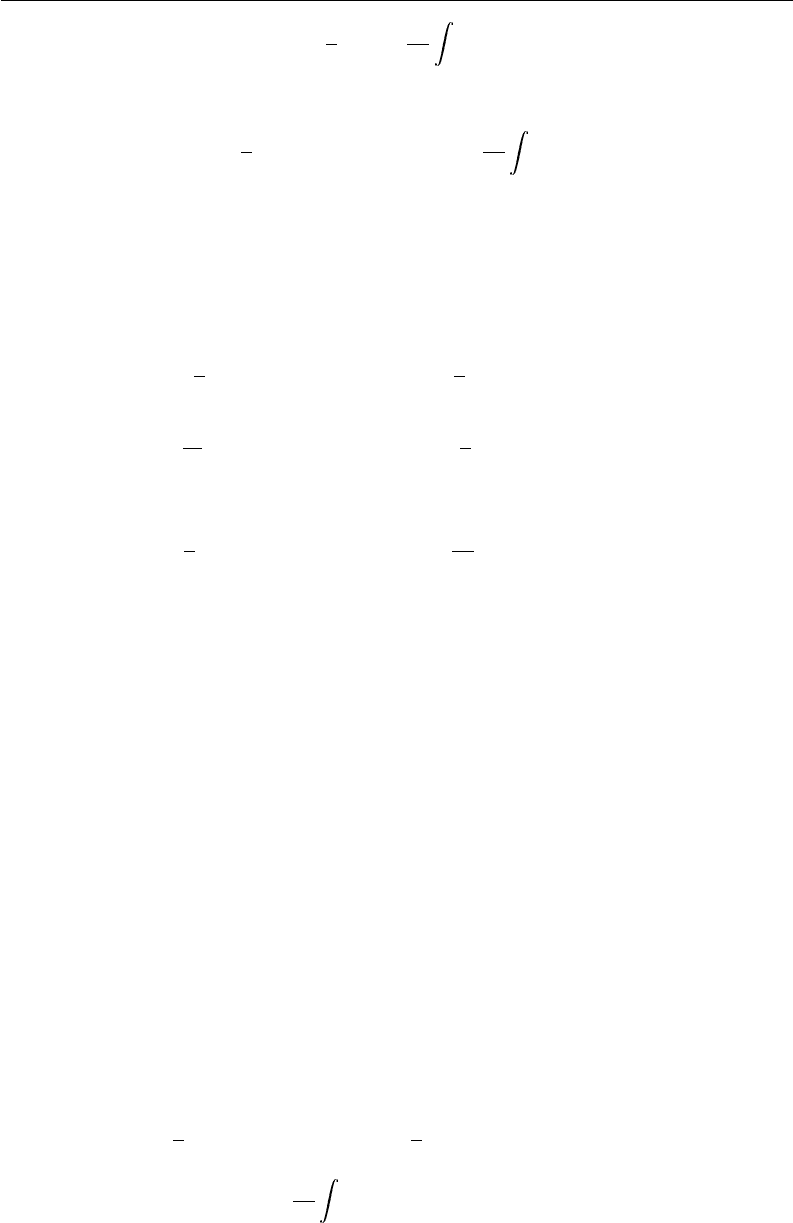
f (x) −g(x) =
1
a
x
x
0
ψ(s)d
s
,
where x
0
is
arbitrary and fixed. Solving this system with respect to f and g, we calculate
f (x) =
1
2
ϕ(x)
+
1
2a
x
x
0
ψ(s)d
s,
Hyperbolic P
artial Differential Equations 17
g(x)
=
1
2
ϕ(x) −
1
2a
x
x
0
ψ(s)d
s
.
Substituting this expressions into (2.1.3) we arrive at the formula
u(x,t) =
1
2
(ϕ(x + a
t)
+ ϕ(x −at)) +
1
2a
x+a
t
x−a
t
ψ(s)ds, (2.1.4)
which is called D’Alembert’s formula. Thus, we have proved that if the solution of the
Cauchy problem (2.1.1)-(2.1.2) exists, then it is given by (2.1.4). From this we get the
uniqueness of the solution of problem (2.1.1)-(2.1.2). On the other hand, it is easy to check
by direct verification that the function u(x,t), defined by (2.1.4), is a solution of problem
(2.1.1)-(2.1.2). Indeed, differentiating (2.1.4) twice with respect to t we obtain
u
t
(x,t) =
a
2
³
ϕ
0
(x + a
t) −ϕ
0
(x −a
t)
´
+
1
2
³
ψ(x + a
t)
+ ψ(x −at)
´
,
u
tt
(x,t) =
a
2
2
³
ϕ
00
(x + a
t)
+ ϕ
00
(x −at)
´
+
a
2
³
ψ
0
(x + a
t) −ψ
0
(x −a
t)
´
.
Analogously, differentiating (2.1.4) twice with respect to x we get
u
xx
(x,t) =
1
2
³
ϕ
00
(x + a
t)
+ ϕ
00
(x −at)
´
+
1
2a
³
ψ
0
(x + a
t) −ψ
0
(x −a
t)
´
.
Hence, the function u(x,t) is the solution of problem (2.1.1)-(2.1.2). Thus, we have proved
the following assertion.
Theorem 2.1.1. Let ϕ(x) ∈C
2
, ψ(x) ∈C
1
. Then the solution of the Cauchy problem
(2.1.1) −(2.1.2) exists, is unique and is given by D’Alembert’s formula (2.1.4) .
Let us now study the stability of the solution of problem (2.1.1)-(2.1.2).
Definition 2.1.2. The solution of problem (2.1.1)-(2.1.2) is called stable if for any
ε > 0 , T > 0 there exists δ = δ(ε,T ) > 0 such that if
|ϕ(x) −
˜
ϕ(x)| ≤ δ, |ψ(x) −
˜
ψ(x)| ≤ δ
for all x, then
|u(x,t) − ˜u(x,t)| ≤ ε
for all (x,t) ∈ D. Here ˜u(x,t) is the solution of the Cauchy problem with the initial data
˜
ϕ,
˜
ψ.
Let us show that the solution of the Cauchy problem (2.1.1)-(2.1.2) is stable. Indeed,
by virtue of (2.1.4) we have
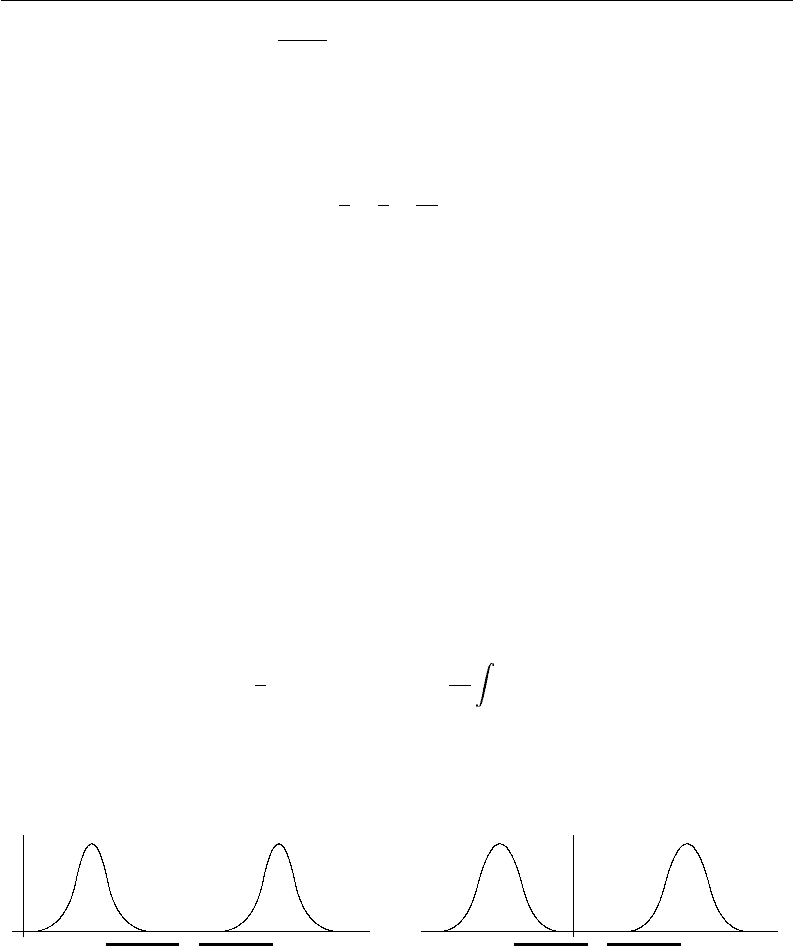
|u(x,t) − ˜u(x,t)| ≤
1
2
|ϕ(x + a
t) −
˜
ϕ
(x + at)|+
1
2
|ϕ(x −a
t) −
˜
ϕ(x −a
t)|
+
1
2a
x+a
t
x−a
t
|ψ(s) −
˜
ψ(s)|ds.
18 G.
Freiling and V. Yurko
For ε > 0
, T > 0 choose δ =
ε
1 + T
and
suppose
that
|ϕ(x) −
˜
ϕ(x)| ≤ δ, |ψ(x) −
˜
ψ(x)| ≤ δ
for all x. Then it follows from (2.1.5) that
|u(x,t) − ˜u(x,t)| ≤
δ
2
+
δ
2
+
δ
2a
2aT =
(1 + T )
δ = ε.
Thus, the Cauchy problem (2.1.1)-(2.1.2) is well-posed.
Below we will use the following assertion.
Lemma 2.1.1. 1) If ϕ(x) and ψ(x) are odd functions, then
u(0,t) = 0.
2) If ϕ(x) and ψ(x) are even functions, then
u
x
(0,t) = 0.
Proof. Let
ϕ(x) = −ϕ(−x), ψ(x) = −ψ(−x).
Then it follows from (2.1.4) for x = 0 that
u(0,t) =
1
2
(ϕ(a
t)
+ ϕ(−at))+
1
2a
a
t
−a
t
ψ(s)ds = 0.
Analogously one can prove the second assertion of the lemma.
6
-
u
x
u = g(x) u = g(x −a
t)
a
t
6
-
u
x
u = f (x + a
t) u = f (x)
a
t
| {z }
|
{z }
Figure
2.1.1.
Remark
2.1.1. The solutions of the form u = f (x + at) and u = g(x −at) are called
travelling waves, and a is the wave velocity. The wave u = f (x + at) travels to the left,
and the wave u = g(x −at) travels to the right (see fig. 2.1.1). Thus, the general solution
(2.1.3) of equation (2.1.1) is the superposition of two travelling waves moving in opposite
directions along the x -axis with a common speed.

Hyperbolic P
artial Differential Equations 19
2. Non-homogeneous
equation of the vibrating string
Consider the Cauchy problem for the non-homogeneous equation of the vibrating string:
u
tt
= a
2
u
xx
+ f (x,t), −∞ < x < ∞, t > 0,
u
|t=0
= ϕ(x), u
t|t=0
= ψ(x).
)
(2.1.6)
We seek a solution of problem (2.1.6) in the form
u(x,t) = ˜u(x,t) + v(x,t),
where ˜u(x,t) is the solution of the Cauchy problem for the homogeneous equation
˜u
tt
= a
2
˜u
xx
, −∞ < x < ∞, t > 0,
˜u
|t=0
= ϕ(x), ˜u
t|t=0
= ψ(x),
)
(2.1.7)
which can be solved by d’Alembert’s formula, and v(x,t) is the solution of the problem for
the non-homogeneous equation with zero initial conditions:
v
tt
= a
2
v
xx
+ f (x,t), −∞ < x < ∞, t > 0,
v
|t=0
= 0, v
t|t=0
= 0.
)
(2.1.8)
It is easy to see that the solution of problem (2.1.8) has the form
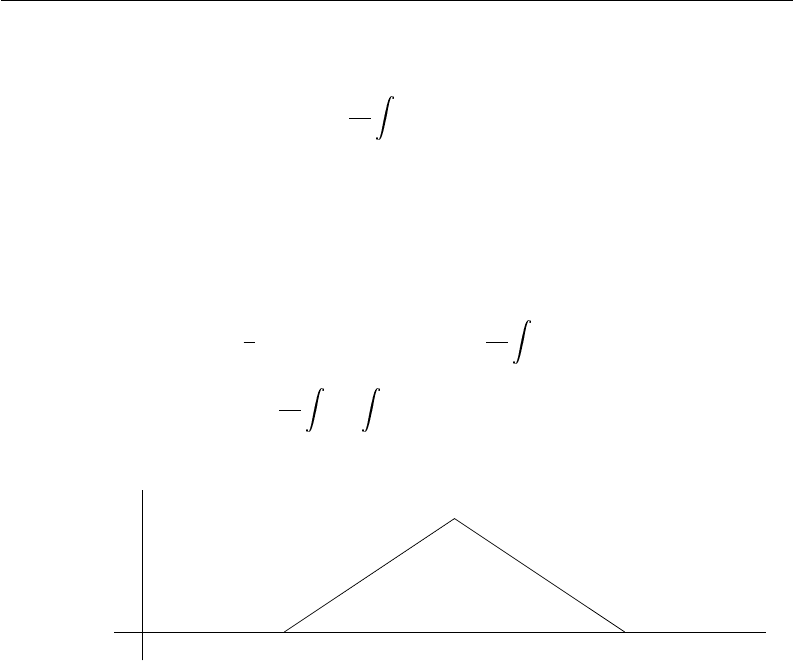
v(x,t) =
t
0
w(x,t, τ)dτ, (2.1.9)
where the function w(x,t,τ) for each fixed τ ≥0 is the solution of the following auxiliary
problem:
w
tt
= a
2
w
xx
, −∞ < x < ∞, t > τ,
w
|t=τ
= 0, w
t|t=τ
= f (x,τ).
)
(2.1.10)
Indeed, differentiating (2.1.9) with respect to t, we obtain
v
t
(x,t) =
t
0
w
t
(x,t, τ)dτ + w(x,t,t).
By virtue of (2.1.10) w(x,t,t) = 0, and consequently,
v
t
(x,t) =
t
0
w
t
(x,t,τ)dτ.
Analogously we calculate
v
tt
(x,t) =
t
0
w
tt
(x,t,τ)dτ + f (x,t).
Since
v
xx
(x,t) =
t
0
w
xx
(x,t,τ)dτ,
20 G.
Freiling and V. Yurko
and w
tt
= a
2
w
x
x
, we conclude that v(x,t) is a solution of problem (2.1.8).
The solution of (2.1.10) is given by the D’Alembert formula:
w(x,t, τ) =
1
2a
x+a(t−τ)
x−a(t−τ)
f (s, τ)d
s.
Since
the solution of (2.1.7) is also given by the D’Alembert formula, we arrive at the
following assertion.
Theorem 2.1.2. Let f (x,t) ∈C(D) have a continuous partial derivative f
x
(x,t), and
let ϕ and ψ satisfy the conditions of Theorem 2.1.1. Then the solution of the Cauchy
problem (2.1.6) exists, is unique and is given by the formula
u(x,t) =
1
2
(ϕ(x + a
t)
+ ϕ(x −at)) +
1
2a
x+a
t
x−a
t
ψ(s)ds
+
1
2a
t
0
dτ
x+a(t−τ)
x−a(t−τ)
f (s, τ)d
s
. (2.1.11)
6
-
τ
s
(x,t)
∆(x,t)
s = x + a(t −τ)s = x −a(t −τ)
x −a
t x + a
t
Figure 2.1.2.
Remark 2.1.2. It follows from (2.1.11) that the solution u(x,t) at a fixed point (x,t)
depends on the prescribed data f , ϕ and ψ only from the characteristic triangular ∆(x,t) =
{(s,τ) : x −a(t −τ) ≤s ≤x +a(t −τ), 0 ≤τ ≤t} (see fig. 2.1.2). In other words, changing
the functions f , ϕ and ψ outside ∆(x,t) does not change u(x,t) at the given point (x,t) .
Physically this means that the wave speed is finite.
3. The semi-infinite string
Consider now the problem for the semi-infinite string:
u
tt
= a
2
u
xx
, x > 0, t > 0,
u
|x=0
= 0,
u
|t=0
= ϕ(x), u
t|t=0
= ψ(x).
(2.1.12)
In order to solve this problem we apply the so-called reflection method. Let ψ(x) ∈ C
1
,
ϕ(x) ∈C
2
, ϕ(0) = ϕ
00
(0) = ψ(0) = 0. We extend ϕ(x) and ψ(x) to the whole axis −∞ <
x < ∞ as odd functions, i.e. we consider the functions
Φ(x) =
½
ϕ(x), x ≥ 0,
−ϕ(−x), x < 0,
Hyperbolic P
artial Differential Equations 21
Ψ(x)
=
½
ψ
(x), x ≥ 0,
−ψ(−x), x < 0.
According to the D’Alembert formula the function
u(x,t) =
1
2
(Φ(x + a
t)
+ Φ(x −at)) +
1
2a
x+a
t
x−a
t
Ψ(s)ds (2.1.13)
is the solution of the Cauchy problem
u
tt
= a
2
u
xx
, −∞ < x < ∞, t > 0;
u
|t=0
= Φ(x), u
t|t=0
= Ψ(x).
By Lemma 2.1.1 we have u
|x=0
= 0. We consider the function (2.1.13) for x ≥ 0, t ≥ 0.
Then
u
|t=0
= Φ(x) = ϕ(x), x ≥ 0,
u
t|t=0
= Ψ(x) = ψ(x), x ≥ 0.
Thus, formula (2.1.13) gives us the solution of the problem (2.1.12). For x ≥ 0, t ≥ 0 we
rewrite (2.1.3) in the form
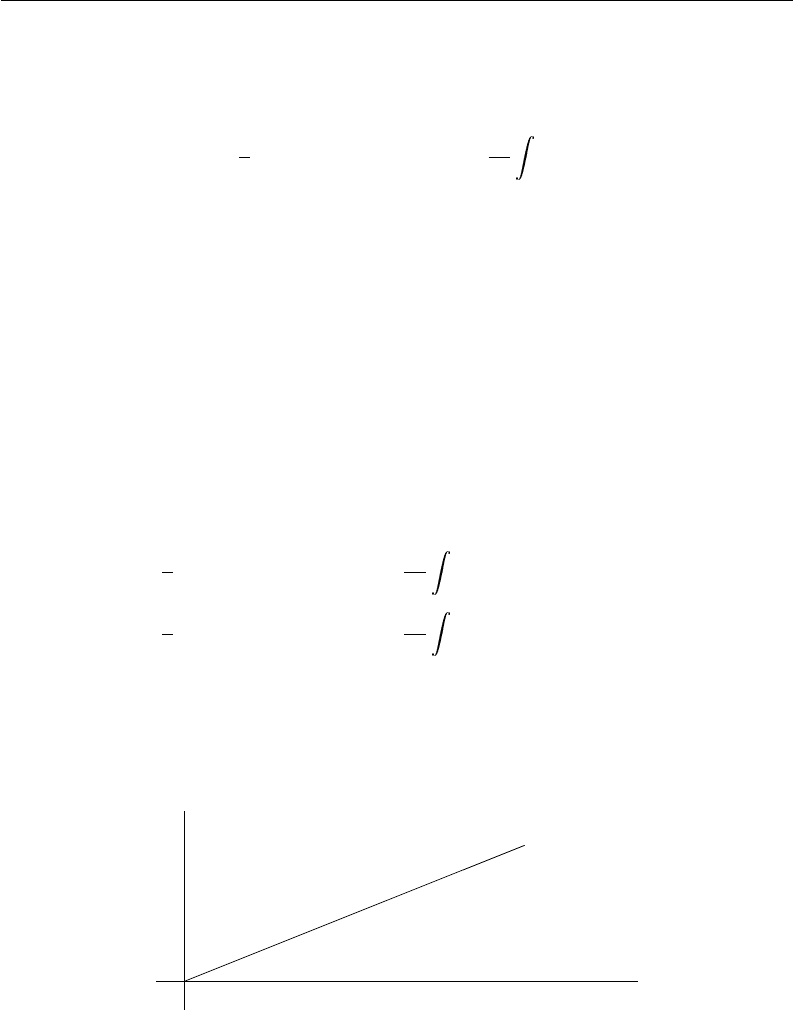
u(x,t) =
1
2
(ϕ(x + a
t)
+ ϕ(x −at)) +
1
2a
x+a
t
x−a
t
ψ(s)ds, x ≥ at,
1
2
(
ϕ
(
x
+
a
t
)
−
ϕ
(
a
t
−
x
)) +
1
2a
x+a
t
a
t−x
ψ
(
s
)
ds
,
x
≤
at
.
(2.1.14)
We note that in the domain x ≥ at, the influence of the wave reflected from the end x = 0
is not present, and the solution has the same form as for the infinite string.
6
-
t
x
x = a
t
x −a
t > 0
x −at < 0
Figure 2.1.3.
Remark 2.1.3. Analogously one can solve the problem with the boundary condition
u
x|x=0
= 0. This can be recommended as an exercise. In this case, according to Lemma
2.1.1 we should extend ϕ(x) and ψ(x) as even functions. Other exercises related to the
topic one can find in Chapter 6, section 6.2.