
Freiling G., Yurko V. Lectures on Differential Equations of Mathematical Physics: A First Course
Подождите немного. Документ загружается.

42 G.
Freiling and V. Yurko
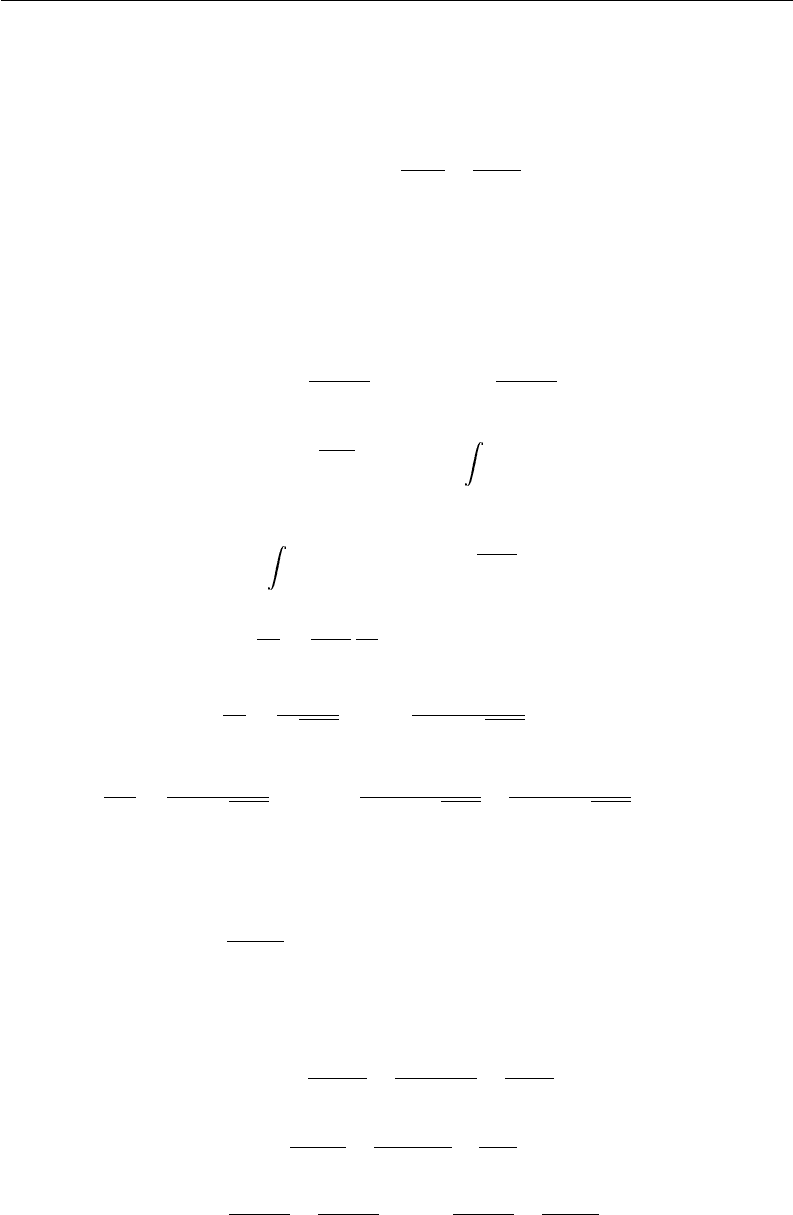
Therefore, equation
(2.2.67) is transformed to the following equation with respect to Z(x) :
−Z
00
(x) + a(x)Y (x) = λr(x)Z(x), 0 < x < l, (2.2.69)
where
a(x) = q
0
(x) −
p
0
(x)
2
+
p
2
(x)
4
.
The
boundary
conditions (2.2.35) takes the form
h
1
Z
0
(0) −h
0
Z(0) = 0,
H
1
Z
0
(l) + H
0
Z(l) = 0,
)
(2.2.70)
where
h
0
= h −
h
1
p(0)
2
, H
0
= H +
H
1
p(l)
2
.
Step
2. Denote
R(x)
=
p
r(x) > 0, T =
l
0
R(τ)dτ.
W
e
make the replacement
ξ =
x
0
R(τ)dτ, z(ξ) =
p
R(x)Z(x). (2.2.71)
It
follo
ws from (2.2.71) that
d
dξ
=
1
R(x)
d
d
x
. Hence
d
z
dξ
=
1
p
R(x)
Z
0
(x)
+
R
0
(x)
2R(x)
p
R(x)
Z(x),
d
2
z
dξ
2
=
1
R(x)
p
R(x)
Z
00
(x)
+
³
R
00
(x)
2R
2
(x)
p
R(x)
−
3(R
0
(x))
2
4R
3
(x)
p
R(x)
´
Z(x).
Therefore,
the
boundary value problem (2.2.69)-(2.2.70) is transformed to the following
boundary value problem with respect to z(ξ) :
−
d
2
z(ξ)
dξ
2
+ P(ξ)z(ξ)
= λ
z(ξ), 0 < ξ < T, (2.2.72)
z
0
(0) −αz(0) = 0, z
0
(T ) + βz(T ) = 0, (2.2.73)
where
P(ξ) =
R
00
(x)
2R
3
(x)
−
3(R
0
(x))
2
4R
4
(x)
+
a(x)
R
2
(x)
=
r
00
(x)
4r
2
(x)
−
5(r
0
(x))
2
16r
3
(x)
+
a(x)
r(x)
,
α =
h
0
h
1
R(0)
+
R
0
(0)
2R
2
(0)
, β =
H
0
H
1
R(l)
−
R
0
(l)
2R
2
(l)
.
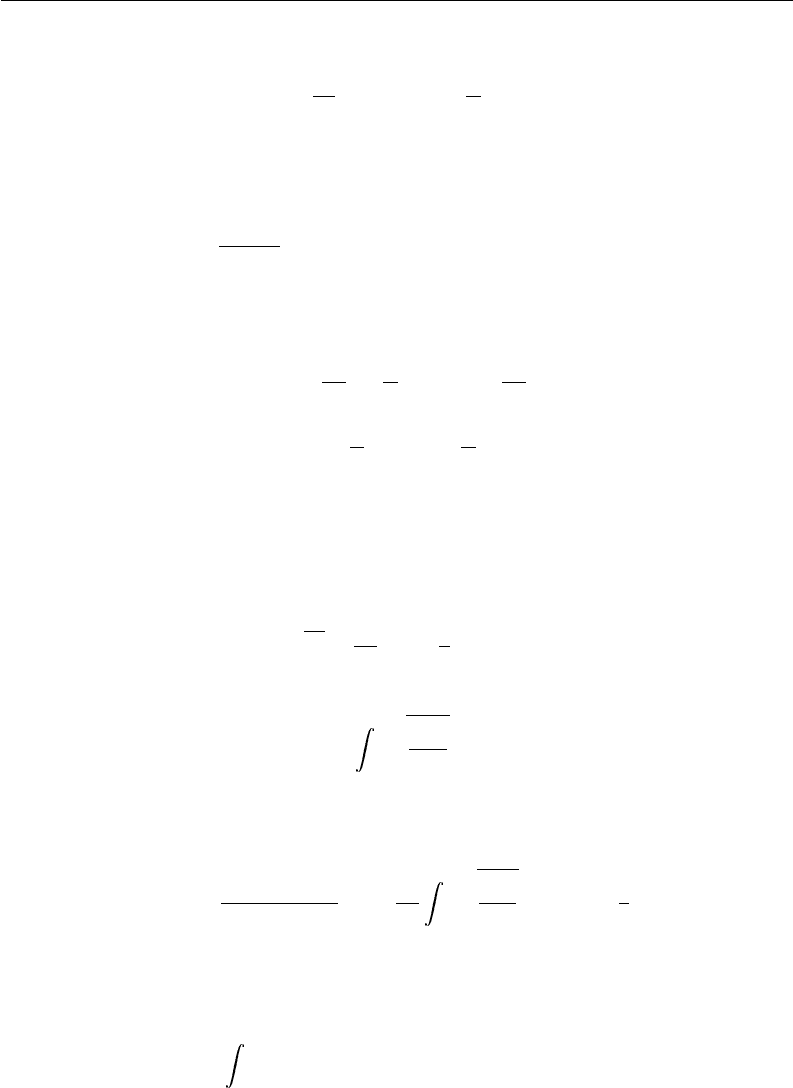
Hyperbolic P
artial Differential Equations 43
Step 3. W
e make the substitution
η =
πξ
T
, y(η)
= z
µ
T
π
η

.
Then
the
boundary value problem (2.2.72)-(2.2.73) is transformed to the following bound-
ary value problem with respect to y(η) :
−
d
2
y(η)
dη
2
+ Q(η)y(η)
= µy
(η), 0 < η < π,
y
0
(0) −α
0
y(0) = 0, y
0
(π) + β
0
y(T ) = 0,
where
Q(η) =
T
2
π
2
P
µ
T
π
η

, µ =
T
2
π
2
λ,
α
0
=
T
π
α, β
0
=
T
π
β.
Thus,
we
have reduced the Sturm-Liouville problem (2.2.34)-(2.2.35) to the form
(2.2.36). Using the results obtained above we conclude that the following theorem holds.
Theorem 2.2.8. (1) The boundary value problem (2.2.34) −(2.2.35) has a countable
set of eigenvalues {λ
n
}
n≥0
. They are real and simple ( i.e. λ
n
6= λ
k
for n 6= k) , and
ρ
n
:=
p
λ
n
=
nπ
T
+ O
µ
1
n

, n →∞, (2.2.74)
wher
e
T =
l
0
s
ρ(τ)
k(τ)
dτ.
F
or
each eigenvalue λ
n
, there exists only one ( up to a multiplicative constant ) eigenfunc-
tion Y
n
(x) . For n → ∞ ,
Y
n
(x) =
1
(k(x)ρ(x))
1/4
cos
Ã
πn
T
x
0
s
ρ(s)
k(s)
d
s
!
+ O
µ
1
n

uniformly
in
x ∈ [0, l].
(2) The eigenfunctions related to different eigenvalues are orthogonal in
L
2,ρ
(0,l) , i.e.
l
0
Y
n
(x)Y
k
(x)ρ(x)dx = 0 for n 6= k.
The system of eigenfunctions {Y
n
(x)}
n≥0
is complete in L
2,ρ
(0,l) .
(3) Let f (x), x ∈[0,l] be an absolutely continuous function. Then
f (x) =
∞
∑
n=0
a
n
Y
n
(x),
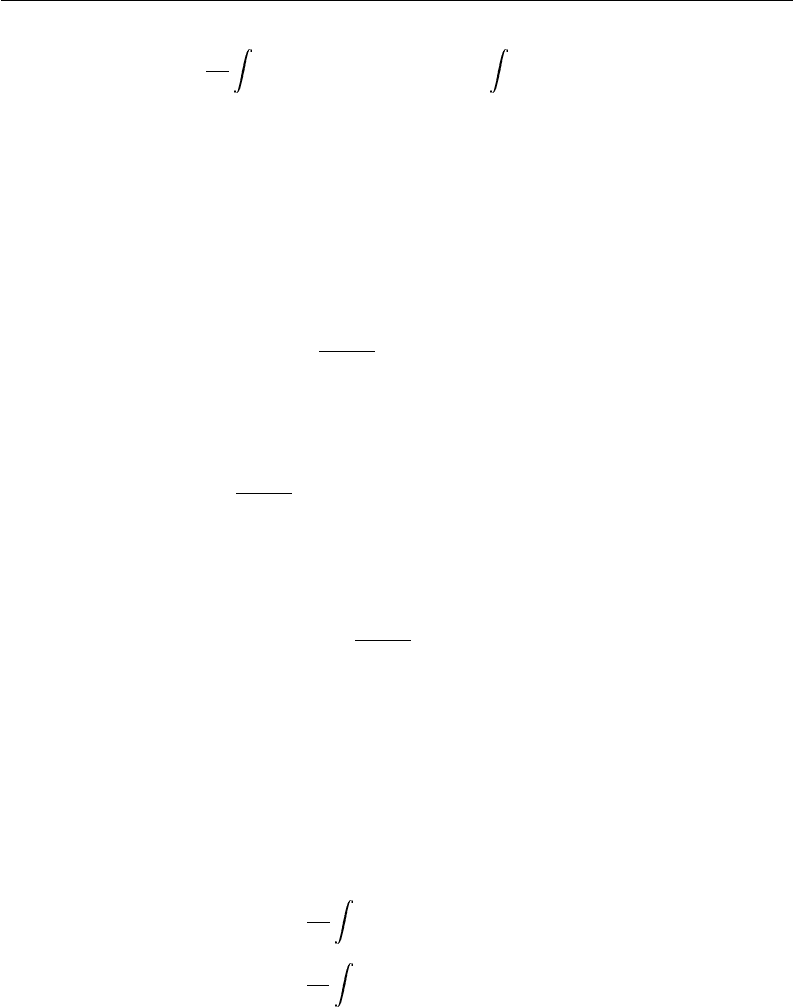
44 G.
Freiling and V. Yurko
where
a
n
=
1
α
n
l
0
f (x)Y
n
(x)ρ(x)d
x, α
n
=
l
0
Y
2
n
(x)ρ
(x)dx.
and the series converges uniformly on [0,l].
4.3. Since nontrivial solutions of problem (2.2.34)-(2.2.35) exist only for the eigen-
values λ = λ
n
of the form (2.2.74), it makes sense to consider equation (2.2.33) only for
λ = λ
n
:
¨
T
n
(t) + ρ
2
n
T
n
(t) = 0, n ≥ 0, λ
n
= ρ
2
n
.
The general solution of this equation has the form
T
n
(t) = A
n
sinρ
n
t
ρ
n
+ B
n
cosρ
n
t, n ≥0,
where A
n
and B
n
are
arbitrary
constants. Thus, the solutions of the auxiliary problem have
the form
u
n
(x,t) =
µ
A
n
sinρ
n
t
ρ
n
+ B
n
cosρ
n
t

Y
n
(x), n = 0,1,2,
.
.. (2.2.75)
We will seek the solution of the mixed problem (2.2.27)-(2.2.29) by superposition of
standing waves (2.2.75), i.e. as a formal series solution:
u(x,t) =
∞
∑
n=0
µ
A
n
sinρ
n
t
ρ
n
+ B
n
cosρ
n
t

Y
n
(x). (2.2.76)
By
construction
the function u(x,t) satisfies formally equation (2.2.27) and the boundary
conditions (2.2.28) for all A
n
and B
n
. Choose A
n
and B
n
such that u(x,t) satisfies also
the initial conditions (2.2.29). Substituting (2.2.76) into (2.2.29) we calculate
Φ(x) =
∞
∑
n=0
B
n
Y
n
(x), Ψ(x) =
∞
∑
n=0
A
n
Y
n
(x),
and consequently,
B
n
=
1
α
n
l
0
Φ(x)Y
n
(x)ρ(x)d
x,
A
n
=
1
α
n
l
0
Ψ(x)Y
n
(x)ρ(x)d
x.
(
2.2.77)
Thus, the solution of the mixed problem (2.2.27)-(2.2.29) has the form (2.2.76), where the
coefficients A
n
and B
n
is taken from (2.2.77).
We note that the series in (2.2.76) converges uniformly in D := {(x,t) : 0 ≤ x ≤ l, t ≥
0}. Indeed, let
`
0
Y (x) := −(k(x)Y
0
(x))
0
+ q(x)Y (x).
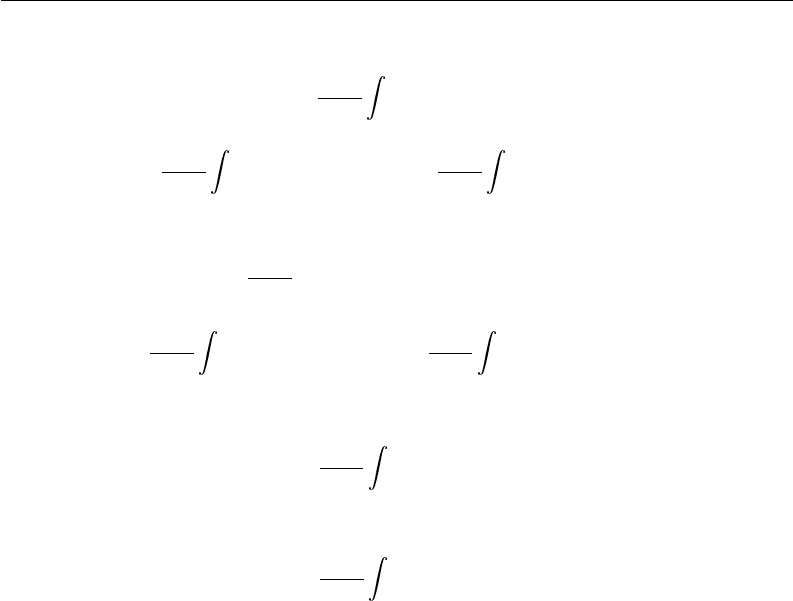
Hyperbolic P
artial Differential Equations 45
Since `
0
Y
n
(x) = λ
n
ρ(x)Y
n
(x), it
follows from (2.2.77) that
A
n
=
1
α
n
λ
n
l
0
Ψ(x)`
0
Y
n
(x)d
x
= −
1
α
n
λ
n
l
0
Ψ(x)
(k(x)Y
0
n
(x))
0
d
x +
1
α
n
λ
n
l
0
Ψ(x)q(x)Y
n
(x)d
x.
Inte
grating by parts twice the first integral we get
A
n
=
1
α
n
λ
n
¡
k(x)(Ψ
0
(x)Y
n
(x) −Ψ(x)Y
0
n
(x))
¢
¯
¯
l
0
−
1
α
n
λ
n
l
0
(k(x)Ψ
0
(x))
0
Y
n
(x)d
x +
1
α
n
λ
n
l
0
Ψ(x)q(x)Y
n
(x)d
x.
The
substitution vanishes since the functions Ψ(x) and Y
n
(x) satisfy the boundary condi-
tions (2.2.35). Therefore,
A
n
=
1
α
n
λ
n
l
0
Ψ
0
(x)Y
n
(x)d
x,
where Ψ
0
(
x) := `
0
Ψ(x). Similarly,
B
n
=
1
α
n
λ
n
l
0
Φ
0
(x)Y
n
(x)d
x,
where Φ
0
(x) :
= `
0
Φ(x). Taking the asymptotics for λ
n
and Y
n
(x) into account (see The-
orem 2.2.8) we conclude that the series (2.2.76) converges uniformly in D.
2.3. The Goursat Problem
The Goursat problem is the problem of solving a hyperbolic equation with given data on
characteristics. Therefore, this problem is also called the problem on characteristics. It
is convenient for us to consider the canonical form of hyperbolic equations for which the
characteristics are parallel to the coordinate axes. For simplicity, we confine ourselves to
linear equations. So, we consider the following Goursat problem:
u
xy
= a(x,y)u
x
+ b(x,y)u
y
+ c(x,y)u + f (x,y), (x,y) ∈ Π, (2.3.1)
u
|x=x
0
= ϕ(y), u
|y=y
0
= ψ(x). (2.3.2)
Here x,y are the independent variables, u(x, y) is an unknown function and Π = {(x, y) :
x
0
≤ x ≤ x
1
, y
0
≤ y ≤ y
1
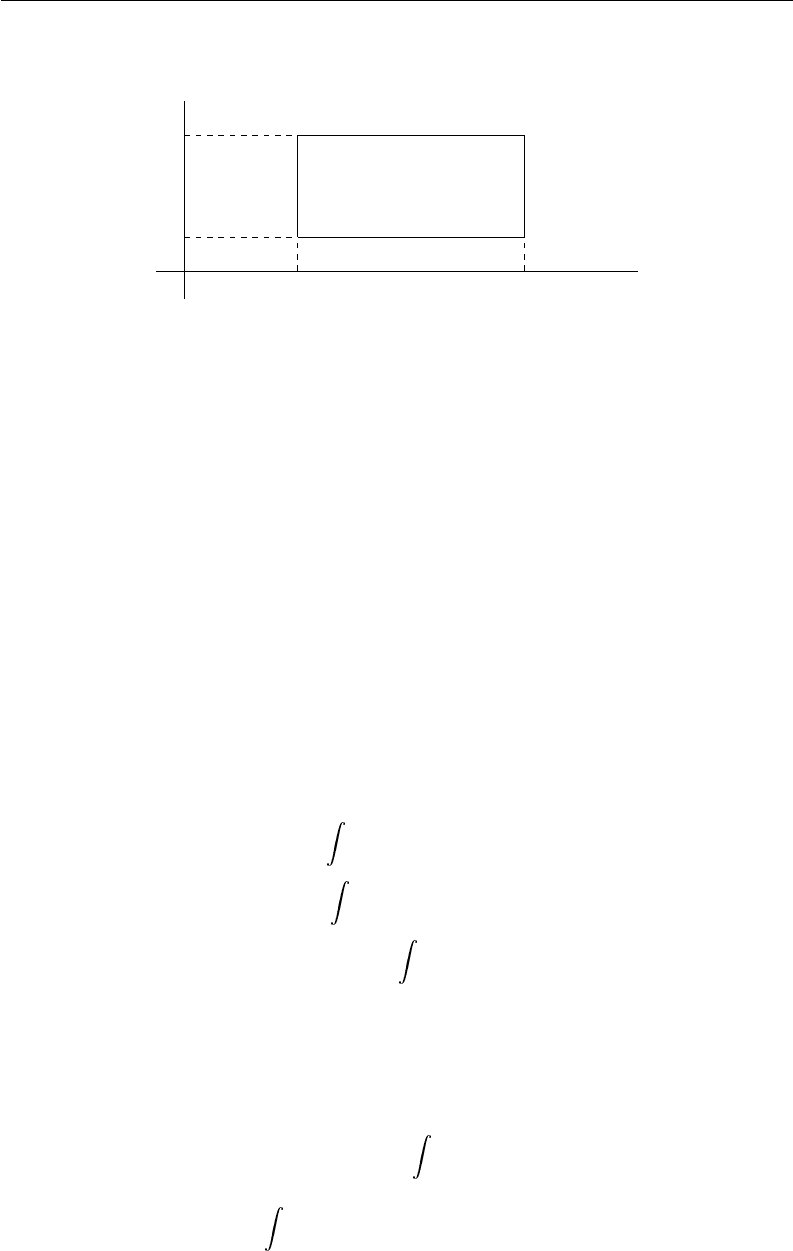
} is a rectangle (see fig. 2.3.1). Equation (2.3.1) has two families
of characteristics x = const and y = const. . Thus, the conditions (2.3.2) are conditions on
the characteristics x = x
0
and y = y
0
.
46 G.
Freiling and V. Yurko
6
-
y
x
Π
y
0
y
1
x
1
x
0
Figure
2.3.1.
Definition
2.3.1. The function u(x, y) is called a solution of problem (2.3.1)-(2.3.2)
if u(x, y) is defined and continuous with its derivatives u
x
,u
y
,u
xy
in the rectangle Π and
satisfies (2.3.1) and (2.3.2).
Theorem 2.3.1. Let the functions a,b,c, f be continuous in Π, and let the functions
ϕ and ψ be continuously differentiable with ϕ(y
0
) = ψ(x
0
). Then the solution of problem
(2.3.1) −(2.3.2) exists and is unique.
Proof. 1) We reduce the Goursat problem (2.3.1)-(2.3.2) to an equivalent system of
integral equations. Suppose that the solution u(x,t) of problem (2.3.1)-(2.3.2) exists. Put
v = u
x
, w = u
y
.
Then
v
y
= av + bw + cu + f , w
x
= av + bw + cu + f , u
y
= w. (2.3.3)
Integrating (2.3.3) and taking (2.3.2) into account we obtain
v(x,y) = ψ
0
(x) +
y
y
0
(av + bw + cu + f )(x,η) dη,
w(x,y) = ϕ
0
(y) +
x
x
0
(av + bw + cu + f )(ξ,y)dξ,
u(x,y) = ψ(x) +
y
y
0
w(x,η) dη.
(2.3.4)
Thus, if u is a solution of problem (2.3.1)-(2.3.2), then the triple u,v,w is a solution of the
system (2.3.4).
The inverse assertion is also valid. Indeed, let the triple u,v,w define a solution of the
system (2.3.4). Differentiating (2.3.4) we deduce that the equalities (2.3.3) hold. Moreover,
u
x
(x,y) = ψ
0
(x) +
y
y
0
w
x
(x,η) dη
= ψ
0
(x) +
y
y
0
(av + bw + cu + f )(x,η) dη = v(x,y).
Hyperbolic P
artial Differential Equations 47
Thus u
x
= v. Together
with (2.3.3) this yields that the function u(x,t) is a solution of
equation (2.3.1). Furthermore, it follows from (2.3.4) for x = x
0
and y = y
0
that
u(x,y
0
) = ψ(x),
u(x
0
,y) = ψ(x
0
) +
y
y
0
w(x
0
,η) dη = ψ(x
0
) +
y
y
0
ϕ
0
(η)dη = ϕ(y),
i.e. u(x,y) satisfies the conditions (2.3.2). Thus, the Goursat problem (2.3.1)-(2.3.2) is
equivalent to the system (2.3.4).
2) We will solve the system (2.3.4) by the method of successive approximations. Put
v
0
(x,y) = ψ
0
(x) +
y
y
0
f (x, η)dη,
w
0
(x,y) = ϕ
0
(y) +
x
x
0
f (ξ, y)dξ,
u
0
(x,y) = ψ(x),
v
n+1
(x,y) =
y
y
0
(av
n
+ bw
n
+ cu
n
)(x,η) dη,
w
n+1
(x,y) =
x
x
0
(av
n
+ bw
n
+ cu
n
)(ξ,y)dξ,
u
n+1
(x,y) =
y
y
0
w
n
(x,η) dη.
(2.3.5)
Take the constants M ≥ 0 and K ≥ 1 such that
|u
0
|,|v
0
|,|w
0
| ≤ M, |a|+ |b|+ |c| ≤ K.
Using (2.3.5), by induction one gets the estimates:
|v
n
(x,y)|, |w
n
(x,y)|, |u
n
(x,y)| ≤ MK
n
(x + y −x
0
−y
0
)
n
n!
. (2.3.6)
Indeed,
for n = 0
these estimates are obvious. Fix N ≥ 0 and suppose that estimates
(2.3.6) are valid for n =
0,N. Then,
using
(2.3.5) and (2.3.6) we obtain
|v
N+1
(x,y)| ≤
y
y
0
MK
N
(|a(x,η)|+ |b(x,η)|
+|c(x,η)|)
(x + η −x
0
−y
0
)
N
N!
dη,
and
consequently
,
|v
N+1
(x,y)| ≤ MK
N+1
y
y
0
(x + η −x
0
−y
0
)
N
N!
dη
= M
K
N+1
(x + η −x
0
−y
0
)
N+1
(N + 1)!
¯
¯
¯
¯
y
y
0
≤ M
K
N+1
(x + y −x
0
−y
0
)
N+1
(N + 1)!
.
48 G.
Freiling and V. Yurko
For w
n
and u
n
ar
guments are similar.
By virtue of (2.3.6), the series
u(x,y) =
∞
∑
n=0
u
n
(x,y),
v(x,y) =
∞
∑
n=0
v
n
(x,y),
w(x,y) =
∞
∑
n=0
w
n
(x,y)
(2.3.7)
converge absolutely and uniformly in Π (since they are majorized by the convergent nu-
merical series M
∞
∑
n=0
K
n
(x
1
+ y
1
−x
0
−y
0
)
n
n!
),
and
|v(x,y
)|,|w(x,y)|,|u(x,y)| ≤ M exp(K(x
1
+ y
1
−x
0
−y
0
)). (2.3.8)
Obviously, the triple u, v,w, constructed by (2.3.7), solves system (2.3.4).
3) Let us prove the uniqueness. Let the triples (u,v, w) and ( ˜u, ˜v, ˜w) be solutions
of system (2.3.4). Then the functions u
∗
= u − ˜u , v
∗
= v − ˜v , w
∗
= w − ˜w satisfy the
homogeneous system
v
∗
(x,y) =
y
y
0
(av
∗
+ bw
∗
+ cu
∗
)(x,η) dη,
w
∗
(x,y) =
x
x
0
(av
∗
+ bw
∗
+ cu
∗
)(ξ,y)dξ,
u
∗
(x,y) =
y
y
0
w
∗
(x,η) dη.
Since the functions u
∗
,v
∗
,w
∗
are continuous in Π, there exists a constant M
1
> 0 such
that |u
∗
|,|v
∗
|,|w
∗
| ≤ M
1
. Repeating the previous arguments, by induction we obtain the
estimate
|v
∗
(x,y)|, |w
∗
(x,y)|, |u
∗
(x,y)| ≤ M
1
K
n
(x + y −x
0
−y
0
)
n
n!
.
As n → ∞ this
yields u
∗
(x,y
) = v
∗
(x,y) = w
∗
(x,y) = 0. Theorem 2.3.1 is proved. 2
Let us study the stability of the solution of the Goursat problem.
Definition 2.3.2. The solution of the Goursat problem is called stable if for each
ε > 0 there exists δ = δ(ε) > 0 such that if |ϕ
(ν)
(y) −
˜
ϕ
(ν)
(y)| ≤ δ , |ψ
(ν)
(x) −
˜
ψ
(ν)
(x)| ≤
δ , ν = 0,1 , x ∈ [x
0
,x
1
] , y ∈ [y
0
,y
1
], then |u(x,y) − ˜u(x,y)| ≤ ε , |u
x
(x,y) − ˜u
x
(x,y)| ≤
ε , |u
y
(x,y) − ˜u
y
(x,y)| ≤ ε for all (x,y) ∈ Π. Here ˜u(x, y) is the solution of the Goursat
problem for the data
˜
ϕ,
˜
ψ.
Let us show that the solution of problem (2.3.1)-(2.3.2) is stable. Indeed, denote u
∗
=
u − ˜u , v
∗
= v − ˜v , w
∗
= w − ˜w , ϕ
∗
= ϕ −
˜
ϕ , ψ
∗
= ψ −
˜
ψ , f
∗
= 0. By virtue of (2.3.8),
|v
∗
(x,y)|, |w
∗
(x,y)|, |u
∗
(x,y)| ≤ M
∗
exp(K(x
1
+ y
1
−x
0
−y
0
)),

Hyperbolic P
artial Differential Equations 49
where
M
∗
= max(max
x
|ψ
∗
(x)|,max
x
|ψ
∗,0
(x)|,max
y
|ϕ
∗,0
(y)|) ≤ δ.
Choosing δ = εexp(
−K(x
1
+ y
1
−x
0
−y
0
)) and using the relation M
∗
≤ δ, we get
|u
∗
(x,y)|, |v
∗
(x,y)|, |w
∗
(x,y)| ≤ ε. Thus, the Goursat problem (2.3.1)-(2.3.2) is well-posed.
Now we reformulate the results obtained above for another canonical form of hyperbolic
equations. We consider the following Goursat problem
u
xx
−u
tt
+ a(x,t)u
x
+ b(x,t)u
t
+ c(x,t)u = f (x,t), (2.3.9)
(x,t) ∈ ∆(x
0
,t
0
),
u(x,x −x
0
+t
0
) = ϕ(x), u(x,−x + x
0
+t
0
) = ψ(x), (2.3.10)
where
∆(x
0
,t
0
) = {(x,t)) : t −t
0
+ x
0
≤ x ≤ −t +t
0
+ x
0
, 0 ≤t ≤ t
0
}
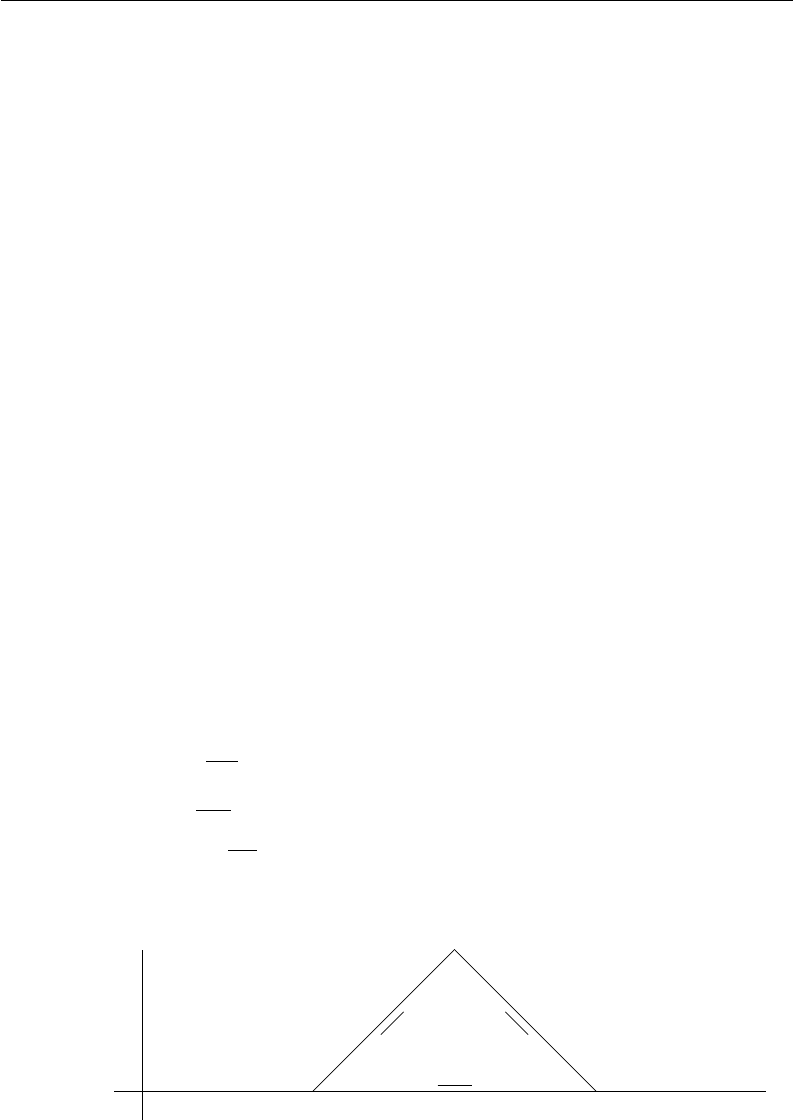
is the characteristic triangular (see fig. 2.4.1). Equation (2.3.9) has two families of charac-
teristics x + t = const and x −t = const. Thus, the conditions (2.3.10) are conditions on
the characteristics I
1
: t = x −x
0
+ t
0
and I
2
: t = −x + x
0
+ t
0
. Problem (2.3.9)-(2.310)
can be reduced to a problem of the form (2.3.1)-(2.3.2) by the replacement:
x = ξ −η + t
0
, t = ξ + η −x
0
This yields
ξ =
t + x
2
+
x
0
−t
0
2
, η =
t −x
2
+
x
0
+t
0
2
.
Indeed,
denote
˜u
(ξ,η) = u(ξ −η +t
0
,ξ + η −x
0
) = u(x,t).
Then u
x
= ( ˜u
ξ
− ˜u
η
)/2 , u
t
= ( ˜u
ξ
+ ˜u
η
)/2 , u
xx
−u
tt
= −˜u
ξη
, and consequently, equation
(2.3.9) takes the form
˜u
ξη
= ˜a(ξ,η) ˜u
ξ
+
˜
b(ξ,η) ˜u
η
+ ˜c(ξ,η) ˜u +
˜
f (ξ, η), (2.3.11)
where
˜a =
a + b
2
,
˜
b = −
a −b
2
, ˜c = c,
˜
f = −f .
The
characteristics I
1
and I
2
of
equation (2.3.9) are transformed into characteristics of
equation (2.3.11) η = t
0
and ξ = x
0
, respectively, and conditions (2.3.10) become
˜u(ξ,t
0
) =
˜
ϕ(ξ), ˜u(x
0
,η) =
˜
ψ(η),
where
˜
ϕ(ξ) = ϕ(ξ) ,
˜
ψ(η) = ψ(−η+x
0
+t
0
). Therefore, the following theorem is a corol-
lary of Theorem 2.3.1.
Theorem 2.3.2. Let the functions a, b,c, f be continuous in ∆(x
0
,t
0
), and let the
functions ϕ and ψ be continuously differentiable with ϕ(x
0
) = ψ(x
0
). Then the solution
of the Goursat problem (2.3.9) −(2.3.10) exists and is unique.
50 G.
Freiling and V. Yurko
2.4. The
Riemann Method
Riemann’s method is a classical technique for solving the Cauchy problem for hyperbolic
linear equations in two variables; in particular it provides information for domains of
dependence and influence for solutions.
We consider the following Cauchy problem
u
xx
−u
tt
+ a(x,t)u
x
+ b(x,t)u
t
+ c(x,t)u = f (x,t), (2.4.1)
−∞ < x < ∞, t > 0,
u
|t=0
= ϕ(x), u
t|t=0
= ψ(x). (2.4.2)
Denote D = {(x,t) : −∞ < x < ∞, t ≥ 0}. Suppose that a,b ∈C
1
(D) , c, f ∈C(D) , ϕ ∈
C
2
(R), ψ ∈C
1
(R).
Definition 2.4.1. A function u(x,t) is called a solution of problem (2.4.1)-(2.4.2) if
u(x,t) ∈C
2
(D), and u(x,t) satisfies (2.4.1) and (2.4.2).
Derivation of the Riemann formula. Denote
L u = u
xx
−u
tt
+ au
x
+ bu
t
+ cu,
L
∗
v = v
xx
−v
tt
−(av)
x
−(bu)
t
+ cv.
Fix a point (x
0
,t
0
) and consider the characteristic triangular ∆(x
0
,t
0
) = {(x,t) : t −t
0
+
x
0
≤ x ≤ −t + t
0
+ x
0
, 0 ≤ t ≤ t
0
} (see fig. 2.4.1) with vertices at the points M = (x
0
,t
0
) ,
P = (x
0
−t
0
,0) and Q = (x
0
+t
0
,0). The boundary ∂∆ of ∆ consists of three segments:
∂∆ = I
1
∪I
2
∪I
3
, where
I
1
=
M
P :
= {(x,t) : t = x −x
0
+t
0
, x
0
−t
0
≤ x ≤ x
0
},
I
2
=
QM := {(x,t) : t = −x + x
0
+t
0
, x
0
≤ x ≤ x
0
+t
0
},
I
3
=
PQ := {(x,t) : t = 0, x
0
−t
0
≤ x ≤ x
0
+t
0
}.
6
-
t
x
M =
(x
0
,t
0
)
∆
(x
0
,t
0
)
I
2
I
1
P = (x
0
−t
0
,0) Q = (x
0
+t
0
,0)I
3
-
I
ª
fig.
2.4.1
Hyperbolic P
artial Differential Equations 51
Suppose that
the solution u(x,t) of problem (2.4.1)-(2.4.2) exists. Let v(x,t) ∈C
2
(D)
be an arbitrary function. Since
vL u −uL
∗
v = (vu
x
−uv
x
+ auv)
x
−(vu
t
−uv
t
−buv)
t
,
it follows from Green’s formula that
∆
(vL u −uL
∗
v)dxdt
=
∂∆
(vu
t
−uv
t
−buv)dx + (vu
x
−uv
x
+ auv)dt (2.4.3)
(with counterclockwise orientation of ∂∆ ). Let us transform the integral along the bound-
ary. We have
∂∆
=
I
1
+
I
2
+
I
3
.
1) On I
1
: t = x −x
0
+t
0
, dt = dx. Denote
α
1
(x) = u(x, x −x
0
+t
0
), β
1
(x) = v(x, x −x
0
+t
0
).
Then α
0
1
(x) = (u
x
+ u
t
)
|t=x−x
0
+t
0
, β
0
1
(x) = (v
x
+ v
t
)
|t=x−x
0
+t
0
, and consequently,
I
1
=
P
M
(v(u
t
+ u
x
) −u(v
t
+ v
x
) + (a −b)uv)(x,x −x
0
+t
0
)dx
=
P
M
(β
1
(x)α
0
1
(x) −α
1
(x)β
0
1
(x)
+(a −b)(x,x −x
0
+t
0
)α
1
(x)β
1
(x))dx.
Integrating by parts the first term we get
I
1
=
³
β
1
(x)α
1
(x)
´
¯
¯
¯
P
M
−
P
M
α
1
(x)
¡
2β
0
1
(x) −(a −b)(x,x −x
0
+t
0
)β
1
(x)
¢
dx.
Impose a first condition on the function v(x,t), namely:
2β
0
1
(x) −(a −b)(x,x −x
0
+t
0
)β
1
(x) = 0.
Solving this ordinary differential equation we calculate
v(x,x −x
0
+t
0
) = exp
µ
1
2
x
x
0
(a −b)
(ξ
,ξ −x
0
+t
0
)dξ

. (2.4.4)
Then
I
1
= u(P)v(P) −u(M)v(M). (2.4.5)