
Gao R.X., Yan R. Wavelets: Theory and Applications for Manufacturing
Подождите немного. Документ загружается.

J
f
l
ði; jÞ¼
jm
i; f
l
m
j; f
l
j
2
s
2
i; f
l
þ s
2
j; f
l
(8.12)
The symbols m
i; f
l
, m
j; f
l
and s
2
i; f
l
, s
2
j; f
l
represent the mean values and the variances of
the lth feature, f
l
, and for the classes i and j, respective ly. Since typically more than
two defect severity levels need to be evaluated in a machine defect diagnosis
system, a k-class, p feature component problem with kðk 1Þ=2 class pairs is
investigated for generality. The process for feature selection, based on the FLD
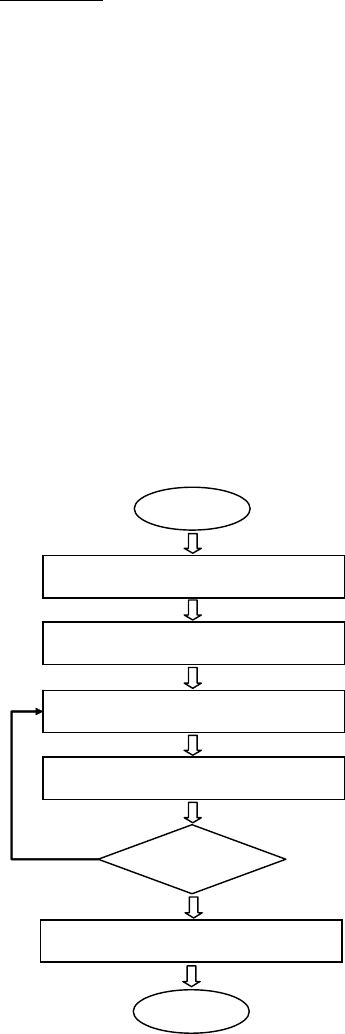
analysis method, is illustrated in Fig. 8.3.
Features (i.e., subband energy and kurtosis values) are first extracted by
means of the WPT from the signals measured on the machine (e.g., a milling
machine, a spindle), under various operating conditions (e.g., speed and load).
The mean values and variances of each individual feature f
l
corresponding
to each machine status are then calculated, for each set of operation conditions
(e.g., 1,200 rpm, 3.6 kN radial load). For each possible class pair
fði; jÞji ¼ 1; 2; ...; k 1; j ¼ i þ 1; i þ 2; ...; k
g
formed from two different
machine states (e.g., health vs. light defect), the discriminant power measure J
f
l
ði; jÞ
for each feature f
l
, is calculated, using (8.12). Descending sorting J
f
l
ði; jÞ yields:
Y
N
Start
End
Sub-band feature f
l
extraction
Condition pair (i,j) selection
Discriminant power J
f
l
(i,j) calculation
Feature subset F
i,j
selection
Final feature set F
final
selection
Next class
pair exist ?
Fig. 8.3 Flowchart of the
FLD feature selection process
130 8 Wavelet Packet Transform for Defect Severity Classification
J
f
1
ði; jÞJ
f
2
ði; jÞJ
f
d
ði; jÞJ
f
p
ði; jÞ (8.13)
The first group of d features that have the highest relative J
f
l
ði; jÞ values are chosen
to form the feature subset F
i;j
, for each class pair ði; jÞ :
F
i; j
¼ff
l
jl ¼ 1; 2; ...; dg; i ¼ 1; 2; ...; k 1; j ¼ i þ 1; i þ 2; ...; k (8.14)
The final feature set is obtained by taking the union of each feature subset across all
the class pairs as:
F
final
¼
[
L 1
i¼1
[
L
j¼iþ1
F
i; j
)(
(8.15)
This feature set is subsequently selected for the machine defect severity classification.
8.2.2 Principal Component Analysis
PCA, as a multivariate statistical technique, has been intensively studied and
utilized as an effective tool for process monitoring (Kano et al. 2001), structural
damage identification (De Boe and Gol inval 2003), and machine health diagnosis
(Baydar et al. 2001; He et al. 2008). This is due to its ability in dimension reduction
and pattern classification. In general, the PCA technique seeks to determine a series
of new variables, called the principal components, which indicates the maximal
amount of variability in the data with a minimal loss of information (Jolliffe 1986),
to best represent the data in a least square sense.
Suppose there are m feature vectors FV
i
ði ¼ 1; 2; ...; mÞ extracted from m
signals, respectively. A p m feature matrix X can then be formulated as:
X ¼½FV
1
; FV
2
; ...; FV
m
(8.16)
where the symbol FV denotes a p-dimensional feature vector as shown in (8.10).
Depending on the decomposition level j of the WPT, the dimension of the feature
vector is determined as p ¼ 2
jþ1
. Correspondingly, a scatter matrix S is constructed
from the feature matrix X as:
S ¼ E½ðX XÞð X XÞ
T
(8.17)
Where X is the mean value of X, and E½
is the statistical expectation operation
(Duda et al. 2000). Performing singular value decomposition on the scatter matrix
leads to:
8.2 Key Feature Selection 131
S ¼ ALA
T
(8.18)
where A is a p p matrix whose columns are the orthonormal eigenvectors of the
scatter matrix, and A
T
A ¼ I
p
. The symbol L is a diagonal matrix whose diagonal
elements
l
1
l
2
l
p
are the eigenvalues of the scatter matrix. Since the
eigenvector in matrix A with the highest eigenvalue (i.e., l
1
in the diagonal matrix L )
is the first pri nciple component of the p-dimensional feature vect ors, it is better-suited
than any other feature vectors as the representative feature that identifies the condition
of the machine being monitored, for example, defect severity of a bearing. As a result,
PCA ranks the order of eigenvectors by means of their respective eigenvalues, from the
highest to the lowest. Such a ranking sequence reflects upon the order of significance of
the corresponding components. By examining the accumulated variance (e.g., 90%) of
the principle components, which is defined as:
var ¼
P
q
i
1
l
i
P
p
j
1
l
j
!
100 % (8.19)
a lower-dimensional feature vectors Y can be constructed as:
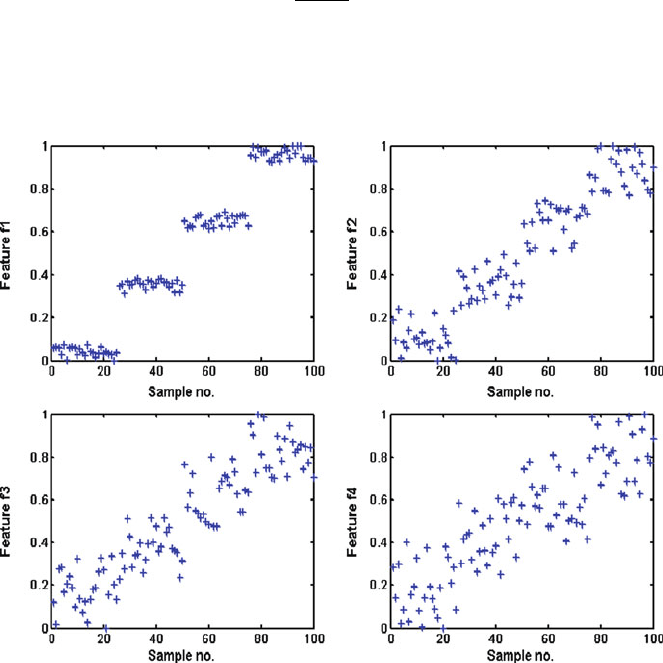
Fig. 8.4 Simulated data of ( f
1
, f
2
, f
3
, f
4
) for developing a feature selection scheme
132 8 Wavelet Packet Transform for Defect Severity Classification
Y ¼ A
T
pq
X (8.20)
where q<p, and A
pq
is the first q columns of A.
Given that the features transformed by the principal components are not directly
connected to the physical nature of the defect, the eigenvectors in A
pq
for the
transformed features are only used as the basis for choosing the most significant
features from the original p-dimensional feature vectors. This is explained by
means of a numerical simulation. As illustrated in Fig. 8.4, four normalized feature
vectors, f
1
, f
2
, f
3
, and f
4
, are constructed with each of them forming clusters around
four distinct levels of magnitudes. A total of 100 samples are considered for each of
the four features, hence each feature is a 100-by-1 vector. The four features are
simulated to have random variations from the same mean for each of the four
clusters. This is similar in principle to the variation of a measured data feature for
four different defect severities. Each of the four clusters for each feature contained
25 data points. The four features become less clearly differentiated from f
1
to f
4
,as
overlap between the clusters increases.
It is evident that a suitable feature selection scheme should be able to rank f
1
, f
2
,
f
3
, and f
4
in the same order as shown in Fig. 8.4. To derive the principal components
for the simulated data set, the four normalized features are collected in a 4-by-100
matrix X:
X ¼½f
1
; f
2
; f
3
; f
4
T
(8.21)
The eigenvalues and the eigenvectors are calculated from the scatter matrix S.The
matrix of eigenvectors can be represented as A ¼[a
i,j
], where i ¼1to4,andj ¼1to4.
The eigenvector a
4
consists of four components from the fourth column of the matrix
A as a
4
¼½
a
1;4
a
2;4
a
3;4
a
4;4
. Similar arrangement applies to a
1
, a
2
,anda
3
(i.e.,
a
1
¼½
a
1;1
a
2;1
a
3;1
a
4;1
, a
2
¼½
a
1;2
a
2;2
a
3;2
a
4;2
,and
a
3
¼½
a
1;3
a
2;3
a
3;3
a
4;3
), respectively. The matrix A is a 4 4 square matrix
because of the presence of the four features f
1
f
4
. The eigenvector corresponding to the
eigenvalue with the largest magnitude is chosen. As shown in Table 8.2, one of the
four eigenvalues of the data set is much larger than the other three, indicating that most
of the variance is concentrated in one direction. Table 8.3 lists the component
magnitudes for the eigenvector corresponding to the largest eigenvalue. Since this
corresponds to a
4
, the feature that is responsible for the maximum variance in the data
is thus identified.
Subsequently, the magnitudes of the four components of e
4
are examined. As
shown in Table 8.3, ja
1,4
j > ja
2,4
j > ja
3,4
j > ja
4,4
j. This result can be interpreted in
terms of the directionality of the eigenvector (a
4
) in the original feature space. If the
unit vectors for the original feature space are represented as u
1
, u
2
, u
3
, and u
4
(where
u
1
¼ [1 0 0 0]
T
, u
2
¼ [0 1 0 0]
T
, etc.), then a higher magnitude of a
i,4
denotes
the similarity in direction of the eigenvector a
4
with u
i
, when compared with the
other unit vectors forming the basis for the original feature space. For the simulated
data, the component a
1,4
has the largest magnitude, followed by a
2,4
, a
3,4
, and a
4,4
.
8.2 Key Feature Selection 133

Thus, the feature represented along u
1
is the most sensitive, followed by those along
u
2
, u
3
, and u
4
. As a result, the PCA-based scheme ranks the four features f
1
f
4
as
desired and selects most representative features.
8.3 Neural-Network Classifier
Once a suitable feature set (e.g., 6) is chosen from the extracted features (e.g., 32),
the machine defect severity levels can be evaluated by means of a status classifier.
Neural network as a classifier has been applied to machine health diagnosis, for
example, for classifying rotating mac hines with imbalance and rub faults (McCor-
mick and Nandi 1997), bearing faults (Li et al. 2000), and tank reactor operation
states (Maki and Loparo 1997). In general, a neural network consists of multiple
layers of nodes or neurons, and each layer has a number of parallel nodes that are
connected to all the nodes in the succeeding layer through different weights
(Haykin 1994). Using a training algorithm, the weights are adjusted such that the
neural network responds to the inputs with outputs corresponding to the severity of
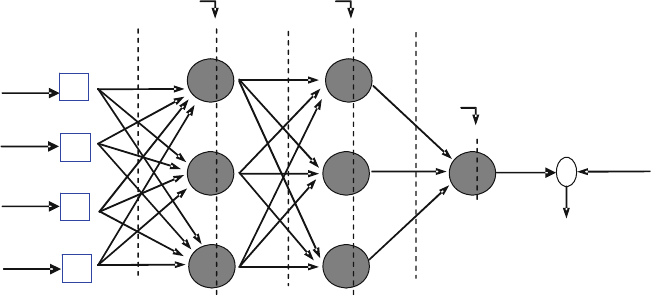
a structura l defect at the output layer. Figure 8.5 illustrates the architecture of a
feed-forward neural network. For the ith layer of links, the symbols w
(i)
, b
(i)
, x
(i)
,
and y
(i)
represent a vector of weights between the layers, node biases of a layer,
inputs of nodes at one layer, and output at the output layer, respectively. At the
output layer, a linear neuron is used to produce an output to indicate the machine
defect severity level.
The weights of a multilayer feed-forward neural network are continuously
updated, while it is trained with training data consist ing of a set of machine defect
feature input vectors (x) and known output (d). This is realized by minimizing the
error between the computed output of the network and the known output in the
training process. Consider n pairs of input and output training data {(x
p
, d
p
)j, p ¼ 1,
2,..., n}. For the pth pair data {x
p
, d
p
}, the mean square error (MSE) of the network
output y
p
is expressed as:
Table 8.3 The fourth
eigenvector component
magnitudes for simulated
data
Component Magnitude
a
1,4
0.599
a
2,4
0.523
a
3,4
0.439
a
4,4
0.417
Table 8.2 Eigenvalues for
simulated data
l
1
0.241
l
2
0.775
l
3
1.318
l
4
32.023
134 8 Wavelet Packet Transform for Defect Severity Classification
e
p
¼
X
j
m¼1
ðd
pm
y
pm
Þ
2
(8.22)
where m is the number of nodes at the output layer. Assuming that each input vector
corresponds to a single severity value, the value of m is 1. For the entire training
data set, the total error Err, i.e., the learning error, is expressed as:
Err ¼
X
n
p¼1
e
p
¼
X
n
p¼1
X
j
m¼1
ðd
pm
y
pm
Þ
2
(8.23)
In the training process, the learning error is minimized through continuously
updating the connection weights in its structure with certain lea rning rule. After
training with the training data, the designed network with the resulting connection
weights generalize the relationship between the input and output to correctly
classify new input data. When input feature vectors associated with a defective
measurement occur, for which the network is however not trained, the neural
network will interpola te a defect severity by the location of the new input in the
space spanned by the training data.
There are several gradient-based learning rules to minimize the learning error Err
by changing the connection weight w of the multilayer feed-forward neural network.
Different learning rules differ in how they use the gradients to update the weights w in
training. Steepest decent with fixed learning rate is the traditional learning rule of the
neural network, in which the weight w
(k)
between the kth layer and (k þ 1)th layer is
tuned for each epoch, along the gradient direction by an amount:
1
2
3
1
2
3
1
2
Input Layer
(1)
Hidden Layer
(2)
Hidden Layer
(3)
Output Layer
(4)
x
(1)
1
x
(2)
x
(3)
x
(1)
2
x
(1)
3
x
(1)
4
Input
Vector x
Computed
Output
(y)
Weights
w
(3)
Weights
w
(2)
Weights
w
(1)
1
Bias
b
(1)
Bias
b
(2)
Bias
b
(3)
3
4
-
Known
Output
(d)
Error
(e)
Fig. 8.5 Structure of a multilayer feed forward neural network
8.3 Neural Network Classifier 135
Dw
ðkÞ
¼
@E
@w
ðkÞ
(8.24)
where , referred to as the learning rate, is fixed between 0 and 1. The learning rate
affects the convergence speed and stability of the weights during learning. Gener-
ally, the training error decreases slowly with a learning rate close to 0. On the
contrary, the error may oscillate and not converge if is close to 1. To speed up the
training process for the steepest descent method, (8.24) is modified by adding a
momentum term (Haykin 1994), expressed as:
Dw
ðkÞ
¼
@E
@w
ðkÞ
þ a Dw
prev
(8.25)
where Dw
prev
is the previous adjust amount, and the momentum constant a is set
between 0.1 and 1 in practice. The addition of this momentum term smoothes weight
updating and tends to resist erratic weight changes (Haykin 1994). After the network is
trained with representative data, it is able to evaluate the new measurement data and
classify them according to the rules that it has learned through the training data set.
8.4 Formulation of WPT-Based Defect Severity Classification
Utilizing the advantages of the WPT in subband signal decomposition, this section
introduces a WPT-based defect severity classification algorithm, with assistance from
the neural-network classifier introduced in Sect. 8.3. It starts with a WPT on the
measured signals. After statistical features are extracted from the wavelet coefficients
Signal 1
WPT
Sub-band FE
Sub-band Feature Vectors
Signal n
WPT
Sub-band FE
Key Feature Selection
Neural Network Classifier
Wavelet Packet Transform (WPT)
Input Signal x
Neural Network (NN) Classifier
Output Diagnostic Information
Selected Feature Vector (FV)
Training Evaluation
Sub-band Feature Extraction (FE)
Store NN
Model
Guide FV
selection
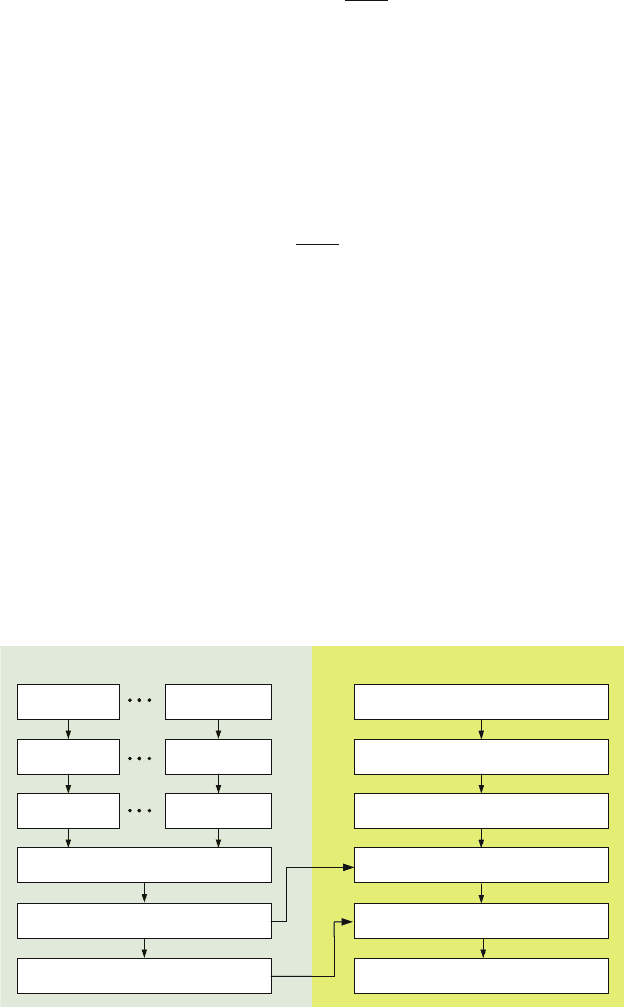
Fig. 8.6 Procedure of the WPT based defect severity classification
136 8 Wavelet Packet Transform for Defect Severity Classification
in each subband, key feature selection process is performed to determine the most
significant features from the feature set, which are subsequently used as input to a
neural network-based classifier for defect severity classification. Figure 8.6 illustrates
how the developed technique is realized. The left side of Fig. 8.6 depicts the training
process of the hybrid technique in a manner of supervised learning (i.e., based on the
available reference data, denoted as signal 1, ..., n). In addition to providing inputs
for constructing the neural-network classifier model, the results from the feature
selection process are used to guide the feature vector selection in the evaluation
process. The right side of Fig. 8.6 describes an evaluation process of the WPT-based
algorithm. An input signal is passed through the process of signal decomposition,
feature extraction, and selection. Eventually, the corresponding defect severity level
is determined through the neural network classifier.
8.5 Case Studies
The appl ication of the above described wavelet packet-based machine defect
severity classification algorithm is described through two case studies.
8.5.1 Case Study I: Roller Bearing Defect Severity Evaluation
The first case study is to evaluate the defect severity level of a set of roller bearings
(N205 ECP) with and without seeded defects. Specifically, vibration data were
measured from both a new, “healthy” bearing that served as a reference base and
three defective bearings containing localized defects of different sizes:
(a) one 0.1 mm diameter hole in the outer raceway
(b) one 0.5 mm diameter hole in the outer raceway
(c) one 1 mm diameter hole in the outer raceway
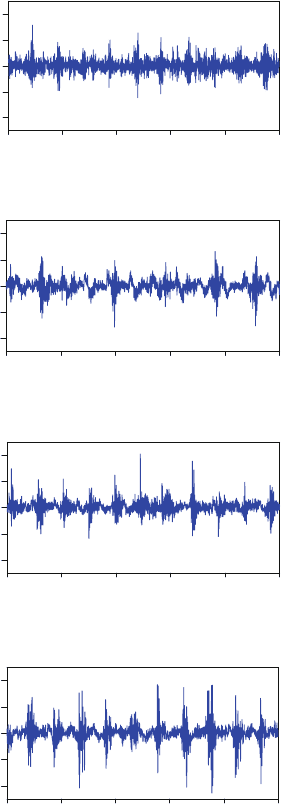
In Fig. 8.7, segments of vibration signals measured from the healthy and defective
bearings are shown.
To provide sufficient training and testing data sets to the neural-network classi-
fier, a total of 240 vibration data sets were collected under a bearing rotating
speed of 1,200 rpm and a radial load of 3,600 N. For each operation condition,
60 data sets were collected. Each data set was first decomposed by the WPT.
Analysis has shown that features extracted from a four-level decomposition
provided adequate information to differentiate the four defect conditions from
each other (Gao and Yan 2007). On the basis of the information collected in the
16 subfrequency bands (since 2
4
¼ 16 ), a feature vector was subsequently con-
structed, which contained 32 feature elements (i.e., 16 subband energy values and
16 subband kurtosis values).
8.5 Case Studies 137
FLD analysis is then applied for feature selection . The means and variances of the
feature element, f
l
, are obtained for each of the four bearing conditions. Table 8.4
summarizes the discriminant power of the extracted features for different condition
pairs, based on the Fisher discriminant criterion. The first three key features within
each condition pair, for example, E
12
4
, E
13
4
, and E
14
4
for the condition pair (healthy,
light defect), are selected, and the final feature set is obtained through a union
0 20406080100
0
0.4
a
b
c
d
0.2
−0.4
−0.2
Time (ms)
Signal (V)
Signal from a healthy bearing
0 20406080100
0
0.4
0.2
−
0.4
−
0.2
Time (ms)
Signal (V)
Signal from a defective bearing (0.1 mm diameter hole)
0 20406080100
0
0.4
0.2
−0.4
−0.2
Time (ms)
Signal (V)
Signal from a defective bearing (0.5 mm diameter hole)
0 20 40 60 80 100
0
0.4
0.2
−0.4
−0.2
Time (ms)
Signal (V)
Si
g
nal from a defective bearin
g
(1 mm diameter hole)
Fig. 8.7 Vibration signals
measured from roller bearings
with different conditions. (a)
Signal from a healthy bearing.
(b) Signal from a defective
bearing (0.1 mm diameter
hole). (c) Signal from a
defective bearing (0.5 mm
diameter hole). (d) Signal
from a defective bearing
(1 mm diameter hole)
138 8 Wavelet Packet Transform for Defect Severity Classification

operation from all the six condition pairs as listed in Table 8.5, where the energy
features E
2
4
, E
7
4
, E
12
4
, E
13
4
, E
14
4
, and E
15
4
are selected as the most repr esentative
features, because they possess higher discriminant power than others as listed in
Table 8.4.
Next, the PCA technique was performed on the feature vectors. As seen in Fig. 8.8,
the first five principal components represent over 90% variance, which preserves most
of the information contained in the original feature set (Jolliffe 1986). This is
Table 8.4 Discriminant power of the extracted features for various condition pairs in different
subbands
Subband
features
Healthy vs.
light
Healthy vs.
medium
Healthy vs.
severe
Light vs.
medium
Light vs.
severe
Medium
vs. severe
E
0
4
0.52 2.55 1.80 2.58 2.19 2.15
E
1
4
0.06 48.91 8.57 0.43 0.05 10.49
E
2
4
18.29 695.40 118.62 41.28 8.37 193.98
E
3
4
0.01 110.73 8.86 1.06 0.97 27.86
E
4
4
1,222.60 92.10 89.62 1,696.00 216.26 52.50
E
5
4
45.20 212.92 125.51 374.81 260.53 11.15
E
6
4
41.60 346.97 61.40 2.88 0.08 5.64
E
7
4
226.86 440.07 191.23 308.11 88.32 71.01
E
8
4
2.41 172.13 7.43 173.16 0.01 183.39
E
9
4
87.38 47.61 4.48 69.18 204.47 52.60
E
10
4
466.15 8.60 211.70 916.98 170.90 340.01
E
11
4
80.74 14.86 69.41 60.15 15.69 44.79
E
12
4
5,118.80 1,238.00 133.33 7,946.10 873.16 12.21
E
13
4
12,702.00 308.19 2,280.10 7,397.60 3,293.60 788.82
E
14
4
3,652.80 36.25 2,374.40 2,414.90 707.70 1,414.70
E
15
4
1,863.40 56.36 12,956.60 730.50 86.52 1,150.90
K
0
4
2.54 57.50 41.34 0.33 0.10 7.88
K
1
4
0.01 0.33 4.04 0.01 0.01 2.30
K
2
4
0.02 17.60 7.80 0.03 0.01 16.22
K
3
4
0.04 6.98 37.80 0.04 0.03 51.64
K
4
4
0.91 39.95 9.99 0.03 0.25 3.07
K
5
4
0.34 74.66 50.31 0.18 0.15 1.06
K
6
4
0.07 2.33 7.47 0.09 0.10 8.72
K
7
4
7.81 30.13 21.94 1.84 1.90 10.41
K
8
4
0.98 51.73 6.09 0.05 0.14 0.36
K
9
4
0.40 74.16 32.09 0.10 0.18 7.43
K
10
4
0.25 14.71 9.05 0.02 0.06 0.51
K
11
4
0.89 15.32 38.21 0.11 0.38 3.09
K
12
4
0.30 4.62 11.99 0.04 0.02 0.93
K
13
4
0.02 9.95 2.88 0.01 0.02 0.92
K
14
4
0.03 16.09 3.15 0.02 0.03 2.39
K
15
4
0.01 9.42 4.90 0.01 0.01 1.51
8.5 Case Studies 139