
Gao R.X., Yan R. Wavelets: Theory and Applications for Manufacturing
Подождите немного. Документ загружается.


9.1.2 Energy Difference
From the decomposition results of a signal’s wavelet packet transform, the normal-
ized energy associated with the wavelet packet node (j, k) is calculated as:
E
j;k
¼
P
M
l¼1
jx
j;k;l
j
2
E
xðtÞ
(9.3)
In (9.3), the symbols j and k represent the wavelet packet decomposition level and
subfrequency band, respectively. These two symbols, collectively, represent a
wavelet packet node ( j, k). The symbol x
j;k;l
denotes the lth wavelet packet coeffi-
cient within the node ( j, k ), and the symbol M denotes the total number of
coefficients within that node. E
xðtÞ
is the total energy contained in the signal.
The difference in the normalized energy associated with wavelet packet node
( j, k) between the signals from two classes (denoted as class 1 and class 2) can be
defined as a dissimilarity measure, given by:
D
2
ðE
1
; E
2
Þ¼E
1
j;k
E
2
j;k
(9.4)
The symbols E
1
j;k
and E
2
j;k
represent the normalized energy associated with wavele t
packet node (j, k) from class 1 and class 2 signals, respectively. Since each wavelet
packet node corresponds to a time frequency subspace, the normalized energy
computed at a node provides the energy distrib ution of the signal in a particular
subfrequency band. The greater the difference at a particular node in the energy
distribution of the two classes , the more significant the node for discriminating the
classes will be. Similar to the definition expressed by (9.1), (9.4) represents the
energy difference measure used for a two-class problem. For multiple-class pro-
blems, the dissimilarity measure based on the energy difference is expressed as:
D
2
ðfE
m
g
L
m¼1
Þ¼
X
L 1
a¼1
X
L
b¼aþ1
D
2
ðE
a
; E
b
Þ (9.5)
where L is the number of classes. Equation (9.5) indicates the dissimilarity measure
of multiple-class problems is the summation of energy difference for each pair of
two-classes among all the classes.
9.1.3 Correlation Index
The dissimilarity measure can also be defined from the correlation between the
wavelet packe t node (j, k ) from class 1 and class 2. This measure can be used to
identify those nodes that can detect the difference in the temporal characteristics of
9.1 Dissimilarity Measures 151

the signals between class 1 and class 2. The dissimilarity measure based on the
correlation index, which is used in a two-class problem, is formulated as:
D
3
ðx
1
; x
2
Þ¼hx
1
j;k;l
; x
2
j;k;l
i (9.6)
where the symbols j, k, and l represe nt decomposition level, subfrequency band, and
time position, respectively, and x
1
j;k;l
and x
2
j;k;l
are the coefficients of the
corresponding wavelet packet node (j, k) of class 1 and class 2. An average low
correlation index at a particular node indicates high dissimilarity between the
classes. Similarly, for a multiple class problem, the dissimilarity mea sure based
on correlation index is expressed as:
D
3
ðfx
m
g
L
m¼1
Þ¼
X
L 1
a¼1
X
L
b¼aþ1
D
3
ðx
a
; x
b
Þ (9.7)
where L is the number of classes. Equation (9.7) indicates that the dissimilarity
measure of multiple-class problems is the summa tion of correlation index for each
pair of two-classes among all the classes.
9.1.4 Nonstationarity
Nonstationarity of the wavelet packet coefficients may also be used to measure
the dissimilarity. It is computed as the set of variances along the segments of the
wavelet packet coefficients at a given node (j, k). The ratio of this variance between
class 1 and class 2 indicates the amount of deviation in the nonstationarity between
the two classes. Consequently, the dissimilarity measure based on nonstationarity,
which is used in a two-class problem, can be defined as:
D
4
ðv
1
; v
2
Þ¼
var½v
1
j;k
var½v
2
j;k
(9.8)
where the symbols j and k represent the decomposition level and subfreque ncy band
of the wavelet coefficients, respectively. The symbols v
1
and v
2
are variance
vectors. Each of them contains L variances, obtained by equally segmenting the
wavelet packet coefficients at node (j, k) for class 1 and class 2 signals, respectively.
For example, given a signal in class 1 with 4,096 data points, there will be 1,024
wavelet packe t coefficients at node (2, 1), since 4,096/2
2
¼ 1,024. If these wavelet
packet coefficients are equally partitioned into eight segments (i.e., L ¼ 8), then
there will be eight elements in variance vector v
1
. Each of the elements is calculated
from 128 wavelet packet coefficients (1,024/8 ¼ 128). Variance vector v
2
can be
obtained in the same way.
152 9 Local Discriminant Bases for Signal Classification

Similarly, for multiple class problems, the dissimilarity measure based on
nonstationarity is expressed as:
D
4
ðfv
m
g
L
m¼1
Þ¼
X
L 1
a¼1
X
L
b¼aþ1
D
4
ðv
a
; v
b
Þ (9.9)
where L is the number of classes. Equation (9.9) indicates that the dissimilarity
measure of multiple class problems is the summation of nonstationarity for each
pair of two-classes among all the classes.
9.2 Local Discriminant Bases
Utilizing one of the dissimilarity measures introduced earlier (e.g., relative
entropy), the LDB algorithm can identify wavelet packet nodes that exhibit high
discrimination, as indicated by a large statistical distance among the classes.
Let us assume that O
0,0
denotes the wavelet packet node 0 of the parent tree (i.e.,
the signal itself). Then at each level, the wavelet packet node O
j
,
k
is split into two
mutually orthogonal subspaces (i.e., nodes O
jþ1,2k
and O
jþ1,2kþ1
), given by
O
j;k
¼ O
jþ1;2k
O
jþ1;2kþ1
(9.10)
where j indicates the level of the tree, and k represents the node index in level j,given
by k ¼ 0, ...,2
j
1. This process is repeated until level J, giving rise to 2
J
mutually
orthogonal subspaces. The goal is to select a set of best subspaces that provide
maximum dissimilarity information among different classes of the signals. This can
be realized by a pruning approach, where the wavelet packet tree is pruned in such a
way that, starting from the bottom decomposition level, a node is split if the
cumulative discriminative measure of the children nodes is greater than that of the
parent node. In other words, a node is split if the children nodes have better
discriminative power than that of the parent node. Such a process is executed until
it reaches the top level of the decomposition. As a result, the process will end with a
subset of wavelet packet nodes that contribute to maximizing the statistical distance
among different classes. As an example, Fig. 9.1 shows a wavelet packet tree for a
two-level signal decomposition. The LDB algorithm first compares the discriminant
Ω
1,0
Ω
2,0
Ω
2,1
Ω
2,2
Ω
2,3
Ω
1,1
Ω
0,0
Fig. 9.1 Illustration of all
nodes in two level wavelet
packet decomposition
9.2 Local Discriminant Bases 153
power associated with the coefficients of training signals in different classes at
the O
1,1
node with that of the O
2,2
and O
2,3
nodes, respectively. If the relative
entropy of O
1,1
is larger than that of O
2,2
and O
2,3
, it keeps the bases belonging to
node O
1,1
and omits the other two nodes (O
2,2
and O
2,3
). Otherwise it keeps the
two nodes (O
2,2
and O
2,3
) and disregards the basis of node O
1,1
.Thisprocessis
applied to all the nodes in a sequential manner, up to the scale j ¼ 0. As a result, a
set of complete orthogonal wavelet packet bases having the highest discriminant
power are obtained, which can be sorted out further for classification, according
to a decreasing order.
Suppose that A
j
,
k
represents the desired local discriminant base restricted to the
span of B
j
,
k
, which is a set of wavelet packet coefficients at (j, k) node, and D
j
,
k
is the
array containing the discriminant measure of the same node, then the LDB algo-
rithm for selecting the optimal wavelet packet base can be summa rized as follows
(Tafreshi et al. 2005):
LDB Algorithm Given a training dataset that consists of L class of signals
ffx
ðlÞ
i
g
N
l
i¼1
g
L
l¼1
with N
l
being the total number of training signals in class l,
Step 0: Choose a time frequency analysis method, such as the wavelet packet
transform, to decompose the signals in the training dataset.
Step 1: Select a dissimilarity measure (e.g., relative entropy D
1
ðfp
m
g
L
m¼1
Þ) to apply
on the wavelet packet coefficients to the corr esponding nodes (j, k) of the
wavelet packet trees.
Step 2: Set A
J
,
k
¼ B
J
,
k
where B
J
,
k
is the basis set spanning subspace of O
j
,
k
node
(J, k), and then evaluate D
J
,
k
for k ¼ 0, ...,2
J
1.
Step 3: Determine the best subspace A
j
,
k
for j ¼ J 1,...,0,k ¼ 0, ...,2
j
1 by the
following rule:
Set D
j
,
k
as the dissimilarity measure, e.g., D
j
,
k
¼ D
1
ðfp
m
g
L
m¼1
Þ
If D
j
,
k
D
jþ1,2k
þ D
jþ1,2kþ1
, i.e., if the discriminant power of a parent node
in wavelet packet tree is greater than those of children nodes,
Then
A
j
,
k
¼ B
j
,
k
Else
A
j
,
k
¼ D
jþ1,2k
L
D
jþ1,2kþ1
and set D
j
,
k
¼ D
jþ1,2k
þ D
jþ1,2kþ1
.
Step 4: Order sort the chosen basis functions by their power of discrimination in a
decreasing order.
Step 5: Sele ct the first k(l) highest discriminant base functions.
After step 3 is performed, a complete orthogonal basis is constructed. Orthogo-
nality of the bases ensures that wavelet coefficients used as features during classifi-
cation process are uncorrelated as much as possible. Subsequently, one can simply
choose the first k highest discriminant bases in step 5 and use the corresponding
coefficients as features in a classifier, or employ a statistical method, such as
Fisher’s criteria, to reduce the dimensionality of the problem first and then apply
them into a classifier.
154 9 Local Discriminant Bases for Signal Classification
9.3 Case Study
To evaluate the effect iveness of the wavelet packet bases constructed using the
LDB algorithm, three classes of signals are synthetically formed:
x
ð1Þ
ðtÞ¼SineðtÞþn
1
ðtÞ for class 1
x
ð2Þ
ðtÞ¼GauspulsðtÞþn
2
ðtÞ for class 2
x
ð3Þ
ðtÞ¼TripulsðtÞþn
3
ðtÞ for class 3
8
>
>
<
>
>
:
(9.11)
In (9.11), SineðtÞ, GauspulsðtÞ, and TripulsðtÞ represent the sinusoidal, Gaussian-
modulated sinusoidal pulse, and triangle wave signals, respectively. The terms
n
1
(t), n
2
(t), and n
3
(t) represe nt white noise. For each class, 100 training signals
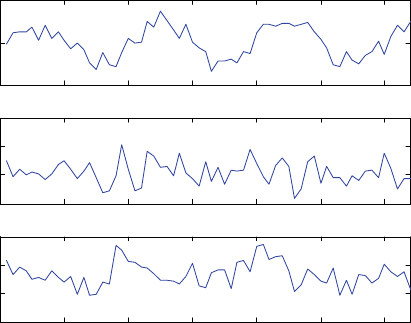
and 1,000 test signals wer e constructed, and the white noise was regenerated each
time. Figure 9.2 shows one sample signal with 64 sampling points from each class.
Each sample signal can be decomposed up to the six level (i.e., 2
6
¼ 64), and the
total number of nodes contained in the wavelet packet library for the signal is 127
(i.e., 1 for the 0 level, 2 for the first level, ..., 64 for the sixth level).
The LDB algorithm is first applied to the training signals to select a subset of
wavelet packet nodes from a wavelet packet library that best discriminate the three
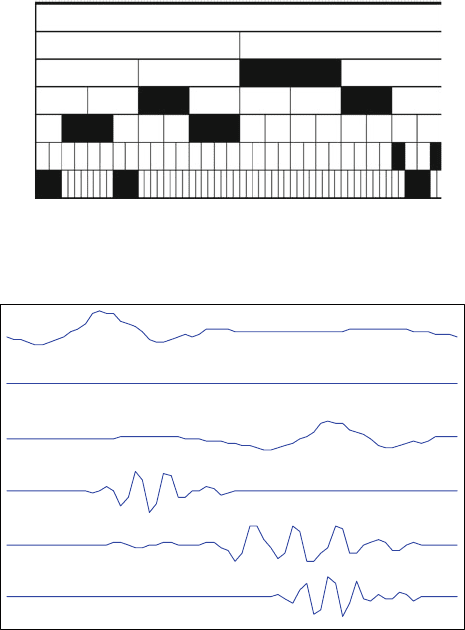
classes. Figure 9.3 shows the selected wavelet packet nodes. It can be seen that the
selected wavelet packet nodes (highlighted in black color) are distributed across
different decomposition levels. Altogether, they form comple te orthogonal bases.
The first six selected LDB bases are shown in Fig. 9.4, with each containing
64 coefficients. It should be noted that these bases are sorted according to their
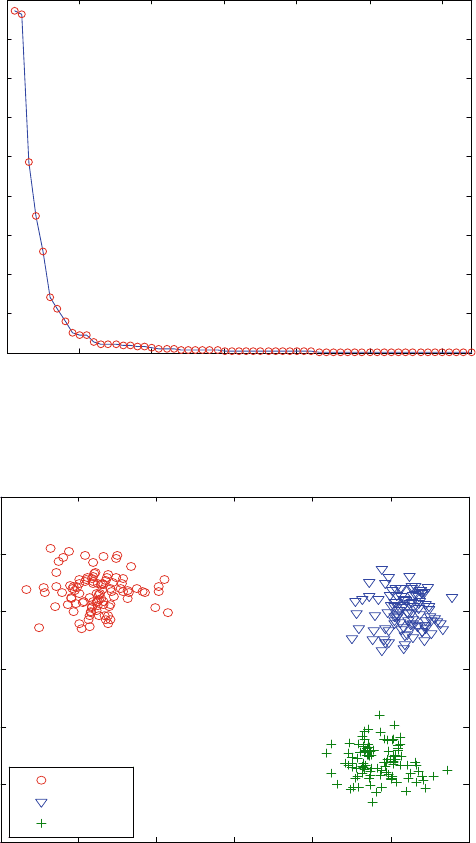
discriminant power. A complete discrimiant power for all the 64 LDB bases is
010
a
b
c
20 30 40 50 60
−2
0
2
0 102030405060
−1
0
1
2
0 102030405060
−2
−1
0
1
Fig. 9.2 Sample waveform from (a) class 1, (b) class 2, and (c) class 3
9.3 Case Study 155
shown in Fig. 9.5 with a decreasing order. A rapid decrease of the discriminant
power relative to the LDB bases is seen after the first few bases. Therefore, only the
first few bases (e.g., the first six bases) with large discriminative power are
considered for purpose of classification.
Wavelet coefficients constructed by projecting the signals onto the selected
bases are then used to form feature variables for classification. For the training
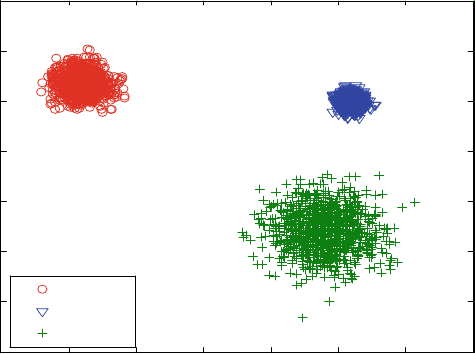
data set, two features (i.e., two wavelet coefficients) generated by the top two LDB
bases have produced the clustering result as shown in Fig. 9.6.
To classify the three synthetic signals introduced above, these two features are
used as input to a classifier. Various classifiers, such as linear discriminant analysis
(LDA), neural network (NN), and support vector machine (SVM) can be considered
for this purpose. In this example, the LDA classifier is selected due to its simplicity
(Duda et al. 2000). Taking the two features as inputs to the LDA classifier, the
0
1
2
3
4
5
6
01020 30 40 50 60
Level
Fig. 9.3 The wavelet packet nodes selected by the LDB algorithm
1
2
3
4
5
6
0102030405060
Fig. 9.4 The first six LDB bases selected from the signals
156 9 Local Discriminant Bases for Signal Classification
training dataset are classified. The test signals are subsequently projected onto the
top two LDB vectors to produce coefficients. Figure 9.7 indicates the scatter plot
of the testing dataset by the two features. It is seen that, using the LDA classifier, all
the testing data set are classified successfully.
0 10 20 30 40 50 60
0
0.5
1
1.5
2
2.5
3
3.5
4
4.5
LDB Base
Discriminant Power
Fig. 9.5 Discriminant power of all 64 LDB bases
−5 −4 −3 −2 −10 1
−4
−3
−2
−1
0
1
2
Feature 1
Feature 2
Class 1
Class 2
Class 3
Fig. 9.6 Training signals represented by selected top two LDB features
9.3 Case Study 157
The above case study illustrates that the LDB-based wavelet packe t base selec-
tion method is effective in producing features that enables effective discrimination
of different classes.
9.4 Application to Gearbox Defect Classification
Application of the LDB algorithm to real-world classification problems has been
reported in various areas, such as geophysical acoustic waveform classification
(Saito and Coifman 1997), radar signal classification (Guglielmi 1997), automatic
target recognition (Spoon er 2001), ultrasonic echoes classification (Christian
2002), audio signal classification (Umapathy et al. 2007), biomedical signal analy-
sis (Englehart et al. 2001; Umapathy and Krishnan 2006), and fault classification of
mechanical systems (Tafreshi et al. 2005; Yen and Leong 2006). In this chapter, the
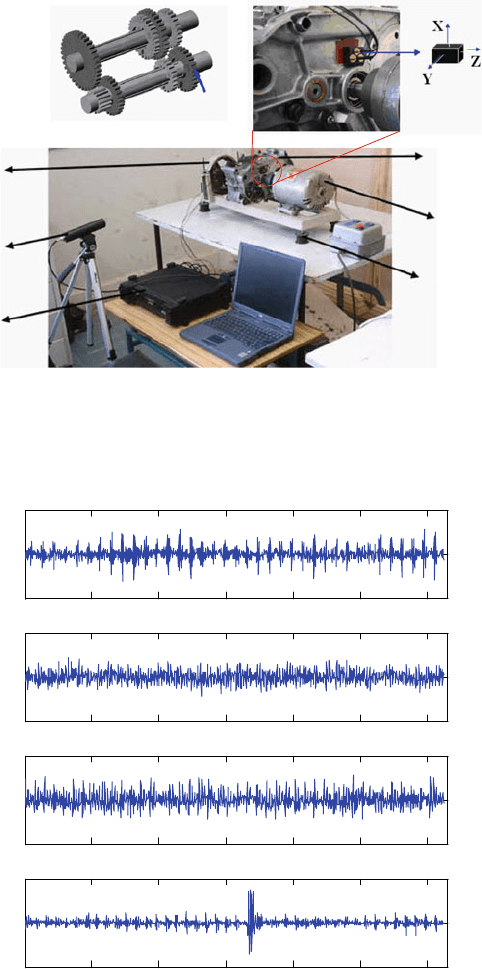
LDB algorithm is applied to classifying the severity of defects in gearbox. Figure
9.8 illustrates the experimental set-up (Rafiee et al. 2007) where the vibration from
a four-speed motorcycle gearbox is measured. An electrical motor drives the
gearbox at a constant nominal rotational speed of 1,420 rpm. A tachometer mea-
sures the act ual rotational speed to account for fluctuations caused by the load
variations. Vibration signals are measured by a triaxial accelerometer mounted on
the outer surface of the gearbox’s housing, close to the input shaft of the gearbox.
Four different working conditions of the test gear, including faultless, slight-worn,
medium-worn, and with broken-teeth, are examined by analyzing the measured
vibration data. The signals are sampled at 16,384 Hz. The sampled signals under the
four different working conditions are shown in Fig. 9.9.
−5 −4 −3 −2 −1012
−5
−4
−3
−2
−1
0
1
2
Feature 1
Feature 2
Class 1
Class 2
Class 3
Fig. 9.7 Testing signals represented by selected top two LDB features
158 9 Local Discriminant Bases for Signal Classification
Gearbox
Motor
Shock
Absorber
Load
Mechnism
Tachometer
Data
Acquisition
System
Sensor
Location
Test Gear
Schematic View of Gearbox
Fig. 9.8 Experimental setup to test a four speed motorcycle gearbox
0 0.01 0.02 0.03 0.04 0.05 0.06
-200
0
200
0 0.01 0.02 0.03 0.04 0.05 0.06
−200
0
200
0 0.01 0.02 0.03 0.04 0.05 0.06
−200
0
200
Amplitude
0 0.01 0.02 0.03 0.04 0.05 0.06
−500
0
500
Time
(
s
)
a
b
c
d
Fig. 9.9 Raw vibration signals of four gearbox conditions: (a) faultless, (b) slight worn, (c)medium
worn, and (d)brokenteeth
9.4 Application to Gearbox Defect Classification 159
To classify the gearbox defect under different working conditions, 60 training
signals and 80 testing signals, each containing 1,024 data points, are segmented
from the raw signal corresponding to each defect condition. The LDB algorithm is
then applied to the training data, where the relative entropy was chosen as the
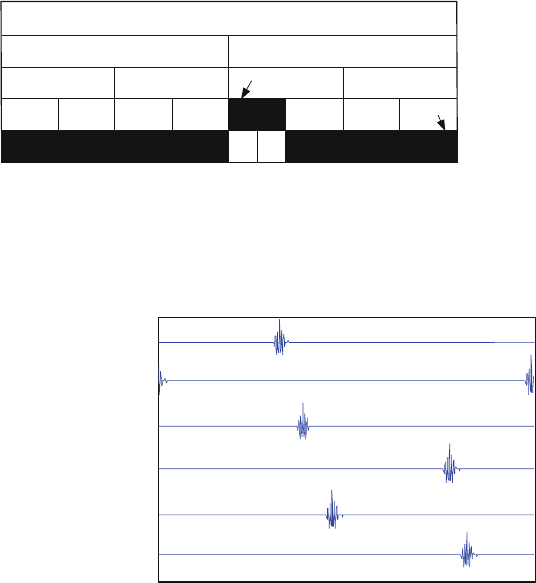
discriminant measure. Figure 9.10 shows the wavelet packet nodes selected from a
four-level signal decomposition, and the first 6 LDB bases are shown in Fig. 9.11
To evaluat e the effectiveness of the LDB algorithm, the performance of classifi-
cation by using the testing data are compared between the LDB-selected nodes and
all the 16 nodes at the 4th decomposition level. The energy values from the selected
nodes are calculated and then used as inputs to a LDA classifier for characterizing
the severity of the defect. Figures 9.12 and 9.13 illustrate the distribution of two
energy features from node (3, 4) and node (4, 15) for the training and test data,
respectively. The results of classification of gearbox defect severity are listed in
Table 9.1. It is seen that, for the training data, although the miscl assification rate for
features with and without basis selection is the same, the LDB-selected features
have resulted in a lower misclassification rate (1.56%) than those without (2.19%),
for the testing data. This indicates the merit of the LDB in signal classification.
6
5
4
3
2
1
0
384256
128
512
768640
1024896
Fig. 9.11 The first six LDB
bases selected from the
gearbox vibration signals
02
4
6
8
10 12
14
2
3
4
1
0
(3,4)
(4,15)
Level
Fig. 9.10 Selected wavelet packet nodes for the gearbox data by the LDB algorithm
160 9 Local Discriminant Bases for Signal Classification