
Gao R.X., Yan R. Wavelets: Theory and Applications for Manufacturing
Подождите немного. Документ загружается.

0 1 2 3 4 5
x 10
4
0
1
2
3
4
5
6
7
8
9
x 10
5
Energy of node (3,4)
Energy of node (4,15)
faultless
slight worn
medium worn
broken teeth
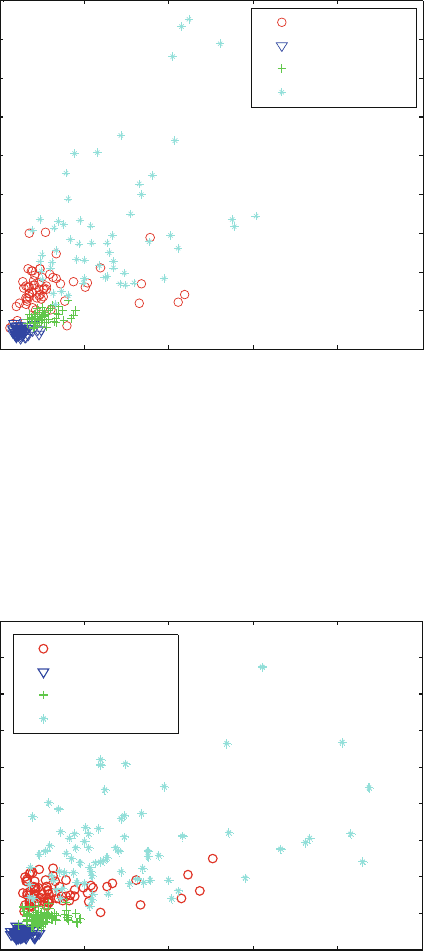
Fig. 9.12 Illustration of training samples by two features
0 1 2 3 4 5
x 10
4
0
1
2
3
4
5
6
7
8
9
x 10
5
Energy of node (3,4)
Energy of node (4,15)
faultless
slight-worn
medium-worn
broken-teeth
Fig. 9.13 Illustration of testing samples by two features
9.4 Application to Gearbox Defect Classification 161

9.5 Summary
The LDB provides an effective platform for the wavelet packet transform to
decompose and classify signals. In this chapter, we have demonstrated that, using
this approach, working conditions of a gearbox can be successfully classified by
analyzing the measured vibration signals. Research on the theory of LDB has been
continued in recent years. For example, the probability density of each class is
estimated from the wavelet packet nodes to select the discriminant bases (Saito
et al. 2002), and the features derived from this approach has been shown to be more
sensitive to phase shifts than those from the origina l LDBs. Combing the LDB
algorithm with signal-adapted filter banks (Strauss et al. 2003), a shape-adapted
LDB approach has been developed for bio-signal processing. It can be expected that
more powerful algorithms and computational tools are yet to come to better serve
the need for signal classification in manufacturing.
9.6 References
Basseville M (1989) Distance measures for signal processing and pattern recognition. Signal
Processing 8(4):349 369
Christian B (2002) Local discriminant bases and optimized wavelet to classify ultrasonic echoes:
application to indoor mobile robotics. Proc IEEE Sens 1654 1659
Coifman RR, Wicherhauser MV (1992) Entopy based algorithms for best basis selection. IEEE
Trans Inf Theory 38(2):713 718
Duda RO, Hart PE, Stork DG (2000) Pattern classification, 2nd edn.Wiley Interscience,
New York
Englehart K, Hudgins B, Parker PA (2001) A wavelet based continuous classification scheme for
multifunction myoelectric control. IEEE Trans Biomed Eng 48(3):302 311
Guglielmi RJM (1997) Wavelet feature definition and extraction for classification and image
processing. Ph.D. Dissertation, Yale University
Rafiee J, Arvani F, Harifi A, Sadeghi MH (2007) Intelligent condition monitoring of a gearbox
using artificial neural network. Mech Syst Signal Process 21:1746 1754
Saito N (1994) Local feature extraction and its applications using a library of bases, Ph.D.
Dissertaion, Yale University
Saito N, Coifman RR (1995) Local discriminant bases and their applications. J Math Imaging Vis
5(4) 337 358
Satio N, Coifman RR (1997) Extraction of geological information from acoustic well logging
waveforms using time frequency wavelets. Geophysics 62(6):337 358
Table 9.1 Effect of wavelet packet node selection on gearbox defect severity classification
Features
Misclassification rate
Training signals (%) Testing signals (%)
Wavelet packet nodes w/o LDB 0.83 2.19
Wavelet packet nodes w/LDB 0.83 1.56
162 9 Local Discriminant Bases for Signal Classification
Saito N, Coifman RR, Geshwind FB, Warner F (2002) Discriminant feature extraction using
empirical probability density estimation and a local basis library. Pattern Recognit
35:2841 2852
Spooner CM (2001) Application of local discriminant bases to HRR based ATR. In: Proceeding of
thirty fifth asilomar conference on signals, systems and computers, pp 1067 1073
Strauss DJ, Steidl G, Delb W (2003) Feature extraction by shape adapted local discriminant bases.
Signal Processing 83:359 376
Tafreshi R, Sassani F, Ahmadi H, Dumontb G (2005) Local discriminant bases in machine fault
diagnosis using vibration signals. Integr Comput Aided Eng, 12:147 158
Umapathy K, Krishnan S (2006) Modified l ocal discriminant bases algo rithm and its
application in analysis of human knee joint vibration signals. IEEE Tra ns Biomed Eng
53(3):517 523
Umapathy K, Krishnan S, Rao RK (2007) Au dio signal feature extraction and classification
using local discriminant bases. IEEE Trans Audio Speech Lang Processing 15(4):1236 1246
Yen GG, Leong WF (2006) Fault classification on vibration data with wavelet based feature
selection scheme. ISA Trans 45(2):141 151
9.6 References 163
Chapter 10
Selection of Base Wavelet
One of the advantages of wavelet transform for signal analysis is the abundance of
the base wavelets developed over the past decades there are a total of 13 wavelet
families documented in the MATLAB library. From such abundance arises a
natural question of how to choose a base wavelet that is best suited for analyzing
a specific signal. The question is valid, since the choice in the first place may affect
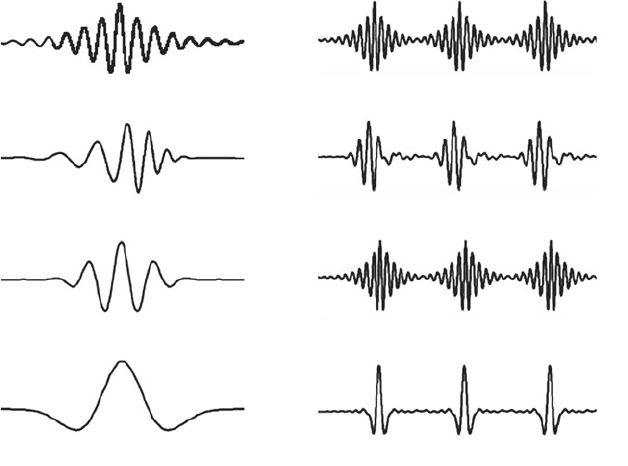
the result of wavelet transform at the end. As an example, Fig. 11.1 (top row, left)
illustrates an impulsive signal and how it may appear as a time series (top row,
right) in real-world applications. The three rows below illustrate three representa-
tive base wavelets and the results of using them to analyze the impulsive signal: (1)
Daubechies wavelet (Daubechies 1992), (2) Morlet wavelet, and (3) Mexican hat
wavelet. These base wavelets have been used for machine condition monitoring and
health diagnosis studies, as reported in Shao and Nez u (2004), Li et al. (2000), and
Abu-Mahfouz (2005). Comparing the wavelet transform results using these wave-
lets (shown in the right column, Fig. 10.1), it is apparent that only the Morlet
wavelet is effective in extracting the impulsive component from the signal, as
illustrated by the similarity in the waveform between the corresponding wavelet
coefficient and the impulsive component. The Daubechies and Mexican-hat wave-
lets, in comparison, did not fully reveal the characteristics of impulsive component.
Such an example motives the study of base wavelet selection to achieve optimal
result in feature extraction from a signal. In this chapter, we first present a general
strategy for base wavelet selection, from both a qualitative and a quantitative
aspect. Subsequently, we introduce several quantitative measures that can be used
as guidelines for wavelet selection, to guarantee effective extraction of signal
features.
10.1 Overview of Base Wavelet Selection
The topic of base wavelet selection has been addressed by researchers from
different aspects. These prior approaches can be categorized as either qualitative
or quantitative, and are reviewed in the following two sections.
R.X. Gao and R. Yan, Wavelets: Theory and Applications for Manufacturing,
DOI 10.1007/978 1 4419 1545 0 10,
#
Springer Science+Business Media, LLC 2011
165
10.1.1 Qualitative Measure
Base wavelets are characterized by a number of properties, such as orthogonality,
symmetry, and compact support. Understanding these properties will be helpful for
choosing a candidate base wavelet from the wavelet families for analyzing a
specific signal. For example, the orthogonality property indicates that the inner
product of the base wavelet is unity with itself, and zero with other scaled and
shifted wavelets. As a result, using an orthogonal wavelet will result in efficient
signal decomposition into nonoverlapping subfrequency bands. High computa-
tional efficiency can be achieved when orthogonal wavelets are used for imple-
menting the discrete wavelet transform (DWT, see Chap. 4 for details) and wavelet
packet transform (WPT, refer to Chap. 5). The symmetric property ensures that a
base wavelet can serve as a linear phase filter. This is an important property in
filtering operations, as the absence of it can lead to phase distortion. A compact
support wavelet is one whose basis function is nonzero only within a finite interval.
This allows the wavelet transform to efficiently represent signals that have localized
features. The efficiency of such representation is important for data compression.
In recent years, the basic properties of wavelets have been extensively investi-
gated to determine the suitability of a wavelet for specific applications. For example,
based on the experiments conducted on a total of 23 Brodatz textures (Mojsilovic
´
Impulsive component
Daubechies wavelet
Morlet wavelet
Mexican-hat wavelet Coefficients extracted by Mexican-hat wavelet
Coefficients extracted by Daubechies wavelet
Coefficients extracted by Morlet wavelet
A series of impulsive components
Fig. 10.1 Impulsive feature extraction using different base wavelets
166 10 Selection of Base Wavelet
et al. 2000), it was concluded that the Biorthogonal wavelets with symmetry
property enabled higher texture classification rate than the Daubechies wavelets,
which is asymmetrical (e.g., 64.34% for Db3 vs. 82.17% for Bior3.3r). Similarly, the
symmetric property of five wavelets (i.e., Haar, Db6, Coif4, Bior5.5, and Bior6.8)
were reviewed (Fu et al. 2003), from which the Bior6.8 wavelet was chosen as the
best-suited wavelet to separate the roughness, waviness, and geometrical form of an
engineering surface into different frequency bands for both functional correlation
and process diagnosis in manufacturing. In the area of biomedical engineering, the
regularity and symmetry of base wavelets were considered as essential features for
auditory-evoked potentials (AEP) signal analysis (Bradley and Wilson 2004). The
morphology and latency of peaks, which characterize the AEP signal, were pre-
served when using a symmetric base wavelet, and the smooth peaks contained in the
AEP signal were well matched when regularity of a base wavelet is greater than two.
By taking into account the properties of compact support, vanishing moment, and
orthogonality, the Coiflet 4 wavelet was selected to effectively separate burst and
tonic components in the compound surface electromyogram (EMG) signals
recorded from patients with dystonia (Wang et al. 2004). In addition to orthogonal-
ity, the property of complex or real basis was used to guide the choice of the base
wavelet for electrocardiogram (ECG) signal analysis (Bhatia et al. 2006). The
Morlet wavelet, Gaussian wavelet, Paul wavelet at order 4, and quadratic B-Spline
wavelet were preselected as the candidates for ECG events detection and segmenta-
tion. In the area of image processing, the properties of regularity, compact support,
symmetry, orthogonality, and explicit expression were used for recommending base
wavelet for image sequence superresolution (Ahuja et al. 2005). It was concluded
that the B-Spline family represents the most suitable base wavelet among the four
candidates (i.e., Daubechies, Symlet, Coiflet, and B-Spline wavelets) for image
sequence superresolution, as it is orthogonal, symmetric, and has the highest regu-
larity, smallest support size, and explicit expression. In analyzing power system
transients (Safavian et al. 2005), the Db4, Coiflet, and B-Spline wavelet were shown
to be equally well-performing for the transient detection in a power system, as they
share the same basic properties: finite support size and low vanishing moment.
Shape matching has been studied as an alternative approach to wavel et selec-
tion. For example, to measure the timing of multiunit bursts in surface EMGs
from single trials (Flanders 2002), wavelets of different shapes, such as square,
triangular, Gaussian and Mexican Hat, were investigat ed. The Db2 wavelet was
chosen for its similarity to the shape of motor unit potentials hidden in the EMG
signal. Also, base wavelets of different shapes were compared with ECG signals
to determine their appropriateness for extracti ng a reference base from corrupted
ECG, for magnetic resonance imaging (MRI) sequence triggering ( Fokapu et al.
2005; A bi-Abdallah e t al. 2006). To analyze impulses in vibration signals,
researchers looked at the geometric shape of wavelets to determine the optimal
choice (Yang a nd Ren 2004). It was found that components in a signal may be
extracted effectively when a base wavelet with similar s hape as the component is
employed.
10.1 Overview of Base Wavelet Selection 167
10.1.2 Quantitative Measure
The various approaches described in Sect. 10.1.1 illustrate the importance of
choosing an appropriate base wavelet for effective signal processing. However,
the basis properties of a wavelet only qualitatively determine its suitability for a
particular application. As far as shape matching is concerned, it is generally
difficult to accurately match the shape of a signal to that of a base wavelet through
a visual comparison. These deficiencies motivate the study of quantitative measures
for base wavelet selection.
The measures of inequality (Goel and Vidakovic 1995), which includes the Schur
concave functions such as Shannon entropy and Fishlow’s measure (Marshall and
Olkin 1979), Emelen’s modified entropy measure (Emlen 1973), and Schur convex
functions (Gini’s coefficient and Schutz’s coefficient by Marshall and Olkin 1979)
were proposed for wavelet selection in data compression and data denoising. A time-
series, which was constructed by adding white noise into the sampled Db3 wavelet
function, was used to evaluate each of the inequality measures. All of them, except
for the Fishlow’s measure, recognized the Db3 wavelet as the best base wavelet
among a set of wavelets (Db1 Db20, Db30, Coif8, Coif12, and Coif18).
The Shannon entropy was also utilized to identify optimal base wavelet for
velocity and temperature time series analysis in atmospheric surface layer (ASL)
(Katul and Vidakovic 1996). The large scale eddy motion and small scale fluctua-
tions in the ASL were successfully separated with the chosen Daubechies wavelet.
In another study (Bedek ar et al. 2005), the Shannon entropy was used to choose the
Daubechies wavelet of order 3 from 23 preselected wavelets as the optimal wavelet
for radio-frequency intravascular ultrasound (IVUS) data decomposition. It accu-
rately decomposed 29 out of 30 IVUS data at all levels. The rest of the wavelets
only decomposed less than 21 IVUS data.
In the field of biomedical engineering, study on horse gait classification has
discussed an uncertainty model for wavelet selection (Arafat et al. 2003). The
model combines the fuzzy uncertainty with the probabilistic uncertainty to provide
a better measure, when compared with using either fuzzy or probabilistic uncer-
tainty alone, for choosing an appropriate base wavelet to improve correct classifi-
cation of different horse gait signals.
Study on assessing hypnotic state of anesthetized patients undergoing
surgery (Bibian et al. 2001)hasusedthediscrimination power, which is defined
as the difference between the statistical features, such as probability density
function, in the awake as well as in the anesthetized states, to select the appropri-
ate base wavelet. It was found that among the Daubechies, Coiflet, Symlet ,
biorthogonal, and reverse biorthogonal wavelets, the Daubechies wavelet at
order 8 provided the highest discrimination power, thus effectively estimated
the hypnotic state. In a nother study on diagnosing cardiovascular ailments in
patients (Singh and Tiwari 2006), experimental results have revealed the suitabil-
ity of the Daubechies base wavelet at order 8 for the ECG signal denoising, as it
168 10 Selection of Base Wavelet
has the maximum cross correlation coef ficient between the ECG signa l and
the chosen base wavelets, (Daubechies, Symlet, and Coiflet wavelets). The
cross correlation measure has also be en used in evaluating a base wavelet for
detecting and locating the p artial discharge (PD) occurred in operational trans-
formers (Ma et al. 2002a, b;Yangetal.2004). It was found that an optimal base
wavelet would maximize the correlation coefficient between the signal of interest
and the base wavelet, resulting in PD pulses being successfully separated from
electrical noise.
For image denoisi ng, two criteria, the signal information extraction criterion and
the distribution error criterion, were proposed to select an optimal wavelet
for improving the denoising performance (Zhang et al. 2005). The first criterion
was implemented by calculating the mutual information of wavelet coefficients of
the image without noise contamination and those of the image with noise contami-
nation. The second criterion was the difference betwee n the Gaussian and the actual
distribution of the wavelet coefficients of the image without noise contamination.
It was reasoned that the smaller the difference is the better the denoising perfor-
mance will be, as the denoising performance is optimal only if the underlying signal
distribution is Gaussian. Using these two criteria, it was found that the Bior1.3
wavelet provided the best performance among the eight wavelets (Bior1.1, Bior1.3,
Bior2.2, Bior2.4, Bior3.3, Db2, Db3, and Db4) investigated when testing four
benchmark images.
For automatic ultrasound nondestructive foreign body (FB) detection and
classification in nonflat surface containers (Tsui and Basir 20 0 6), the relative
entropy was empl oye d as a wavelet coe fficie nt similarity measure t o select the
best base wavelet. The results have shown t hat the best base wavelet f or FB shape
classification is Bior3.1, while Haar (or Sym1 or reverse Bior1.1) and reverse
Bior3.9 are the best f or spherical and rectangular FB material classifications,
respectively.
For analysis of impulses in vibration signals (Schuk in et al. 2004), the minimum
total error and time-frequency resolution were devised to evaluate different base
wavelets on impulsive parameter identification of a single-degree-of-freedom sys-
tem model. A comprehensive comparison among ten base wavelets (complex
B-Spline, Gaussian, Shannon, etc.) indicated that the impulse wavelet is the most
appropriate base wavelet for the analysis of impulses.
10.2 Wavelet Selection Criteria
The importance of the base wavelet has been addressed by various researchers, as
summarized earlier. This section introduces several quantitative measures in eval-
uating the performance of base wavelets for the specific application domain of
condition monitoring and health diagnosis in manufacturing.
10.2 Wavelet Selection Criteria 169
10.2.1 Energy and Shannon Entropy
The energy content of a signal is a mea sure that uniquely characterizes the signal,
thus can be used for base wavelet select ion. The amount of energy contained in a
signal xðtÞ is expressed as:
E
xðtÞ
¼
ð
jxðtÞj
2
dt (10.1)
Similarly, when the signal is represented by discrete sample values
xðiÞði ¼ 1; 2; ...; NÞ, the amount of energy is given by:
E
xðiÞ
¼
X
N
i¼1
jxðiÞj
2
(10.2)
In (10.2), N is the length of the signal expressed by the number of data points, and
x(i) is the amplitude of the signal.
The energy cont ent of a signal can also be calculated from its wavelet coeffi-
cients, and is expressed as:
E
energy
¼
ðð
jwtðs; tÞj
2
dsdt (10.3)
The corresponding sampled version is given by:
E
energy
¼
X
s
X
i
jwtðs; iÞj
2
(10.4)
Equations (10.3) and (10.4) indicate that the energy associated with each particular
scaling parameter s is expressed as:
E
energy
ðsÞ¼
ð
jwtðs;tÞj
2
dt (10.5)
And the energy of the corresponding sampled version is described as:
E
energy
ðsÞ¼
X
N
i¼1
jwtðs; iÞj
2
(10.6)
where N is the number of wav elet coefficients and wt(s, i) represents the wavelet
coefficients.
If a major frequency component corresponding to a particular scale s exists in the
signal, then the wavelet coefficients at that scale will have relatively high
170 10 Selection of Base Wavelet

magnitudes at the time when this major frequency component occurs. As a result,
the energy related to such frequency component will be extracted from the signal
when applying the wavelet transform to the signal. For purpose of condition
monitoring and health diagnosis, the higher the energy content extracted from the
defect-induced transient vibrations is the more effective the wavelet transform of
the sign al will be. Therefore, the energy content can serve as a criterion for
selecting the base wavelet. This is formulated in the following criterion.
1. Maximum energy criterion: The base wavelet that extracts the largest amount of
energy from the signal being analyzed represents the most appropriate wavelet
for extracting features from defect-induced transient vibrations.
Given that for the same amount of energy within a subfrequency band, the specific
condition of the signal may be significantly different (e.g., only several frequency
components with high magnitude and others with negligible magnitude vs. a
widespread spectrum), the spectral distribution (or concentration) of the energy
needs to be considered also to ensure effective feature extraction. The energy
distribution of the wavelet coefficients is quantitatively described by the Shannon
entropy (Cover and Thomas 1991):
E
entropy
ðsÞ¼
X
N
i¼1
p
i
log
2
p
i
(10.7)
where p
i
is the energy probability distribution of the wavelet coefficients, defined as:
p
i
¼
jwtðs; iÞj
2
E
energy
ðsÞ
(10.8)
with
P
N
i¼1
p
i
¼ 1, and p
i
log
2
p
i
¼ 0ifp
i
¼ 0.
Equations ( 10.7) and (10.8 ) indicate that the entropy of the wavelet coefficients
is bounded by:
0 E
entropy
ðsÞlog
2
N (10.9)
in which E
entropy
ðsÞ will be equal to (1) zero, if all other wavelet coefficients are equal
to zero except for one wavelet coefficient, and (2) log
2
N, if the probability of energy
distribution for all the wavelet coefficients are the same (i.e., 1/N). This leads to the
conclusion that the lower the entropy value is, the higher the energy concentration will
be. Therefore, an appropriate base wavelet should yield large magnitude at a few
wavelet coefficients and negligible magnitude at others when the signal is decomposed
into various scales, leading to the minimum Shannon entropy. The corresponding
Shannon entropy-based wavelet selection criterion can thus be designed as:
2. Minimum Shannon entropy criterion: The base wavelet that minimizes the
entropy of the wavelet coefficients represents the most appropriate wavelet for
defect-induced transient vibration analysis.
10.2 Wavelet Selection Criteria 171