
Gao R.X., Yan R. Wavelets: Theory and Applications for Manufacturing
Подождите немного. Документ загружается.


Combining the strengths of the two criteria described earlier, we note that an
appropriate base wavelet should extract the maximum amount of energy from the
signal being analyzed, while minimizing the Shannon entropy of the corresponding
wavelet coefficients. This lead to the energy-to-Shannon entropy ratio, which is
defined as:
RðsÞ¼
E
energy
ðsÞ
E
entropy
ðsÞ
(10.10)
In (10.10), the energy E
energy
ðsÞ and the entropy E
entropy
ðsÞ are calculated from
(10.6) and (10.7), respectively. By maximizing the energy-to-Shannon entropy ratio
RðsÞ, an appropriate base wavelet can be selected from a set of candidat e base
wavelets. This leads to the following criterion for wavelet selection:
3. Energy-to-Shannon entropy ratio measure: The base wavelet that has produced
the maximum energy-to-Shannon entropy ratio should be chosen as the most
appropriate wavelet for defect-induced transient vibration signal analysis.
10.2.2 Information Theo retic Measure
The energy and Shannon entropy-related criteria are solely based on the content of
the wavelet coefficients themselves. Since the coefficients of a signal’s wavelet
transformation are inherently related to the signal, information theoretic measures,
which describes the relationship between a pair of data sequence, can be explored for
best suited base wavelet selection. These are introduced in the following sections.
10.2.2.1 Joint Entropy
The joint entropy HðX; YÞ between two data sequences X and Y is defined to
measure information associated with them as a whole (Cover and Thomas 1991).
This is expressed as
HðX; YÞ¼
X
x2X
X
y2Y
pðx; yÞlog pðx; yÞ (10.11)
where p(x, y) is the joint probability distribution of the two data sequences.
10.2.2.2 Conditional Entropy
With probability distribution of the data sequence X known, the amount of infor-
mation cont ained in the other data sequence Y can be measured by the condi tion
entropy HðYjXÞ as (Cover and Thomas 1991):
172 10 Selection of Base Wavelet

HðYjXÞ¼
X
x2X
pðxÞHðYjX ¼ xÞ
¼
X
x2X
pðxÞ
X
y2Y
pðyjxÞlog pðyjxÞ
(10.12)
In (10.12), p(x) is the probability distribution of the data sequence X, and pðyjxÞ
denotes the conditional probability distribution of the data sequence Y when the
data sequence X is known. The conditional probability distribution pðyjxÞ is
expressed as (Mendenhall and Sincich 1995):
pðyjxÞ¼
pðx; yÞ
pðxÞ
(10.13)
with p(x, y) being the joint probability distribution of the two data sequence X and Y.
As a result, (10.12) can be further expressed as:
HðYjXÞ¼
X
x2X
X
y2Y
pðx; yÞlog
pðx; yÞ
pðxÞ
¼
X
x2X
X
y2Y
pðx; yÞlog pðx; yÞþ
X
x2X
X
y2Y
pðx; yÞlog pðxÞ
¼ HðX; YÞþ
X
x2X
pðxÞlog pðxÞ¼HðX; YÞHðXÞ (10.14)
Equation (10.14) indicates that, given the data sequence X, the condition entropy of
data sequence Y can be calculated by the joint entropy between the two data
sequences, minus the entropy of the data sequence X.
10.2.2.3 Mutual Information
The mutual information I(X; Y) measures the amount of information that data
sequence X contains about data sequence Y, which is defined as (Cover and Thomas
1991):
IðX; YÞ¼
X
x2X
X
y2Y
pðx; yÞlog
pðx; yÞ
pðxÞpðyÞ
¼
X
x2X
X
y2Y
pðx; yÞlog pðx; y Þ
X
x2X
X
y2Y
pðx; yÞlog½ pðxÞpðyÞ
¼HðX; YÞ
X
x2X
pðxÞlog pðxÞ
X
y2Y
pðyÞlog pðyÞ
¼HðX; YÞþHðXÞþHðYÞ
(10.15)
10.2 Wavelet Selection Criteria 173
Equation (10.15) indicates that the mutual information is the sum of the entropies
H(X) and H(Y), minus the joint entropy H(X, Y).
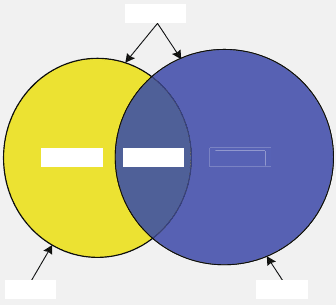
The relationships among the joint entropy, condition entropy, and mutual infor-
mation are illustrated in a Venn diagram (Cover and Thomas 1991), as shown in
Fig. 10.2. It is noted that the mutual information I(X; Y) is represented by the
intersection of the two data sequences. The greater the mutual information is, the
more similar the two data sequences will be. The condition entropy H(XjY)or
H(YjX) expresses the information that is particular to each corresponding data
sequence itself, while the joint entropy H(X, Y) includes all information of the
two data sequences.
The above-described relationship can be appl ied to base wavelet selection by
taking the signal to be analyzed and its corresponding wavelet coefficients as two
data sequences X and Y, respectively. Since defect-induced transient features are
represented by the wavelet coefficients, a high value of mutual information between
the vibration signal and wavelet coefficients can be expected when an appropriate
wavelet is chosen. It should be noted that, when a vibration signal is obtained, the
information H(X) is fixed. Similarly, the information H(Y) of the wavelet coeffi-
cients is fixed once a base wavelet is chosen. On the basis of the relationship
described earlier, low values of both the joint entropy and condition entropy are
desired for choosing an appropriate wavelet for characterizing defect-induced
transient vibrations.
Following are several criteria for base wavelet selection, based on the informa-
tion theoretic measures.
4. Minimum joint entropy criterion: The base wavelet that minimizes the joint
entropy between the signal and the wavelet coefficients represents the most
appropriate wavelet for defect-induced transient feature extraction.
5. Minimum condition entropy criterion: The base wav elet that minimizes the
condition entropy between the signal and the wavelet coefficients represents
the most appropriate wavelet for defect-induced transient feature extraction.
H(X,Y)
H(X|Y)
H(X) H(Y)
H(Y|X)
H
(Y|X)
I(X;Y)
Fig. 10.2 Relationships
among entropies and mutual
information
174 10 Selection of Base Wavelet

6. Maximum mutual information criterion: The base wavelet that maximizes the
mutual information between the signal and the wavelet coefficients represents
the most appropriate wavelet for defect-induced transient feature extraction.
10.2.2.4 Relative Entropy
In contrast to the mutual information, which measures shared information between
two data sequences, the relative entropy (also known as Kullback Leibler distance or
the divergence) is a measure of the distance between probability distributions of data
sequences X and Y (Cover and Thomas 1991). The relative entropy is defined as
DðXjjYÞ¼
X
x2X
pðxÞlog
pðxÞ
pðyÞ
(10.16)
with pðxÞlog
pðxÞ
pðyÞ
¼ 0ifpðxÞ¼0, and pðxÞlog
pðxÞ
pðyÞ
¼1if pðyÞ¼0.
Equation (10.16) states that the relative entropy value is always nonnegative,
and it is zero if and only if both probability distributions are equivalent [i.e., p(x) ¼
p(y)]. The smaller the relative entropy is, the more similar the distributions of the
two data sequences will be. For applications in machine condition monitoring and
health diagnosis, it is expected that an appro priately chosen base wavelet will be
able to extract features related to defect-in duced transient vibrations completely.
Consequently, a small relative entropy value between the signal (i.e., data sequence
X) and its corresponding wavelet coefficients (i.e., data sequence Y) is desired. The
following criterion reflects this consideration:
7. Minimum relative entropy criterion: The base wavelet that minimizes the rela-
tive entropy between the signal and the wavelet coefficients represents the most
appropriate wavelet for defect-induced transient feature extraction.
Synthesizing the above crite ria, an appropriate wavelet should minimize the
joint entropy, condition entropy, and relative entropy while maximizing the mutual
information. Such consideration is captured in the following information measure:
InfoðsÞ¼
IðX; YÞ
HðX; YÞHðYjXÞDðXjjYÞ
(10.17)
In ( 10.17), the joint entropy HðX; YÞ, condition entropy HðYjXÞ , relative entropy
DðXjjYÞ, and mutual information IðX; YÞ are calculated using (10.11), (10.14),
(10.16), and (10.15), respectively. Maximizing the information measure Info ðsÞ
leads to the following comprehensive criterion:
8. Maximum information criterion: The base wavelet that has produced the maxi-
mum information value should be chosen to be the most appropriate wavelet for
defect-induced transient feature extraction.
10.2 Wavelet Selection Criteria 175
10.3 Numerical Study on Base Wavelet Selection
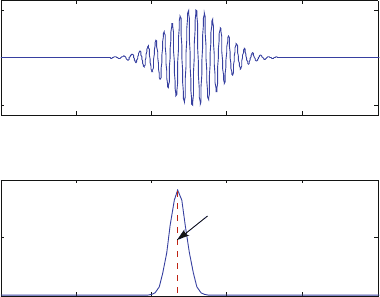
To quantitatively evaluate the base wavelet selection criteria described earlier, a
Gaussian-modulated sinusoi dal test signal is numerically simulat ed. Mathemati-
cally such a signal can be expressed as
xðtÞ¼e
bðt t
0
Þ
2
sin½2pf ðt t
0
Þ (10.18)
The symbol b denotes the attenuation factor, and t
0
is the time delay of the signal.
This type of signal has been widely used for simulating transient vibrations
involved in mechanical systems (Ho and Randall 2000; Schukin et al. 2004;
Yang and Ren 2004). Figure 10.3 illustrates the test signal, in which the center
frequency is 48 Hz, and the sampling frequency is 1,024 Hz. In the following, the
criteria presented in the above sections are evaluated for choosing best suited base
wavelet from both real-valued and complex-valued wavelets.
10.3.1 Evaluation Using Real-Valued Wavelets
The performance of real-valued wavelets on processing the test signal is evaluated
first, for which the DWT is performed to decompose the test signal. Th e decomposi-
tion level L of the wavelet transform is determined by the sampling frequency f
q
and
0 200 400 600 800 1000
-1
0
1
Time (ms)
Amplitude
a
b
0 20 40 60 80 100
0
50
100
Frequency (Hz)
Magnitude
f =48 Hz
Fig. 10.3 Test signal: Gaussian modulated sinusoidal signal
176 10 Selection of Base Wavelet

frequency component to be identified in the signal, as expressed in the following
equation:
f
q
2
Lþ1
bf
char
b
f
q
2
L
(10.19)
In (10.19), f
q
is the sampling frequency, and f
char
is related to the characteristic
frequency component of the signal (e.g., f
char
¼ 48 Hz for the test signal). In Table
10.1, the respective frequency ranges covered by each of the decomposition levels
under the sampling rate of 1,024 Hz are shown. Since the center frequency (48 Hz)
of the test signal falls within the frequency range of 32 64 Hz, which is covered by
the decomposition level 4 (corresponding to scale s ¼ 2
4
¼ 16), this level is chosen
for the evaluation of each wavelet.
Thirty candidate base wavelets were preselected from seven wavelet families.
The energy extracted from the Gaussian-modulated sinusoidal signal by these
wavelets is listed in Table 10.2. It is shown that the Meyer wavelet has extracted
the highest amount of energy, thus is considered the most appropriate base wavelet
for analyzing the Gaussian-modulated sinusoi dal signal with the given parameters.
It is also found that the amount of energy that is extracted from the signal increases
with increasing order of the base wavelet, for each wavelet family. This is because
base wavelets of higher order withi n a wavelet family possess higher degree of
regularity. As a result, they are better suited for extracting energy from the
Gaussian-modulated sinusoidal test signal than their lower-ordered counterparts
in the same wavelet family.
The Shannon entropy of the extract ed Gaussian-modulated sinusoidal signal is
then calculated, as listed in Table 10.3. On the basis of the minimum Shannon
entropy, the Symlet 3 wavelet is considered as the most appropriate base wavelet.
Table 10.1 Frequency range for each decomposition level under a 1,024 Hz sampling rate
Decomposition level (L) Frequency range (Hz) Decomposition level (L) Frequency range (Hz)
1 256 512 4 32 64
2 128 256 5 16 32
3 64 128 6 8 16
Table 10.2 Energy extracted from the test signal: real valued wavelets
Base wavelet Energy (J) Base wavelet Energy (J) Base wavelet Energy (J)
Haar 33.855 Coif4 60.662 Bior2.6 53.645
Db2 45.546 Coif5 61.856 Bior4.4 52.310
Db4 54.433 Sym2 45.546 Bior5.5 54.614
Db6 58.167 Sym3 51.143 Bior6.8 58.415
Db8 60.207 Sym4 54.433 rBio1.3 45.326
Db10 61.471 Sym6 58.167 rBio2.4 55.138
DB20 63.687 Sym8 60.217 rBio2.6 55.546
Coif1 46.065 Meyr 64.146 rBio4.4 59.235
Coif2 55.038 Bior1.3 53.481 rBio5.5 61.123
Coif3 58.692 Bior2.4 49.198 rBio6.8 60.464
10.3 Numerical Study on Base Wavelet Selection 177

This concl usion is not consistent with the Meyer wavelet selected by the maximum
energy criterion. To resolve such conflict, the energy-to-Shannon entropy ratio is
calculated and the results are listed in Table 10.4. From the maximum energy-to-
Shannon entropy ratio criterion, the Meyer wavelet possesses the highest values,
thus is considered the most appropriate wavelet to analyze the Gaussian-modulated
sinusoidal signal.
Various criteria based on information theoretic measures have also been studied
to evaluate the performance of each of the real-valued candidate wavelets, as listed
in Table 10.5 10.8. It is noted that all of the four measur es (i.e., joint entropy,
condition entropy, mutual information, and relative entropy) point to the Meyer
wavelet as the most suited wavelet when analyzing the Gaussian-modulated sinu-
soidal signal. This is because it maximizes the maximum mutual information, while
minimizing the joint entropy, condition entropy, and relative entropy. The compre-
hensive criterion “maximum information” that integrates the eff ect of these four
measures, as illustrated in (10.17 ), has also shown that the Meyer wavelet is the most
appropriate wavelet. This is verified in Table 10.9, in which a maximum information
value is obtained when the Meyer wavelet is chosen as the base wavelet.
Table 10.3 Shannon entropy of the extracted signal: real valued wavelets
Base
wavelet
Shannon
entropy
Base
wavelet
Shannon
entropy
Base
wavelet
Shannon
entropy
Haar 3.667 Coif4 2.945 Bior2.6 5.959
Db2 3.137 Coif5 2.985 Bior4.4 5.673
Db4 3.475 Sym2 3.137 Bior5.5 6.042
Db6 3.171 Sym3 2.800 Bior6.8 4.069
Db8 3.491 Sym4 3.011 rBio1.3 4.579
Db10 3.121 Sym6 3.598 rBio2.4 4.665
DB20 3.653 Sym8 3.613 rBio2.6 4.949
Coif1 2.856 Meyr 2.959 rBio4.4 4.664
Coif2 3.609 Bior1.3 6.197 rBio5.5 5.034
Coif3 3.617 Bior2.4 6.214 rBio6.8 4.069
Table 10.4 Energy to Shannon entropy ratio of the extracted signal: real valued wavelets
Base wavelet
Energy to Shannon
entropy ratio
Base
wavelet
Energy to Shannon
entropy ratio
Base
wavelet
Energy to Shannon
entropy ratio
Haar 9.229 Coif4 20.594 Bior2.6 9.002
Db2 14.512 Coif5 20.719 Bior4.4 9.220
Db4 15.662 Sym2 14.512 Bior5.5 9.047
Db6 18.341 Sym3 18.265 Bior6.8 14.356
Db8 17.246 Sym4 18.079 rBio1.3 9.896
Db10 19.693 Sym6 16.162 rBio2.4 11.817
DB20 17.428 Sym8 16.662 rBio2.6 11.221
Coif1 16.124 Meyr 21.678 rBio4.4 12.699
Coif2 15.244 Bior1.3 8.629 rBio5.5 12.141
Coif3 16.224 Bior2.4 7.915 rBio6.8 14.858
178 10 Selection of Base Wavelet

10.3.2 Evaluation Using Complex-Valued Wavelets
The criteria for choosing an appropriate complex-valued wavelet can be evaluated
by applying the continuous wavelet transform to the test signal. The scale whose
Table 10.5 Joint entropy of the extracted signal: real valued wavelets
Base wavelet Joint entropy Base wavelet Joint entropy Base wavelet Joint entropy
Haar 4.086 Coif4 3.261 Bior2.6 3.414
Db2 3.409 Coif5 3.246 Bior4.4 3.338
Db4 3.394 Sym2 3.398 Bior5.5 3.415
Db6 3.495 Sym3 3.291 Bior6.8 3.379
Db8 3.358 Sym4 3.250 rBio1.3 3.603
Db10 3.256 Sym6 3.441 rBio2.4 3.329
DB20 3.086 Sym8 3.336 rBio2.6 3.619
Coif1 3.082 Meyr 2.957 rBio4.4 3.341
Coif2 3.614 Bior1.3 3.682 rBio5.5 3.348
Coif3 3.366 Bior2.4 3.313 rBio6.8 3.453
Table 10.6 Condition entropy of the extracted signal: real valued wavelets
Base
wavelet
Condition
entropy
Base
wavelet
Condition
entropy
Base
wavelet
Condition
entropy
Haar 1.539 Coif4 0.715 Bior2.6 0.792
Db2 0.851 Coif5 0.699 Bior4.4 0.868
Db4 0.847 Sym2 0.851 Bior5.5 0.833
Db6 0.948 Sym3 0.745 Bior6.8 1.057
Db8 0.812 Sym4 0.704 rBio1.3 0.783
Db10 0.710 Sym6 0.895 rBio2.4 1.073
DB20 0.539 Sym8 0.790 rBio2.6 0.795
Coif1 0.536 Meyr 0.411 rBio4.4 0.802
Coif2 1.067 Bior1.3 1.136 rBio5.5 0.907
Coif3 0.819 Bior2.4 0.767 rBio6.8 0.792
Table 10.7 Mutual information of the extracted signal: real valued wavelets
Base wavelet
Mutual
information
Base
wavelet
Mutual
information
Base
wavelet
Mutual
information
Haar 1.243 Coif4 1.261 Bior2.6 1.045
Db2 0.69 Coif5 1.317 Bior4.4 1.101
Db4 1.074 Sym2 0.869 Bior5.5 1.165
Db6 1.151 Sym3 0.990 Bior6.8 1.559
Db8 1.174 Sym4 1.085 rBio1.3 0.969
Db10 1.291 Sym6 1.110 rBio2.4 0.873
DB20 1.502 Sym8 1.241 rBio2.6 1.011
Coif1 0.760 Meyr 1.721 rBio4.4 0.913
Coif2 1.078 Bior1.3 0.511 rBio5.5 0.979
Coif3 1.148 Bior2.4 0.997 rBio6.8 1.435
10.3 Numerical Study on Base Wavelet Selection 179

corresponding center frequency is equal to that of the frequency component of
interest (e.g., 48 Hz in the test signal) is chosen for the wavelet transform. In
general, the scale of the wavelet, s, and the corresponding center frequency of the
scaled wavelet, f
s c
, are related by (Abry 1997 ):
s ¼
f
q
f
b c
f
s c
(10.20)
Table 10.9 Information value of the extracted signal: real valued wavelets
Base
wavelet
Information
value
Base
wavelet
Information
value
Base
wavelet
Information
value
Haar 0.296 Coif4 3.226 Bior2.6 0.773
Db2 0.232 Coif5 5.155 Bior4.4 1.054
Db4 0.679 Sym2 0.232 Bior5.5 1.550
Db6 1.139 Sym3 0.471 Bior6.8 2.915
Db8 2.146 Sym4 0.858 rBio1.3 0.187
Db10 4.348 Sym6 1.221 rBio2.4 0.292
DB20 40 Sym8 2.347 rBio2.6 0.461
Coif1 0.339 Meyr 1,000 rBio4.4 0.371
Coif2 0.594 Bior1.3 0.082 rBio5.5 0.537
Coif3 1.495 Bior2.4 0.633 rBio6.8 1.534
Table 10.10 Energy
extracted from the test signal:
complex valued wavelets
Base wavelet Energy (J)
Morlet wavelet 96.243
Gaussian wavelet 58.942
B Spline wavelet 57.257
Shannon wavelet 14.789
Harmonic wavelet 15.835
Table 10.8 Relative entropy of the extracted signal: real valued wavelets
Base wavelet
Relative
entropy Base wavelet
Relative
entropy Base wavelet
Relative
entropy
Haar 0.4851 Coif4 0.163 Bior2.6 1.155
Db2 1.09 Coif5 0.111 Bior4.4 0.564
Db4 0.506 Sym2 1.091 Bior5.5 0.423
Db6 0.290 Sym3 0.764 Bior6.8 0.371
Db8 0.194 Sym4 0.507 rBio1.3 0.240
Db10 0.125 Sym6 0.281 rBio2.4 0.182
DB20 0.022 Sym8 0.194 rBio2.6 1.146
Coif1 1.149 Meyr 0.002 rBio4.4 0.985
Coif2 0.435 Bior1.3 1.155 rBio5.5 0.515
Coif3 0.266 Bior2.4 0.564 rBio6.8 0.817
180 10 Selection of Base Wavelet

where f
q
is the sampling rate, f
b fc
is the center frequency of the base wavelet, and
f
s c
is the center frequency of the scaled wavelet.
Table 10.10 lists the energy values extracted from the test signal, whereas Table
10.11 lists the corresponding Shannon entropy of the extracted signal. It is seen that the
maximum energy criterion selected the complex Morlet wavelet as the most suited
wavelet among the five complex-valued wavelets, while the minimum Shannon
entropy criterion identified the Complex Gaussian wavelet. Such a conflict is resolved
by the integrated energy-to-Shannon entropy ratio criterion. In Table 10.12,itisshown
thatthe Complex Morlet wavelet led to the maximum energy-to-Shannon entropy ratio.
As a result, the Complex Morlet wavelet is considered the most suited base wavelet.
The information theoretic measures can also be used to evaluate performance for
each of the candidate wavelets, as listed in Table 10.13 10.16. It is noted that the
Complex Morlet wavelet is again identified as the most suited wavelet by using the
following three criteria: minimum joint entropy, the minimum condition entropy,
Table 10.11 Shannon
entropy of the extracted
signal: complex valued
wavelets
Base wavelet Shannon entropy
Morlet wavelet 7.322
Gaussian wavelet 7.290
B Spline wavelet 7.365
Shannon wavelet 7.690
Harmonic wavelet 7.453
Table 10.12 Energy to
Shannon entropy ratio of the
extracted signal: complex
valued wavelets
Base wavelet
Energy to Shannon
entropy ratio
Morlet wavelet 13.143
Gaussian wavelet 8.085
B Spline wavelet 7.772
Shannon wavelet 1.923
Harmonic wavelet 2.125
Table 10.13 Joint entropy of
the extracted signal: complex
valued wavelets
Base wavelet Joint entropy
Morlet wavelet 3.121
Gaussian wavelet 3.280
B Spline wavelet 3.248
Shannon wavelet 4.167
Harmonic wavelet 3.639
Table 10.14 Condition
entropy of the extracted
signal: complex valued
wavelets
Base wavelet Condition entropy
Morlet wavelet 0.575
Gaussian wavelet 0.734
B Spline wavelet 0.702
Shannon wavelet 1.614
Harmonic wavelet 1.093
10.3 Numerical Study on Base Wavelet Selection 181