
Gao R.X., Yan R. Wavelets: Theory and Applications for Manufacturing
Подождите немного. Документ загружается.

0 0.005 0.01 0.015 0.02
−2
−1
0
1
2
Time (s)
Vsensor (Volts)
0 0.005 0.01 0.015 0.02
−2
0
2
4
Time (s)
Vsensor (Volts)
Original signal
Filtered signal, stopband = 1500 Hz
Fig. 11.3 Impulse response of a ball bearing
−
1
0 2 4 6 8 10 12 14
−
1
0
1
2
0 2 4 6 8 10 12 14
0
1
2
0 2 4 6 8 10 12
14
0
1
2
−
1
f(t)
f(t/2)
2
–0.5
h
n
f(t – n), n = 0, 1, …, 7
2
–0.5
f(t/2) = Σh
n
f(t – n)
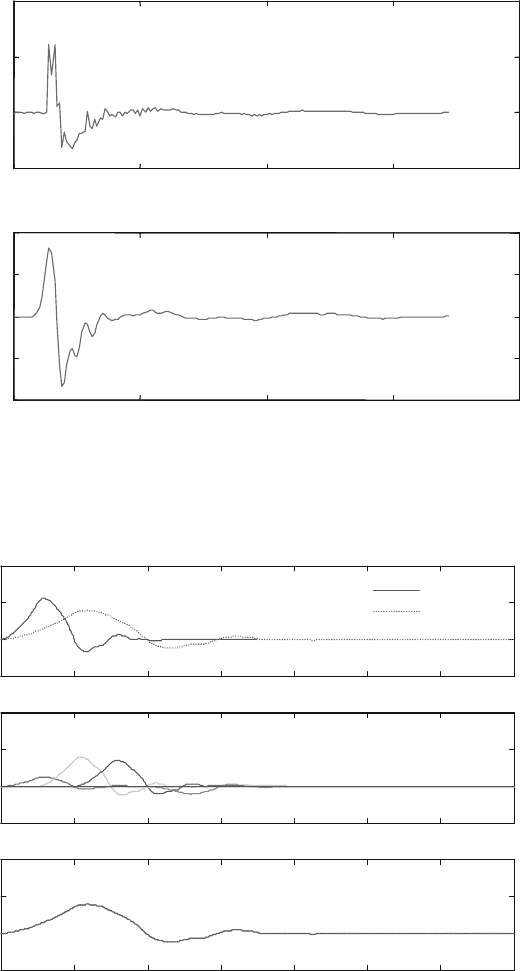
Fig. 11.4 The Daubechies scaling function
11.2 Construction of an Impulse Wavelet 193
After the sequence of coefficients h
n
is obtained, they are used to form an FIR
filter denoted by H
*
. The FIR filters H
*
and G
*
are quadrature mirror filters if, for a
signal x(t):
jjH
xðtÞjj þ jjG
xðtÞjj ¼ jjxðtÞjj (11.4)
Together, H
*
and G
*
form a pair of reconstruction filters for the wavelet decompo-
sition of a signal. This process, called deconstruction , is implemented via the
adjoints of H
*
and G
*
, which are denoted by H and G, respectively (Kaiser 1994).
For the Daubechies scaling function f(t) shown in Fig. 11.4a, the filter coefficients
are as follows: h
n
¼ {0.2304, 0.7148, 0.6309, 0.0280, 0.1870, 0.0308, 0.0329,
0.0106}, n ¼ 0, 1, . . . , 7 (Misiti et al. 1997). In Fig. 11.4b, the scaled and
translated version of f(t) (i.e., h
n
f(t n) for n ¼ 0, 1, 2, . . . , 7) is shown. Since
f(t) is a valid scaling function and h
n
are valid filter coefficients, the dilation
equation is satisfied, as shown in Fig. 11.4c.
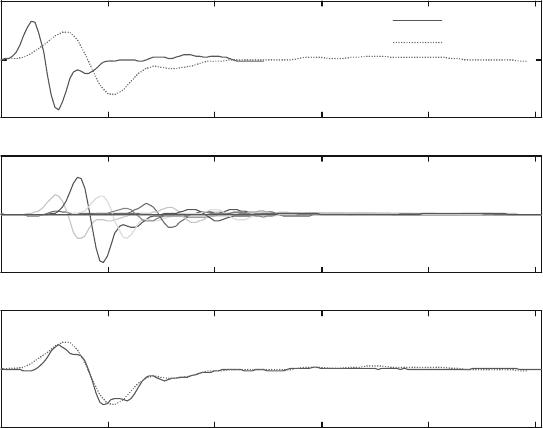
The above procedure is repeated for the impulse response as shown below in
Fig. 11.5. It should be noted that the impulse response f(t) here is a function of the
bearing dynamics, not an exact solution to the dilation equation . However, a set of
filter coefficients h
n
can be determined such that the impulse response approxi-
mately satisfies the dilation equation.
The filter coefficients can be calculated such that the dilation equation is sat isfied
exactly at integer values of t. The solution is recursive: each h
n
, for n > 0, can be
0 5 10 15 20 25
−
2
0
2
0 5 10 15 20 25
−
2
0
2
0 5 10 15 20 25
−
2
0
2
φ(t)
2
–0.5
φ(t/2)
h
n
φ(t – n), n = 0, 1, …, 12
2
–0.5
φ(t/2) = Σh
n
φ(t – n)
Fig. 11.5 The impulse scaling function obtained from the ball bearing
194 11 Designing Your Own Wavelet

explicitly determined as a function of f(t) and h
0
, h
1
, h
2
,..., h
n 1
.Thefirst
coefficient, h
0
, is simply a function of f(t). These solutions are obtained by eval-
uating the dilation equation at integer values of t.Fort ¼ 1, (11.1)gives
fð1=2Þ= 2
p
¼ h
0
fð1Þ. The terms h
1
fð0Þ, h
2
fð1Þ, etc., do not appear because
f(t) ¼ 0fort 0. (Recall that f is compactly supported.) Thus, h
0
is determined by:
h
0
¼
2
1
=
2
fð1=2Þ
fð1Þ
(11.5)
Similarly, for t ¼ 2, (11.1) gives:
1
2
p
fð1Þ¼h
0
fð2Þþh
1
fð1Þ (11.6)
For t ¼ 3:
1
2
p
f
3
2
¼ h
0
fð3Þþh
1
fð2Þþh
2
fð1Þ (11.7)
For t ¼ N +1:
1
2
p
f
N þ 1
2
¼ h
0
fðN þ 1Þþh
1
fðNÞþh
2
fðN 1Þþþh
N
fð1Þ (11.8)
Equations (11.5) (11.8) determine a recursive definition for each filter coefficient h
n
.
With the first coefficient h
0
given by (11.5), the remaining coefficients are given by:
h
n
¼
2
1=2
fððn þ 1Þ=2Þ
P
n 1
k 0
h
k
fðn þ 1 kÞ
fð1Þ
; for n 1 (11.9)
Since the scalin g function f(t) is given by the impulse response of the bearing, each
of the filter coefficients h
n
can be readily determined from (11.5) and (11.9).
Furthermore, note that the dilation equation can be written as:
1
2
p
f
t
2
¼ h
0
fðtÞþ
X
N
j¼1
h
j
fðt jÞ (11.10)
Since h
n
is given by (11.9), the dilation equatio n can be rewritten as:
1
2
p
f
t
2
¼
P
N
j 1
2
1=2
fððj þ1Þ=2Þ
P
j 1
k 0
h
k
fðj þ1 kÞ
hi
fðt jÞ
fð1Þ
þh
0
fðtÞ (11.11)
11.2 Construction of an Impulse Wavelet 195

Collecting terms yields the following form for the dilation equation:
1
2
p
f
t
2
¼
P
N
j 1
½2
1=2
fððj þ 1Þ=2Þfðt j Þ
fð1Þ
P
N
j 1
P
j 1
k 0
h
k
fðj þ 1 kÞfðt jÞ
fð1Þ
þ h
0
fðtÞ (11.12)
Note that only the second term on the right hand side of (11.12) contains filter
coefficients h
n
, which are determined by (11.5) and (11.9). Equation (11.12) serves
to illustrate the interesting relationship that the dilation equation imposes between
h
n
and f(t). Particularly, the expression given by (11.12) shows that the dilated
version of the scaling functi on is related not only to f(t n) scaled by the filter
coefficient h
n
, but also to f(t n), scaled by f(t), which is evaluated at integer
values of t. The recursive relationship given by (11.9) gives h
n
such that the dilation
equation is satisfied at x ¼ {0, 1, 2, . . .}. At other points, the sum on the right hand
side of (11.1) might differ from the left hand side. In practical treatment of an
impulse scaling function such as shown in Fig. 11.5a, (11.5) and (11.9) are first used
to obtain an initial set o f filter coefficients. These coefficients are then optimized by
minimizing the following error function:
E
rms
¼
1
T
ð
T
0
1
2
p
f
t
2
X
n
h
n
fðt nÞ
!
2
dt
v
u
u
t
(11.13)
The error E
rms
is a scalar valued function of the vector of filter coefficients h
n
, and the
optimization is accomplished by finding the vector which minimizes E
rms
. Since
E
rms
is a measure of how well the dilation equation is satisfied, the vector h
n
minimizing E
rms
is the best set of filter coefficients that can be obtained from f(t).
Using this technique, the filter coeffi cients are determined to be: h
n
¼ {0.0529,
0.4897, 0.9601, 0.4848, 0.1467, 0.2653, 0.1723, 0.1295, 0.1208, 0.0495, 0.0182,
0.0255, 0.0131}, for n ¼ 0, 1, . . . , 12. The translated and scaled versions of f(t)
corresponding to these h
n
(i.e., h
n
f(t n)) are plotted in Fig. 12.5b. As indicated by
Fig. 12.5c, the impulse response is an approximate solution to the dilation equation
(E
rms
¼0.0984). The low pass filter coefficients derived from this scaling function f(t)
can then be used to determine the corresponding wavelet c(t)(Young1993;Mallat
1998). The coefficients for the high pass reconstruction filter G
*
are determined from
(11.4). The wavelet is evaluated by upsampling G
*
, convolving it with H
*
, and then
iteratively repeating this procedure:
H
nþ1
¼* G
H
n
(11.14)
where * is a dyadic up-sampling operator. Thus, after N iterations, cðtÞffiH
Nþ1
.
Figure 11.6 shows the result of four iterations of (11.1 4 ), which produced a
196 11 Designing Your Own Wavelet
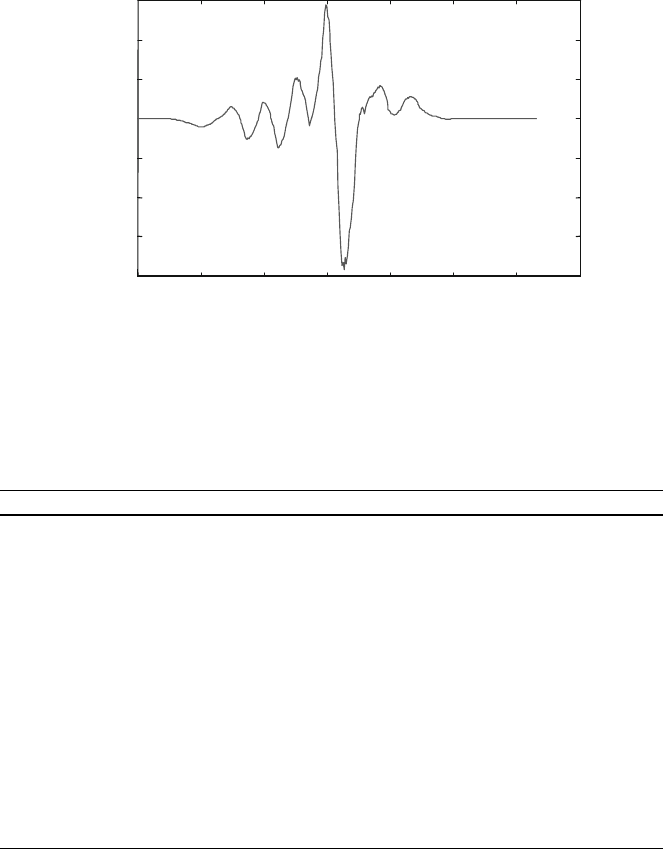
customized wavelet, based on the impulse response of the rolling bearing structure.
The set of FIR filters based on c(t) and synthesis based on f(t) are given in
Table 11.1, where the filters have been normalized to have a norm of 1= 2
p
.
0.15
0.1
0.05
0
0.05
0.1
0.15
0.2
0 2 4 6 8 10 12
14
Amplitude
Fig. 11.6 The wavelet derived from the impulse response
Table 11.1 Normalized filter coefficients
Deconstruction Reconstruction
Low pass High pass Low pass High pass
0 0.0274 0.0274 0
0.0068 0.2532 0.2532 0.0068
0.0132 0.4964 0.4964 0.0132
0.0094 0.2507 0.2507 0.0094
0.0256 0.0759 0.0759 0.0256
0.0625 0.1372 0.1372 0.0625
0.0670 0.0891 0.0891 0.0670
0.0891 0.0670 0.0670 0.0891
0.1372 0.0625 0.0625 0.1372
0.0759 0.0256 0.0256 0.0759
0.2507 0.0094 0.0094 0.2507
0.4964 0.0132 0.0132 0.4964
0.2532 0.0068 0.0068 0.2532
0.0274 0 0 0.0274
11.2 Construction of an Impulse Wavelet 197
11.3 Impulse Wavelet Application
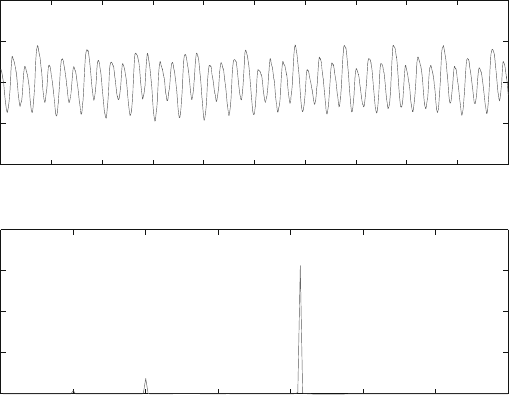
As an application example, the impulse wavelet is used to diagnose bearing defect.
Figure 11.7a shows a vibration signal measured on a SKF 6220 ball bearing with a
0.25-mm hole on its inner raceway. This signal is sampled at 10 kHz, and the
rotating speed of the bearing is 600 rpm (i.e., corresponding to 10 Hz rotating
frequency). Based on geometric dimensions of the bearing and the rotating speed
(Harris 1991), the defect characteristic frequency on the inner raceway of such
bearing is f
BPFI1
¼ 58.6 Hz. As illustrated in Fig. 11.7b, such a defect-related
frequency component is not seen in its power spectral density (PSD) resulted from
the Fourier transform.
Utilizing the wavelet integrated with Fourier transform technique, which is
described in Chap. 7, the same vibration signal is first analyzed by the wavelet
transform. The impulse wavelet, developed from the impulse response of the rolling
bearing as described above, is used as the base wavelet. Fourier transform is then
performed on the wavelet coefficients obtained from the wavelet transform to
expose explicitly the related frequency components. Figure 11.8 illustrates the
resulting wavelet coefficients and their corresponding PSD. It is seen that the
defect-related frequency component f
BPFI1
at 58.6 Hz is clearly shown in the
spectrum, thus verifying the existence of a localized inner raceway defect.
To demonstrate the signature extraction capability of the designed impulse
wavelet for bearing defect diagnosis, a comparison study is carrie d out, where
0 0.1 0.2 0.3 0.4 0.5 0.6 0.7 0.8 0.9 1
−1
−0.5
0
0.5
1
Time (s)
Signal (V)
0
10 20 30 40 50 60 70
0
0.02
0.04
0.06
0.08
Frequenc
y
(Hz)
PSD (Watts/Hz)
f
m
f
BPFO1
f
u
Fig. 11.7 Vibration signal and its PSD from a defective bearing
198 11 Designing Your Own Wavelet
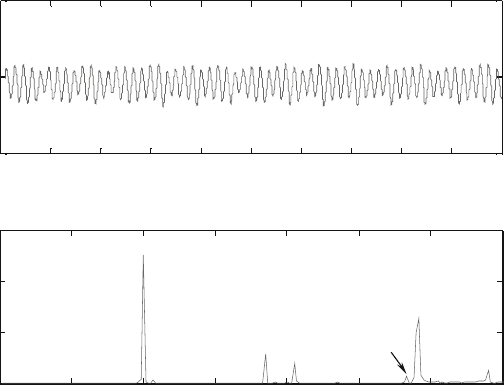
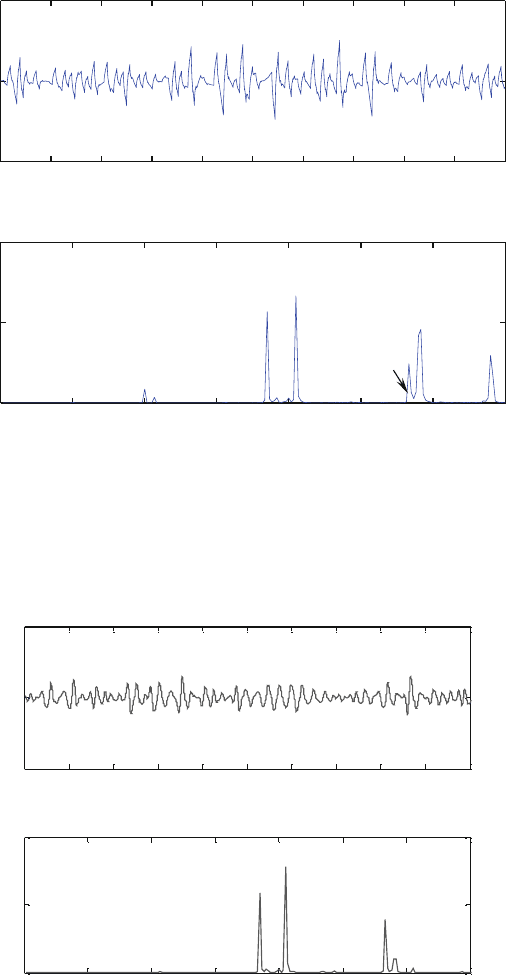
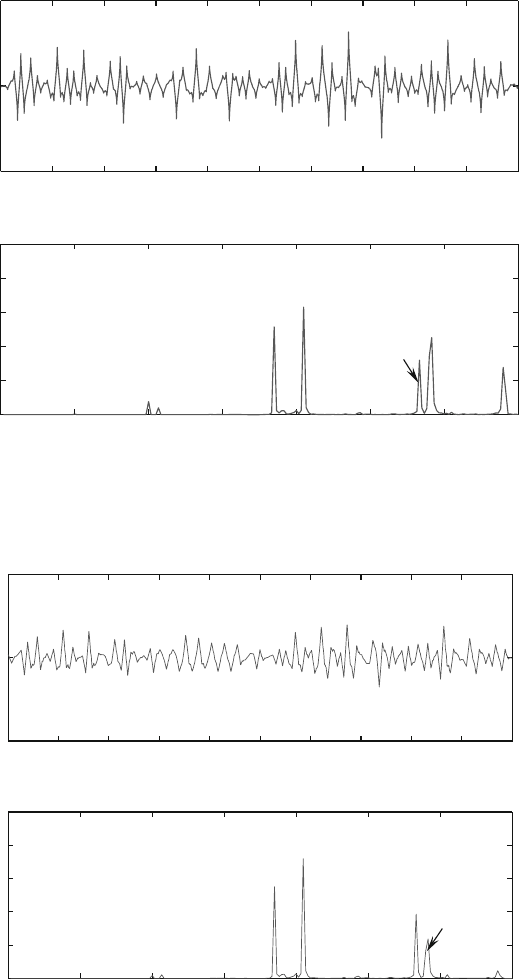
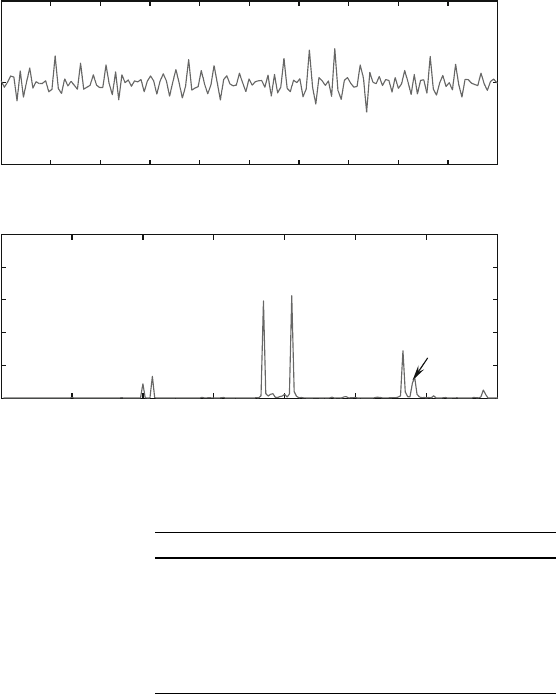
five standard base wavelets from the literature: Daubechies 2 and 4 wavelets,
Coiflets 1, Symlets 3, and Biorthogonal 2.2 (Daubechies 1992 ; Lou and Loparo
2004; Zhang et al. 2005) are used to analyze the vibration signal. The upper parts of
Figs. 11.9 11.13 are intermediate results (i.e., wavelet coefficients) of the
integrated wavelet-Fourier transf orm analysis, and the lower parts of these figures
are their corresponding PSDs. It is shown that all the five standard base wavelets
can identify the defect-related frequency component, and the results are shown in
the lower parts of Figs. 11.9 11.13.
In the spectra of Figs. 11.9 11.13, there exists a frequency component f
BPFO2
at
56.5 Hz, which has a distinct magnitude. Such a frequenc y component is identified
as from the ball rotation of another bearing in the support structure (Yan et al.
2009). To enabl e a quantitative performanc e comparison of the developed impulse
wavelet and other five standard base wavelets, a sign al-to-noise ratio measure is
introduced, which is the amplitude ratio between the defect frequency f
BPFI1
and the
adjacent frequency f
BPFO2
. As listed in Table 11.2, the impulse wavelet has shown
the highest signal-to-noise ratio in detecting the defect-characteristic frequency of
f
BPFI1
¼ 58.6 Hz. This result can be attributed to the nature of this customized
wavelet, which is derived from the actual impulse respo nse of the bear ing structure.
The direct link to the dynamics of the bearing and thus inherent better match to the
bearing signature than a standard wavelet has made it more effective in exposing
the constituent features for defect identification.
0 0.1 0.2 0.3 0.4 0.5 0.6 0.7 0.8 0.9 1
−0.05
0
0.05
Time (s)
Signal (V)
0 10203040506070
0
0.5
1.5
1
x 10
−6
Frequenc
y
(Hz)
PSD (Watts/Hz)
f
BPFO1
f
BPFO2
f
BPF11
f
m
Fig. 11.8 Wavelet integrated Fourier spectrum using the customized impulse wavelet
11.3 Impulse Wavelet Application 199
0 0.1 0.2 0.3 0.4 0.5 0.6 0.7 0.8 0.9 1
−0.5
0
0.5
Time (s)
Signal(V)
0 10 20 30 40 50 60 70
0
0.5
1
x 10
−3
Frequency (Hz)
PSD (Watts/Hz)
f
BPFO1
f
BPFI1
f
BPFO2
f
m
Fig. 11.9 Wavelet integrated Fourier spectrum results using Daubechies 2 (Db2) wavelet
f
BPFI1
f
BPFO2
0 0.1 0.2 0.3 0.4 0.5 0.6 0.7 0.8 0.9 1
0.5
0
0.5
Time (s)
Signal (V)
0 10 20 30 40 50 60 70
0
0.5
1
x 10
−3
Frequency (Hz)
PSD (Watts/Hz)
f
BPFO1
f
m
Fig. 11.10 Wavelet integrated Fourier spectrum results using Daubechies 4 (Db4) wavelet
200 11 Designing Your Own Wavelet
0 0.1 0.2 0.3 0.4 0.5 0.6 0.7 0.8 0.9 1
−0.5
0
0.5
Time (s)
Signal (V)
0 10 20 30 40 50 60 70
0
0.2
0.4
0.6
0.8
1
x 10
−3
Frequenc
y
(Hz)
PSD (Watts/Hz)
f
BPFO1
f
BPFO2
f
BPF11
f
m
Fig. 11.11 Wavelet integrated Fourier spectrum results using Coiflets 1 (Coif1) wavelet
f
BPFO1
0 0.1 0.2 0.3 0.4 0.5 0.6 0.7 0.8 0.9 1
−0.5
0
0.5
Time (s)
Signal (V)
0 10 20 30 40 50 60 70
0
0.2
0.4
0.6
0.8
1
x 10
−3
Frequency (Hz)
PSD (Watts/Hz)
f
m
f
BPFO2
f
BPF11
Fig. 11.12 Wavelet integrated Fourier spectrum results using Symlets 3 (Sym3) wavelet
11.3 Impulse Wavelet Application 201
11.4 Summary
This chapter introduces the procedure to design a wavelet based on the dynamics of
the physical syst em being analyzed. Using the impulse response of a rolling bearing
system, an impulse wavelet has been constructed for defect-induced signature
extraction. Experimental study has verified the effectiveness of the impulse wavelet
in identifying bearing localized defect of the bearing in its inner raceway, as
illustrated in the comparative study involving five standard wavelets from the
literature. Although the impulse wavelet development is based on a specific type
of bearing, the analytical procedure described in this chapter should be applicable to
the analysis of other types of mechanical systems.
0 0.1 0.2 0.3 0.4 0.5 0.6 0.7 0.8 0.9 1
−0.5
0
0.5
Time (s)
Signal (V)
0 10 20 30 40 50 60 70
0
0.2
0.4
0.6
0.8
1
x 10
−3
Frequency (Hz)
PSD (Watts/Hz)
f
BPFO1
f
m
f
BPFI1
f
BPFO2
Fig. 11.13 Wavelet integrated Fourier spectrum results using Biorthogonal 2.2 (Bior2.2) wavelet
Table 11.2 Comparison of
signal to noise ratios for
different base wavelets
Base wavelet f
BPFI1/
f
BPFO2
Impulse 9.55
Db2 1.88
Db4 0.27
Coif1 1.41
Sym3 0.62
Bior2.2 0.43
202 11 Designing Your Own Wavelet