
Gates A.E., Ritchie D. Encyclopedia of Earthquakes and Volcanoes
Подождите немного. Документ загружается.

but all four engines died after climbing only some 3,000 feet
(900 m). Compressor erosion and other damage were con-
siderable. Ash that melted and resolidified on the stage-one
turbine nozzle guide vanes was found later to be the primary
cause of loss of engine thrust. Eight minutes after the engines
stalled, after the airplane had descended approximately
13,000 feet (4,000 m), the aircrew succeeded in restarting the
engines. All engines, nose cowls and thrust reverses had to
be replaced. The sandblasting effect of passing through the
ash cloud caused heavy damage to the pilots’ windshields,
some cabin windows, and landing light covers and required
their removal and replacement. Sandblasting also forced the
removal and replacement of leading edges on the wing, stabi-
lizer, and vertical fin. Ash contaminated the whole interior of
the aircraft, so that all seats, side walls, and other interior fur-
nishings had to be taken out and either cleaned or replaced.
Contamination from ash extended to the electronic equip-
ment. The fuel, oil, hydraulic, and drinking-water systems
also were contaminated and required draining and cleaning.
Total damage to the aircraft exceeded $80 million.
Before this incident, other aircraft had encountered clouds of
volcanic ash over Alaska on several occasions and undergone
various degrees of damage. The 1986 eruption of Augus-
tine volcano had extensive effects on aircraft operation in
the vicinity of Cook Inlet. Air carrier service at Anchorage
all but ceased during the eruption, and the U.S. Air Force
moved most of its aircraft out of Anchorage for several days.
No disabling incidents involving aircraft were reported dur-
ing this eruption. During an earlier eruption of Augustine,
in 1976, two F-4E Phantom jets passed through the volca-
no’s ash plume and had their canopies scoured. Sandblast-
ing removed some paint from the wings, and fine material
penetrated many portions of the planes’ interiors. A DC-
8 passing through the ash cloud on the way to Tokyo had
its center windshield scoured, and the windshield had to be
replaced. Large amounts of ash stuck to the plane, and some
abrasion was reported on landing gear and other external
parts of the aircraft. Two other passenger aircraft had ash
adhering to them, but damage was less extensive than to the
DC-8. A brief eruption of Mount Spurr near Anchorage in
1953 resulted in sandblasting damage to three aircraft that
flew through the ash plume. In this eruption, the Air Force’s
5039th Air Transport Squadron evacuated more than 20 of
its aircraft to Laird and Eielson Air Force Bases. Three big
military cargo aircraft that remained on the ground, exposed
to the ashfall, needed 10 days to be cleaned of ash.
Other eruptive activity in various parts of the world has
provided further information on airborne ash and its effect on
aircraft. Eruptions of the volcano Galung Gung in Indone-
sia in 1982 affected two aircraft that flew above the volcano
on June 24 and July 13. The planes had to make emergency
landings at Jakarta. The 1986 eruption of the Lascar volcano
in Chile also had a bearing on aviation safety, although no
incidents involving aircraft were reported. The eruption of
Lascar occurred at a remote location and lasted only several
minutes, but its ash plume traveled quickly over populated
areas served by commercial air travel and illustrated how
even a largely ignored volcano such as Lascar (it was not con-
sidered dangerous before its eruption) could pose hazards to
air travel.
The Boeing Commercial Airplane Group has reported
that flights have observed many peculiar conditions during
flights through volcanic ash, including heavy discharges of
static, a glow in the engine inlets, and false cargo fire warn-
ings. Ash also may enter the cockpit, accompanied by an
odor of acid.
Azores The Azores island group off the western coast of
Africa in the Atlantic Ocean includes several volcanoes,
notably Agua de Pau, Furnas, and Sete Cidades. Five of
the volcanoes have undergone eruptions within historical
times starting from 1563, and submarine eruptions have been
numerous. Minor eruptions occurred at the east end of the
Azores in 1638 and 1881 but did not form any lasting addi-
tions to the island chain. Other volcanoes include Fayal, Gra-
ciosa, Monaco Bank, and Pico.
See also hot spot.
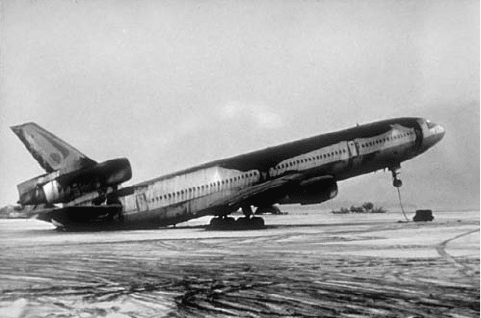
A World Airways DC-10 jet at Cubi Point Naval Air Station is covered
with volcanic ash after the eruption of Mount Pinatubo, Philippines, June
17, 1991. Ash is very abrasive and can cause engines to stall or fail if an
airplane flies through an eruption cloud. The eruption of Mount Pinatubo
caused 11 commercial aircraft emergencies. (Courtesy of the USGS)
22 Azores
backarc The area directly adjacent to an island arc on the
opposite side of the subduction zone. Typically, this area is
on the landward side of the island arc. In many cases, second-
ary convection develops in the mantle above the subducting
oceanic crust below this area. The convection causes the
backarc area to undergo extension and begin to rift, creating
a backarc basin. The basin is active with earthquake-producing
normal faults and even minor mafic igneous activity, including
volcanic eruptions. Unlike the volcanoes of the island arc, they
are typically not particularly dangerous.
Baikal, Lake Russia Lake Baikal, in eastern Siberia, Rus-
sia, has been the site of many notable earthquakes, including
events recorded in 1828, 1839, 1862, 1869, 1871, and 1959.
Many extinct volcanoes are located in the vicinity of the lake.
A rift passing through Lake Baikal has been linked tenta-
tively to a nascient mid-ocean ridge within the continental
landmass of eastern Asia. Earthquakes around Lake Baikal
are mostly restricted to a narrow zone around the rift. nor-
mal faults and strike-slip faults are common in the Lake
Baikal rift.
Baitoushan volcano, China Situated on the China-Korea
border, the Baitoushan stratovolcano in the Tien-Chi cal-
dera has erupted five times in the last millennium. Its most
recent eruption was in 1702. Its most impressive eruption was
rhyolitic and occurred at about a.d. 1050. This eruption
had a VEI = 7 and produced 32 cubic miles (150 km
3
) of pum-
ice. There was a thick circular apron of pumice around the
volcano of radius at least 25 miles (40 km) wide. These num-
bers make it one of the largest eruptions of the last 10,000
years.
Baja California Mexico The elongate strip of land that
lies approximately north to south along the west coast of
Mexico and is separated from continental Mexico by the
Gulf of California. Baja California is a small piece of land
that has rifted away from North America. The Gulf of
California contains a mid-ocean ridge (divergent margin)
that connects to the San Andreas Fault of California. These
tectonics cause Baja California to push northward into Cali-
fornia. This movement is part of the tectonic environment
that gives rise to frequent strong earthquakes in southern
California, as the northward-moving plate strikes and grinds
against the deeply rooted mass of the Sierra Nevada.
See also Los Angeles.
Baker, Mount Washington, United States One of the
peaks of the volcanic Cascade Mountains, Mount Baker
has been active on numerous occasions over the past few cen-
turies. Many eruptions were observed in the last 200 years,
notably 1792, 1843, and 1880. The 1843 eruption depos-
ited ash over a large area. Although Mount Baker appears
to have emitted lava in the recent geologic past, it is consid-
ered more likely to expel ash and fragments of rock. Mount
Baker stands just north of Seattle and is heavily glaciated. It
was the site of an interesting phenomenon in 1975: the rapid
formation of a crater lake. The lake appeared as a result of
increased activity at Sherman Crater, a vent several hundred
feet from the mountain’s summit. Ice in the crater broke
apart and melted, forming a lake more than 150 feet (46 m)
wide and 200 feet (61 m) long. The lake is thought to have
been buried under an avalanche of ice in 1977.
Bam earthquake, Iran The third most devastating earthquake
of the 21st century (as of March 2006) struck the oasis city of
Bam, in southeastern Iran, at 5:26 a.m. local time on Decem-
ber 26, 2003. Sadly, one year later, this earthquake would be
upstaged by the Banda Aceh earthquake as the most devastat-
ing of the century. The magnitude of the Bam earthquake was
6.7, and the shaking lasted 20 seconds. Local intensity of the
quake reached IX on the modified Mercalli scale, and activity
on the Bam Fault was responsible for the event.
The earthquake killed about 43,200 people and left over
90,000 homeless. More than 200,000 people lost their liveli-
hood. This is especially tragic because Bam was a prosperous
23
B
city, with a wealthy middle class based on agriculture and
enterprise. Its ancient walled citadel had been a popular
tourist destination but was flattened by the earthquake. Elec-
tric and water lines were also severed, destroying the city’s
agriculture. Besides internal aid from the government of Iran,
the United Nations and other world organizations provided
aid. Unfortunately, relief came slowly, and riots broke out
as a result, causing further distress to an already beleaguered
population.
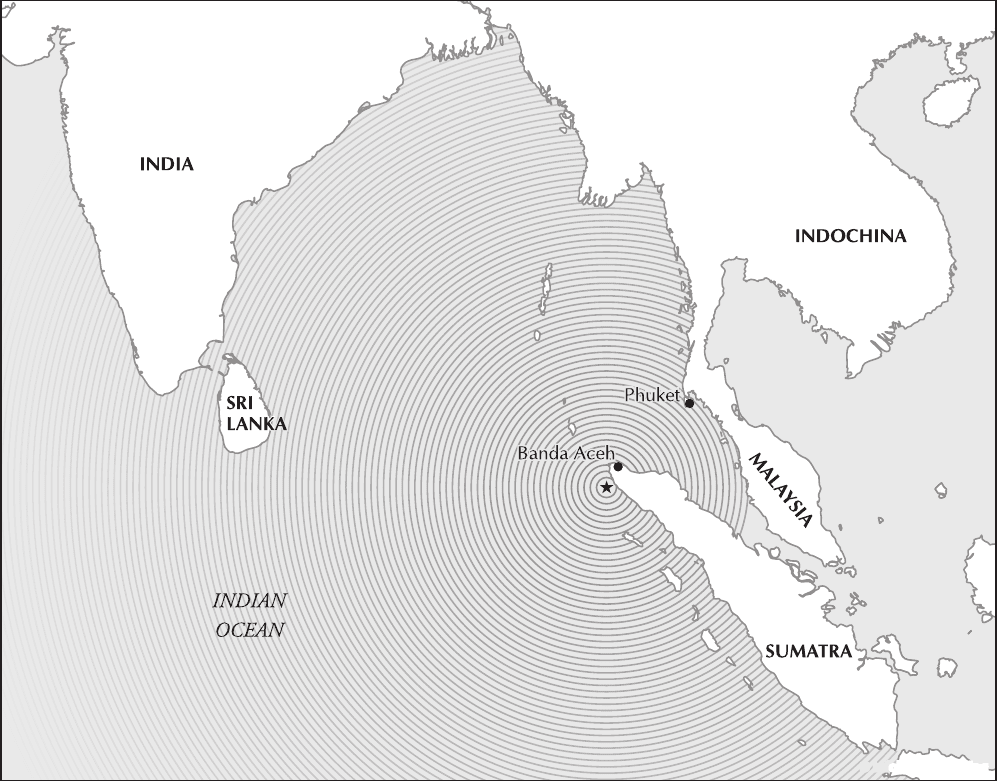
Banda Aceh earthquake and tsunamis, Indonesia At 7:58
a.m. on December 26, 2004, a huge submarine earthquake
of magnitude 9.0 occurred about 100 miles (160 km) off the
west coast of northern Sumatra near Banda Aceh. At 9.0, it
was tied for the fourth-strongest earthquake since measure-
ments began in 1899. Not since the 1964 Good Friday
earthquake, 40 years earlier, had a quake been so strong.
The energy released by this earthquake was equivalent to
23,000 Hiroshima-type atomic bombs. The focus was shal-
low, at six miles (10 km) depth.
The fault that generated the earthquake is part of the
subduction zone that forms the Sunda trench where the
India and Burma plates collide. This fault is considered a
megathrust by its form and size. During the earthquake,
a 720-mile (1,200-km) stretch of this plate boundary fault,
roughly the length of California, slipped with up to 50 feet
(15 m) of displacement, though most of the movement was
concentrated to a 240-mile (400-km) section. This displace-
ment uplifted the seafloor and in turn the ocean water above
it. It was the redistribution of the ocean surface that formed
the teletsunami that devastated the Indian Ocean basin.
geophysicists from the U.S. Geological Survey real-
ized the severity of this earthquake as the arrivals began to
send the seismographs wild. They located the epicenter
and immediately suspected that a tsunami was possible. The
problem was that unlike the Pacific Ocean, which has a real-
© Infobase Publishing
Computer-generated model of the tsunami waves generated by the Banda Aceh earthquake just as the first waves reached Sri Lanka. The star shows the
location of the epicenter.
24 Banda Aceh
time tsunami monitoring system (Pacific Tsunami Warn-
ing System), the Indian Ocean does not. Further, there was
no system to dispatch warnings around the ocean basin, so
the geophysicists could not send out a widespread alert. As
a result, the Indonesian coastal resorts, overbooked because
of the holidays, were struck blind. It was a bad event at a
bad time.
A tsunami struck the Indonesian coast less than one hour
later with waves ranging from 50 feet (15 m) up to 90 feet
(27 m) in height. The waves penetrated inland one-half mile
to nearly one mile, depending upon topography. The death
toll was phenomenal. The waves made their way around
the basin rim for the rest of the morning, slowing and losing
height with time but still causing death and destruction every-
where they touched. Resorts in Thailand, especially Phuket,
were literally demolished as the now 20-foot (6-m) waves
came ashore. In typical fashion, as the waves approached, they
drew the water away from the coast, exposing the seabed for
several minutes before crashing back, sweeping away tourists
and inhabitants alike. Two hours later, 40-foot (12-m) waves
hit India and Sri Lanka, continuing inland one-half mile (0.8
km). There was a story of an eight-year-old girl in India who
had done a report on tsunamis in school the previous semes-
ter. When she saw the water retreat, she sounded an alarm
and saved the lives of 100 people who had been on the beach.
The waves devastated all of the ocean islands (Maldives, for
example) and even caused death and destruction on the east
coast of Africa, with smaller but still powerful waves.
The death toll for the total event was staggering. Esti-
mates continue to be revised, but as of 2006, 283,100 people
were believed to have perished, making the earthquake the
second or third worst earthquake disaster in history. There
are still 14,100 people listed as missing, and a staggering
1,126,900 people are considered homeless. The worst dam-
age occurred in Indonesia, where there were 108,000 con-
firmed dead and 127,700 listed as missing and believed dead.
Other losses included 30,900 dead in Sri Lanka, 10,700 in
India, 5,300 in Thailand, and even 150 in Somalia, Africa.
Media coverage of the disaster was unparalleled, with
television and Internet news continuing for months. Ama-
teur videos taken by tourists during the tsunami and stories
of rescued people who had been clinging to trees or ocean
debris for days tugged at the world’s heartstrings prompting
an outpouring of aid. In addition to many countries deliver-
ing record amounts of aid, an extraordinary amount of pri-
vate donations came pouring in. The U.S. military conducted
extensive rescue and relief operations, and there were fund-
raising concerts and campaigns.
The numerous aftershocks on the days subsequent to
the main shock numbered in the hundreds but died down
in a few days. The fault, however was not finished. The
biggest aftershock ever on record and among the top 10
earthquakes ever occurred on March 28, 2005, at 11:09
p.m. It had a phenomenal 8.7 magnitude and also gener-
ated tsunamis, though of much smaller size. (Approximately
1,000 people were killed in Indonesia.) There was an after-
shock of magnitude 6.7 on April 10, 2005; a 6.8 on May
14, 2005; and a 7.2 on July 22, 2005. This event does not
seem to end.
Banda Api caldera, Banda Sea, Indonesia Banda Api is
located in the Banda Sea near the islands of Buru and Ceram
and is part of the Banda group, which includes 10 islands.
Two of these islands (Banda Besar and Pisang) are situated
along the rim of the Banda Api caldera. Another island,
Neira, stands on the eastern rim of a smaller caldera nested
inside the one marked by Banda Besar and Pisang. Banda Api
appears to have formed in much the same pattern as Kraka-
toa, with two or more episodes of caldera-building, each one
involving the growth and destruction of a stratovolcano.
Banda Api has been active frequently in the 19th and
20th centuries. One frightening eruption occurred without
warning in June 1820 and scared the inhabitants into fleeing
by boat. Clouds of ash and smoke emanated from the vol-
cano in 1824 during the formation of a new crater. sulfur
vapor from the volcano caused a thick mist to form in late
1835, and a subsequent strong earthquake was followed by
still more shocks that continued for several days.
Less powerful earthquakes occurred in late 1853, and
the volcano put out unusually large amounts of steam.
Noises from underground were heard in December 1855, and
a minor earthquake occurred in January 1856. More sub-
terranean noises were heard later that month. The volcano
reportedly emitted large amounts of smoke during these times
of rumbling. Five earthquakes, one of them accompanied by
a tsunami, occurred in June and July 1859. Earthquakes
continued in August. One especially strong earthquake on
September 25 was associated with a dramatic rise in the sea
along the southern coast of Neira, although this disturbance
of the sea appears to have caused no significant damage.
More strong earthquakes occurred on October 18, November
7–8, and December 29. In 1859 and 1860, Banda Api emitted
unusually large amounts of smoke.
Several notable earthquakes occurred in 1860, including
one that was accompanied by a strange underground roar-
ing noise that reportedly appeared to move from southeast to
northeast. Neira experienced frequent earthquakes between
early January and late June of 1877, although the vol-
cano did not erupt. A fairly strong earthquake in 1887 that
appeared to be centered near Banda Api was followed by an
increase in steam from the volcano, although no such rise in
activity was observed in connection with other, strong shocks
that followed several months later. A very strong earthquake
with pronounced subterranean rumbling shook Banda Api on
August 12, 1890, followed by an even stronger earthquake
on November 23. aftershocks continued for days. Damage
to buildings was widespread. A fresh active crater with three
fissures emanating from it appeared at this time.
Earthquakes and detonations occurred on May 18,
1901, and a glow was seen near the summit of Gunungapi.
A minor earthquake occurred in March 1902, and more sub-
terranean rumbling was heard. A strong earthquake in June
1987, approximately 90 miles (145 km) southeast of Banda
Api, preceded the release of a steam plume from the volcano.
Earthquake activity increased dramatically in early May
before an eruption on May 9.
Bandai-San volcano, Japan The July 15, 1888, eruption of
Bandai-San is one of the worst volcanic disasters in Japanese
Bandai-San 25
history. Although the mountain had displayed no signs of activ-
ity for perhaps a thousand years beforehand, Bandai-San blew
up in a series of approximately 20 steam-blast explosions in a
single day. The eruption had a VEI = 4. Most of the destruc-
tion occurred within several minutes, when the most powerful
explosion set off a huge landslide that sent the entire north
slope of the mountain rolling into the Nagase Valley. More
than 461 people were reported killed, but only 116 bodies
were found. According to one estimate, the eruption expelled
some 1 billion cubic yards (750,000,000 m
3
) of solid material
into the valley below the volcano. One volcanologist put
this volume of material into more easily understandable terms
when he explained that if the material from this eruption were
formed into ships of 15,000 tons each, the resulting line of
ships would span the Pacific Ocean from Japan to Califor-
nia. This eruption was one of several (including Bogoslof
and Vulcano) that occurred about the same time and were
implicated in a sharp drop in the amount of solar radiation
reaching Earth in 1890–91. (See climate, volcanoes and.)
In total, Bandai-San volcano has erupted four times between
806 and 1888. Besides the 1888 eruption, most eruptions are
moderate in size (VEI = 2–3).
Bandelier Tuff southwestern United States The Bandelier
Tuff in New Mexico is made up of volcanic ash deposited
over a wide area by an eruption of the Valles caldera.
Bantul earthquake, Indonesia On Saturday, May 27, 2006,
at 5:54 a.m. local time, a strong earthquake struck the Bantul-
Yogyakarta area of Indonesia. The earthquake had a magni-
tude of 6.3, a maximum intensity of VII–IX on the modified
Mercalli scale, and a focal depth of 6.2 miles (10 km). The
death toll for this event was more than 6,000 victims, with
more that 30,000 injured. Damage to Bantul was extreme, with
more than 80 percent of homes (135,000 houses) destroyed,
leaving more than 650,000 people displaced.
The earthquake occurred just weeks after renewed erup-
tive activity on Mount Merapi volcano just 20–25 miles
(32–40 km) to the north. It is possible that the eruption and
earthquake were related, and fear that the earthquake would
cause much stronger eruptions was widespread. Indonesia lies
above a subduction zone between the Australian plate to
the south and the Eurasian crustal plate. The collision is
not orthogonal (head-on) but is oblique, with Australia mov-
ing northwestward. Instead of Australia subducting at an
oblique angle under Indonesia, it is partitioned into orthog-
onal at the trench, and all westward motion is taken up on
a large San Andreas–like strike-slip fault that produces
destructive shallow earthquakes as that in Batul.
Barcena Mexico Barcena is a volcano on San Benedicto
Island south of Baja California, and west of Mexico City
in the Pacific Ocean. The only historic eruption of Barcena
was in 1952. It produced a lava flow and a glowing ava-
lanche during this eruption.
Bardarbunga volcano, Iceland Buried under the ice of
the Vatnajökull, Bardarbunga, and its surrounding area are
thought to have been the site of several notable eruptions
since the late ninth century. A large eruption occurred along
fissures to the southwest of Bardarbunga around 900 and
again around 1480. Layers of tephra have been associated
with eruptions in 1477 and 1717. An eruption from a fissure
some 20 to 25 miles (32–40 km) southwest of Bardarbunga
in the 1860s released a substantial lava flow and apparently
some tephra as well. Earthquake activity around Bardarbunga
showed a marked increase in the mid-1970s. Between 1974
and 1986, several moderately strong earthquakes occurred.
Activity at Bardarbunga may be related to activity at Krafla,
some 70 miles (113 km) north of Bardarbunga. It has been
suggested that inflation at Krafla accompanies deflation at
Bardarbunga and that changes in pressure are transmitted
through a layer of partly molten crustal rock.
barranco Steep-sided drainage channels in a volcanic cone
formed by coalescence of smaller channels. They typically
form a radial pattern around the volcanic cone.
Barren Island volcano, Andaman Islands, India Barren
Island is a volcano with a .99-mile (1.6-km)-wide crater that
contains a central pyroclastic cone. It erupted in 1787,
1789, 1795, 1803, 1852, 1991, and 1995. The 1803 erup-
tion was the most intense of the older group and produced
lava flows that reached the coast. The 1991 eruption pro-
duced basaltic andesite flows that covered 17,000 square feet
(1,600 m
2
) and reached the northwest coast. The 1995 erup-
tion was a large Strombolian type that produced extensive
ash and ejecta eruptions with volumetrically lesser amounts
of lava.
barrier (fault) Part of a fault surface that resists move-
ment because of its geometry or some geologic body or
change. A bend or step in the fault surface or another rock
body, such as an igneous intrusion, can stop a fault from
moving in that area. Stress can build to excessive levels in this
area, and if it finally ruptures, the resultant earthquake can
be very strong.
Barrier, The caldera, Kenya The Barrier is located south
of Lake Turkana and separates the lake from Lake Logipi
and the Sugata Valley to the south. The Barrier has an outer
and an inner, younger caldera. Although there are reports
of eruptions in the mid- to late 19th century and in 1921–22,
details are unavailable.
basalt A dark volcanic rock, basalt is the most abundant
volcanic rock on Earth’s surface. Basalt is composed of
pyroxene, plagioclase, and commonly olivine. It occurs
in several different forms. The ocean floor from all ocean
basins is composed of basalt covered by ocean sediments.
The basalt is produced at the mid-ocean ridge as part of
the new crust. When basalt is extruded underwater, it comes
out as small spherical blobs that settle to the ocean floor and
form pillow lava (basalt) because of their shape. “Plateau
basalts,” or flood basalts, are found where large quanti-
ties of basalt have poured from fissures, sweeping over the
surface and overwhelming landforms in their path. Plateau
basalts may contain hundreds of thousands of cubic miles
26 Bandelier Tuff
of rock. Examples of plateau basalts are found in the Pacific
Northwest of the United States, specifically the Columbia
Plateau and the Snake River Plain. Other examples of pla-
teau basalts are found in India’s Deccan Plateau and along
Manchuria’s borders with Korea and Russia, notably around
the Baekdoo-San volcano on the Korean border. Yet another
plateau basalt, possibly made up of several plateaus, stretches
from Scotland to Greenland. The Karoo basalts of Africa,
the Pirana basalts of South America, and the Watchung
basalts of New Jersey are other examples. Plateau basalts
are noted for their absence of pyroclastic material. Individual
lava flows in a plateau may be up to approximately 150 feet
(46 m) thick and may extend for 10 miles (16 km) or more.
The geological record indicates these flows were not accom-
panied by explosive eruptive activity. Basalt sometimes exhib-
its a phenomenon called columnar jointing, in which the
rock forms a vertical prismatic structure reminiscent in some
ways of a honeycomb. A spectacular example of a basalt for-
mation exhibiting columnar jointing is Giant’s Causeway in
the British Isles. It occurs only in basalt that has flowed to
Earth’s surface and cooled in air. Basalt is believed to form
from magma originating in the upper mantle. The process
that causes the melting solid rock in the upper mantle to pro-
duce basaltic magma is called decompression melting.
basal wreck The bowl-like structure formed when the
peak of a volcano is destroyed in an eruption. A basal wreck
is characterized by a roughly circular shape, a raised rim, and
a central depression.
basic An old term for mafic.
Basin and Range Province western United States The
Basin and Range Province in the United States extends
from the vicinity of Klamath Falls, Oregon, and Bear Lake,
Idaho, southward through Nevada and Utah, and occu-
pies large portions of southeastern California, southern
Arizona and southwestern and central New Mexico. The
province covers some 300,000 square miles (777,000 km
2
),
or roughly 8% of the United States. More than 200 mountain
ranges occupy the Basin and Range Province, which shows
widespread evidence of recent faulting (notably along the
Wasatch Mountains in Utah, at the base of which contains
fresh exposures of unweathered rock indicating movement
along a fault there in the very recent geologic past).
The Basin and Range Province consists of a series of
parallel mountain ranges that trend north-south. The ranges
enclose and are separated by long depressions. The Basin
and Range Province represents a region of thinning and
rifting of Earth’s crust, where crustal rock has split into
many blocks that are separated by normal faults. The blocks
that sank became depressions, or grabens. The blocks that
remained elevated became the ranges, or horsts. The Basin
and Range Province represents the early stages of a diver-
gent boundary.
The Basin and Range Province is noted for strong
earthquake activity. A recent example was the Dixie Valley,
Nevada, earthquake of 1952 (magnitude 7.1). One of the
greatest earthquakes recorded in the Basin and Range Prov-
ince occurred in 1872 and involved more than 20 feet (6
m) of vertical displacement between Owens Valley and the
Sierra Nevada. Seismic activity is generally most intense
along the eastern and western edges of the province. The
powerful Kern County, California, earthquake of 1952
took place just beyond the western boundary of the Basin
and Range Province, and the Owens Valley earthquake of
1872 took place on that boundary at the Southern Sierra
Gap. On the opposite boundary, a 1959 earthquake near
Hebgen Lake, Montana, had a magnitude of 7.1 and was
felt over an area of more than a half-million square miles
(1.4 million km
2
). This earthquake set off an avalanche
that dammed the Madison River, formed a lake, and killed
more than 20 persons. Another earthquake of approxi-
mately the same magnitude struck Idaho in 1983, caused
two deaths, and resulted in more than $12 million in dam-
age to property. Other strong earthquakes in the Basin and
Range Province affected Nevada in 1869, 1903, 1915, 1932,
1934, and 1954. The Great Basin, which includes Death
Valley, is part of the Basin and Range Province. Volcanic
activity also occurs along the boundaries of the province, a
notable example being the Long Valley caldera.
Evidence of volcanism is also abundant within the Basin
and Range Province. lavas and other products of erup-
tions have buried older rock along the northern edge of the
Great Basin. Volcanic rocks extending across the Great Basin
include huge volumes of tuff, or pyroclastic material welded
together. Large flows of basalt are found on the northwestern
and southeastern edges of the Great Basin, along the Colum-
bia Plateau and the Snake River Plain and the southern
edge of the Colorado Plateau respectively. Ubehebe Crater is
a famous product of relatively recent volcanic activity in the
Basin and Range Province.
Mines and mining have played an important part in the
development of the Basin and Range Province during the
past two centuries. Copper, gold, silver, lead, zinc, antimony,
iron, mercury, magnesium, manganese, and beryllium have
all been mined in large quantities from deposits in the Basin
and Range Province.
See also North America; North American crustal
plate.
batholith A large pluton or body of intrusive igne-
ous rock that has a surface (exposed) area of greater than
39 square miles (100 km
2
). Less than that and the body is
a stock. Batholiths are prominent in the landscapes of the
western United States and Canada. The northern Rocky
Mountains contain tremendous batholiths, but it is uncertain
what combination of processes created them. The Idaho
Batholith, roughly 250 miles (402 km) long and 100 miles
(161 km) across at its broadest point, contains the Salmon
River and Clearwater Mountains. The Bitterroot Range
along the eastern edge of the batholith lies along the border
between Montana and Idaho. Batholiths may have great
economic importance if associated with valuable ore depos-
its. A break along the northern part of the Idaho Batholith
contains the Coeur d’Alene district, which is famous for its
lead, zinc, and silver mines. The nearby Boulder Batholith
in Montana is also a rich source of metals and has yielded
batholith 27
about a third of the copper mined in the United States. Gran-
ite batholiths form large portions of the northern Cascade
Mountains, the Coast Mountains in British Columbia,
southern Alaska, and the Sierra Nevada in California.
The granite in these batholiths may be very coarse-grained,
indicating that the magma that formed the rock cooled
slowly and at great depth. (Fine-grained igneous rocks gen-
erally cooled more rapidly, at or near the surface, so that
coarse grains did not have an opportunity to develop.) The
chemical composition of these granitic rocks may vary. Sec-
tions of country rock may separate individual plutons, and
entire blocks of country rock may be included with plutons,
having become separated from the walls or roof of a pluton
and fixed in the intruding magma as an inclusion.
Batholiths are most commonly felsic or intermedi-
ate in composition, but some notable mafic varieties exist.
Batholiths form the roots of large magmatic arcs, so they
are common in areas of such ocean-continent convergence
as the Andes. They may also form from hot spots on land,
such as those in Australia and even along rifts in the early
stages of a divergent boundary.
Batur caldera, Bali, Indonesia Batur is situated on the
island of Bali and is one of two active volcanoes, the other
being the very dangerous Agung. Batur undergoes frequent
explosive eruptions but is less dangerous than Agung. The
Batur caldera began its formation about 500,000 years ago.
About 50,000 years ago, it underwent a huge explosion that
produced about 31 cubic miles (140 km
3
) of ejecta (VEI =
7). About 20,000 years ago, another similarly massive erup-
tion produced the large caldera that exists today.
Two calderas, one inner and one outer, have been
described at Batur within the larger old caldera. Inside the inner
caldera, a small stratovolcano (also called Batur) has arisen
and is active. There have been 23 dacite and basalt eruptions
from 1824 through 1994. lava flows occurred in 1849, 1888,
1904, 1905, 1921, 1926, 1968, and 1974. In 1888, numerous
earthquakes were felt in Bali in late May, days before an erup-
tion of Batur. The Batur volcano also may have been involved
in detonations and earthquakes perceived from October 9 to
October 11, 1902. A lava flow from Batur invaded a local vil-
lage in 1904 or 1905. Although strong earthquakes occurred in
the vicinity of Batur in 1917, these are thought to have been
tectonic rather than volcanic in origin. Batur erupted again
from 1921 to 1926. (It is not certain whether this resumption
of eruptive activity was related to the earthquakes of 1917.)
The volcano expelled incandescent pieces of rock, and detona-
tions shook the ground. There was a brief diminution in erup-
tions at the summit of the volcano as lava started to flow on
April 9 and 10. Powerful explosions began again, however, in
mid-April. Lesser eruptions took place between 1922 and 1925,
followed by a more powerful eruption with accompanying
earthquakes in 1926. It was probably the largest historical erup-
tion of Batur. Lava emerged from a 1.3-kilometer-long fissure
on the southwestern side of Batur, and soon afterward another
fissure opened on the southeast side of the volcano, releasing a
lava flow that overran the nearby village of Batur. Lava tubes
formed during the 1926 eruption. In 1959 emissions of hydro-
gen sulfide increased from the northern part of the caldera lake.
Small earthquakes were observed on the rim of the caldera
during the eruption of Agung volcano, several miles southeast
of Batur, on September 5, 1963. Batur started erupting later
that day. Lava flowed from several vents on the west side of
Batur during this eruption. Minor explosions occurred every
few days at Batur between August and December 1965. Explo-
sions occurred again on a frequent basis in early 1968, and lava
flowed from Batur. Bubbles of gas, smelling of sulfur, rose
from the lake in 1969, and small explosions took place in 1970.
The latest 1994 eruption produced only ash.
Bayonnaise caldera, Japan A mostly submerged caldera
in southern Japan, Bayonnaise has a record of submarine
eruptions dating back to 1896. An eruption of the volcano
Myozin-Syo, a lava dome in the middle of the caldera, in
1952 destroyed a research ship that crossed over a vent and
killed more than 30 people on board. Myozin-Syo has pro-
duced some spectacular phreatic explosions.
bedrock All solid rock that underlies the sediment and soil
that typically covers the Earth. Besides the thin veneer of soft
material that covers the planet, the entire Earth is made of
rock. If a person were to dig down and hit that rock, he or
she would have struck bedrock. Where bedrock reaches the
surface, it is called an outcrop or exposure.
Benbow, Mount See Ambrim.
Bengkulu earthquake, Indonesia On June 4, 2000, a strong
earthquake occurred 21 miles (33 km) beneath the Indian
Ocean just west of Bengkulu, whose population is more than
1.2 million. The quake measured 7.9 on the Richter scale
and was followed 11 minutes later by an aftershock of mag-
nitude 6.0. During the next six hours, some 53 smaller after-
shocks were recorded. Many landslides occurred from the
shaking. More than 97 people were killed, more than 1,900
were injured, and many thousands were left homeless. Elec-
tricity, water supplies, and telephone lines were all interrupted
and many roads were left impassable. The police reported that
virtually every building in the city was damaged, and many
were destroyed.
Benioff zone A zone of earthquake activity that tracks the
downgoing oceanic crust within a subduction zone. The
Benioff zone starts near the surface at the trench and progres-
sively extends perhaps 400 miles (644 km) below the surface
proportional to the distance into the island arc or magmatic
arc. If the foci of the earthquakes are plotted on a map and
cross-section of an arc, the top of the downgoing crust can be
imaged and a relatively accurate picture of what the subduc-
tion zone looks like, including the angle of descent and how
much the crust is bent, can be made. This discovery was one of
the key elements in developing the plate tectonic model. It
is named after Hugo Benioff (1899–1968), an American seis-
mologist who mapped such zones in the 1940s and 1950s.
bentonite An ash bed from an ashfall within a sequence
of predominantly sedimentary rock layers. The ash is con-
verted to a layer of clay with a distinctive composition.
28 Batur
Bermuda The island of Bermuda occupies the summit of
a volcanic seamount that rises some 6,000 feet (1,800 m)
from the ocean floor. At one time, waters covered the peak,
and coral formed on the summit. The coral now constitutes
the surface of the island. A well-drilling project showed that
almost 400 feet (130 m) of limestone overlies the basaltic
rocks that make up the volcanic portion of the seamount.
Bezymianny volcano, Kamchatka, Russia Part of the Kli-
uchevskoi complex of volcanoes, Bezymianny is a strato-
volcano whose name means “no name” because it is small
compared to its larger neighbors like Kliuchevskoi and because
it had no historical eruptions. This situation changed when it
erupted with great violence in 1955–56. In many ways, this
eruption closely resembled that of Mount Saint Helens in
Washington in the United States in 1980, except that it
was much bigger. On March 30, 1956, a tremendous explo-
sion destroyed the summit of Bezymianny and produced a
crater one mile (1.6 km) × 1
1
/
4
miles (2 km) wide. The east-
ern side of the mountain was blown open. The blast leveled
trees one foot (0.3 m) in diameter at a distance of 15 miles
(24 km). Fires were started at 18 miles (29 km) distance by
the heat of the gas cloud. Glowing avalanches and lahars
swept down the volcano with great force. A lava dome
formed in the crater. The March 30 eruption alone is believed
to have cast out about 2.4 billion tons of rock. The eruption
column was 24 miles (39 km) high. An ash flow laid down
by the volcano produced an area of fumaroles similar to the
Valley of Ten Thousand Smokes created by the eruption
of Mount Katmai in Alaska; this site came to be known as
the Valley of Ten Thousand Smokes of Kamchatka.
There have been 34 eruptions of Bezymianny since 1955,
making it one of the most active volcanoes on Earth. Its most
recent eruptions were in 1994, 1997, 1999, and 2000. The
1997 eruption produced a 40,000- to 45,000-foot (12,192-
to 13,716-m) eruptive column and a plume that spread some
260 miles (418 km) to the east-northeast. It was accompanied
by significant seismic activity. The 1999 and 2000 eruptions
were similar in character but smaller.
Bhuj earthquake, India One of the major earthquakes of
the still young 21st century struck the Gujarat area of west-
ernmost India at 8:46 a.m. on January 26, 2001. (Notably,
the quake struck virtually the same area as the Allahbund
earthquake of 1819.) The Bhuj earthquake has also been
unofficially called the Gujarat earthquake and the “Repub-
lic Day” earthquake. Its moment magnitude was 7.6,
with a duration of 85–90 seconds. The focus of the earth-
quake was on the newly discovered east-west-oriented North
Wagad Fault, which is a reverse fault. Slip is believed
to have been three to 13 feet (1 to 4 m) on the fault, and
surface expression included a line of minor cracking and
deformation in the form of a bulge similar to that in the
1819 earthquake about 1.2 miles (2 km) long. liquefac-
tion was common, with mud volcanoes hundreds of feet
to even three miles (5 km) across in one case. In some cases,
groundwater was driven to the surface in such quantity to
activate desert rivers that had been dry for more than 100
years. aftershocks continued for months, with the stron-
gest reported on January 28 with a magnitude of 5.8 and a
duration of 30 seconds.
The official death toll for this event was 19,727
although some sources place it at 13,805. Over 166,000
were injured, and more than 600,000 were left homeless.
There were 348,000 houses destroyed and 844,000 dam-
aged. More than 20,000 cattle were killed. The Indian gov-
ernment estimated that 15.9 million people were directly or
indirectly affected by the quake, and the economic losses
exceeded $1.3 billion, although some estimates place it as
high as $5 billion.
Bible, earthquakes in the The Bible contains numerous
references to earthquakes, in both the Old and New Tes-
taments. In the first book of Kings (I Kings 19:11–12), the
prophet Elijah experienced an earthquake:
And, behold, the Lord passed by, and a great and
strong wind rent the mountains, and brake in pieces
the rocks before the Lord; but the Lord was not in
the wind; and after the wind an earthquake; but the
Lord was not in the earthquake: and after the earth-
quake a fire; but the Lord was not in the fire.
Isaiah also described God’s power in terms of an earthquake
(Isaiah 9:6):
Thou shalt be visited of the LORD of hosts with
thunder, and with earthquake, and great noise, with
storm and tempest, and the flame of devouring fire.
Amos, who lived around 750 b.c., used a famous earthquake
to set the date of his prophecies (Amos 1:1):
The words of Amos, who was among the herdmen
of Tekoa, which he saw concerning Israel in the
days of Uzziah king of Judah, and in the days of
Jeroboam the son of Joash king of Israel, two years
before the earthquake.
This same earthquake, apparently, is mentioned in Zechariah
14:5:
And ye shall flee to the valley of the mountains; for
the valley of the mountains shall reach unto Azal;
yea, ye shall flee, like as ye fled from before the
earthquake in the days of Uzziah king of Judab: and
the Lord my God shall come, and all the saints with
thee.
Matthew wrote that Christ predicted His return would be
preceded by earthquakes (Matthew 24:7):
For nation shall rise up against nation, and kingdom
against kingdom: and there shall be famines, and
pestilences, and earthquakes, in divers places.
Mark repeated this same warning in similar language (Mark
13:8):
Bible, earthquakes in the 29
For nation shall rise against nation, and kingdom
against kingdom: and there shall be earthquakes in
divers places, and there shall be famines and trou-
bles: these are the beginnings of sorrows.
Luke’s version of this prophecy (Luke 21:11) reads as follows:
And great earthquakes shall be in divers places, and
famines, and pestilences; and fearful sights and great
signs shall there be from heaven.
Matthew also reported that an earthquake accompanied the
crucifixion of Christ and greatly impressed onlookers (Mat-
thew 27:54):
Now when the centurion, and they that were with
him, watching Jesus, saw the earthquake, and those
things that were done, they feared greatly, saying,
Truly this was the Son of God.
Matthew added (Matthew 28:2) that another earthquake
occurred when the stone was rolled away, by angelic action,
from Christ’s tomb:
And behold, there was a great earthquake: for the
angel of the Lord descended from heaven, and came
and rolled back the stone from the door, and sat
upon it.
In Acts 16:26, an earthquake released the apostles Paul and
Silas from prison:
And suddenly there was a great earthquake, so that
the foundations of the prison were shaken: and
immediately all the doors were opened, and every
one’s hands were loosed.
Revelation, the final book of the New Testament, abounds
in references to earthquakes in connection with prophecies of
the final days before Christ’s return. The first-person narrator
was the author, the apostle John:
And I beheld when he had opened the sixth seal,
and, lo, there was a great earthquake; and the sun
became black as sackcloth of hair, and the moon
became as blood. [6:12]
And the angel took the censer, and filled it with
the fire of the altar, and cast it into the earth: and
there were voices, and thunderings, and lightnings,
and an earthquake. [8:5]
And the same hour was there a great earth-
quake, and the tenth part of the city fell, and in the
earthquake were slain of men seven thousand; and
the remnant were affrighted, and gave glory to the
God of heaven. [11:13]
And the temple of God was opened in heaven,
and there was seen in his temple the ark of his testa-
ment; and there were lightnings, and voices, and thun-
derings, and an earthquake, and great hail. [11:19]
And there were voices, and thunders, and light-
nings; and there was a great earthquake, such as
was not since men were upon the earth, so mighty
an earthquake, and so great. [16:18]
Bihar earthquake, India A deadly earthquake struck India
near the Nepal border and devastated the Bihar area at 2:21
p.m. local time on January 15, 1934, registering an 8.0 on
the Richter scale. The fault that generated the earthquake
experienced left-lateral strike-slip motion, although reports
of normal fault movement also exist.
The death toll from the Bihar earthquake was 10,653,
making it one of the deadliest in India. Damage was primar-
ily the result of intense liquefaction, slumping, and intense
ground shaking. fissures opened in the center of towns and
were reported as being up to 240 feet (72 m) long and eight
feet (2.5 m) wide. Subsidence occurred as a result of slump-
ing and lateral spreading, with the ground surface dropping
up to 10 feet (3 m) in several cases. Liquefaction caused the
greatest damage, leaving many buildings in various states of
distress. It was accompanied by great sand blows and mud
volcanoes. In all, sand and water were emitted over an area
of about 18,000 square miles (46,600 km
2
). aftershocks
continued to affect the area for years after the main shock.
Especially strong aftershocks (magnitudes between 5 and 6)
occurred on January 19, 1934; June 2, 1934; and February
11, 1936—causing damage and loss of life in some cases.
biotite Otherwise known as black mica, biotite is a com-
mon mineral especially in intermediate rocks but also in
many felsic rocks. Biotite occurs in shiny black booklike
sheets or flakes.
Birjand-Qã-yen earthquake, northern Iran On May 10,
1997, an earthquake of Richter magnitude of 7.2 occurred.
At least 1,567 people were killed, 2,300 people were injured,
and 50,000 were left homeless. 10,533 homes were destroyed
either directly from the earthquake or from the landslides it
triggered. The earthquake occurred on the Abiz Fault, which
underwent left-lateral strike-slip movement. The Abiz Fault
produced the Dasht-e-Bayez earthquake of magnitude 7.3 in
1968. It killed 12,000 to 20,000 people.
Bishop Tuff western United States A pyroclastic flow,
the Bishop Tuff covers almost 600 square miles (1,600 km
2
)
of Nevada and central California. The tuff is thought
to have been laid down in the catastrophic eruptions asso-
ciated with the formation of the Long Valley caldera in
California about 730,000 years ago. This eruption involved
the collapse of the roof of a magma chamber. This collapse
forced 150 cubic miles (2,300 km
3
) of rhyolitic magma
into plinian ash columns and associated ashfalls and ash
flows. Compare the volume of ash to that of Mount Saint
Helens, which produced one cubic mile of ash. The Bishop
Tuff extends through Arizona, Colorado, and Utah and
has been identified as far east as Kansas.
See also tephra.
black smoker See mid-ocean ridge.
30 Bihar
blind fault A fault that does not reach the ground surface.
Faults may grow off of a larger fault. The fault will grow with
continued stress if it is great enough. The fault will produce
earthquakes as it grows but it will form no surface expression.
Because they form no surface expression, geologists may not
know that the faults exist until they produce an earthquake.
Therefore they are hidden and will take people by surprise
when they rupture. The North Ridge earthquake of 1994
near Los Angeles was produced by a blind fault. Because the
area is riddled with active faults, a major earthquake is not
unexpected. In other areas, where earthquake activity is less,
sudden activity from a blind fault may be devastating.
block The largest type of volcanic ejecta, blocks are
defined as being larger than 10 inches (25.6 cm). Blocks are
larger than bombs but are similar in appearance.
body wave In contrast to surface waves, which only
travel along the Earth’s surface, body waves are seismic waves
that travel throughout the volume of the planet. Body waves
are p-waves and s-waves and are much faster than surface
waves but less destructive. Body waves are the first arrivals
on the seismic records for an earthquake event.
body wave magnitude The body wave magnitude m
b
is
a determination of the magnitude of an earthquake based
purely upon the amplitude of the initial p-wave, which is a
body wave.
Bogoslof volcano, Aleutian Islands, Alaska, United States
Bogoslof volcano is one of the most famous in the world
because of its record of self-destruction and reemergence
over the past few centuries. It is visible as an island that is the
summit of the volcano, based on the seabed some 6,000 feet
(1,900 m) below. The summit of the volcano keeps building
itself up and tearing itself apart in explosive eruptions or con-
tinues being destroyed by wave activity. The island actually is
a set of lava domes that have appeared at various locations.
An island at the location of Bogoslof was reported first in
1768 and was named Ship Rock. Castle Rock, another island,
appeared in 1796 during a loud eruption that frightened
natives on a neighboring island. By 1826, Castle Rock was
about two miles (3 km) long, less than a mile wide, and more
than 300 feet (91 m) high. A great mass of volcanic rock
arose from the waters near Ship Rock, on the opposite side
from Castle Rock, in 1883. This new island was called New
Bogoslof. A bar of clastic, or loose and fragmented, material
linked New Bogoslof with Ship Rock and Castle Rock. Wave
activity soon produced a channel, however, and thus cut the
temporary, single island into two. Two new domes, Metcalf
Cone and McCulloch Peak, formed in the waters between the
two islands in 1906 and 1907. Metcalf Cone appeared first
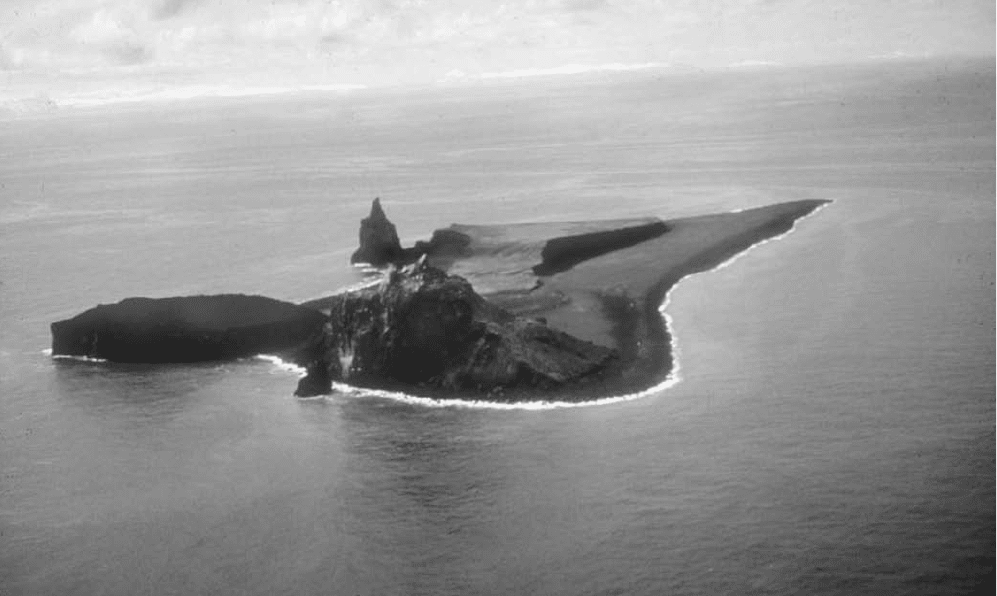
A wave-modified volcanic island, Bogoslof Island, Aleutian Islands, Alaska. It started as a circular volcanic island in the late 1700s. Wave action has
turned the island elongate. This evolution is one step in the destruction of a volcanic island. (Courtesy of the USGS)
Bogoslof 31