
Gates A.E., Ritchie D. Encyclopedia of Earthquakes and Volcanoes
Подождите немного. Документ загружается.

but was partially destroyed by an explosive eruption before
McCulloch Peak formed. McCulloch Peak was itself short-
lived; only 10 months after it appeared, the peak was demol-
ished by an explosion, leaving behind a heated lagoon almost
a mile wide. This eruption is said to have been spectacular,
with a thick black cloud and lightning reported. Further erup-
tions were reported in 1910, 1926, and 1931. The 1926 erup-
tion produced a new dome. An eruption of Bogoslof in the
1890s was one of several eruptions that occurred around the
same time (Bandai-San in 1888 and Vulcano in 1888–90).
Bolivia Located in the seismically and volcanically active
“Ring of Fire” that encircles the Pacific Ocean basin,
Bolivia is situated in northwest South America. A volca-
nic mountain in Bolivia, Cerro Rico, played an important
part in the economic exploitation of the Inca by the Spanish
Empire. The mountain contained rich veins of silver ore and
yielded great quantities of silver to be shipped to Europe. Vol-
canoes in Bolivia include Illimani, Parinacota, and Sajama.
On June 9, 1994, a massive earthquake of magnitude
8.2 occurred in a remote area of northern Bolivia. It triggered
many landslides and rockfalls, but damage to buildings
and roads was minor. The importance of this earthquake was
that it was felt throughout the United States and even in
parts of Canada. It is the first recorded incidence of an earth-
quake from this part of South America being felt in North
America. It is also the highest magnitude ever recorded in
this part of South America.
See also Andes Mountains.
Bolu-Duzce Turkey On November 12, 1999, an earth-
quake of magnitude 6.0 occurred. The earthquake resulted
in 834 deaths and 4,566 injuries. It triggered several major
landslides that blocked roadways. This earthquake was the
largest in a complex swarm of earthquakes that affected this
part of Turkey at the time.
bomb Fluid to blocky mass of lava that is shot out of a
volcano and solidifies or cools in midair before landing on
the ground. In general, volcanic bombs tend to be stream-
lined but may occur in many different shapes. If they are still
fluid, when they land they flatten. If solid, they tend to crack
and break apart. There are several different names for bombs
depending upon their shape, including bread-crust bombs
and cow-pie bombs.
Bonneville Slide Columbia River Gorge, Oregon and
Washington, United States The Bonneville Slide is a huge
quantity of soil and rock that fell from the sides of the
Columbia River gorge near Crown Point, east of Portland,
Oregon, some centuries ago, possibly around a.d. 1100.
Almost a half cubic mile of solid material was involved in the
Bonneville Slide, which may have occurred as a result of an
earthquake engendered by the Cascadia Subduction Zone
offshore to the west. The northern side of the gorge is espe-
cially susceptible to landslides because the uplift of the Cas-
cade Mountains has tilted the gorge toward the south and
because easily eroded sedimentary material underlying lava
flows along the northern side of the gorge undermines the
land. Landslides along the gorge are believed to have buried
more than 10 square miles (26 km
2
) of the gorge and created
a huge natural dam perhaps 200 feet (61 m) high and more
than 5,000 feet (1,500 m) wide. Other slides in the vicinity of
the Bonneville Slide include the Fountain Slide, Ruckel Slide,
Skamania Slide, Wind Mountain Slide, and Washougal Slide.
Boquerón volcano, El Salvador Located near the city of
San Salvador, Boquerón erupted explosively on June 6, 1917.
Though brief, the eruption destroyed most of San Salvador
and carried destruction over an area of some 20 miles (32 km)
around the volcano. A lake that had formed inside the cra-
ter of Boquerón spilled out in the form of a hot flood that
overwhelmed more than a dozen communities. lava from this
eruption collected to depths of 160 feet (49 m) in some loca-
tions, and ash accumulated in layers several feet in depth. One
curious effect of this eruption was hair loss among residents of
the area; evidently acid in an ashfall was responsible for this
occurrence. More than 400 people were reported killed in this
eruption of Boquerón. On more than a dozen previous occa-
sions, eruptions had destroyed the city of San Salvador.
bore Among the many meanings of the word bore, it also
describes a single wave in the ocean with a near vertical front.
These waves can result from seismic activity.
Bowens Reaction Series A theoretical model for the order
of crystallization of minerals in igneous rocks that explains
most rocks quite well. The diagram for crystallization is Y-
shaped with temperature decreasing downward. The left arm
of the Y represents the discontinuous reaction series (different
minerals) and the right arm represents the continuous reac-
tion series (one mineral). At about 1,400°C, olivine begins
to crystallize from the melt on the discontinuous side. As tem-
perature decreases, pyroxene, hornblende, biotite, and
muscovite will crystallize in progression, depending upon
composition of the melt. These minerals are largely ferro-
magnesian and dark in color. At 1,400°C, plagioclase
also begins to crystallize on the continuous side and it crys-
tallizes all the way down with decreasing temperature. It is
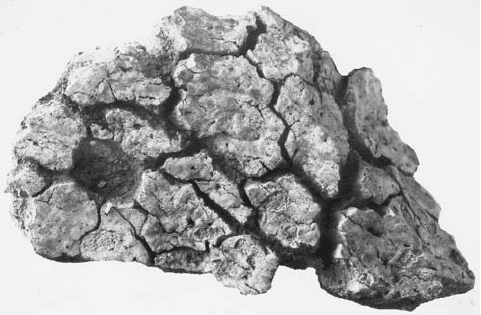
Breadcrust volcanic bomb named for the breadcrust-like cracked surface
of the bomb. (Courtesy of the USGS)
32 Bolivia
calcium-rich at high temperature and sodium-rich at low tem-
perature. The ratio of calcium to sodium depends upon the
temperature. At the stem of the Y are the lowest temperature
minerals k-feldspar and finally quartz. They crystallize at
about 750°C. This model also shows the mafic rocks crystal-
lize (and erupt) at the highest temperature (1,400°C) because
they are composed of olivine, pyroxene, and Ca-plagioclase.
intermediate rocks are composed of hornblende, biotite,
and Ca-Na plagioclase and form at intermediate temperatures
(1,000°C). felsic rocks are composed of quartz and feldspar
and form at the lowest temperatures (750°C).
bradyseism A long-continued, extremely slow vertical
instability in the crust near a volcano as in the volcanic dis-
trict west of Naples, Italy. The Phlegraean bradyseism
involves movements from 20 feet (6 m) above to 20 feet (6
m) below sea level during the last 2,000 years.
branching fault Branch off of a main fault. Also known
as a splay fault. These faults may take up some of the
movement that would have otherwise occurred on a main
fault. They may also relieve stresses that have built up but
which cannot be relieved by movement on a main fault. Most
branching faults are smaller than the main fault, but in some
cases the major movement can shift over to the branching
fault to the point of leaving parts of the main fault inactive.
bread-crust bomb Volcanic bomb with a surface that
looks like bread crust. The bomb has a rough surface that
develops cracks as it cools. It looks like old-fashioned or bak-
ery bread in which the crust is cracked as the result of expan-
sion during baking.
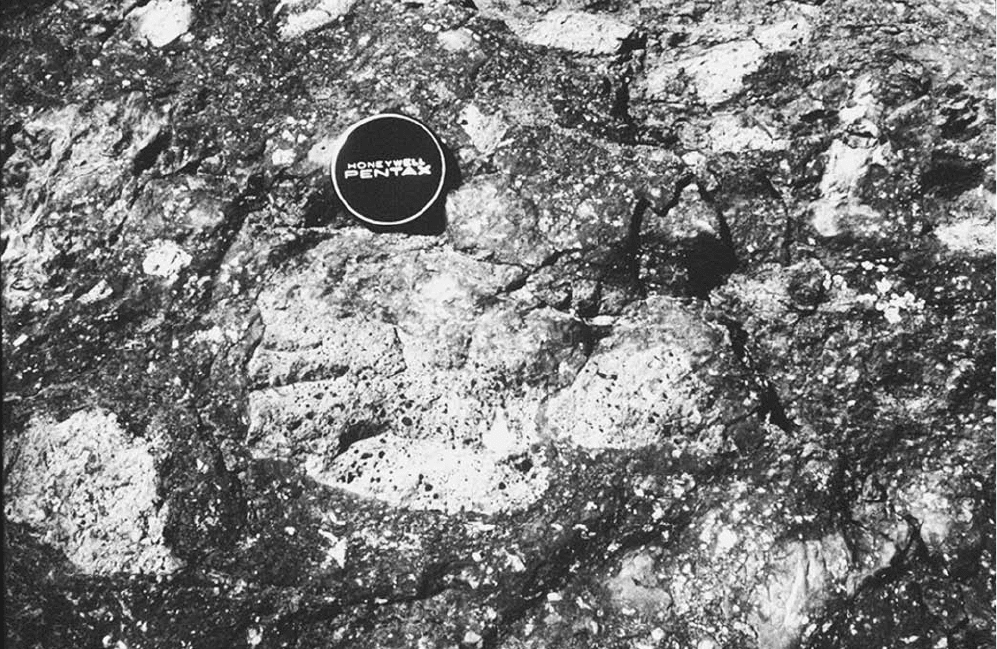
breccia A coarse-grained sedimentary rock that is made
up of angular clasts, or particles. They typically indicate that
the source of the rock fragments is nearby. There are also
volcanic breccias. In the case of volcanoes, a breccia is a rock
made up of angular clasts that are fragmented from explo-
sions at the vent of a volcano. They look similar to sedimen-
tary breccia but all of the fragments are volcanic rock and
there can be distinctive cementing material. There is also
fault breccia. Fault breccia is made of angular clasts that
were fragmented by fault movement during an earthquake.
The size of the clasts in fault breccia can vary widely.
British Columbia Canada The Canadian province of
British Columbia is located on the Pacific coast within the
circum-Pacific “Ring of Fire,” the belt of earthquake and
volcanic activity that encircles the Pacific basin. Although not
as noted for earthquake and volcanic activity as the coastal
United States (California, Oregon, and Washington)
to its south, British Columbia has a history of considerable
seismic and volcanic activity. This activity is due to the
Volcanic vent breccia produced during an explosive eruption. The white broken fragments are encased in lava. (Courtesy of the USGS)
British Columbia 33
subduction of the Juan de Fuca crustal plate along the
Cascadia Subduction Zone beneath the Pacific Ocean
to the west of the province. This subduction zone produces
the volcanoes of the Cascade Mountains, which reach into
southern British Columbia and include Mount Garibaldi, a
volcano north of Vancouver.
brittle A brittle response of a material to stress is to crack
and shatter like glass. Brittle rocks break into unconnected
pieces that are internally unchanged by the stress. For them
to break, stress must increase until it exceeds the strength
of the rock. The rock snaps, releasing sound and seismic
waves. The snapping is an earthquake. Therefore, all shal-
low faults are brittle. In contrast, ductile deformation
involves the slow and steady shape change as would occur in
squeezing gum.
brittle-ductile boundary In the shallow crust, rocks
deform in a brittle manner. They crack upon failure and
produce earthquakes. Deeper in the crust, rocks behave in a
ductile manner, distorting but not breaking. These rocks
typically do not produce earthquakes. There is a diffuse
boundary between rocks exhibiting each of these mechani-
cal behaviors that depends upon various factors. Typically,
this boundary lies at a certain depth below the surface as
a function of increasing temperatures and pressures. For
the dominant quartz-feldspar-rich rock, the transition
occurs between six and nine miles (10 and 15 km) of depth.
Under most crustal conditions, earthquakes are generated
at depths of less than six to nine miles (10–15 km). Rock
type is the primary determining factor. Clay is ductile at the
surface of the Earth, whereas ultramafic and mafic igne-
ous rocks can be brittle through the entire thickness of the
crust. mantle rocks are ultramafic, so they can be brittle
to much greater depths. Earthquakes can be generated at
depths of 240 miles (400 km) or more in a subduction
zone because the rocks are driven to great depths before
they can heat up. Normally, the transition from the lith-
osphere to the asthenosphere marks the brittle-ductile
transition in the mantle.
Bucharest earthquake, Romania A major earthquake struck
Bucharest, the capital city of Romania, at 9:20 p.m. on March
4, 1977. The earthquake had a Richter magnitude of 7.4
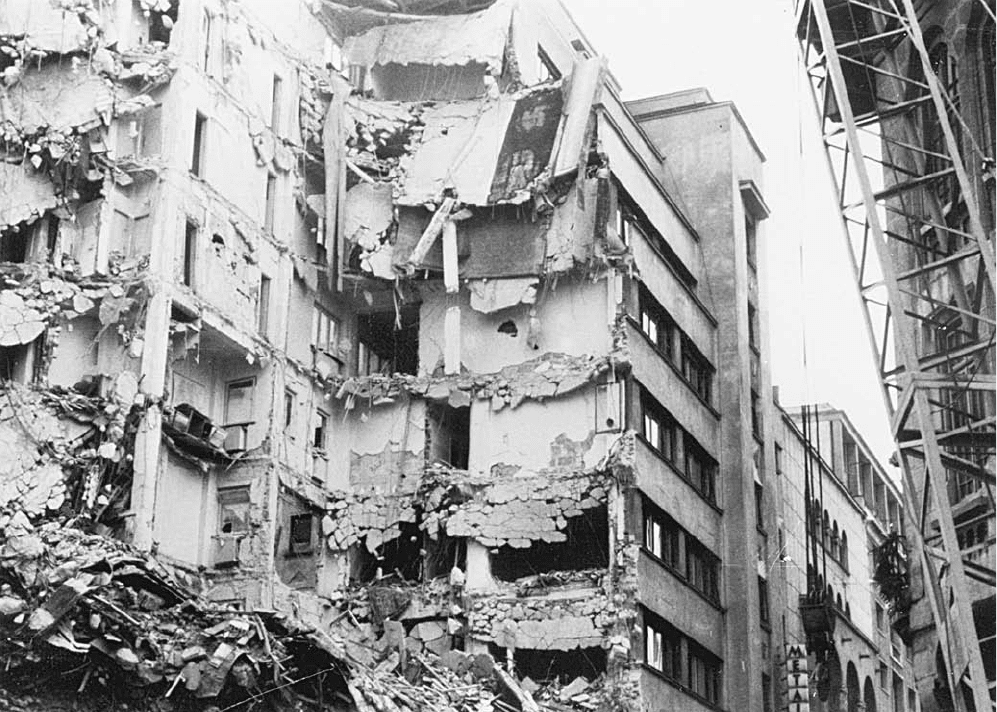
The 1977 earthquake in Bucharest caused the partial collapse of the reinforced concrete frames and masonry walls in office and apartment
buildings. (Courtesy of the USGS)
34 brittle
and was felt throughout the Balkans. Earthquakes in this area,
termed the Vrancea Zone, are typically from deep foci. The
recurrence intervals for seismic events are 30 years for mag-
nitude 7, and 120 years for magnitude 7.5. This earthquake
caused between 1,570 and 2,000 deaths. Damage was extensive.
Some 30,000 apartments, 32 eight-to-12-story buildings and
150 older six-to-eight-story buildings were destroyed, leaving
more than 35,000 families homeless. The total damage was esti-
mated at $2 billion.
Bulusan volcano, Philippine Islands Also known as Iro-
sin, the stratovolcano Bulusan is located in the southern
part of Luzon Island. Recorded explosive eruptions date
back to 1852 and have occurred every few years since then.
It erupted at least 13 times between 1886 and 1988. Seismic
records from 1978 to 1983 indicate that earthquake activity
increased before eruptions, and temperatures at hot springs
in the vicinity during this period have shown marked fluctua-
tions. earthquake swarms, however, have not always been
followed by eruptions. Earthquakes and hot-spring activ-
ity did not provide any warning of a small eruption of ash
in 1988, although an earthquake swarm was noticed some
hours following the eruption.
butte A geomorphic feature with steep sides and a flat top.
Buttes must be higher than they are wide. Otherwise, they
would be classified as a mesa or a plateau. Old weathered-
away volcanic necks like Devils Tower form buttes.
Buyin-Zahra earthquake, Iran The earthquake-ravaged
country of Iran was once again struck by a deadly temblor
in the Buyin-Zahra region in the northwestern part of the
country on September 1, 1962. The quake registered a 7.3 on
the Richter scale, and the focus was determined to be at
12 miles (20 km) of depth. Damage to buildings occurred in
Tehran, more than 100 miles (160 km) from the epicenter.
Some 12,220 people lost their lives in this disaster, and
more than 30,000 people were made homeless. More than
21,000 houses were destroyed, and heavy damage extended
60 miles (100 km) from the epicenter. Total property damage
was estimated at US$30 million in 1962 money, which made
it the most expensive disaster in Iran up to that point. It shut
down the Trans-Iranian railway for several days, stalling the
relief effort. The United States provided significant amounts
of aid that was distributed by the Iranian Red Cross.
b-value The b-value for an area is a calculated factor that
describes the ratio of small to large earthquakes within a
given time period. The b-value is commonly constant over a
large range of earthquake magnitudes. Mathematically, it is
the slope of the curve in the Guttenberg-Richter earthquake
recurrence relationship.
b-value 35
Cairo earthquake, Egypt Approximately two-thirds of
the great city of Cairo, Egypt, was reportedly destroyed by
a devastating earthquake on September 10, 1754. The esti-
mated Richter magnitude for this event was only 5.4, but
the epicenter was right under the city and the focus was at
a shallow depth. The damage rated X on the modified Mer-
calli scale. The final death toll was estimated at 40,000,
making it one of the most destructive in Egyptian history.
Calabria earthquakes, Italy The earthquakes that began in
Calabria in southern Italy in early February 1783 and con-
tinued for the rest of that year were felt over a wide area of
the Italian Peninsula and Sicily. The earthquakes began with
a powerful shock on February 5 and continued with another
strong event on March 28. The earthquakes appear to have
been centered near the town of Oppido and to have caused
extensive destruction for several miles around. Scarcely any
structure in Oppido was said to remain standing after the first
earthquake. Large chasms opened in the ground and report-
edly swallowed numerous houses. One chasm opened in these
disturbances measured some 500 feet (152 m) long and 200
feet (61 m) deep. landslides occurred along the shores of the
Straits of Messina and allegedly destroyed numerous villas.
Following the February 5 earthquake, residents of the
area recognized the danger of remaining on the coast and
evacuated the shoreline, either moving slightly inland to ele-
vated ground or putting out to sea on fishing boats. These
safety measures proved ineffective. The night after the evacu-
ation, a strong earthquake dislodged a large mass of earth
from Mount Jaci; part of the falling material landed in the
sea and generated a disturbance that sent a wave rolling over
the ground on which the refugees had gathered. The wave is
also said to have caused the destruction of the fleet of boats.
More than 1,400 people were reported killed. Much of the
city of Messina was destroyed in the earthquakes by the
shocks themselves and by subsequent fires.
The earthquakes in February and March are believed to
have killed some 40,000 people, not counting an estimated
20,000 who died later from exposure, disease, and other
causes. Reportedly, thermal springs burst forth from fissures
in the ground. One spectacular account says that some indi-
viduals fell into these fissures and then were cast out again
in outbursts of boiling water; although survivors of these
ordeals were reportedly rare, some did live through them but
were said to have been crippled by burns for the remainder of
their lives.
In another great earthquake at Calabria on December
16, 1857, whole villages reportedly fell into huge fissures in
the earth, and more than 10,000 people are thought to have
been killed. According to one estimate, some 111,000 people
in the vicinity of Calabria were killed in earthquakes between
the years 1783 and 1857—an average of 1,500 deaths per
year.
Calaveras Fault California One large splay fault off the
main San Andreas Fault. It is an active fault that produces
major earthquakes.
Calbuco volcano, Chile The stratovolcano Calbuco has
erupted several times since 1837. A 1929 eruption buried for-
ests in the vicinity under thick layers of ash.
calc-alkaline series A chemical index for volcanic rocks
that are produced in a subduction zone. The series usu-
ally begins with basalt of a composition distinct from that
produced in the mid-ocean ridge or in a hot spot. Later
volcanic rocks are andesite and possibly dacite. This suc-
cession contrasts sharply with that produced in a mid-ocean
ridge, which is referred to as a tholeiitic series.
Calcutta earthquake?, India The 1737 Calcutta earth-
quake was estimated to have caused some 300,000 deaths,
placing it among the top 3 or 4 earthquakes of all time.
Recent analyses of the event, however, not only cast grave
doubt on the number of casualties but also whether there
was an earthquake at all. The problem is that on the day of
C
37
the supposed earthquake, October 11, 1737, a major cyclone
struck the Calcutta area. It was such an intense storm that it
scuttled and sank eight of the nine British ships moored in the
Ganges River and virtually all of the boats operated by the
natives. Certainly, many deaths were attributed to this storm.
The British East India Company, however, did not compile
an official report of the disaster until the survivors reached
headquarters in London some six months later. Their official
report listed 3,000 fatalities, with no mention of an earth-
quake at all. In the following year, Gentlemen’s Magazine
and London Magazine featured stories that claimed 300,000
deaths as the result of an earthquake. Thus began the con-
fusion about the event. Historical records indicate that the
urban population of Calcutta in 1737 was probably less than
20,000. There were other settlements outside of Calcutta,
but it is doubtful that there were 300,000 in the whole area,
much less that many killed. Although there were numerous
small to moderate earthquakes in the Calcutta area, they were
not the huge temblors that struck the plate boundary area to
the north. It is unlikely, but not impossible, that such a huge
earthquake could even strike Calcutta. It is most likely that
the 1737 Calcutta earthquake is the earthquake that never
happened.
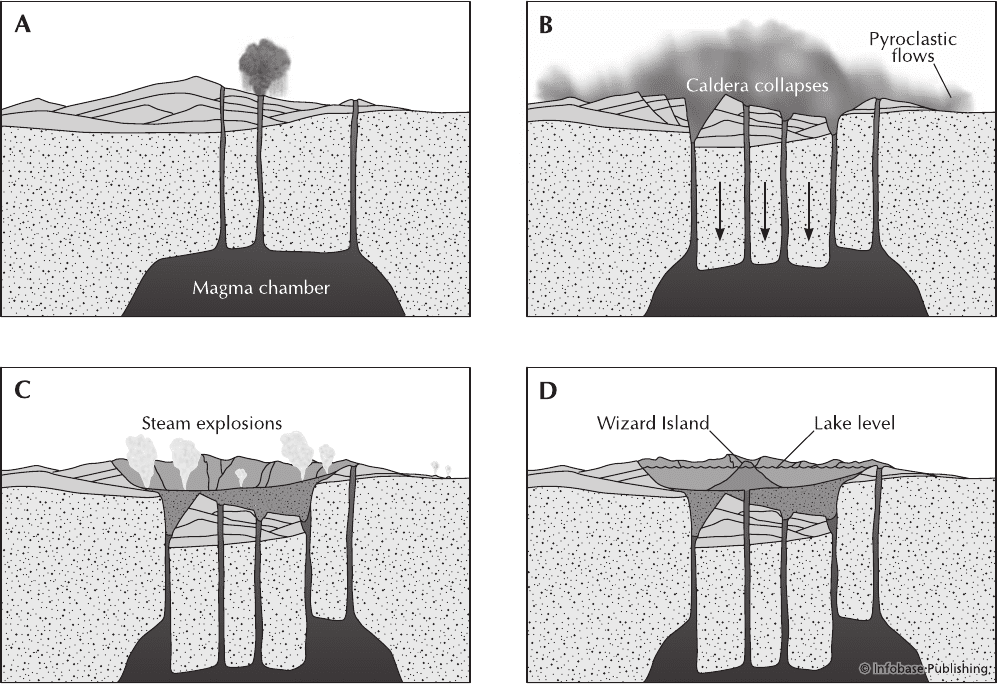
caldera A large, roughly circular depression commonly
formed by the explosion or collapse of a volcanic cone at
any elevation. A caldera may be miles in diameter and har-
bor lakes containing volcanic islands. A famous example of a
caldera is Crater Lake in Oregon. A caldera is much wider
than the volcanic vent(s) involved in its formation. A caldera
complex consists of the rock assemblage underlying a caldera
and may involve a wide variety of constituents, including, but
not limited to, tuff, breccia, dikes, stocks, and sills. A
“resurgent” caldera is one in which volcanic activity resumes
after the caldera has formed. Crater Lake again is a familiar
example of a resurgent caldera. Others include Creede Cal-
dera in Colorado and Valles caldera in New Mexico.
The formation of a caldera is a spectacular event. A tre-
mendous explosion or series of explosions may be involved,
as in the case of the destruction of Krakatoa, where explo-
sions demolished much of the island and left behind a fresh
caldera. Such an event may affect areas hundreds or even
Four-stage schematic model for caldera collapse and the formation of a crater lake at Mount Mazama. (A) Typical volcanic eruption with overlapping
stratovolcanoes. (B) Collapse of the caldera by gravity as magma is drained from the magma chamber. This results in extensive pyroclastic flows. (C)
Post-eruption fumarole activity. (D) A small cinder cone is built as water fills the collapsed caldera.
38 caldera
thousands of miles away, through mechanisms such as ash-
falls and tsunamis. The opposite process, collapse, rather
than explosion, also may be responsible for forming calde-
ras. Collapse may occur when magma underneath a volcanic
peak drains away through underground conduits or perhaps
through a parasitic vent on the flank of the volcano; as the
molten rock below it is removed, the peak loses its underpin-
nings, so to speak, and falls inward upon itself. This process
appears to have created Crater Lake in Oregon, one of the
most accessible and scenic calderas in the world. Calderas are
not always so easy to identify as those at Krakatoa and Crater
Lake; subsequent volcanic activity and/or erosion may cover
or erase many traces of a caldera. Over many years, several
calderas may form at a given location and form a complex
pattern of overlapping, roughly circular features.
Activity at calderas may take many forms. Ground
deformation may occur. In some cases, ground deforma-
tion is so slight that it can be measured only by using special,
sensitive instruments. In other cases, ground deformation
may be dramatic, measured in inches per day. In rare cases,
ground deformation has lifted structures at harbors many feet
out of the water. Giant shield volcanoes, such as those in
Hawaii, exhibit a special pattern of deformation. The entire
summit inflates until lava emanates from the volcano. Some-
times uplift at calderas can elevate the surface more than
1,000 feet (305 m), as happened during an eruption at Toya
caldera in Japan. A caldera floor may also drop suddenly by
hundreds of feet under the appropriate conditions. Perhaps
the most famous case in point occurred at Fernandina cal-
dera in the Galápagos Islands in 1968, when a portion of
caldera floor subsided up to 1,000 feet (305 m) or more in
little more than a week. As a rule, however, uplift and sub-
sidence at calderas tend to be more gradual.
Temperature changes are commonly seen when activity
occurs at calderas. fumaroles, lakes, hot springs, and the soil
itself may show marked increases in temperature. The water
level in crater lakes may change, as may the colors of lakes.
Chemical changes in groundwater, hot springs, and fumaroles
also may be observed. Another phenomenon observed in and
near calderas in connection with eruptions is change in Earth’s
magnetic field. Little is understood about these changes,
although they are thought to be linked to tectonic forces or to
demagnetization of country rock. Changes in gravity have
been noted at calderas and have been attributed to uplift or
subsidence, changes in density of rock beneath the surface, and
movement of magma or groundwater.
Unrest at a caldera may be brief or prolonged, depending
on circumstances at the site. Some calderas have been active
almost continually in the recent past, whereas others have
been quiet for many centuries. There is also a great range of
intensity in caldera unrest. Activity at some calderas has been
extremely violent, whereas other calderas have a history of
only mild activity. The most evident unrest may be confined
to the area of an active vent, although it is commonplace for
unrest at a caldera to involve the entire caldera in one way or
another; deformation and other signs of unrest may occur all
through a caldera during an episode of unrest.
Among the more exotic factors that appear to influence
activity at calderas are ocean loading and unloading, mean-
ing the increase and decrease respectively of the weight from
water piled atop the area of a caldera. Increased ocean load-
ing is thought to contribute to eruptions in some situations
by exerting pressure on a magma reservoir underground and
forcing magma toward the surface. This process is believed to
operate at Pavlof volcano in Alaska from time to time. On
the other hand, ocean unloading also is suspected of creating
conditions favorable to eruptions; a case in point is Rabaul,
where an eruption in 1983 and 1984 is believed to have been
connected with ocean unloading.
As a rule, earthquakes in or near calderas are small,
although there have been notable exceptions to this pattern,
such as the powerful earthquakes, greater than magnitude 7
on the Richter scale, that have occurred in the vicinity of
Kilauea in Hawaii on occasion. Earthquakes in a caldera
setting have various causes. Some are tectonic in origin,
meaning they result from the readjustment of shifting blocks
of Earth’s crust rather than directly from volcanic processes.
(A very strong earthquake in the vicinity of a caldera stands a
good chance of being tectonic rather than volcanic in origin.)
Some earthquakes at calderas are associated with intrusion of
molten rock underground, whereas others may result from
processes including tectonic activity and the draining away
of molten rock from beneath the caldera. Volcanic tremor
is the expression for earthquakes that are thought to result
from flow of magma and/or gases through narrow space
underground or other mechanisms such as the collapse of
bubbles in magma. There is no single pattern of seismic activ-
ity associated with eruptions at calderas; although, one pat-
tern often observed is for an eruption to occur as earthquakes
reach a maximum of energy release after a quick increase.
Another pattern sometimes seen is for an eruption to begin
in the lull after seismic energy has increased and then dimin-
ished sharply. There appears to be no connection between the
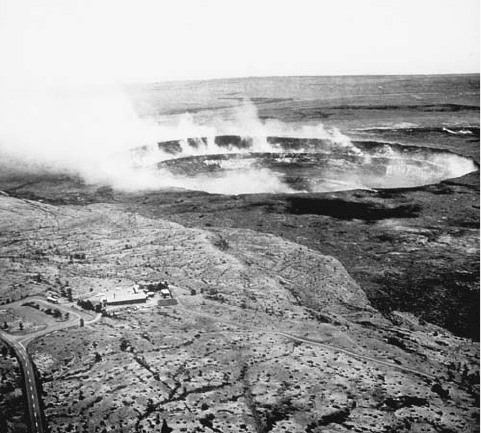
A large caldera on Kilauea, Hawaii. The white steam comes from boiling
groundwater. (Courtesy of the USGS)
caldera 39
intensity of earthquake activity before an eruption at a cal-
dera and the power of the eruption itself. Eruptions at calde-
ras may be classified as normal explosions, involving magma
and gases released from it, and phreatic explosions, involv-
ing groundwater turned into vapor. Phreato-magmatic explo-
sions, as they are sometimes called, are combinations of the
previous two varieties. Eruptive phenomena may include ash-
falls, lava flows, lava lakes, domes, crypto-domes, land-
slides, cinder cones,
NUÉE ARDENTEs, avalanches, and
submarine and subglacial eruptions.
caldera complex A group of multiple calderas on a single
or even small group of volcanoes. Caldera complexes are
common on shield volcanoes. There can be several calde-
ras that are concurrently active, or they can be intermittently
active. Typically, one of the calderas will be dominant both
in size and activity. In addition, new calderas may develop
while others may become inactive. A good example of a cal-
dera complex is Kilauea on Hawaii. Several calderas on the
same shield volcano have been active through recorded his-
tory. Each is named.
California United States California is known as the earth-
quake state because it has been the site of some of America’s
most powerful and destructive earthquakes, including the
famous San Francisco earthquake of 1906. The great San
Andreas Fault lies along the western shore of California, but
it is not the only active fault in the state. Numerous faults,
inactive and active, are found in California, and no part of the
state is completely free from seismic disturbances. Well-known
faults in California include the Hayward Fault, Calaveras
Fault Zone, Imperial Fault, Manix Fault, and Garlock Fault.
California is so active from a seismic standpoint that a com-
plete list of all earthquakes in its history is impossible in the
space available here. What follows is a partial list of major
California earthquakes during the past two centuries:
EARTHQUAKE HISTORY OF CALIFORNIA
Early Earthquakes
An earthquake on July 28, 1769, in the region of Los Ange-
les involved four very strong shocks followed by many oth-
ers over the next few days and possibly into the following
year. In October 1800, an earthquake at San Juan Bautista
left every dwelling there uninhabitable, and carts outdoors
were used for sleeping; the date of the principal shock is not
known, but it reportedly was accompanied by an extremely
loud noise. An earthquake in June 1838 in the area of San
Francisco is thought to have been comparable in power to the
catastrophe that destroyed the city in 1906; the earthquake
generated effects of Mercalli intensity X, and large displace-
ments were reported along the San Andreas Fault. The shock
was especially strong at Yerba Buena, and heavy damage was
reported at the missions in San Francisco, San Jose, and Santa
Clara, as well as at the Presidio in San Francisco.
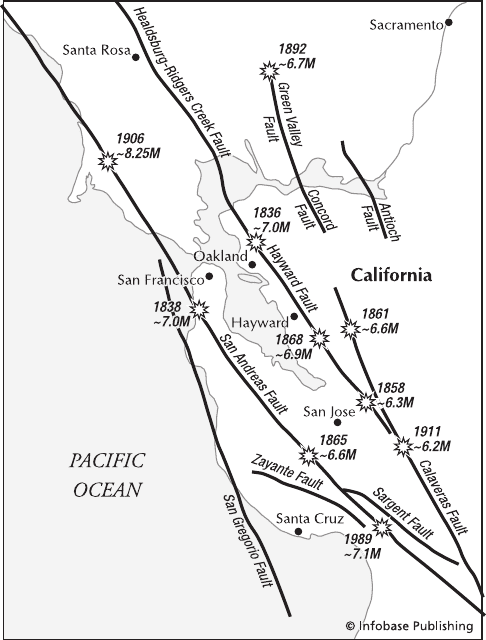
Hayward, 1868
The October 21, 1868, earthquake at Hayward caused maxi-
mum damage there and at other locations along the Hayward
Fault. Virtually every building in Hayward experienced heavy
damage, and some were ruined completely. Civic buildings
were destroyed in San Leandro. San Francisco again experi-
enced damage to buildings on landfill, and property damage
appears to have exceeded $350,000. Some 30 persons are
thought to have been killed in this earthquake, which was fol-
lowed by aftershocks continuing into the following month.
The great San Francisco earthquake of April 18, 1906, is cov-
ered in detail elsewhere in this volume.
Santa Barbara, 1925
The Santa Barbara earthquake of June 29, 1925, caused an
estimated $8 million in damage in Santa Barbara, where
most buildings on the principal street in the commercial dis-
trict were damaged. Thirteen people were killed in the earth-
quake, and movement of approximately one foot was seen
along a boulevard built on a beach. An earth dam at a reser-
voir failed, but the freed water did little harm. Much of the
exterior of a hotel collapsed. An office building failed, and
the roof of a church collapsed. This earthquake served as a
reminder that sound design and construction can preserve a
Fault and major recent earthquake map of northern California, San
Francisco Bay area. The San Andreas Fault is a transform margin whose
actions control the activity of the other faults in the area. They are either
splays or compensation features. The star symbols are the locations of
major earthquake epicenters with the year of the event and the Richter
magnitude followed by an M.
40 caldera complex
building even in earthquake-prone territory and on less than
stable soil. For example, one concrete building, well designed
and given a good foundation, went through the earthquake
with little or no damage, even though the building was con-
structed in a marshy area. Reinforced concrete proved resis-
tant to the earthquake, except where construction was faulty.
Strong aftershocks were reported on July 3. Another earth-
quake at Santa Barbara on June 29, 1926, killed a child and
knocked down some chimneys.
Long Beach, 1933
The Long Beach earthquake of March 10, 1933, was not one
of the most powerful in California’s history (magnitude of
only 6.3), but it caused extensive damage because it occurred
in a heavily settled area. The epicenter was located slightly
offshore from Huntington Beach, but the shock was felt from
San Diego to Santa Barbara and as much as 50 miles (80 km)
inland. More than 120 people were killed, and hundreds
more were injured. Damage was estimated at approximately
$50 million. Most damage occurred in an area character-
ized by water-rich soil and structurally unsound buildings.
The most strongly affected area extended from southern Los
Angeles to Manhattan Beach, Anaheim, and Laguna Beach.
Destruction was especially notable in such places as Comp-
ton, Huntington Park, and Long Beach. Severe damage to
up to 75% of school buildings occurred, some to the point
of complete collapse. If school had been in session, it is esti-
mated that there would have been several thousand deaths.
No fault displacement was noted.
El Centro, 1940
One of the most famous and powerful earthquakes in Cali-
fornia history was the Imperial Valley earthquake of May 18,
1940. The earthquake was estimated at magnitude 7.1, gen-
erated effects of Mercalli intensity X, and had its epicenter
southeast of El Centro. Horizontal displacement up to 15 feet
(5 m) and vertical displacement of as much as four feet (1.3
m) were reported. Damage was widespread in the Imperial
Valley and was estimated at $6 million on the United States
side of the border alone, not counting indirect effects such
as those on agricultural irrigation systems. Surface ruptures
occurred over some 40 miles (70 km). About four-fifths of
the buildings in Imperial were damaged, and the city’s water
tanks were ruined. Almost half the buildings in nearby Braw-
ley were damaged, and a city water tank collapsed at Holt-
ville. The earthquake also was blamed for a fire at a hotel in
Mexicali, Mexico.
One of California’s largest earthquakes was in Kern
County, 1952. It and the San Fernando earthquake of
February 9, 1971, are described in detail elsewhere in this
volume, as is the 1989 Loma Prieta earthquake in the San
Francisco area and the 1994 North Ridge earthquake near
Los Angeles.
Tsunamis in California
California, having a long coastline, is subject to occasional
tsunamis, or seismic sea waves. These waves may be gen-
erated by earthquakes along the California coast or else-
where; the 1964 Good Friday earthquake in Alaska, for
example, produced a tsunami that caused extensive damage
in Crescent City, California, near the Oregon border.
One of the most remarkable tsunamis in California history
occurred on December 17, 1896, when a wave that may
have been seismic in origin struck Santa Barbara and carried
away a large portion of a boulevard that had been reinforced
especially to resist wave action. A large hill of sand between
the boulevard and the usual high-tide mark was also carried
away by the wave. There is a possibility, however, that this
wave was produced by a storm rather than by seismic activity
because there appears to have been no strong earthquake in
the vicinity on this date.
Because of the earthquake potential of southern Califor-
nia, the “tsunamigenic,” or tsunami-making, potential of faults
there has received considerable attention. Generally speak-
ing, faults along the southern California coast do not appear
to pose a great tsunamigenic threat, but faults thought to be
capable of producing tsunamis are found in some locations
off the coast of southern California, notably in the vicinity of
Point Arguello. In and near the Santa Lucia Bank, an elevated
area on the continental slope near the California shore, faults
are suspected of being able to produce powerful earthquakes
and the tsunamis associated with them. Another offshore area
with suspected tsunamigenic potential is located in the area
of Santa Barbara Channel and the nearby Transverse Ranges.
Powerful, destructive earthquakes have occurred in this area
(the December 21, 1812, earthquake that caused such heavy
damage to missions onshore, for example, is thought to have
involved fault rupture under the Santa Barbara Channel), and
future earthquakes of high magnitude might result in tsuna-
mis of considerable destructive power. Tsunamis produced
by submarine slides are another possibility along the southern
California coast, although this particular hazard is thought to
be small. The California coast remains vulnerable, however,
to tsunamis involved with seismic disturbances elsewhere
around the Pacific Basin, particularly in Alaska, where certain
areas contain the potential for very powerful earthquakes that
might produce large tsunamis.
California also has a history of recent volcanic activity,
some of it during the 20th century. Lassen Peak, a volcano
in northern California, erupted with great violence during
World War I. Volcanic formations may be seen also at Long
Valley caldera. geothermal energy plays a small but
interesting part in providing electric power for California.
Cameroon, Mount Cameroon A stratovolcano located
180 miles west of the capital city of Yaoundé. It is also
known as Mount Faka and “Chariot of the Gods.” It gen-
erally produces flank eruptions with lava flows from
small cinder cones. One eruption in the fifth century b.c.
and observed by a Carthaginian ship is one of the earliest
recorded volcanic eruptions in the world. Mount Cameroon
is very active, having produced six eruptions in the 20th cen-
tury alone. Its most recent activity lasted from March until
June 1999. Thousands of people were evacuated, and hun-
dreds of homes were destroyed during this eruption.
Campania earthquake, Italy On November 23, 1980,
an earthquake of magnitude 6.8 struck southern Italy. It
Campania 41