
Gliklikh Y.E. Global and Stochastic Analysis with Applications to Mathematical Physics
Подождите немного. Документ загружается.

306 13 Some Problems on Lorentz Manifolds
in the world line and construct in T
m
M a basis e
0
,e
1
,e
2
,e
3
such that e
0
is
the 4-velocity of our observer and e
1
,e
2
,e
3
are space-like vectors with square
+1, orthogonal on M to each other and to e
0
with respect to the Lorentzian
metric (such a basis is called an orthonormal basis).
Definition 13.14. The above basis is called a reference frame of the observer
at m.
Remark 13.15. The reference frame described in Definition 13.14 is a very
particular case of a general notion used in contemporary physics, but it is
convenient for our exposition. We refer the reader, e.g., to [182, 199, 200]for
a detailed discussion. Below in Section 13.2 we deal with a special type of
reference frame suggested by A. Poltorak [196, 197, 198].
The linear span of e
1
,e
2
,e
3
is a 3-dimensional subspace in T
m
M
4
,or-
thogonal to the 4-velocity of the observer, that is interpreted as the space of
3-dimensional velocities of physical objects around the observer at m. Vectors
from this subspace of T
m
M
4
are called 3-vectors. For any 3-vector we can
find a unique geodesic starting from m in its direction. The surface filled by
such geodesics is interpreted as the set of events perceived by the observer as
synchronous with the event m in his (or her) world line.
Notice that for two different observers at the same event m their syn-
chronous surfaces are different since they depend on (i.e., are orthogonal to)
the 4-velocity of the observer.
Remark 13.16. (Past and Future Domains) Unlike the synchronous surface,
which depends on the 4-velocity (and hence on the reference frame) of the
observer, the notions of “past” and “future” are “absolute”, i.e., they depend
only on the event and so they are the same for all observers located at the
same event. These notions are introduced as follows.
Specify an event m ∈ M
4
. We say that an event m
1
belongs to the future
for m if there exists a time-like or light-like world line that starts from m and
as τ (or η) increases, eventually reaches m
1
for some value of the parameter.
If such a world line is time-like, we say that m
1
belongs to the proper future
of m.
The notions of “past” and “proper past” are introduced analogously. Note
that “proper future” and “proper past” are open domains in M
4
while “past”
and “future” are closed, i.e., they are the closures of the “proper future” and
the “proper past”, respectively.
There are simple examples describing the following phenomenon: If m
2
belongs neither to “future” nor to “past” for m
1
(and so vice versa), there
exists an observer for whom those events are synchronous, an observer for
whom m
1
happens earlier than m
2
and an observer for whom m
2
happens
earlier than m
1
.
Let V ∈ T
m
M be the 4-velocity of some object. Represent V as a pair
V =(˙q
0
,
¯
V )where ˙q
0
is collinear with e
0
and
¯
V belongs to the linear span

13.1 Introduction to Relativity Theory 307
of e
1
,e
2
,e
3
.
¯
V is interpreted as an infinitesimal motion in space and ˙q
0
is
interpreted as an infinitesimal increment of time. Thus from the usual physical
ideology we get the following:
Definition 13.17. v =
¯
V
˙q
0
is called the 3-velocity corresponding to the 4-
velocity V with respect to the above reference frame.
In the same manner we can define the 3-velocity of light. This means
that for any light-like vector X ∈ T
m
M we consider its decomposition X =
(X
0
,
¯
X), where X
0
is collinear with e
0
and
¯
X belong to the linear span of
e
1
,e
2
,e
3
, and then define the 3-velocity of light as
¯
X
X
0
.
Proposition 13.18 For every observer the norm of the 3-velocity of light
(i.e., light speed) is equal to 1.
Proof. Without loss of generality we can suppose that
¯
X is collinear with e
1
(if this is not the case we simply rotate the triple e
1
,e
2
,e
3
around e
0
). Thus
the coordinate presentation of X in this basis is X =(X
0
,X
1
, 0, 0), i.e.,
¯
X =(X
1
, 0, 0). On the one hand X
2
= 0 and on the other hand, in our case,
X
2
= X, X = −(X
0
)
2
+(X
1
)
2
.ThusX
0
= X
1
and
¯
X
X
0
=
X
1
X
0
=1.
Following Proposition 13.18, we shall be working in a system of units where
the speed of light c isequalto1.
Now let us turn back to time-like vectors. Of course the observer can see
only 3-velocities. If a v with norm less than 1 is given, then it is possible to
recover V since it is the unique time-like vector with square −1 such that
v =
¯
V
˙q
0
. To find V notice that the square of the vector (1,v)isequalto−1+v
2
so that the square of (
1
√
1−v
2
,
v
√
1−v
2
)is−1. Since
v
√
1−v
2
divided by
1
√
1−v
2
gives v,wehaveV =(
1
√
1−v
2
,
v
√
1−v
2
).
Since P = mV we obtain P =(
m
√
1−v
2
,
mv
√
1−v
2
). The 3-vector p =
mv
√
1−v
2
is interpreted as 3-momentum. Since v is much less that c (i.e., less than 1
in our system of units), the denominator is very close to 1 and, by ignoring
this negligible difference, the above formula turns into the usual definition of
momentum one finds in high school physics.
In order to understand the physical interpretation of
m
√
1−v
2
let us find its
Taylor expansion in v at a neighborhood of v = 0. This expansion has no odd
terms and we get:
m
√
1 −v
2
= m +
mv
2
2
+ ...
Further terms are negligible, so they can be omitted.
mv
2
2
is the kinetic en-
ergy. The quantity m is interpreted as the internal energy of the object with
mass m. It is well-known as E = mc
2
(Einstein’s famous formula of internal
energy) and takes the above form only because c = 1 in our system of units.
Thus
m
√
1−v
2
has the physical interpretation of total energy, a type of energy
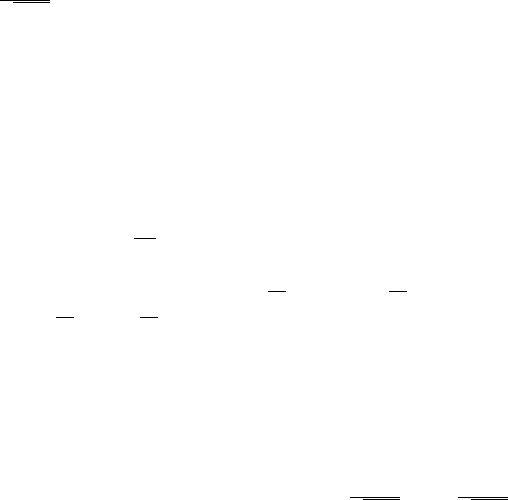
previously unknown in classical physics.
308 13 Some Problems on Lorentz Manifolds
Notice that as v → 1 (i.e., as the speed of an object approaches light
speed) both the 3-momentum and the total energy tend to infinity.
Remark 13.19. Sometimes m is called the rest mass and another sort of
mass m
r
=
m
√
1−v
2
, called relativistic mass, is introduced. In this notation
p = m
r
v and one says that the relativistic mass (and the 3-momentum) tends
to infinity as v → 1. From the mathematical point of view (a view shared by
many physicists) since this approach is equivalent to that presented above,
there is no reason to introduce the notion of relativistic mass.
If a world line m(τ) is not a geodesic, then it describes the “life” of an
observer under the action of the so-called 4-force F and the equation of this
world line takes the form
D
dτ
P = F (m(τ),V). (13.3)
Note that since V,V = −1 (constant),
d
dτ
V,V =2
D
dτ
V,V =0.From
this it follows that
D
dτ
P = m
D
dτ
V is orthogonal to V .
Remark 13.20. The 4-force is always orthogonal to the 4-velocity and so,
in particular, it necessarily depends on the 4-velocity.
The 4-force F can be represented in the same manner as V and P, i.e., as
the pair (f
0
,
¯
f). The 3-vector
¯
f is interpreted as 3-force, the physical force
that can be measured by the observer. In order to understand the meaning
of f
0
recall that F, V = 0 (see above). Hence −f
0
m
√
1−v
2
+
¯
f ·
mv
√
1−v
2
=0
where the dot denotes the inner product in the linear span of e
1
,e
2
,e
3
(recall
that it is positive definite since e
1
, e
2
and e
3
are space-like). Thus f
0
=
¯
f ·v
is the power of the 3-force
¯
f.
13.1.4 Some consequences
The parameter of velocity and hyperbolic trigonometry
The coordinate expansion of a vector X ∈ T
m
M at some m ∈ M with re-
spect to e
0
,e
1
,e
2
,e
3
takes the form (X
0
,X
1
,X
2
,X
3
). Consider the subspace
consisting of vectors with X
2
= X
3
= 0. This is a 2-dimensional vector space
with (Minkowski) inner product X, Y = −X
0
Y
0
+ X
1
Y
1
. An analog of the
Euclidean unit circle is the set of vectors in this subspace whose square is
−1. Of course this set is not a circle but the hyperbola −(X
0
)
2
+(X
1
)
2
= −1
(equivalently, (X
0
)
2
− (X
1
)
2
=1).
The length of an arc in the above hyperbola, starting at (1, 0), is an analog
of the angle, and the abscissa and ordinate of the end point of the arc are
analogs of cosine and sine, respectively.

13.1 Introduction to Relativity Theory 309
In order to investigate these analogs, represent the hyperbola in para-
metric form X(θ)=(X
0
(θ),X
1
(θ)) and consider its derivative
˙
X(θ)=
(
˙
X
0
(θ),
˙
X
1
(θ)). Since X(θ),X(θ) = −1, we have
X(θ),
˙
X(θ) =
1
2
d
dθ
X(θ),X(θ) =0
and so
˙
X(θ) is orthogonal to X(θ), i.e.,
˙
X(θ) is collinear to (X
1
(θ),X
0
(θ)):
indeed, (X
0
(θ),X
1
(θ)), (X
1
(θ),X
0
(θ)) = −X
0
(θ)X
1
(θ)+X
1
(θ)X
0
(θ)=0.
Without loss of generality we may suppose that
˙
X(θ)=(X
1
(θ),X
0
(θ)).
Thus, in particular,
˙
X(θ)
2
= −(X
1
(θ))
2
+(X
0
(θ))
2
= −X(θ)
2
=1sothat,
on the one hand, the vector
˙
X(θ) is space-like and on the other hand the
parameter θ is the length of the arc since the norm of the derivative with
respect to this parameter is 1.
Definition 13.21. The parameter θ introduced above is called the parameter
of velocity on the hyperbola X
2
= −1.
Now let us try to find the coordinates X
0
(θ)andX
1
(θ) of a point in the
hyperbola, i.e., the analogs of cosine and sine. Introduce the variables Y (θ)=
X
0
(θ)+X
1
(θ)andZ(θ)=X
0
(θ) −X
1
(θ). Since
˙
X(θ)=(X
1
(θ),X
0
(θ)), we
have
˙
X
0
(θ)=X
1
(θ)and
˙
X
1
(θ)=X
0
(θ). Thus
˙
Y (θ)=Y (θ)and
˙
Z(θ)=
−Z(θ). These are linear differential equations whose solutions with initial
conditions Y (0) = 1 and Z(0) = 1 (corresponding to the initial point (1, 0)
of the hyperbola) are Y (θ)=e
θ
and Z(θ)=e
−θ
, respectively. Then X
0
(θ)=
1
2
(Y (θ)+Z(θ)) =
e
θ
+e
−θ
2
=coshθ, the hyperbolic cosine of θ,andX
1
(θ)=
1
2
(Y (θ) − Z(θ)) =
e
θ
−e
−θ
2
=sinhθ, the hyperbolic sine of θ.
Now the 3-velocity v, corresponding to V =(X
0
(θ),X
1
(θ)) belonging to
the unit hyperbola (i.e., it is some 4-velocity), is represented in the form
v =
X
1
(θ)
X
0
(θ)
=
sinh θ
cosh θ
=tanhθ, the hyperbolic tangent of θ. This is why we call
θ the parameter of velocity (see Definition 13.21).
Composition of velocities
Consider the reference frame of an observer as described in Section 13.1.3.
Suppose that, for example, a brick with 4-velocity V
b
is in flight near the
observer. Then the 3-velocity v
b
of the brick with respect to the observer
can be calculated as the hyperbolic tangent of the parameter of velocity θ
1
between e
0
and V
b
(see above) in the reference frame of the observer.
Suppose in addition that an ant with 4-velocity V
a
is creeping along the
brick in the same direction that the brick is passing the observer. The 3-
velocity v
ab
of the ant with respect to the brick is the hyperbolic tangent of
the parameter of velocity θ
2
between V
b
and V
a
in the reference frame of the
brick.
Since the brick and the ant are moving in the same direction, in classical
Newtonian physics the vector of the ant, with respect to the observer, would

310 13 Some Problems on Lorentz Manifolds
be given by the vector in this common direction with norm equal to the sum
of the norms of the brick vector, relative to the observer, and the ant vector,
relative to the brick. This is not the case in Relativity Theory.
Let us suppose that the direction of e
1
coincides with the common direction
of the motion of the brick and the ant. The parameter of velocity for V
a
in
the reference frame of the observer is θ
1
+ θ
2
. It then follows from the above
constructions that v
a
=tanh(θ
1
+ θ
2
). One can easily find the following
formula for the hyperbolic tangent of a sum:
tanh(θ
1
+ θ
2
)=
tanh θ
1
+tanhθ
2
1+tanhθ
1
tanh θ
2
(compare this with the formula for the usual tangent of a sum). Thus we get
that
v
a
=
v
b
+ v
ab
1+v
b
v
ab
.
This is the well-known relativistic rule for the composition of velocities. Notice
that if both v
b
and v
ab
are negligible in comparison with 1 (the light speed
in our system of units), this formula turns into the familiar formula for the
composition of velocities of classical physics.
Proposition 13.22 The speed of light does not depend on the speed of the
light source.
Proof. Let us replace the ant of the above example by a beam of light. This
means that V
a
is replaced by a light-like vector X and that its 3-velocity in
the reference frame of the brick is 1. By the above formula for the composition
of velocities we get that the 3-velocity of light with respect to the observer is
v
b
+1
1+v
b
=1.
The assertion of Proposition 13.22 was the starting point of Einstein’s
relativity theory.
Lorentz transformations
In Euclidean space there are linear operators A which satisfy Ax ·Ay = x ·y
for any vectors x, y,where· is the inner product, i.e. the operator does not
change the inner product of any pair of vectors. Such operators are said to be
orthogonal. By physical reasons we suppose those operators to be orientation
preserving. In 2-dimensional Euclidean space the form of the matrix of an
orthogonal operator (a rotation) with respect to an orthonormal basis is well-
known:
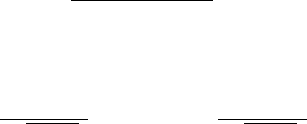
cos ϕ sin ϕ
−sin ϕ cos ϕ
where ϕ is the angle of rotation.
In Minkowski space there are analogous operators which leave the
Lorentzian inner product unchanged.
13.1 Introduction to Relativity Theory 311
Definition 13.23. An operator L in Minkowski space such that for any vec-
tors X,Y the relation AX, AY = X, Y holds, where ·, · is the Lorentzian
inner product, is called a Lorentz transformation.
In particular, if we have two observers at an event of a Lorentzian mani-
fold, a Lorentz transformation sends the reference frame of one observer into
that of another. In this case we can restrict ourselves to the 2-dimensional
subspace spanned by the 4-velocities of the observers. The basis (a “part” of
the reference frame) corresponding to each observer in this subspace consists
of the 4-velocity and the space-like vector orthogonal to the 4-velocity and
having square +1. This basis is orthonormal with respect to the Lorentzian
inner product.
By physical reasons we consider Lorentz transformations preserving both
standard and time orientations. They form the so-called proper orthochronous
Lorentz group (see [72]).
Denote by θ the parameter of velocity between e
0
in some reference frame
and its image Le
0
under the Lorentz transformation L. It is well-known that
the matrix of L in the corresponding 2-dimensional subspace with respect to
an orthonormal basis takes the form:
cosh θ sinh θ
sinh θ cosh θ
.
Denote by A the reference frame of an observer. Thus the coordinates
(X
0
,X
1
) of the vector X with respect to the reference frame L(A)are
expressed via the coordinates (X
0
,X
1
) of the same vector with respect to A
by the formulae X
0
= X
0
cosh θ+X
1
sinh θ and X
1
= X
0
sinh θ+X
1
cosh θ.
Recall that in hyperbolic trigonometry we have the relation cosh
2
θ−sinh
2
θ =
1 (easily derived from the definitions). So we can divide the right-hand sides
of the above expressions by
cosh
2
θ − sinh
2
θ = 1. Canceling cosh θ and
taking into account that the 3-velocity v of L(A) with respect to A is the
hyperbolic tangent v =tanhθ,weget
X
0
=
X
0
+ vX
1
√
1 −v
2
,X
1
=
vX
0
+ X
1
√
1 −v
2
.
This is the standard form of a Lorentz transformation. The formulae de-
scribe the differences between the time and space components of any 4-vector
in different reference frames.
The twin paradox
One of the most well-known consequences of relativity theory is the so-called
twin paradox. Suppose that following the birth of twins one twin is placed
in a spaceship that leaves Earth moving at a speed very close to the speed

312 13 Some Problems on Lorentz Manifolds
of light while the other twin remains on the planet. When the traveling twin
returns to Earth he (or she) is much younger than the Earth-bound twin.
The twin paradox is explained as follows. Introduce the functional of
proper time on the set of time-like world lines by analogy with the func-
tionals mentioned in Section 11.4. The formula for the variation of proper
time with fixed end-points is practically the same as that for the length on
Riemannian manifolds and the proof of this formula is similar to the proof
of Theorem 11.11. Imitating the proof of Theorem 11.11,onecanprovethat
the geodesics, and only the geodesics, are extremals with fixed end-points
of proper time. But unlike the distance in Section 11.4, the geodesics on a
Lorentz manifold attain the maximum proper time among all time-like world
lines close to the extremal (while, in contrast, in a Riemannian manifold the
geodesics attain minimum length).
The remainder of the argument is as follows. Since there are no forces
except gravitation acting on Earth, its world line is a geodesic (see Postu-
late 4), while the world line of the spaceship is not a geodesic since some other
forces act on it. Consider the world lines of both twins intersecting at the two
events: the departure of the spaceship from Earth and its return. Since the
world line of the Earth-bound twin coincides with that of the Earth, it is a
geodesic, while the world line of the traveling twin is not a geodesic. Thus the
interval of proper time between the above events is shorter along the world
line of the traveling twin and so he (or she) is younger.
13.1.5 The electromagnetic field
Let M be a Riemannian or semi-Riemannian manifold and
¯
J be a vector field
on M.
Definition 13.24. The system of equations
dF =0
δF =
˜
J (13.4)
where F is a 2-form and
˜
J is the 1-form physically equivalent to
¯
J,isknown
as Maxwell’s equations. F is called the electromagnetic field corresponding to
the current density
¯
J.
The world line of a charged particle with charge e that is moving in the
presence of an electromagnetic field F is described by the so-called Lorentz
equation
D
dτ
P = e
(V F). (13.5)
On the right-hand side of (13.5) there is a 4-force (see Section 13.1.3)in
which: V F is the interior product of the 4-velocity V and the 2-form of

13.1 Introduction to Relativity Theory 313
the electromagnetic field F (thus the result is a 1-form) and e (V F )isthe
vector physically equivalent to the 1-form multiplied by the scalar e (with
the corresponding sign).
If M = R
n
then, as stated above, any closed form is exact. Hence, from the
first equation of (13.4) it follows that F =dA where A is some 1-form. On an
arbitrary manifold M such A may not exist and usually one assumes that F
is exact (i.e., F =dA for some A). The 1-form A is called the vector potential
of the electromagnetic field F. Such A is not unique; both A and A +dλ,
where λ is an arbitrary smooth function, lead to the same electromagnetic
field F =dA since by Theorem 1.67 ddλ =0.
In the following, we work in Minkowski space (see Example 13.4). In this
space equations (13.4) take on a familiar special form.
To make our notation consistent with the usual one for electrodynamics, we
replace the symbol q
0
by t. The coordinate system (t, q
1
,q
2
,q
3
) on Minkowski
space determines a certain observer for whom the “zero” coordinate axis is
the world line and so t is the proper time. Thus all our constructions are
made in the reference frame of this observer.
Recall that physical equivalence with respect to an orthonormal frame
(see formulae (1.20)and(1.21)) leaves invariant the absolute value of the
components. But since in the Lorentz case g
00
= g
00
= −1andg
ii
= g
ii
=1,
the sign of the “zero” coordinate under a transition to a physically equivalent
object is changed while the other signs remain unchanged.
The 1-form of the 4-current density
˜
J in the above reference frame has
the coordinate decomposition
˜
J = ρdt +
¯
j
i
dq
i
. The physically equivalent 4-
vector of the current density has the form
¯
J = −ρ
∂
∂t
+ j
i
∂
∂q
i
where j
j
= j
i
.
The function ρ is called the “density of electric charge” and the 3-vector
¯
j =
(j
1
,j
2
,j
3
) is called “three-dimensional current density” (where everything is
in the reference frame of our observer).
In our reference frame the 2-form F has the coordinate decomposition
F = E
i
dt∧dq
i
+B
1
dq
2
∧dq
3
−B
2
dq
1
∧dq
3
+B
3
dq
1
∧dq
2
. Consider the vectors
E =(E
1
,E
2
,E
3
)andB =(B
1
,B
2
,B
3
) composed from the components of F.
Under a Lorentz transformation of Minkowski space these vectors transform
as ordinary 3-dimensional vectors. E is called the electric field strength and
B is called the magnetic field strength.
The vector-potential A in our reference frame takes the form A = ϕdq
0
+
A
j
dq
j
where ϕ is called the potential of the electric field and
˜
A =(A
1
,A
2
,A
3
)
is called the vector potential of the magnetic field. Then
F =dA
=
∂ϕ
∂q
α
dq
α
∧ dt +
∂A
j
∂q
α
dq
α
∧ dq
j
(13.6)
= −
∂ϕ
∂q
i
dt ∧dq
i
+
∂A
i
∂t
dt ∧dq
i
+
∂A
1
∂q
2
−
∂A
2
∂q
1
dq
1
∧ dq
2
+
∂A
2
∂q
3
−
∂A
3
∂q
2
dq
2
∧ dq
3
−
∂A
1
∂q
3
−
∂A
3
∂q
1
dq
1
∧ dq
3
.

314 13 Some Problems on Lorentz Manifolds
From (13.6) we obtain that E = −grad ϕ+
∂
˜
A
∂t
and B =rot
˜
A. These relations
between A and F are commonly used in classical electrodynamics.
By formula (1.30) we find that dF =
∂E
i
∂q
α
dq
α
∧dt ∧ dq
i
+
∂B
1
∂q
α
dq
α
∧dq
2
∧
dq
3
−
∂B
2
∂q
α
dq
α
∧dq
1
∧dq
3
+
∂B
3
∂q
α
dq
α
∧dq
1
∧dq
2
. Recall that since the exterior
product is skew-symmetric, it equals zero if at least two factors are equal
to each other. Then from the first equation of (13.4) we obtain that (
∂B
1
∂q
1
+
∂B
2
∂q
2
+
∂B
3
∂q
3
)dq
1
∧ dq
2
∧ dq
3
= 0. This means that div B =0.
Another consequence of (13.4)isthat(
∂E
1
∂q
2
−
∂E
2
∂q
1
+
∂B
3
∂t
)dt ∧dq
1
∧dq
2
=0
and analogous relations hold for the other coordinates. One can easily see
that this yields rot E = −
∂B
∂t
.
Now let us turn to the calculation of δF. The Riemannian volume form
on Minkowski space is dt ∧dq
1
∧dq
2
∧dq
3
. On the other hand, by the above-
mentioned rules of physical equivalence the 2-vector
¯
F , physically equivalent
to F , takes the form
¯
F = −E
i
∂
∂t
∧
∂
∂q
i
+B
1
∂
∂q
2
∧
∂
∂q
3
−B
2
∂
∂q
1
∧
∂
∂q
3
+B
3
∂
∂q
1
∧
∂
∂q
2
,
E
i
= E
i
, B
i
= B
i
.Then∗F = B
i
dt∧dq
i
−E
1
dq
2
∧dq
3
+E
2
dq
1
∧dq
3
−E
3
dq
1
∧
dq
2
(cf. the above formula for F in coordinates). Using the definition of
δ = ∗
−1
d∗ (see Definition 1.71) and the second equation of (13.4), by analogy
with the above calculations we obtain that div E = ρ and rot B =
¯
j +
∂E
∂t
.
The four equalities derived above:
div E = ρ, rot E = −
∂B
∂t
,
div B =0, rot B =
¯
j +
∂E
∂t
yield the form of Maxwell’s equations that is usually found in classical elec-
trodynamics.
13.1.6 Gravitational fields
In this section we briefly describe the Einstein equation of a gravitational
field and discuss some its features. Details can be found, e.g., in [182, 200].
By Ric we denote the Ricci tensor of the Levi-Civit´a connection of a
Lorentz metric ·, · and by S the scalar curvature (see Section 2.5).
Definition 13.25. A(0, 2)-tensor
G(X, Y )=Ric(X, Y ) −
1
2
S ·X, Y
is called an Einstein tensor.
Space-time which is outside the influence of large masses and physical
fields is said to be “empty”. The Einstein equation in “empty” space-time
has the form
G =0. (13.7)

13.1 Introduction to Relativity Theory 315
It is not hard to show that (13.7) is equivalent to Ric = 0 (see [182, 200]).
Thus outside the influence of large masses and physical (non-gravitational)
fields space-time has zero Ricci curvature. Taking into account the material
of Section 2.5 one can see that “empty” space-time is not necessarily flat. In
particular there may exist solutions of (13.7) which are “gravitational waves”.
We remark that gravitational waves have not been directly observed.
The condition of “emptiness” is fulfilled by the inter-planetary space of
the solar system. Specify a reference frame in the solar system in which the
planetary speeds are small relative to the speed of light. Let the metric satisfy
(13.7), be independent of time in this reference frame and have small enough
curvature in M
4
. Under these assumptions it is shown that the equation of a
time-like geodesic in this reference frame is well-approximated by Newton’s
classical law of gravitation (for details, see, e.g., [51]).
In the general case the Einstein equation takes the form
G = T, (13.8)
where the T on the right-hand side is the so-called stress-energy tensor.
The equation (13.8) continues to make mathematical sense if T is any
(0, 2)-tensor with the same features as G.
From a physical point of view the notion of a stress-energy tensor is much
more complicated. Such a tensor must be assigned to every type of matter
in order to describe the features of the latter (for details, see [182, 200]). We
present two examples of stress-energy tensors, one for a beam of particles and
another for an electromagnetic field.
Example 13.26. For a beam of particles with density η its stress-energy tensor
equals η
˜
P ⊗
˜
P where
˜
P is the 1-form physically equivalent to the 4-momentum
P .
Example 13.27. Let F be an electromagnetic field (see Section 13.1.5). The
components of F , and of the tensors physically equivalent to it, are denoted
by F
αβ
, F
α
β
and F
αβ
. Then the stress-energy tensor of F has the components
T
αβ
=
1
4π
F
αμ
F
μ
β
−
1
4
g
αβ
F
μν
F
μν
.
The behavior of a particle in a gravitational field is described by the
geodesic equations (13.1)and(13.2) (in the absence of forces other than
gravitation) or by equation (13.3) if other forces are present. Thus for those
equations we need to know the Levi-Civit´a connection of the Lorentz metric
rather than the metric itself and so the connection plays the role of the field
strength. It is clear that Einstein equations (13.7)and(13.8) are equations
with respect to the Christoffel symbols of the Levi-Civit´a connection.
Comparing formulae (2.33)and(2.35) for Christoffel symbols with formula
(13.6) for the description of the electromagnetic field via its 4-potential, we