
Gliklikh Y.E. Global and Stochastic Analysis with Applications to Mathematical Physics
Подождите немного. Документ загружается.


316 13 Some Problems on Lorentz Manifolds
see that that the coefficients of the metric play the role of the potential for
the field strength.
13.2 A Two-Point Boundary Value Problem on a
Lorentz Manifold Arising in A. Poltorak’s Concept
of Reference Frame
13.2.1 Discussion of the problem
In [196, 197] A. Poltorak suggested a concept in which a reference frame in
general relativity is defined as a certain smooth manifold with a connection.
In the most simple cases this is Minkowski space (see Example 13.4) with
its natural flat connection but in more complicated cases some more general
manifolds and connections may also appear.
In the reference frame, the gravitational field is described as a (1, 2)-tensor
G (see Theorem 2.36) that on any pair of vector fields X and Y takes the
value
G(X, Y )=∇
X
Y −
¯
∇
X
Y,
where
¯
∇ is the covariant derivative of the Levi-Civit´a connection of the
Lorentz metric while ∇ is the covariant derivative of the connection in the
reference frame. Denote by
D
dτ
the covariant derivative of the connection in
the reference frame along a given world line with respect to some parameter
τ. Then the geodesic m(τ) of the Levi-Civit´a connection in M (a world line in
the absence of all force fields except gravitation) is described in the reference
frame by the equation
D
dτ
m
(τ)=G
m(τ)
(m
(τ),m
(τ)) (13.9)
where G
m
(X, Y ) is the value of G(X, Y )atpointm (cf. equation (12.1)).
Notice that the right-hand side of (13.9) is quadratic in the velocity m
(τ).
We refer the reader to [196, 197] for more details on Poltorak’s concept
and for a physical interpretation of the covariant derivative of a connection
in the reference frame, of the tensor G and several other objects associated
with it. The subsequent development of this idea can be found in [198].
We suggest a version of the concept where the manifold of the reference
frame is the tangent space T
m
M
4
at an event m ∈ M
4
and where a Lorentz-
orthonormal basis e
α
,whereα =0, 1, 2, 3, is specified (the time-like vector e
0
is the observer’s 4-velocity). We assume that this reference frame is valid in a
neighborhood O of the origin in T
m
M
4
, which is identified with a neighbor-
hood U of the event m by the exponential map of the Levi-Civit´a connection
of the Lorentz metric (the normal chart).

13.2 A two-point boundary value problem on Lorentz manifold 317
We deal with two choices of connection on the manifold T
m
M
4
. In the first
one, we consider on T
m
M
4
its natural flat connection of Minkowski space
(the main case considered by A. Poltorak). In the second case, we involve a
Riemannian connection of a certain (positive definite) Riemannian metric on
T
m
M
4
. This case is motivated by a natural development of the idea yielding
Euclidean models in quantum field theory. Observe that the above-mentioned
Riemannian connection may not be the Levi-Civit´a connection, and that a
non-zero torsion connection compatible with the metric is also allowed. In
principle, this also allows one to consider electromagnetic interactions.
For the two reference frames mentioned above, we investigate the question
of whether it is possible to connect two events m
0
and m
1
in M
4
by a time-
like geodesic if they are connected in the reference frame by a geodesic of the
corresponding connection whose initial vector is time-like, i.e., lies inside the
light cone in the space T
m
0
M
4
. This question can be interpreted as follows:
does the event m
1
belong to the proper future of the event m
0
if this is true
in the reference frame? (See Remark 13.16.) The fact that this is not always
so is illustrated by the following example:
Example 13.28. For the sake of simplicity we deal with a 2-dimensional space-
time. Consider the manifold R
2
+
= {(q
0
,q
1
) ∈ R
2
|q
0
> 0} with the Lorentz
metric g = −dq
0
⊗ dq
0
+(q
0
)
4/3
dq
1
⊗ dq
1
. This is a 2-dimensional Lorentz
submanifold in the Einstein-de Sitter space-time (see Example 13.5). The flat
Minkowski connection of the metric h = −dq
0
⊗dq
0
+dq
1
⊗dq
1
plays the role
of a connection in the reference frame while g is the metric transferred into
the reference frame from the space-time by the exponential map as described
above.
Let m
0
=(a
0
,b
0
) ∈ R
2
+
be an event. The proper future I
h
of m
0
with
respect to the flat Minkowski connection is the interior of the light cone
at m
0
, i.e., the events from its future are located between the lines (a
0
+
t, b
0
+(a
−2/3
0
)t)and(a
0
+ t, b
0
− (a
−2/3
0
)t)wheret>0. On the other hand,
the proper future I
g
of m
0
with respect to the Levi-Civit´a connection of g
consists of the events located between the curves (a
0
+ t, b
0
+3
3
√
a
0
+ t)and
(a
0
+ t, b
0
− 3
3
√
a
0
+ t), t>0. One can easily see that the closure
¯
I
g
(simply
called “the future”), except the event m
0
, is a proper subset of the open set
I
h
. This means that if an event m
1
∈ I
h
is “far enough” from m
0
and “close
enough” to the boundary of the light cone I
h
, it may not lie in I
g
, hence
it may not be connected to m
0
by a time-like geodesic of the Levi-Civit´a
connection of g. But by construction m
1
is connected to m
0
by a time-like
geodesic of the flat Minkowski connection (its initial vector is time-like).
If m
1
is conjugate with m
0
along all geodesics joining them in a reference
frame, it may be impossible to connect m
0
and m
1
by a geodesic of another
connection (in particular, of the connection in the space-time; see general
examples of this sort in Section 12.2).
For the two reference frames described above we find geometric conditions
that in each case guarantee a positive answer to the aforementioned question.

318 13 Some Problems on Lorentz Manifolds
The conditions take the form of a certain interrelation between the tensor G
and some geometric characteristics measuring in particular “how far” m
1
is
from m
0
and “how close” m
1
is to the boundary of the “proper future” of
m
0
and to conjugate points (if they exist) in the reference frame. For this
investigation we use the machinery developed in Chapter 12.
13.2.2 The reference frame with flat connection
In this section we investigate the reference frame of the first type mentioned
above, i.e., the manifold of the reference frame is T
m
M
4
with a basis e
α
,
where α =0, 1, 2, 3, such that the time-like vector e
0
is the 4-velocity of some
observer, and the connection in T
m
M
4
is the flat connection of the Minkowski
space.
In this case, it is convenient to regard O as a domain in a linear space
on which there are given the Lorentz metric, the tensor G and other objects
described above. Here we can make use of the familiar facts of linear algebra.
In particular, the tangent space T
¯m
M
4
at ¯m ∈Ocan be identified with
T
m
M
4
by a translation and for any ¯m ∈Owe may consider the light cone
in T
¯m
M
4
(generated by the Lorentz metric tensor at ¯m)aslyinginT
m
M
4
but depending on ¯m.
Geodesics in T
m
M
4
with respect to the flat connection are straight lines.
Thus, in this reference frame, the question under consideration takes the
following form: is it possible to connect the events m
0
and m
1
on M
4
by a
time-like geodesic if they are connected by the straight line a(τ) in O so that
a(0) = m
0
, a(T )=m
1
and which lies inside the light cone in T
m
0
M
4
? Here
τ is a parameter that can be, say, the proper time on M
4
or the natural
parameter in the reference frame, etc. In this case the fact that the straight
line a(τ) belongs to the light cone in T
m
0
M
4
is equivalent to the fact that the
vector of the derivative a
(0) =
d
dτ
a(τ)
|τ=0
lies inside that cone, as postulated.
Since the covariant derivative with respect to the flat connection coincides
in this case with the ordinary derivative in T
m
M
4
, equation (1) takes the
form
d
dτ
m
(τ)=G
m
(m
,m
). (13.10)
Thus the main problem is reduced to the two-point boundary value problem
for (13.10). Since the right-hand side of (13.10) has quadratic growth in
velocity, for some pairs of points the two-point problem may have no solutions
(see Sections 12.1 and 12.2).
Recall that the tangent space T
m
M
4
to the Lorentz manifold M
4
has
the natural structure of a Minkowski space whose inner product is the metric
tensor of M
4
at the event m. Since the specified basis e
α
,whereα =0, 1, 2, 3,
is Lorentz-orthonormal, the Minkowski inner product of X = X
α
e
α
and
Y = Y
α
e
α
has the form

13.2 A two-point boundary value problem on Lorentz manifold 319
X · Y = −X
0
Y
0
+ X
i
Y
i
,
where X
i
= X
i
for i =1, 2, 3. Introduce a Euclidean inner product in T
m
M
4
by changing the sign of the time-like summand, i.e., by setting
(X, Y )=X
0
Y
0
+ X
i
Y
i
.
Hereafter in this section all norms and distances are determined with respect
to the latter inner product.
By a linear change of time introduce a parameter s along a(·) such that for
the line ˜a(s) obtained from a(τ ) we get ˜a(0) = m
0
and ˜a(1) = m
1
. Consider
the Banach space C
0
([0, 1],T
m
M
4
) of continuous curves in T
m
M
4
with the
usual supremum norm.
Lemma 13.29 There exists a sufficiently small real number ε>0 such that,
for any curve ˜v(s) from the ball U
ε
⊂ C
0
([0, 1],T
m
M
4
) of radius ε centered
at the origin, there exists a vector
˜
C
˜v
∈ T
m
M
4
belonging to a bounded neigh-
borhood of the vector ˜a
(0) =
d
ds
˜a(s)
|s=0
and such that
˜
C
˜v
lies inside the light
cone of the space T
m
0
M
4
and the curve m
0
+
s
0
(˜v(t)+
˜
C
˜v
)dt takes the value
m
1
at s =1. The vector
˜
C
˜v
continuously depends on ˜v(·) and
˜
C
˜v
<C for
any curve ˜v ∈ U
ε
for some C>0.
Proof. By explicit integration one can easily prove that C
˜v
such that m
0
+
1
0
(˜v(t)+
˜
C
˜v
)dt = m
1
exists and is continuous in ˜v. Then by continuity, from
thefactthatthevector˜a
(0) lies inside the light cone of the space T
m
0
M
4
,
it follows that for a perturbation ˜v(·) sufficiently small with respect to the
norm, the vector
˜
C
˜v
also lies inside the same light cone. Take for C the
upper bound of the set of norms of the vectors
˜
C
˜v
from the above-mentioned
bounded neighborhood of
d
ds
˜a(s)
|s=0
.
C is an estimate of the Euclidean distance between m
0
and m
1
.
We turn back to the parametrization of the line a(·) by the parameter τ.
Consider the Banach space C
0
([0,T],T
m
M
4
).
Lemma 13.30 Let a real number k>0 be such that T
−1
ε>k,where
ε is as in Lemma 13.29. Then for any curve v(t) from the ball U
k
⊂
C
0
([0,T],T
m
M
4
) of radius k centered at the origin, there exists a vector
C
v
∈ T
m
M
4
from a bounded neighborhood of the vector a
(0) =
d
dτ
a(τ)
|τ=0
such that the vector C
v
lies inside the light cone of the space T
m
0
M
4
and the
curve m
0
+
τ
0
(v(t)+C
v
)dt takes the value m
1
at τ = T . The vector C
v
is
continuous in v(·).
Proof. Changing the time along a(τ) construct the straight line ˜a(s)=a(Ts)
that meets the conditions ˜a(0) = m
0
and ˜a(1) = m
1
as in Lemma 13.29.For
any curve v(·) ∈ U
k
⊂ C
0
([0,T],T
m
M
4
), construct the curve ˜v(s)=Tv(Ts)
that lies in U
ε
⊂ C
0
([0, 1],T
m
M
4
), i.e., which satisfies Lemma 13.29.In

320 13 Some Problems on Lorentz Manifolds
particular, for this curve, there exists a vector
˜
C
˜v
such that
˜
C
˜v
<C from
Lemma 13.29. By explicit calculation one can easily derive that
m
0
+
1
0
(˜v(s)+
˜
C
˜v
)ds = m
0
+
T
0
(v(t)+C
v
)dt = m
1
,
where C
v
= T
−1
˜
C
˜v
.
By construction C
v
<T
−1
C for any v ∈ U
k
.
For the tensor G, introduced above, define the norm G
m
by the standard
formula
G
m
=sup
X∈T
m
M
4
,X≤1
G
m
(X, X).
The definition immediately implies the estimate
G
m
(X, X)≤G
m
X
2
for any X ∈ T
m
M
4
. (13.11)
Theorem 13.31 Let m
0
and m
1
be connected in O by a straight line a(τ )
that lies inside the light cone of the space T
m
0
M
4
and satisfies the conditions
a(0) = m
0
and a(T )=m
1
.Letm
0
and m
1
belongtoaballV ⊂ T
m
M
4
such
that for any ˆm ∈ V the inequality G
ˆm
<
ε
(ε+C)
2
holds, where ε and C are
as in Lemma 13.29.ThenonM
4
there exists a time-like geodesic m
0
(τ) of
the Levi-Civit´a connection of the Lorentz metric such that m
0
(0) = m
0
and
m
0
(T )=m
1
.
Proof. Consider the ball U
K
⊂ C
0
([0,T],T
m
M
4
) of radius K = T
−1
ε −
ϕ centered at the origin, where ϕ is as in Lemma 12.6.SinceK<T
−1
ε,
the assertion of Lemma 13.30 is true for U
K
and the following completely
continuous operator
Bv =
τ
0
G
m
0
+
R
t
0
(v(s)+C
v
)ds
(v(t)+C
v
,v(t)+C
v
)dt
is well-defined on this ball. Let us show that this operator has a fixed point
in U
K
. Recall that, for any curve v ∈ U
K
,itsC
0
-norm is not greater than
K = T
−1
ε−ϕ and that by Lemma 13.30 C
v
<T
−1
C. Then the hypothesis
of the Theorem, the estimate (13.11) and Lemmas 12.6, 13.29 and 13.30 imply
that
G
m
0
+
R
t
0
(v(s)+C
v
)ds
((v(t)+C
v
), (v(t)+C
v
))
≤
G
m
0
+
R
t
0
(v(s)+C
v
)ds
(εT
−1
− ϕ)+CT
−1
2
< (T
−2
ε −T
−1
ϕ).
From the last inequality we obtain

13.2 A two-point boundary value problem on Lorentz manifold 321
τ
0
G
m
0
+
R
t
0
(v(s)+C
v
)ds
((v(t)+C
v
), (v(t)+C
v
))dt
< (T
−1
ε −ϕ)=K.
This means that the operator B sends the ball U
K
into itself and so, by
Schauder’s principle, B has a fixed point v
0
(t) in this ball. It is easy to see
that m
0
(τ)=m
0
+
τ
0
(v
0
(t)+C
v
0
)dt is a solution of the differential equation
(13.10) such that m
0
(0) = m
0
and m
0
(T )=m
1
. Notice that by construction
m
0
(τ) is a geodesic of the Levi-Civit´a connection of the Lorentz metric on
M
4
. The equality Bv
0
= v
0
and the definition of B implies that v
0
(0) = 0,
and hence
d
dτ
m
0
(τ)
|τ=0
= C
v
0
, where by Lemma 13.30 the vector C
v
0
lies in
the light cone of the space T
m
0
M
4
, i.e., its Lorentz scalar square is negative.
Since the scalar square of the derivative is constant along the geodesic of the
Levi-Civit´a connection of the Lorentz metric, this geodesic is time-like.
Remark 13.32. Recall (see above) that C estimates the Euclidean distance
between m
0
and m
1
. By construction, ε estimates in some sense “how close”
m
1
is to the boundary of the proper future of m
0
in the reference frame. This
clarifies the meaning of the condition G
ˆm
<
ε
(ε+C)
2
.
13.2.3 The reference frame with Riemannian
connection
In this section we investigate the reference frame at the event m ∈ M
4
of the
second type described in Section 13.2.1. The manifold here is identical to the
manifold in the previous section: T
m
M
4
with a specified orthonormal basis,
while the connection may be not flat but it is assumed to be compatible with
a (positive definite) Riemannian metric on T
m
M
4
(see Section 13.2.1). We
do not assume this connection to be torsionless.
Here, the question of the existence of a geodesic of the Levi-Civit´acon-
nection on M
4
that we are looking for is reduced to the solvability of the
two-point boundary value problem for equation (13.9) in the reference frame.
An important difference between this case and the case of a flat connection
is the fact that for non-flat connections conjugate points may exist. This yields
additional difficulties since there are examples (see Section 12.2) showing
that, for a pair of points conjugate along all geodesics joining them, the
boundary value problem for a second order differential equation may have
no solutions at all. We suppose from the very beginning that m
0
and m
1
are connected by a geodesic in the reference frame along which they are
not conjugate. Under these conditions, we find conditions under which the
problem for (13.9) is solvable.
The case of a non-flat connection requires more complicated machinery
than the previous case. In particular, we replace ordinary integral operators
(used in the previous section) by the integral operators with parallel trans-

322 13 Some Problems on Lorentz Manifolds
lation from Section 3.2. In fact the method we use here is a modification of
that elaborated in Chapter 12.
Everywhere in this section the norms in the tangent spaces and the dis-
tances on manifolds are induced by the above-mentioned positive definite
Riemannian metric.
Recall that the operator S from Section 3.2 is well-defined on complete
Riemannian manifolds. Consider the neighborhood O in T
m
M
4
described in
Section 13.2.1. Without loss of generality we may assume that the Rieman-
nian metric on O is a restriction of a complete Riemannian metric on T
m
M
4
.
Indeed, take a relatively compact domain O
1
⊂Owith smooth boundary
such that O
1
contains the points 0 ∈ T
m
0
M
4
, m
0
and m
1
as well as the
geodesic γ(t), where t ∈ [0, 1], joining m
0
and m
1
(if O is relatively compact
one can take O
1
= O). Then it is possible to change the Riemannian metric
outside O
1
so that it becomes complete on T
m
M
4
, and to use O
1
in place of
O. Thus, the operator S is well-defined in this case.
Recall that for a constant curve v(t) ≡ X ∈ T
m
0
M we get by construction
that Sv(t) = exp X, where exp is the exponential map of the given connection
(see Section 3.2).
Let the points m
0
,m
1
∈Obe connected in O by a geodesic γ(t)ofthe
Riemannian connection so that γ(0) = m
0
and γ(1) = m
1
. In particular, we
get m
1
=exp(
d
dt
γ(t)
|t=0
)=S(
d
dt
γ(t)
|t=0
), where exp is the exponential map
of the Riemannian connection. Let m
0
and m
1
be non-conjugate along γ(·)
and the vector
d
dt
γ(t)
|t=0
lie inside the light cone of T
m
0
M
4
.
Hereafter we denote by U
k
the ball of radius k centered at the origin in
some Banach space of continuous maps.
Lemma 13.33 In the conditions and notation of Lemmas 3.48 and 3.50, the
number ε can be chosen so that for the curve ˜u(·) ∈ U
ε
⊂ C
0
([0, 1],T
m
0
O)
the vector
˜
C
˜u
lies inside the light cone of the space T
m
0
M
4
and, for the curve
u ∈ U
K
⊂ C
0
([0,T],T
m
0
O), the vector C
u
also lies inside the light cone of
the space T
m
0
M
4
.
Proof. The fact that, for sufficiently small ε>0, the vector C
˜u
belongs to
the interior of the light cone is derived from continuity considerations as in
Lemma 13.29.ForC
u
, this statement follows from the fact that C
v
= T
−1
C
˜v
,
where ˜v(s)=Tv(Ts) ∈ U
ε
⊂ C
0
([0, 1],T
m
0
O)(seeabove).
Hereafter we choose ε satisfying the hypotheses of Lemmas 3.48 and 13.33.
Let γ(t)beaC
1
-curve given for t ∈ [0,T]andletX(t, m) be a vector
field on O. Denote by ΓX(t, γ(t)) the curve in T
γ(0)
O obtained by parallel
translation of vectors X(t, γ(t)) along γ(·)atthepointγ(0) with respect to
the connection of the reference frame.
Imitating the previous section, we introduce the norm G
m
by means
of the norms of vectors with respect to the Riemannian metric on O,as
mentioned above. Clearly, (13.11) is valid for G
m
, as in the previous section.
With the help of S and Γ we construct the integral operator B : U
k
→
C
0
([0,T],T
m
0
M
4
) of the following form:
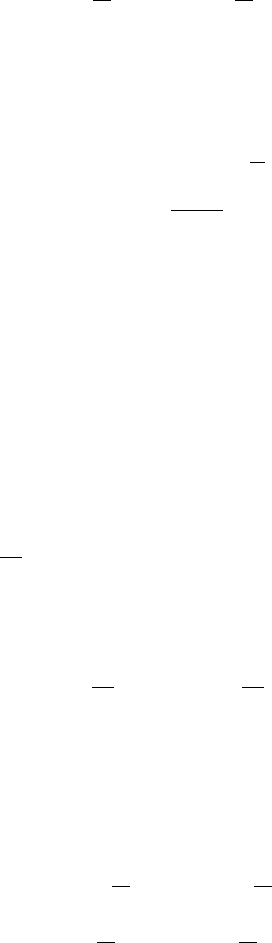
13.2 A two-point boundary value problem on Lorentz manifold 323
Bv =
τ
0
ΓG
S(v(t)+C
v
)
d
dt
S(v(t)+C
v
),
d
dt
S(v(t)+C
v
)
dt, (13.12)
where k and T satisfy the conditions of Lemmas 3.50 and 13.33. One can
easily see that the operator B is completely continuous.
Theorem 13.34 Let m
0
,m
1
∈Oand let there exist a geodesic γ(τ) of the
connection in the reference frame such that γ(0) = m
0
, γ(T )=m
1
, m
0
and
m
1
are not conjugate along γ(·) and the vector
d
dt
γ(t)
|t=0
lies inside the light
cone of the space T
m
0
M
4
.Ifm
0
and m
1
belong to the ball V ⊂Osuch that
at any m ∈ V the inequality G
m
<
ε
(ε+C)
2
holds, where ε and C are as in
Lemmas 3.48 and 13.33, then there exists a time-like geodesic m
0
(τ) of the
Levi-Civit´a connection of the Lorentz metric on M
4
such that m
0
(0) = m
0
and m
0
(T )=m
1
.
Proof. Let k := T
−1
ε − ϕ,whereϕ is as in Lemma 12.6. For this k,the
hypothesis of Lemma 3.50 is satisfied. Hence, on the ball
U
k
⊂ C
0
([0,T
1
],T
m
0
M
4
),
the operator (13.12) is well-defined. Recall that, for the curve v(·) ∈ U
k
,its
C
0
-norm is not greater than k,thatC
v
<T
−1
C and that the parallel
translation with respect to the Riemannian connection preserves the norms
of vectors. Then taking into account the definition of operator S we see that
d
dτ
S(v(τ )+C
v
)
< (T
−1
ε −ϕ)+T
−1
C.
Hence, formula (13.11), the hypothesis of theorem and Lemma 12.6 imply
that
G
S(v(τ)+C
v
)
d
dτ
S(v(τ )+C
v
),
d
dτ
S(v(τ )+C
v
)
≤
G
S(v(τ)+C
v
)
((T
−1
ε −ϕ)+T
−1
C)
2
(13.13)
< (T
−2
ε −T
−1
ϕ).
Since the operator Γ of parallel translation preserves the norms of the vectors,
from the last inequality we obtain:
τ
0
ΓG
S(v(t)+C
v
)
d
dt
S(v(t)+C
v
),
d
dt
S(v(t)+C
v
)
dt
≤
τ
0
G
S(v(t)+C
v
)
d
dt
S(v(t)+C
v
),
d
dt
S(v(t)+C
v
)
dt
< (T
−1
ε −ϕ)=k. (13.14)
This means that the completely continuous operator B sends the ball U
k
into itself. Hence, by Schauder’s principle, B has a fixed point v
∗
(τ)inU
k
.

324 13 Some Problems on Lorentz Manifolds
Then from the definition of the operator S and the usual properties of the
covariant derivative it follows that m
∗
(τ)=S(v
∗
(τ)+C
v
∗
) is a solution of
the differential equation (13.9) (see Chapter 12). By construction the curve
m
∗
(τ) is a geodesic of the Levi-Civit´a connection of the Lorentz metric on
M
4
and, for it, m
∗
(0) = m
0
and m
∗
(T )=m
1
.
From the equality Bv
∗
= v
∗
and (13.12) it follows that v
∗
(0) = 0. Then
from the definition of the operator S it follows that
d
dτ
m
0
(τ)
|τ=0
= C
v
∗
,
where the vector C
v
∗
belongs to the light cone of the space T
m
0
M
4
by
Lemma 13.33. This means that the Lorentz scalar square of the vector C
v
∗
is
negative. Since C
v
∗
is the initial vector of the derivative of the geodesic m
∗
(τ)
of the Levi-Civit´a connection on M
4
and since the Lorentz scalar square of
the derivative along this geodesic is constant, the geodesic m
∗
(τ) is time-like.
The meaning of condition G
m
<
ε
(ε+C)
2
is analogous to that in the
previous section (see Remark 13.32), but here C estimates the Riemannian
distance between m
0
and m
1
while ε depends on the geometry of the reference
frame and in some sense estimates “how close” m
1
is to the boundary of
the “proper future” of m
0
and “how close” it is to conjugate points in the
reference frame.
13.3 A Classical Particle in a Classical Gauge Field
In this Section we introduce and investigate a special class of differential
equations on the total spaces of fiber bundles equipped with connections. We
interpret these equations as equations of motion for a classical particle in a
classical gauge field.
It should be pointed out that the term ‘gauge field’, as used in contempo-
rary physics, means a connection on a fiber bundle. Gauge fields are generally
used in quantum physics.
The problem of the motion of a classical particle in a classical gauge field
was first treated by S.K. Wong (see [231]). Further developments can be
found, e.g., in [143, 201, 213, 214, 215]. The symplectic geometry and the
Hamiltonian formalism on some special fiber bundles were exploited in [213,
214, 215]. Here we suggest another approach using the connection (i.e., the
gauge field itself) on bundles different from those of [143, 213, 214, 215].
This approach seems to be more natural; we show that in the special case
of the electromagnetic field our equation is reduced to the ordinary Lorentz
equation (13.5).
In what follows we denote fiber bundles and their total spaces by the same
symbols.
13.3 A Classical Particle in a Classical Gauge Field 325
13.3.1 A brief introduction to gauge fields and some
preliminary constructions
Let M
4
be a Lorentz manifold with a metric g(·, ·). We retain the standard
notation M
4
of this chapter for a Lorentz manifold since our principal ex-
ample of such a manifold is a space-time. Nevertheless please note that in
all constructions below in this section we do not use the fact that the di-
mension of the manifold is 4 and so all our results are valid in arbitrary
finite-dimensional Lorentz manifolds.
Consider a principal bundle Π : E→M
4
with structure group G.TheLie
algebra of G will be denoted by g.
Let H be a connection on the bundle E. Recall (see Section 2.7)thatH is
a distribution on E, i.e., a sub-bundle of TE, that is invariant with respect
to the natural right action of G on E and is complementary to the vertical
distribution V consisting of subspaces tangent to the fibers of E.Notethat
all subspaces V
b
⊂ T
b
E are canonically isomorphic to g (see Section 2.7).
We introduce a semi-Riemannian (Lorentz) metric g
E
on the manifold E by
determining an inner product in g, and hence in all subspaces V, by defining
the inner product in the subspaces H as the inverse image of g with respect
to TΠ, and by setting the subspaces V
b
and H
b
in all T
b
E to be orthogonal to
each other. Following this we can treat the manifold E as an ordinary semi-
Riemannian manifold, in particular, we can consider all the usual operations
with differential forms on E.
In what follows we shall also denote by V and H the projections of T
b
E =
V
b
⊕ H
b
onto the vertical (i.e., V
b
) and horizontal (i.e., H
b
), respectively,
subspaces in T
b
E where b ∈Eis an arbitrary point. So, for X ∈ T
b
E, VX
is its vertical component and HX is its horizontal component. This notation
will be used when dealing with all types of fiber bundles with connections.
Consider the connection form ϕ and the curvature form Φ =Dϕ of H where
the covariant differential D on the right hand side is defined by the usual
formula Dϕ(·, ·)=dϕ(H·, H·) (see Section 2.7). Recall that ϕ is a vertical
1-form (i.e., equal to zero on subspaces H)andΦ is a horizontal 2-form (i.e.,
equal to zero on subspaces V), both taking values in g. We interpret Φ as the
gauge field strength. The gauge field, as usual, is determined by the equations
DΦ =0, D ∗Φ = ∗J, (13.15)
where J is a horizontal 1-form on E with values in g and ∗ is the star operator.
The first equation is Bianchi’s identity (2.39). Note that (13.15) are analogous
to Maxwell’s equations (13.4).
Let F be a (real or complex) linear space with inner product h(·, ·). Sup-
pose that the left action of G on F is given and h(·, ·) is invariant under this
action. We interpret F as the space of internal states of the particle and the
group G as
the group of its internal symmetries. In addition, we suppose that