
Gliklikh Y.E. Global and Stochastic Analysis with Applications to Mathematical Physics
Подождите немного. Документ загружается.

6 1 Manifolds and Related Objects
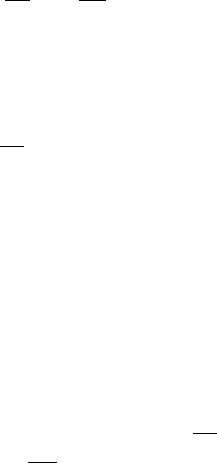
the basis
∂
∂ ˙q
1
,...,
∂
∂ ˙q
n
in T
X
R
k
as described above. Now p : T
X
R
k
→ R
k
is
well-defined by formula (1.2).
Consider a chart U
α
on M and denote by T U
α
the restriction of the tangent
bundle to U
α
.NotethatT U
α
can be presented as the direct product T U
α
=
U
α
× R
n
since every point of T U
α
can be described by 2n coordinates: n
coordinates of the point in U
α
and n coordinates of the vector with respect to
the basis
∂
∂q
i
. Such a presentation as a direct product is called a trivialization,
in the case under consideration, with respect to coordinates (q
1
,...,q
n
). If we
choose another system of coordinates in U
α
, we obtain another trivialization.
There exist some other types of trivializations, for example, by a field of
orthonormal frames in a chart of a Riemannian manifold (see below).
Consider TU
α
as a chart in TM. The change of coordinates between T U
α
and T U
β
is given as a pair:
(ϕ
βα
,ϕ
βα
):U
α
× R
n
→ U
β
× R
n
(1.3)
where ϕ
βα
sends the coordinates of points with respect to U
α
into those of
the same points with respect to U
β
and ϕ
βα
sends coordinate columns of a
vector with respect to the basis
∂
∂q
i
into those of the same vector with respect
to the basis
∂
∂q
i
according to formula (1.1).
Note that if ϕ
βα
is a C
k
-map, ϕ
βα
is only a C
k−1
-map, i.e. TM is a C
k−1
-
manifold if M is C
k
. However, if M is C
∞
, TM is also C
∞
(recall that, unless
the contrary is stated, we assume our manifolds to be C
∞
).
Convention 1.3 In what follows we denote the points of a tangent bundle in
two different ways: (m, X) as a point in TM and X
m
as a tangent vector to M
at m. Both symbols have the same meaning and can be used interchangeably;
we will favor one when it is more suitable that the other. Strictly speaking, this
notation makes proper sense only in charts but for the sake of convenience
we also use it in invariant language.
Definition 1.4. A vector field on M is a map X : M → TM such that
πX = id, i.e., πX(m)=m for each m ∈ M.
Note that for a general mapping X : M → TM the value X(m) could
belong to any fiber but from the relation πX(m)=m it follows that X(m) ∈
T
m
M.
Definition 1.5. We say that a vector field X is continuous (smooth)ifthe
map X : M → TM is continuous (smooth, respectively).
Clearly the derivative of a smooth curve is a tangent vector. Let a smooth
vector field X be given on M. The curve m(t) described by equation
˙m(t)=X(m(t)). (1.4)
is called the integral curve of X.
1.1 Manifolds, Vectors and Covectors. A Glossary 7
In a given chart, (1.4) can be considered as a differential equation in vec-
tor space. Hence, we can apply the theory of ordinary differential equations
to (1.4). In particular, since the right-hand side of (1.4) is smooth, we ob-
tain from the classical existence theorem that for any point m
0
∈ M there
exist a real number ε
m
0
> 0 and a unique solution m(t)of(1.4) with the
initial condition m(0) = m
0
that is well-defined for t ∈ [0,ε
m
0
). In order
to investigate all solutions of (1.4) we denote by g
t
(m
0
) the solution such
that g
0
(m
0
)=m
0
. From the theorem on smooth dependence of a solution
on initial values and parameters it follows that g
t
(m
0
):U → M is jointly
smooth in t and m
0
∈ M,whereU is some neighborhood of 0×M in R×M.
From the uniqueness theorem for solutions of ordinary differential equations
it follows that g
t
(·) is a diffeomorphism for all t such that g
t
(m) exists for all
m ∈ M.
Definition 1.6. g
t
(·) is called the general solution of (1.4)ortheflow of
vecotr field X .
Let f : M → R be a real-valued function on M . Specify a point m ∈ M
and denote by m(t) the integral curve of X such that m(0) = m. Consider
the restriction of f onto m(t), i.e. the function f(m(t)). Note that f (m(t)) is
a real-valued function of a real argument.
Definition 1.7.
d
dt
f(m(t))
|t=0
is called the derivative of f in the direction
of X at m. Having found the derivative of f along X at all points of M,we
obtain a new function on M, denoted by Xf, that is called the derivative of
f in the direction of X.
Note that applying the above construction to the derivative of f in the
direction of a vector field
∂
∂q
i
, we obtain the partial derivative
∂f
∂q
i
.Thisis
the reason for denoting this vector field by the partial derivative symbol.
Let X be a vector field on M andinachartU
α
let it be presented in
coordinate form as X = X
i
∂
∂q
i
. Then we easily obtain the following formula
for Xf in U
α
:
Xf = X
i
∂f
∂q
i
(1.5)
Let X and Y be smooth vector fields on M.
Definition 1.8. The Lie bracket [X, Y ]ofX and Y is the vector field on M
such that for any smooth real-valued function f on M its derivative along
[X, Y ] is given by the formula: [X, Y ]f = X(Yf) − Y (Xf).
Usually the definition of [X, Y ] is given in operator form as follows:
[X, Y ]=X ◦Y − Y ◦ X. (1.6)
By direct calculation one can easily show that the vector field [X, Y ] exists,
is unique and, in local coordinates, is described by the formula

8 1 Manifolds and Related Objects
[X, Y ]=
X
l
∂Y
k
∂q
l
− Y
l
∂X
k
∂q
l
∂
∂q
k
. (1.7)
The Lie bracket is evidently skew-symmetric: [X, Y ]=−[Y,X].
Proposition 1.9 The Lie bracket satisfies the so-called Jacobi identity:
[X, [Y,Z]] + [Y,[Z, X]] + [Z, [X, Y ]] = 0. (1.8)
Consider a smooth mapping of manifolds F : M → N. Specify a point
m ∈ M and its image F (m) ∈ N. The mapping F generates a mapping
d
m
F : T
m
M → T
F (m)
N that in a chart at m and in a chart at F (m)is
described by the Jacobi matrix of F at m. We call d
m
F the differential of F
at m ∈ M.
Definition 1.10. The tangent mapping TF : TM → TN is defined by the
formula
TF(m, X)=(F (m), d
m
F (X)).
So, the tangent mapping TF is defined globally as a mapping of tangent
bundles, and the differential d
m
F of F at m is a restriction of TF to T
m
M.
Note that for a smooth curve m(t)inM we have the relation
d
dt
F (m(t)) = TF
d
dt
m(t)
, (1.9)
which can be considered as a coordinate-free definition of TF.
If F sends M into a linear space, say, F : M → R
k
, the construction of
the differential can be modified so that it becomes a map from TM to R
k
.
We introduce it as the composition
dF = p ◦d
m
F : T
m
M → R
k
(1.10)
where p is defined in (1.2). Note that dF can be applied to vectors from any
T
m
M, m ∈ M, so it is well-defined on the entire tangent bundle TM.
Definition 1.11. A cotangent vector (which we also call a covector or 1-
form) b at m ∈ M is a linear functional on the tangent space T
m
M, i.e. a
linear map b : T
m
M → R. The set of all covectors at m is called the cotangent
space at m and is denoted by T
∗
m
M.
By definition, T
∗
m
M is a linear space, dual to T
m
M. The total cotangent
bundle is denoted by T
∗
M.
In every chart U
α
the coordinates (q
1
,...,q
n
) generate the basis dq
1
,...,
dq
n
in every T
∗
m
M, dual to the basis
∂
∂q
1
,...,
∂
∂q
n
(i.e., dq
i
(
∂
∂q
j
)=δ
i
j
where δ
i
j
equals 1 if i = j and 0 otherwise). Thus every covector a in U
α
has coordinate
representation a
α
= a
i
dq
i
(note that the indices of covectors are superscripts

1.1 Manifolds, Vectors and Covectors. A Glossary 9
while the indices for their coordinates are subscripts). The relation between
such presentations a
α
and a
β
in the charts U
α
and U
β
is given by the formula
a
β
= a
α
◦ (ϕ
βα
)
−1
, i.e., in coordinates a
j
=
∂q
i
∂q
j
a
i
. (1.11)
Note that in (1.11) the Jacobi matrix ϕ
βα
is applied to the row a
α
from
the right while in (1.1) it is applied to the column X
α
from the left. Having
transposed both sides of (1.11) we obtain (1.11) in the form similar to (1.1):
a
T
β
=[(ϕ
βα
)
−1
]
T
◦ a
T
α
. (1.12)
Proposition 1.12 The transformation rules (1.1) and (1.11) coincide if and
only if ϕ
βα
is an orthogonal matrix.
Indeed, if and only if ϕ
βα
is orthogonal, we have [(ϕ
βα
)
−1
]
T
= ϕ
βα
by a
characteristic property of orthogonal operators.
Recall that the velocity of a curve, in particular of the trajectory of a
mechanical particle, is a tangent vector. The momentum p of the trajectory
is introduced in elementary text books by the property that the inner product
of p and the velocity v is equal to the kinetic energy multiplied by 2:
p ·v =2K. (1.13)
Note that in fact p is a covector. Indeed the kinetic energy K is a scalar, i.e.
it takes the same value in all charts and coordinate systems. So, since v is
a vector (transforming under changes of coordinates by (1.1)), p ·v in (1.13)
can take the same value in all coordinate systems if and only if p transforms
by (1.11), i.e., if p is a covector.
Another physical example of a covector is force. Indeed, the inner product
of a force f and velocity v is a scalar known as the power N:
f · v = N.
As in (1.13), since v transforms according to (1.1)andN has the same value
in all coordinate systems, f must transform according to (1.11), i.e., it is a
covector.
Note that in elementary text books only motion in R
3
with orthonormal
coordinate systems is considered. Thus, only orthogonal coordinate changes
are used and so the vectors v and covectors p and f have the same transfor-
mation rules (see above). This is not the case for systems given on manifolds
with arbitrary coordinate systems.
As for TM, T
∗
M inherits a manifold structure from M: the charts on T
∗
M
are of the form T
∗
U
α
, which can be represented as U
α
× R
n
, and changes
of coordinates are of the form (ϕ
βα
, ((ϕ
βα
)
−1
)
T
)(formula(1.12)isinuse
instead of (1.1)). The points of T
∗
M we shall denote either by (m, b)(asa
point of T
∗
M) or, equivalently, as b
m
(covector b at the point m).

10 1 Manifolds and Related Objects
As for TM we denote by the symbol π : T
∗
M → M the projection which
sends (m, b) ∈ T
∗
M into m ∈ M.
Definition 1.13. A covector field on M is a map b : M → T
∗
M such that
π ◦b = id (cf. Definition 1.4).
A covector field is called continuous (smooth)ifb as a map of manifolds
is continuous (smooth, respectively).
Since R is a linear space, the construction of the differential df according
to (1.10) is well-defined for any given real-valued function f : M → R. Here
we are to emphasize the following:
Proposition 1.14 df is a covector field on M.
Indeed, by the construction, df is a map from TM into R which is linear
(coinciding with d
m
f)onanytangentspaceT
m
M. This means that at any
m ∈ M the map df is a linear functional on T
m
M, i.e. a covector.
In a given chart U
α
,df can be expressed in terms of coordinates with
respect to a basis dq
1
,... dq
n
. To do this we should calculate the Jacobi
matrix for f in coordinates q
1
,... q
n
. We then find that it takes the form
(
∂f
∂q
1
,...,
∂f
∂q
n
) and hence
df =
∂f
∂q
i
dq
i
. (1.14)
Remark 1.15. Note that in classical vector analysis (
∂f
∂q
1
,...,
∂f
∂q
n
)isknown
as the gradient of the function f while (1.14) has the form of a total differ-
ential. We should point out that both formulas describe (in different forms)
the object we have called the differential of f. The geometrically well-defined
definition of gradient is given in the next chapter in such a way that in Eu-
clidean n-space it turns out to be a vector (i.e., a coordinate column, not a
row) with coordinates
∂f
∂q
i
.
Taking into account (1.14), we obtain for X = X
i
∂
∂q
i
that
df(X)=X
i
∂f
∂q
i
. (1.15)
Comparing (1.5) with (1.15) we obtain that the equality
Xf =df(X) (1.16)
holds for any X and any f.
Note that (1.16) is sometimes used as the definition of df.
Above we have described the notion of a tangent mapping of tangent
bundles generated by a smooth mapping of manifolds. A natural mapping of
a cotangent bundle is also generated but, unlike the tangent mapping, it sends
T
∗
N to T
∗
M.LetM and N be smooth finite-dimensional manifolds and let
1.2 Lie Groups and Lie Algebras 11
F : M → N be a smooth map. Specify a point m ∈ M and consider its image
F (m) ∈ N.Leta ∈ T
∗
F (m)
N be a covector at F (m). It can be mapped into
T
∗
m
M by the following procedure. Denote by T
∗
F (a) the covector in T
∗
m
M
such that its value on any vector X ∈ T
m
M is defined by the relation
T
∗
F (a)(X)=a(TF(X)) (1.17)
where TF is the tangent mapping. By the construction of TF (see Definition
1.10), we get that TF(X) ∈ T
F (m)
N and so the value a(TF(X)) is well-
defined.
Definition 1.16. The map T
∗
F : T
∗
N → T
∗
M is called the cotangent map-
ping of F : M → N or the pull-back.
1.2 Lie Groups and Lie Algebras
Definition 1.17. A manifold G is called a Lie group if there exists an alge-
braic operation • on G such that G is a group with respect to • and g
1
• g
2
is jointly smooth in g
1
,g
2
∈ G as a map from G × G to G.
The first examples of Lie groups are the space R
n
(which is obviously a
commutative Lie group with respect to addition) and the circle S
1
, i.e. the
set of complex numbers with unit modulus, with respect to multiplication
(also commutative).
It is clear that the n-dimensional torus T
n
= S
1
×···×S
1
(the cartesian
product of n copies of S
1
) is a Lie group. The group operation on T
n
is given
by coordinate-wise multiplication.
Remark 1.18. T
n
may also be described as the quotient space R
n
/Z
n
of R
n
with respect to the integral lattice Z
n
. This means that in R
n
the points whose
corresponding coordinates differ from one other by an integer are considered
as equivalent and are pasted onto each other. It is clear that S
1
is obtained
from the corresponding coordinate axis in R
n
by factorization with respect
to integer points.
Let us turn to non-commutative groups. First we mention the three-
dimensional sphere S
3
(the set of points with unit modulus in the space
of quaternions) and the sphere S
7
(the set of points with unit modulus in the
space of octaves).
Consider the group of real invertible n × n matrices with respect to ma-
trix multiplication. We denote this group, called the general linear group,by
GL(n, R).
Theorem 1.19 GL(n, R) is a Lie group.
12 1 Manifolds and Related Objects
The closed set det
−1
(0) ∈ L(n, R) subdivides GL(n, R) into two connected
components: the matrices with positive determinants and those with negative
determinants. Since the determinant of a product equals the product of the
determinants, the product of two matrices with positive determinants has
positive determinant, i.e., this connected component is a Lie sub-group of
GL(n, R).
Another Lie sub-group of GL(n, R) is the group O(n) of orthogonal n ×
n matrices. Recall that a matrix A is orthogonal if its action on vectors
preserves the inner product in R
n
or, equivalently, if A
t
= A
−1
where A
t
is the transposed matrix. O(n) is a regular surface (i.e., a submanifold) in
GL(n, R).
Like GL(n, R), O(n) has two connected components: the orthogonal ma-
trices with determinant +1 and those with determinant −1. The former is a
Lie sub-group of O(n) (the product of matrices with unit determinant has
unit determinant). This group is called the special orthogonal group and is
denoted by SO(n). The matrices in SO(n) preserve the space orientation
while the matrices with determinant −1 reverse it. The latter set of matrices
is not a subgroup of O(n).
Definition 1.20. A left action of a Lie group G on a manifold M is defined
if a certain C
∞
-map G ×M → M, denoted for g ∈ G and m ∈ M by gm,is
given such that the following hypotheses hold:
(i) for any g ∈ G the map g : M → M that sends m to gm is a diffeomor-
phism;
(ii) (g • h)m = g(hm)forg, h ∈ G, m ∈ M.
A right action of a Lie group G on a manifold M is the specification of a
certain C
∞
-map from M ×G to G,forg ∈ G and m ∈ M , which satisfies (i)
and the following replacement of (ii):
(iii) (g • h)m = h(gm)forg, h ∈ G, m ∈ M.
When a right action is given, the notation mg for g ∈ G, m ∈ M is used
so that m(g •h)=(mg)h.
In what follows we shall denote the unit of a Lie group G by e.
For g ∈ G two special maps, the left translation L
g
: G → G and the
right translation R
g
: G → G, are defined by the formulae L
g
h = g • h and
R
g
h = h •g, respectively, for any h ∈ G. From Definition 1.17 it follows that
both L
g
and R
g
are smooth maps of G.
Note that the tangent bundle TG is trivial, i.e., it can be presented as
direct product. Indeed, having taken a certain basis in T
e
G we can translate
it to T
g
G at each point g ∈ G by TL
g
(or TR
g
) and so obtain the presentation
of TG as G ×R
n
,wheren =dimG.
Definition 1.21. The vector field on G obtained by left (right) translations
of a vector X ∈ T
e
G at all points of G is called the left-invariant (right-
invariant, respectively) vector field, generated by X.
1.2 Lie Groups and Lie Algebras 13
It should be noted that one can imitate the construction of left- and right-
invariant vector fields and define left- and right-invariant Riemannian metrics
and more general tensors (see the definitions of these object below).
Proposition 1.22 Let
¯
X and
¯
Y be left-invariant (right-invariant) vector
fields on G generated by X, Y ∈ T
e
G. Then the vector field [
¯
X,
¯
Y ] is left-
invariant (right-invariant, respectively).
See, e.g., [26] for the proof of Proposition 1.22.
Denote by [X, Y ] the vector in T
e
G which generates [
¯
X,
¯
Y ].
Definition 1.23. [X, Y ] is called the bracket of X, Y .
Proposition 1.24 The bracket in T
e
G introduced in Definition 1.23 satisfies
the Jacobi identity (1.8).
The assertion of Proposition 1.24 follows from Propositions 1.9 and 1.22.
Definition 1.25. A linear space on which an additional operation [·, ·]sat-
isfying the Jacobi identity is given is called a Lie algebra.
Thus, by Proposition 1.24, T
e
G has the structure of a Lie algebra.
Definition 1.26. The vector space T
e
G, equipped with the bracket defined
in Definition 1.23, is called the Lie algebra of the Lie Group G.
We generally denote Lie groups by Latin capitals (say, G)andtheirLie
algebras by the corresponding lower case Fraktur characters (say, g).
It is known that every finite dimensional Lie algebra is the Lie algebra
of a certain Lie group, however different Lie groups may have the same Lie
algebra. For example, a group and a subgroup of the same dimension have
the same algebra.
Let us present some examples of Lie algebras.
On every linear space one can introduce the trivial bracket defined by the
equality [X, Y ] = 0 for every X and Y . Thus every linear space is a (trivial)
Lie algebra. It is clear that the algebras of the groups R
n
, S
1
and T
n
are
trivial, as well as the algebras of all commutative groups.
Consider Euclidean space R
3
together with the skew-symmetric vector
product operation. This operation is usually denoted by the bracket symbol,
a notation which we retain, i.e., for two vectors X, Y ∈ R
3
the symbol [X, Y ]
denotes their vector product. By direct calculation one can easily prove the
following:
Proposition 1.27 The vector product operation satisfies the Jacobi identity.
Thus, R
3
with the vector product is a Lie algebra.
The Lie algebra gl(n, R) is the set of all n×n matrices with linear addition
in the underlying vector space and with the bracket [A, B]=AB − BA
(commutator of matrices).

14 1 Manifolds and Related Objects
The groups O(n)andSO(n) generate the same Lie algebra (indeed, the
unit of O(n) is contained in the subgroup SO(n)). This algebra is denoted
by so(n). It consists of skew-symmetric n ×n matrices with the same bracket
as in gl(n, R)(so(n) is a Lie subalgebra of gl(n, R)).
A particular case, the algebra so(3), is of special interest to us because of
its use, below, in some examples of mechanical systems. The matrices from
so(3) have the form
⎛
⎝
0 ab
−a 0 c
−b −c 0
⎞
⎠
. (1.18)
Denote by Ψ : so(3) → R
3
the mapping that sends the matrix (1.18)tothe
vector
⎛
⎝
−a
−b
−c
⎞
⎠
. The next statement is obvious.
Proposition 1.28 Ψ is a linear isomorphism of so(3) to R
3
.
Proposition 1.29 For every A, B ∈ so(3) the operator Ψ sends the commu-
tator AB −BA to the vector product of Ψ(A) and Ψ(B) in R
3
.
We introduce on so(3) a bilinear form by the formula (A, B)=−
1
2
tr(AB).
This bilinear form is called the Killing form.
Proposition 1.30 −
1
2
tr(AB) equals the inner product of the vectors Ψ(A)
and Ψ(B) in R
3
.
Propositions 1.29 and 1.30 are proved by direct calculation with matrices.
Thus −
1
2
tr(AB) is an inner product in so(3) and so we have introduced
the structure of Euclidean space in so(3). From Propositions 1.29 and 1.30
we obtain:
Proposition 1.31 The linear isomorphism Ψ : so(3) → R
3
is an isomor-
phism of Lie algebras and of Euclidean spaces.
1.3 Fiber Bundles
Definition 1.32. A fiber bundle comprises the following five objects:
(i) a manifold M, called the base of the bundle;
(ii) a manifold E, called the total space of the bundle;
(iii) a manifold F , called the standard fiber of the bundle;
(iv) a Lie group G, called the structure group of the bundle;
(v) a smooth projection π : E → M, called the projection of the bundle,
and the following interrelations between these objects hold:

1.3 Fiber Bundles 15
1) a left action of G on F is given (see Definition 1.20);
2) for any chart U
α
in M the set π
−1
U
α
is homeomorphic to U
α
× F ;
3) for U
α
∩ U
β
= ∅ the “change of coordinates” from U
α
× F to U
β
× F
is given as the pair (ϕ
βα
,g
βα
(m)) where ϕ
βα
: U
αβ
→ U
αβ
is defined
above and g
βα
(m):F → F is an element of G,smoothinm ∈ U
αβ
,
which is a diffeomorphism of F according to the definition of the left
action of G.
Usually we denote a fiber bundle by the symbol of its total space, say
E, and in this case E
m
denotes the fiber at the base point m (note that
E
m
= π
−1
(m) is homeomorphic to F ). In order to indicate the details of
a certain fiber bundle we may say that there is a bundle E over M or that
π : E → M is a fiber bundle. To denote the bundle with fiber F ,aconvenient
notation is F
.
Strictly speaking U
α
× F and U
β
× F are not charts, but U
α
× F and
U
β
× F contain the charts in E of the form U
α
× V
κ
and U
β
× V
λ
(where
V
κ
and V
λ
are charts in F ). Here, the restrictions of (ϕ
βα
,g
βα
) become real
changes of coordinates.
The simplest example of a fiber bundle is a trivial (or product) bundle
E = M ×F . Here all g
βα
are equal to the unique element e = id (unit) in G
(and so the group G may be reduced to its subgroup consisting of the unique
element e). The elements of any product bundle are scalars (see above). Recall
that under changes of coordinates in M, scalars are not transformed at all.
Note that according to Definition 1.32 every bundle over each chart U
α
is
presented as a trivial one by means of a certain diffeomorphism F
α
that is
called a trivialization (it is often said that over each chart the bundles are
trivial or that all bundles by means of Definition 1.32 are locally trivial).
It is important to understand from the very beginning that many different
trivializations of a bundle may exist even over a specified chart.
Definition 1.33. A vector bundle is a fiber bundle where F = R
k
for a
certain k, G is the group GL(k, R) of non-degenerate linear operators in R
k
,or
a subgroup thereof, and the elements of G act on R
k
as linear automorphisms.
The product bundles with F = R
k
are examples of vector bundles. Two
more examples are the tangent and the cotangent bundles of a manifold.
Indeed, for the tangent bundle, M is the base, TM is the total space, the
fiber is R
n
(assuming that dim M = n), G = GL(n, R) with the natural
action on R
n
and g
αβ
(m)=ϕ
αβ
(m)(see(1.3)). For the cotangent bundle,
M is also the base, T
∗
M is the total space, the fiber is R
n
and G is also
GL(n, R) with the same natural action on R
n
but g
αβ
now takes the form
[(ϕ
αβ
)
−1
]
T
(see (1.12)).
Of course, in the infinite-dimensional case Definition 1.33 is modified by
replacing R
k
with some Hilbert or Banach space and G = GL(n, R)bythe
group of bounded invertible linear operators.
Definition 1.34. A principal bundle is a fiber bundle where F = G.