
Gliklikh Y.E. Global and Stochastic Analysis with Applications to Mathematical Physics
Подождите немного. Документ загружается.

16 1 Manifolds and Related Objects
It should be pointed out that on a principal bundle E both the left and
the right actions of its structure group G on fibers are well-defined, since any
fiber of E is isomorphic to G. In particular, having specified g ∈ G,wecan
consider the right translation η ◦ g of each point η ∈ E. Thus we obtain the
right action of G on E (see Definition 1.20).
Every principal bundle generates the so-called associated bundle as follows.
Let E be a principal bundle with structure group G,andletF be a manifold
on which a left action of G is given. Consider the quotient of the direct product
E ×F with respect to the right action of G defined by the formula (η, f)g =
(η ◦g, g
−1
f) (note that this is indeed a right action since (gh)
−1
= h
−1
g
−1
).
Consider a chart U
α
on M. The restriction of E ×F on U
α
has the form U
α
×
G×F . The above-mentioned quotient space consists of the orbits of elements
of this product: for (m, h, f) ∈ U
α
×G ×F the orbit is the set (m, hg, g
−1
f)
for all g ∈ G. Such an orbit is associated with the point (m, hf) ∈ U
α
× F .
Indeed, for any point of the orbit we have (m, (hg)(g
−1
f)) = (m, hf )andso
this association is well-defined. Thus, over U
α
, the above quotient space is
presented in the form U
α
× F and the total quotient space is a bundle over
M with fiber F and structure group G where the g
αβ
are the same as in E.
Definition 1.35. The above quotient is called the bundle associated to E
with fiber F .
Notation 1.36 Denote by λ the mapping of E × F onto the total space
of the associated bundle that is the factorization sending the orbits to the
corresponding points in the quotient.
It should be noted that every non-principal fiber bundle is associated to
some principal bundle.
Let Q be a vector bundle with fiber R
k
and let it be an associated bundle
to a principal bundle E with G = GL(k,R). Observe that, clearly, any b ∈ E
canbeconsideredasaframeb = e
1
,...,e
k
in the fiber Q
πb
of Q through πb
and, consequently, as a linear map b : R
k
→ Q
πb
sending x =(x
1
,...,x
k
)to
bx = x
1
e
1
+ ···+ x
k
e
k
.
Definition 1.37. The frame bundle BM of a manifold M is a principal bun-
dle over M with G = GL(n, R)(n =dimM)andg
βα
= ϕ
βα
.
Note that TM and T
∗
M are bundles associated to BM, and so a point b ∈
BM may be regarded as a frame b = e
1
,...,e
n
in the tangent space T
πb
M.
Thus b can also be considered as a linear mapping b : R
n
→ T
πb
M which sends
a vector x =(x
1
,...,x
n
) ∈ R
n
to the vector bx = x
1
e
1
+ ···+ x
n
e
n
∈ T
πb
M.
Definition 1.38. A cross-section X of a fiber bundle E is a map X : M → E
such that π ◦X =id:M → M , i.e. X(m) ∈ E
m
for any m ∈ M.
Examples of cross-sections are vector fields (cross-sections of a tangent
bundle) and covector fields (cross-sections of a cotangent bundle). This im-
mediately follows from Definitions 1.38, 1.4 and 1.13. Every vector bundle E

1.3 Fiber Bundles 17
has a smooth cross-section, called the zero-section, which sends m ∈ M into
the origin of E
m
. Unlike vector bundles, a principal bundle has a global (i.e.,
defined on the entire manifold M) continuous cross-section if and only if the
bundle is trivial.
Definition 1.39. If the tangent bundle of a manifold M is trivial, M is called
parallelizable or trivializable.
As mentioned above, all Lie groups are parallelizable by left- or right-
invariant vector fields. In particular, the n-dimensional torus is parallelizable.
Remark 1.40. A natural trivialization Φ of the tangent bundle T T
n
can be
described as a trivialization by coordinate frames as follows. Introduce on
S
1
i
the angle coordinate q
i
=
ϕ
2π
where ϕ is an angle. We then obtain the
system of angle coordinates (q
1
,...,q
n
)onT
n
. At each point m ∈T
n
the
vectors
∂
∂q
1
,...,
∂
∂q
n
form an orthonormal frame in T
m
T
n
.For(X
i
∂
∂q
i
)
m
we
set Φ(X
i
∂
∂q
i
)
m
=(m, (X
1
,...,X
n
)) ∈T
n
× R
n
.
Definition 1.41. If in each tangent space T
m
M to a manifold M a k-
dimensional linear subspace β
m
is chosen that smoothly depends on m ∈ M
(in the sense described below), we say that a k-dimensional distribution β is
given on M.
Smooth dependence of β
m
on m means that in some neighborhood of each
point m ∈ M there are k smooth linearly independent vector fields X
1
,...,X
k
such that at each m
in this neighborhood the space β
m
is the linear span of
the vectors X
1
(m
),...,X
k
(m
).
If on M there exists a smooth vector field nowhere equal to zero, the
straight lines spanned on the vectors of this field form a 1-dimensional dis-
tribution.
Definition 1.42. A k-dimensional distribution β is said to be integrable if
for each point m there exists a k-dimensional submanifold M
m such that
at every point m
∈ M
the property T
m
M
= β
m
is fulfilled. In this case
the manifold M
is called an integral manifold of the distribution β.
Every 1-dimensional distribution is integrable. Its integral manifolds are
integral curves of the vector field on which the distribution is spanned. Dis-
tributions of dimension greater than 1 may not be integrable. There is a
necessary and sufficient condition for integrability that involves the notion of
involutory distributions.
Definition 1.43. A distribution β is called involutory ifforeverytwovector
fields X and Y on M such that X
m
,Y
m
∈ β
m
at each m ∈ M,theirLie
bracket [X, Y ] also belongs to the space of distributions at each point of M.
Theorem 1.44 (Frobenius’ Theorem) A distribution is integrable if and
only if it is involutory.
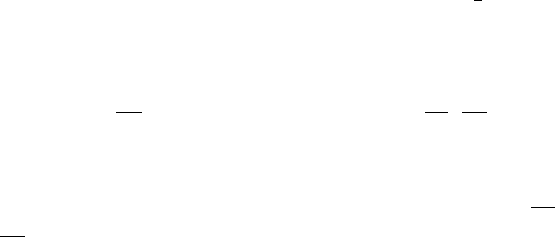
A proof of Theorem 1.44 can be found, for example, in [26, 172, 212].
18 1 Manifolds and Related Objects
1.4 Riemannian and Semi-Riemannian Metrics
Definition 1.45. We say that a Riemannian metric is given on a manifold
M if in each tangent space T
m
M, m ∈ M, a symmetric positive-definite
bilinear form ·, ·
m
is specified which depends smoothly on m (in the sense
defined below). A manifold with a Riemannian metric is called a Riemannian
manifold.
When we say that ·, ·
m
depends smoothly on m we mean that for any
two smooth vector fields X and Y on M the real-valued function X
m
,Y
m
m
on M is smooth in m.
For a Riemannian manifold every tangent space T
m
M becomes a Euclidean
space with inner product ·, ·
m
.
In what follows, if it does not lead to confusion, we shall omit the point m
in the inner product notation. Indeed, X, Y obviously has only one interpre-
tation: X and Y lie in the same tangent space and they are to be substituted
into the inner product of that space.
The first example of a Riemannian metric is the so-called first fundamental
form of a surface in Euclidean space. Recall that for X,Y ∈ T
m
M,whereM
is a surface in a Euclidean space E,thenumberI(X, Y ) (the value of the first
fundamental form I at X and Y ) is defined by the equality: I(X, Y )=(X, Y )
where (X,Y ) is the inner product in E. Note that, in spite of the fact that the
unique inner product in E is used to determine the inner products in tangent
spaces, the latter are still specific to their own spaces: we still cannot identify
different tangent spaces and so cannot say whether the inner products are
the same.
An embedding i : M → N of a Riemannian manifold M into another
Riemannian manifold N is isometrical if X, Y
M
= iX, iY
N
for every pair
X, Y of vectors belonging to the same tangent space of M.Notethatanem-
bedded manifold with the first fundamental form is isometrically embedded
into Euclidean space.
Theorem 1.46 (Nash [186]) Every n-dimensional Riemannian manifold can
be isometrically embedded into a Euclidean space R
N
with N =
1
2
n(n+1)(3n+
11).
In a chart U
α
the form ·, ·
m
can be described in terms of its matrix.
As is typical in linear algebra, we consider the coefficients of ·, ·
m
with
respect to the basis
∂
∂q
k
defined by the formula g
ij
=
∂
∂q
i
,
∂
∂q
j
.Notethat
the coefficients g
ij
depend on m ∈ U
α
and so they are real-valued functions
on U
α
.
The linearity of ·, · allows us to derive a coordinate formula for the inner
product of vectors involving the coefficients g
ij
. For vectors X = X
i
∂
∂q
i
and
Y = Y
i
∂
∂q
j
we obviously have X, Y = g
ij
X
i
Y
j
. Note that this notation can
be applied both for vectors X and Y at a given point and for vector fields on

1.4 Riemannian and Semi-Riemannian Metrics 19
U
α
. In the latter case both the coefficients g
ij
and the coordinates X
i
and
Y
j
are functions on U
α
.
One can easily prove that ·, ·
m
is smooth in m ∈ U
α
if and only if all of
the functions g
ij
(m)aresmooth.
Using a Riemannian metric one can create natural analogs of many notions
of ordinary geometry in Euclidean space.
For a vector X ∈ T
m
M we define its norm X by the formula X =
X, X. For two vectors X,Y ∈ T
m
M denote by θ the angle between them.
Then cos θ =
X,Y
X·Y
.Letm(t), t ∈ [a, b], be a curve in M . Its length s is
defined by the formula
s|
b
a
=
b
a
˙m(t)dt. (1.19)
Note that all the notions introduced above, after embedding M isometrically
into a Euclidean space, coincide with the usual definitions of norm, angle and
length, respectively, in that space.
Let m
0
,m
1
∈ M. Denote by ℵ the total set of piecewise smooth curves in
M connecting m
0
and m
1
.
Definition 1.47. The infimum of the lengths of the curves in ℵ is called the
Riemannian (or internal) distance in M between m
0
and m
1
and is denoted
by ρ(m
0
,m
1
).
Proposition 1.48 The distance ρ(·, ·) satisfies the axioms of a metric:
(i) ρ(m, m)=0and from ρ(m
0
,m
1
)=0it follows that m
0
= m
1
;
(ii) ρ(m
0
,m
1
)=ρ(m
1
,m
0
) for every pair m
0
,m
1
∈ M;
(iii) ρ(m
0
,m
1
)+ρ(m
1
,m
2
) ≥ ρ(m
0
,m
2
) for any m
0
,m
1
,m
2
∈ M.
The proof of Proposition 1.48 can be found, for example, in [26].
Hence, from Proposition 1.48 it follows that a Riemannian manifold is a
metric space with respect to its Riemannian distance ρ.
Definition 1.49. The Riemannian metric is called complete if the metric
space M with distance ρ generated by the Riemannian metric is complete.
In this case one says that M is a complete Riemannian manifold .
Recall that a bilinear form is called non-degenerate if its matrix (g
ij
)is
not degenerate, i.e., it is invertible. Since the bilinear form of a Riemannian
metric is positive-definite it follows that the form is non-degenerate.
Definition 1.50. We say that a semi-Riemannian metric is given on a man-
ifold M if in each tangent space T
m
M, m ∈ M, a symmetric non-degenerate
bilinear form ·, ·
m
is specified which depends smoothly on m. A manifold
with a semi-Riemannian metric is called a semi-Riemannian manifold.
So, a Riemannian metric is a particular case of a semi-Riemannian metric.
For a semi-Riemannian metric a scalar square X, X may be negative or

20 1 Manifolds and Related Objects
even zero for non-zero X, hence neither norm nor distance are well-defined
on semi-Riemannian manifolds. Nevertheless, semi-Riemannian metrics ap-
pear naturally in many physical theories. The main example for us is the
appearance of semi-Riemannian metrics in relativity theory.
Notation 1.51 For a Riemannian or semi-Riemannian metric with matrix
(g
ij
) in a certain chart, we denote the inverse matrix (g
ij
)
−1
by (g
ij
), i.e.,
its coefficients are denoted by g
ij
.
Remark 1.52. One can easily show that (g
ij
) is the matrix of an inner prod-
uct in the cotangent space at the corresponding point. Both the latter field
of inner products in cotangent spaces and the Riemannian metric (i.e., the
field of inner products in tangent spaces described by matrices (g
ij
)) are
traditionally called “metric tensors”.
Real mechanical and physical objects can be described both as vectors
and as covectors which are said to be physically equivalent. The set up of a
physical problem usually involves a certain Riemannian or semi-Riemannian
metric on a manifold. These metrics determine the physical equivalence as
follows.
Definition 1.53. For X ∈ T
m
M the physically equivalent covector b
X
∈
T
∗
m
M is defined by the relation b
X
(Y )=X, Y for any Y ∈ T
m
M.
For b ∈ T
∗
m
M the physically equivalent vector X
b
∈ T
m
M is defined by the
relation b(Y )=X
b
,Y for any Y ∈ T
m
M.
From Definition 1.53 it follows that for any X ∈ T
m
M the physically equiv-
alent covector b
X
exists and is unique. Moreover, one can easily calculate its
coordinates. Let X = X
i
∂
∂d
i
and Y = Y
j
∂
∂d
j
. Denote by X
j
the coordinates
of b
X
, i.e., b
X
= X
j
dq
j
. Then, since b(Y )=X
j
Y
j
and X,Y = g
ij
X
i
Y
j
for
any coordinate column Y
j
, we obtain from the definition
X
j
= g
ij
X
i
. (1.20)
Applying (1.20) to the matrix (g
ij
), the inverse of the matrix of the Rie-
mannian metric, one can easily see that
X
i
= g
ij
X
j
. (1.21)
Remark 1.54. Note that here we use the existence of the matrix (g
ij
)=
(g
ij
)
−1
, and do not use positive-definiteness. Thus physical equivalence is
well-defined for the general case of a semi-Riemannian metric, not only for a
Riemannian one.
Definition 1.55. The vector physically equivalent to the differential df of a
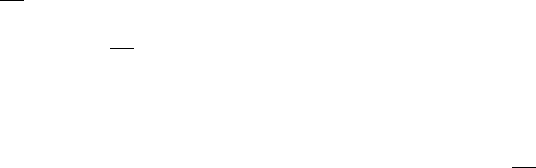
function f (see (1.14)) is called the gradient of f and is denoted by gradf.
1.5 Tensors 21
So, the gradient is determined by the relation df(X)=gradf,X for
any X. Comparing this formula with (1.16) we obtain the following equality
which holds for all X and f:
Xf =df(X)=gradf,X. (1.22)
Convention 1.56 In what follows we shall denote the coordinates of phys-
ically equivalent vectors and covectors by the same character, using upper
indices for vector coordinates and lower indices for covector coordinates as
in formulae (1.20) and (1.21).
In mechanics and physics (1.20)and(1.21) are usually called ‘formulae of
lifting and lowering indices’. The term “physical equivalence” is suggested in
[200].
Let M be a Riemannian manifold. If in some T
m
M, m ∈ U
α
,wehave
g
ij
= δ
ij
=
1ifi = j
0ifi = j
,
i.e., the basis
∂
∂q
i
consists of orthonormal vectors, the coordinates of physi-
cally equivalent vectors and covectors coincide. In particular, and this is true
only in this case, dq
i
and
∂
∂q
i
are physically equivalent. However, a coordi-
nate system satisfying g
ij
= δ
ij
can be created only in a Euclidean space.
In a general Riemannian manifold one can easily create a coordinate system
satisfying the above equality at a single point, but the relation will generally
not be satisfied at other points in its neighborhood. For semi-Riemannian
manifolds the situation is quite analogous, the only modification being: if
∂
∂q
i
is an orthonormal basis, g
ii
= ±1.
1.5 Tensors
Main definitions
In order to describe many physical and mechanical notions one needs to
use mathematical objects more general than vectors and covectors. These
objects are called tensors and, in common with vectors and covectors, they
are characterized by the rules for transformation of their components under
changes of coordinates. Moreover, vectors and covectors turn out to be trivial
particular cases of tensors.
Let m ∈ M and consider the Cartesian product of r copies of T
∗
m
M and s
copies of T
m
M.
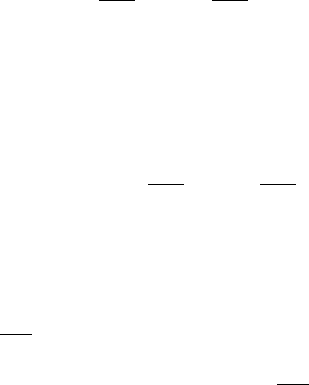
Definition 1.57. A tensor of type (r, s)(or(r, s)-tensor)atthepointm is
a polylinear form on the above Cartesian product.
22 1 Manifolds and Related Objects
This means that a tensor T of type (r, s) is a real-valued function, linear
in all its arguments, such that for any collection of r covectors a,b,...,c and
s vectors X,Y,...,Z the real value T(a,b,...,c,X,Y,...,Z) is defined.
A tensor field on M is defined if we associate to each point of M atensor.
Definition 1.58. The total number of arguments in a tensor T is called its
valency. The number of covector arguments is called the contravariant rank
of T and the number of vector arguments is called the covariant rank of T.
Scalars are tensors of valency 0. Tensors of valency 1 are vectors and
covectors. By definition, a vector is a tensor of contravariant rank 1 and a
covector is a tensor of covariant rank 1.
There exists a construction allowing one to create tensors of higher va-
lency from vectors and covectors. Consider vectors E
1
,...,E
r
and covectors
p
1
,...,p
s
. Define the tensor T = E
1
⊗···⊗E
r
⊗ p
1
⊗···⊗p
s
of type (r, s)
by the equality
E
1
⊗···⊗E
r
⊗ p
1
⊗···⊗p
s
(a
1
,...,a
r
,X
1
,...,X
s
)
= E
1
(a
1
) ...E
r
(a
r
)p
1
(X
1
) ...p
s
(X
s
) (1.23)
for every multiplicity of covectors a
1
,...,a
r
and vectors X
1
,...,X
s
.
Definition 1.59. A tensor of the form (1.23) is called the tensor product of
vectors E
1
,..., E
r
and covectors p
1
,...,p
s
. Tensors of this type are called
elementary.
The space of tensors of type (r, s) at a point m is obviously a linear space.
It is clear that the elementary tensors
∂
∂q
i
1
⊗···⊗
∂
∂q
i
r
⊗ dq
j
1
⊗···⊗dq
j
s
, (1.24)
where the indices i
1
,...,i
r
,j
1
,...,j
s
take all values from 1 to n (we assume
an n-dimensional manifold M), form a basis for this space.
For any (r, s)-tensor T, its coordinates with respect to the basis (1.24)are
denoted by T
i
1
...i
r
j
1
...j
s
so that
T = T
i
1
...i
r
j
1
...j
s
∂
∂q
i
1
⊗···⊗
∂
∂q
i
r
⊗ dq
j
1
⊗···⊗dq
j
s
. (1.25)
In order to avoid any confusion (we usually assume that coordinates appear
with respect to a basis in T
∗
m
M or in T
m
M), we call T
i
1
...i
r
j
1
...j
s
the components
of the tensor T.
Note that, for the sake of simplicity, the summands of (1.25) are ordered so
that all
∂
∂q
i
r
precede all dq
j
s
in the tensor products (and consequently, in the
components all terms with upper indices precede all terms with lower indices).
In arbitrary tensors the factors of types
∂
∂q
i
r
and dq
j
s
(and component terms
with upper and lower indices) may appear in any order.

1.5 Tensors 23
Taking into account formulae (1.1)and(1.11), one can easily derive the
following formula for the transformation of components under a change of
coordinates:
T
i
1
...i
r
j
1
...j
s
=
dq
i
1
dq
i
1
...
dq
i
r
dq
i
r
dq
j
1
dq
j
1
...
dq
j
s
dq
j
s
T
i
1
...i
r
j
1
...j
s
(1.26)
Note that all upper indices are transformed as in (1.1) and all lower indices
as in (1.11).
Formula (1.26) is the main characteristic of tensors. The above definition
of a tensor as a polylinear form is convenient only from the general point of
view. For concrete tensors, the fact that they can be presented as polylinear
forms may not be important for a given physical problem. On the other hand,
transformation rule (1.26) distinguishes tensors from all other objects.
In analogy with the constructions of tangent and cotangent bundles we
define the (r, s)-tensor bundle over M as the set of all (r, s)-tensors at all
points of M and define a smooth manifold structure on it as follows. The
sets of tensors over the charts U
α
and U
β
in M play the roles of charts in
our bundle (note that using (1.25) one can easily see that these new charts
are presented as direct products) and the changes of coordinates are given in
the form (ϕ
βα
,g
βα
)whereϕ
βα
is the change of coordinate in M and g
βα
is
defined by (1.26). Now one can easily give the definition of an (r, s)-tensor
field as a cross-section of a tensor bundle according to Definition 1.38 (i.e.,
in analogy with Definitions 1.4 and 1.13).
It is clear that a Riemannian metric is an example of a (0, 2)-tensor, i.e.,
in a chart, ·, · = g
ij
dq
i
⊗ dq
j
. The matrix (g
ij
), the inverse of the matrix
(g
ij
) of a Riemannian metric in a certain coordinate system, is an example of
a(2, 0)-tensor, i.e., in a chart this metric tensor takes the form g
ij
∂
∂q
i
⊗
∂
∂q
i
.
Thus, in any T
∗
m
M this matrix describes the inner product of covectors, dual
to the inner product on vectors in T
m
M (the Riemannian inner product)
with respect to physical equivalence.
It appears that (1, 1)-tensors are linear operators. Indeed, consider an ele-
mentary tensor E ⊗p at some m ∈ M and substitute into p a certain vector
X ∈ T
m
M.ThenE ⊗ p(·,X)=p(X)E ∈ T
m
M is vector linearly depen-
dent on X, i.e. E ⊗ p : T
m
M → T
m
M is a linear operator. Thus the tensor
T = a
i
j
∂
∂q
i
⊗ dq
j
is the linear operator in T
m
M with matrix (a
i
j
).
Note that we can substitute a covector a ∈ T
∗
m
M into E in E ⊗p so that
E ⊗p(a, ·)=E(a)p ∈ T
∗
m
M, i.e. E ⊗p can be considered as a linear operator
acting on T
∗
m
M. Hence a
i
j
∂
∂q
i
⊗dq
j
can also be considered as a linear operator
on T
∗
m
M.Thisoperatorisknownasthedual (or conjugate)operatortothe
operator on T
m
M, mentioned above, with the same matrix (a
i
j
).
Operations with tensors
The set of all (r, s)-tensors at a point m ∈ M form a linear space, i.e., addition
and multiplication (by a real number) are well-defined. From this it follows

24 1 Manifolds and Related Objects
that for tensor fields the operations of addition and of multiplication by a
real-valued function are also well-defined.
Further operations will be first determined for elementary tensors. Since
every tensor is a sum of elementary tensors (see expansion (1.25)), we can
easily extend the operations from elementary to all tensors.
The tensor product of an (r, s)-tensor A and a (k, l)-tensor B creates a new
(r + k, s+ l)-tensor A⊗B as follows. For A = E
1
⊗···⊗E
r
⊗p
1
⊗···⊗p
s
and
B =
¯
E
1
⊗···⊗
¯
E
k
⊗ ¯p
1
⊗···⊗¯p
l
we have A ⊗B = E
1
⊗···⊗E
r
⊗p
1
⊗···⊗
p
S
⊗
¯
E
1
⊗···⊗
¯
E
k
⊗ ¯p
1
⊗···⊗¯p
l
. For arbitrary tensors T and
¯
T, expanded
according to (1.25), we multiply by this rule each summand of T with each
summand of
¯
T and sum up all the products to get the expansion of T ⊗
¯
T.
This means that the set of components for T ⊗
¯
T is obtained by taking the
product of all components of T with all components of
¯
T.
A contraction (or trace) transforms an (r, s)-tensor into an (r − 1,s− 1)-
tensor as follows. For A = E
1
⊗···⊗E
r
⊗ p
1
⊗···⊗p
s
its contraction by
l − th lower and v − th upper factors is the tensor of the form
p
v
(E
l
)E
1
⊗···⊗E
l−1
⊗ E
l+1
...E
r
⊗ p
1
⊗···⊗p
v−1
⊗ p
v+1
⊗···⊗p
s
.
Applying this rule to a general tensor T with expansion (1.25) and taking
into account that dq
v
(
∂
∂q
l
)=δ
v
l
, we see that the contraction causes a lot of
summands in (1.25) to vanish. The remaining non-zero summands have the
form T
i
1
...i
l−1
ki
l+1
...i
r
j
1
...j
v−1
kj
v+1
...j
s
(the sum with respect to k =1,...,n).
For example, consider the contraction of a (1, 1)-tensor (linear operator)
T = a
i
j
∂
∂q
i
⊗ dq
j
(see above). Evidently we get trT = a
k
k
, the ordinary trace
of the matrix of the linear operator T.
Physically equivalent tensors
Let M be a Riemannian manifold. For an elementary tensor we define a
physically equivalent tensor by replacing a certain vector (or covector) in the
corresponding tensor product by the physically equivalent covector (vector,
respectively).
When transforming an arbitrary tensor with expansion (1.25) into a phys-
ically equivalent one, we should remember that generally speaking
∂
∂q
i
is not
physically equivalent to dq
i
. This is why, on replacing a certain
∂
∂q
i
(of dq
i
)
by the physically equivalent object, we should create the expansion (1.25)for
the obtained tensor. Taking into account formulae (1.20)and(1.21), one can
easily derive the corresponding formulae for arbitrary tensors. For the sake of
simplicity we present them for tensors with three indices; the general formu-
lae are analogous. Usually the components of physically equivalent tensors
are denoted by the same character, changing only the location of indices. So,

1.6 Differential Forms and Polyvectors 25
A
i
jk
= g
il
A
ljk
;
B
ik
j
= g
lj
B
ilk
;
C
ij
k
= g
iu
g
jv
C
uvk
,
and so on.
Remark 1.60. Note that the two versions of a metric tensor, i.e., matrices
(g
ij
)and(g
ij
) (see Remark 1.52), are physically equivalent to each other.
Symmetric tensors
We say that an (r, 0)- or (0,s)-tensor is symmetric or skew-symmetric if
the polylinear form describing the tensor is respectively symmetric or skew-
symmetric. A symmetric form is a form whose value does not depend on
the order of its arguments while the sign of a skew-symmetric form changes
whenever two of its arguments are interchanged.
We consider (0,s)-tensors since the case of (r, 0)-tensors is analogous. One
can easily see that for a symmetric tensor, if the basis tensors in expansion
(1.25) differ only by the order of their factors, the corresponding components
are equal. In order to simplify the notation we introduce the notion of a
symmetric tensor product:
dq
i
1
···dq
i
s
=
1
s!
s!
1
dq
j
1
⊗···⊗dq
j
s
where the summands dq
j
1
⊗···⊗dq
j
s
differ only by the order of factors (it
is obvious that the number of such summands is s!). Thus, any symmetric
tensor has the expansion:
T = T
i
1
...i
s
dq
i
1
···dq
i
s
where the indices i
1
, ..., i
s
are written in increasing order. One can also
easily show that the tensors dq
i
1
···dq
i
s
form a basis in the space of all
symmetric (0,s)-tensors.
1.6 Differential Forms and Polyvectors
A skew-symmetric (0,s)-tensor given at a point on a manifold is called an
exterior s-form and the corresponding tensor field is called a differential s-
form; the valency of these tensors is called the degree of the form.
Skew-symmetric (r, 0)-tensors are called r-vectors. A vector field in which
all the tensors are r-vectors is sometimes called an r-vector field.Ifone
needn’t indicate the valency, we simply refer to an exterior (differential) form