
Griffiths D.F., Higham D.J. Numerical Methods for Ordinary Differential Equations: Initial Value Problems
Подождите немного. Документ загружается.

86 6. Linear Multistep Methods—III
Example 6.12
Find the interval of absolute stability of the mid-point rule: x
n+2
−x
n
= 2hf
n+1
.
In this case
p(r) = r
2
− 2
b
hr − 1,
whose roots are
r
+
=
b
h +
q
1 +
b
h
2
, r
−
=
b
h −
q
1 +
b
h
2
,
and it should be immediately obvious that |r
−
| > 1 when
b
h < 0, so the method
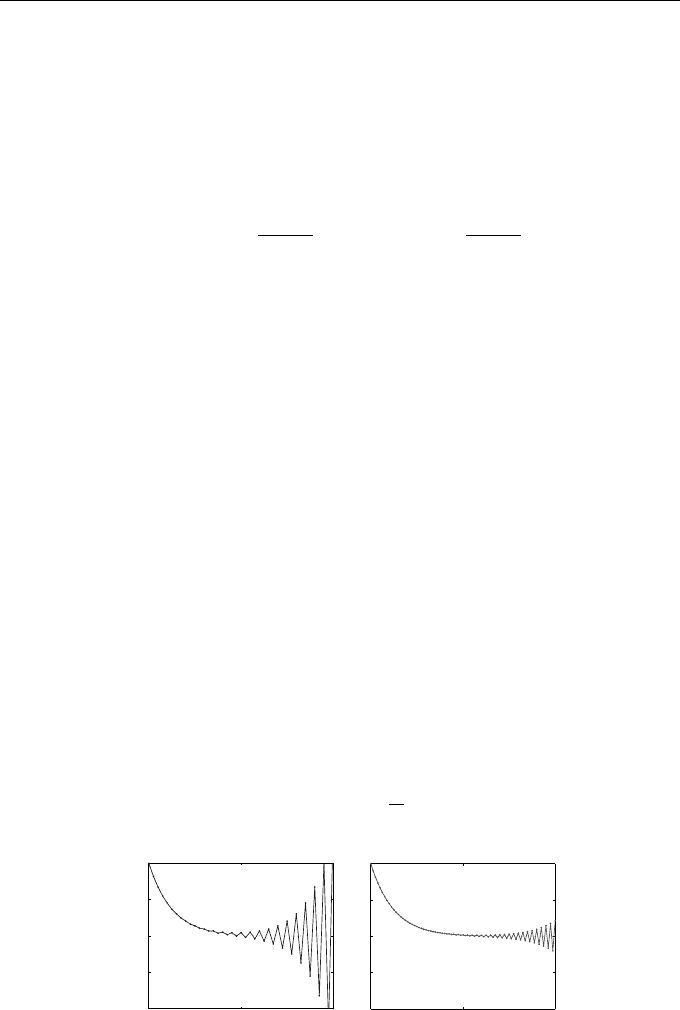
can never be absolutely stable. To see the consequences of this, the method
is applied to the IVP x
0
(t) = −8x(t) with x(0) = 1. The results are shown
in Figure 6.9 with h = 1/40 (
b
h = 1/5) and h = 1/120 (
b
h = 1/15) and the
additional starting value provided by the exact solution at t = t
1
. The solutions
of the mid-point rule are given by (the details are left to Exercise 6.13)
x
n
= Ar
n
+
+ Br
n
−
, (6.5)
where the constants A and B are chosen to satisfy the starting conditions
x
0
= 1, x
1
= e
b
h
. It can be shown that
r
+
= e
b
h
+ O(
b
h
3
) and r
−
= −e
−
b
h
+ O(
b
h
3
),
so that r
n
+
= e
λt
∗
+ O(h
2
) and r
n
−
= (−1)
n
e
−λt
∗
+ O(h
2
) at t
∗
= nh. The first
of these approximates the corresponding term in the exact solution, e
λt
∗
, while
r
−
has no such role—for this reason it is usually referred to as a spurious root:
the ODE is of first order but the difference equation that approximates it is of
second order. On solving for A and B and expanding the results in a Maclaurin
series in
b
h we find
A = 1 + O(h
2
), B = −
1
12
h
3
+ O(h
4
).
0 0.5 1
−100
−50
0
50
100
t
n
x
n
0 0.5 1
−100
−50
0
50
100
t
n
x
n
Fig. 6.9 Numerical solution by the mid-point rule for Example 6.12 with
h = 1/40 (left) and h = 1/120 (right)

6.3 The Boundary Locus Method 87
Hence, the first term Ar
n
+
in the solution (6.5) approximates the exact solution
to within O(h
2
) while the second term satisfies
Br
n
−
= −
1
12
h
3
(−1)
n
e
−λt
∗
+ O(h
4
).
It is this term that causes problems: it is exponentially growing when <(λ) < 0
(and the exact solution is exponentially decaying) and the factor (−1)
n
causes
it to alternate in sign on consecutive steps (producing the oscillations evident
in Figure 6.9). On a positive note, it has an amplitude proportional to h
3
, so
becomes negligible compared with the dominant O(h
2
) term in the GE when
h is sufficiently small.
Other Nystr¨om and Milne–Simpson methods have similar properties, so
cannot be recommended for solving problems with damping (<(λ) < 0). How-
ever, it is a different story if λ is purely imaginary (oscillatory problems)—see
Section 7.3.
6.3 The Boundary Locus M ethod
It is, in general, quite difficult to determine the region of absolute stability of an
LMM since we have to decide, for each
b
h ∈ C, whether the roots of the stability
polynomial satisfy the strict root condition (|r| < 1). It is more attractive to
look for the boundary of the region, because at least one of the roots of p(r)
on the boundary has modulus |r| = 1. Thus, the boundary is a subset of the
points
b
h ∈ C for which r = e
is
, where s ∈ R. Substituting r = e
is
into the
stability polynomial and solving for
b
h we obtain
b
h =
b
h(s) and plotting the
locus in the complex plane gives a curve, part of which will be the required
boundary. We illustrate the process with an example that contains most of the
important features.
Example 6.13
Use the boundary locus method to determine the boundary of the region of
absolute stability of the LMM x
n+2
− x
n+1
= hf
n
(see Example 6.11).
With r = e
is
the stability polynomial (6.4) gives
b
h = r
2
− r, and so
b
h(s) = e
2is
− e
is
= [cos(2s) − cos(s)] + i[sin(2s) − sin(s)].
Plotting the locus of the points bx(s) = cos(2s) −cos(s), by(s) = sin(2s) −sin(s)
for 0 ≤ s < 2π we obtain the curve shown in Figure 6.10, which divides the
plane into three subregions—it remains to decide which subregion is the region
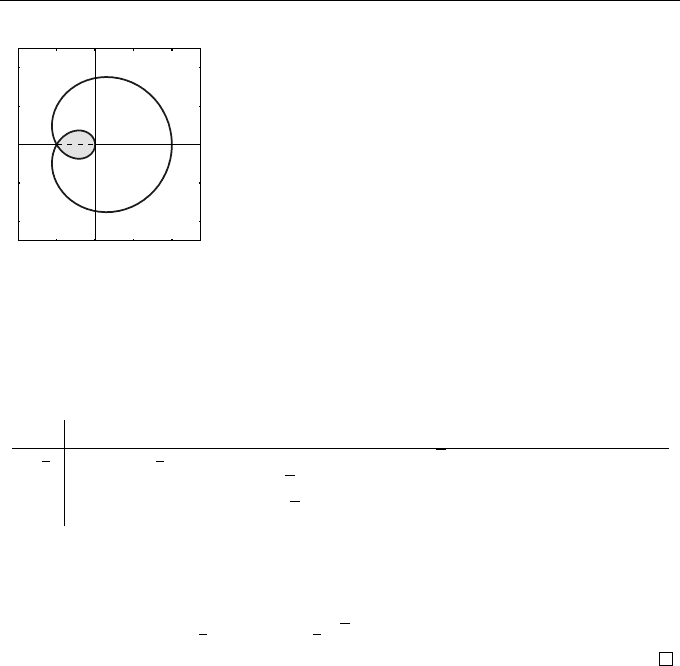
88 6. Linear Multistep Methods—III
−2 −1 0 1 2
−2
−1
0
1
2
ℜ(
b
h)
ℑ(
b
h)
O
Fig. 6.10 Stability region R for Example 6.13
(shaded). The solid curve is the locus of points
where the stability polynomial p(r) has at least one
root r with |r| = 1
of absolute stability. We need only test one point in each subregion: if the roots
at that point satisfy the strict root condition then the point lies in the region
of absolute stability, otherwise it does not lie in the region. This is done in the
table below.
b
h p(r) Roots |r| Absolutely stable
−
1
2
r
2
− r +
1
2
r = (1 ± i)/2 |r| = 1/
√
2 < 1 yes
1 r
2
− r − 1 r = (1 ±
√
5)/2 |r| > 1 no
−2 r
2
− r + 2 r = (1 ± i
√
7)/2 |r| > 1 no
We conclude that the region of absolute s tability is the shaded region in
Figure 6.10. The curve intersects itself when =(
b
h(s)) = 0. This is easily s hown
to occur when cos s =
1
2
, so sin s =
1
2
√
3 and
b
h = −1. The interval of absolute
stability is, therefore, (−1, 0), in agreement with Example 6.11.
6.4 A-stability
Some LMMs (the trapezoidal rule is one example) applied to the mo del prob-
lem (6.1) have the satisfying property that x
n
→ 0 as n → ∞ whenever
x(t) → 0 as t → ∞ regardless of the size of h. This is sufficiently important to
give the set of all such methods a name:
Definition 6.14 (A-Stability)
A numerical method is said to be A-stable if its region of absolute stability R
includes the entire left half plane (<(
b
h) < 0).
This is a severe requirement, as evidenced by the following theorem.

6.4 A-stability 89
Theorem 6.15 (Dahlquist’s Second Barrier Theorem)
1. There is no A-stable explicit LMM.
2. An A-stable (implicit) LMM cannot have order p > 2.
3. The order-two A-stable LMM with scaled error constant (C
p+1
/σ(1)) of
smallest magnitude is the trapezoidal rule.
Proof
See Hairer and Wanner [29].
We can relax our requirements when λ is real.
Definition 6.16 (A
0
-Stability)
A numerical method is said to be A
0
-stable if its interval of absolute stability
includes the entire left real axis (<(
b
h) < 0, =(
b
h) = 0).
As a parting remark, we observe that A-stability has been defined in terms of
the simple linear differential equation x
0
(t) = λx(t). What is remarkable (and
not fully understood) is why methods which are A-stable generally outperform
other methods on more general non-linear problems.
EXERCISES
6.1.
??
By writing
b
h = 2X + 2iY in Example 6.9 prove that
|r
1
|
2
− 1 =
4X
(1 − X)
2
+ Y
2
and deduce that |r
1
| < 1 for all <(
b
h) < 0.
What can be concluded about the interval of absolute stability of
the trapezoidal rule?
6.2.
??
Prove that the region of absolute stability of the backward Euler
method x
n+1
= x
n
+ hf
n+1
is given by |1 −
b
h| > 1. By writing
b
h = bx + iby show that this corresponds to the exterior of the circle
(bx − 1)
2
+ by
2
= 1. Sketch a diagram analogous to Figure 6.6.
90 6. Linear Multistep Methods—III
ℜ(
b
h)
ℑ(
b
h)
O
bx = 1/(2θ − 1)
ℜ(
b
h)
ℑ(
b
h)
O
bx = 1/(2θ − 1)
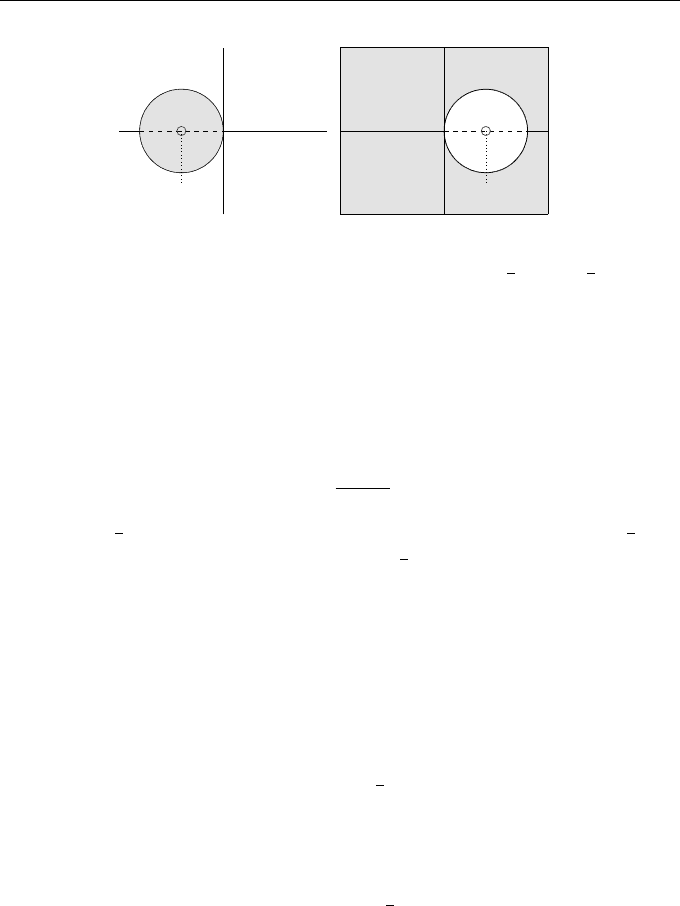
Fig. 6.11 The region of absolute stability for the θ-method (shaded) and the
interval of absolute stability (broken line). Left: 0 ≤ θ <
1
2
; right:
1
2
< θ ≤ 1.
See Exercise 6.3.
6.3.
??
Determine the region of absolute stability of the θ-method
x
n+1
− x
n
= h(θf
n+1
+ (1 − θ)f
n
).
By writing
b
h = bx + iby show that this corresponds to the exterior of
the circle
bx
2
+
2
2θ − 1
bx + by
2
= 0
if
1
2
< θ ≤ 1 and to the interior of the circle if 0 ≤ θ <
1
2
. See
Figure 6.11. What happens at θ =
1
2
?
6.4.
?
Verify the identity
a
2
− 4b = (|a| − 2)
2
− 4
1 + b − |a|
for any real numbers a, b and deduce that b > |a| − 1 whenever
a
2
< 4b, as required in the proof of Lemma 6.10.
6.5.
?
Find the interval of absolute stability of the LMM
x
n+2
− x
n
=
1
2
h(f
n+1
+ 3f
n
).
6.6.
?
Find the interval of absolute stability of the two-step Adams–
Bashforth method (AB(2))
x
n+2
− x
n+1
=
1
2
h(3f
n+1
− f
n
).
6.7.
??
Consider the one-parameter family of LMMs
x
n+2
− 4θx
n+1
− (1 − 4θ)x
n
= h
(1 − θ)f
n+2
+ (1 − 3θ)f
n
for solving the ODE x
0
(t) = f (t, x), where the notation is standard.
(a) Determine the error constant for this family of methods and
identify the method of highest order. What is its error constant?
Exercises 91
−2 −1 0
−1
0
1
ℜ(
b
h)
ℑ(
b
h)
O
−8 −6 −4 −2 0 2
−4
−3
−2
−1
0
1
2
3
4
ℜ(
b
h)
ℑ(
b
h)
O
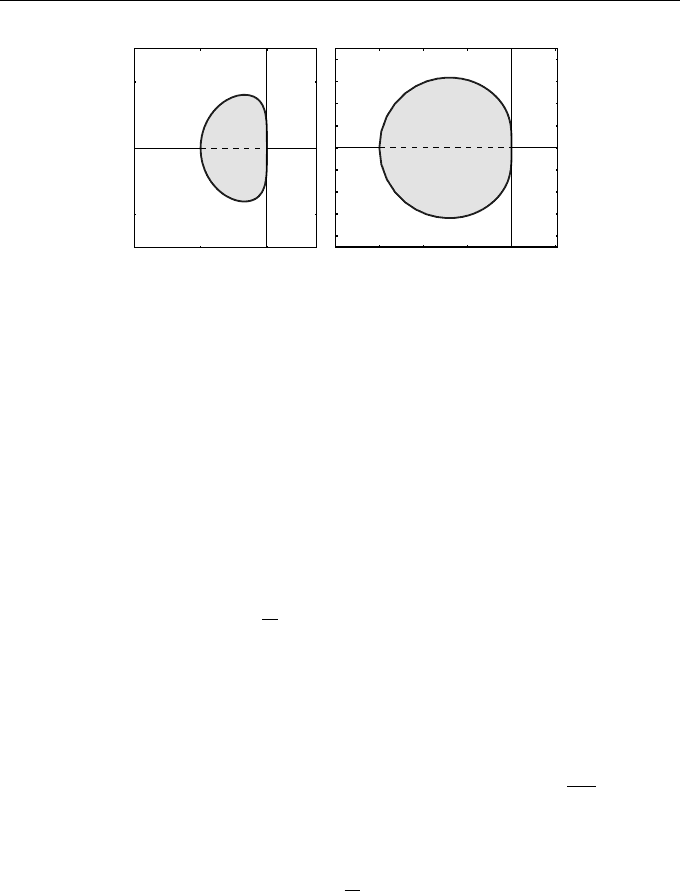
Fig. 6.12 Stability regions R for Exercise 6.9. One belongs to the Adams–
Bashforth method AB(2) and the other to the Adams–Moulton method AM(2)
(b) For what values of θ are members of this family of methods
convergent?
Is the method of highest order convergent? Explain your answer
carefully.
(c) Prove that the method is A
0
-stable when θ = 1/4.
6.8.
???
What is the stability polynomial of the LMM
x
n+2
− (1 + a)x
n+1
+ ax
n
=
1
12
h[(5 + a)f
n+2
+ 8(1 − a)f
n+1
− (1 + 5a)f
n
].
– Why must the condition −1 ≤ a < 1 be stipulated?
– Assuming that
b
h ∈ R, show that the discriminant of the (quadratic)
stability p olynomial is strictly positive for all values of
b
h and a.
What information does this give regarding its roots?
– Deduce that the interval of absolute stability is (−6
1+a
1−a
, 0).
6.9.
??
Shown in Figure 6.12 are the stability regions of the AB(2) (see
Exercise 6.6) and the Adams–Moulton method (AM(2))
x
n+2
− x
n+1
=
1
12
h(5f
n+2
+ 8f
n+1
− f
n
). (6.6)
Use the boundary locus method to ascertain which region belongs
to which method.
6.10.
?
Apply the boundary locus me thod to the mid-point rule (see Exam-
ple 6.12) to show that
b
h(s) = i sin s
so that the region of absolute stability consists of that part of the
imaginary axis between −i and i.

92 6. Linear Multistep Methods—III
6.11.
??
Show that the LMM
x
n+2
− x
n+1
=
1
4
h(f
n+2
+ 2f
n+1
+ f
n
)
is A
0
-stable.
6.12.
??
Prove that the coefficient of r
2
in the stability polynomial (6.3) is
always positive for
b
h in the interval of absolute stability; i.e.
1 −
b
hβ
2
> 0 for all
b
h ∈ R
0
.
6.13.
???
Complete the details in Example 6.12. Show, in particular, that
A =
1
2
(1 + a) and B =
1
2
(1 − a), where
a =
e
b
h
−
b
h
p
1 +
b
h
2
= 1 +
1
6
b
h
3
+ O(
b
h
4
).
Deduce that A = 1 + O(
b
h
3
) and B = O(
b
h
3
).
6.14.
??
Find the interval of absolute stability of each member of the con-
vergent family of LMMs of the form (see Exercise 5.11)
x
n+2
− x
n
= h (β
1
f
n+1
+ β
0
f
n
).
Why can no member of the family be identified as having the largest
such interval?
6.15.
???
Show that all convergent members of the family of methods
x
n+2
+ (θ − 2)x
n+1
+ (1 − θ)x
n
=
1
4
h [(6 + θ)f
n+2
+ 3(θ − 2)f
n
],
parameterized by θ, are also A
0
-stable.
6.16.
??
Show that the method
2x
n+2
− 3x
n+1
+ x
n
=
1
2
h (4f
n+2
− 3f
n+1
+ f
n
)
is A
0
-stable.
6.17.
???
Consider the family of LMMs
x
n+2
− 2ax
n+1
+ (2a − 1) x
n
= h [af
n+2
+ (2 − 3a) f
n+1
],
where a is a parameter.
(a) What are its first and sec ond characteristic polynomials?
(b) When is the method consistent?
(c) Under what conditions is it zero-stable?

Exercises 93
(d) When is the method convergent?
(e) What is its order? What is the error constant?
(f) Are there any members of the family that are A
0
-stable?
(g) What c onclusions can you draw concerning the backward differ-
entiation formula (BDF(2))
3x
n+2
− 4x
n+1
+ x
n
= 2hf
n+2
?
(h) Verify that all three statements of Dahlquist’s second barrier
theorem hold for this family of methods.
6.18.
??
Show that the method 2x
n+2
− x
n+1
− x
n
= 3hf
n+2
is A
0
-stable.
Use the b oundary locus method to show that, on the boundary of
the region of stability,
b
h(s) = (2 − e
−is
− e
−2is
)/3. Deduce that
<(
b
h(s)) ≥ 0 for all s and conclude that the method is A-stable.
6.19.
?
Use Lemma 6.10 to derive necessary and sufficient conditions on
the (real) coefficients (a, b) for the roots of the polynomial q(r) =
r
2
+ ar + b to satisfy the root condition. Pay particular attention to
double roots having m odulus equal to one.
6.20.
???
Supp ose that a convergent LMM has a cubic characteristic poly-
nomial
ρ(r) = r
3
+ ar
2
+ br + c.
Prove that
(a) it can be factorized as ρ(r) = (r − 1)(r
2
+ (1 + a)r − c);
(b) the coefficients a and c must satisfy
2 + a − c > 0, a + c ≤ 0, 1 + c ≥ 0
while excluding the point (a, c) = (1, −1).
[Hint: use Lemma 6.10, paying particular attention to roots of
ρ(r) with |r| = 1.]
6.21.
???
The composite Euler method uses Euler’s method with a step size
h
0
on even-numbered steps and a step size h
1
on odd-numbered
steps, so
x
2m+1
= x
2m
+ h
0
f
2m
and x
2m+2
= x
2m+1
+ h
1
f
2m+1
,
where h
0
= (1 − γ)h, h
1
= (1 + γ)h (0 ≤ γ < 1) so a time interval
of 2h is covered in two consecutive steps. The interval of absolute
94 6. Linear Multistep Methods—III
stability of this composite method can be deduced by applying it to
the ODE x
0
(t) = λx(t) and examining the ratio R(
b
h) = x
2m+2
/x
2m
.
Show that R(
b
h) = (1 +
b
h)
2
− γ
2
b
h
2
.
By determining the global m inimum of the function R(
b
h), prove
that −1 < R(
b
h) < 1 if, and only if,
b
h lies in the interval of absolute
stability given by
−
2
1 − γ
2
<
b
h < 0.
Deduce that the largest interval of absolute stability is
b
h ∈ (−4, 0)
and occurs when γ = 1/
√
2. Hence, the composite method may be
used in a stable manner with a value of h that is twice as large as the
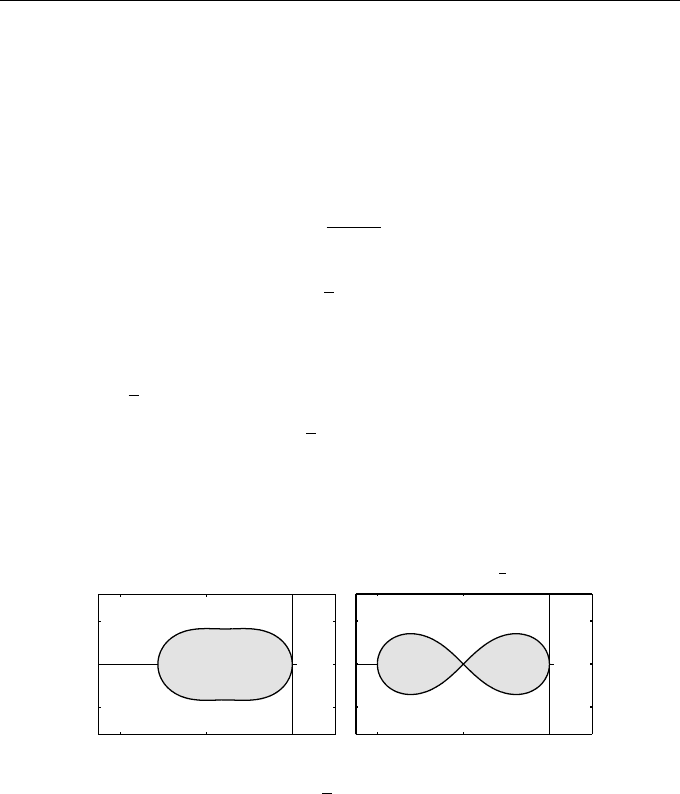
standard Euler method. The region of absolute stability with γ = 0
is the same as for Euler’s method (Figure 6.8); when γ = 3/5 and
1/
√
2 it is as shown in Figure 6.13.
6.22.
??
Supp ose that γ = 1/
√
2 and λ = −8 + i in the previous exercise.
Show that the method will be absolutely s table when h = 1/8 and
3/8 but not when h = 1/4 and 1/2. Relate these results to the region
of absolute stability shown in Figure 6.13. See also Exercise 10.14.
−4 −2 0
−1
0
1
γ = 3/5
ℜ(
b
h)
ℑ(
b
h)
O
−4 −2 0
−1
0
1
γ = 1/
√
2
ℜ(
b
h)
ℑ(
b
h)
O
Fig. 6.13 The region of absolute stability for the composite Euler method for
Exercise 6.21 when γ = 3/5 and 1/
√
2

7
Linear Multistep Methods—IV:
Systems of ODEs
In this chapter we describe the use of LMMs to solve systems of ODEs and
show how the notion of absolute stability can be generalized to such problems.
We begin with an example.
Example 7.1
Use the LMM (AB(2))
x
n+2
− x
n+1
=
1
2
h(3f
n+1
− f
n
)
to compute the solution at t = 0.2 of the IVP
u
0
(t) = −tu(t)v(t),
v
0
(t) = −u
2
(t),
with u = 1, v = 2 at t = 0. Use h = 0.1 and Euler’s method to calc ulate u
1
and v
1
.
We begin by using the differential equations to calculate u
0
(0) = 0 and
v
0
(1) = −1 so we have the starting values
t
0
= 0, u
0
= 1, v
0
= 2, u
0
0
= 0, v
0
0
= −1.
Springer Undergraduate Mathematics Series, DOI 10.1007/978-0-85729-148-6_7,
© Springer-Verlag London Limited 2010
D.F. Griffiths, D.J. Higham, Numerical Methods for Ordinary Differential Equations,