
Griffiths D.F., Higham D.J. Numerical Methods for Ordinary Differential Equations: Initial Value Problems
Подождите немного. Документ загружается.


96 7. Linear Multistep Methods—IV
Then, applying Euler’s method (see Section 2.5) to each of the individual ODEs:
n = 0 : t
1
= 0.1,
u
1
= u
0
+ hu
0
0
= 1,
v
1
= v
0
+ hv
0
0
= 1.9,
with which we can compute u
0
1
= −t
1
u
1
v
1
= −0.19 and v
0
1
= −u
2
1
= −1.
When the given LMM is applied to both the u and v differential equations
it is seen that we have to c alculate, for each n = 0, 1, 2, . . . ,
t
n+2
= t
n+1
+ h,
u
n+2
= u
n+1
+
1
2
h(3u
0
n+1
− u
0
n
),
v
n+2
= v
n+1
+
1
2
h(3v
0
n+1
− v
0
n
),
u
0
n+2
= −t
n+2
u
n+2
v
n+2
,
v
0
n+2
= −u
2
n+2
.
So,
n = 0 : t
2
= t
1
+ h = 0.2,
u
2
= u
1
+
1
2
h(3u
0
1
− u
0
0
) = 0.9715,
v
2
= v
1
+
1
2
h(3v
0
1
− v
0
0
) = 1.8,
u
0
2
= −t
2
u
2
v
2
= −0.19,
v
0
2
= −u
2
2
= −1.0.
The computations of the first few steps are summarized in Table 7.1.
More generally, for the system of ODEs written in vector form,
u
0
(t) = f (t, u(t)), t > t
0
,
with u(t
0
) = u
0
, the first step is computed by Euler’s method , after which
t
n+2
= t
n+1
+ h,
u
n+2
= u
n+1
+
1
2
h(3u
0
n+1
− u
0
n
),
u
0
n+2
= f (t
n+2
, u
n+2
),
for n = 0, 1, 2, . . . .
n t
n
u
n
v
n
u
0
n
v
0
n
0 0 1.0000 2.0000 0 −1.0000 Initial data
1 0.1000 1.0000 1.9000 −0.1900 −1.0000 Euler’s Method
2 0.2000 0.9715 1.8000 −0.1900 −1.0000 AB(2)
3 0.3000 0.9525 1.7000 −0.3497 −0.9438 . . .
Table 7.1 Numerical solutions for Example 7.1

7.1 Absolute Stability for Systems 97
7.1 Absolute Stability for Systems
The notion of absolute stability for systems of ODEs requires us to apply our
LMM to the model problem involving a system of m first-order linear ODEs
with constant coefficients:
u
0
(t) = Au(t), (7.1)
where u(t) is an m-dimensional vector (u(t) ∈ R
m
) and A is a constant m ×m
matrix (A ∈ R
m×m
). We first recall some aspects of ODE theory.
Diagonalization of ODEs. In order to understand how solutions of the ODE
system behave we carry out a “diagonalization” process. We assume that A is a
diagonalizable matrix, i.e. it has m linearly independent eigenvectors v
1
, . . . , v
m
with corresponding eigenvalues λ
1
, . . . , λ
m
:
Av
j
= λ
j
v
j
.
Under these circumstances, there exists a (possibly complex) nonsingular ma-
trix V whose columns are the vectors v
1
, . . . , v
m
, such that
V
−1
AV = Λ,
where Λ is the m ×m diagonal matrix with entries λ
1
, . . . , λ
m
on the diagonal.
Defining u(t) = V x(t), then x(t) satisfies the differential equation
x
0
(t) = Λx(t), (7.2)
a typical component of which is
x
0
(t) = λx(t), (7.3)
where λ is an eigenvalue of A. The solution of the linear system (7.1) has
been reduced to solving a collection of scalar problems of the type studied in
Section 6.2, one for each eigenvalue of A. Since x(t) and u(t) are connected
through a fixed linear transformation, they have the same long-term behaviour.
Hence, the scalar problems (7.3) tell us everything we need to know. This is
illustrated in the next example and formalized in the theorem that follows.
Example 7.2
Determine the general solution of the system (7.1) when
A =
1 3
−2 −4
and examine the behaviour of solutions as t → ∞.

98 7. Linear Multistep Methods—IV
The matrix A may be diagonalized using
V =
3 −1
−2 1
into the form
V
−1
AV =
−1 0
0 −2
.
This shows that A has eigenvalues λ
1
= −1 and λ
2
= −2, with corresponding
eigenvectors
v
1
=
3
−2
, v
2
=
−1
1
.
In some circumstances it would be convenient to work with the normalized
eigenvectors
1
√
13
v
1
and
1
√
2
v
2
, but in our context normalizing is not helpful.
Using u
0
(t) = Au(t), the new variables x(t) = V
−1
u(t) satisfy
x
0
(t) = V
−1
u
0
(t) = V
−1
Au(t) = V
−1
AV x(t) =
−1 0
0 −2
x(t).
We have now uncoupled the system into the two scalar problems x
0
(t) = −x(t)
and y
0
(t) = −2y(t), where x(t) = [x(t), y(t)]
T
. These have general solutions
x(t) = A e
−t
and y(t) = B e
−2t
, where the constants A and B depend on the
initial data. It follows that u(t) has the general form
u(t) = V x(t) =
3 −1
−2 1
A e
−t
B e
−2t
= A e
−t
3
−2
+ B e
−2t
−1
1
.
It is now obvious that u(t) → 0 as t → ∞, and it is clear from the derivation
that this property follows directly from the nature of the two eigenvalues.
Absolute stability is concerned with solutions of unforced ODEs that tend
to zero as t → ∞ and these are characterized in the following theorem.
Theorem 7.3
If A is a diagonalizable matrix having eigenvalues λ
1
, . . . , λ
m
, then the solutions
of u
0
(t) = Au(t) tend to zero as t → ∞ for all choices of initial conditions if,
and only if, <(λ
j
) < 0 for each j = 1, 2, . . . , m. (<(λ) denotes the real part
of λ.)
For a proof see Braun [5, Section 4.2], Nagle et al. [57, Section 12.7] or
O’Malley [59, Section 5.3].

7.1 Absolute Stability for Systems 99
Diagonalization of LMMs. Applying the general two-step LMM
x
n+2
+ α
1
x
n+1
+ α
0
x
n
= h(β
2
f
n+2
+ β
1
f
n+1
+ β
0
f
n
) (7.4)
to the system u
0
(t) = Au(t) we obtain (since f
n
= Au
n
)
u
n+2
+ α
1
u
n+1
+ α
0
u
n
= hA(β
2
u
n+2
+ β
1
u
n+1
+ β
0
u
n
). (7.5)
Following the treatment of scalar ODEs, we define u
n+j
= V x
n+j
for each
n and each j. Then, (7.5) becomes, on multiplying by V
−1
,
V
−1
u
n+2
+ α
1
V
−1
u
n+1
+ α
0
V
−1
u
n
= hV
−1
A(β
2
u
n+2
+ β
1
u
n+1
+ β
0
u
n
)
= hV
−1
AV (β
2
V
−1
u
n+2
+ β
1
V
−1
u
n+1
+ β
0
V
−1
u
n
),
which simplifies to
x
n+2
+ α
1
x
n+1
+ α
0
x
n
= hΛ(β
2
x
n+2
+ β
1
x
n+1
+ β
0
x
n
).
This is precisely the recurrence that arises when we apply the LMM directly
to the diagonalized sys tem of ODEs (7.2). The components are now uncoupled
and, if we write x
n
to denote a typical component of x
n
, we find
x
n+2
+ α
1
x
n+1
+ α
0
x
n
= hλ(β
2
x
n+2
+ β
1
x
n+1
+ β
0
x
n
), (7.6)
in which λ is a typical eigenvalue of A. This is the same equation (6.2) that
was obtained when the general two-step LMM (7.4) was applied to the scalar
ODE (7.3).
We have shown that the two processes
1. apply the LMM
2. diagonalise A
commute—the same result is obtained regardless of the order in which the op-
erations are carried out. This can be illustrated by the “commutative diagram”
u
0
= Au
Apply LMM
−−−−−−−−−−→ (7.5)
y
Diagonalize
y
Diagonalize
x
0
= Λx
Apply LMM
−−−−−−−−−−→ (7.6)
in which the route taken from top left to bottom right is immaterial.
1
We now return to the question of absolute stability—the following definition
is simply a rephrasing of Definition 6.3 to accommodate systems of ODEs and
k-step methods.
1
In practice, though, the constants hidden inside the arrows can be important. See
Trefethen and coworkers [35, 67] for details of the fascinating topic of pseudoeigen-
values.

100 7. Linear Multistep Methods—IV
Definition 7.4 (Absolute Stability)
Supp ose that all solutions of u
0
(t) = Au(t) tend to zero as t → ∞ for all
choices of initial condition u
0
. A k-step numerical method with a given stepsize
h applied to such a system is said to be absolutely stable if all its solutions tend
to zero as n → ∞ for all choices of starting values u
0
, u
1
, . . . , u
k−1
.
Using the diagonalization trick that produced (7.2) and (7.3), we can appeal
to the scalar analysis from Chapter 6. We know that u
n
→ 0 if, and only if,
x
n
→ 0, and hence we simply require that all solutions to (7.6) tend to zero
for every eigenvalue λ of A. Thus
An LMM is absolutely stable for the diagonalizable system u
0
(t) =
Au(t) if λh ∈ R (the region of absolute stability) for every eigenvalue
λ of A.
In other words, to analyse the behaviour of any LMM applied to (7.1), we
need only consider its application to the scalar problem (7.3) and our results can
be transferred to systems of ODEs simply by interpreting λ as any eigenvalue
of A.
Example 7.5
What is the largest step size h allowed by absolute stability when the system
u
0
(t) = −11u(t) + 100v(t), v
0
(t) = u(t) − 11v(t) (7.7)
is solved using Euler’s method?
Euler’s method is, in this case,
u
n+1
= u
n
+ h
−11u
n
+ 100v
n
,
v
n+1
= v
n
+ h
u
n
− 11v
n
.
The system of ODEs may be written in matrix-vector form u
0
(t) = Au(t) with
coefficient matrix
A =
−11 100
1 −11
,
which has eigenvalues −1 and −21. Since these are real we use the interval of
absolute stability of Euler’s m ethod (see Example 6.7), which requires hλ ∈
(−2, 0). Therefore, h must satisfy
−2 < −h < 0 and − 2 < −21h < 0,
i.e. 0 < h <
2
21
≈ 0.0952.
7.1 Absolute Stability for Systems 101
0 1 2 3 4 5
0
1
2
3
4
5
t
u(t), v(t)
Fig. 7.1 The components u(t) (solid curve)
and v(t) (dashed curve) of the solution of the
IVP of Example 7.5
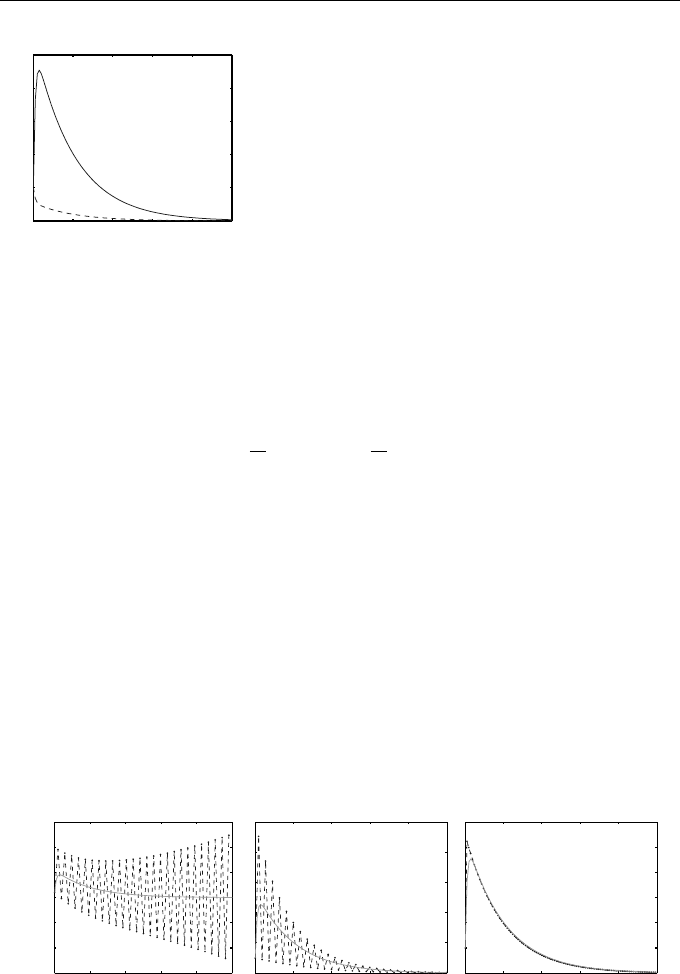
The exact solution of the ODEs with initial values u(0) = v(0) = 1 is shown
in Figure 7.1. There is a “rapid initial transient” as one component grows to
its maximum at a time t = 0.14, after which it decays more gradually to zero.
The fast transient is governed by the eigenvalue λ = −21 and the slow decay
by λ = −1, the exact solution being (see Exercise 7.1)
u
v
=
11
20
10
1
e
−t
−
9
20
10
−1
e
−21t
. (7.8)
Results for Euler’s method with various step sizes are shown in Figure 7.2.
h = 0.0962, which is 1% over the stability limit h = 2/21 (Figure 7.2 left).
Although the amplitude of the solution grows only slowly, the rapid oscil-
lations are a tell-tale sign of instability.
h = 0.0905, which is 5% under the limit (Figure 7.2 middle). Although the
solution tends to zero (b ecause we are within the limit of absolute stability)
there continue to be strong oscillations and the solution does not begin to
be accurate until t nears the end of the interval of integration.
h = 0.0476, which is 50% of the limit (Figure 7.2 right). We now have a smooth
0 1 2 3 4 5
−15
−10
−5
0
5
10
15
t
n
u
n
, v
n
h = 0.0962
0 1 2 3 4 5
0
2
4
6
8
10
t
n
h = 0.0905
0 1 2 3 4 5
0
1
2
3
4
5
6
t
n
h = 0.0476
Fig. 7.2 The u(t) component in Example 7.5 (solid line) and the correspond-
ing component of the numerical solution u
n
by Euler’s method (dashed line)

102 7. Linear Multistep Methods—IV
solution (u(t) is the solid line and v(t) the dashed line).
2
The numerical
solution is indistinguishable from the exact solution (thin solid line) for
t > 0.2.
7.2 Stiff Systems
Examples 6.1 and 7.5 show that in certain types of system we have to use
a small s tep size in order to produce an absolutely stable solution when, on
grounds of accuracy, we would have expected to have been able to use a much
larger value of h. Linear problems of this kind are characterized by matrices
whose eigenvalues have negative real parts (so that u(t) → 0 as t → ∞), but
some have small absolute values while others are very large. That is, the ratio
max
j
−<(λ
j
)
min
j
−<(λ
j
)
may be extremely large (a ratio of 10
6
is not uncommon). We say that such
problems are stiff. If we apply a method whose region of absolute stability is
bounded, we find that the step length is restricted by the most negative eigen-
value, while the long-term solution u(t) will be dominated by the least negative
eigenvalues. Therefore, very many time steps must be taken to compute the so-
lution over a mo derately long time. A by-product is that the numerical solution
may be much more accurate than is needed.
The use of an A- stable method in such circumstances allows h to be chosen
simply on grounds of accuracy, with no regard for stability. Thus, A-stable
methods are particularly important for stiff systems.
7.3 Oscillatory Systems
Although all unforced physical processes exhibit some level of damping (and
their mathematical models should, therefore, be solved by absolutely stable
methods), some processes are best regarded as being undamped. Examples are
(a) the motion of the planets, (b) inviscid flow of high-speed gases (where the
effects of viscosity of a fluid may be ignored), and (c) molecular dynamics
(which simulates the interactions of atoms and molecules). The Lotka–Volterra
2
To avoid oscillations, the roots of the stability polynomial should satisfy 0 < r < 1
(rather than −1 < r < 1) and, for Euler’s method, this leads to λh ∈ (−1, 0).

7.3 Oscillatory Systems 103
equations (Example 1.3) modelling a naive predator-prey situation also have
no damping.
Allowing complex-valued functions, the simplest oscillator is described by
x
0
(t) = iωx(t),
which is a special case of the equation x
0
(t) = λx(t) we have met several
times (see (6.1) and (7.3), for instance) with λ = iω, an imaginary number.
The general solution of this equation is x(t) = c e
iω t
, where c is an arbitrary
constant. Taking the absolute value, we have
|x(t)| = |c|,
and the motion in the complex plane is circular with a radius dictated by
the starting condition. Numerical methods can be applied to complex prob-
lems, but we prefer to use the equivalent real system (see Exercise 1.6). The
next example illustrates the unsuitability of both forward and backward Eu-
ler methods for solving oscillatory problems. A particularly large s tep size is
chosen to exaggerate the effects so that they are more easily visualized.
Example 7.6
Use Euler’s method, the trapezoidal rule and the backward Euler method with
h = 0.5 to solve the IVP
u
0
(t) = −v(t), v
0
(t) = u(t),
u(0) = 1, v(0) = 0.
We calculate
d
dt
u
2
(t) + v
2
(t)
= 2u(t)u
0
(t) + 2v(t)v
0
(t) = 0 (7.9)
so that the function u
2
(t)+v
2
(t) remains constant in time: the motion in the u-v
phase plane is circular. This example examines which of the one-step methods
can reproduce this type of motion.
Euler’s method: u
n+1
= u
n
− hv
n
and v
n+1
= v
n
+ hu
n
for n = 0, 1, . . . with
u
0
= 1 and v
0
= 0.
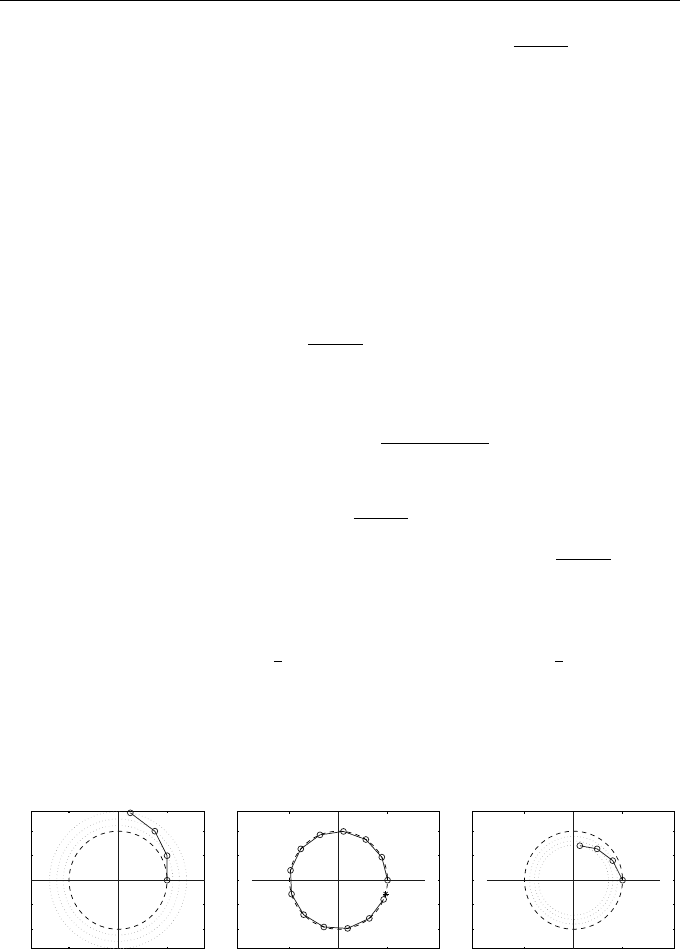
The first three steps are shown on the left of Figure 7.3 (◦ symbols) and
the numerical solution clearly spirals outwards. At the nth step the mo-
tion generated by Euler’s method is tangential to the circle with radius
p
u
2
n
+ v
2
n
(these circles are shown as dotted curves). An easy calculation
shows that
u
2
n+1
+ v
2
n+1
= (1 + h
2
)(u
2
n
+ v
2
n
),
104 7. Linear Multistep Methods—IV
so that the distance to the origin increases by a factor
√
1 + h
2
at each step.
Thus, Euler’s method displays a weak form of instability—not sufficient to
prevent convergence (were we to take the limit h → 0) but strong enough to
make it unsuitable for simulating, for instance, the motion of the planets.
Backward Euler method: u
n+1
= u
n
− hv
n+1
and v
n+1
= v
n
+ hu
n+1
for n =
0, 1, . . . with u
0
= 1 and v
0
= 0. Thus,
1 h
−h 1
u
n+1
v
n+1
=
u
n
v
n
leading to
u
n+1
v
n+1
=
1
1 + h
2
1 h
−h 1
u
n
v
n
.
The first three steps are shown on the right of Figure 7.3 (◦ symbols) and
the numerical solution clearly spirals inwards. At the nth step the motion
is tangential to the circle with radius
q
u
2
n+1
+ v
2
n+1
. It can be shown that
u
2
n+1
+ v
2
n+1
=
1
1 + h
2
(u
2
n
+ v
2
n
),
so that the distance to the origin decreases by a factor 1/
√
1 + h
2
at each
step. Thus, the backward Euler method applies too much damping at each
step.
Trapezoidal rule: u
n+1
= u
n
−
1
2
h(v
n+1
+ v
n
) and v
n+1
= v
n
+
1
2
h(u
n+1
+ u
n
)
for n = 0, 1, . . . with u
0
= 1 and v
0
= 0. Thus,
1 h/2
−h/2 1
u
n+1
v
n+1
=
1 −h/2
h/2 1
u
n
v
n
−1 0 1
−1
−0.5
0
0.5
1
u
v
−1 0 1
−1
−0.5
0
0.5
1
u
−1 0 1
−1
−0.5
0
0.5
1
u
Fig. 7.3 Numerical solution of the system in Example 7.6 by Euler’s method
(left), trapezoidal rule (middle), and backward Euler (right), all using h = 1/2
and drawn in the u-v phase plane. The exact solution is shown by the dashed
circle

7.4 Postscript 105
leading to
u
n+1
v
n+1
=
1
4 + h
2
4 − h
2
−4h
4h 4 − h
2
u
n
v
n
. (7.10)
The first 12 steps are shown in Figure 7.3 (ce ntre: ◦ symbols) and the
numerical solution appears to follow a circular motion: it c an be confirmed
algebraically that (7.10) implies that (see Exercise 7.7)
u
2
n+1
+ v
2
n+1
= u
2
n
+ v
2
n
. (7.11)
The trapezoidal rule faithfully computes the amplitude of the solution; it
has, however, a second-order phase error—see Exercise 7.7.
More generally, linear systems of higher dimension have the familiar structure
u
0
(t) = Au(t),
but, for oscillatory problems, the eigenvalues of A are imaginary numbers and
so A is typically a skew-symmetric matrix. In Chapter 14 we consider general
quadratic invariants, of which (7.9) is a special case.
7.4 Postscript
It would be wrong to give the impression that LMMs whose stability polynomi-
als have all their roots strictly on the unit circle are the only, or even preferred,
candidates for solving undamped problems.
When an absolutely stable numerical metho d is used to solve a damped
problem (characterized by having eigenvalues with negative real parts) the LTE
committed at one step is itself damped in subsequent steps. This can be seen
most clearly in the expression (2.16) for the GE for Euler’s method applied to
x
0
(t) = λx(t)—the effect at t = t
n
of the LTE, T
j
, committed at the jth ste p is
(1 + hλ)
n−j
T
j
,
with |1 + hλ| < 1. A similar argument applies to the rounding error committed
at the jth step.
In contrast, local errors committed in undamped LMMs can persist for all
time (in periodic problems the LTE will also be periodic, so there will usually
be some me asure of cancellation of local errors over a period). There may,
however, be some advantage in these situation in using LMMs that include a
small amount of damping.