
Griffiths D.F., Higham D.J. Numerical Methods for Ordinary Differential Equations: Initial Value Problems
Подождите немного. Документ загружается.

6 1. ODEs—An Introduction
Example 1.3 (Lotka–Volterra Equations)
The Lotka–Volterra equations (developed circa 1925) offer a simplistic model of
the conflict between populations of predators and prey. Suppose, for instance,
that the numbers of rabbits and foxes in a certain region at time t are u(t) and
v(t) respectively. Then, given the initial population siz es u(0) and v(0) at time
t = 0, their numbers might evolve according to the autonomous system
u
0
(t) = 0.05u(t)
1 − 0.01v(t)
,
v
0
(t) = 0.1v(t)
0.005u(t) − 2
.
(1.10)
These ODEs reproduce certain features that make sense in this predator-prey
situation. In the first of these:
– Increasing the number of foxes (v(t)) decreases the rate (u
0
(t)) at which
rabbits are produced (because more rabbits get eaten).
– Increasing the number of rabbits (u(t)) increases the rate at which rabbits
are produced (because more pairs of rabbits are available to mate).
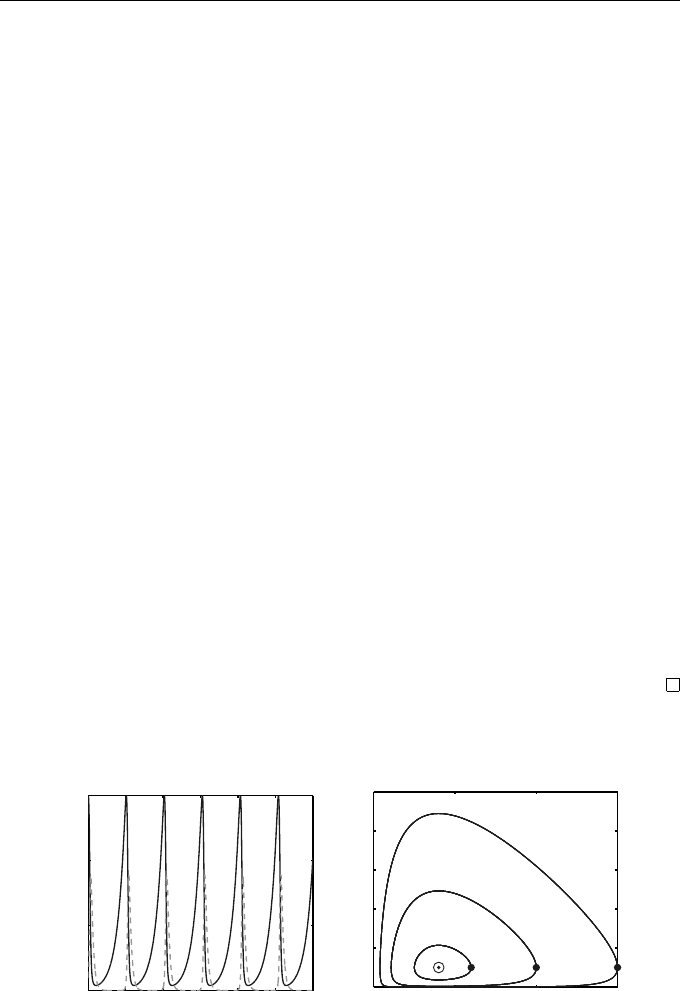
The solutions corresponding to an initial population of 1500 rabbits (solid
curves) and 100 foxes (dashed curves) are shown on the left of Figure 1.3.
On the right we plot these, and other solutions, in the phase plane, i.e., the
locus of the point (u(t), v(t)) parameterized by t for 0 ≤ t ≤ 600. Initially there
are 100 foxes and the three curves corresp ond to there being initially 600, 1000,
and 1500 rabbits (the starting values are shown by solid dots). The periodic
nature of the p opulations can be deduced from the fact that these are closed
curves. The “centre” of rotation is indicated by a small circle.
The text by Murray [56] is packed with examples where ODEs are used to
model biological processes.
0 100 200 300 400 500 600
0
500
1000
1500
t
u(t), v (t)
0 500 1000 1500
0
200
400
600
800
1000
u(t)
v(t)
Fig. 1.3 Solutions for the Lotka–Volterra equations (1.10)

1.1 Systems of ODEs 7
Example 1.4 (Biochemical Reactions)
In biochemistry, a Michaelis–Menten-type process involving
– a substrate S,
– an enzyme E,
– a complex C, and
– a product P
could be summarized through the reactions
S + E
c
1
→ C
C
c
2
→ S + E
C
c
3
→ P + E.
In the framework of chemical kinetics, this set of reactions may be interpreted
as the ODE system
S
0
(t) = −c
1
S(t) E(t) + c
2
C(t),
E
0
(t) = −c
1
S(t) E(t) + (c
2
+ c
3
)C(t),
C
0
(t) = c
1
S(t) E(t) − (c
2
+ c
3
)C(t),
P
0
(t) = c
3
C(t),
where S(t), E(t), C(t) and P (t) denote the concentrations of substrate, enzyme,
complex and product, respectively, at time t.
Letting x(t) be the vector [S(t), E(t), C(t), P (t)]
T
, this system fits into the
general form (1.8) with m = 4 components and
f(t, x) =
−c
1
x
1
x
2
+ c
2
x
3
−c
1
x
1
x
2
+ (c
2
+ c
3
)x
3
c
1
x
1
x
2
− (c
2
+ c
3
)x
3
c
3
x
3
.
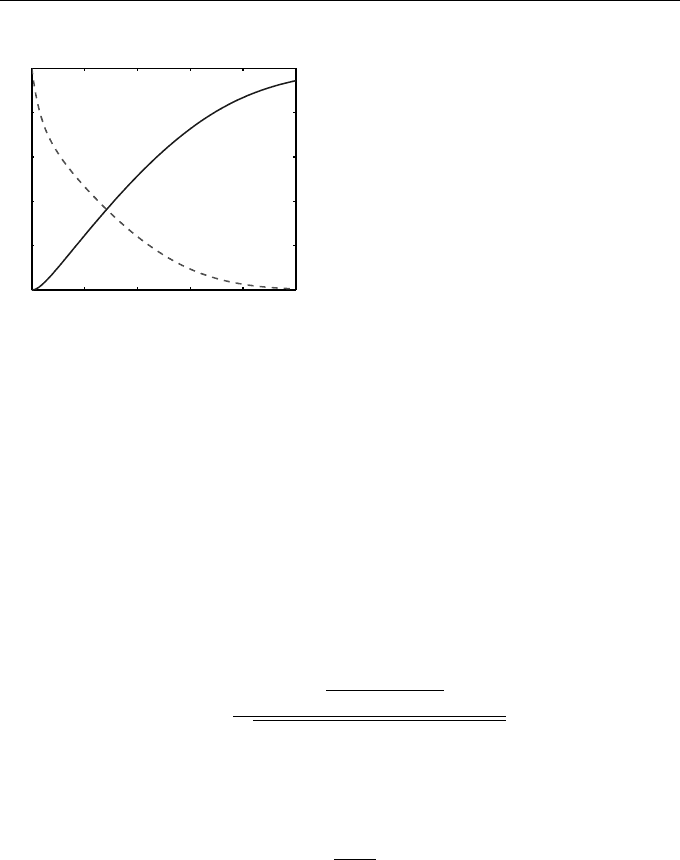
In Figure 1.4 we show how the levels of substrate and product, x
1
(t) and
x
4
(t) respectively, evolve over time. It is clear that the substrate becomes de-
pleted as product is created. Here we took initial conditions of x
1
(0) = 5×10
−7
,
x
2
(0) = 2 × 10
−7
, x
3
(0) = x
4
(0) = 0, with rate constants c
1
= 10
6
, c
2
= 10
−4
,
c
3
= 0.1, based on those in Wilkinson [69] that were also used in Higham [33].
We refer to Alon [1] and Higham [33] for more details about how ODE
models are used in chemistry and biochemistry.
8 1. ODEs—An Introduction
0 10 20 30 40 50
0
1
2
3
4
5
x 10
−7
t
Concentration
Product
Substrate
Fig. 1.4 Substrate and product con-
centrations from the chemical kinetics
ODE of Example 1.4
Example 1.5 (Fox-Rabbit Pursuit)
Curves of pursuit arise naturally in military and predator-prey scenarios when-
ever there is a moving target. Imagine that a rabbit follows a predefined path,
(r(t), s(t)), in the plane in an attempt to shake off the attentions of a fox. Sup-
pose further that the fox runs at a speed that is a constant factor k times the
speed of the rabbit, and that the fox chases in such a way that at all time s its
tangent points at the rabbit. Straightforward arguments then show that the
fox’s path (x(t), y(t)) satisfies
x
0
(t) = R(t) (r(t) − x(t)),
y
0
(t) = R(t) (s(t) − y(t)),
where
R(t) =
k
p
r
0
(t)
2
+ s
0
(t)
2
p
(r(t) − x(t))
2
+ (s(t) − y(t))
2
.
In the case where the rabbit’s path (r(t), s(t)) is known, this is an ODE system
of the form (1.8) with m = 2 components.
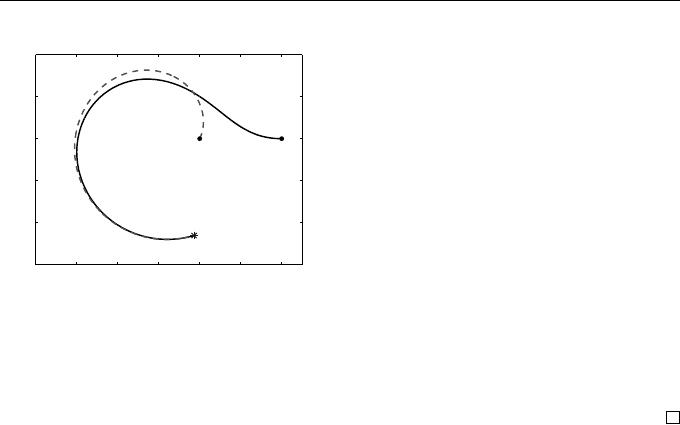
In Figure 1.5 the rabbit follows an outward spiral
r(t)
s(t)
=
√
1 + t
cos t
sin t
,
shown as a dashed curve in the x, y plane, with a solid dot marking the initial
location. The fox’s path, found by solving the ODE with a numerical method,
is shown as a solid line. The fox is initially located at x(0) = 3, y(0) = 0
and travels k = 1.1 times as quickly as the rabbit. We solved the ODE up to
t = 5.0710, which is just before the critical time where rabbit and fox meet
(marked by an asterisk). At that point the ODE would be ill defined because
of a division-by-zero error in the definition of R(t) (and because of a lack of
rabbit!).
1.1 Systems of ODEs 9
−3 −2 −1 0 1 2 3
−3
−2
−1
0
1
2
x
y
Fox
Rabbit
Fig. 1.5 Fox-rabbit pursuit curve
from Example 1.5
This example is taken from Higham and Higham [34, Chapter 12], where
further details are available. A comprehensive and very entertaining coverage
of historical developments in the field of pursuit curves can be found in Nahin’s
bo ok [58].
Example 1.6 (Zombie Outbreak)
ODEs are often used in epidemiology and population dynamics to describe the
spread of a disease. To illustrate these ideas in an eye-catching science fiction
context, Munz et al. [55] imagined a zombie outbreak. At each time t, their
model records the levels of
– humans H(t),
– zombies Z(t),
– removed (‘dead’ zombies) R(t), which may return as zombies.
It is assumed that a zombie may irreversibly convert a human into a zombie. On
the other hand, zombies cannot be killed, but a plucky human may temporarily
send a zombie into the ‘removed’ class. The simplest version of the model takes
the form
H
0
(t) = −βH(t)Z(t),
Z
0
(t) = βH(t)Z(t) + ζR(t) − αH(t)Z(t),
R
0
(t) = αH(t)Z(t) − ζR(t).
The (constant, positive) parameters in the model are:
– α, dealing with human–zombie encounters that remove zombies.
– β, dealing with human–zombie encounters that convert humans to zombies.
– ζ, dealing with removed zombies that revert to zombie status.
10 1. ODEs—An Introduction
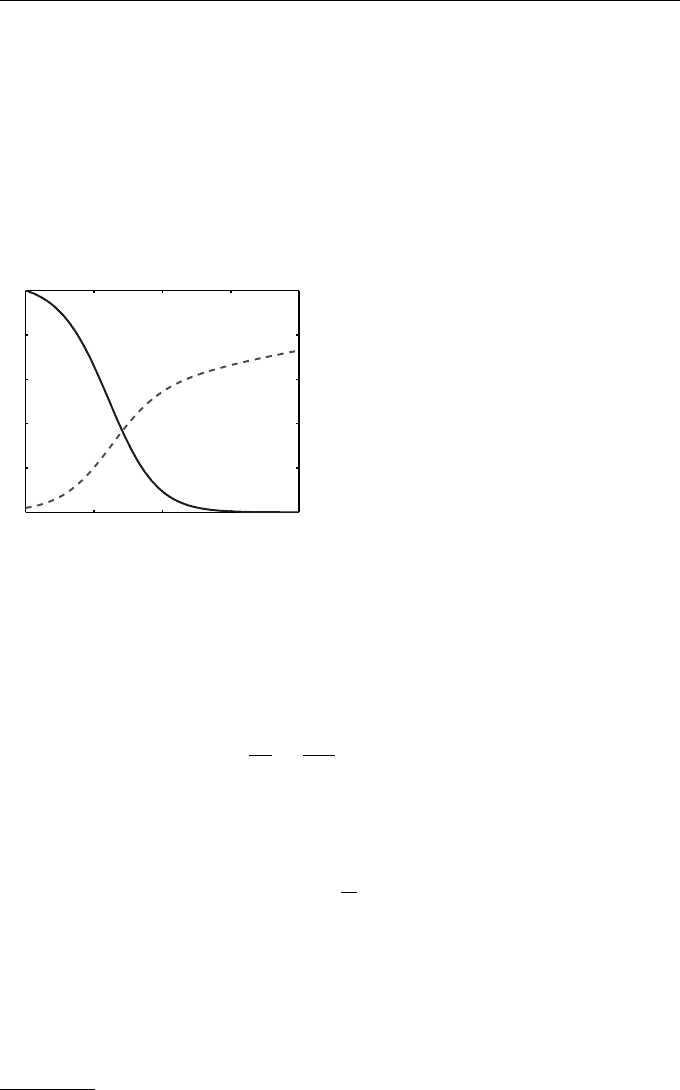
Figure 1.6 shows the case where β = 0.01. α = 0.005 and ζ = 0.02. We
set the initial human population to be H(0) = 500 with Z(0) = 10 zombies.
We have in mind the scenario where a group of zombies from Lenzie, near
Glasgow, attacks the small community of Newport in Fife. The figure shows
the evolution of the human and zombie levels, and the doomsday outcome of
total zombification.
The issue of how to infer the m odel parameters from observed human/zombie
population levels is treated in [7].
0 1 2 3 4
0
100
200
300
400
500
t
Humans
Zombies
Fig. 1.6 Human and zombie popula-
tion levels from Example 1.6
Example 1.7 (Method of Lines for Partial Differential Equations)
The numerical solution of partial differential equations (PDEs) can lead to
extremely large systems of ODEs. Consider the solution of Fisher’s equation
∂u
∂t
=
∂
2
u
∂x
2
+ u(1 − u)
defined for 0 < x < 5 and t > 0. The solution u(t, x) also has to satisfy
boundary conditions u(t, 0) = 0 and u(t, 5) = 1, and match given initial data
u(0, x), which we take to be
u(0, x) = e
x/5−1
sin
2
3
10
πx, 0 ≤ x ≤ 5.
This is a simple example of one of the many initial-b oundary-value problems for
equations of reaction-diffusion type that occur in chemistry, biology, ecology,
and countless other areas. It can be solved numerically by dividing the interval
0 < x < 5 into 5N subintervals (say) by the points x
j
= j/N, j = 0 : 5N and
using u
j
(t) to denote the approximation to u(x
j
, t) at each of these locations.
3
After approximating the second derivative in the equation by finite differences
3
For integers m < n, j = m : n is shorthand for j = m, m + 1, m + 2, . . . , n.

1.1 Systems of ODEs 11
(see, for instance, Le veque [47] or Morton and Mayers [54]) we arrive at a
system of 5N − 1 differential equations, of which a typical equation is
u
0
j
= N
2
(u
j−1
− 2u
j
+ u
j+1
) + u
j
− u
2
j
,
(j = 1 : 5N −1) with end conditions u
0
(t) = 0, u
5N
(t) = 1 and initial conditions
that specify the values of u
j
(0):
u
j
(0) = e
1−j/5N
sin
2
3j
10N
π, j = 1 : 5N −1.
By defining the vector function of t
u(t) = [u
1
(t), u
2
(t), . . . , u
5N−1
(t)]
T
and the (5N − 1) × (5N −1) tridiagonal matrix A
A = N
2
−2 1
1 −2 1
.
.
.
.
.
.
.
.
.
1 −2 1
1 −2
(1.11)
we obtain a system of the form
u
0
(t) = Au(t) + g(u(t)), t > 0,
where the jth component of g(u) is u
j
− u
2
j
(except for the last component,
g
5N−1
(u), which has an additional term, N
2
, due to the non-zero boundary
condition at x = 5) and u(0) = η is the known vector of initial data. The
solution with N = 6 is shown in Figure 1.7 for 0 ≤ t ≤ 0.1.
0
0.1
0
5
0
1
t
x
j
u
j
(t)
Fig. 1.7 Solution for the 29 ODEs
approximating Fisher’s equation with
N = 6. The initial conditions for
the components are indicated by solid
dots (•)
Generally, PDEs involving one spatial variable (x) typically lead to 100–1000
ODEs. With two spatial variables (x and y) these numbe rs become 100
2
–1000
2
so the number of ODEs in a system may run to millions.

12 1. ODEs—An Introduction
1.2 Higher Order Differential Equations
Some mathematical models involve derivatives higher than the first. For ex-
ample, Newton’s laws of motion involve acceleration—the second derivative of
position with respect to time. Such higher-order ODEs are automatically con-
tained in the framework of systems of first-order ODEs. We first illustrate the
idea with an example.
Example 1.8 (Van der Pol Oscillator)
For the second-order IVP
x
00
(t) + 10(1 − x
2
(t))x
0
(t) + x(t) = sin πt,
x(t
0
) = η
0
, x
0
(t
0
) = η
1
,
we define u = x, v = x
0
so that
u
0
(t) = v(t),
v
0
(t) = −10(1 − u
2
(t))v(t) − u(t) + sin πt,
with initial conditions u(t
0
) = η
0
and v(t
0
) = η
1
. These equations are now in
the form (1.7), so that we may again write them as (1.8), where
x(t) =
u(t)
v(t)
, f(t, x(t)) =
v(t)
−10
1 − u
2
(t)
v(t) − u(t) + sin πt
.
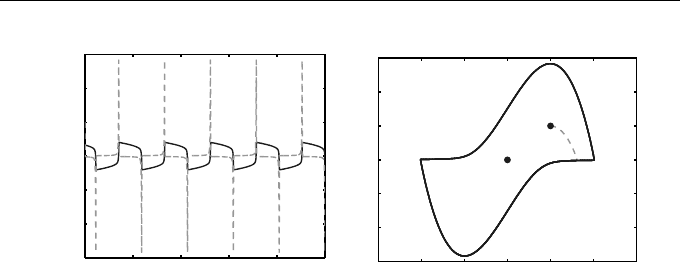
The solution of the unforced equation, where the term sin πt is dropped, for
the initial condition u(0) = 1, v(0) = 5 is shown in Figure 1.8 for 0 ≤ t ≤ 100.
After a short initial phase (0 ≤ t ≤ 0.33—shown as a broken curve emanating
from P) the solution approaches a periodic motion; the limiting closed curve
is known as a limit cycle. In the figure on the left the solution v(t) ≡ x
0
(t) is
shown as a broken curve and appears as a sequence of spikes.
It is straightforward to extend the s ec ond-order example in Example 1.8 to
a differential equation of order m:
x
(m)
(t) = f
t, x(t), x
0
(t), . . . , x
(m−1)
(t)
. (1.12)
New dependent variables may be introduced for the function x(t) and each of
its first (m − 1) derivatives:
x
1
(t) = x(t),
x
2
(t) = x
0
(t),
.
.
.
x
m
(t) = x
(m−1)
(t).
1.2 Higher Order Differential Equations 13
0 20 40 60 80 100
−15
−10
−5
0
5
10
15
t
u(t), v(t)
−3 −2 −1 0 1 2 3
−15
−10
−5
0
5
10
15
P
O
u
v
Fig. 1.8 Solution for the ODEs representing the unforced Van der Pol equa-
tion of Example 1.8. On the left, u(t) ≡ x(t) (solid curve) and v(t) ≡ x
0
(t)
(broken curve) are shown as functions of t. The phase portrait is drawn on the
right, where P marks the initial point
There are obvious relationships between the first (m − 1) such functions:
x
0
1
(t) = x
2
(t),
x
0
2
(t) = x
3
(t),
.
.
.
x
0
m−1
(t) = x
m
(t).
These, together with the differential equation, which has become,
x
0
m
(t) = f (t, x
1
(t), x
2
(t), . . . , x
m
(t)),
give a total of m ODEs for the components of the m-dimensional vector function
x = [x
1
, x
2
, . . . , x
m
]
T
. The corresponding IVP for x(t) has values specified for
the function itself as well as its first (m − 1) derivatives at the initial time
t = t
0
, and these give directly the initial conditions for the m components of
x(t
0
). We therefore have an IVP of the form (1.8), where
f(t, x(t)) =
x
2
(t)
x
3
(t)
.
.
.
x
m
(t)
f(t, x
1
(t), x
2
(t), . . . , x
m
(t))
, η =
x(0)
x
0
(0)
.
.
.
x
(m−2)
(0)
x
(m−1)
(0)
.
The general principle in this book is that numerical methods will be constructed
and analysed, in the first instance, for approximating the solutions of IVPs for
scalar problems of the form given in (1.6), after which we will discuss how the
same methods apply to problems in the vector form (1.8).

14 1. ODEs—An Introduction
1.3 Some Model Problems
One of our strategies in assessing numerical methods is to apply them to very
simple problems to gain understanding of their behaviour and then attempt to
translate this understanding to more realistic scenarios.
Examples of simple model ODEs are:
1. x
0
(t) = λx(t), x(0) = 1, λ ∈ <; usually λ < 0 so that x(t) → 0 as t → ∞.
2. x
0
(t) = ix(t), x(0) = 1 (i =
√
−1) modelling oscillatory motion (see Exer-
cise 1.6).
3. x
0
(t) = −100x(t) + 100e
−t
, x(0) = 2. The exact solution is x(t) = e
−t
+
e
−100t
, which combines two decaying terms, one of which is very rapid and
one that decays more slowly. Hence, there are two distinct time scales in
this solution.
4
4. x
0
(t) = 1, x(0) = 0.
5. x
0
(t) = 0, x(0) = 0.
The last two, in particular, are trivial, but of course, a numerical method, if
it is to be useful, must work well on such simple examples—if methods cannot
reproduce the solutions to these problems then they are deemed to be un-
suitable for solving any IVPs. Through use of simple ODEs we can highlight
deficiencies; and the simpler the ODE, the simpler the analysis is.
Example 1.9 (A Cooling Cup of Coffee)
Although linear ODEs such as 1–5 above are useful for testing numerical meth-
ods, they may also arise as mathematical models. For example, suppose that
a cup of boiling coffee is prepared at time t = 0 and cools according to New-
ton’s law of cooling: the rate of change of te mperature is prop ortional to the
difference in temperature between the coff ee and the surrounding room (see,
for instance, Chapter 12 of Fulford et al. [20]). Suppose that u(t) represents
the coffee temperature (in degrees Celsius) after t hours. This leads to the
differential equation
u
0
(t) = −α(u(t) − v),
where α is known as the rate constant (which will be taken to be α = 8
◦
C h
−1
)
and v represents room temperature. We consider a number of scenarios (see Fig-
ure 1.9).
4
Recall that the function A e
−λt
(λ ∈ R) decays to half its initial value (A at
t = 0) in a time t = (log 2)/λ ≈ 0.7/λ, commonly referred to as its half-life. The
larger the rate constant λ is, the more quickly it decays.

1.3 Some Model Problems 15
1. Room temperature is a constant v = 20
◦
C. We then have a scalar IVP
u
0
(t) = −8(u(t) − 20), u(0) = 100. (1.13)
This has solution u(t) = 80e
−8t
+ 20.
2. The room is also cooling ac cording to Newton’s law from an initial temper-
ature of 20
◦
C with a rate constant 1/8 and exterior temperature of 5
◦
C.
With v(t) denoting room temperature, we have the following system of two
ODEs
u
0
(t) = −8(u(t) − v(t)), u(0) = 100,
v
0
(t) = −(v(t) − 5)/8, v(0) = 20.
(1.14)
The second of these ODEs may be solved to give
v(t) = 15e
−t/8
+ 5,
which can be used to give a scalar IVP for u:
u
0
(t) = −8(u(t) − 15e
−t/8
− 5), u(0) = 100. (1.15)
It follows that u(t) =
1675
21
e
−8t
+
320
21
e
−t/8
+ 5 (see Exercise 1.13).
3. There is a third situation where the coffee container is well insulated and
the room is not. We may model this by the IVP
u
0
(t) = −
1
8
(u(t) − 5 + 5025e
−8t
), u(0) = 100, (1.16)
so that it has the same solution as (1.15). Although the two problems have
the same solution, numerical methods applied to the two problems will
generally behave differently, and this will be explored in due course (see
Examples 6.1 and 6.2).
0 4 8 12 16
0
20
40
60
80
100
t
u(t)
0 4 8 12 16
0
20
40
60
80
100
t
u(t)
Fig. 1.9 The solution of (1.13) (left) and (1.14)–(1.16) (right)