
Griffiths D.F., Higham D.J. Numerical Methods for Ordinary Differential Equations: Initial Value Problems
Подождите немного. Документ загружается.


46 4. Linear Multistep Methods—I
Example 4.1
Apply the TS(2), trapezoidal and AB(2) methods to the IVP x
0
(t) = (1 −
2t)x(t), t ∈ (0, 4], x(0) = 1 (cf. Examples 2.1 and 3.1) with h = 0.2 and
h = 0.1. Compare the accuracy achieved by the various methods at t = 1.2.
The application of TS(2) is described in Example 3.1. With f(t, x) = (1 −
2t)x, the trapezoidal rule gives
x
n+1
= x
n
+
1
2
h[(1 − 2t
n+1
)x
n+1
+ (1 − 2t
n
)x
n
],
which can be rearranged to read
x
n+1
=
1 +
1
2
h(1 − 2t
n
)
1 −
1
2
h(1 − 2t
n+1
)
x
n
(4.11)
for n = 0, 1, 2, . . . and x
0
= 1. When h = 0.2 we take n = 6 steps to reach
t = 1.2, at which point we obtain x
6
= 0.789 47. Comparing this with the exact
solution x(1.2) = 0.786 63 gives a GE of −0.0028.
For the AB(2) method, we find
x
n+2
= x
n+1
+
1
2
h[3(1 − 2t
n+1
)x
n+1
− (1 − 2t
n
)x
n
]
=
1 +
3
2
h(1 − 2t
n+1
)
x
n+1
−
1
2
h(1 − 2t
n
)x
n
,
which holds for n ≥ 0. When n = 0 we have x
0
= 1, t
0
= 0, t
1
= h, and
x
2
=
1 +
3
2
h(1 − 2h)
x
1
−
1
2
h.
It is necess ary to use some other method to find the additional starting value
x
1
before we can begin. Two obvious possibilities are to use either Euler’s
method, x
1
= (1 + h)x
0
(we label the results ABE), or the value computed by
the trapezoidal rule (4.11) with n = 0 (leading to ABT).
The calculation of the sequence {x
n
} is best organized with a start-up phase:
first calculate f
0
= 1 from the initial data x = x
0
at t = t
0
. The solution at
t = t
1
is then calculated by Euler’s method (for instance):
t
1
= t
0
+ h = 0.2,
x
1
= x
0
+ hf
0
= 1.2 (Euler’s method),
f
1
= (1 − 2t
1
)x
1
= 0.72;
then, for each n = 0, 1, 2, . . . , x
n+2
and f
n+2
are calculated from
t
n+2
= t
n+1
+ h,
x
n+2
= x
n+1
+
1
2
h(3f
n+1
− f
n
),
f
n+2
= (1 − 2t
n+2
)x
n+2
,
4.1 Introduction 47
0 1 2 3 4
0
0.2
0.4
0.6
0.8
1
1.2
t
n
x
n
0 1 2 3 4
−0.06
−0.05
−0.04
−0.03
−0.02
−0.01
0
0.01
0.02
t
n
x
n
TS(2)
Trap . R ule
AB(E )
AB(T)
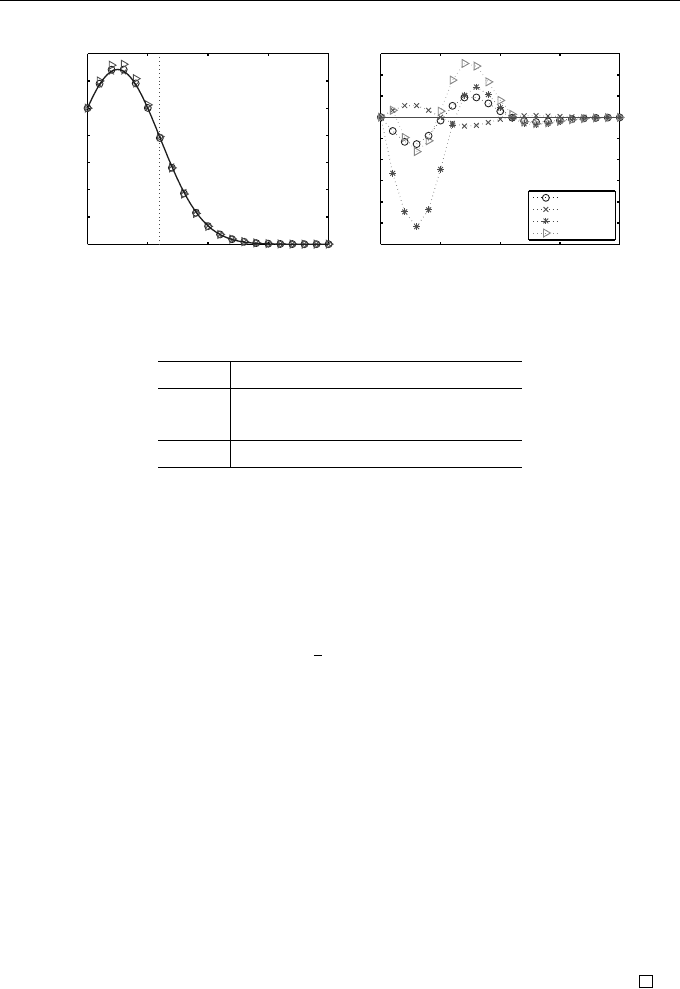
Fig. 4.1 Numerical solutions (left) and GEs (right) as functions of time with
h = 0.2 for Example 4.1
h TS(2) Trap. ABE ABT
0.2 5.4 −2.8 −3.6 17.6
0.1 1.4 −0.71 −0.66 4.0
Ratio 3.90 4.00 5.49 4.40
Table 4.1 Global errors (multiplied by 10
3
) at t = 1.2
so that the value of f at t = t
n+2
is available in the succeeding steps—i.e. the
value of f at any given grid point needs be computed only once.
The solutions obtained with these methods are shown in Figure 4.1 (left)
as functions of t
n
. These are indistinguishable from the exact solution curve
except near to the maximum at t =
1
2
; the corresponding GEs are shown in the
right of the figure. The GEs at t = 1.2 (obtained by subtracting the numerical
solutions from the exact solution) are shown in Table 4.1 for h = 0.2 and
h = 0.1. Dividing the GE when h = 0.2 by that when h = 0.1 leads to the
bottom row in Table 4.1. Since this ratio is close to 4, it suggests that the four
methods shown all converge at a second-order rate: e
n
∝ h
2
. Surprisingly, the
GE of ABE is smaller than that of ABT, which uses a more accurate starting
value x
1
. However, when we look at the behaviour of the GE over the whole
domain in Figure 4.1, we see that ABE has a particularly large GE at t ≈ 0.5;
to sample the errors at only one time may be misleading. Closer scrutiny of
the figure reveals that the greatest overall accuracy is given by the trapezoidal
rule, and we estimate that
GE
TS(2)
≈ −GE
trap
, GE
ABT
≈ −2 GE
trap
, GE
ABE
≈ −5 GE
trap
.

48 4. Linear Multistep Methods—I
k p Method Name
1 1 x
n+1
− x
n
= hf
n
Euler
1 1 x
n+1
− x
n
= hf
n+1
Backward Euler
1 2 x
n+1
− x
n
=
1
2
h(f
n+1
+ f
n
) trapezoidal
2 2 x
n+2
− x
n+1
=
1
2
h(3f
n+1
− f
n
) two-step Adams–Bashforth
2 2 x
n+2
− x
n+1
=
1
12
h(5f
n+2
+ 8f
n+1
− f
n
) two-step Adams–Moulton
2 4 x
n+2
− x
n
=
1
3
h(f
n+2
+ 4f
n+1
+ f
n
) Simpson’s rule
2 3 x
n+2
+ 4x
n+1
− 5x
n
= h(4f
n+1
+ 2f
n
) Dahlquist (see Example 4.11)
Table 4.2 Examples of LMMs showing their step number (k) and order (p)
4.2 Two-Step Methods
So far we have encountered three examples of LMMs: Euler’s me thod, the
trapezoidal rule (4.7 ) and the AB(2) method (4.10). The last two were derived
from the expansions (4.3) and (4.9), which are valid for all three times differ-
entiable functions z, and which we regard as being generalizations of Taylor
series—they relate the values of z and z
0
(t) at several different points.
For the time being we shall be concerned only with two-step LMMs, such
as AB(2), that involve the three time levels t
n
, t
n+1
, and t
n+2
. For these, we
need to find the coefficients α
0
, α
1
, β
0
, β
1
, and β
2
so that
z(t + 2h) + α
1
z(t + h) + α
0
z(t)
= h(β
2
z
0
(t + 2h) + β
1
z
0
(t + h) + β
0
z
0
(t)) + O(h
p+1
), (4.12)
where p might be specified in some cases or we might try to make p as large
as possible in others. We have taken α
2
= 1 as a normalizing condition (the
coefficient of z(t + 2h)).
Choosing z = x, where x
0
= f (t, x), and dropping the O(h
p+1
) remainder
term, we arrive at the general two-step LMM
x
n+2
+ α
1
x
n+1
+ α
0
x
n
= h(β
2
f
n+2
+ β
1
f
n+1
+ β
0
f
n
). (4.13)
An LMM is said to be explicit (of explicit type) if β
2
= 0 and implicit if β
2
6= 0.
F
or example, Euler’s method (x
n+1
= x
n
+ hf
n
) is an example of an explicit
one-step LMM while the trapezoidal rule is an example of an implicit one-step
method.
On occasion we may write (4.13) in the form
x
n+2
+ α
1
x
n+1
+ α
0
x
n
= h(β
2
x
0
n+2
+ β
1
x
0
n+1
+ β
0
x
0
n
).
Some further examples of one- and two-step LMMs are listed in Table 4.2.

4.2 Two-Step Methods 49
4.2.1 Consistency
In order to streamline the process of determining the coefficients in the LMM
(4.13), we introduce the notion of a linear difference operator.
Definition 4.2
The linear difference operator L
h
associated with the LMM (4.13) is defined
for an arbitrary continuously differentiable function z(t) by
L
h
z(t) = z(t + 2h) + α
1
z(t + h) + α
0
z(t) −
h(β
2
z
0
(t + 2h) + β
1
z
0
(t + h) + β
0
z
0
(t)).
Apart from the remainder term, this is the difference between the left- and
right-hand sides of (4.12). L
h
is a linear operator since, for constants a and b,
L
h
(az(t) + bw(t)) = aL
h
z(t) + bL
h
w(t).
The construction of new methods amounts to finding suitable coefficients
{α
j
, β
j
}. We shall prove later in this chapter that the coefficients should be
determined so as to ensure that the resulting LMM is consistent.
Definition 4.3
A linear difference operator L
h
is said to be consistent of order p if
L
h
z(t) = O(h
p+1
)
with p > 0 for every smooth function z.
An LMM whose difference operator is consistent of order p for some p > 0 is
said to b e consistent. A method that fails to meet this requirement is called
inconsistent (see Exercise 4.9). This definition is in keeping with our findings
for TS(p) methods: an LTE of order (p + 1) gives rise to convergence of order
p (Theorem 3.2).
Example 4.4
Show that Euler’s method is consistent.
The linear difference operator for Euler’s method is
L
h
z(t) = z(t + h) − z(t) − hz
0
(t),

50 4. Linear Multistep Methods—I
which, by Taylor expansion, gives
L
h
z(t) =
1
2!
h
2
z
00
(t) + O(h
3
),
and so L
h
z(t) = O(h
2
) and the method is consistent of order 1 (p = 1).
Example 4.5
What is the order of consistency of the last method listed in Table 4.2?
The associated linear difference operator is
L
h
z(t) = z(t + 2h) + 4z(t + h) − 5z(t) − h(4z
0
(t + h) + 2z
0
(t)).
With the aid of the Taylor expansions
z(t + 2h) = z(t) + 2hz
0
(t) + 2h
2
z
00
(t) +
4
3
h
3
z
000
(t) +
2
3
h
4
z
0000
(t) + O(h
5
),
z(t + h) = z(t) + hz
0
(t) +
1
2
h
2
z
00
(t) +
1
6
h
3
z
000
(t) +
1
24
h
4
z
0000
(t) + O(h
5
),
z
0
(t + h) = z
0
(t) + hz
00
(t) +
1
2
h
2
z
000
(t) +
1
6
h
3
z
0000
(t) + O(h
4
),
we find (collecting terms appropriately)
L
h
z(t) = [1 + 4 − 5] z(t)
+ h [2 + 4 − [4 + 2]] z
0
(t)
+ h
2
[2 + 2 − 4] z
00
(t)
+ h
3
4
3
+ 4 ×
1
6
− 4 ×
1
2
z
000
(t)
+ h
4
2
3
+ 4 ×
1
24
− 4 ×
1
6
z
0000
(t) + O(h
5
).
Thus, L
h
z(t) =
1
6
h
4
z
0000
(t) + O(h
5
) and so L
h
z(t) = O(h
4
) and the method
is consistent of order p = 3. It is, in fact, the explicit two-step method having
highest possible order.
4.2.2 Construction
In the previous section the coefficients of LMMs were given and we were then
able to find their order and error constants. We now describe how the coeffi-
cients may be determined by the method of undetermined coefficients.
For the general two-step LMM given by Equation (4.13) the associated
linear difference operator is (see Definition 4.2)
L
h
z(t) = z(t + 2h) + α
1
z(t + h) + α
0
z(t) −
h(β
2
z
0
(t + 2h) + β
1
z
0
(t + h) + β
0
z
0
(t)) (4.14)

4.2 Two-Step Methods 51
and the right-hand side may b e expanded with the aid of the Taylor expansions
z(t + 2h) = z(t) + 2hz
0
(t) + 2h
2
z
00
(t) +
4
3
h
3
z
000
(t) + . . . ,
z(t + h) = z(t) + hz
0
(t) +
1
2
h
2
z
00
(t) +
1
6
h
3
z
000
(t) + . . . ,
z
0
(t + 2h) = z
0
(t) + 2hz
00
(t) + 2h
2
z
000
(t) +
4
3
h
3
z
0000
(t) + . . . ,
z
0
(t + h) = z
0
(t) + hz
00
(t) +
1
2
h
2
z
000
(t) +
1
6
h
3
z
0000
(t) + . . . .
The precise number of terms that should be retained depends on either the
order required
2
or the maximum order possible with the “template” used—
some coefficients in the LMM may be set to zero in order to achieve a method
with a particular pattern of terms. It will also become clear as we proceed
that it is generally advantageous not to fix all the coefficients so as to achieve
maximum order of consistency, but to retain some free parameters to meet
other demands (notably stability).
We focus initially on the issue of consistency, i.e. what is needed for methods
to have order at least p = 1. Expanding the right of (4.14) we find (collecting
terms appropriately)
L
h
z(t) =
1 + α
1
+ α
0
z(t) + h
2 + α
1
− (β
2
+ β
1
+ β
0
)
z
0
(t) + O(h
2
).
We shall have
L
h
z(t) = O(h
2
)
and, therefore, consistency of order 1, if the coefficients are chosen so that
1 + α
1
+ α
0
= 0,
2 + α
1
= β
2
+ β
1
+ β
0
.
(4.15)
These conditions can be written more concisely if we introduce two poly-
nomials.
Definition 4.6
The first and second characteristic polynomials of the LMM
x
n+2
+ α
1
x
n+1
+ α
0
x
n
= h(β
2
f
n+2
+ β
1
f
n+1
+ β
0
f
n
)
are defined to be
ρ(r) = r
2
+ α
1
r + α
0
, σ(r) = β
2
r
2
+ β
1
r + β
0
(4.16)
respectively.
2
For order p all terms up to those containing h
p+1
must be retained but, since the
β-terms are already multiplied by h, the expansions of the z
0
terms need only include
terms up to h
p
.

52 4. Linear Multistep Methods—I
The following result is a direct consequence of Definition 4.3 and writing con-
ditions (4.15) in terms of the characteristic polynomials.
Theorem 4.7
The two-step LMM
x
n+2
+ α
1
x
n+1
+ α
0
x
n
= h(β
2
f
n+2
+ β
1
f
n+1
+ β
0
f
n
)
is consistent with the ODE x
0
(t) = f (t, x(t)) if, and only if,
ρ(1) = 0 and ρ
0
(1) = σ(1).
In general, when the right side of the linear difference operator (4.14) is
expanded to higher order terms and these are collected appropriately, it is
found that
L
h
z(t) = C
0
z(t) + C
1
hz
0
(t) + ··· + C
p
h
p
z
(p)
(t) + O(h
p+1
), (4.17)
where, as in the lead up to (4.15), C
0
= 1 + α
1
+ α
0
and C
1
= 2 + α
1
− (β
2
+
β
1
+β
0
). The coefficients C
j
are each linear combinations of the α and β values
that do not involve h. In view of Definition 4.3, an LMM will b e consistent of
order p if
C
0
= C
1
= ··· = C
p
= 0,
in which case
L
h
z(t) = C
p+1
h
p+1
z
(p+1)
(t) + O(h
p+2
). (4.18)
The first non-zero coefficient C
p+1
is known as the error constant.
The next theorem sheds light on the significance of consistency.
Theorem 4.8
A convergent LMM is consistent.
Thus consistency is necessary for convergence, but it is not true to say that
consistent methods are always convergent.
Proof
Supp ose that the LMM (4.13) is convergent. Definition 2.3 then implies that
x
n+2
→ x(t
∗
+ 2h), x
n+1
→ x(t
∗
+ h) and x
n
→ x(t
∗
) as h → 0 when t
n
= t
∗
.
However, since t
n+2
, t
n+1
→ t
∗
, taking the limit on both sides of
x
n+2
+ α
1
x
n+1
+ α
0
x
n
= h(β
2
f
n+2
+ β
1
f
n+1
+ β
0
f
n
)

4.2 Two-Step Methods 53
leads to
ρ(1)x(t
∗
) = 0.
But x(t
∗
) 6= 0, in general, and so ρ
(1) = 0, the first of the consistency conditions
in Theorem 4.7.
For the second part of the proof the limit h → 0 is taken of both sides of
x
n+2
+ α
1
x
n+1
+ α
0
x
n
h
= β
2
f
n+2
+ β
1
f
n+1
+ β
0
f
n
.
The right-hand side converges to the limit σ(1)f(t
∗
, x(t
∗
)) and, for the left-hand
side, we use the limits x
n+2
→ x(t
∗
+ 2h), x
n+1
→ x(t
∗
+ h), and x
n
→ x(t
∗
)
together with l’Hˆopital’s rule to conclude that
lim
h→0
x
n+2
+ α
1
x
n+1
+ α
0
x
n
h
= (2 + α
1
)x
0
(t
∗
).
Thus, the limiting function x(t) satisfies
3
ρ
0
(1)x
0
(t
∗
) = σ(1)f(t
∗
, x(t
∗
))
at t = t
∗
, which is not the correct differential equation unless ρ
0
(1) = σ(1).
Example 4.9
Determine the coefficients in the 1-step LMM
x
n+1
+ α
0
x
n
= h(β
1
f
n+1
+ β
0
f
n
)
so that the resulting method has order 1. Find the error constant and show
that there is a unique method having order 2. What is the error constant for
the resulting method?
The associated linear difference operator is, by definition,
L
h
z(t) = z(t + h) + α
0
z(t) − h(β
1
z
0
(t + h) + β
0
z
0
(t)) (4.19)
and Taylor expanding the terms z(t + h) and z
0
(t + h) gives
L
h
z(t) = (1 + α
0
)z(t) +
1 − (β
1
+ β
0
)
hz
0
(t) + O(h
2
).
Therefore, we shall have consistency (i.e., order at least 1) if the terms in z(t)
and hz
0
(t) vanish. This will be the case if
1 + α
0
= 0 and 1 = β
1
+ β
0
.
3
The details are left to Exercise 4.17.

54 4. Linear Multistep Methods—I
These are two equations in three unknowns and their general solution may be
expressed as α
0
= −1, β
1
= θ, β
0
= 1−θ, which gives rise to the one-parameter
family of LMMs known as the θ-method:
x
n+1
− x
n
= h(θf
n+1
+ (1 − θ)f
n
). (4.20)
The error constant is C
2
, for which we have to retain one more term in each of
the Taylor expansions of z(t + h) and z
0
(t + h). We then find
L
h
z(t) = (
1
2
− θ)h
2
z
00
(t) + O(h
3
)
so that C
2
=
1
2
− θ. The common choices for θ are:
1. θ = 0. Euler’s method: x
n+1
− x
n
= hf
n
.
2. θ = 1. Backward Euler method: x
n+1
− x
n
= hf
n+1
(see Table 4.2). This
is also known as the implicit Euler method.
3. θ =
1
2
. trapezoidal rule: x
n+1
− x
n
=
1
2
h(f
n
+ f
n+1
). This is the unique
value of θ for which C
2
= 0 and the me thod becomes of second order. To
compute its error constant C
3
, the Taylor expansions must be extended by
one term (with θ =
1
2
), so:
L
h
z(t) = h
3
(
1
6
−
1
2
θ)z
000
(t) + O(h
4
)
= −
1
12
h
3
z
000
(t) + O(h
4
)
and, therefore, C
3
= −
1
12
.
Example 4.10
Determine the coefficients in the two-step LMM
x
n+2
+ α
0
x
n
= h(β
1
f
n+1
+ β
0
f
n
)
so that it has as high an order of consistency as possible. What is this order
and what is the error constant for the resulting method?
The associated linear difference operator is
L
h
z(t) = z(t + 2h) + α
0
z(t) − h(β
1
z
0
(t + h) + β
0
z
0
(t)).
The LMM contains three arbitrary constants so we expect to be able to sat-
isfy three linear equations; that is, we should be able to make the terms in
z(t), hz
0
(t), and h
2
z
00
(t) in the Taylor expansion of L
h
z(t) all vanish leaving
L
h
z(t) = C
3
h
3
z
000
(t) +O(h
4
). We therefore expect to have order p = 2; for this
to occur we have to retain terms up to h
3
z
000
(t). (For some methods we get a
“bonus” in that the next term is automatically z ero—see Simpson’s method.)

4.2 Two-Step Methods 55
With the aid of the Taylor series
z(t + 2h) = z(t) + 2hz
0
(t) + 2h
2
z
00
(t) +
4
3
h
3
z
000
(t) +
2
3
h
4
z
0000
(t) + O(h
5
)
z
0
(t + h) = z
0
(t) + hz
00
(t) +
1
2
h
2
z
000
(t) +
1
6
h
3
z
0000
(t) + O(h
4
)
we find, on collecting terms in powers of h,
L
h
z(t) = [1 + α
0
] z(t) + h [2 − (β
1
+ β
0
)] z
0
(t)
+ h
2
[2 − β
1
] z
00
(t)
+ h
3
4
3
−
1
2
β
1
z
000
(t) + O(h
4
).
Setting the coefficients of the first three terms to zero gives
1 + α
0
= 0, 2 = β
1
+ β
0
, 2 = β
1
whose solution is α
0
= −1, β
1
= 2, β
0
= 0 and the resulting LMM is
x
n+2
− x
n
= 2hf
n+1
, (4.21)
known in some circles as the mid-point rule and in others as the “leap-frog”
method; we shall see in the next chapter that it belongs to the class of Nystr¨om
methods. It follows that
L
h
z(t) =
1
3
h
3
z
000
(t) + O(h
4
)
and so L
h
z(t) = O(h
3
) and the method is consistent of order p = 2 with error
constant C
3
=
1
3
.
An alternative approach to constructing LMMs based on interpolating poly-
nomials is suggested by Exercises 4.18 and 4.19.
Is this all there is to constructing LMMs? Theorem 4.8 did not say that
consistent methods are convergent, and the following numerical example indi-
cates that some further property is required to generate a useful (convergent)
method.
Example 4.11
Use the method
x
n+2
+ 4x
n+1
− 5x
n
= h(4f
n+1
+ 2f
n
)
(see Example 4.5) to solve the IVP x
0
(t) = −x(t) for t > 0 with x(0) = 1. Use
the three different grid sizes h = 0.1, 0.001 and 0.0001 and, for the additional
starting value, use x
1
= e
−h
.