
Griffiths D.F., Higham D.J. Numerical Methods for Ordinary Differential Equations: Initial Value Problems
Подождите немного. Документ загружается.


16 1. ODEs—An Introduction
EXERCISES
1.1.
?
Use the variation of constants formula (1.4) to derive the exact
solution of the ODE (1.1).
1.2.
??
Complete the details leading up to the variation of constants for-
mula (1.4).
1.3.
??
Show that the IVP x
0
(t) = x(t)(1 − x(t)), x(10) = −1/5, has
solution x(t) = 1/(1 − 6e
10−t
). Deduce that x(t) → −∞ as t →
10 + log 6 ≈ 11.79—the solution is said to blow up in finite time.
1.4.
??
Sh
ow that x(t) = t(4 − t)/4 satisfies both the ODE x
0
(t) =
p
1 − x(t) and the s tarting condition x(0) = 0 but cannot be a
solution of the IVP for t > 2 since the formula for x(t) has a nega-
tive derivative while the right-hand side of the ODE is non-negative
for all t.
1.5.
??
Rewrite the following IVPsas IVPs for first order systems, as illus-
trated in Section 1.2.
(a) Simple harmonic motion:
θ
00
(t) + θ(t) = 0, θ (0) = π/10, θ
0
(0)
= 0.
(b)
x
00
(t) − x
0
(t) − 2x(t) = 1 + 2t, x(0) = 1, x
0
(0) = 1.
(c)
x
000
(t) − 2x
00
(t) − x
0
(t) + 2x(t) = 1 − 2t,
x(0) = 1, x
0
(0) = 1, x
00
(0) = 0.
1.6.
??
Supp ose that λ ∈ C. Show that the complex ODE x
0
(t) = λx(t)
may be written as a first-order system of two real ODEs. (Hint: let
x(t) = u(t)+iv(t) and λ = a+ib and consider the real and imaginary
parts of the result.)
When a = 0, use the chain rule to verify that
d
dt
u
2
(t) + v
2
(t)
= 0
so that solutions lie on the family of circles u
2
(t) + v
2
(t) = constant
in the u-v phase plane.

Exercises 17
1.7.
?
Write the differential equation of Example 1.2 as an autonomous
system with two components.
1.8.
?
Use the system of ODEs (1.10) to decide whether the periodic mo-
tion described by the rightmost set of curves in Figure 1.3 is clock-
wise or counter clockwise.
1.9.
??
Show that the IVP
x
00
(t) − ax
0
(t) − bx(t) = f(t), x(0) = ξ, x
0
(0) = η
may be written as a first-order system x
0
(t) = Ax(t) + g(t), where
A is a 2 × 2 matrix, x = [x, x
0
]
T
and the components of the 2 × 1
vector g should be related to the forcing function f (t). What is the
characteristic polynomial of A?
1.10.
??
Write the IVP
x
000
(t) − ax
00
(t) − bx
0
(t) − cx = f(t),
x(0) = ξ, x
0
(0) = η, x
00
(0) = ζ
as a first-order system x
0
(t) = Ax(t) + g(t). What is the character-
istic polynomial of A?
1.11.
?
By summing the first, third and fourth ODEs in the Michaelis–
Menten chemical kinetics system of Example 1.4, show that S
0
(t) +
C
0
(t) + P
0
(t) = 0. This implies that the total amount of “substrate
plus complex plus product” does not change over time. Convince
yourself that this conservation law is intuitively reasonable, given
the three chemical reactions involved. (Invariants of this type will
be discussed in Chapter 14.)
1.12.
?
Show that, for the populations in Example 1.6, the total population
H(t) + Z(t) + R(t) remains constant in time.
1.13.
?
Differentiate u(t) =
1675
21
e
−8t
+
320
21
e
−t/8
+ 5 and hence verify that
this function solves both the ODEs (1.15) and (1.16).
1.14.
???
Supp ose that x(t) denotes the solution of the ODE x
0
(t) = 1 +
x
2
(t).
(a) Find the general solution of the given differential equation and
show that it contains one arbitrary constant.
(b) Use the change of dependent variable x(t) = −y
0
(t)/y(t) to show
that x(t) will solve the given first-order differential equation pro-
vided y(t) solves a certain linear second-order differential equa-
tion and determine the general solution for y(t).

18 1. ODEs—An Introduction
Deduce the general solution for x(t) and explain why this ap-
pears to contain two arbitrary constants.
1.15.
?
Consider the logistic equation x
0
(t) = ax(t)
1 −
x(t)
X
, in which the
positive constants a and X are known as the growth (proliferation)
rate and carrying capacity, respectively. This might model the num-
ber of prey x(t) at time t in a total population of predators and prey
comprising a fixed number X of individuals.
Derive the corresponding ODE for the fraction u(τ) = x(t)/X of
prey in the population as a function of the scaled time τ = a t.
2
Euler’s Method
During the course of this bo ok we will describe three families of methods for nu-
merically solving IVPs: the Taylor series (TS) method, linear multistep methods
(LMMs) and Runge–Kutta (RK) methods.
They aim to solve all IVPs of the form
x
0
(t) = f (t, x(t)), t > t
0
x(t
0
) = η
(2.1)
that possess a unique solution on some specified interval, t ∈ [t
0
, t
f
] say.
The three families can all be interpreted as generalisations of the world’s
simplest metho d: Euler’s method. It is appropriate, therefore, that we start
with detailed descriptions of Euler’s method and its derivation, how it can be
applied to systems of ODEs as well as to scalar problems, and how it be haves
numerically.
We shall, throughout, use h to refer to a “small” positive number called the
“step size” or “grid size”: we will seek approximations to the solution of the
IVP at particular times t = t
0
, t
0
+h, t
0
+2h, ..., t
0
+nh, . . ., i.e., approximations
to the sequence of numbers x(t
0
), x(t
0
+h), x(t
0
+2h),. . . , x(t
0
+nh), . . ., rather
than an approximation to the curve {x(t) : t
0
≤ t ≤ t
f
}.
Springer Undergraduate Mathematics Series, DOI 10.1007/978-0-85729-148-6_2,
© Springer-Verlag London Limited 2010
D.F. Griffiths, D.J. Higham, Numerical Methods for Ordinary Differential Equations,

20 2. Euler’s Method
2.1 A Preliminary Example
To illustrate the process we begin with a specific example before treating the
general case.
Example 2.1
Use a step s ize h = 0.3 to develop an approximate solution to the IVP
x
0
(t) = (1 − 2t)x(t), t > 0
x(0) = 1
(2.2)
over the interval 0 ≤ t ≤ 0.9.
We have purposely chosen a problem with a known exact solution
x(t) = exp[
1
4
− (
1
2
− t)
2
] (2.3)
so that we can more easily judge the level of accuracy of our approximations.
At t = 0 we have x(0) = 1 and, from the ODE, x
0
(0) = 1. This information
enables us to c onstruct the tangent line to the solution curve at t = 0: x = 1+t.
At the specified value t = 0.3 we take the value x = 1.3 as our approximation:
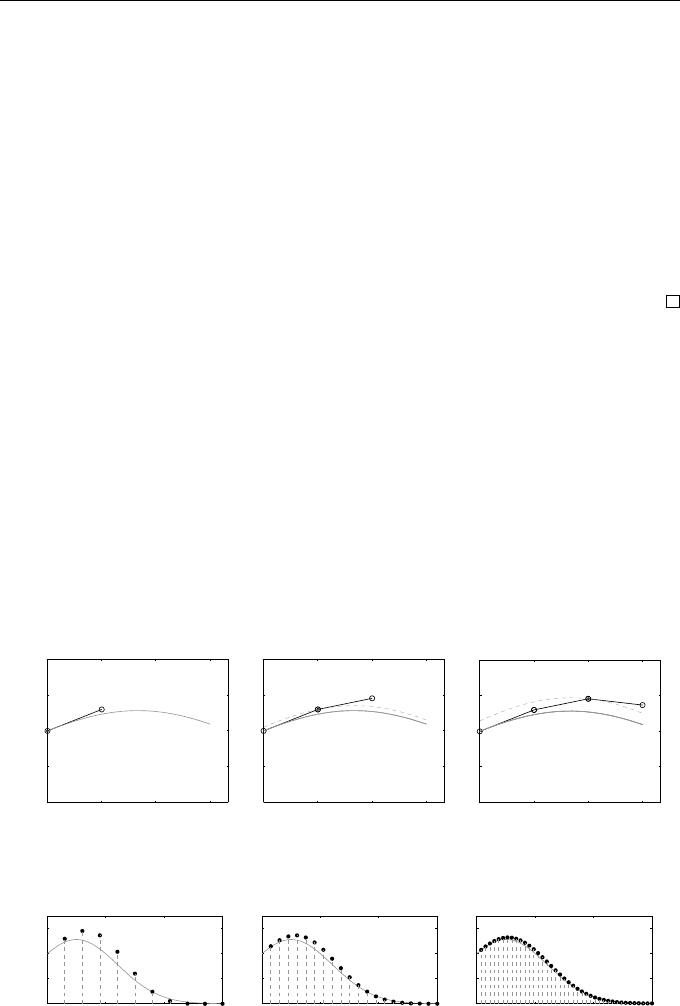
x(0.3) ≈ 1.3. This is illustrated on the left of Figure 2.1—here the line joining
P
0
(0,1) and P
1
(0.3, 1.3) is tangent to the exact solution at t = 0.
To organize the results we let t
n
= nh, n = 0, 1, 2, . . ., denote the times at
which we obtain approximate values and denote by x
n
the computed approxi-
mation to the exact solution x(t
n
) at t = t
n
. It is also convenient to record the
value of the right side of the ODE at the point (t
n
, x
n
):
x
0
n
= (1 − 2t
n
)x
n
.
The initial conditions and first step are summarized by
n = 0 : t
0
= 0 , n = 1 : t
1
= t
0
+ h = 0.3,
x
0
= 1, x
1
= x
0
+ hx
0
0
= 1.3,
x
0
0
= 1, x
0
1
= (1 − 2t
1
)x
1
= 0.52.
The pro ce ss is now repeated: we construct a line through P
1
(t
1
, x
1
) that
is tangent to the solution of the differential equation that passes through P
1
(shown as a dashed curve in Figure 2.1 (m iddle)). This tangent line passes
through (t
1
, x
1
) and has slope x
0
1
:
x = x
1
+ (t − t
1
)x
0
1
.
2.1 A Preliminary Example 21
At t = 2h we find
x
2
= x
1
+ hx
0
1
,
so the calculations for the next two steps are
n = 2 : t
2
= t
1
+ 0.3 = 0.6, n = 3 : t
3
= t
2
+ h = 0.9,
x
2
= x
1
+ hx
0
1
= 1.456, x
3
= x
2
+ hx
0
2
= 1.3686,
x
0
2
= (1 − 2t
2
)x
2
= −0.2912, x
0
3
= (1 − 2t
3
)x
3
= −1.0949.
The points P
n
(t
n
, x
n
) (n = 0, 1, 2, 3) are shown in Figure 2.1. For each n the line
P
n
P
n+1
is tangent to the solution of the differential equation x
0
(t) = (1−2t)x(t)
that passes through the point x(t) = x
n
at t = t
n
.
2.1.1 Analysing the Numbers
The computed points P
1
, P
2
, P
3
in Figure 2.1 are an appreciable distance from
the solid curve representing the exact solution of our IVP. This is a consequence
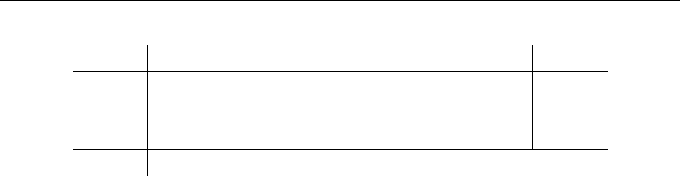
of the fact that our chosen time step h = 0.3 is too large. In Figure 2.2 we show
the results of computing the numerical solutions (shown as solid dots) over
the extended interval 0 ≤ t ≤ 3 with h = 0.3, 0.15, and 0.075. Each time h is
halved:
1. Twice as many steps are needed to find the solution at t = 3.
0 0.3 0.6 0.9
0
0.5
1
1.5
2
P
0
P
1
t
n
x
n
0 0.3 0.6 0.9
0
0.5
1
1.5
2
P
1
P
0
P
2
t
n
x
n
0 0.3 0.6 0.9
0
0.5
1
1.5
2
P
1
P
2
P
0
P
3
t
n
x
n
Fig. 2.1 The development of a numerical solution to the IVP in Example 2.1
over three time steps. The exact solution of the IVP is shown as a solid curve
0 1 2 3
0
0.5
1
1.5
t
n
x
n
0 1 2 3
0
0.5
1
1.5
t
n
x
n
0 1 2 3
0
0.5
1
1.5
t
n
x
n
Fig. 2.2 Numerical solutions for Example 2.1 with h = 0.3 (left), h = 0.15
(middle) and h = 0.075 (right)
22 2. Euler’s Method
h x
n
Global errors (GEs) GE/h
0.3 x
3
= 1.3686 x(0.9) − x
3
= −0.2745 −0.91
0.15 x
6
= 1.2267 x(0.9) − x
6
= −0.1325 −0.89
0.075 x
12
= 1.1591 x(0.9) − x
12
= −0.0649 −0.86
Exact x(0.9) = 1.0942
Table 2.1 Numerical results at t = 0.9 with h = 0.3, 0.15 and 0.075
2. The computed points lie closer to the exact solution curve. This illustrates
the notion that the numerical solution converges to the exact solution as
h → 0.
To obtain more concrete evidence, the numerical solutions at t = 0.9 are shown
in Table 2.1; since the exact solution at this time is known, the errors in the
approximate values may be calculated. The difference
e
n
= x(t
n
) − x
n
is referred to as the global error (GE) at t = t
n
. It is seen from the table that
halving h results in the error being approximately halved. This suggests that
the GE is proportional to h:
e
n
∝ h.
It is possible to prove that this is true for a wide class of (nonlinear) IVPs;
we will develop some theory along these lines in Section 2.4 for a model linear
problem. The final column in Table 2.1 suggests that the constant of propor-
tionality in this case is about −0.9 : e
n
≈ −0.9h, when nh = 0.9; so, were
we to require an accuracy of three decimal place s, h would have to be small
enough that |e
n
| < 0.0005, i.e. h < 0.0005/0.9 ≈ 0.00055. Consequently, the
integration to t = 0.9 would require about n = 0.9/h ≈ 1620 steps.
An alternative view is that, for each additional digit of accuracy, the GE
should be reduced by a factor of 10, so h should also b e reduced by a factor of 10
and, consequently, 10 times as many steps are required to integrate to the same
final time. Thus, 10 times as much computational effort has to be expended to
improve the approximation by just one decimal place—a substantial increase
in cost.
2.2 Landau Notation
We will make extensive use of the standard notation wherein O(h
p
), with p a
positive integer, refers to a quantity that decays at least as quickly as h
p
when

2.3 The General Case 23
h is small enough. More precisely, we write z = O(h
p
) if there exist positive
constants h
0
and C such that
|z| ≤ Ch
p
, for all 0 < h < h
0
,
so that z converges to zero as h → 0 and the order (or rate) of convergence is p.
The O(h
p
) notation is intended to convey the impression that we are interested
primarily in p and not C, and we say that “z is of order h
p
” or “z is of pth
order”. For example, the Maclaurin expansion of e
h
is
e
h
= 1 + h +
1
2!
h
2
+
1
3!
h
3
+ ··· +
1
n!
h
n
+ ··· ,
from which we deduce
e
h
= 1 + O(h) (2.4a)
= 1 + h + O(h
2
) (2.4b)
= 1 + h +
1
2!
h
2
+ O(h
3
). (2.4c)
We use this idea to compare the magnitudes of different terms: for example,
the O(h
3
) term in (2.4c) will always be smaller than the O(h
2
) term in (2.4b)
provided h is sufficiently small; the higher the order, the smaller the term. The
notion of “sufficiently small” is not precise in general: h
3
is less than h
2
for
h < 1, while 100h
3
is less than h
2
for h < 1/100. Thus, the s mallness of h
depends on the context.
All methods that we discuss will be founded on the assumption that the
solution x(t) is smooth in the sense that as many derivatives as we require are
continuous on the interval (t
0
, t
f
). This will allow us to use as many terms as
we wish in Taylor series expansions.
2.3 The Gener al Case
To develop Euler’s method for solving the general IVP (2.1) the approximation
process begins by considering the Taylor series of x(t + h) with remainder (see
Appendix B):
x(t + h) = x(t) + hx
0
(t) + R
1
(t). (2.5)
The remainder term R
1
(t) is called the local truncation error (LTE). If x(t)
is twice continuously differentiable on the interval (t
0
, t
f
) the remainder term
may be written as
R
1
(t) =
1
2!
h
2
x
00
(ξ), ξ ∈ (t, t + h). (2.6)

24 2. Euler’s Method
Then, if a positive number M exists so that |x
00
(t)| ≤ M for all t ∈ (t
0
, t
f
), it
follows that
|R
1
(t)| ≤
1
2
Mh
2
,
i.e., R
1
(t) = O(h
2
).
To derive Euler’s method we begin by substituting x
0
(t) = f(t, x) into the
Taylor series (2.5) to obtain
x(t + h) = x(t) + hf (t, x(t)) + R
1
(t). (2.7)
We now introduce a grid of points t = t
n
, where
t
n
= t
0
+ nh, n = 1 : N (2.8)
and N = b(t
f
−t
0
)/hc is the number of steps
1
of length h needed to reach, but
not exceed, t = t
f
. With t = t
n
(for n < N) in (2.7) we have
x(t
n+1
) = x(t
n
) + hf(t
n
, x(t
n
)) + R
1
(t
n
), n = 0 : N −1,
and, with the initial condition x(t
0
) = η, we would be able to compute the
exact solution of the IVP on the grid {t
n
}
N
n=0
using this re currence relation
were the LTE term R
1
(t) not present.
However, since R
1
(t) = O(h
2
), it can be made arbitrarily small (by taking
h to be s ufficiently small) and, when neglected, we obtain Euler’s method,
x
n+1
= x
n
+ hf (t
n
, x
n
), n = 0, 1, 2, . . . ,
with which we can compute the sequence {x
n
} given that x
0
= η. We shall use
the notation
f
n
≡ f(t
n
, x
n
) (2.9)
for the value of the derivative at t = t
n
, so that Euler’s method may be written
as
x
n+1
= x
n
+ hf
n
. (2.10)
On occasions (such as when dealing with components of systems of ODEs)
it is more convenient to write x
0
n
for the approximation of the derivative of x
at t = t
n
. Then Euler’s method would be written as
x
n+1
= x
n
+ hx
0
n
. (2.11)
1
bxc is the “floor” function—take the integer part of x and ignore the fractional
part.
2.4 Analysing the Method 25
Example 2.2
Use Euler’s method to solve the IVP
x
0
(t) = 2x(t)
1 − x(t)
, t > 10,
x
(10) = 1/5,
for 10 ≤ t ≤ 11 with h = 0.2.
With f(t, x) = 2x(1 −x) and η = 1/5, we calculate, for each n = 0, 1, 2, . . .,
the values
2
t
n
, x
n
and x
0
n
. The calculations for the first five steps are shown in
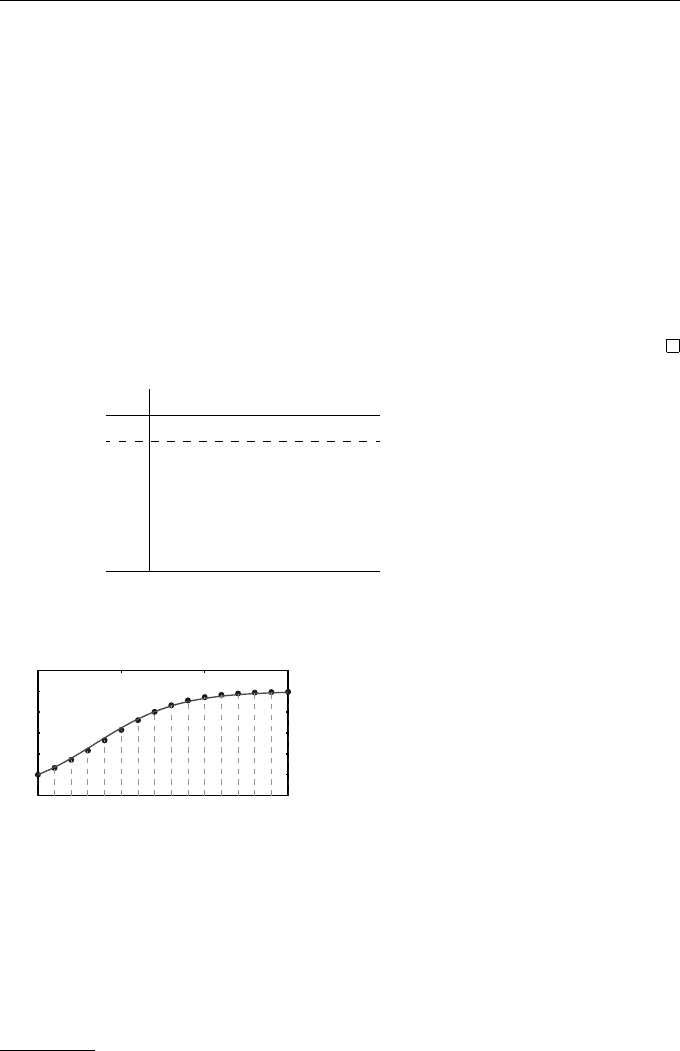
Table 2.2 and the points {(t
n
, x
n
)}, when the computation is extended to the
interval 10 ≤ t ≤ 13, are shown in Figure 2.3 by dots; the solid curve shows
the exact solution of the IVP: x(t) = 1/(1 + 4 exp(2(10 − t))).
n t
n
x
n
x
0
n
= 2x
n
(1 − x
n
)
0 10.0 0.2 0.32 (starting condition)
1 10.2 0.2640 0.3886
2 10.4 0.3417 0.4499
3 10.6 0.4317 0.4907
4 10.8 0.5298 0.4982
5 11.0 0.6295 0.4665
Table 2.2 Numerical results for Example 2.2 for 10 ≤ t ≤ 11 with h = 0.2
10 11 12 13
0
0.2
0.4
0.6
0.8
1
t
n
x
n
Fig. 2. 3 Numerical solution to Ex-
ample 2.2 (dots) and the exact solution
of the IVP(solid curve)
2.4 Analysing the Method
In this section the b ehaviour of numerical methods, and Euler’s method in
particular, is investigated in the limit h → 0. When h is decreas ed, it is required
2
It is not necessary to tabulate the values of t
n
in this example since the ODE
is autonomous—its right-hand side does not involve t explicitly. It is, nevertheless,
go od practice to record its value.