
He M., Petoukhov S. Mathematics of Bioinformatics: Theory, Methods and Applications
Подождите немного. Документ загружается.

SEQUENCE ANALYSIS AND FURTHER DISCUSSION 83
state are visible. Each state has a probability distribution over the possible
output tokens. Therefore, the sequence of tokens generated by an HMM gives
some information about the sequence of states. Hidden Markov models are
especially well known for their application in temporal pattern recognition,
such as speech, handwriting, gesture recognition, musical score following,
partial discharges, and bioinformatics.
2 . Profi le hidden Markov models. These have several advantages over stan-
dard profi les. Profi le HMMs have a formal probabilistic basis and have a
consistent theory behind gap and insertion scores, in contrast to standard
profi le methods, which use heuristic methods. HMMs apply a statistical method
to estimate the true frequency of a residue at a given position in the alignment
from its observed frequency, whereas standard profi les use the observed fre-
quency itself to assign the score for that residue. This means that a profi le
HMM derived from only 10 to 20 aligned sequences can be equivalent in
quality to a standard profi le created from 40 to 50 aligned sequences. In
general, producing good profi le HMMs requires less skill and manual interven-
tion than does producing good standard profi les.
3 . Pattern discovery. Given a sequence of data such as a DNA or amino
acid sequence, a motif or pattern is a repeating subsequence. Such repeated
subsequences often have important biological signifi cance, and hence discov-
ering such motifs in various biological databases turns out to be a very impor-
tant problem in computational biology. Of course, in biological applications
the various occurrences of a pattern in the given sequence may not be exact,
so it is important to be able to discover motifs even in the presence of small
errors. Various tools are now available for carrying out automatic pattern
discovery. This is usually the fi rst step toward a more sophisticated task such
as gene fi nding in DNA or secondary structure prediction in protein sequences
at the system level.
4 . Scoring functions. The choice of a scoring function that refl ects biologi-
cal or statistical observations about known sequences is important in produc-
ing good alignments. Protein sequences are frequently aligned using substitution
matrices that refl ect the probabilities of given character - to - character substitu-
tions. A series of matrices called PAM (point accepted mutation) matrices ,
originally defi ned by Margaret Dayhoff and sometimes referred to as Dayhoff
matrices ) explicitly encode evolutionary approximations regarding the rates
and probabilities of particular amino acid mutations. Another common series
of scoring matrices, known as BLOSUM (blocks substitution matrix), encodes
empirically derived substitution probabilities (Durbin et al., 1998 ). Variants of
both types of matrices are used to detect sequences with differing levels of
divergence, thus allowing users of BLAST or FASTA to restrict searches to
more closely related matches or to expand to detect more divergent sequences
(Durbin et al., 1998 ). Gap penalties account for the introduction of a gap —
in the evolutionary model, an insertion or deletion mutation — in both nucleo-
tide and protein sequences, and therefore the penalty values should be
84 BIOLOGICAL SEQUENCES, SEQUENCE ALIGNMENT, AND STATISTICS
proportional to the rate expected for such mutations. The quality of the align-
ments produced therefore depends on the quality of the scoring function. It
can be very useful and instructive to try the same alignment several times with
different choices for scoring matrix and/or gap penalty values, and to compare
the results. Regions where the solution is weak or nonunique can often be
identifi ed by observing which regions of the alignment are robust to variations
in alignment parameters.
5 . Structural alignments. These are usually specifi c to protein and some-
times RNA sequences, and use information about the secondary and tertiary
structure of the protein or RNA molecule to aid in aligning the sequences.
These methods can be used for two or more sequences and typically produce
local alignments; however, because they depend on the availability of struc-
tural information, they can only be used for sequences whose corresponding
structures are known (usually through x - ray crystallography or NMR spectros-
copy). Because both protein and RNA structure is more evolutionarily con-
served than is sequence (Chothia and Lesk, 1986 ), structural alignments can
be more reliable between sequences that are very distantly related and that
have diverged so extensively that sequence comparison cannot reliably detect
their similarity.
Structural alignments are used as the gold standard in evaluating align-
ments for homology - based protein structure prediction (Zhang and Skolnick,
2005 ) because they explicitly align regions of the protein sequence that are
structurally similar rather than relying exclusively on sequence information.
However, clearly, structural alignments cannot be used in structure prediction
because at least one sequence in the query set is the target to be modeled, for
which the structure is not known. It has been shown that given the structural
alignment between a target and a template sequence, highly accurate models
of the target protein sequence can be produced; a major stumbling block in
homology - based structure prediction is the production of structurally accurate
alignments given only sequence information.
We are witnessing the emergence of the “ data - rich ” era in biology. The
myriad data available, ranging from sequence strings to complex phenotypic
and disease - relevant data, pose a huge challenge to modern biology. The stan-
dard paradigm in biology that deals with “ hypothesis to experimentation
(low - throughput data) to models ” is gradually being replaced by “ data to
hypothesis to models and experimentation to more data and models. ” And
unlike data in physical sciences, those in the biological sciences are almost
guaranteed to be highly heterogeneous and incomplete. To make signifi cant
advances in this data - rich era, it is essential that there be robust data reposi-
tories that allow interoperable navigation, query, and analysis across diverse
data, a plug - and - play tools environment that will facilitate seamless interplay
of tools and data, and versatile user interfaces that will allow biologists to
visualize and present the results of analysis in the most intuitive and user -
friendly manner. We address below several challenges posed by the enormous
CHALLENGES AND PERSPECTIVES 85
need for scientifi c data integration in biology, with specifi c examples and strat-
egies. The issues that need to be addressed may include:
• Architecture of data and knowledge repositories
• Databases (fl at, relational, and object - oriented; which is most
appropriate?)
• The imminent need for ontologies in biology
• The middle layer (how to design it)
• Applications and integration of applications into the middle layer
• Reduction and analysis of data (the largest challenge!)
• How to integrate legacy knowledge with data
• User interfaces (Web browser and beyond)
The complex and diverse nature of biology mandates that there is no “ one
solution fi ts all ” model for the issues listed above. Although there is a need to
have similar solutions across multiple disciplines within biology, the dichotomy
of having to deal with the context, which is everything in some cases, poses
severe design challenges. For example, can a system that describes cellular
signaling also describe developmental genetics? Can the ontologies that span
different areas (e.g., anatomy, gene and protein data, cellular biology) be com-
patible and connective? Can the detailed biological knowledge accrued pains-
takingly over decades be integrated easily with high - throughput data? These
are only few of the questions that arise in designing and building modern data
and knowledge systems in biology.
3.5 CHALLENGES AND PERSPECTIVES
Although the human genome project has great potential, theoretical work is
essential for sequencing and mapping all genomes, human and nonhuman,
animal and plant. Mathematical and computational advances provide dramatic
efforts in sequencing and mapping. Specifi c comparative analyses of the
genomes of diverse organisms can increase our understanding of the natural
world. For example, when a DNA sequence is determined, it is examined for
a variety of sequence features known to be important: tRNAs, rRNAs, protein
coding regions — introns and regulatory regions, promoters, and enhancers. It
is often quite diffi cult to identify them, as these sequence features are not
identical in all organisms. Even the widely studied bacterium Escherichia coli
promoter sequences cannot be identifi ed with certainty. As more and more
DNA is sequenced, it becomes increasingly important to have accurate
methods to identify these regions, without many false positives. Statistics and
mathematics should make signifi cant contributions in this area.
One of the most common comparative methods of biological sequences is
pairwise alignment. However, multiple sequence alignments remain a serious
86 BIOLOGICAL SEQUENCES, SEQUENCE ALIGNMENT, AND STATISTICS
problem, with a long computation time. Heuristic methods that align by build-
ing up pairwise alignments have been proposed, but they often fail to give
good multiple alignments. Closely coupled with multiple alignment is the
construction of evolutionary trees. Closely related sequences should be neigh-
bors with few changes between them. DNA sequences are collected in the
GenBank database, and protein sequences are collected in the Protein
Identifi cation Resource (PIR). When a new DNA sequence is determined,
GenBank is searched for approximate similarities with the new sequence.
Translations of the DNA sequence into the corresponding amino acid sequence
are used to search the protein database. Sensitive search methods require time
and space proportional to the product of the sequences being compared.
Searching GenBank (now more than 40 × 1 0
6
bases) with a 5000 - bp sequence
requires time proportional to 2 × 1 0
11
with traditional search techniques.
Lipman and Pearson (1985) have developed techniques that greatly reduce
the time needed. Using their techniques, one can screen the databases rou-
tinely with new sequences on IBM PCs, for example. These methods rapidly
locate diagonals where possible similarities might lie and then perform more
sensitive alignments. This family of programs (FASTA, FASTN, etc.) are the
most widely used sequence analysis programs and have accounted for many
important discoveries. An example of the impact of such analysis is the unex-
pected homology between an oncogene and a growth factor. This discovery
became the basis of the molecular theory of carcinogenesis.
Many current and future challenges for statistics and probability that are
motivated by questions in molecular biology, genetics, and molecular evolution
will require new techniques and theories. One such set of challenges involves
the use of DNA sequence data to reconstruct phylogenetic trees, analyze
genetically complex traits, and study other problems. As more and more DNA
sequence data are accumulated, patterns arise and exploratory data analysis
techniques need to be developed to look through the wealth of data for pat-
terns. The ordering and frequency of the four nucleotides are not random
(even in noncoding regions). To compare two sequences of DNA or protein
(or to compare a given sequence with a databank) and to look for matches or
similarities requires the creation of new algorithms. Comparisons can answer
both evolutionary and functional questions. Are sequences descended from a
common ancestral sequence? Do they serve similar functions? One problem
has been to calculate the probability of a long matching region between two
DNA sequences, where some level of dependence occurs as a result of over-
lapping regions. Strong limit laws have been established that give rates for the
longest matching sequences between different sequences (with a given propor-
tion of mismatches) as the length of the sequences increases. Detailed distri-
butional behavior has been obtained using the Chen – Stein method of
approximation by a Poisson random variable. These new distributional results
are now used as a basis for statistical tests. Arratia et al. (1990) contains a
snapshot of current mathematical work on these questions.
REFERENCES 87
More sensitive sequence analysis can be obtained by dynamic programming
methods. In part they are used after the diagonals are located in the FASTN
and FASTA programs. Here similar sequence elements are aligned with
positive scores, and dissimilar elements are aligned with negative scores.
Complicating the analysis are insertions and deletions, which also receive
negative scores. The challenge of the problem is to arrange two sequences into
the maximum number of scoring alignments. Additional diffi culty arises from
the fact that slightly similar regions of DNA or protein sequences might lie in
otherwise unrelated sequences. Despite the complex nature of the problem,
an effi cient algorithm (Smith and Waterman, 1981 ) has been devised and is
widely used.
The problem of sequence comparison creates a related statistical problem
of estimating p - values (attained signifi cance levels) for the alignment scores.
The set of possible alignment scores from two sequences are dependent
random variables, since they result from overlapping sequence segments.
Another area of mathematical research that will be stimulated by biology is
the probabilistic theory of discrete and dynamic structures. While the scattered
beginnings of this fi eld have extended over the past three decades, the major
developments are yet to come. Illustrative developments in the fi eld include
random graphs and random directed graphs, interacting particle systems, sto-
chastic cellular automata, products of random matrices, and nonlinear dynami-
cal systems with random coeffi cients. For example, Erd ö s and R é nyi (1960)
created the fi eld of random graphs to model apparently random connections
in neural tissue. Erd ö s and R é nyi discovered numerous examples of “ phase
transitions, ” and many more have been discovered since (see Bollob á s, 1985 ).
REFERENCES
Altschul , S. F. , and Erickson , B. W. ( 1985 ). Signifi cance of nucleotide sequence align-
ments: a method for random sequence permutation that preserves dinucleotide and
codon usage . Mol. Biol. Evol. , 2 , 526 – 538 .
Altschul , S. F. , Gish , W. , Miller , W. , Myers , E. W. , and Lipman , D. J. ( 1990 ). Basic local
alignment search tool . J. Mol. Biol. , 215 , 403 – 410 .
Arratia , R. , Goldstein , L. , and Gordon , L. ( 1990 ). Poisson approximations and the
Chen – Stein method . Stat. Sci. , 5 , 403 – 434 .
Bollob á s , B. ( 1985 ). Random Graphs . Orlando, FL : Academic Press .
Chenna , R. , Sugawara , H. , Koike , T. , Lopez , R. , Gibson , T. J. , Higgins , D. G. , and
Thompson , J. D. ( 2003 ). Multiple sequence alignment with the Clustal series of
programs . Nucleic Acids Res. , 31 ( 13 ), 3497 – 3500 .
Chothia , C. , and Lesk , A. M. ( 1986 ). The relation between the divergence of sequence
and structure in proteins . EMBO J. , 5 ( 4 ), 823 – 826 .
Deken , J. ( 1983 ). Probabilistic behavior of longest - common - subsequence length . In:
D. Sankoff and J. B. Kruskal (Eds.), Time Warps, String Edits and Macromolecules:
88 BIOLOGICAL SEQUENCES, SEQUENCE ALIGNMENT, AND STATISTICS
The Theory and Practice of Sequence Comparison . Reading, MA : Addison - Wesley ,
pp. 55 – 91 .
Dembo , A. , Karlin , S. , and Zeitouni , O. ( 1994). Limit distribution of maximal non -
aligned two - sequence segmental score . Ann. Probab. , 22 , 2022 – 2039 .
Durbin , R. , Eddy , S. , Krogh , A. , and Mitchison , G. ( 1998 ). Biological Sequence
Analysis: Probabilistic Models of Proteins and Nucleic Acids . Cambridge, UK :
Cambridge University Press .
Erd ö s , P. , and R é nyi , A. ( 1960 ). On the evolution of random graphs . Publ. Math. Inst.
Hungar. Acad. Sci. , 5 , 17 – 61 .
Fitch , W. M. ( 1983 ). Random sequences . J. Mol. Biol. , 163 , 171 – 176 .
Gumbel , E. J. ( 1958 ). Statistics of Extremes . New York : Columbia University Press .
Karlin , S. , and Altschul , S. F. ( 1990 ). Methods for assessing the statistical signifi cance
of molecular sequence features by using general scoring schemes . Proc. Natl. Acad.
Sci . USA , 87 , 2264 – 2268 .
Levenshtein , V. I. ( 1966 ). Binary codes capable of correcting deletion, insertions, and
reversals . Sov. Phys . Dokl. , 6 , 707 – 710 .
Lipman , D. J. , and Pearson , W. R. ( 1985 ). Rapid and sensitive protein similarity searches .
Science , 227 , 1435 – 1441 .
Lipman , D. J. , Wilbur , W. J. , Smith , T. F. , and Waterman , M. S. ( 1984 ). On the statistical
signifi cance of nucleic acid similarities . Nucleic Acids Res. , 12 , 215 – 226 .
Pearson , R. W. , and Lipman , D. J. ( 1988 ). Improved tools for biological sequence com-
parison . Proc. Natl. Acad. Sci. USA , 85 , 2444 – 2448 .
Reich , J. G. , Drabsch , H. , and Daumler , A. ( 1984 ). On the statistical assessment of simi-
larities in DNA sequences , Nucleic Acids Res. , 12 , 5529 – 5543 .
Sellers , P. H. ( 1984 ). Pattern recognition in genetic sequences by mismatch density . Bull.
Math. Biol. , 46 , 501 – 514 .
Smith , T. F. , and Waterman , M. S. ( 1981 ). Identifi cation of common molecular subse-
quences . J. Mol. Biol. , 147 , 195 – 197 .
Waterman , M. S. (Ed.) ( 1999 ). Mathematical Methods for DNA Sequences . Boca Raton,
FL : CRC Press .
Zhang , Y. , and Skolnick , J. ( 2005 ). The protein structure prediction problem could be
solved using the current PDB library . Proc. Natl. Acad. Sci. USA , 102 , 1029 – 1034 .

4 Structures of DNA and
Knot Theory
It is well known that DNA is the genetic material of all cells, containing coded
information about cellular molecules and processes. DNA consists of two
polynucleotide strands twisted around each other in a double helix. DNA
packing can be visualized as two very long strands that have been intertwined
millions of times, tied into knots, and subjected to successive coiling. DNA is
involved in transcribing proteins that direct cell growth and activities. However,
DNA is tightly packed into genes and chromosomes. For replication or tran-
scription to take place, DNA must fi rst unpack itself so that it can interact with
enzymes. However, replication and transcription are much easier to accom-
plish if the DNA is neatly arranged rather than tangled up in knots. Enzymes
are essential to unpacking DNA. Enzymes act to slice through individual knots
and reconnect strands in a more orderly way. Enzymes maintain the proper
geometry and topology during the transformation and also “ cut ” the DNA
strands and recombine the loose ends.
Mathematics can be used to model these complicated processes. In this
chapter we provide an introduction to the structures of DNA; key elements
of knot theory, such as links, tangles, and knot polynomials; and applications
of knot theory to the study of closed circular DNA. The physical and chemical
properties of this type of DNA can be explained in terms of basic character-
istics of the linking number, which is invariant under continuous deformation
of the DNA structure and is the sum of two geometric quantities, twist and
writhing. This chapter is in no way exhaustive of all the topological applica-
tions in DNA structures. For comprehensive coverage of the topology of DNA,
readers should consult the excellent survey articles in the fi eld (e.g., Sumners,
1987, 1990, 1992 ).
4.1 INTRODUCTION
DNA is a double - stranded molecule composed of two polarized strands (of
deoxyribonucleotide polymers) which run in opposite directions (termed
Mathematics of Bioinformatics: Theory, Practice, and Applications, By Matthew He and
Sergey Petoukhov
Copyright © 2011 John Wiley & Sons, Inc.
89
90 STRUCTURES OF DNA AND KNOT THEORY
antiparallel ) and wind around a central, common axis. One is entwined about
the other such that an overall helical shape results (known as a plectonemic
helix ). Both are wound in a right - handed manner. This structure is to be con-
trasted with a paranemic helix , in which a pair of coils lie side by side without
interwinding. The strands are occasionally distinguished as the Watson strand
and the Crick strand.
In the case of the molecular structure of eukaryotic chromosomes in each
human cell, two meztres of DNA is packaged into the cell nucleus. To access
the information, the DNA must be unwound as a double helix and needs to
be “ spread out ” in the nucleus. However, during cell division (mitosis), in
order to move the strands around, they are packaged into dense bundles as
follows :
• Nucleosome formation (beads on a string): 2.5 loops of DNA wrapped
around core DNA
• Solenoid formation (beaded string is coiled): six nucleosomes per sole-
noid coil
• Supercoiling (coil of solenoids is itself coiled): the coiled coil is then
folded, as in a mitotic chromosome (i.e., a 10,000 - fold reduction in length)
Each nucleotide base of one strand is paired with a nucleotide base on the
other strand to create a stable structure of the two polymers. The pairing of
the four types of bases (A, T, C, G) by hydrogen bonds is not random: An A
pairs with a T and a G pairs with a C. The bases on the outside of the helix
are exposed to solvent within two grooves along the helix, the major groove
and the minor groove. It is within these grooves that DNA interacts with other
molecules. The three structural variations of these grooves (A, B and Z DNA),
which differ in the relationship between the bases and the helical axis, offer
one mechanism by which reactivity of DNA is modulated:
• B - DNA. This is fully hydrated DNA, the most common encountered in
vivo. Owing to the location of the helical axis in the center of the base
pairs, the edges of the base pairs are about equally deep in the interior.
• A - DNA. When B - DNA is dehydrated, there is a reversible structural
change in A - DNA.
• Z - DNA. Unlike B - DNA and A - DNA, Z - DNA is a left - handed helix. The
conformational change from B - DNA to Z - DNA is one mechanism for
relief of the torsional strain found in B - DNA in vivo and may serve as a
switch mechanism to regulate gene expression.
In circular double - helix DNA (closed circular ccDNA), the strands are
joined covalently to form a circular duplex molecule. The geometry of such an
assembly is such that its number of coils cannot be changed without fi rst break-
ing one of its strands. This topological “ dilemma ” is resolved within the cell —
INTRODUCTION 91
to ensure proper biological functioning — by specialized enzymes that unknot,
untwist, and unwind the DNA to enable replication and then re - form the
compact mode thereafter.
Forms of DNA
1 . Supercoiled (or knotted) DNA. Double - stranded circular (or linear) DNA
can have tertiary or higher - order structure. Superhelicity is therefore some-
times referred to as DNA ’ s tertiary structure. Supercoils refer to the DNA
structure in which the two strands of circular DNA twist around each other.
This is termed supercoiling , supertwisting , or superhelicity — meaning the
coiling of a coil, also understood in terms of knots. Only topologically closed
domains (such as a covalently closed circle) can undergo supercoiling. A linear
molecule can have topological domains as long as there is a region of the DNA
bounded by constraints on the rotation of the DNA double helix. Eukaryotic
DNAs in association with nuclear proteins acquire superhelical conformation
in chromosomes. Adding a twist to the DNA (as catalyzed by an enzyme)
imposes a strain. A DNA segment so strained that it is closed into a circle
would then contort into a fi gure eight (or its topological equivalent) — the
simplest supercoil. This is the shape that circular DNA assumes to accommo-
date one too many or one too few helical twists. For each additional helical
twist that is accommodated, the lobes will show one more rotation about their
axis. Such superhelicity results in more compact structures. In any other natu-
rally found geometry, the DNA is either under - or overwound. Its helical axis
does not lie in a plane or on the surface of a sphere because of writhing and
twisting. This is the physical solution to the potential (torsional) energy mini-
mization problem. Supercoiling can therefore be:
a . Negative (right - handed). Supercoils formed by a defi cit in link, called
negative supercoils, result from underwinding, unwinding, or subtractive
twisting of the DNA helix. The two lobes of the fi gure eight then
appear rotated counterclockwise with respect to each other. All naturally
occurring double - stranded DNAs are negatively supercoiled. Negative
supercoiling facilitates DNA - strand separation during replication,
recombination, and transcription. All the naturally occurring double -
stranded DNAs are negatively supercoiled (including bacterial and viral
circular duplex DNAs).
b . Positive (left - handed). Supercoils formed by an increase in link, called
positive supercoils, result from tighter winding or overwinding of the
DNA helix, resulting in extrahelical twists. The two lobes of the fi gure
eight then appear rotated clockwise with respect to each other. This
would compact DNA as effectively as negative supercoiling but would
make strand separation much more diffi cult.
In nondividing eukaryotic cells, chromosomal DNA is wrapped around
a nucleosome core which consists of highly basic proteins called histones .
The DNA is wrapped around the nucleosome in a left - handed solenoidal
92 STRUCTURES OF DNA AND KNOT THEORY
arrangement. This negative supercoiling is one of the forms taken up by under-
wound DNA.
2 . Relaxed DNA. Circular DNA without superhelical twist is known as a
relaxed molecule. DNA in its relaxed (ideal) state usually assumes the B con-
fi guration. In a relaxed double - helical segment of DNA, the two strands twist
around the helical axis once every 10.6 base pairs of sequence. Relaxed, closed
circular DNA is defi ned as DNA that has no supercoils when constrained to
lie fl at in a plan. The following structures are consistent with the relaxed state:
(a) linear DNA (either straight or curved); (b) closed circular DNA, provided
that its axis lies in a plane or on the surface of a sphere.
Supercoiling is thus vital to two major functions. It helps pack large circular
rings of DNA into a small space by making the rings highly compact. It also
helps in the unwinding of DNA required for its replication and transcription.
Supercoiled DNA is thus the biologically active form. The normal biological
functioning of DNA occurs only if it is in the proper topological state.
4.2 KNOT THEORY PRELIMINARIES
Knots
A knot is a closed continuous curve in space that does not intersect itself
anywhere. When a knot is deformed (i.e., stretched, compressed, bent, or
twisted), but not cut or torn, all the deformed curves will be considered to be
the same as the original closed knotted curve. The simplest knot of all is the
unknotted circle, called an unknot or trivial knot and denoted C . The next
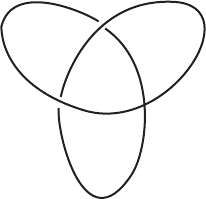
simplest knot is called a trefoil knot (Figure 4.1 ).
In a projection of a knot into a plane, we call the places where the knot
crosses itself in the graphs the crossings of the projection. The crossing number
of a knot K , denoted c ( K ), is the smallest number of crossings that occur in
any projection of the knot. If a knot is nontrivial , it has more than one crossing
in a projection. A fi gure - eight knot (Figure 4.2 ) has four crossings.
FIGURE 4.1 Trefoil knot.