
Higgins M.D. Quantitative textural measurement in igneous and metamorphic petrology
Подождите немного. Документ загружается.

3.3.3.3 Mean grain size by shape independent intersection methods
The ratio of the surface area to the volume, S
V
, can be accurately determined
without any assumptions of grain shape or orientation (see Section 2.4.2). This
parameter is a measure of the mean curvature of the grains and has the
dimensions of L
1
. The inverse of this parameter is a measure of the mean
size of the grains, which is just the mean intercept length. This measure of mean
size is used in some materials science literature (Brandon & Kaplan, 1999).
3.3.4 Extraction of grain size distributions from grain intersection data
3.3.4.1 Nature of the problem
The problem of conversion of two-dimensional intersection or projection size
data to three-dimensional CSDs is not simple for objects more geometrically
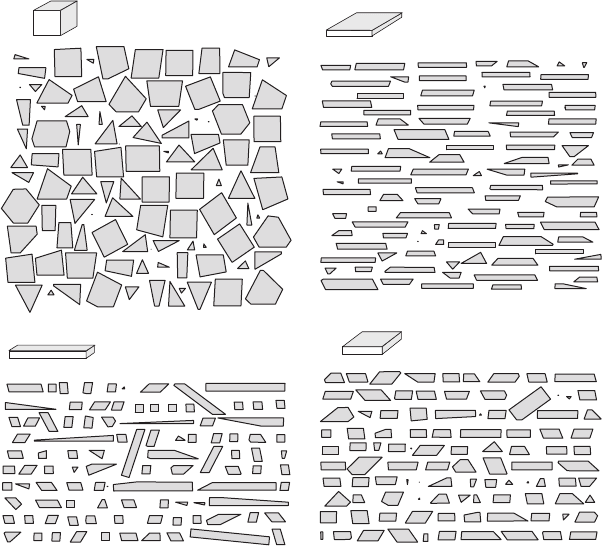
complex than a sphere and there is no unique solution for real data (Figure 3.27).
Tablet 1:10:10
Cube 1:1:1
Prism 1:1:10
Tablet 1:2:5
Figure 3.27 Intersections of random planes with regular geometric figures.
It should be noted that tablets tend to give elongated intersections, which are
commonly thought to indicate a lath shape, whereas prisms commonly have a
rectangular cross-section (Higgins, 1994).
3.3 Analytical methods 79
The problem was first attacked in geology by sedimentologists: empirical
solutions were developed early and, despite criticism, have been commonly
applied since then (Friedman, 1958, Johnson, 1994). In the field of igneous
and metamorphic petrology the problem has been discussed by Cashman and
Marsh (1988), Peterson(1996), Sahagian and Proussevitch (1998) and Higgins
(2000). The following treatment generally follows the stereological approach
of Higgins (2000).
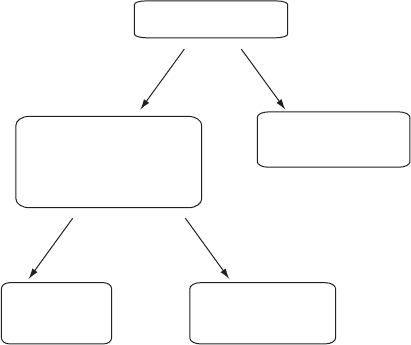
Stereological solutions to this problem can be classed into direct or
unbiased methods for which no assumptions about the shape and size distribu-
tion of the particles are necessary, and indirect or biased methods, in which
some assumptions are needed (Figure 3.28; Royet, 1991). Indirect methods
can be classified further into parametric methods, where a size distribution
law is assumed, and distribution-free methods that are applicable to all
distributions.
In an ideal world the direct methods would be the best solution. However,
although direct methods for the determination of mean size are very powerful
and simple (Howard & Reed, 1998), they are not available for size distribu-
tions. Three-dimensional methods can yield size distributions directly, but
their limitations have already been discussed (see Section 2.2). The lack of a
direct size distribution method has prompted some workers in stereology to
suggest that size distributions should not be determined from sections, or that
size distributions do not give any useful information to practical problems
(Exner, 2004). These limitations, however, seem unduly onerous and hence we
are usually left, therefore, with indirect methods.
Assume shape?
Direct (unbiased)
methods
Parametric
methods
Distribution-free
methods
Yes
Yes
No
No
Indirect (biased)
methods
Assume distribution?
Figure 3.28 Flow diagram for stereological methods (after Higgins, 2000).
80 Grain and crystal sizes
It should be mentioned that the techniques to be discussed below are based
on the assumption that the section measured (or visible part of the surface) is
thin compared with the dimensions of the object. For thin sections viewed in
transmitted light, this assumption means that the crystals must be larger than
0.03 mm, the thickness of a standard thin section. If crystals smaller than this
limit are to be measured, then the crystal outlines are a projection and not a
section, and hence different equations must be used (see Figure 3.25 and
Section 3.3.5).
3.3.4.2 Parametric solutions
The earliest geological methods for stereological conversion were determined
from studies of loose sediments, supplemented by determinations of grain size
from thin sections. However, it was discovered early that there was a systema-
tic bias in thin section data as compared to sieved fractions (Chayes, 1950).
The earliest attempts to solve this problem were based on empirical data:
sediments were analysed by sieving and thin-section analysis (Friedman,
1958). True grain size distributions are commonly approximately lognormal
by mass at the precision level of this type of analysis; hence this method is
actually parametric. The core of the method is to use the quartiles from the
analysis of size in thin sections and transform these to quartiles equivalent to
those of the sieved data using a simple linear equation. This method has been
corrected and modified by others, but was most severely criticised by Johnson
(1994). He pointed out that the method does not work very well for the smaller
size fractions, but only suggested a way of calculating the mean particle size
from intersection measurements.
Kong et al.(2005) proposed another parametric solution for spheres with
lognormal or gamma distributions. Despite the complexity of the mathema-
tical arguments, this method is very restrictive in terms of shape and distribu-
tion: it will be shown below that there are much simpler and more powerful
solutions to this problem. They also concluded that a simple factor can be used
to convert 2-D mean sizes to 3-D mean sizes. Again, a much better solution is
to use stereologically exact global parameters (see Section 2.5.2) as there is no
need to assume shape or distribution.
Peterson (1996) proposed a parametric solution based on another distribu-
tion: he initially assumed that rock CSDs have a strict logarithmic variation in
population density for a linear variation in size. This distribution is indicated
by the theoretical studies of Marsh (1988b) for simple igneous systems.
Peterson first corrected the data for the intersection-probability effect (see
below). He then applied a further correction using three empirical parameters
that depend on the shape and spatial orientation of the crystals. He found a
3.3 Analytical methods 81

good correlation between the CSDs determined by his methods and the true
CSDs for synthetic data with logarithmic-linear CSDs. However, many
published natural CSDs are not linear. Peterson was aware of this problem
and applied the corrections derived from linear approximations to the
actual curved CSDs. However, he did not verify whether the results for
curved CSDs were accurate using synthetic or natural data. Hence, it is
not clear if these parametric methods can be applied to many natural
systems. It also seems unwise to use a technique to find CSDs that assumes a
CSD shape beforehand. Another limitation of these methods is that they can
only be applied to isotropic (massive) fabrics, unless other parameters are
introduced.
3.3.4.3 Distribution-free solutions
The intersection-probability and cut-section effects are relevant for distribution-
free solutions (Underwood, 1970,Royet,1991). The intersection-probability
effect is that for a population of grains with different true sizes (polydisperse),
smaller grains are less likely to be intersected by a plane than larger grains. The
cut-section effect is that the intersection plane never cuts exactly through the
centre of each particle; hence, even in a population of equal-sized particles
(monodisperse), intersection sizes have a broad range about the modal value,
from zero to the greatest 3-D length. Both problems compound to make the
stereological conversion complex.
The intersection-probability effect is easily resolved for a monodisperse
collection of spheres (Royet, 1991):
n
V
¼
n
A
D
This equation can be modified so that it applies to polydisperse (many true
sizes) collections of spheres if many size ranges are treated separately: for
instance 0–1 mm, 1–2 mm, 2–3 mm. Other shapes can be accommodated if a
linear measure of the size of the particle is used instead of the diameter.
The simplest formulation of the intersection-probability effect for non-
spherical objects in a size interval j is:
n
V
ðL
j
Þ¼
n
A
ðl
j
Þ
H
j
Mean projected height (or mean calliper diameter)
H
j
is defined as the mean
height of the shadow of the particle for all possible orientations (Sahagian &
Proussevitch, 1998). It is commonly close to the other definitions of size
discussed in Section 3.1.2.
82 Grain and crystal sizes
The intersection probability effect uses the assumption that each intersec-
tion passes exactly through the centre of the object along the longest axis. This
is very unlikely and hence we have to contend also with the cut-section effect.
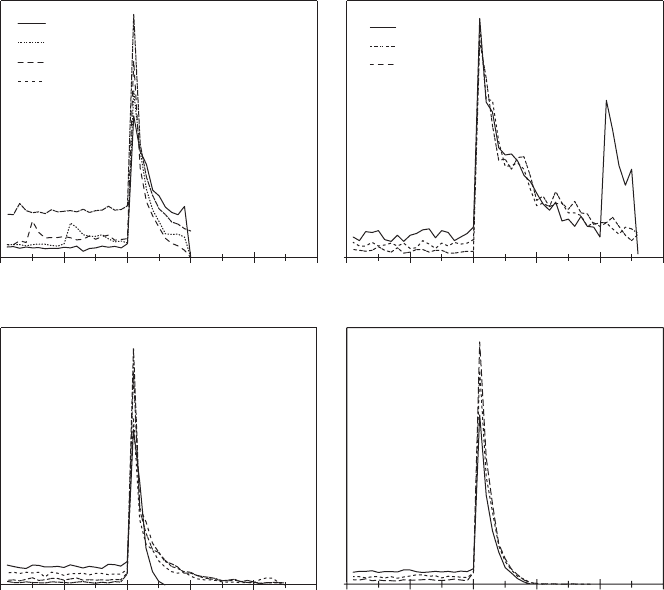
The cut-section effect can be solved analytically only for spheres (e.g.,
Royet, 1991). The size distributions of intersections between a random plane
and a sphere of unit diameter rises to a maximum near the diameter of the
sphere(Figure3.29a).Hence,themostlikelyintersectiondiameteriscloseto
the maximum and the true diameter.
The intersection of a triaxial ellipsoid with a plane produces an ellipse. The
distribution of the major and minor axes (¼ length and width) of the inter-
section can be evaluated numerically (Figure 3.29). The intersection lengths of
oblateellipsoids(Figure3.29a)andintersectionwidthsofprolateellipsoids
(Figure3.29d)havesizedistributionsthatresemblespheres.Intersection
lengthsofprolateellipsoids(Figure3.29b)alsorisetoamaximumatthe
Table 3.1 Some symbols that are used below. Lower case letters
commonly refer to intersections and upper case to 3-D parameters.
Other symbols are discussed later.
j A size interval
x, y Size limits of an interval
L 3-D size
W
j
Width of interval j
L
j
Mean size in interval j
D Sphere diameter
V Volumetric phase proportion
l Intersection length
l
j
Mean intersection length in interval j
w Intersection width
w
j
Mean intersection width in interval j
P
AB
Probability that a crystal with a true size in size interval A will
have an intersection that falls in intersection size interval B
H
j
Mean projected height for size interval j
n
A
Total number per unit area
n
V
Total number per unit volume
n
A
(l
j
) Number per unit area for size interval j
n
V
(L
j
) Number per unit volume for size interval j
n
V
(0) Nucleation density (intercept on size axis)
n
0
V
(L) Population density at length L
Shape parameters
S Short axis of parallelepiped or minor axis of ellipsoid
I Intermediate axis of parallelepiped or intermediate axis of
ellipsoid
L Long axis of parallelepiped or major axis of ellipsoid
3.3 Analytical methods 83
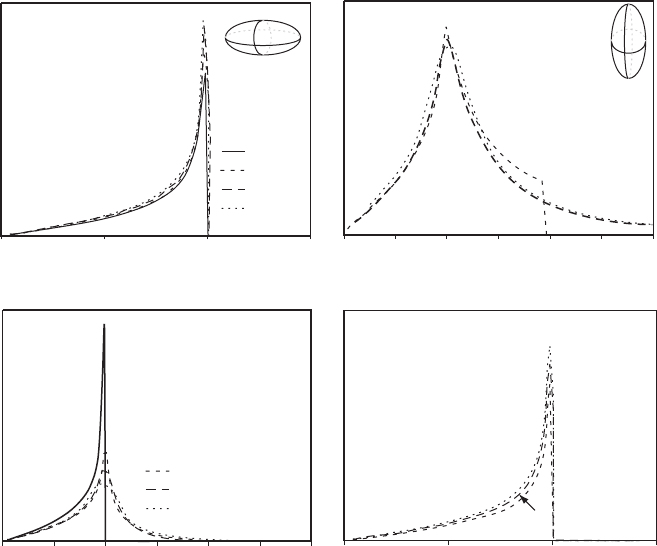
intermediate axis value, but continue to larger sizes. Intersection widths of
oblate ellipsoids rise to a maximum for the minor axis and also continue to
largersizes(Figure3.29c).
The distribution of intersection dimensions for shapes such as parallelepi-
peds must be derived numerically and can be very complex with several modes
(Figure 3.30; Higgins, 1994, Sahagian & Proussevitch, 1998).
As noted above, for spheres and near-equant forms, the mean intersection
length is close to the true 3-D size of the object. However, for monodisperse
populations of randomly oriented anisotropic figures, such as parallelepipeds,
the most-likely intersection length is close to the intermediate dimension
(Higgins, 1994). That is, for a particle 1 2 10 mm, the most-likely inter-
section length is 2 mm. The most-likely intersection width is close to the short
dimension. The same argument can also be applied to populations of crystals
0 0.5 1.0 1.5
Sphere
1:2:2
1:5:5
1:10:10
0 0.5 1.0 1.5 2.0 2.5 3.0
Sphere
1:2:2
1:5:5
1:10:10
0 0.5 1.0 1.5 2.0 2.5 3.0
1:1:2
1:1:5
1:1:10
0 0.5 1.0 1.5
1:1:2
1:1:5
1:1:10
intersection length
/ intermediate axis
intersection width
/ minor axis
(a) Oblate ellipsoids
+ spheres
(c) Oblate ellipsoids
+ spheres
(b) Prolate
ellipsoids
(d) Prolate
ellipsoids
frequencyfrequency
Figure 3.29 Intersections between a random plane and a triaxial ellipsoid
(this study). One million randomly oriented intersections were calculated for
different shapes of ellipsoids. Intersection lengths and widths are normalised
to true (3-D) intermediate and minor axes of the ellipsoid. Oblate ellipsoids
are short and wide and prolate ellipsoids are tall and thin.
84 Grain and crystal sizes
with different true sizes. These modal values for intersection length and width
can be corrected to the true length of the crystal, or any other size parameter, if
the shape of the solid is known (see Chapter 4). However, there is another
problem: intersection lengths and widths for a monodisperse population tail
out to smaller and larger values respectively around the most-likely intersection
length. If the simple conversion equations are used, then the effects of tailing
become very important. This is because small intersections of large objects
(corners) will be converted using their apparent length and not their true length.
3.3.4.4 Saltikov method
Saltikov (1967) proposed a method
3
of unfolding a population of intersection
lengths into the true length using a function of the intersection lengths
(Figure 3.31). For a polydisperse population, the 3-D distribution of lengths
0 0.5 1.0 1.5 2.0 2.5 0 0.5 1.0 1.5 2.0 2.5
intersection length
/ intermediate dimension (l/I)
intersection width
/ short dimension (w/S)
1:1:1
1:2:2
1:5:5
1:10:10
0 0.5 1.0 1.5 2.0 2.5 0 0.5 1.0 1.5 2.0 2.5
1:1:2
1:1:5
1:1:10
(a) Cube
and tablets
(c) Cube and
tablets
(b) Prisms
(d) Prisms
frequency frequency
Figure 3.30 Intersections between a random plane and a regular
parallelepiped. Intersection lengths and widths normalised to intermediate
and short parallelepiped dimensions (Higgins, 1994, Higgins, 2000).
3.3 Analytical methods 85
3-D
2-D
2-D cross-section
from 1st 3-D class
from 2nd
from 3rd
from 4th
2-D cumulative
distribution
3-D real
distribution
size classes
accumulation from
all larger classes
1234567. . .
#
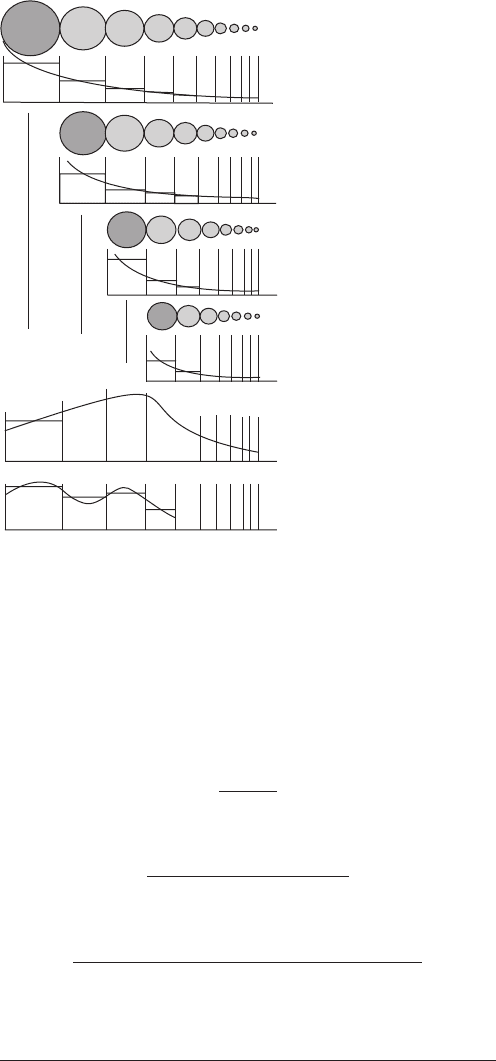
Figure 3.31 Cut-section effect. Diagram after Sahagian and Proussevitch (1998).
can be found by applying the function for a monodisperse population of the
same shape to the 2-D length distribution. The values of n
V
ðL
XY
Þ for a series of
bins from 1, 2, 3, 4 ...can be calculated sequentially using the equations of
Sahagian and Proussevitch (1998) as modified by Higgins (2000):
n
V
ðL
1
Þ¼
n
A
ðl
1
Þ
P
11
H
1
n
V
ðL
2
Þ¼
n
A
ðl
2
Þn
V
ðL
1
ÞP
12
H
1
P
22
H
2
n
V
ðL
3
Þ¼
n
A
ðl
3
Þn
V
ðL
2
ÞP
23
H
2
n
V
ðL
1
ÞP
13
H
1
P
33
H
3
n
V
ðL
4
Þ¼
n
A
ðl
4
Þn
V
ðL
3
ÞP
34
H
3
n
V
ðL
2
ÞP
24
H
2
n
V
ðL
1
ÞP
14
H
1
P
44
H
4
where subscript 1 refers to the first (largest) size interval.
86 Grain and crystal sizes
The size intervals (bins) are logarithmic as this simplifies the calculations.
However, programs such as CSDCorrections can accommodate any size bins.
Both Saltikov (1967) and Sahagian and Proussevitch (1998) proposed ten size
bins per decade, that is each bin is 10
0.1
smaller than its neighbour. Higgins
(2000) suggests 5 bins per decade as a starting value as this reduces the total
number of bins and hence the accumulation of uncertainty. It also yields larger
numbers of crystals, and smaller counting errors, in each bin where applied to
typical geological samples. The probabilities, P
AB
, can be calculated from
numerical models of different crystal shapes (Higgins, 1994, Sahagian &
Proussevitch, 1998). For isotropic fabrics, the shape is constructed mathema-
tically and sectioned using randomly oriented planes placed random distances
from the centre of the crystal model. The mean projected heights also can be
calculated using the same models.
The Saltikov method works well for spheres and near equant objects (spher-
oids) because the modal 2-D length lies close to the maximum 3-D length (e.g.,
Armienti et al., 1994, Sahagian & Proussevitch, 1998). However, Higgins
(2000) has shown that this method is less successful for complex objects
because the largest 2-D intersections are not very common. That is, the
modal 2-D length is much less than the maximum 2-D length. Therefore, the
less abundant, and hence less accurately determined, larger intersections are
used to correct for the most abundant intersections, introducing large uncer-
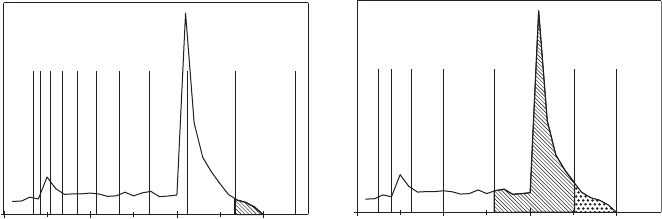
taintiesinthecorrected3-Dlengthdistributions(Figure3.32a).Theproblem
is actually worse than might be expected from the works of Saltikov (1967) and
0 0.5 1.0 1.5
intersection length (l)
6 4 4 6 33 26
3
(a) Saltikov method
Per cent in each bin
Undersize
frequency
0 0.5 1.0 1.5
48 13
48
6
(b) Modified by Higgins
Per cent in each bin
Oversize
Undersize
frequency
intersection length (l)
33 5 8 2 8
Figure 3.32 The Saltikov method for a tablet 1:5:5. (a) The Saltikov (1967)
method uses the largest interval (shaded) for correcting the smaller
intervals. For a 1:5:5 tablet this interval has only 3% of the intersections
and is hence imprecise. (b) Higgins (2000) modified the Saltikov method by
using a much wider bin that contains 48% of the intersections and is hence
more precise.
3.3 Analytical methods 87
Sahagian and Proussevitch (1998) as both authors placed the maximum inter-
section length at the upper limit of the size bin. Because true particle sizes can
be distributed throughout the size bin, at the very least the maximum inter-
section size should be placed at the centre of the bin.
Sahagian and Proussevitch (1998) reduced this problem by ignoring the
class of largest intersections and shifting the probabilities to lower classes.
Higgins ( 2000) used the most likely intersection length or width (modal value)
tocorrectforthetailingtootherintersections(Figure3.32b).However,itis
not possible to correct tailing in both directions using this technique – tailing to
intersections either larger or smaller than the modal value must be ignored. In
general tailing to smaller intersections is a much more important problem than
tailing to larger intersections for most CSDs. Hence, the first size interval is
centred on the mode of the intersection length or width.
Some workers have considered the Saltikov technique to be impractical
because of the accumulation of terms, and hence uncertainties, in the smaller
bins. This problem is not always very serious as many of the terms are not
significant, especially for equant and spherical forms. It can also be reduced by
using fewer, wider bins. Intersections larger than the first interval cannot be
corrected precisely with this method. However, if they are added to the first
interval, then this source of uncertainty is minimised.
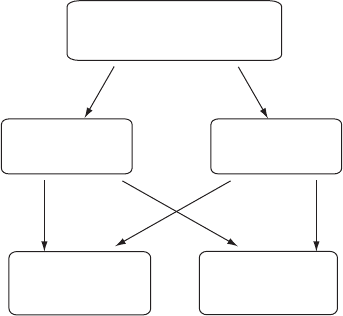
Clearly, the fewer corrections that are needed the greater the accuracy of the
final data. In many cases use of intersection widths instead of lengths reduces
the amount of corrections necessary (Figure 3.33).
Crystal size distribution
steep?
Cube?
Either cube
or prism?
Use length
measurements
Use width
measurements
Yes
YesYes
No
No No
Figure 3.33 A possible strategy for choosing width or length intersection
measurements (Higgins, 2000).
88 Grain and crystal sizes