
Higgins M.D. Quantitative textural measurement in igneous and metamorphic petrology
Подождите немного. Документ загружается.

times of 1.5 to 4 years, except for two of the lower lavas with residence times of
4 to 9 years. The residence times correlate inversely with nucleation density
and broadly correlate inversely with silica content: high-residence-time, low-
silica lavas occur at the base of the pile, whereas low-residence-time, high-silica
lavas occur at the top of the pile. One interpretation of the residence time data
is that the lavas are from an open system of more or less constant residence
time but varying spatially in system locations; e.g. a magma chamber in which
steady-state recharge and eruption may have been reached. Alternatively,
these lavas may represent small samples, closely spaced in time, of a slowly
cooling, large batch or reservoir of magma. The greater residence times asso-
ciated with the lower flows may indicate the increased amount of time neces-
sary to form the conduit of the magma-volcano system by the oldest magma or
simply that part of the system with the highest liquidus temperature.
The Soufriere Hills volcano, Montserrat started to erupt at the end of 1995
after a hiatus of 300 years and continues to this day. The volcano is dominated
by a dome of andesite that sheds pyroclastic flows as it inflates. Typical dome
fragments are glassy and rich in plagioclase crystals – up to 35% for crystals
larger than 0.03 mm. The pyroclastic material is texturally similar, but
–6
–4
–2
0
2
4
6
8
0123
size (mm)
(a) Plagioclase in andesite,
Mt Taranaki, New Zealand
ln (population density) (mm
–4
)
characteristic length (mm)
0.06
0.08
0.10
0.12
0.14
0.16
0.18
0.20
10 20 30
volumetric phase (%)
Staircase
Summit &
Castle
Fantham's
Peak
(b)
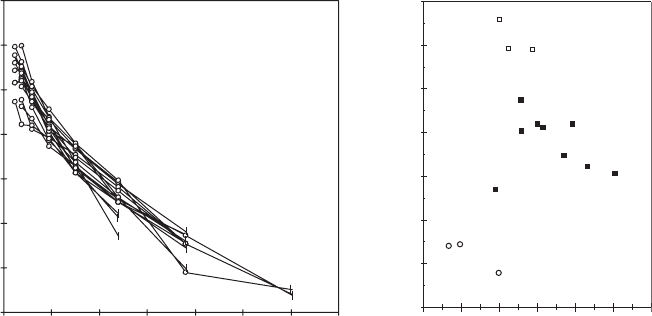
Figure 3.44 Plagioclase in andesite lavas from M t Taranaki (Egmont
Volcano), New Zealand. The original data from Higgins (1996a) were
recalculated and published in Higgins (2000). (a) In a conventional CSD
diagram it is not easy to discern variation trends between samples.
(b) Although the CSDs are slightly curved it is still profitable to calculate
the characteristic length (1/slope) and plot this against the dense-rock
volumetric phase per cent of plagioclase, calculated from the total area of
the crystal intersections and corrected for vesicles. Three groups of lavas
clearly stand out on this diagram.
3.4 Typical applications 109
vesicular. A particular aspect of these rocks is the abundance of large amphi-
bole oikocrysts, up to 12 mm long, many of which are loaded with plagioclase
crystals. Oikocrysts seal in early textures and preserve aspects of them for later
examination. Hence, it is possible to see a sequence of textures in such rocks
that can show how the CSD has varied with time (Higgins, 1998). Plagioclase
CSDs in both dome fragments, pyroclastic rocks and within amphiboles were
examined by Higgins and Roberge ( 2003).
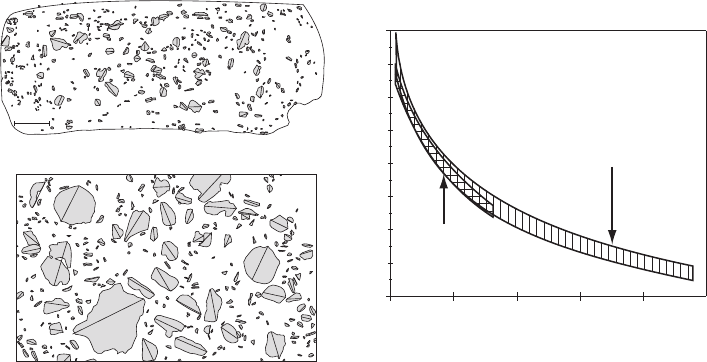
The texture of the material outside the oikocrysts, the matrix, largely pre-
serves the last state of the magma before eruption whereas the oikocrysts
preserve earlier textures. All matrix CSDs are strongly curved and broadly
similar (Figure 3.45). CSDs of plagioclase from the oikocrysts are coincident
with the CSDs of the matrix, but do not extend to the same sizes. In fact, there
appears to be an almost continuous range of maximum crystal sizes in different
matrix samples and oikocrysts. The instability of amphibole at depths above
5 km indicates that plagioclase crystallisation began below that level.
The oikocryst and matrix plagioclase textures cannot be related by simple
growth of plagioclase. Plagioclase crystals must start small and numerous and
progress towards small numbers of larger crystals. The overall process must
10
–6
–4
–2
0
2
4
6
8
0
12
size (mm)
(c) Plagioclase CSD
Plagioclase in
matrix (groundmass)
Plagioclase in
amphibole
I mm
ln (population density) (mm
–4
)
(a) Plagioclase in amphibole oikocryst
(b) Plagioclase in matrix
Figure 3.45 Plagioclase in andesites of the Soufriere Hills volcano,
Montserrat (Higgins & Roberge, 2003). (a) Plagioclase chadocrysts in
the amphibole give an early view of the texture in the magma chamber.
(b) Plagioclase in the matrix gives a view just before the eruption – same scale
as the oikocryst. (c) Plagioclase CSDs in both environments are summarised by
envelopes that represent the range of a number of samples. The two groups of
CSDs are similar for small sizes, but that of the matrix continues the curve to
larger crystals. A similar variation can be seen in the individual matrix CSDs.
110 Grain and crystal sizes
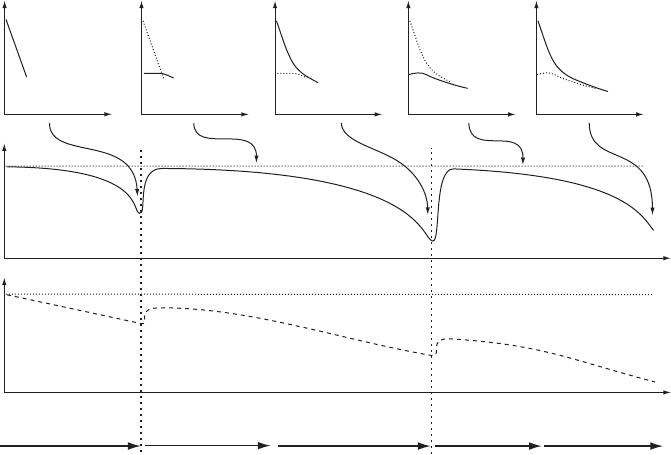
progressively extend the CSD towards larger crystals. Such an overall process
must involve both crystallisation and solution. Higgins and Roberge (2003)
proposed a model that involves repeated cycles of crystal growth and coarsen-
ing (Ostwald ripening) in response to varying degrees of undercooling and
superheat (Figure 3.46). The first cycle started when plagioclase crystallised in
response to increasing undercooling in the magma chamber. This phase ended
when the undercooling decreased. This could have been caused by addition of
heat from mafic magma intruded into the magma chamber or by changes in
pressure (depth) or volatile fugacity. Under these conditions coarsening began.
Small crystals dissolved to feed larger crystals. Numerous repetitions of this
cycle will yield the observed complexly zoned large crystals. At Montserrat the
overall process has increased the total crystal content of the magma, but this
may not necessarily happen elsewhere. Finally, small crystals grow in response
to uplift that just precedes the eruption. Amphiboles may have also grown by
the same process.
Solidus
Liquidus
time
temperatureper cent
liquid
0%
100%
Mafic
magma
injection
Mafic
magma
injection
Nucleation
and growth
Initial texture
developed by
nucleation and
growth
Further nucleation
and growth.
Oikocrysts develop
trapping this texture
Further nucleation
and growth gives
final CSD seen in
erupted material
Solution and
coarsening flattens
CSD
A further period of
solution and
coarsening flattens
CSD
Nucleation
and growth
Nucleation
and growth
Solution and
coarsening
Solution and
coarsening
size size size size
size
ln (population density)
ln
(population density)
ln
(population density)
ln
(population density)
ln
(population density)
Buffering Buffering
Figure 3.46 Soufriere Hills volcano, Montserrat. The solidification model
of Higgins and Roberge (2003) involves repeated cycles of nucleation and
growth, followed by coarsening.
3.4 Typical applications 111
3.4.1.5 Olivine in picrite
The 1959 eruption of Kilauea Iki comprised a series of lava flows and created
a lava lake that has only recently completely solidified. The magma was
picritic, a very unusual composition for Hawaii. Mangan (1990) studied the
CSDs of olivine in samples of the pyroclastic deposits of this eruption. The
material is not very easy to measure because some of the olivine crystals are
xenocrystic, and were derived from disaggregated mantle peridotites. Such
crystals have solid-state deformation features which are lacking in the
magmatic olivine. However, this distinction becomes more difficult for
smaller crystals. The magmatic olivine crystallised in a magma chamber
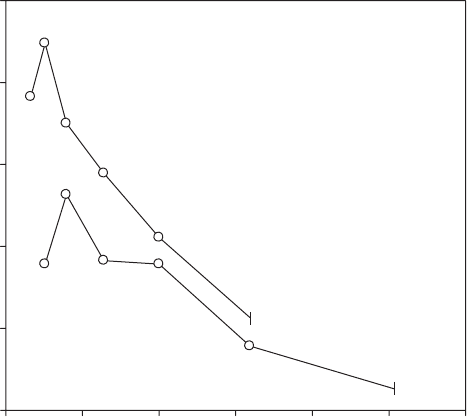
beneath the volcano. Mangan (1990) measured a small number of crystals
from many different samples, but data have been summed here to improve the
precision (Figure 3.47). The turn-down for small crystals may be an artefact of
measurement. Although the CSD of magmatic crystals is slightly curved, a
–10
–8
–6
–4
–2
0
0123456
size (mm)
ln (population density) (mm
–4
)
Plagioclase in picrite: 1959 eruption
of Kilauea Iki, Hawaii
‘Magmatic’ crystals
Xenocrysts
Figure 3.47 Olivine in picrite scoria from the 1959 eruption of Kilauea Iki
(Mangan, 1990). Data have been recalculated from the original length
measurements supplied by Dr Mangan using the shape of crystals in
samples from the lava lake that developed later in the eruption that we have
measured in our laboratory. For both populations of crystals the aspect ratios
were 1:1.25:1.25, with a roundness of 0.5 and crystals were randomly
orientated (massive fabric). ‘Xenocrysts’ show evidence of solid-state
deformation; ‘Magmatic’ crystals lack such deformation.
112 Grain and crystal sizes
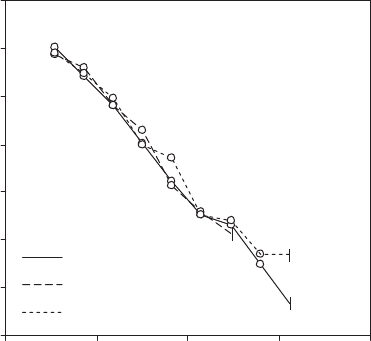
characteristic length of 0.34 mm can be calculated. Mangan (1990) chose
somewhat arbitrarily a growth rate for olivine of 10
9
mm s
1
as this was
what was used for olivine in the Makaopuhi lava lake (Marsh, 1988a). If we
apply the Marsh (1988b) steady-state model, then this gives a residence time of
11 years. The significance of the CSD of the olivine xenocrysts is not clear and
more data are needed.
3.4.1.6 Anorthoclase in phonolite
Dunbar et al.(1994) have looked at anorthoclase phenocrysts in phonolite
from Mt Erebus, Antarctica. These crystals are up to 90 mm long and are very
abundant. They sampled the crystals in volcanic bombs thrown out by the
volcano. These bombs can be disintegrated easily and the crystals separated
and measured using a ruler. The three samples measured all had straight CSDs
down to 10 mm, the measurement limit (Figure 3.48). They did not attempt to
extend this CSD to smaller sizes with a thin section; hence it is not clear if these
rocks lack very small crystals.
Dunbar et al.(1994) concluded that anorthoclase had low nucleation rates
but that it crystallised continuously through time. Anorthoclase should float
in a phonolite magma, but the authors considered that the uniformity of the
three CSDs did not support this idea. However, it seems to me there is no
reason why flotation cannot produce uniform CSDs. The low overall crystal
–14
–12
–10
–8
020406080
1984-1
1984-2
1988
size (mm)
ln (population density) (mm
–4
)
Anorthoclase in phonolite:
Mt Erebus, Antarctica
Figure 3.48 CSD of anorthoclase from Mt Erebus (Dunbar et al., 1994).
The crystals were extracted whole by disintegration of three volcanic bombs
erupted in 1984 and 1988. The original data have been converted so that size
equals length in mm using a width/length ratio of 0.33.
3.4 Typical applications 113
abundance and large sizes suggest that coarsening was important. Initially
there may have been a high nucleation rate and many small crystals, but these
were removed during coarsening. A key test would be to look at the abundance
of small crystals – their absence would suggest coarsening. This could well be
combined with accumulation by flotation.
3.4.2 Mafic plutonic rocks
Quantitative textural studies of plutonic rocks really started with Jackson’s
work on the Stillwater complex in 1961 (Jackson, 1961). He measured crystal
size distributions of olivine, orthopyroxene and chromite, but did not record
the area that he measured; hence his data cannot be completely compared with
modern data.
3.4.2.1 Gabbro
The Oman ophiolite is one of the best exposed and preserved sections of the
oceanic crust, and is thought to have formed at a fast or medium spreading
ridge. Garrido et al.(2001) studied plagioclase in the lower and middle sec-
tions, whereas Coogan et al.(2002) examined plagioclase in the uppermost
gabbros, just below the sheeted dykes. In both studies plagioclase CSDs were
concave down, with straight right limbs and a clear lack of small crystals. The
simple shape suggests a simple history: Coogan et al.(2002) proposed that a
high-level magma chamber was filled with primitive, aphyric magma and that
all crystals grew there in place. Garrido et al.(2001) considered that the lack of
small crystals reflected coarsening during the early phases of the evolution of
the textures: late reheating to 500 8C did not cause appreciable grain growth.
Other authors have suggested that grain-boundary migration during coarsen-
ing can be halted by the presence of other phases (grain-boundary pinning).
However, here it is shown that this process did not significantly limit the
coarsening process. Garrido et al.(2001) divided up their gabbro section into
two parts on the basis of the CSDs and interpreted this in terms of near-vertical
isotherms close to the ridge axis.
The Kiglapait intrusion is one of the younger components of the Nain
Plutonic Suite. It has a conical form about 30 km in diameter, and is about
8.5 km thick in the centre (Morse, 1969). It has been well studied because it is
essentially undeformed and unaltered. The lower zone is composed of plagio-
clase and olivine; clinopyroxene joins the assemblage towards the top and
marks the base of the upper zone.
Higgins (2002b) determined the CSDs of plagioclase, olivine clino-
pyroxene in a series of 13 sections from the base to the top of the intrusion
114 Grain and crystal sizes
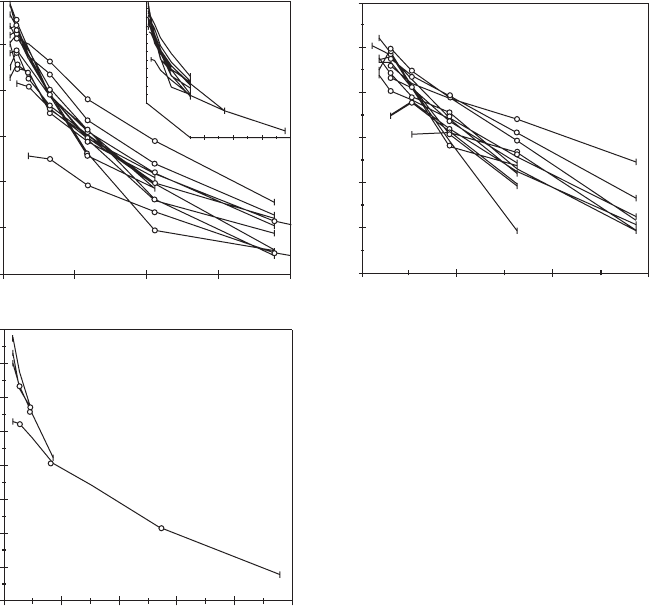
(Figure 3.49). All CSDs lack small crystals and are slightly curved to the right,
concave up. However, the curvature is not as strong as first appears: the CSDs
define a fan, as expected if there is little variation in mineral abundance
(Higgins, 2002a). Most of the textural variation is the result of variable degrees
of coarsening, following the Communicating Neighbours model (DeHoff,
1991). The degree of coarsening is lowest at the base, when the magma was
first introduced into cool host rocks. Coarsening reaches a maximum when
the intrusion was 20% solidified, and then decreases towards the top of the
intrusion. This reflects the lower volume and hence heat production of the
crystallising magma, which could be therefore dissipated more readily. There
does not seem to be a correlation between the degree of coarsening of the
olivine and plagioclase, suggesting that they were not always on the liquidus at
the same time.
–10
–8
–8
–6
–4
–4
–2
0
0
2
ln (population density) (mm
–4
)
ln
(population density) (mm
–4
)
04
10
6
20
2 8
size (mm) size (mm)
(b) Olivine
(a) Plagioclase
2
–10
–8
–6
–4
–2
0
0 2 4 6
–14
–16
–12
–10
–8
–6
–4
–2
0
ln (population density) (mm
–4
)
0 5 10 15 20 25
size (mm)
(c) Pyroxene
Kiglapait intrusion,
Labrador, Canada
Figure 3.49 CSDs of plagioclase, olivine and clinopyroxene from the
Kiglapait intrusion, Canada (Higgins , 2002b).
3.4 Typical applications 115
Part of the lower zone is well layered, in some cases with well developed
mineral grading. If such layers were produced by crystal settling then we would
expect to see grading in both the amount of the phases and their size distribu-
tions. One of these layers was examined in detail. A settling origin is strongly
suggested by the sharp base rich in olivine, which grades up into a top rich in
plagioclase. However, plagioclase and olivine CSDs from the base and top do
not show the expected effect. This suggests that subsequent coarsening has
obscured the grain size effects of crystal setting.
3.4.2.2 Troctolite and anorthosite
Higgins (1998) showed that the textures of plagioclase crystals within large
olivine oikocrysts preserve a textural sequence of the formation of anorthosite.
Such textures have been quantified in a troctolite/anorthosite from the
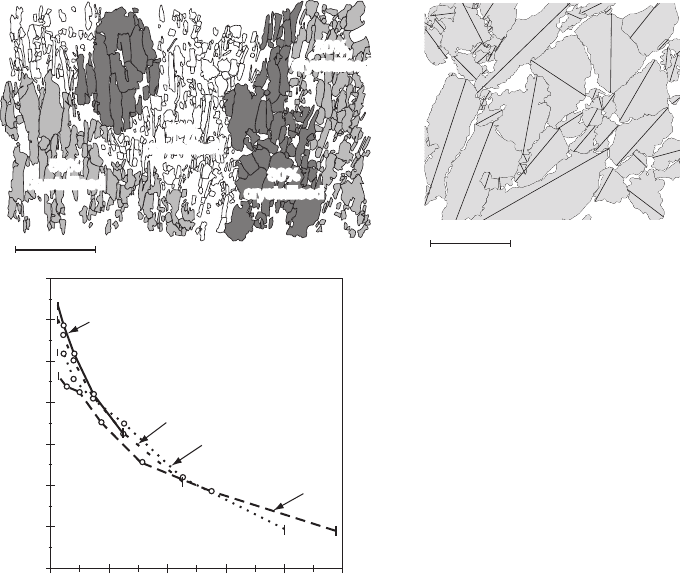
Proterozoic Lac-Saint-Jean anorthosite suite, Canada (Figure 3.50).
Plagioclase CSDs indicate that it initially nucleated and grew in an environ-
ment of linearly increasing undercooling, producing a straight-line CSD.
During this phase, latent heat of crystallisation was largely removed by circu-
lation of magma through the porous crystal mush. By about 25% solidifica-
tion the crystallinity was such that it reduced, but did not eliminate, the
circulation of magma, resulting in the retention of more latent heat within
the crystal pile. The temperature increased until it was buffered by the solution
of plagioclase close to the liquidus temperature of plagioclase. Nucleation of
plagioclase was inhibited and conditions were suitable for coarsening of both
plagioclase and olivine to occur.
Higgins (1998) considered that the shapes of the plagioclase CSDs fit better
the Communicating Neighbours equation of coarsening, rather than the clas-
sic Lifshitz-Slyozov-Wagner equation (see Section 3.2.4), as do other examples
drawn from the literature. If olivine started to nucleate at a higher temperature
than plagioclase, then during the coarsening phase olivine would have been
more undercooled than plagioclase, and would have had a higher maximum
growth rate. Under these conditions olivine would coarsen more rapidly than
plagioclase and engulf it. Hence the order of crystallisation determined from
the textures would be the reverse of the order of first nucleation of the two
phases, from equilibrium phase diagrams. Maintenance of the temperature
near the plagioclase liquidus may also inhibit the nucleation and growth of
other phases.
The upper part of the unmetamorphosed Sept Iles intrusive suite contains a
series of anorthosites about 1 km thick (Higgins, 1991, Higgins, 2005). Parts of
the anorthosite are very well foliated with abrupt transitions to massive
anorthosite. In an early study I examined quantitatively the textures of one
116 Grain and crystal sizes
sample from each facies with the goal of determining the origin of the lamina-
tion (Figure 3.51; Higgins, 1991). One aspect that is particularly striking is the
strong difference in crystal shape between the thin tablets of the laminated
anorthosite (1:5:7) and the stubbier crystals of the massive anorthosite
(1:2.5:4). The recalculated CSDs for the laminated and massive anorthosite
are essentially collinear, but the massive anorthosite extends to larger sizes.
There are no crystals smaller than 1 mm for the massive anorthosite and 2 mm
for the laminated anorthosite. In the figure the CSDs terminate at 2–3 mm
–14
–12
–10
–8
–6
–4
–2
0
0 5 10 15 20 25
ln (population density) (mm
–4
)
40%
50%
80%
Matrix
100%
10 mm
40%
crystallised
40%
crystallised
40%
crystallised
80%
crystallised
80%
crystallised
80%
crystallised
50%
crystallised
10 mm
(a) Plagioclase in olivine oikocryst (b) Plagioclase in matrix
(c) Plagioclase CSDs
Oikocrystic anorthosite,
Alma, Lac-Saint-Jean
anorthosite suite
size (mm)
50%
crystallised
Figure 3.50 Plagioclase in oikocrystic anorthosite (troctolite) from the Lac-
Saint-Jean anorthositic suite (Higgins, 1998). (a) A large olivine oikocryst
was subdivided into regions of varying plagioclase content: 40, 50 and 80%.
They are considered to preserve a textural development sequ ence. (b) The
anorthosite from between the oikocrysts is termed the matrix and is 100%
plagioclase. (c) Plagioclase CSDs from the oikocryst regions and the matrix.
Data were recalculated from the original data using a shape of 1:3:3 for the
oikocryst sampl es and 1:1:1 for the matrix sample.
3.4 Typical applications 117
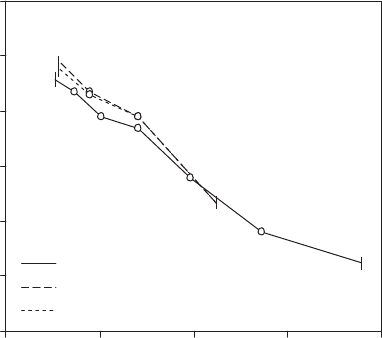
because of analytical difficulties. The similarity of the CSDs indicates that the
anorthosite of the two facies crystallised in the same pressure, temperature
and time environment, but that other processes were responsible for producing
the foliation and differences in crystal shape. The most likely candidate is
simple shear which can produce the foliation and also remove magma
around the growing crystal depleted in the plagioclase component (see
Section 5.2.2.2).
3.4.2.3 Impact melt rocks
The Sudbury igneous complex is the melt sheet produced by a large meteorite
impact. The overall composition is a norite, but the body is differentiated. It
may have been superheated when first produced. Zieg and Marsh (2002) have
reported CSDs from this fascinating unit, but unfortunately give few details.
They state that the plagioclase CSDs are linear, but do not present any actual
CSDs. It is also not clear if small crystals are absent, as in many plutonic rocks.
They have shown however, that the characteristic length of the crystals
increases systematically with height in the melt sheet by a factor of two.
They used these data and a simple cooling model to calculate an effective growth
rate of 1.5 10
13
mm s
1
and a cooling time of 1.8 10
12
s (57 ka). These
–14
–12
–10
–8
–6
–4
–2
0 5 10 15 20
Laminated – Section normal to lamination
Massive
Laminated – Section parallel to lamination
size (mm)
ln (population density) (mm
–4
)
Plagioclase in anorthosite:
Sept Iles, Canada
Figure 3.51 Plagioclase in laminated and massive anorthosite from the Sept
Iles intrusive suite (Higgins, 1991). The original data have been recalculated
using the methods of Higgins (2000) and a shape of 1:2.5:4 for the massive
sample and 1:5:7 for the laminated sample. Two orthogonal sections of the
laminated sample were analysed: It is gratifying that they give very similar
CSDs as there is, of course, only one actual CSD for a phase in a rock sample.
118 Grain and crystal sizes