
Higgins M.D. Quantitative textural measurement in igneous and metamorphic petrology
Подождите немного. Документ загружается.


Once the mode of the intersection length or width is used instead of the
maximum values, then the intersection length scale no longer corresponds to
the true length scale: that is, L
x
6¼ l
x
. For a parallelepiped with a short dimen-
sion S, an intermediate dimension I and a long dimension L, or an ellipsoid
with the same dimensions, the modal value of the intersection lengths on
randomly oriented planes is I (Higgins, 1994) hence:
L
x
¼ l
x
L=I
Similarly, the modal value of the intersection widths is S hence:
L
x
¼ w
x
L=S
Higgins (2000) found that for tablets, where L/I ¼ 1, a much better fit is
obtained to the test data of Peterson (1996) if the mean intersection length is
used rather than L in the above equations. This gives a maximum difference of
20% in the length scale for 1:10:10 tablets and decreases to zero for cubes. The
Saltikov equations do not need to be changed as
H
1
is determined in terms of
the true crystal length.
Other refinements have also been made to the Saltikov method. Tuffen
(1998) has pointed out that the inverse of the mean projected height must be
averaged over the true length interval and proposed that:
1
H
xy
¼
1
x y
Z
x
y
dL
L
where x ¼ upper limit of interval and y ¼ lower limit of interval. This can be
integrated to give:
1
H
xy
¼
lnðx=yÞ
x y
The original equations of Saltikov (1967) used logarithmic size bins.
Sahagian and Proussevitch (1998) followed this idea, but introduced more
complex equations for linear size bins. However, if the probabilities used in the
Saltikov equations are calculated for each cycle of corrections then the calcu-
lations remain simple for any set of bin sizes. This method of calculation has
been implemented in the program CSDCorrections (Higgins, 2000), so that
previously published data can be corrected. Nevertheless, the use of logarith-
mic size bins is recommended for most studies.
The Saltikov method can only be used in its simplest form for isotropic
fabrics. However, the probabilities of intersection, and the factors for
3.3 Analytical methods 89
converting intersection widths and lengths to true crystal sizes can be readily
modelled for anisotropic fabrics if the fabric parameters are known or can be
estimated. This is done on a dynamic basis in the program CSDCorrections
(Higgins, 2000). The intersection probabilities also depend on the shape of the
crystals. Crystal shapes will be discussed in Chapter 4.
There have been a number of published methods which are modifications of
the Saltikov method, although the authors were not always aware of this at the
time. Pareschi et al.(1990) developed a stereological procedure that they called
‘unfolding’ which closely resembles the Saltikov method. In this method they
reduced the intersection area to a circle of equal area, but otherwise used the
Saltikov technique for spheres. The ‘Stripstar’ technique and program is again
very similar (Heilbronner & Bruhn, 1998). Crystals are assumed to be spheres
and simple corrections are made using a fixed number of fixed-width size
intervals. The weaknesses of fixed-size intervals have been noted above.
Variable-size intervals can be readily accommodated if population density
instead of frequency is used in the final CSD diagrams (see Section 3.3.7). In
this technique, if all intersections from larger spheres are stripped off from
smaller size bins then negative quantities of spheres (antispheres) are permitted,
which seems to be counterproductive. Programs such as CSDCorrections
(Higgins, 2000) can do the same type of simple corrections using spheres, with
a flexible choice in size intervals and without negative quantities of crystals.
3.3.4.5 Uncertainty analysis of the Saltikov method
Inaccuracy in the determination of population densities arises principally from
three sources (Higgins, 2000): the easiest to understand and quantify is the
counting uncertainty. This is taken to be the square root of the number of
intersections within an interval. It is usually only significant for larger size
intervals with fewer than 20 intersections.
The second source of uncertainty is in the value of the probability para-
meters P
AB
used in the Saltikov equations. Although these parameters are
defined precisely for fixed convex shapes, crystals in most natural systems have
more irregular and variable shapes. Another source of uncertainty is that
tailing to intersections larger than the modal interval is included in the
modal interval. Hence, it is difficult to estimate the contributions from this
source to the total uncertainty. However, it is easy to calculate the contribution
of the counting uncertainties of other intersection intervals to the total correc-
tion of an interval. This source of uncertainty is most important for small size
intervals, where corrections are most significant.
The third source of uncertainty lies in the conversion of intermediate crystal
dimensions (for intersection length measurements) or short crystal dimensions
90 Grain and crystal sizes

(for intersection width measurements) to true crystal lengths. Uncertainties in
the determination of the crystal shape will produce systematic uncertainties in
both the population density and the size distribution.
3.3.4.6 Data conversion methods used in early CSD studies: Wager
and Grey methods
Many early crystal and vesicle size distribution studies used the following
equation to convert intersection size data to CSDs:
n
V
ðL
j
Þ¼n
A
ðl
j
Þ
1:5
for each size interval j.
This equation has been ascribed to many different workers, but appears to
have been first used by Wager (1961) to convert total numbers of crystals in
sections to volumetric numbers, without any discussion of its origin or justi-
fication for its use. Wager (1961) may have chosen this equation because it is
the simplest way to convert the dimensions of n
A
ðl
j
Þ, 1/L
2
, to that of n
V
ðL
j
Þ,
1/L
3
. This equation is not discussed in general reviews of stereological methods
(e.g. Underwood, 1970, Royet, 1991, Howard & Reed, 1998) or those applied
to geological problems (e.g. Sahagian & Proussevitch, 1998). It is not correct
and the use of this equation should be discontinued.
Published data determined using Wager’s equation are not wasted and can
be recalculated if information on grain shape, grain fabric and orientation of
the section to the fabric are available or can be estimated. The easiest way is
to use tables of intersection data. If these are not available then the
published CSD graphs can be measured and the size intervals and erroneous
population density determined. In some graphs the actual or base 10 log-
arithm of the erroneous population density is plotted and this must be con-
verted to the natural logarithm of the erroneous population density. The
Wager equation is then applied in reverse to the erroneous population density
of each size interval and the true value of N
A
recovered. This can then be used
to calculate the true N
V
, using a stereologically correct method (see sections
above).
Another method of converting intersection dimensions to three-dimensional
data was proposed by Grey (1970). This equation can be applied to each size
interval
n
V
ðL
j
Þ¼
ðpaÞ
1=2
n
A
ðl
j
Þ
4r
3.3 Analytical methods 91

where a is the aspect ratio (intersection length/intersection width ratio ¼ l/w)
and r is the radius of a circle of area equal to the area of the crystal outline. If
the intersections are assumed to be square this equation can be recast as
n
V
ðL
j
Þ¼
ffiffiffiffiffiffiffiffiffiffiffi
pl=w
p
4
ffiffiffiffiffiffiffiffiffiffi
lw=p
p
n
A
ðl
j
Þ
This can be simplified to
n
V
ðL
j
Þ¼
pa
4
1
l
n
A
ðl
j
Þ
In this form it is clearly similar to the classic equation n
V
ðL
j
Þ¼n
A
ðl
j
Þ=
H
j
, but
crystal sizes will be offset by a factor of pa=4 from the true values.
3.3.5 Extraction of grain size distributions from projected grain data
The stereological corrections for grains measured in projection are generally
much simpler than those for intersections described above. However, it is
essential that the whole object is seen – that is it does not emerge from either
surface. The intersection probability effect does not exist; hence projective
methods are equally sensitive for small and large grains. The cut-section effect
is replaced by the projected outline effect. As before this can be assessed using
two simple models: ellipsoid and parallelepiped. The most common use of
projected images is in sedimentary petrology where rounded grains are com-
mon, hence the importance of the ellipsoid model.
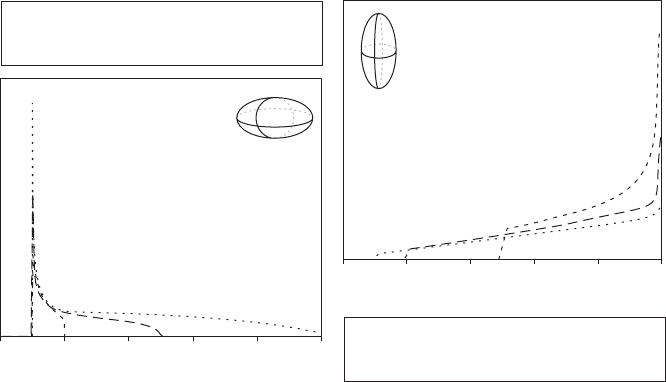
For three shapes of rotational ellipsoid no corrections are necessary as the
projected size is unique (Figure 3.34): (1) The projected size of a sphere equals
its true size. (2) The projected length of oblate ellipsoids equals the major axis
of the ellipsoid. (3) The projected width of prolate ellipsoids equals the minor
axis of the ellipsoid. The length of prolate ellipsoids and the width of oblate
ellipsoids are not unique and these measures should be avoided. For triaxial
ellipsoids the outline length is strongly bimodal with peaks at the major and
intermediate axes; the outline width is also bimodal with peaks at the inter-
mediate and short axes. The complexity of these data necessitates more com-
plex data reduction methods. A method similar to that of Saltikov
(Section 3.3.4.4) can also be applied to these models.
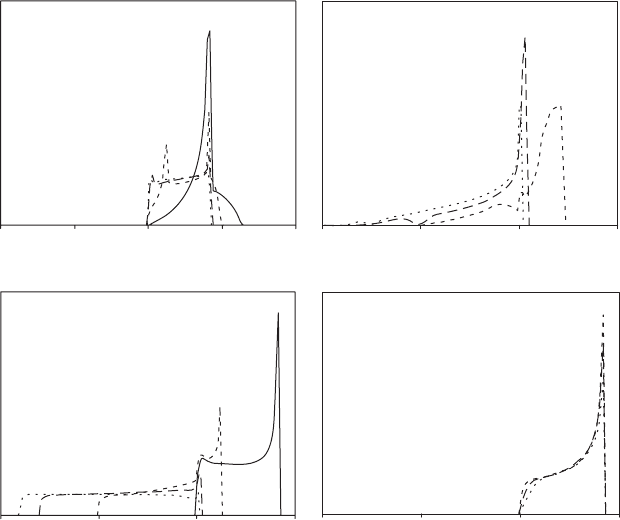
The length of the outlines of both tablets and prisms are easy to interpret
(Figure3.35a):Theoutlinelengthisclosetotheactuallongdimensionofthe
parallelepiped. The width of tablets, when normalised to the intermediate
dimension, is widely dispersed and this measurement should be avoided
92 Grain and crystal sizes
(Figure3.35c).Thenormalisedwidthoftheprismsissimpleandidenticalfor
thedimensions:itvariesfrom1to1.5(Figure3.35d).Thenormalisedlengthof
theprismsiswidelydispersedandshouldbeavoided(Figure3.35b).Blocks
with shapes between tablets and prisms have complex distributions and a
method similar to that of Saltikov can be used.
3.3.6 Verification and correction of grain size distributions using
the volumetric phase proportion
Higgins (2002a) has shown that it is easy to verify that CSDs have been
calculated correctly by comparing the volume of a phase present in the rock
calculated using stereologically exact methods (such as phase area proportion;
see Section 2.7) with that calculated from the CSD.
The volumetric proportion of phase, V, is calculated by integration of the
volume of all the crystals:
V ¼ s
Z
1
0
n
V
ðLÞL
3
dL
(a) Projected oblate
ellipsoids
(b) Projected prolate
ellipsoids
0 0.2 0.4 0.6 0.8 1.0
1:1:2
1:1:5
1:1:10
0246810
1:2:2
1:5:5
1:10:10
projected length/major axis
projected width/minor axis
Projected lengths of prolate
ellipsoids are invariable
Projected widths of oblate
ellipsoids are invariable
Figure 3.34 Projections of ellipsoids with random orientations (this study).
Oblate ellipsoids are wide and short; prolate ellipsoids are tall and thin.
Lengths of projections are divided by the major axis of the ellipsoid; widths
are divided by the minor axis of the ellipsoid. Invariable lengt hs are always
equal to the major axis of the ellipsoid and invariable widths are always equal
to the minor axis of the ellipsoid. Invariable parameters are always the best
choice as no stereological corrections are needed.
3.3 Analytical methods 93
where s ¼ shape factor ¼ the ratio of the crystal volume to that of a cube of
side L (see below). Size is defined here as the length of the longest axis of the
smallest rectangular parallelepiped that encloses the crystal.
The shape factor, s, is expanded into a more applicable form:
s ¼½1 Oð1 p=6ÞIS=L
2
where O is the roundness factor, which varies from 0 for rectangular paralle-
lepipeds to 1 for a triaxial ellipsoid (Higgins, 2000). Obviously most crystals
have a more complex shape, but we are concerned here just with a statistical
measure.
For CSDs with discrete size intervals these equations can be modified to
V ¼ s
X
n
V
ðL
j
ÞL
3
j
W
j
(a) Projected cube
and tablets
0 0.5 1.0 1.5 2.0
(c) Projected cube
and tablets
0 0.5 1.0 1.5
(b) Projected prisms
0 0.5 1.0 1.5
projected length
/ long dimension
projected width
/ intermediate dimension
1:1:2
1:1:2
1:1:5
1:1:5
1:1:10
1:1:10
(d) Projected prisms
0 0.5 1.0 1.5
1:1:1
1:1:1
1:2:2
1:2:2
1:5:5
1:5:5
1:10:10
1:10:10
Figure 3.35 Projections of parallelepipeds with random orientations (this
study). Projected width and length are the dimensions of the smallest
rectangle that can be fitted around the projected outline.
94 Grain and crystal sizes
The summation is for all intervals j. Hence the volumes of a phase can always
be calculated from a CSD. It should be remembered that the natural logarithm
of the population density is plotted on a classical CSD diagram.
If CSDs are straight on a classical CSD diagram of ln(population density)
versus size (see below; Marsh, 1988b) the equation can be integrated to
V ¼ 6sn
V
ð0ÞC
4
where n
V
ð0Þ¼intercept and C ¼ characteristic length ¼1/slope. It should
be emphasised that this equation is for straight CSDs and that volumetric
phase proportions calculated in this way are sensitive to an incorrect choice of
the shape factor.
These equations are a useful way to verify that CSDs have been correctly
converted from two-dimensional data, by comparing the measured value of
the phase proportion with that defined by the CSD. However, caution must be
exercised as the uncertainty in phase proportion estimated from CSDs can be
significant. This is because much of the phase volume is contributed by the
largest crystals. These are not numerous and hence their population density is
not well known.
It is also possible to correct the CSD so that the volume calculated from the
CSD, V
CSD
, matches the measured phase volume, V
M
. This process closely
resembles normalising major element analyses to 100%, and similarly must be
used with caution. We assume that error in V
CSD
arises from a systematic error
in the relationship between the crystal size used in the CSD and the crystal
dimensions. For instance the crystals may be partly convex, hence the simple
ellipsoid or parallelepiped models cannot be applied. These errors can be
corrected if the true size of each crystal is multiplied by a correction factor F:
F ¼
ffiffiffiffiffiffiffiffiffiffiffiffiffiffiffiffiffiffiffiffiffi
V
M
=V
CSD
3
p
This correction is available in the program CSDCorrections (see Appendix).
3.3.7 Graphical display of grain size distributions
Grain size distributions can be expressed graphically in many different ways.
Such diagrams are useful to show how well a grain size distribution corresponds
to various theoretical size distributions. Some authors have confused the numer-
ical grain size distribution with the graph used to display such distributions
(e.g. Pan, 2001): obviously, the grain size distribution of a population does not
change when different diagrams are used to display it. Various theoretical size
distributions can be verified by graphical or numerical methods (see Section 2.5).
3.3 Analytical methods 95

3.3.7.1 Size limits of measurements
All analytical methods are limited in the size of the grains that can be accurately
measured (see Section 2). The upper size limit of all methods is the number of
large grains that are in the largest size bin. The precision needed will vary with
the goal, but for diagrams that use a logarithm of the size a minimum of 4
crystals is generally sufficient, but not ideal. In general, the measured maximum
grain size can be increased by augmenting the volume or area measured.
The smallest grain that can be measured is equivalent to the limit of quanti-
fication in chemical analyses. The grain size distribution below this value is
undefined. It may be necessary to combine different analytical methods to get
an adequate range in measurable sizes (see Section 2). It is very important that
size limits of the analytical technique are discussed in a study. If no crystals are
recorded below a certain size, then it must be made clear if small crystals are
absent or if the cut-off is an artefact of measurement.
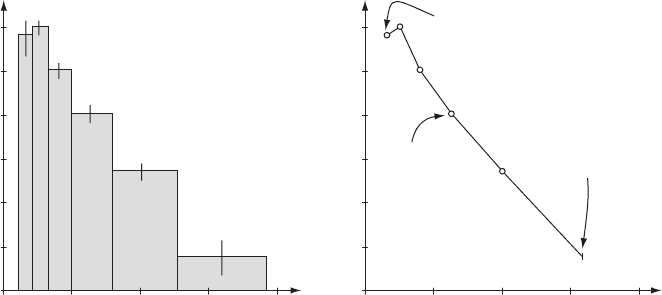
3.3.7.2 Semi-logarithmic: ‘CSD diagram’
In igneous petrology the natural logarithm of the population density of
crystals is commonly plotted against linear crystal size, following the initial
work of Marsh (1988b). This diagram has become known as the CSD diagram
(Figure 3.36).
Population density n
0
V
ðLÞ is defined as the number of crystals per unit
volume within a size interval DL as DL tends to zero (Marsh, 1988b). This is
not very practical as the number of crystals is limited. Marsh (1988b) suggested
that it is better to use the cumulative number of crystals greater than size L,
N
V
ðLÞ. This is a stable, continuously increasing function from which the
population density can be simply derived:
n
0
V
ðLÞ¼
dN
V
ðLÞ
dL
This definition can be used if the true size of all crystals is known, which is
the case for large 3-D datasets derived by tomography or serial sectioning.
However, in many CSD studies data are gathered from two-dimensional
sections and the data transformed to discrete intervals of three-dimensional
sizes. We then need a definition of population density based on size intervals.
In a size interval j, the population density, n
0
V
ðL
j
Þ, is the number density of
crystals in the size interval, n
V
ðL
j
Þ, divided by width of the interval, W
j
.
n
0
V
ðL
j
Þ¼
n
V
ðL
j
Þ
W
j
96 Grain and crystal sizes
Note that the units of population density, n
0
V
ðLÞ, are length
4
, as the volu-
metric number density of crystals, n
V
ðLÞ, has the units of length
3
and it is
divided by a length, the interval width W
j
.
A CSD is said to be continuous if it has no empty bins. For a continuous
CSD the value of population density will change smoothly for different bin
widths. If gaps (empty bins) appear owing to scarcity of data then either more
data should be acquired or the bin widths should be widened until every bin
has an adequate number of crystals in it. However, there is no intrinsic reason
why all CSDs should be continuous and so we must be able to accommodate
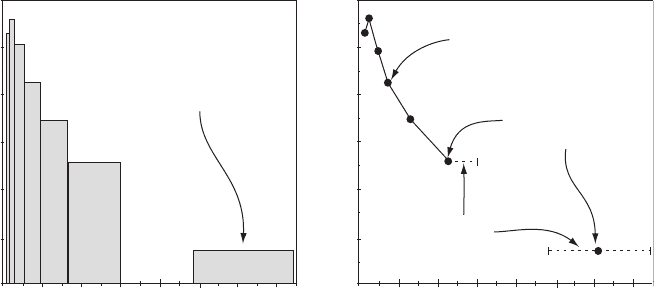
such gaps. Although commonly drawn as line graphs or as a series of uncon-
nected points, CSD diagrams are actually histograms (Figure 3.37). Therefore,
the line type CSDs should not be connected across empty bins. A suggestion
forclarifyingthisproblemisshowninFigure3.37b.
If the CSD is linear on this diagram then it can be regressed and the intercept
and slope determined. Some regressions use the uncertainty in each point
as weighting and calculate the goodness-of-fit parameter Q (see Section 2.5.2;
e.g. CSDCorrections 1.3).
–14 –14
–13 –13
–12 –12
–11 –11
–10 –10
–9 –9
–8 –8
0010 1020 2030 3040 40
ln (population density) (mm
–4
)
ln
(population density) (mm
–4
)
crystal size (mm) crystal size (mm)
Termination of CSD
(no larger crystals)
Point in CSD
Start of CSD (smaller
crystals not measured)
(a) CSD as histogram (b) CSD as line graph
Figure 3.36 A simple semi-logarithmic ‘CSD diagram’ following Marsh
(1988b). (a) The diagram is actually a histogram as data are integrated over
the width of each size bin. Each size bin has an uncertainty associated with it
indicated by the uncertainty bar. (b) CSDs are commonly drawn as line
graphs, by connecting the centre of the top of each histogram bar. Higgins
(2003) has suggested that the nature of the ends of the CSDs be clearly
indicated: a vertical bar shows that there are no larger (or smaller) crystals.
A circle just indicates a data point. A circle at the end of the CSD indicates
that the termination is just an artefact of measurement as we have not
examined smaller or larger crystals.
3.3 Analytical methods 97
The slope (m) is sometimes transformed into the characteristic size, C,as
follows:
C ¼1=m
This parameter is easier to comprehend than the slope, as it has the units of
length. Indeed, for a straight CSD that extends from zero to infinite size, the
characteristic size is equal to the arithmetic mean size of all the crystals.
3.3.7.3 Bi-logarithmic: ‘Fractal’
The mathematical concept of fractional dimensions – fractals – is recent, but
has had a remarkable impact on the natural sciences, particularly in geology
(Mandelbrot, 1982, Turcotte, 1992). Many natural features are thought to be
self-similar: that is, the texture remains the same at all magnifications. This
behaviour can be described by a fractal dimension.
Fractal (self-similar) distributions can be identified using a bi-logarithmic
diagram – for instance log (number of grains larger than r) against log (r),
where r is the size of the grains (Figure 3.38). A similar diagram of ln (popula-
tion density) against ln (size) can also be used. It is very important to use a wide
range of crystal sizes, otherwise such a fractal behaviour cannot be identified
(Pickering et al., 1995). The slope of the line can be used to establish the fractal
dimension of the distribution. If the line has several well-defined slopes then
the distribution may be described as multifractal.
–10
–10
–8
–8
–6
–6
–4
–4
–2
–2
0
0
2
2
ln (population density) (mm
–4
)
ln
(population density) (mm
–4
)
0
0
2
2
4
4
6
6
12
12
8
8
14
14
10
10
size (mm) size (mm)
The width of isolated
bins are clear
(a) CSD as histogram (b) CSD as line graph
No grains
in this
interval
These points cannot
be connected
These points should be
connected to indicate that
there are no empty bins
Suggested way
of indicating
an empty bin(s)
Figure 3.37 The problem of ‘empty’ bins in CSD diagrams. (a) If the data
are presented as a histogram, then the width of the empty bin is clear. (b) On
a conventional CSD diagram the width of the empty bin is not clear. It
is suggested here that the widths of terminal (end) and isolated bins are
indicated by a horizontal dashed line ending a vertical bar.
98 Grain and crystal sizes