
Higgins M.D. Quantitative textural measurement in igneous and metamorphic petrology
Подождите немного. Документ загружается.

3.3.7.4 Lognormal and loghyperbolic
Lognormal distributions by mass or volume of grain sizes are commonly
proposed in sedimentary petrology (Lewis & McConchie, 1994b). Cashman
and Ferry (1988) proposed that metamorphic rocks also have a lognormal by
number CSD. Such a lognormal by number model has also been proposed for
CSDs of crystals grown at low temperatures in aqueous systems (Eberl et al.,
1998, Kile et al., 2000). It should be mentioned that chemical abundances are
commonly thought to follow a lognormal by number distribution, although
recent analysis suggests that this is rarely true (Reimann & Filzmoser, 2000).
The parameter that has a normal or lognormal size distribution should
always be specified. In sedimentology the parameter is generally mass, but
volume may be used also. In other applications the parameter is the number of
grains. A distribution that is lognormal by volume will not be lognormal by
grain numbers (Jerram, 2001).
Some authors have used linear frequency diagrams to verify lognormal
distribution (Eberl et al., 1998); this is not the best solution, as deviations
Granite fragments
log (number of fragments > r )
lo
g
(equivalent len
g
th, r ) (mm)
Fractal dimension
= 2.50
0.01
0.1 1 10 100 1000
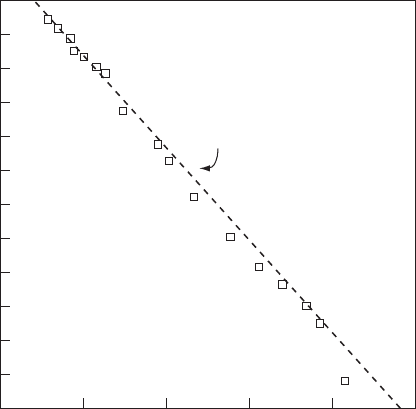
Figure 3.38 An example of a bi-logarithmic diagram used to examine
possible fractal size behaviour. The size parameter (equivalent length, r)is
the cube root of the particle volume. It is equivalent to the side of a cube
of equivalent volume. The points on this diagram could be linked up as
the distribution is continuous, but this has been omitted for clarity. After
Turcotte (1992).
3.3 Analytical methods 99
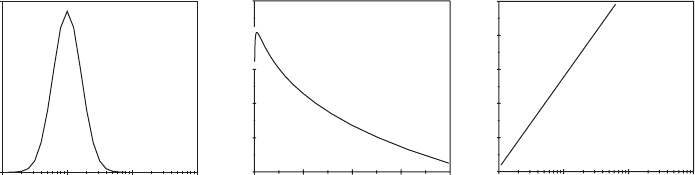
from the ideal distribution are not clearly shown, especially for sizes far from
the mean (Figure 3.39). The best way to verify if data have a lognormal
size distribution is to use a graph of cumulative distribution function (CDF)
of volume, mass or number against log (size). Cumulative data can be
transformed using the inverse function of the standard normal cumulative
distribution available in spreadsheet programs (e.g. Excel function
NORMSINV; see Appendix). Sedimentologists generally specify size in phi (F)
units where
F ¼log
2
ðLÞ
and L is in millimetres.
On this diagram a lognormal distribution plots as a straight line. Mixtures of
lognormal distributions can sometimes be identified as two or more straight
line segments. If intersection data are used then it is very important that
conversion to size distribution is done using stereologically correct methods
(see Section 3.3.2; e.g. Higgins, 2000) and that the data extend for several
standard deviations on either side of the mean. Phi diagrams cannot be
recalculated to population density diagrams unless the volume measured or
the total phase volume is documented.
A number of sedimentologists have proposed that grain sizes follow a
loghyperbolic distribution (Christiansen & Hartman, 1991). Normal distribu-
tions have the form of a parabola, when plotted as the log (probability density)
against size; loghyperbolic distributions are hyperbolas in the same space.
Whereas a normal or lognormal distribution is defined by two parameters,
the mean and standard deviation, a loghyperbolic distribution needs four
parameters. Very well defined size data are needed to verify if sizes follow a
loghyperbolic distribution. Much sedimentological size data may not warrant
0.1 1 10 100
lo
g
(size)
frequency
(a) Simple
frequency
diagram
–40
–30
–20
–10
0
10
020406080
size
ln (population density)
(b) ‘Classic’ CSD Diagram
0.1 1 10
100
lo
g
(size)
50
25
75
95
5
1
99
cumulative frequency
(c) CDF
diagram
Figure 3.39 (a) Lognormal grain size distributions are not clearly displayed
on a simple frequency diagram. (b) They are difficult to recognise on a semi-
logarithmic ‘CSD diagram’. (c) The clearest graph is of the cumulative
distribution function (CDF) against log (size).
100 Grain and crystal sizes
this level of treatment as the methods used to obtain the data commonly have
systematic biases. There is no particular graphical solution that is amenable to
verify this distribution. Another distribution that has proved popular is the
Weibull distribution (Murthy et al., 2004). This function can have many very
different forms and is popular with modelling of failure in mechanical systems.
Again there are no particular graphs that can linearise this function.
3.3.7.5 Relative frequency and other methods
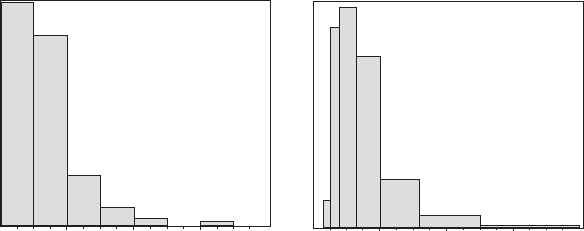
Many studies express size data as a simple histogram of relative or absolute
numberfrequencyorpercentvolumeormassagainstsize(Figure3.40a).This
class of diagrams has the benefit of simplicity, but few other advantages. The
height of each bar in the histogram clearly depends on the width of the size
interval: if the width is doubled then the number of grains in that interval will
increase also. If size intervals are not constant this can create a false view of the
data. It is also difficult to see variation in frequency for very small or large
crystals. If this type of diagram must be used then population density (fre-
quency / interval width) should replace frequency, so that the height of the
histogram bars will not be affected by the width of the intervals (Figure 3.40).
Data presented on these types of diagram cannot be converted to a classical
CSD diagram without knowledge of the volume of the sample.
population density
or frequency
population density
size
(b) Variable size bins
size
(a) Equal size bins
Figure 3.40 Plot of the same grain population on two simple, linear size
distribution graphs. (a) Equal sized bins are used to express CSDs in many
studies. For equal sized bins, frequency and population density graphs are
identical. Here, the graph conceals much detail for small grains, and there are
empty bins for large grains. (b) If the population density is used then the bin
widths do not have to be constant and they can vary with the quantity of data.
Here logarithmic-s ized bins reveal aspects of the distribution concealed by
fixed width bins.
3.3 Analytical methods 101
3.3.8 Overall grain size parameters: moments of number density
Moments are parameters extracted from the size distribution that are used for
describing overall aspects of the grain population. The material is assumed to
be homogeneous and without preferred orientation (fabric). The moments of a
number density distribution, M
0
, M
1
etc., are defined by
M
i
¼
Z
L
0
L
i
n
V
ðLÞdL
M
0
¼ total number of grains per unit volume
M
1
¼ total length of grains per unit volume
Higher moments must accommodate a shape factor for departures of the
grains from cubes.
M
2
¼ C
A
*
total projected area of grains per unit volume. The shape factor
C
A
is equal to the mean projected area of the grain divided by L
2
. This moment
has been misconstrued by some authors as being related to the total surface
area of the grains. The total surface area can be obtained precisely by other
methods without the need for a shape factor (see Section 2.4.2)
M
3
¼ C
V
*
total volume of grains per unit volume. The shape factor C
V
is
equal to the volume of the grain divided by L
3
. This moment has been used to
verify that CSDs have been calculated correctly (see Section 3.2.6). Again this
parameter can be obtained precisely by other methods without the need for a
shape factor (see Section 2.4.2).
If the size distribution function is known (variation of number with size)
then the moments can be evaluated in terms of other textural parameters (e.g.
Marsh, 1988b). Moments are not generally very useful, as the same parameters
can commonly be evaluated more precisely with much less work (see
Section 2.4.2).
3.4 Typical applications
The applications chosen here are representative of the diversity of materials
and problems that have been studied so far and extend two previous reviews of
the subject (Cashman, 1990, Marsh, 1998). However, number of studies on any
rock type is very limited and hence much work is still exploratory. The
scientific quality of publications in this field is extremely variable: some
authors continue to use discredited conversion methods even though they
know that they give incorrect results or have not understood the nature of
102 Grain and crystal sizes
the conversion problem. Other authors do not specify how they converted
intersection data, and hence their results are of little use.
Many older CSDs were calculated using conversion equations, such as the
‘Wager’ or ‘Kirkpatrick’ method that are now known to be inaccurate. These
data can be recalculated if the shape of the crystals, the nature of the rock
fabric and the orientation of the section to the fabric can be estimated (see
Section 3.3.4.5). If the raw data are available then this is simple, but more
commonly the published graphs must be measured and back calculated (a few
early CSDs have been recalculated in this way in Higgins, 2000). The greatest
error in the ‘Wager’ method is generally in the intercept of the CSD and the
least in the slope. In addition, the abundance of smaller crystals is much less
accurate than that of large crystals. Where necessary, and possible, data
presented here have been recalculated for the more important papers using
stereologically correct methods (Higgins, 2000) and converted to millimetre
units and natural logarithms.
Another possible pitfall in reviewing published data is the units used in
CSDs, which are not always explicitly indicated. In some CSDs the population
density is calculated in terms of cm
4
, even if the size axis is in millimetres. In
this case:
lnðpopulation density in cm
4
Þ¼lnðpopulation density in mm
4
Þþ9:2
In addition some authors use a logarithmic base 10 scale for the population
density, instead of natural logarithms (base e, 2.718 ...).
CSD data can be presented on many different types of diagram. If none is
specified then it must be assumed that a ‘classical’ CSD diagram of ln (popula-
tion density) against size was used.
In the available literature growth rates are expressed in a number of units
that are not easy to comprehend. Here are a few useful conversions for a
typical growth rate: 10
10
cm s
1
¼ 10
9
mm s
1
¼ 1pms
1
¼ 0.031 mm a
1
.
The conventional atomic radius of oxygen is about 120 pm, hence this corre-
sponds to one layer of oxygen atoms every four minutes.
3.4.1 Mafic volcanic rocks
3.4.1.1 Plagioclase in a basaltic lava lake
The study by Cashman and Marsh of the Makaopuhi lava lake (Cashman &
Marsh, 1988) was the first geological application of the CSD theory developed
by Randolph and Larson (1971) and modified by Marsh (1988b), and is
probably the most quoted CSD paper. The Makaopuhi lava lake was on the
3.4 Typical applications 103
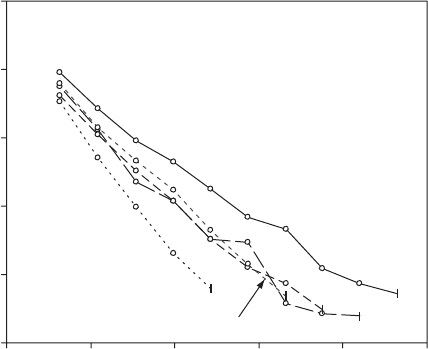
flanks of Kilauea Iki, Hawaii, and was filled in 1965 with basalt initially
containing about 4% plagioclase, as well as olivine and augite. The lava lake
was drilled repeatedly during its solidification; hence a time-sequence of
textural development in the upper part was sampled. CSDs of plagioclase,
ilmenite and magnetite were determined from six samples in a single drill hole
that had total crystal contents from 20% to 80%. Cashman and Marsh (1988)
measured the lengths of a large number of crystals, 3000–5000 per section, and
reduced the data using the ‘Wager’ method (see Section 3.3.4.6). Plagioclase
data have been recalculated in Figure 3.41.
The corrected CSDs are slightly more curved than the CSDs published by
Cashman and Marsh (1988), but can still be considered almost straight
(Figure 3.41). Overall, the new CSDs have shapes and relative differences
similar to those of the original data, but the actual population densities are
different. The sample with the lowest crystal content has the steepest slope and
this decreases regularly with increasing crystal content. The intercept of the
regression is constant. Cashman and Marsh (1988) applied the theory of
size (mm)
ln (population density) (mm
–4
)
Plagioclase in basalt:
Makaopuhi lava lake
2
4
6
8
10
12
0 0.1 0.2 0.3 0.4 0.5
83%
66%
47%
39%
20%
Figure 3.41 Plagioclase in basaltic magma from the Makaopuhi lava lake,
Hawaii (Cashman & Marsh, 1988). Data were recalculated from graphs of the
reduced data in Cashman and Marsh (1988) and Cashman (1986 ) using a
crystal shape of 1:3:4, block shape and a massive texture. Some data intervals
have been amalgamated to impr ove precision and fill empty bins. The
intersection data have been cut off at 0.03 mm, as the crystals are dominantly
in projection below this size and CSD is undetermined (see Section 3.3.2,
Figure 3.25). With the new corrections the slope of the CSD was reduced
by a factor of about 1.5 and the intercept increased by a factor of 15.
Crystallisation is shown in per cent.
104 Grain and crystal sizes
Marsh (1988b) to these results, although crystallisation in a lava lake is clearly
not a steady-state process. Using the methods of Cashman and Marsh ( 1988),
and the slope of the corrected CSD, the plagioclase growth rates were
3.5 10
10
to 6.5 10
10
mm s
1
and the nucleation rate was 3.6 10
5
to
7.2 10
5
mm
3
s
1
.
It is profitable to look at the changes in the CSD with solidification.
Cashman and Marsh (1988) interpreted their data to indicate that both the
nucleation and growth rates deceased with solidification. The data for growth
rates are much more secure than those for nucleation rates, which depend on
just one early sample. They considered that this was in response to linearly
increasing undercooling, and that each sample developed under constant
conditions. However, increasing undercooling tends to increase both growth
rates and nucleation rates (e.g. Markov, 1995). It is perhaps easier to think of
the rock textures seen here as developing sequentially and hence the samples
represent a sequence of textural development during solidification (Higgins,
1998). Coarsening is an important process in petrology (see Section 3.2.4) and
I have proposed that it may account for some aspects of the textures of these
rocks (Higgins, 1998). However, closed system coarsening cannot account for
the progressive solidification of the system and hence overall growth must also
be important.
3.4.1.2 Plagioclase in basalt flows
Mt Etna is a large volcano that has been erupting porphyritic hawaiites for the
last 200 years. Armienti et al.(1994) examined the CSDs of plagioclase,
olivine, clinopyroxene and oxide minerals in a range of samples from the
1991–3 eruption. They measured crystals using optical and electronic methods
and converted the data using a modified Saltikov technique. All minerals have
strongly curved CSDs, with steep slopes for microlites (down to 30 mm) and
shallow slopes for large crystals. However, linear size intervals were used in
this study, which resulted in many empty bins for large crystals. If the bins are
widened to eliminate this effect then the slope of the right side is much greater
than presented. Armienti et al.(1994) proposed three intervals of crystallisa-
tion: the largest crystals nucleated and grew at depth in the magma chamber.
As the magma rose in the conduit further nucleation and growth occurred. The
microlites formed during quenching of the magma at the surface. However,
mixing of two straight CSDs produces a curved CSD similar to that seen here
(see Section 3.2.3.3), hence only two different periods of crystallisation are
necessary. The similarity of the CSDs of this eruption to those of earlier
eruptions was interpreted to mean that the main features of the volcanic feeder
system had not changed recently.
3.4 Typical applications 105
The a’a and pahoehoe parts of lava flows have both distinctive surfaces and
internal rock textures. Textural work so far on this problem has been some-
what ambiguous. Sato (1995) examined the CSD of two samples, one of each
texture. Unfortunately the samples were from different eruptions.
Nevertheless, he found important differences in their CSDs. The a’a sample
has a steep CSD that did not extend to large sizes, whereas in the pahoehoe
sample the CSD was much more shallow. He attributed this difference to the
initial temperature of the magmas, before degassing and eruption, with the
pahoehoe having a higher initial temperature. However, this does not seem to
fit with the commonly observed transition from pahoehoe to a’a along
some lava flows. Polacci et al.(1999) only looked at crystal number densities
instead of CSDs. They concluded that crystallisation was occurring within
the lava flow itself. Cashman et al.(1999) only examined the total crystal
number by area and concluded that the magmas were well stirred and hence
there were no delays to nucleation. Clearly there is room for more compre-
hensive studies.
Sections of many thicker basalt flows reveal two parts that are clearly
defined by the joint patterns: at the base is the colonnade, with regular,
commonly vertical, columnar joints; above it lies the entablature with more
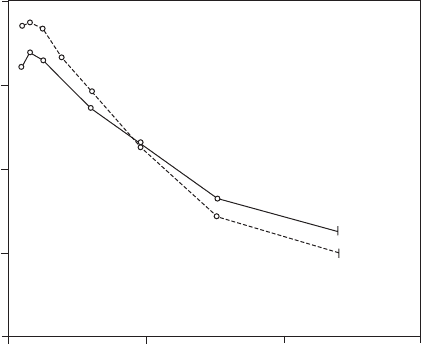
closely spaced, complex joints. Jerram et al.(2003) examined the CSDs of the
two components in the Holyoke basalts (Figure 3.42). Both CSDs are straight,
Entablature
Colonnade
ln (population density)
size (mm)
–8
–4
0
4
8
0
12
3
Figure 3.42 Holyoke basalt flow (from Jerram et al., 2003). The entablature
is the upper irregular part of the flow and the colonnade is the part with
parallel columnar joints. The kink in the CSDs probably represents a change
in the crystallisation conditions.
106 Grain and crystal sizes
except for large sizes (phenocrysts), suggesting a two-stage crystallisation
process. The colonnade has a shallower slope, which can be interpreted as a
longer residence time, if a steady-state model is assumed. Jerram et al.(2003)
calculated residence times of 8 and 11 years for the entablature and colonnade
respectively for a growth rate of 5 10
10
mm s
1
. This gives reasonable
solidification times for the whole flow. The difference between the CSDs of
the entablature and colonnade may also be interpreted in terms of coarsening
(Higgins, 1998): The entablature then represents an earlier texture than the
colonnade, which had more time to coarsen.
3.4.1.3 Plagioclase growth rates in basaltic magmas.
Cashman (1993) reviewed plagioclase growth rates in basaltic systems. Her
study was based on well-known volcanic systems in which the residence time
can be estimated from the history of the volcano or other parameters and
dykes in which cooling parameters can be easily calculated. For samples with
CSDs she used the slope of straight CSDs to get values for the growth rate. In
other samples she relied just on the mean crystal size and total number density.
She also examined experimental results and concluded that nucleation in
natural systems was generally heterogeneous.
Her main conclusion was that growth rates varied with cooling rate, but that
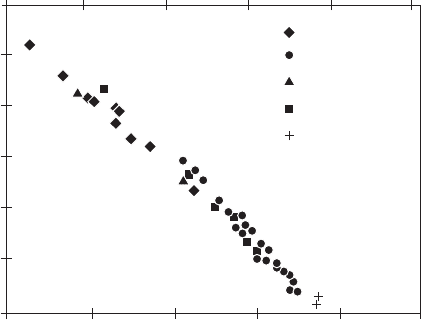
the parameter was not very sensitive (Figure 3.43). A cooling time of 3 years
20
–2 –4
–6
–10
–8
–6
–4
log (growth rate) (mm s
–1
)
log (crystallisation time) (s)
log
(cooling rate) (°C h
–1
)
Palisades
Salvador
Mauna Loa
Makaopuhi
Iritono
2
46810
12
Figure 3.43 Plagioclase growth rate against cooling rate or cooling time
(Cashman, 1993).
3.4 Typical applications 107
(¼10
8
s ¼ cooling rate of 0.008 8Ch
1
) gives a growth rate of 10
9
mm s
1
and
a cooling time of 300 years (¼10
10
s ¼ cooling rate of 0.00008 8Ch
1
) gives a
growth rate of 10
10
mm s
1
. Although some of the CSDs used by Cashman
were measured from sections and not calculated with the appropriate equa-
tions, the errors in the slope are small compared to the range in the slope
values. Such growth rates should be only used in a general way to determine
the residence time or other parameters to within an order of magnitude.
It is not clear how these growth rates can be modified for more silica-rich
magmas. In general such magmas are more viscous and hence have lower diffu-
sion rates. However, this is critically dependent on the water content of the
magmas at depth, which is generally poorly known. Cashman (1992)estimated
that the crystallisation rate for plagioclase in dacite was 5–10 times less than in
basalts. Higgins and Roberge (2003) have proposed that crystallisation is not
continuous but cyclic in an andesite magma chamber. If this is generally true then
it may not be possible to determine crystal growth rates from natural systems.
3.4.1.4 Plagioclase in andesite
Mt Taranaki is an active andesite stratovolcano in New Zealand (Higgins,
1996a). Lavas on the flanks of the volcano contain abundant, generally
euhedral plagioclase crystals, comprising up to 30% of the rock on vesicle-
free basis. Many crystals have concentric zones of dusty inclusions, which are
commonly thought to represent periods of partial melting or re-heating. The
CSDs define a broad curved band, but each individual CSD is much straighter
than the overall trend suggests. Indeed, individual CSDs are almost linear
down to small crystal sizes, suggesting that nucleation and growth dominated
(Figure3.44a).Ifthecrystalsgrowinasteady-statemagmachamberwitha
growth rate of 10
10
mm s
1
then characteristic lengths indicate that the ear-
liestlavas(Figure3.44b;Staircasegroup)hadaresidencetimeof50years.
Subsequent lavas in the Castle and Summit groups had slightly longer resi-
dence times of 50–75 years. The youngest magmas, from both Egmont Summit
and the Fantham’s peak, a secondary vent on the side of the volcano, have the
shortest residence times of 30 years. Variations in residence time may reflect
changes in the magma chamber shape or depth, or the temperature of the
surrounding rocks.
The Dome Mountain lavas comprise a comagmatic pile of some twenty
flows with a total thickness of about 300 m (Resmini & Marsh, 1995). Most
flows are andesitic, but there is some variation to more mafic and felsic
compositions. Most of the plagioclase CSDs show no sign of crystal fractiona-
tion or accumulation, hence they can be used to give magma storage times. If a
growth rate of 10
9
mm s
1
is assumed then most magmas have residence
108 Grain and crystal sizes